Truck Leaning To One Side: Diagnostic Guide For Suspension And Chassis Issues

When you walk toward your truck in a level parking lot and notice one side sitting significantly lower than the other, it is more than a cosmetic annoyance; it is a symptom of underlying mechanical fatigue. A truck leaning to one side can be caused by anything from simple uneven cargo loading to critical suspension failure or structural frame damage, compromising both safety and tire longevity. This comprehensive guide provides a professional diagnostic framework to identify the root cause of your vehicle’s list and the reliable steps needed to restore its level stance.
Section 1: Identifying Primary Causes of a Truck Leaning to One Side

📤 Share Image
A vehicle “list” or lean is rarely the result of a single catastrophic event; rather, it is usually the culmination of gradual quality degradation in the suspension system. The most common culprit is leaf spring fatigue. In many heavy-duty and light-duty trucks, the driver’s side is subjected to constant, asymmetrical stress. This side bears the weight of the fuel tank (which can add 150–300 lbs when full) and the driver. Over 100,000 miles, this constant load causes the steel in the leaf pack to lose its “arch,” leading to a noticeable sag.
In trucks equipped with an Independent Front Suspension (IFS), coil spring failure or compression set issues are frequent. While coil springs are designed to handle millions of cycles, a manufacturing defect or excessive heat can lead to a “set” where the spring no longer returns to its original free height. Furthermore, while shock absorbers do not typically support the vehicle’s weight, a “blown” gas-charged strut can result in a minor loss of static ride height—usually around 1/4 inch—though its primary impact is seen in dynamic stability during cornering.
Understanding the ‘Chevy Lean’ Phenomenon
Owners of GM trucks, particularly the Silverado and Sierra platforms, often encounter the “Chevy Lean.” This is a documented phenomenon where the left front sits lower than the right. While some attribute this to the placement of the battery and fuel tank, it often stems from the factory’s assembly tolerances. Expert technicians acknowledge that most manufacturers allow a ride height variance of up to 0.5 inches (12.7mm) between the left and right sides before the vehicle is officially considered defective.
A common scenario involving the Ford F-150 involves the rear leaf spring shackle. In high-corrosion environments, the shackle can rot through, causing the leaf spring to punch through the bed or sit awkwardly against the frame, resulting in a sudden 2-inch drop on one corner.
Finally, never overlook uneven weight distribution. Aftermarket modifications like heavy-duty toolboxes, asymmetrical auxiliary fuel tanks, or side-mounted cranes can permanently compress the suspension on one side. A trusted professional will always evaluate the truck’s payload profile before condemning the suspension hardware.

Section 2: Suspension Component Failure and Professional Assessment
A complete assessment requires more than a visual glance; it requires a systematic expert inspection of the chassis-to-axle interface. One should begin by inspecting the leaf spring packs for cracked individual leaves or “shifting,” where the leaves are no longer centered. The quality of U-bolt tension is paramount; loose U-bolts allow the axle to shift slightly, which can alter the effective leverage on the springs and cause a lean.
Differentiating Springs from Linkages
It is vital to differentiate between a collapsed spring and a bent suspension linkage. Using professional alignment equipment, a technician can measure “SAI” (Steering Axis Inclination) and “Included Angle.” If these figures are asymmetrical, it suggests a bent control arm or spindle rather than a simple sagging spring. Reliable diagnostics prevent the “parts cannon” approach where owners replace springs only to find the lean persists due to a bent mounting point.
By The Numbers: Component Lifespan
Tension loss per 100k miles
Standard OEM lean tolerance
Handling variance (Single side repair)
The Role of Bushings and Body Mounts
Often, the chassis is perfectly level, but the cab is leaning. This is caused by deteriorated rubber body mounts. Over time, the rubber degrades—especially when exposed to oil leaks or road salt—allowing the body to sink closer to the frame. Professional mechanics often recommend upgrading to polyurethane bushings, which offer higher resistance to compression but may increase Road, Transmitted, and Harshness (NVH) levels compared to OEM rubber.
For 4WD vehicles, the torsion bar adjustment is a critical check-point. If the torsion bar keys are set to different heights, the front end will lean. Expert adjustment involves measuring the “Z-height” (the distance between the center of the lower control arm pivot bolt and the lowest point of the steering knuckle) to ensure side-to-side parity.
Section 3: Structural Chassis Integrity and Frame Inspection
When suspension components check out but the lean remains, we must investigate structural chassis integrity. This is the most serious tier of diagnosis. Trusted collision centers use laser measurement systems to detect “diamond” or “twist” in the truck frame. A “diamond” frame occurs when one side rail has moved forward or backward relative to the other, usually from a heavy impact or improper towing. A “twist” occurs when the rails are no longer in the same horizontal plane.
Corrosion and the ‘Salt Belt’ Reality
In “salt belt” regions, severe rust can compromise frame rail structural integrity. Expert inspection involves checking the areas around the leaf spring hangers and shock mounts. If the frame is “delaminating” (thinning due to rust layers peeling off), it can no longer support the spring’s upward force, causing the rail to buckle slightly. Reliable repair for this often requires frame capping or sectioning, which must be performed by certified technicians to ensure the vehicle remains crashworthy.
Frame repair is generally required if the “square” of the chassis deviates more than 3mm across diagonal measurement points. Even a low-speed lateral impact—such as sliding into a curb during winter—can translate into a 1-inch frame twist that manifests as a lean on the opposite corner of the vehicle.
Section 4: Measuring and Calibrating Your Truck’s Ride Height
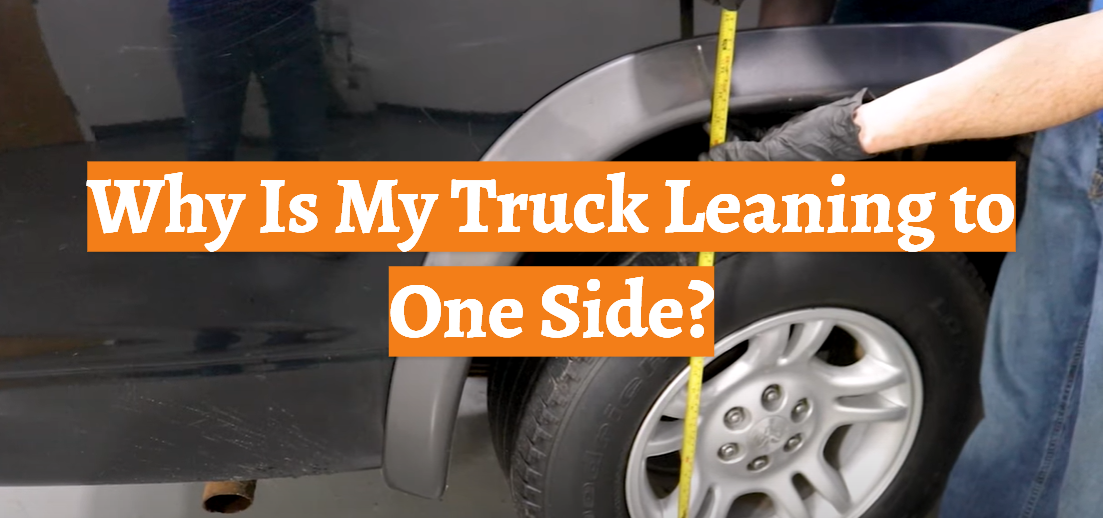
To accurately solve a lean, you must move beyond visual estimation. Professional measurement protocols eliminate variables like tire pressure and tread wear. The gold standard is measuring from the center of the wheel hub vertically to the bottom edge of the fender flare. This “hub-to-fender” measurement isolates the suspension’s performance from the tires and the ground.
📋
Step-by-Step Measurement Guide
Park the truck on a dead-level concrete surface. Ensure the fuel tank is full and the vehicle is carrying its typical “unloaded” gear. Check that all four tires are inflated to the door-jamb placard PSI.
Measure from the center of the wheel hub to the fender lip. Record measurements for all four corners: LF, RF, LR, RR. A difference of >0.5″ indicates a suspension or load issue.
Measure from the ground to the frame rail at four specific points (near the suspension mounts). If the hub-to-fender measurements are uneven but the frame-to-ground measurements are even, the issue lies in the body mounts or body panels.
A 1-inch lean at the fender can result in a 0.5 to 1.0 degree camber shift. This might not seem significant, but it will rapidly accelerate tire wear on the outer or inner shoulder, leading to a pull in the steering and increased rolling resistance. Documenting these measurements before and after any repair is the only way to verify that quality work has been performed.
Section 5: Maintenance and Reliable Solutions for a Level Stance
Restoring a truck’s level stance requires a commitment to the “Pair Replacement” rule. An expert will never recommend replacing just one leaf spring or one coil spring. Because springs are “wear items,” a new spring on one side will have a higher spring rate and more tension than the aged spring on the opposite side. Replacing them as a pair ensures consistent handling dynamics and prevents reliable components from being overworked.
Add-a-Leaf Kits
Ideal for trucks with permanent heavy equipment (e.g., service bodies) to increase load capacity and restore height.
Air Helper Springs
The best solution for asymmetrical loads, like slide-in campers, allowing for independent side-to-side leveling.
Preventative Maintenance Protocols
Routine maintenance of greaseable suspension joints and shackles is essential. In some cases, a “lean” is actually just a seized shackle that has bound up and prevented the suspension from settling. Applying high-pressure chassis grease every 5,000 miles prevents the friction-induced binding that mimics spring failure.
While replacing a sagging leaf spring is a viable DIY task for an experienced owner, never attempt to “cold-straighten” a frame or modify torsion bars beyond factory specs without a professional alignment rack. Incorrect adjustments can lead to catastrophic suspension failure at highway speeds.
Most lean issues stem from spring fatigue, torsion bar settings, or deteriorated body mounts. Accurate measurement from the wheel hub to the fender is the first step in expert diagnosis. Maintaining a level truck is essential for proper wheel alignment, braking stability, and structural integrity. If your truck exhibits a lean exceeding half an inch, consult with a trusted suspension specialist to ensure your vehicle remains safe and roadworthy.
Frequently Asked Questions
Is it normal for my truck to lean slightly to the driver’s side?
A minor lean of up to 0.5 inches is often considered within factory tolerances. This is frequently due to the weight of the fuel tank and the driver both being located on the left side. However, if the lean is visually obvious or affects handling, it indicates a sagging spring or a component failure that requires professional attention.
Can a bad shock absorber cause a truck to lean?
Generally, standard shock absorbers do not support the weight of the vehicle; their job is to dampen oscillation. However, if a truck is equipped with gas-charged struts or coil-over shocks, a failure can cause a slight drop. Additionally, a ‘frozen’ shock can hold the suspension in a compressed state, resulting in a persistent lean to one side.
How do I know if my truck frame is bent?
A bent frame is suspected if the lean remains after replacing springs or if the vehicle ‘dog-tracks’ while driving. A trusted technician will use a frame-centering gauge or a 3D laser system to check for twists. If the diagonal measurements of the frame rails are not identical within a few millimeters, the frame likely requires professional straightening.
Will a leveling kit fix a leaning truck?
A leveling kit is designed to raise the front of the truck to match the rear, not to fix a side-to-side lean. If you install a leveling kit on a truck with a sagging spring, the vehicle will still lean; you will simply have a higher-riding truck that is still crooked. You must replace the damaged components before installing a kit.
Can low tire pressure cause a noticeable lean?
Yes, a significant difference in tire pressure can cause a truck to lean to one side. A tire that is 15-20 PSI lower than the others will noticeably drop that corner of the vehicle. Always check and equalize tire pressures on a level surface before performing any further suspension or ride height measurements to ensure accuracy.