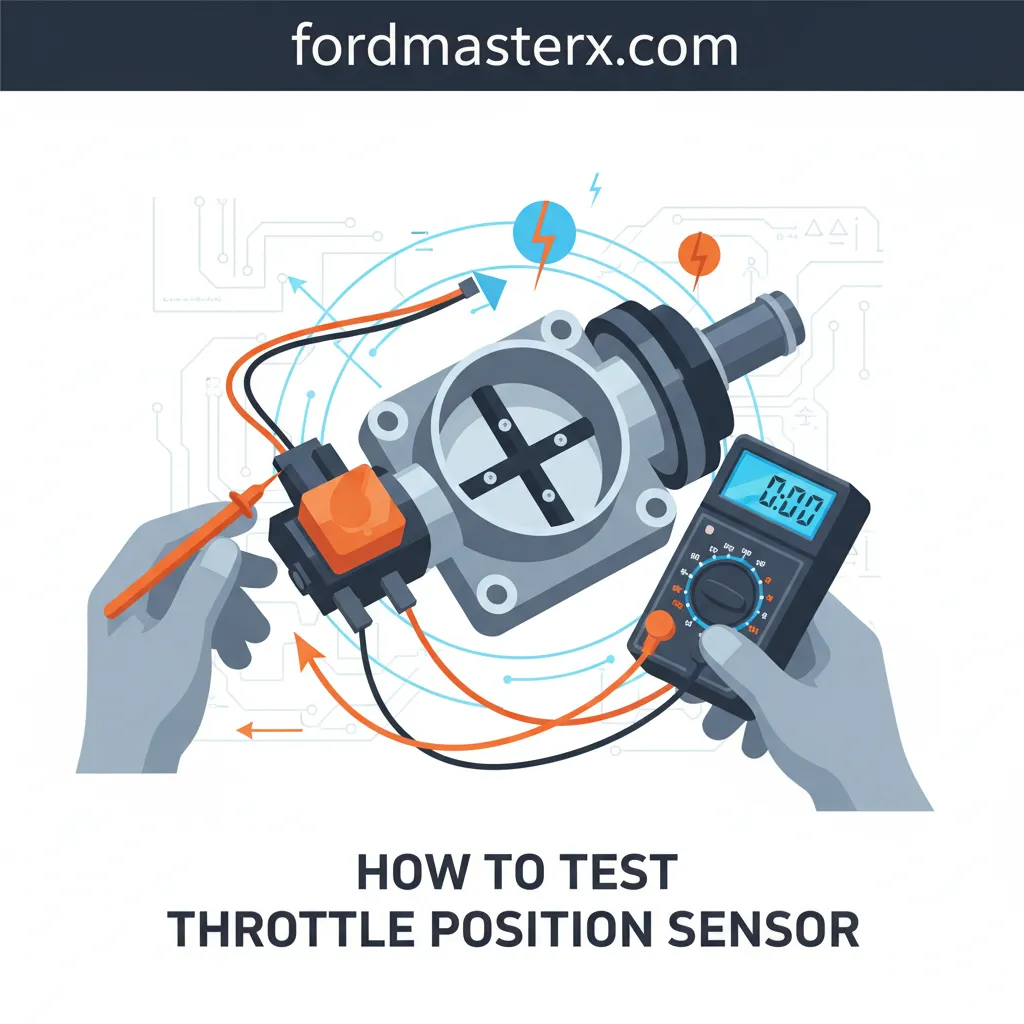
How To Test Throttle Position Sensor: Precision Diagnostic Techniques For Engine Performance

An erratic engine idle or a sudden stumble during acceleration often points to a single, critical component: the throttle position sensor (TPS). When this sensor sends inaccurate data to the vehicle’s computer, it disrupts the air-fuel ratio, leading to poor fuel economy and potentially dangerous loss of power. In this comprehensive guide, you will learn how to master the diagnostic process using a multimeter and scan tool to accurately identify TPS failure and restore your engine’s performance. Whether you are a beginner or a seasoned technician, these essential techniques will ensure your diagnosis is pinpoint accurate.
Master the Fundamentals: How the Throttle Position Sensor Operates
📤 Share Image
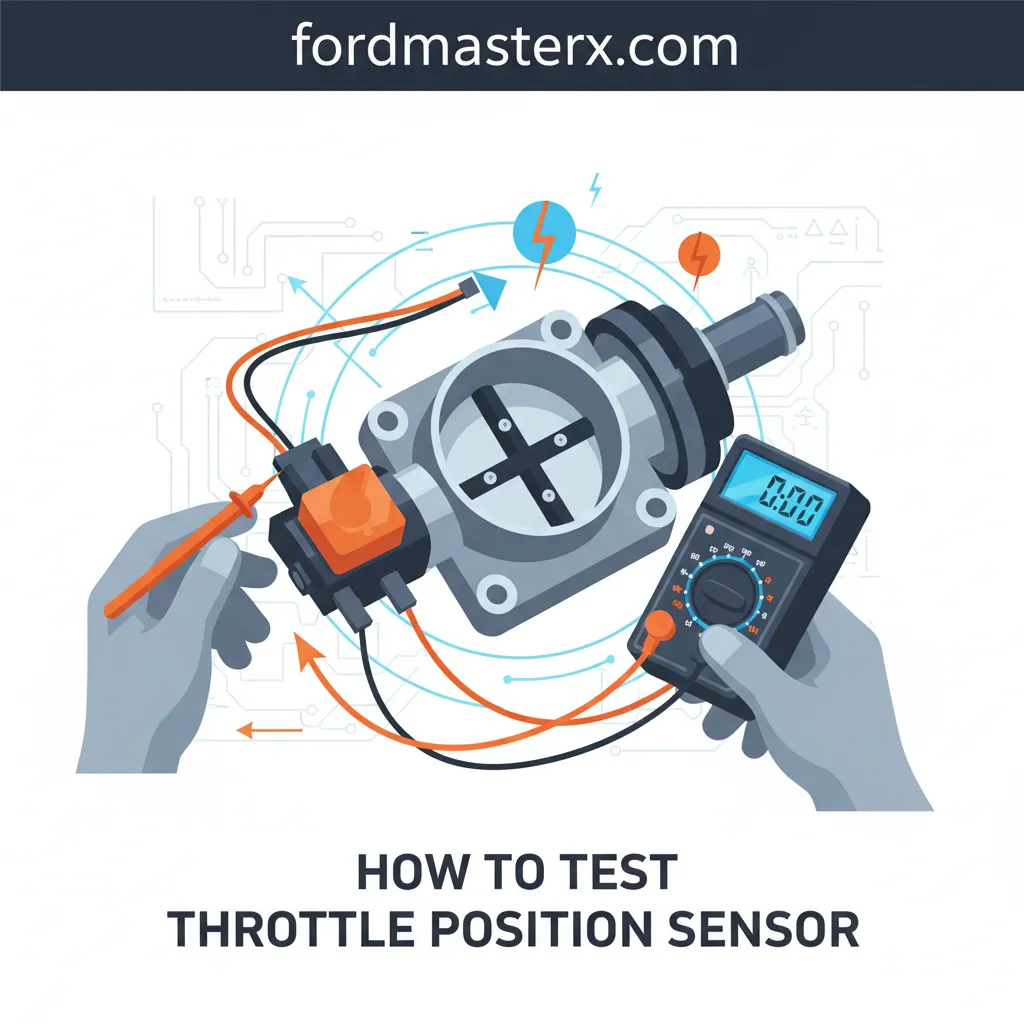
To effectively test the TPS, you must understand its mechanical and electrical relationship with the engine. At its core, the TPS is a potentiometer—a variable resistor—mounted directly to the throttle body. Its primary role is to monitor the angle of the butterfly valve. As you press the accelerator, the sensor rotates, changing the electrical resistance and sending a variable voltage signal to the Powertrain Control Module (PCM).
The Three-Wire Configuration
Most traditional sensors utilize a standard three-wire circuit that is essential for operation:
- 5V Reference Signal: A steady voltage supplied by the ECU to “power” the sensor.
- Ground Wire: Completes the circuit back to the PCM.
- Signal Return Wire: The output voltage that varies based on throttle position.
In a 1990s sedan with a mechanical cable-actuated throttle, the TPS provides a direct analog of your foot’s movement. Conversely, a modern Electronic Throttle Control (ETC) system uses a “drive-by-wire” motor. In these systems, the TPS is even more critical; it provides feedback to the ECU to confirm the motor has moved the plate to the requested position. Most ECUs operate on a 5.0-volt reference signal; a deviation of even 0.2 volts can trigger a limp-home mode.
By The Numbers
Standard ECU Reference
Typical Idle Voltage
Typical WOT Voltage
Contact vs. Hall-Effect Sensors
Traditional sensors use a physical “wiper” arm that slides across a resistive track. Over time, this track wears down, creating the “dead spots” we’ll explore later. Modern vehicles often use Hall-effect sensors, which are contactless and rely on magnetic fields. While Hall-effect sensors are more durable, they still rely on the same 5V reference and signal return logic, making our testing methods applicable to both.

Discover Common Symptoms and Diagnostic Trouble Codes
Before diving into hands-on testing, you must recognize the “personality” of a failing TPS. Because the TPS informs fuel trim, ignition timing, and transmission shift points, a failure can manifest in ways that seem unrelated to the throttle itself.
Driveability Hesitation
Engine stumbles or “flat spots” during acceleration as the sensor loses track of the butterfly valve’s position.
Transmission Hunting
Delayed downshifts or unexpected gear hunting during cruise because the PCM thinks you are changing throttle input.
Common Diagnostic Trouble Codes (DTCs):
- P0121: TPS Range/Performance. This is triggered when the PCM detects a mismatch between the TPS and the Manifold Absolute Pressure (MAP) sensor data.
- P0122: TPS Circuit Low Input. Usually indicates a short to ground or an open 5V reference circuit.
The “Bucking” Scenario: I have often seen vehicles exhibit “bucking” or surging at exactly 35-45 MPH. This is frequently misdiagnosed as a spark plug misfire. In reality, the resistive track inside the TPS has worn out at that specific “cruising” throttle angle, causing the signal to flicker and the ECU to jerk the fuel injectors on and off.

Explore the Visual Inspection and Preparation Process
Never jump straight to replacing parts. Master-level diagnostics require a systematic approach to eliminate external variables like wiring harness integrity and mechanical obstructions.
📋
Preparation Checklist
Identify the TPS opposite the throttle linkage. Inspect for frayed insulation or green verdigris corrosion inside the connector pins, which creates high resistance.
Carbon buildup can prevent the butterfly valve from closing fully. Ensure it hits the mechanical stop so the sensor can reach its correct base idle voltage.
Set your Digital Multimeter (DMM) to DC Volts. Use high-quality leads. Wiring harness resistance should ideally be below 0.5 Ohms.
Always secure the vehicle with the parking brake. Most tests are performed “Key On, Engine Off” (KOEO) to avoid moving parts while probing the sensor.
Learn the Step-by-Step Multimeter Voltage Sweep Test
The voltage sweep is the definitive test for a potentiometer-style TPS. It allows you to discover faults that occur only at specific throttle angles.
1. Back-Probing the Connector
Do not pierce the wire insulation, as this invites future corrosion. Instead, use a T-pin to “back-probe” the connector by sliding it alongside the wire into the back of the weather seal until it contacts the terminal. Connect your positive DMM lead to the T-pin and the negative lead to a solid chassis ground.
2. Verifying the 5V Reference
With the key in the ON position, probe the reference wire. You should see a steady 5.0V (±0.1V). If this voltage is low, the issue is likely in the ECU or the wiring harness, not the TPS itself.
3. The Linear Sweep Test
Probe the signal return wire. At idle, the voltage should be between 0.5V and 0.9V. Now, slowly rotate the throttle linkage by hand toward Wide Open Throttle (WOT). Watch the multimeter display carefully. The voltage should climb steadily and linearly: 0.6V, 1.2V, 2.1V… all the way to approximately 4.5V.
A high-quality TPS should exhibit a linear increase within +/- 0.05V of the expected curve. If you see the voltage climb to 2.1V, then suddenly drop to 0V or jump to “OL” (Open Loop) before returning to 3.5V, you have found a worn resistive track. The sensor is defective and must be replaced.
Master Advanced Diagnostic Tools: Using OBD-II Scanners and Oscilloscopes
While a multimeter is excellent for steady-state testing, it has a significant limitation: sample rate. Standard multimeters update 2-4 times per second. An intermittent glitch might only last for a millisecond—far too fast for a DMM to capture.
Live Data and Graphing
Connect a professional-grade scan tool (like a Snap-On Zeus or Autel) and navigate to “Live Data.” Look for Absolute Throttle Position. This is usually displayed as a percentage (0% to 100%). Use the graphing function to create a visual waveform. If you see “spikes” or “drop-outs” in the line while holding the throttle steady, the sensor is failing. In drive-by-wire systems, you can overlay TP Sensor A and TP Sensor B to check for correlation errors; if the two lines don’t mirror each other perfectly, the ECU will trigger limp mode.
The Oscilloscope Advantage
A lab scope can sample at 1 million times per second, making it 250,000x more accurate for intermittent faults than a DMM. It can identify “noise” in the signal caused by electromagnetic interference (EMI) or a failing alternator diode that might be “dirtying” the ECU’s reference voltage.
The Final Step: TPS Relearn
If your testing confirms a failure and you replace the sensor, you must often perform a Throttle Relearn or Throttle Body Alignment procedure. The PCM needs to “learn” the new sensor’s specific voltage at the idle stop. Without this, you may experience a high idle or a Check Engine Light immediately after the repair.
✅ Why Test First?
- Avoids “parts cannon” expenses
- Confirms wiring integrity
- Identifies mechanical vs electrical issues
- Ensures 5V ECU health
❌ Common Testing Errors
- Probing from the front of the connector
- Testing with a low battery
- Ignoring carbon buildup
- Skipping the relearn process
Testing a throttle position sensor is a straightforward process when you follow a structured diagnostic path. By verifying the 5V reference and ground integrity before blaming the sensor itself, you save time and money. Always perform a slow, steady voltage sweep to identify hidden dead spots in the potentiometer track that standard scanners might miss. Finally, remember to perform a throttle relearn procedure if a new sensor is installed to ensure system calibration. If your voltage sweep revealed inconsistencies, consult your service manual for the exact part number and replace the sensor to prevent further engine damage and restore your vehicle’s peak performance.
Frequently Asked Questions
Can I clean a throttle position sensor instead of replacing it?
Generally, no. Most modern throttle position sensors are sealed units. If the internal resistive track is worn or the Hall-effect chip has failed, topical cleaning will not restore functionality. However, cleaning the throttle body’s butterfly valve can sometimes resolve ‘range’ errors that mimic a faulty sensor.
What should the voltage be at wide-open throttle (WOT)?
While it varies by manufacturer, most vehicles should see a voltage reading between 4.0V and 4.8V at wide-open throttle. If the reading stays below 4.0V when the pedal is fully depressed, the PCM may not enter ‘clear flood’ mode or high-load enrichment, resulting in significant power loss.
Does a bad TPS always trigger a Check Engine Light?
Not necessarily. If the sensor has a small ‘dead spot’ or intermittent high resistance that only occurs briefly, the PCM might filter this out as ‘noise’ rather than a hard fault. You may experience drivability issues like surging long before a DTC like P0121 is actually set.
What is the difference between a 3-pin and 4-pin TPS?
A 3-pin TPS includes 5V power, ground, and signal. A 4-pin TPS usually adds an ‘Idle Switch’ pin. This dedicated circuit tells the ECU exactly when the throttle is fully closed, allowing for more precise idle air control. Testing a 4-pin unit requires checking continuity on that fourth pin.
Can I test a TPS with the engine running?
It is safer and more accurate to test with ‘Key On, Engine Off’ (KOEO). Testing while running introduces engine vibration and electrical interference from the alternator, which can make it difficult to see steady voltage changes on a multimeter. KOEO provides a clean 5V reference for the most accurate sweep test.