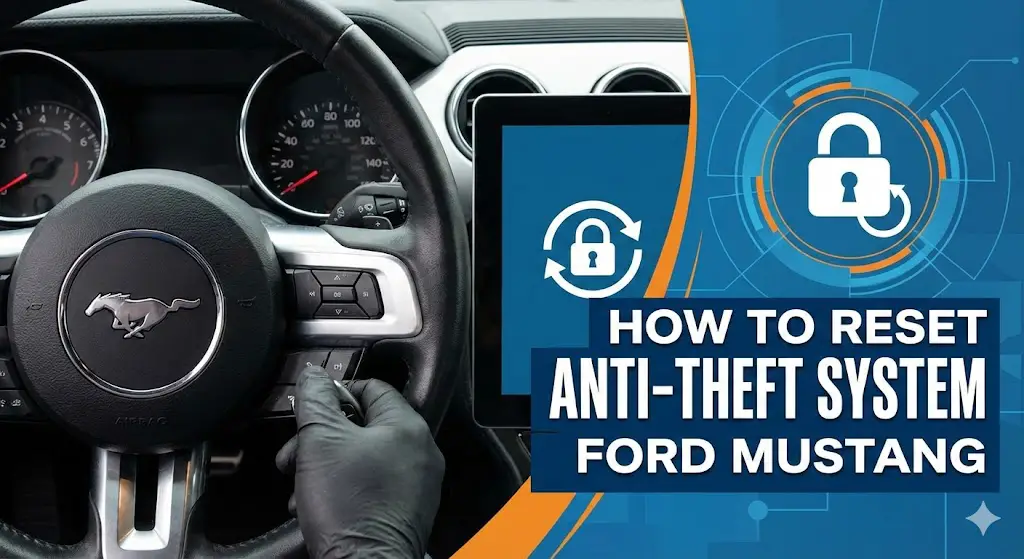
Comprehensive Technical Report on Ford Mustang Anti-Theft Architectures: Diagnostics, Reset Protocols, and System Integration

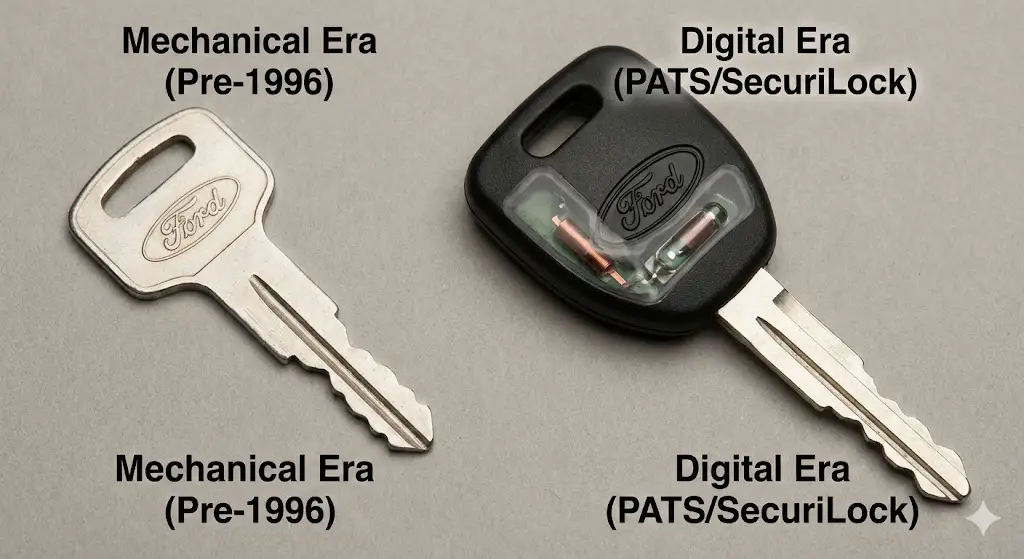
The history of automotive security is a testament to the escalating arms race between vehicle manufacturers and vehicular thieves. In the context of the Ford Mustang, an icon of American performance, this evolution mirrors the broader industry’s transition from purely mechanical barriers to highly integrated, digital authentication networks. Before the mid-1990s, vehicle security was largely defined by the physical integrity of door locks and ignition cylinders—barriers that could be easily bypassed with rudimentary tools like slide hammers or tension wrenches.
The introduction of the Passive Anti-Theft System (PATS), commercially marketed as SecuriLock, marked a fundamental paradigm shift. It decoupled the physical act of turning a key from the authorization to operate the engine, inserting a layer of cryptographic verification that remains the standard for vehicle immobilization today.
This report provides an exhaustive technical analysis of the Ford Mustang’s anti-theft systems across its key modern generations: the SN95 New Edge (1999-2004), the S197 (2005-2014), and the S550 (2015-2023). It explores the intricate “handshake” protocols between control modules, the physics of Radio Frequency Identification (RFID) transponders, and the specific failure modes that leave owners stranded. Furthermore,
it details the authoritative reset procedures—ranging from manual key cycling to advanced software parameter resets—required to restore vehicle function following a system lockout, battery failure, or component replacement. By synthesizing data from technical service bulletins, diagnostic flowcharts, and expert field repair strategies, this document serves as a definitive resource for diagnosing and resolving Ford SecuriLock anomalies.
The Distinction Between Active and Passive Security
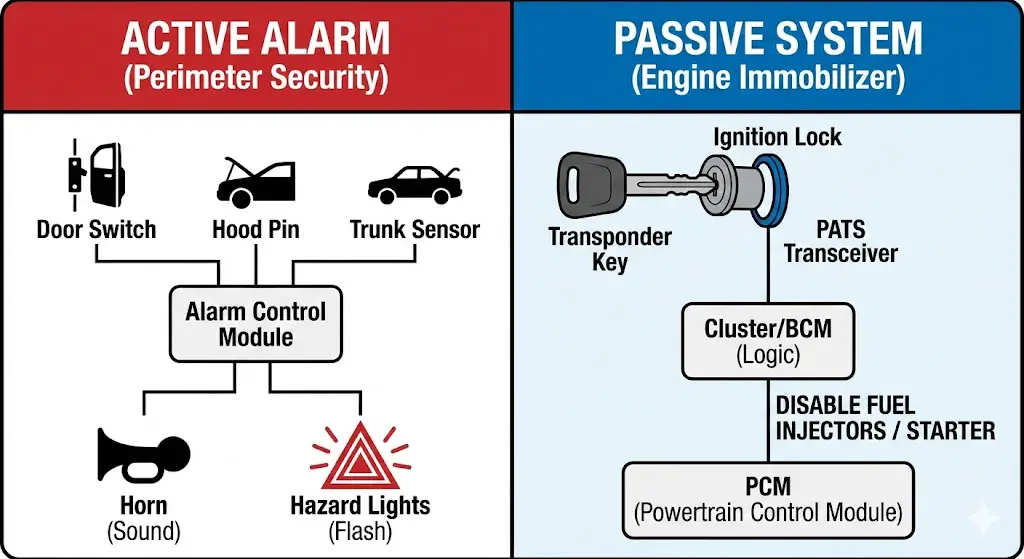
A critical first step in analyzing Mustang security is distinguishing between the two distinct systems often present in the vehicle: the Active Anti-Theft Alarm and the Passive Anti-Theft System (PATS). Confusion between these two architectures is the leading cause of misdiagnosis in “no-start” scenarios.
The Active Anti-Theft Alarm is a perimeter monitoring system. It utilizes door ajar switches, hood pins, and trunk sensors to detect unauthorized entry. When triggered, it initiates a “panic” response involving the horn and hazard lights. In some configurations, particularly on the S197 and S550 platforms, the active alarm can disable the starter motor via a Starter Interrupt Relay, preventing the engine from cranking. This system is “active” because it requires the user to arm it (typically by locking the doors with the fob) and reacts visibly to intrusion.
In contrast, PATS (SecuriLock) is an engine immobilizer. It is “passive” because it requires no deliberate action from the driver other than using the correct key. Its sole function is to validate the identity of the operator before allowing the engine to run. If PATS detects a security breach—such as an unprogrammed key or a transceiver failure—it does not sound the horn. Instead, it silently disables the fuel injectors (and sometimes the starter) via the Powertrain Control Module (PCM), rendering the engine inert. The definitive symptom of a PATS failure is not an audible alarm, but a rapidly flashing “Theft” or “Security” light on the instrument cluster.
Understanding this dichotomy is essential. A “Door Lock Reset” method may fix a perimeter alarm glitch that is preventing cranking, but it will have no effect on a PATS transceiver failure that is cutting fuel.8 This report focuses primarily on the latter—the complex immobilization logic that is the source of most persistent “crank no start” conditions.
Mustang Anti-Theft Reset
Is your PATS light flashing? Engine cranking but not starting? Master the reset procedure without a tow truck.
Why is my Mustang Locked Out?
The Passive Anti-Theft System (PATS) disables your fuel injectors if it doesn’t recognize your key. Before attempting a reset, understand the root cause. While a “glitch” is common, hardware issues often trigger the lockdown.
💡 Quick Diagnostic Tip
Look at the dashboard. If the theft light flashes rapidly (more than once per second) with the ignition ON, the system has immobilized the engine.
Common Triggers for PATS Lockout
Based on aggregated forum data & repair logs
Attempt These Quick Fixes First
Before committing to the long relearn process, try these rapid physical resets.
The Door Cylinder Trick
Often works if the alarm was triggered by a battery change or glitch.
- Exit vehicle, close all doors.
- Insert physical key in driver door.
- Turn to Unlock, then Lock.
- Turn back to Unlock.
- Try starting the engine.
The Hard Battery Reset
Medium EffortForces all electronic modules to reboot, clearing temporary error codes.
- Disconnect Negative (-) terminal.
- Wait fully 15 Minutes.
- Reconnect terminal securely.
- Turn key to ON position for 30s.
- Start engine.
Check Key Transponder
Sometimes the chip inside the key is damaged or the battery is dead.
- Try your Spare Key.
- Replace key fob battery (CR2032).
- Ensure no other RFID tags are near the ignition.
The “Ford Key Cycle” Relearn
If the quick fixes failed, your car has likely “forgotten” the key
code. This procedure forces the ECU to re-handshake with the key.
Note: This takes patience.
Insert & Turn ON
Insert the key and turn the ignition to the
ON position (Run).
DO NOT CRANK THE ENGINE.
The dashboard lights should come on, and the anti-theft light
will flash rapidly.
The 10-Minute Wait
Leave the key in the ON position. Watch the flashing anti-theft light. After approximately 10 to 15 minutes, the light will stop flashing and either go out or stay solid.
Cycle Off
Turn the key to the OFF position and wait 20 seconds.
Start the Engine
Attempt to start the car. If it starts, the system is reset. If not, you may need to repeat this cycle 3 times in a row (for a total of ~30-45 mins) for some Mustang models.
Cost Comparison: Fixing Anti-Theft
Why try DIY first? The dealer markup for a simple PATS reset is significant. However, if the transceiver ring is broken, hardware costs apply.
Success Rates by Method
© 2026 FordMasterX Infographics. Data sourced from manufacturer owner manuals.
Fundamental Architecture of Ford Security Systems
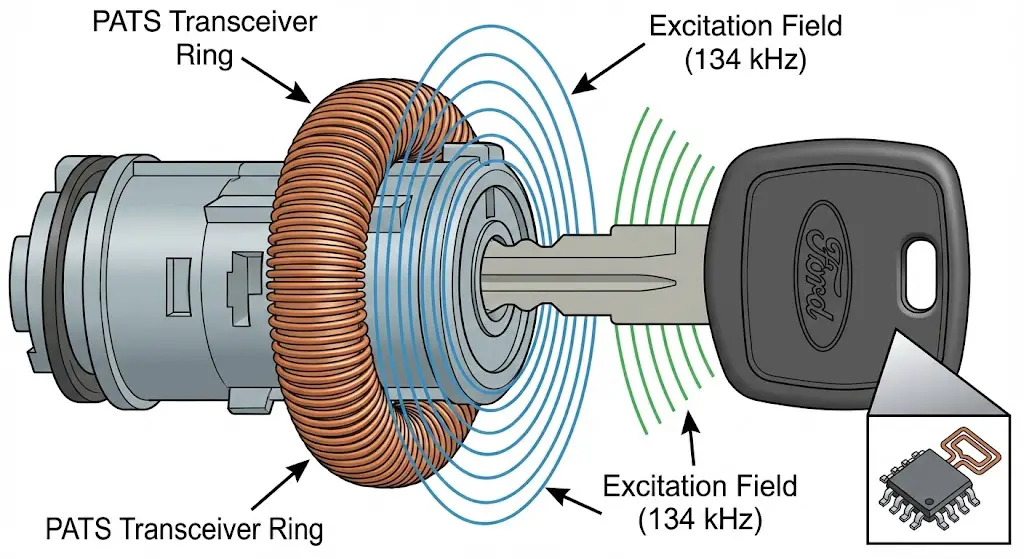
To troubleshoot the Mustang’s anti-theft system effectively, one must understand the hardware components involved and the topology of their communication. The system is not a single black box but a distributed network of modules.
The Physics of RFID Transponders
At the heart of the SecuriLock system is Radio Frequency Identification (RFID). Embedded within the head of the ignition key (or the body of the Intelligent Access fob in S550s) is a miniaturized transponder chip. This chip is a passive device; in the context of the immobilization function, it does not rely on the key fob’s internal battery.
When the key is inserted into the ignition lock cylinder, it passes through a magnetic field generated by the PATS Transceiver—a toroidal coil antenna mounted around the cylinder housing. This low-frequency field (typically 134 kHz) induces an electrical current in the transponder’s internal coil via magnetic induction. This induced current powers the microchip, which then transmits a unique hexadecimal alphanumeric code back to the transceiver.
This transmission is the digital fingerprint of the key. In earlier generations (SN95), this was a fixed 40-bit code (Texas Instruments 4C or 4D encryption). In later S197 and S550 models, the system evolved to 80-bit encryption and “rolling codes,” where the response signal changes algorithmically with each start cycle to prevent “replay attacks”—a method where thieves record a valid signal and rebroadcast it to steal the vehicle.
The Control Module Hierarchy
Once the transceiver captures the key’s code, it does not verify it. The transceiver is merely a relay. It passes the signal down the data bus to a controlling module. The location of this logic has shifted significantly across Mustang generations, altering the reset procedures required for each.
Table 1: Evolution of Mustang PATS Architecture
| Generation | Model Years | Primary Control Module | Key Technology | Immobilization Method |
| SN95 Phase II | 1999-2004 | Hybrid Electronic Cluster (HEC) | Transponder (40-bit/80-bit) | Fuel Injector Cut |
| S197 Phase I | 2005-2009 | Smart Junction Box (SJB) | Integrated Keyhead (IKT) | Starter Relay & Fuel Cut |
| S197 Phase II | 2010-2014 | Body Control Module (BCM) | Integrated Keyhead (IKT) | Starter Relay & Fuel Cut |
| S550 | 2015-2023 | Body Control Module (BCM) | Intelligent Access (PEPS) | Starter & Fuel Inhibition |
In the SN95 New Edge (1999-2004), the “brains” of the system are located inside the Instrument Cluster (HEC). This design choice has profound implications for repair: if the instrument cluster fails, the car will not start because the PATS logic is offline. Replacing the cluster requires “marrying” the new unit to the PCM, a process that requires specialized scan tools.15
In the S197 (2005-2014), the logic migrated to the Smart Junction Box (SJB) and later the Body Control Module (BCM). These modules communicate with the PCM over a High-Speed CAN (Controller Area Network) bus. The separation of the “key reader” (BCM) and the “engine controller” (PCM) means that communication errors on the CAN bus (U-codes) can trigger a theft lockout even if the key and transceiver are perfectly functional.
In the S550 (2015-2023), the system utilizes Passive Entry Passive Start (PEPS). The traditional ignition cylinder is replaced by a Start/Stop button. The system relies on the Remote Function Actuator (RFA) and a series of internal antennas to triangulate the exact location of the key fob. The fob must be inside the vehicle cabin to authorize a start; if it is detected outside (e.g., on the roof), the system will inhibit the engine.
Operational Logic: The Authentication Handshake
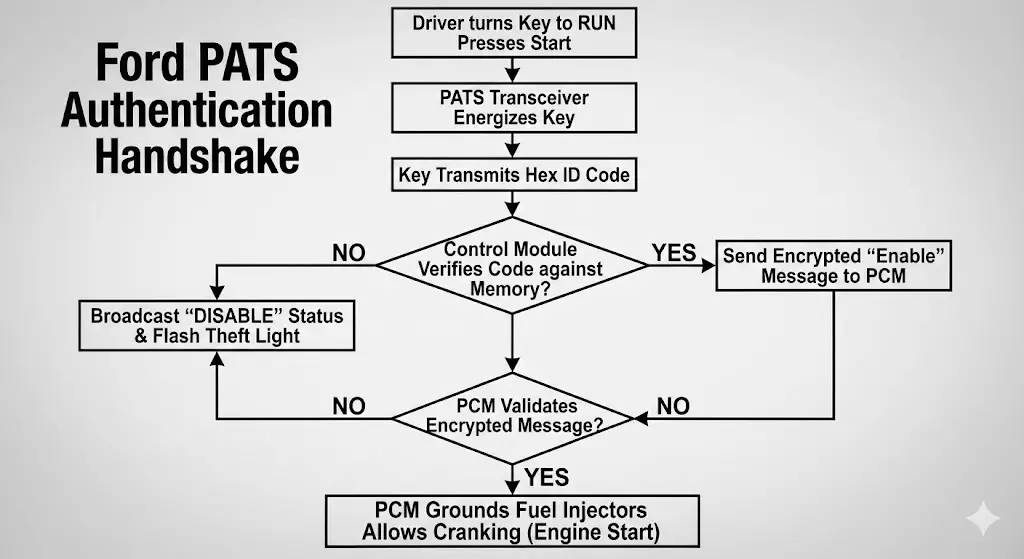
The process of starting a PATS-equipped Mustang is a high-speed digital conversation that occurs within the first few hundred milliseconds of the ignition cycle. Understanding this sequence is vital for diagnosing at which point the system is failing.
The Sequence of Events
- Trigger: The driver turns the ignition key to RUN or presses the Start button.
- Excitation: The PATS Transceiver energizes the transponder in the key.
- Read: The key transmits its ID code.
- Verification (The Gatekeeper): The controlling module (HEC, SJB, or BCM) compares the key ID against its internal memory of “Programmed Keys.”
- If Invalid: The module logs a Diagnostic Trouble Code (DTC) such as B1600 (No Key) or B1601 (Unprogrammed Key) and broadcasts a “Disable” status message.
- If Valid: The module sends an encrypted “Enable” or “Challenge-Response” verification to the Powertrain Control Module (PCM).
- PCM Action:
- The PCM receives the Enable message.
- It compares the encrypted challenge against its own stored shared secret (the “Parameter Reset” data).
- If the handshake is successful, the PCM grounds the fuel injector drivers, allowing fuel to flow.
- In S197/S550 models, the PCM also grounds the Starter Relay control circuit, allowing the engine to crank.
The Failure State: Theft Mode
If any step in this chain fails—whether due to a bad key, a broken transceiver, or a cut wire between modules—the system enters “Theft Mode.” In this state, the theft light on the dashboard flashes rapidly (2-3 Hz).
- 1996-2004 behavior: The engine will typically crank but not start. The starter is not disabled, but the fuel injectors are off. The engine spins dry.
- 2005+ behavior: The engine will typically not crank (No Crank, No Start). The system disables the starter relay to prevent wear on the starter motor and battery.
Diagnostic Framework: Interpreting the Security Indicator
Before attempting any reset procedure, the operator must interrogate the system to understand why it is locked out. The Ford system is designed to communicate its ailment through the “Theft” light. While a scan tool (OBDII) provides the most detail, the light itself offers a built-in diagnostic interface known as “Blink Codes.”
Normal Status Indicators
Under normal operation, the theft light serves as a deterrent and a confirmation signal:
- Armed (Ignition OFF): The light flashes once every 2 seconds. This heartbeat indicates the system is powered and monitoring for intrusion.
- Disarmed (Ignition ON): When a valid key is turned to RUN, the light illuminates solid for 3 seconds and then extinguishes. This solid 3-second burn is the “Green Light” from the system, confirming the handshake was successful.
The “Rapid Flash” and Blink Codes
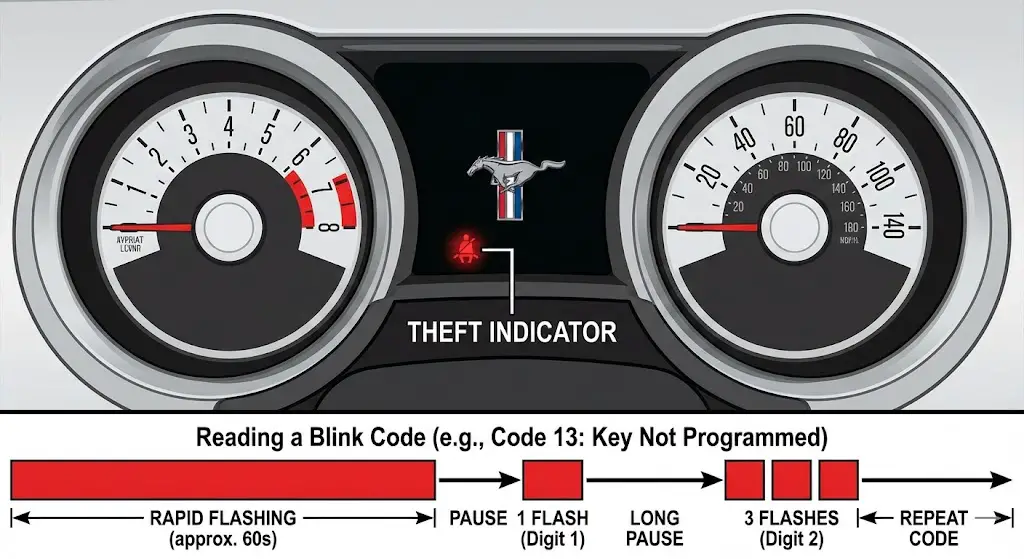
When a failure occurs, the light flashes rapidly immediately upon turning the ignition ON. This rapid flashing persists for approximately 45 to 60 seconds. Do not turn the key off during this phase. If the driver waits until the rapid flashing stops, the light will begin to pulse a 2-digit code.
The code is displayed as a sequence of flashes:
- Example: FLASH (pause) FLASH-FLASH-FLASH. This represents Code 13 (1 flash, pause, 3 flashes).
- The code will repeat several times before the light stays solid or turns off.
Table 2: Comprehensive Ford PATS Blink Code Index
| Blink Code | Diagnostic Meaning | Likely Root Cause | Recommended Action |
| 11 | Transceiver Signal Not Detected | Disconnected transceiver ring; broken wire in steering column. | Inspect connector at lock cylinder; check PATS fuse. |
| 12 | Transceiver Antenna Failure | Internal failure of the transceiver coil (bad winding). | Replace the PATS transceiver ring (Part # 1L3Z-15607-AA). |
| 13 | Key Not Programmed | The key being used is not in the system’s memory. | Perform “Add a Key” procedure or reprogram via scan tool. |
| 14 | Key Transponder Issue | Key is damaged; partial read; interference from other keys. | Remove other keys from ring; try spare key. |
| 15 | Key Invalid (Wrong Type) | Key has incorrect encryption (e.g., non-PATS key or wrong bit-depth). | Verify key blank compatibility (H72 vs H84). |
| 16 | CAN/SCP Data Link Error | PCM and Cluster/BCM are not communicating or are not “married.” | Inspect data bus wiring; perform Parameter Reset (software). |
| 21 | Below Minimum Keys | System requires 2 keys, but fewer than 2 are stored. | Program additional keys to meet minimum requirement. |
Code 16 is particularly notorious in the 1999-2004 and S197 platforms. It signifies a “marriage” failure. Even if the key is good and the reader is good, the Cluster and the PCM have stopped trusting each other. This often happens after a dead battery or a jump start creates a voltage spike that corrupts the shared security token in the Keep Alive Memory (KAM).
Standard Reset Protocols: Non-Invasive Methods
For many owners, the system lockout is not due to a permanent hardware failure but a temporary synchronization glitch or a “confusion” of the logic caused by low voltage. In these cases, manual reset procedures can restore functionality without tools.
The “10-Minute” Relearn Method (Ignition Cycling)
This is the most universally cited and effective procedure for resolving “soft” lockouts and for programming new keys when a working key is unavailable (on older systems) or when the system has lost sync. It forces the module to re-poll the key and, critically, it satisfies the security time penalty hard-coded into the firmware.
Applicability: SN95, New Edge, S197 (specific scenarios).
Mechanism: The 10-minute wait is a security feature, not a loading time. It is designed to prevent thieves from brute-forcing key codes. By forcing a 10-minute delay between programming attempts, Ford makes theft mathematically impractical.
Step-by-Step Procedure:
- Preparation: Ensure the vehicle battery is fully charged. Connect a battery tender if available, as the headlights/ignition will be on for an extended period, draining power.26 Turn off HVAC, radio, and interior lights.
- Initiation: Insert the key and turn the ignition to the ON (RUN) position. Do not crank the engine.
- Observation: The Theft light will flash rapidly.
- The Wait: Leave the key in the ON position. Do not touch it. Wait for 10 minutes (some sources recommend 15 minutes to be safe).
- Termination: Observe the Theft light. It should eventually stop flashing and either turn off or stay solid.
- Cycle: Turn the ignition OFF and wait 30 seconds.
- Attempt: Turn the ignition back to ON. The Theft light should now illuminate for 3 seconds and turn off (normal operation). Attempt to start the engine.
Advanced Iteration (The 30-Minute Loop):
For some module replacements or deeper lockouts, a single cycle is insufficient. The procedure must be repeated three times consecutively to rewrite the key table.
- Cycle 1: ON for 10 min -> OFF.
- Cycle 2: ON for 10 min -> OFF.
- Cycle 3: ON for 10 min -> OFF.
- Total Time: ~30-40 minutes. After the third cycle, the key is accepted as the new master.
The Door Lock Cylinder Method (Active Alarm Reset)
This method addresses the Active Anti-Theft (Perimeter) system rather than the PATS immobilizer, though the symptoms (no start) often overlap. If the car believes it has been broken into (e.g., battery died while locked), it may maintain a starter interrupt state.
Applicability: All Generations (SN95, S197, S550).
Mechanism: The door lock cylinder contains a switch that signals the Body Control Module (or GEM) that a physical key is being used. This signal overrides the electronic alarm state, proving authorized access.
Step-by-Step Procedure:
- Secure the Vehicle: Exit the car. Close all doors, the hood, and the trunk. Ensure the windows are rolled up (or down if you fear being locked out).
- Mechanical Input: Insert the physical key into the driver’s side door lock cylinder.
- The Hold: Turn the key to the UNLOCK position and hold it there against the spring tension for 20 to 30 seconds.
- Toggle: Turn the key to LOCK, then back to UNLOCK.
- Verify: This sequence sends a “Disarm” command to the alarm module. The horn should not sound.
- Entry: Open the door and attempt to start the engine immediately (within 12 seconds).
The Battery Capacitor Discharge (Hard Reset)
When logic modules (BCM, PCM) encounter a voltage spike or a brownout (low voltage), they can “latch” into a fault state that persists even when the key is cycled. A hard reset drains the internal capacitors of these modules, forcing a cold reboot of their operating systems.
Applicability: Universal.
Step-by-Step Procedure:
- Disconnect: Remove the negative (-) cable from the battery terminal. Isolate it so it cannot touch the post.
- Wait: Leave the battery disconnected for 15 to 30 minutes.
- Active Drain (Optional): While disconnected, turn the headlight switch to ON or depress the brake pedal. This creates a load that helps drain residual energy from the system’s capacitors.
- Reconnect: Reattach the negative cable. Ensure the connection is tight; loose terminals are a primary cause of PATS codes.
- Relearn: Turn the key to ON for 30 seconds before cranking to allow the idle trim strategies and sensor baselines to re-initialize.
Generation-Specific Diagnostics and Failures
While the core RFID physics remain constant, the implementation details vary wildly by model year. A “one-size-fits-all” approach will fail.
6.1 The New Edge Era (1999-2004)
The SN95 New Edge Mustang is perhaps the most prone to PATS issues due to age and the integration of the system into the Instrument Cluster (HEC).
The “Dashes” Phenomenon (Odometer Failure):
A distinct failure mode in this generation is the odometer displaying a series of dashes (——) instead of the mileage.
- The Cause: This indicates a loss of communication on the SCP data bus between the Instrument Cluster and the PCM. Since the Cluster holds the PATS logic, if it cannot talk to the PCM, it cannot send the “Enable” command.
- The Fix: This is rarely a key issue. It is typically a blown fuse (check Fuse #2.26 and #2.34 in the interior box) or a loose ground wire near the PCM (passenger kick panel). It can also indicate a failed Cluster circuit board.
Transceiver Ring Drift:
The transceiver antenna (Part # 1L3Z-15607-AA) is mounted around the ignition lock cylinder. In high-mileage vehicles, the plastic mounting tabs can break, or the tilt-steering mechanism can pull on the wiring harness.
- Symptom: Code 11 or 12. The theft light flashes rapidly.
- Diagnosis: Sometimes, tilting the steering wheel all the way up or down, or pressing the key “in” firmly while turning, will re-align the ring enough to get a read. This confirms a physical hardware fault.
The S197 Era (2005-2014)
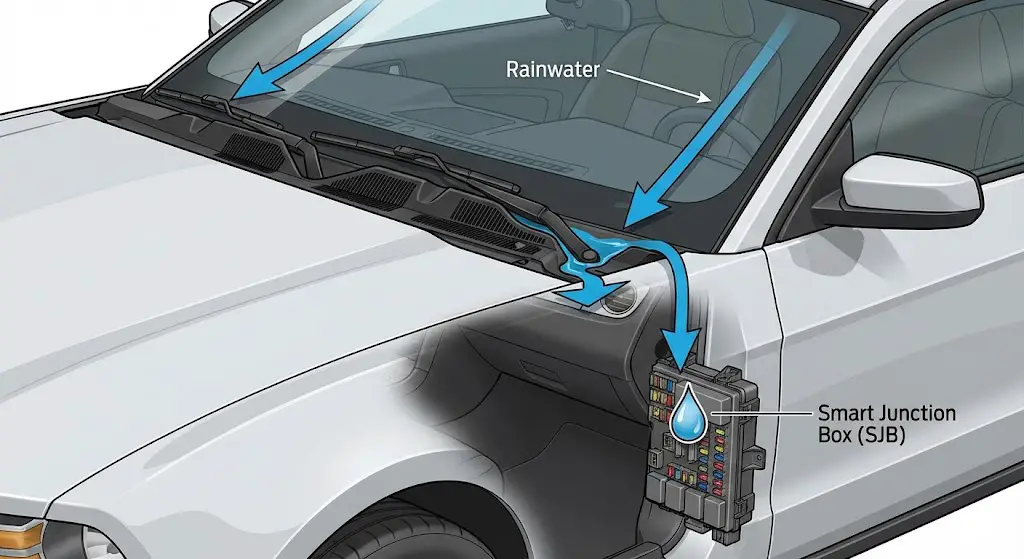
The S197 introduced the Smart Junction Box (SJB), located in the passenger footwell. This generation faces a unique environmental threat.
Water Intrusion and the SJB:
The cowl drains (located under the windshield wipers) on the S197 are notorious for clogging with leaves and debris. When this happens, rainwater accumulates and spills over into the cabin air filter housing, dripping directly onto the SJB in the passenger footwell.
- The Consequence: Water bridges the pins on the SJB, causing erratic electrical behavior. The alarm may sound randomly in the middle of the night, or the PATS system may fail to recognize a key because the data lines are shorted.
- Resolution: If an S197 has “poltergeist” electrical issues and PATS trouble, check the passenger carpet for dampness. The SJB must be dried (or replaced) and the drains cleared.
Remote Start Conflicts:
This era saw a proliferation of aftermarket remote start systems. These systems use a “bypass module” to trick the PATS. Over time, the memory in these cheap bypass modules can degrade, or their wiring connections can corrode.
- Diagnosis: If the car has an aftermarket remote start antenna on the windshield, disconnect the bypass module to see if the factory system restores function.
The S550 Era (2015-2023)
The S550 moved to Intelligent Access with push-button start. The key is no longer physically connected to the car’s electrical system, leading to new failure modes.
Radio Frequency Interference (RFI):
The S550’s internal antennas are sensitive. Placing the key fob near a cell phone, a laptop, or a metal travel mug in the cupholder can block the RFID signal.
- Symptom: The message center displays “No Key Detected” even with the fob present.
- Solution: Move the key away from other electronics.
The Backup Slot (Dead Fob Battery):
If the fob battery dies, the car cannot detect the key’s broadcast. However, Ford included a fail-safe “backup slot” that uses near-field induction (identical to the old ignition cylinders) to read the passive chip inside the fob.
- 2015-2017 Location: Under the rubber mat in the center console storage bin or the cupholder bottom.
- 2018+ Location: A dedicated slot in the cupholder nearest the dashboard.
- Procedure: Remove the rubber liner to expose the slot. Place the fob into the slot (usually buttons facing up or per owner’s manual graphic). Press the Start button. This bypasses the need for the fob battery.
Advanced Diagnostics: Software Parameter Resets
When manual methods and hardware inspections fail, the issue is likely a data corruption between modules. The “handshake” data (the shared secret) between the Key Reader (Cluster/BCM) and the Engine Controller (PCM) has become mismatched. This requires a Parameter Reset.
The Parameter Reset Procedure
This procedure cannot be done with buttons; it requires a bi-directional scan tool. The dealer tool is the IDS (Integrated Diagnostic System), but the enthusiast community relies on FORScan, a powerful software that utilizes an ELM327 OBDII adapter.
The “Marriage” Reset:
- Connect: Interface FORScan with the vehicle via the OBDII port.
- Access: Enter the “Service Functions” or “PATS Programming” menu.
- Initiate: Select “Parameter Reset” (sometimes called “Module Initialization”).
- The Security Wait: The software will invoke a 10 to 12-minute security access delay. This is unavoidable. It is a hard-coded barrier to prevent rapid hacking.
- Synchronization: Once the timer expires, the tool will command the modules to erase their old handshake tokens and generate a new one.
- Instruction: The software typically prompts the user to cycle the ignition (OFF then ON) to finalize the pairing.
- Result: This resolves the dreaded Code 16 (CAN Link Error).
Bypassing and Deleting PATS
For dedicated track cars, engine swaps, or vehicles where the cost of repair exceeds the value, owners often seek to disable PATS entirely.
The “Hardware” Bypass (Remote Start Modules)
This method keeps the PATS system active but “tricks” it. A bypass module (like those from Directed Electronics or Fortin) records the key’s signal and replays it to the transceiver wire whenever the remote start is triggered.
- Emergency “Hack”: In a dire emergency on older models (SN95), one can tape a valid transponder key (or just the chip) inside the steering column shroud, directly next to the transceiver ring. This satisfies the check permanently, allowing the use of a simple hardware store metal key to turn the ignition.
- Risk: This effectively removes all theft protection. If someone hot-wires the ignition switch, the car will start.
The “Software” Delete (PATS Off Tune)
The only way to permanently and cleanly remove the system is via the PCM firmware.
- Method: A custom engine tune is flashed to the PCM using a handheld programmer (SCT X4, Diablosport) or tuning software (HP Tuners).
- The Change: The tuner modifies the
PATS_Switchscalar in the calibration file from “1” (Enabled) to “0” (Disabled). - Result: The PCM ignores the lack of an “Enable” message from the cluster/BCM and fires the injectors anyway.
- Caveat: The theft light on the dashboard may still flash rapidly because the Cluster/BCM is “upset” that it can’t find the key, even though the engine is running. Black electrical tape over the light is the common “fix” for this annoyance.
Legal and Insurance Implications
Disabling PATS has consequences.
- Insurance: Most comprehensive policies mandate a passive immobilizer. If a vehicle is stolen and recovered with a “PATS Delete” tune, the insurer may deny the claim for “disabling safety/security equipment.”
- Resale: Selling a car with disabled security without disclosure can be considered misrepresentation. Professional tuning shops often require “Off-Road Use Only” waivers for PATS deletes.
Troubleshooting Matrix: A Logical Workflow
To synthesize this information into actionable steps, use the following matrix for a “No Start” condition.
Step 1: Analyze the Theft Light
- Does it flash rapidly (2-3Hz) with Key ON?
- YES: PATS Lockout Confirmed. Proceed to Step 2.
- NO: The issue is likely mechanical (Starter, Fuel Pump, Inertia Switch). Stop troubleshooting PATS.
Step 2: Basic Intervention
- Try a second key.
- Perform the Door Lock Reset (Section 5.2).
- Perform the Battery Disconnect (Section 5.3).
Step 3: Diagnostic Read
- Turn Key ON. Wait 60 seconds for rapid flashing to stop.
- Count the Blink Code (Section 4.2).
- Code 11/12: Inspect/Replace Transceiver Ring.
- Code 13/14: Key failure (Try Spare).
- Code 16: Parameter Reset required (FORScan).
Step 4: Relearn
- If no codes are definitive or keys were lost, attempt the 10-Minute Relearn (Section 5.1).
Step 5: Advanced Repair
- Use FORScan to check PIDs (
N_KEYCODE,PATS_EN). - Check for water damage (S197 SJB) or odometer dashes (SN95 Cluster).
Conclusion
The Ford Mustang’s Passive Anti-Theft System is a robust security layer that has significantly reduced vehicle theft since its inception. However, its reliance on precise synchronization between keys, transceivers, and multiple logic modules makes it vulnerable to age-related degradation, voltage fluctuations, and environmental damage. The “rapidly flashing theft light” is the universal distress signal of this system.
While the complexity of PATS can be daunting, the vast majority of “non-hardware” failures—those caused by dead batteries or module confusion—can be resolved through the manual reset procedures detailed in this report. By understanding the distinction between the Active Alarm and the Passive Immobilizer, and by recognizing the generation-specific nuances of the SN95, S197, and S550 platforms, owners and technicians can effectively diagnose and repair these systems, restoring the roar of the Mustang’s engine without unnecessary dealership expense.