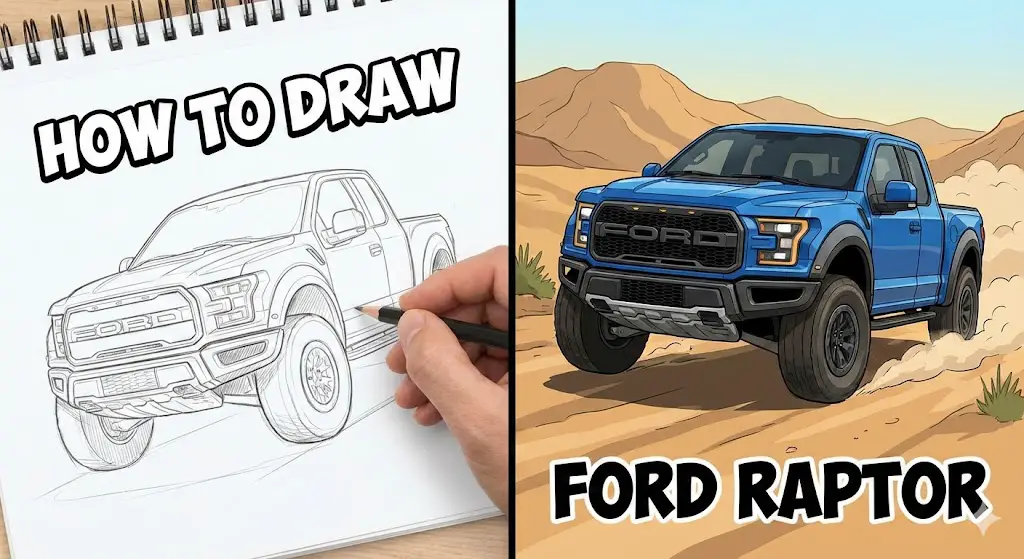
How to Draw a Ford Raptor Series – Artistic Engineering: A Professional Guide to Sketching and Rendering

The Ford Raptor has redefined the high-performance pickup segment since its inception in 2009, evolving from a specialized desert racer into a global symbol of off-road dominance. For the automotive artist or industrial designer, the challenge of rendering a Ford Raptor lies in the intersection of its extreme mechanical capabilities and its aggressive visual language. To successfully draw a Ford Raptor, whether it is the full-size F-150, the mid-size Ranger, or the monstrous Raptor R, one must understand the underlying engineering that dictates its proportions.
This report provides an exhaustive, data-driven analysis of the Raptor’s design philosophy, technical geometry, and a comprehensive step-by-step methodology for producing professional-level automotive illustrations.
FORD RAPTOR
The engineering analysis and design blueprint of the world’s first factory trophy truck.
The Baja Beast
Since its debut in 2010, the Ford F-150 Raptor has defined the high-performance off-road segment. It is not just a truck; it is a marvel of suspension engineering and wide-body design. This visual guide breaks down the data behind the performance and the geometry behind the iconic look, providing a resource for enthusiasts and artists alike.
Design Blueprint: How to Draw the Raptor
Drawing a Ford Raptor requires understanding its unique “Box within a Box” geometry. Unlike a standard F-150, the Raptor is 6 inches wider. Use this CSS-constructed guide to understand the key proportions and character lines that define its aggressive stance.
The “Wide-Stance” Grid Method
Key Rule: The fenders extend significantly beyond the headlights. The grille is a massive rectangle dominating the center third.
Establish the Wheelbase
Start with two large circles for the 37-inch tires. The Raptor sits high; ensure there is significant daylight between the top of the tire and the wheel arch.
The “Brick” Grille
Draw a wide rectangle between the headlights. Unlike other trucks, the Raptor grille integrates the “FORD” lettering directly. Add the three tiny marker lights (dots) at the very top center—a legal requirement for its width.
The Fender Bulge
The defining feature. The fenders should flare out aggressively from the headlights. When drawing the front view, the sides should slant outwards like a trapezoid.
The Power Wars
The Raptor began with a V8, switched to a high-output Twin-Turbo V6 for agility, and returned to the V8 in the “R” variant to combat the RAM TRX. This chart tracks the horsepower escalation over three generations.
- Gen 1 (2010): 6.2L V8 (411 HP) – The Original.
- Gen 2 (2017): 3.5L TT V6 (450 HP) – The Aluminum Era.
- Raptor R (2023): 5.2L SC V8 (720 HP) – The Apex.
Source: Ford Factory Specifications
Raptor vs. The World
For years, the Raptor stood alone. Now, the super-truck segment is crowded. How does the Raptor R stack up against the RAM TRX and the standard Raptor against the Chevy ZR2?
Torque is King
While Horsepower wins headlines, Torque wins off-road. The Raptor R’s supercharged V8 delivers instant low-end power, critical for dune running and rock crawling.
Weight Advantage
The Raptor’s aluminum body makes it significantly lighter than the RAM TRX, giving it a superior power-to-weight ratio despite similar horsepower figures.
Suspension Geometry
The heart of the Raptor is its suspension. Featuring Fox Live Valve shocks and a 5-link rear setup, it is designed to survive jumps that would destroy a standard pickup.
Metrics normalized for chart clarity
Approach Angle (31°/33°)
The high-clearance front bumper exposes the tires, allowing the truck to attack steep inclines without scraping.
Fox Live Valve
Internal bypass shocks adjust damping 500 times per second. They can stiffen in mid-air to prevent bottoming out upon landing.
Track Width
The 74-inch track width provides stability at high speeds in desert terrain, preventing rollovers during slides.
The Evolution of the Apex Predator: Design Philosophy and Heritage
The design of the Ford Raptor is governed by the principle of "Built Ford Tough" infused with the raw energy of desert racing. Unlike standard trucks that prioritize towing or payload in their initial styling, the Raptor's architecture begins with the suspension. The vehicle is designed to jump, catch air, and navigate high-speed desert trails with a level of composure that would disintegrate a standard pickup. This functional requirement necessitates a wider track, which is the foundational element an artist must capture.
The heritage of the Raptor began with the 2010 SVT model, which introduced the iconic "FORD" block-lettering grille. This single design element replaced the traditional blue oval and signaled a shift toward a more utilitarian, military-inspired aesthetic. Over three generations, the F-150 Raptor has shed weight through aluminum body construction—dropping nearly 500 pounds in its second generation—and refined its suspension from 2.5-inch to 3.0-inch FOX™ Live Valve shocks. The artistic implication of these changes is a shift from the "toned" look of the first generation to the "menacing and athletic" appearance of the modern era.
Comparative Evolution of the F-150 Raptor
| Generation | Production Years | Primary Engine | Key Visual Identifier |
| First (SVT) | 2010–2014 | 5.4L / 6.2L V8 | Two hood vents; SVT badging |
| Second | 2017–2020 | 3.5L Twin-Turbo V6 | Large central hood scoop; blockier grille |
| Third | 2021–Present | 3.5L V6 / 5.2L V8 | C-Clamp headlights; 5-link rear suspension |
Technical Proportions: The Geometry of Off-Road Dominance
To draw the Raptor with professional accuracy, the illustrator must adhere to the specific dimensions that give the truck its "imposing stance". The primary difference between a standard F-150 and a Raptor is width; the Raptor is approximately eight inches wider than its standard counterpart, necessitated by its reinforced suspension components and oversized 35-inch or 37-inch tires.
Dimensional Constraints for Full-Size and Mid-Size Variants
The distinction between the F-150 Raptor and the Ranger Raptor is crucial for maintaining correct scale in a composition. While the F-150 Raptor is a "brute" with massive road presence, the Ranger Raptor is designed to be "nimble and agile," ideal for tight trails where its larger sibling might struggle.
| Dimension | F-150 Raptor (Gen 3) | Ranger Raptor (2024/25) |
| Overall Length | 232.6 inches | 210.9 inches |
| Overall Width (w/o mirrors) | 86.6 inches | 79.8 inches |
| Overall Height | 79.8 - 80.6 inches | 75.9 inches |
| Wheelbase | 145.4 inches | 128.7 inches |
| Ground Clearance | 12.0 - 13.1 inches | 10.7 inches |
Understanding these dimensions allows the artist to correctly space the wheels. The 145.4-inch wheelbase of the F-150 Raptor requires a specific ratio of wheel diameter to distance between axles. In professional automotive sketching, the wheelbase is often measured in "wheel units." For the Raptor, the massive 35-inch or 37-inch tires mean that the truck typically sits about four to five tire-heights long.
To further explore the spatial requirements of these vehicles, artists may consult the Ford truck bed size chart, which provides a granular look at the 5.5-foot box standard on Raptor models.
Artistic Visualization of Approach and Departure Angles
The Raptor's capability is defined by its ability to clear obstacles without damaging the bodywork. This is achieved through aggressive approach and departure angles, which the artist must reflect by "raking" the bumpers upward. The 2024 model year further emphasizes this with a modular front bumper that exposes more of the tire tread to the environment.
| Model & Tire Size | Approach Angle | Departure Angle | Breakover Angle |
| F-150 Raptor (35" Tires) | 31.0° | 23.9° | 22.7° |
| F-150 Raptor R (37" Tires) | 33.1° | 24.9° | 24.4° |
| Ranger Raptor | 33.0° | 26.4° | 24.2° |
When sketching the front profile, the illustrator should notice that the bumper does not hang low like a traditional passenger car. Instead, it terminates high, revealing the heavy-duty aluminum skid plate that protects the engine and transmission. This visual "lift" is essential for conveying the truck's purpose-built nature.
Artistic Fundamentals: The Grid and Blocking Methods
Professional automotive sketching can be approached through two primary methodologies: the Grid Method for high-accuracy technical rendering and the Blocking Method for expressive, conceptual work.
The Grid Method: Technical Precision
The Grid Method is favored for creating realistic, "blueprint-style" illustrations. It involves creating a corresponding set of squares on both the reference image and the drawing paper to ensure every component—from the 12-inch digital cluster to the "FORD" lettering—is perfectly placed.
- Grid Construction: For an A4 or A3 composition, a grid of $15 \times 10.5$ units is standard. On A4 paper, this translates to $2 \text{ cm} \times 2 \text{ cm}$ squares.
- Point Identification: The artist identifies keypoints on the Raptor where lines intersect, such as the edge of the flared fender or the corner of the C-clamp headlight.
- Single-Stroke Sketching: To avoid "hairy" or jagged lines, the artist should measure the distance between grid points and connect them in a single, fluid stroke.
- Component Integration: Once the outline is established, internal parts like the 3.5L EcoBoost active exhaust tips or the beadlock-capable wheels are added relative to the established grid.
The Blocking Method: Conceptual Energy
Ford designer Pedro Guarinon emphasizes the "organic freedom" of sketching with pen and paper using the Blocking Method. This approach focuses on the "stance" and "soul" of the vehicle before technical details are addressed.
- The "Two-Block" Front End: Guarinon recommends dividing the Raptor's front end into two primary blocks to establish the initial width and height. This prevents the drawing from becoming too narrow—a common error in truck sketching.
- Wheel Placement: The "circles" for the wheels are drawn first along a baseline. These serve as the foundational scale for the rest of the truck.
- The Cabin and Shoulders: A "brick" shape represents the main body, with a smaller volume on top for the cabin. The "wide shoulders" of the Raptor are then sketched as sweeping lines that connect the front and rear wheel arches.
- Confidence in Line Work: Fluid lines drawn from the shoulder or elbow result in a more professional appearance than lines drawn with finger movements.
Anatomy of the Beast: Capturing Signature Raptor Features
A drawing only becomes a "Raptor" when the artist correctly renders the specialized equipment that differentiates it from a standard F-150 or Ranger.
The Grille and Lighting Signature
The "FORD" block lettering is the face of the vehicle. These letters should be rendered with significant depth to suggest they are part of a rugged, crossbar-style grille. The artist must include the three amber LED marker lights integrated into the top of the grille, which signify the vehicle's "wide load" status.3 The headlights on Gen 3 models utilize a "C-Clamp" daytime running light signature that frames the grille and emphasizes the truck's horizontal width.
The Functional Hood: Bulges and Vents
The Raptor's hood is not flat. It features a prominent "power dome" designed to manage the heat of the high-output engines.
- Standard Raptor: Features a subtle hood bulge with integrated heat extractors.
- Raptor R: Features a "giant bulge" to accommodate the supercharged V8 and specialized "R" graphics in Code Orange.
Suspension and Chassis Visibility
One of the most rewarding aspects of drawing a Raptor is the visible suspension. The 3.0-inch FOX™ Live Valve shocks on the F-150 Raptor are technical marvels that should be visible in the gaps of the wheel wells. The shocks feature electronic compression and rebound controls, which can be suggested through the inclusion of external reservoirs and electrical wiring harnesses. The artist should also depict the 5-link rear suspension with its extra-long trailing arms, which provides the truck with its massive 15 inches of rear travel.
Tires and Wheels: The Foundation of Traction
The Raptor sits on custom 35-inch or 37-inch BFGoodrich® All-Terrain T/A KO2 tires. These are described as "toothy land-eaters" designed to "grip and grab" any terrain.
- Tire Tread Rendering: The tread pattern of the KO2 tires should be rendered with interlocking, jagged blocks. In a perspective view, these treads appear to wrap around the shoulder of the tire, adding to its aggressive look.
- Sidewall Bulge: Because these are high-volume off-road tires, the sidewall should exhibit a slight "bulge" where the rubber meets the ground, suggesting the immense weight of the truck (over 5,600 lbs for the F-150).
- Beadlock-Capable Wheels: The 17-inch cast aluminum wheels often feature a beadlock-capable ring. This is a ring of bolts around the outer edge of the rim that, in a functional setting, prevents the tire from peeling off the rim at low pressures. The artist should render these bolts as small, repeating circular highlights.
Shading, Rendering, and Material Science
To bring the Raptor to life, the illustrator must master the rendering of various materials, from matte plastics to metallic paint.
Values and Highlights
Automotive surfaces are glossy and highly reflective.
- Body Paint: Use a base layer of color (e.g., Lavender Mist or Cornflower Blue) and add deep shadows in the areas where the body panels "tuck" under the chassis.
- Reflections: The "shoulder line" of the truck—the horizontal crease running from the headlights to the taillights—should catch a sharp, bright highlight to define the truck's volume.
- Glass and Transparency: The windshield and side windows should be rendered with gradients of grey. The "DLO" (Daylight Opening) area should show hints of the interior, such as the Recaro sport seats or the red centering stripe on the steering wheel.
Underbody and Ground Shadows
The Raptor's high ground clearance creates a large shadow area beneath the vehicle.
- Core Shadow: The darkest area is directly under the center of the chassis, where the skid plates and drivetrain components are located.
- Contact Patches: The shadow should be darkest where the tires touch the ground.
- Ambient Occlusion: Use light grey markers to blend the dark core shadow into the white of the paper, creating a sense of "air" under the truck.
The 2024–2025 Facelift: Capturing the Latest Design Language
The recent refresh of the F-150 Raptor introduces specific details that an artist must include to ensure their work is contemporary.
The Modular Front Bumper
The 2024 model features a "modular front bumper" designed for easy attachment of accessories like LED light bars. Visually, this bumper is more "sleek" and "refined" than previous versions. The bumper "end caps" are reduced in size on trucks equipped with 37-inch tires to expose more of the front tire tread, a detail that emphasizes the truck's off-road "attitude".
Pro Access Tailgate
The rear of the 2024 F-150 Raptor can be equipped with the "Pro Access Tailgate". This innovative design includes a central section that swings open 100 degrees, allowing access to the bed without dropping the entire tailgate. An illustrator should indicate this by drawing a vertical seam in the middle of the tailgate applique, a departure from the solid, one-piece tailgates of previous generations.
Interior Technology and Graphics
Inside the cabin, the 12-inch digital instrument cluster is now standard and features "Raptor-specific graphics" that change depending on the selected Terrain Management mode (e.g., Baja, Rock Crawl).6When drawing the interior, the artist should include the "Interior Work Surface" and the "stowable shifter" in the center console. For insights into the mechanical systems supporting these interfaces, one might review the to understand how technical placement influences cabin ergonomics.
Professional Drawing Workflow: From Sketch to Final Render
An expert-level automotive illustration follows a disciplined workflow to maintain consistency and quality.
- Reference and Research: Analyze the specific model year and tire size (35" vs 37") as this significantly impacts the "rake" and "gap" in the wheel wells.
- The Underlay: Create a light pencil or pen sketch that establishes the main design theme. This is the "skeleton" of the drawing.
- Color Blocking: Apply the lightest colors first. For a Raptor, this might be a light grey for the skid plates and a base blue for the body.
- Value Layering: Use 2 or 3 shades of the same color to create depth. Go over shadowy areas with a darker marker or apply a second layer of the same marker to increase saturation.
- Technical Detailing: Add the fine lines for the "FORD" lettering, the beadlock bolts, and the heat extractors using a fine-liner or a sharp 2B pencil.
- Final Highlights: Use a white Posca marker or white colored pencil to add sharp, "specular" highlights to the chrome exhaust tips, the LED headlights, and the tops of the fender flares.
Comparing the Raptors: Specialized Models for Artists
An illustrator must be able to distinguish between the three primary members of the Raptor family to ensure their drawings are contextually accurate.
| Feature | F-150 Raptor | F-150 Raptor R | Ranger Raptor |
| Engine | 3.5L Twin-Turbo V6 | 5.2L Supercharged V8 | 3.0L Twin-Turbo V6 |
| Horsepower | 450 hp - 456 hp | 700 hp - 720 hp | 392 hp - 405 hp |
| Tires (Standard) | 35-inch BFGoodrich | 37-inch BFGoodrich | 33-inch BFGoodrich |
| Rear Suspension | 5-Link Coil / Panhard | Retuned 5-Link Coil | Watt's Linkage |
| Best For Drawing | High-speed desert runs | Extreme brute force | Nimble trail work |
The artist should note that while the F-150 Raptor R has "more texture" on the tailgate and a "giant bulge" on the hood, it shares the same 145.4-inch wheelbase as the standard Raptor. In contrast, the Ranger Raptor is nearly 2 feet shorter in length and has a shorter wheelbase of 128.7 inches, giving it a much more compact, "squat" appearance in profile.
Critical Questions for the Automotive Illustrator
When approaching a Raptor drawing, certain technical questions often arise. Addressing these ensures the final piece is grounded in automotive reality.
How does the suspension affect the drawing of the wheel wells?
The Raptor features "long-travel suspension" with up to 15 inches of travel. This means the "gap" between the top of the tire and the fender flare is much larger than on a standard pickup. In an "action" drawing, if the truck is jumping, the suspension will be fully "unloaded," making the wheel gap even more extreme. Conversely, if the truck is landing, the suspension will be "compressed," and the tire might be tucked deep into the flared fender.
What are the "Easter Eggs" of the Raptor design?
Designers often include hidden details. For the Raptor, these include the American flag graphics on the Raptor R, the "R" badging in Code Orange, and the specific digital graphics in the instrument cluster that change with each of the seven Terrain Management modes. Including these small details can elevate a drawing from a "sketch" to a professional "study."
How do I render the BFGoodrich® All-Terrain tires realistically?
The tires are a key part of the Raptor's identity. They have "row after row of biting teeth". Focus on the "interlocking" nature of the tread blocks and the way the "sidewall lugs" provide a textured, rugged look to the tire's profile. Use a dark grey marker for the rubber and save pure black for the deepest recesses of the tread.
Why is the "FORD" grille so important?
The "FORD" block-lettering grille is a "hallmark of the Raptor design language". It not only boosts the truck's "rugged character" but also identifies it instantly to enthusiasts. The letters should be drawn as large, bold, and integrated into the horizontal bars of the grille.
FAQs for Mastering the Ford Raptor Sketch
What are the primary differences between drawing a Gen 2 and Gen 3 Raptor?
The Gen 2 (2017–2020) features a more "futuristic" look with a large central hood scoop and recessed headlights. The Gen 3 (2021+) introduces the "C-Clamp" LED headlight signature and a 5-link rear suspension that is much more visible from the rear view.
How do I draw the Raptor R's unique hood bulge?
The Raptor R features a "giant bulge" compared to the "subtle" bulge on the standard V6 Raptor. This bulge is necessary to clear the 5.2-liter supercharged V8 engine. It should be drawn as a prominent, raised volume on the hood with sharp, "muscular" contours.
What color markers should I use for a realistic Raptor drawing?
For the body, colors like "Performance Blue" or "Code Orange" are iconic. For the mechanical parts, you will need several shades of Neutral Grey (NG03, NG06, NG07) and Cool Grey (CG030, CG070) to render the skid plates, tires, and suspension components.
How do I get the "stance" of the Raptor right?
The "stance" is the way the truck carries itself. Guarinon suggests focusing on the "placement of wheels" and the "wide shoulders". Ensure the wheels are "pushed out" to the corners of the body and that the track is significantly wider than the cabin.
What is the "Trail Control" system and does it affect the drawing?
Trail Control is "cruise control for going off-road". While it is a software feature, you can imply it in an illustration by drawing the truck navigating a technical "Rock Crawl" section with the wheels articulated and the driver focused solely on steering.
How do I render the "toothy" tires of the Raptor?
The 35-inch and 37-inch BFGoodrich tires are a defining feature. Use a "stippling" or "cross-hatching" technique to suggest the rough, high-grip texture of the tread blocks and the aggressive sidewall design.
Is there a specific way to draw the Raptor's interior?
The interior is "feature-rich" and "upscale". Focus on the 12-inch digital productivity screen, the "stowable shifter," and the "Recaro sport seats" with specialized Raptor bolsters.
Conclusion: Synthesizing the Raptor’s Identity
The Ford Raptor is more than a vehicle; it is a "symbol of off-road capability and performance". For the automotive artist, capturing this identity requires a meticulous balance of technical accuracy and expressive energy. By adhering to the dimensional data—such as the 145.4-inch wheelbase and the 13.1-inch ground clearance of the Raptor R—the artist ensures the "stance" is correct. By rendering signature elements like the "FORD" block-lettering grille and the "toothy" BFGoodrich tires, the artist captures the "soul" of the machine.
Whether using the high-precision Grid Method or the fluid Blocking Method advocated by Ford designers, the goal is to communicate the Raptor's purpose: to "speed over rough terrain" and "conquer the desert". As the Raptor continues to evolve with the 2024–2025 facelift and the addition of the supercharged "monster" Raptor R, the illustrator has an ever-expanding canvas of technical and aesthetic details to explore. Through careful observation of lighting, material textures, and the aggressive geometry of high-performance suspension, the artist can produce a rendering that is truly "Built Ford Tough".