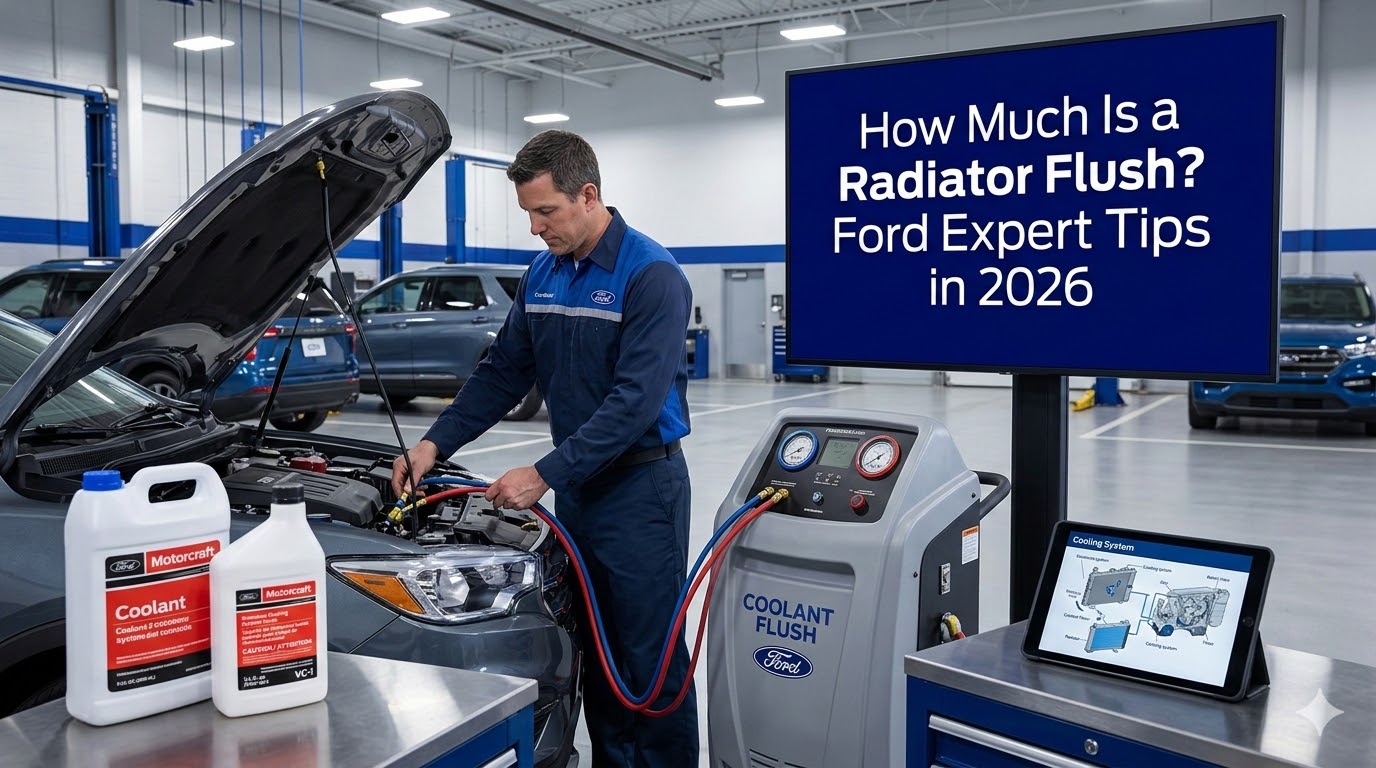
How Much Is a Radiator Flush? 2026 Cost Guide & Ford Expert Tips

The financial requirements of automotive cooling system maintenance depend heavily on the distinct levels of service available in the automotive repair market. For vehicle owners, particularly those managing the specialized requirements of modern Ford engines, understanding the baseline costs and the mechanical realities of a radiator flush is critical for preventing catastrophic engine failure.
The average cost of a radiator flush in 2026 varies significantly based on the chosen service provider, geographic location, and the specific mechanical requirements of the vehicle. Industry data indicates that a basic gravity drain-and-fill service typically ranges from $80 to $150, whereas a comprehensive professional machine flush averages between $120 and $250. However, premium or luxury models, as well as heavily rusted systems requiring multiple chemical cleaning cycles, can push dealership costs considerably higher.
Broad market assessments by institutions like(https://www.kbb.com/coolant-flush/) place the standard radiator flush between $131 and $209. Conversely, more exhaustive services that involve pressurized chemical treatments, system diagnostics, and replacement of peripheral components can escalate costs to between $419 and $487, with labor accounting for $147 to $216 of that total.
Dealership pricing, particularly within the Ford network, exhibits high consistency. Service menus from various authorized Ford service centers quote a standard coolant flush at exactly $199.99. Some specialized services or heavy-duty trucks may incur additional fees for antifreeze beyond standard capacities, typically billed at around $17.95 per gallon.
| Service Category | Estimated Cost Range | Risk and Benefit Profile |
| Do-It-Yourself (DIY) | $7 – $80 | High risk of air pockets; requires manual disposal of hazardous fluids; cheapest upfront cost. |
| Independent Mechanic | $120 – $250 | Moderate cost; professional diagnostic tools reduce air pocket risks; includes fluid disposal. |
| Dealership Service | $199.95 – $260+ | Premium cost; guarantees OEM-spec fluid (e.g., Motorcraft); utilizes proprietary vacuum fill tools. |
Several underlying variables dictate where a specific vehicle will fall within these pricing spectrums. Fluid capacity plays a major role; larger vehicles, such as the Ford F-150 or Super Duty trucks equipped with the 6.7L Power Stroke diesel, possess massive cooling capacities requiring significantly more fluid than a standard sedan. If a vehicle has been neglected, rust and scale build-up will necessitate chemical cleaners and multiple flush cycles to clear debris, increasing both labor and material costs. Furthermore, ancillary repairs often compound the base price. A flush routinely reveals the need to replace compromised components such as the thermostat, radiator hoses, or the pressure cap. Replacing a thermostat concurrently is highly recommended by experts, as these inexpensive parts are frequent failure points. You can cross-reference expected regional labor rates using the to gauge fair pricing in your specific ZIP code.
FordMasterX Exclusive Report
How Much Is a Radiator Flush?
A comprehensive data breakdown of coolant replacement costs, DIY savings, and why skipping this $100 service could cost you thousands in engine repairs.
The Bottom Line: Average Costs in 2026
Understanding the baseline cost of a radiator flush is crucial for vehicle maintenance budgeting. Whether you take your Ford F-150 to a dealership or tackle your Civic in the driveway, here is the immediate financial expectation.
Professional Shop
$100 – $150
Includes labor, disposal, and chemical flush.
DIY At Home
$30 – $50
Cost of premium coolant and flush solution only.
Where Your Money Goes
When paying a mechanic $135 for a coolant flush, you are primarily paying for their time and proper ecological disposal of the toxic ethylene glycol. Here is the exact breakdown of a standard professional invoice.
Average Cost by Vehicle Class
Not all radiators are created equal. A heavy-duty truck like a Ford F-250 holds significantly more coolant (often up to 7 gallons) compared to a compact car’s 1.5 gallons, directly impacting fluid and labor costs.
The Danger of Delay: Coolant Degradation
Coolant doesn’t just prevent freezing; it contains vital anti-corrosion inhibitors that protect your water pump and engine block. As miles accumulate, these chemicals break down. By 50,000 miles, untreated fluid becomes highly acidic and loses its ability to protect the cooling system.
4 Undeniable Signs You Need a Flush Today
Rising Temp Gauge
If your dashboard temperature needle regularly creeps past the halfway mark, your fluid has lost its thermal efficiency.
Rusty or Brown Fluid
Fresh coolant is neon green, orange, or pink. If it looks like muddy brown water, internal rust is already occurring.
Sweet Maple Smell
A syrupy, sweet odor coming from the engine bay or vents usually indicates a minor coolant leak burning off the hot engine.
Poor Cabin Heat
Your car’s heater core relies on hot engine coolant. If the heater blows cold air, a clogged cooling system is likely the culprit.
Should You DIY or Hire a Pro?
| Factor | DIY Flush | Professional Shop |
|---|---|---|
| Total Cost | $30 – $50 | $100 – $150 |
| Time Investment | 1 to 2 Hours | 30 to 45 Minutes (Waiting) |
| Equipment Needed | Drain pan, distilled water, basic hand tools | None (Shop uses pressurized exchange machines) |
| Fluid Disposal | Must transport toxic fluid to recycling center | Handled completely by the facility |
Expert Advice: If you own a modern vehicle with a complex cooling system that requires special “burping” procedures to remove air pockets, a professional pressurized flush is highly recommended to prevent immediate overheating.
Technical Distinction: Radiator Flush vs. Coolant Drain and Fill
A pervasive point of confusion among vehicle owners is the mechanical difference between a simple coolant drain and a pressurized system flush. These are fundamentally different procedures yielding distinctly different results.
The traditional drain-and-fill method relies entirely on gravity. A technician opens the petcock valve at the bottom of the radiator, allowing the fluid to drain out, and then tops off the system with fresh coolant. The primary limitation of this method is that it only clears 40% to 50% of the total fluid volume. The remaining old coolant stays trapped within the engine block’s water jackets, the heater core, and the lower radiator hoses. This procedure dilutes the new fluid with degraded coolant, accelerating the breakdown of fresh corrosion inhibitors. A drain-and-fill is generally only adequate for newer vehicles undergoing strict routine maintenance where the existing fluid is still chemically viable.
Conversely, a true coolant flush requires specialized machinery. The vehicle’s cooling system is connected to a flush machine that forces cleaning chemicals and fresh water through the entire system under high pressure. This methodology ensures a 100% fluid exchange. The pressurized flow blasts away accumulated rust, silicate dropout, scale, and contaminants that gravity draining leaves behind. Flushing restores thermal efficiency, prevents debris from clogging the narrow passages of the heater core, and extends the life of the water pump by removing abrasive particulates.
Symptoms Indicating an Immediate Coolant Flush
Delaying cooling system maintenance leads to cascading mechanical failures. Recognizing the early warning signs of coolant degradation can prevent catastrophic engine damage. Visual and olfactory warning signs are often the first indicators of a compromised system. Healthy coolant is translucent and brightly colored, typically yellow, orange, pink, or green. If the fluid turns brown, muddy, or exhibits floating rust particles, the corrosion inhibitors have failed, and the engine block is actively rusting from the inside out. Additionally, ethylene glycol has a distinctly sweet, syrupy smell. Detecting this odor inside the cabin usually points to a leaking heater core, while smelling it near the grille indicates a radiator or hose weeping under pressure. Visible drops of brightly colored fluid beneath the vehicle indicate a breach in the system’s integrity, necessitating an immediate pressure test and flush.
Performance deterioration provides further evidence of fluid breakdown. If the dashboard temperature gauge creeps higher than its normal center position or the digital readout flashes a warning, the fluid’s thermal transfer capability has been compromised, or the system lacks adequate volume. Another critical symptom is poor heater performance. The vehicle’s cabin heater relies on hot coolant circulating through a small heat exchanger called the heater core. Because the internal tubes of the heater core are exceptionally narrow, they are the first components to clog when rust or scale forms in neglected coolant. If a Ford F-150 or Explorer begins blowing cold air when the heater is engaged, it is highly probable that the heater core is restricted and requires a high-pressure back-flush or outright replacement.
Ford-Specific Cooling System Dynamics: The Motorcraft Evolution
For Ford operators, maintaining the cooling system requires strict adherence to proprietary chemical specifications and procedural guidelines. Ford engineering has undergone significant transitions in coolant chemistry over the last decade, making correct fluid identification paramount. Automotive coolant is not a universal fluid; utilizing the incorrect chemical formulation will trigger rapid galvanic corrosion, destroying aluminum water pumps, radiators, and cylinder heads.
Historically, Ford utilized Motorcraft Premium Gold, a Hybrid Organic Acid Technology (HOAT), and later transitioned heavily to Motorcraft Orange Antifreeze/Coolant, an Organic Acid Technology (OAT) meeting specifications WSS-M97B44-D and WSS-M97B44-D2. However, Ford has officially phased out the Orange coolant in favor of a superior formulation: Motorcraft Yellow Antifreeze/Coolant.
Motorcraft Yellow is a Phosphate Organic Acid Technology (P-OAT) fluid meeting specifications WSS-M97B57-A1 and WSS-M97B57-A2. The new Yellow formulation offers enhanced, immediate corrosion protection and drastically improved resistance to the deposits created by mixed-metal chemical reactions within modern aluminum engine blocks. According to official Ford Technical Service Bulletins, Motorcraft Yellow is fully backward compatible with vehicles factory-filled with Orange coolant.
| Coolant Technology | Motorcraft Branding | Specification Number | Expected Lifespan | Chemical Composition |
| OAT | Motorcraft Orange | WSS-M97B44-D / D2 | 5 Years / 150,000 Miles | Organic Acids |
| HOAT | Motorcraft Gold | WSS-M97B51-A1 | 5 Years / 100,000 Miles | Organic Acids + Silicates |
| P-OAT | Motorcraft Yellow | WSS-M97B57-A1 / A2 | 10 Years / 200,000 Miles | Organic Acids + Phosphates |
When transitioning between these fluids, specific guidelines must be followed. Yellow coolant can be used to directly top-off a system containing Orange coolant without causing chemical gelling or precipitation. If the cooling system is not visibly contaminated, flushing is not strictly required when transitioning an Orange system entirely over to Yellow. However, if a vehicle originally filled with Orange coolant is topped off or refilled with Yellow, the vehicle must still adhere to the original, shorter maintenance schedule dictated in the owner’s manual for the Orange fluid. To achieve the extended 10-year or 200,000-mile lifespan of the Yellow coolant, the system must be thoroughly flushed of all old fluid.
Ford Maintenance Schedules and Diesel Requirements
Ford’s recommended maintenance schedules differ significantly based on the engine type and the specific factory-fill coolant color. For standard gasoline engines, Ford mandates a coolant change at 100,000 miles for vehicles equipped with Orange coolant, followed by subsequent changes every 3 years or 45,000 miles. Vehicles factory-filled with the newer Yellow coolant require their initial change at 200,000 miles, with subsequent changes every 5 years or 100,000 miles.
Diesel engines, such as the 6.7L Power Stroke, operate under immense thermal load and require more rigorous oversight, particularly regarding cavitation protection for cylinder liners. Ford requires inspecting the primary and secondary cooling systems at every oil change interval. At 30,000 miles, technicians must test the additive corrosion inhibitor strength using the Rotunda 328-R071-ELC test kit. If utilizing Orange coolant, the Motorcraft Specialty Orange Engine Coolant Revitalizer (VC-12) must be added if the test indicates depletion. When adding VC-12 to a diesel system, technicians must never exceed 50 fluid ounces for the primary engine system and 20 fluid ounces for the secondary cooling system; overdosing the system causes severe, permanent engine damage due to silicate dropout and overheating.
The Critical Importance of Vacuum Filling
Modern Ford engines, particularly the convoluted coolant routing found in the 2.7L EcoBoost, 3.5L EcoBoost, and 5.0L Coyote V8, are incredibly susceptible to trapped air pockets during a coolant refill. Attempting to refill these systems using a traditional gravity funnel often traps air inside the engine block or the heater core.
An air pocket passing through the water pump causes cavitation—the fluid boils instantly due to extreme pressure drops, creating micro-explosions that physically pit and destroy the water pump impeller. Furthermore, air pockets prevent localized cooling, leading to warped cylinder heads and blown head gaskets.
To mitigate this catastrophic risk, professional technicians employ a Vacuum Coolant Refiller. This tool uses a Venturi valve connected to an air compressor to pull a deep vacuum on the entire cooling system, collapsing the radiator hoses flat. Once the vacuum is achieved and holds steady, proving there are no leaks in the system, a valve is opened. The vacuum then siphons the pre-mixed coolant from a reservoir directly into every cavity of the engine block simultaneously, entirely eliminating the possibility of air pockets.
Navigating Service Center Scams and Best Practices
While regular maintenance is vital, the automotive repair industry is occasionally plagued by predatory upselling tactics. Institutions like the American Automobile Association (AAA) heavily advise consulting the owner’s manual before authorizing any fluid flush to verify the factory-recommended intervals.
A common tactic at quick-lube chains is the unnecessary fluid flush scam. Technicians may dip a chemical test strip into the coolant reservoir and claim the fluid is overly acidic, recommending an immediate high-cost flush, even if the vehicle has only traversed a fraction of its rated fluid lifespan. If the vehicle manufacturer dictates a standard drain and fill at a specific interval, a high-pressure chemical flush is an unnecessary expense unless the system is demonstrably clogged or contaminated with rust.
Furthermore, when a flush is genuinely required, rushed mechanics may commit critical procedural errors. A frequent mistake is failing to remove the thermostat. The thermostat is a temperature-controlled valve that remains closed when the engine is cold. If a mechanic hooks up a flush machine to a cold engine without physically removing this valve, the pressurized chemicals will hit a dead end, bypassing the engine block entirely and only flushing the radiator. Another egregious error is using a suction tool to empty only the plastic overflow reservoir and refilling it with fresh fluid, leaving the vast majority of the degraded coolant untouched inside the engine. A proper flush procedure must also include activating the vehicle’s cabin heater to full blast, which opens the heater control valve and ensures the flush chemicals circulate through the heater core to clear out accumulated sludge.
FAQs
Can I mix orange and yellow Motorcraft coolant?
Yes. According to official Ford engineering directives, Motorcraft Yellow (P-OAT) is entirely backward compatible with Motorcraft Orange (OAT). You can top off an orange system with yellow coolant without causing chemical precipitation or gelling. However, to achieve the extended 200,000-mile lifespan of the Yellow coolant, the system must be completely flushed of the older Orange fluid.
Why does my Ford F-150 heater blow cold air?
The most common cause of a Ford heater blowing cold air is a clogged heater core. Because the internal passageways of the core are extremely narrow, rust and sediment from degraded coolant will easily block fluid flow. Other potential causes include low coolant levels, a failed thermostat stuck in the open position, or a failing water pump impeller that cannot generate enough flow.
How long does a coolant flush take?
A basic gravity drain-and-fill takes approximately 30 to 45 minutes. A comprehensive machine flush, which requires connecting specialized equipment, bringing the engine to operating temperature to cycle the thermostat, and purging the system of air using a vacuum tool, typically takes 1.5 to 2 hours.
What happens if I use tap water instead of distilled water?
Using tap water introduces dissolved minerals, such as calcium and magnesium, into the cooling system. Under the extreme heat of the engine block, these minerals separate from the water and bake onto the internal metal surfaces of the engine and radiator as scale. This scale acts as a thermal insulator, preventing heat transfer and ultimately causing the engine to overheat and fail. Coolant must always be mixed with distilled water.