Ford Ka Headlight Bulb Replacement: Technical Maintenance And Bulb Specification Guide

Maintaining optimal visibility is the single most critical factor for nighttime driving safety in your Ford Ka. Whether you are navigating narrow city streets or unlit rural roads, the integrity of your vehicle’s lighting system dictates your reaction time and overall road awareness. A failed headlight bulb not only compromises your field of vision but also risks a police citation and an immediate MOT failure, potentially sidelining your vehicle when you need it most. This comprehensive guide provides a professional, step-by-step technical breakdown for replacing Ford Ka headlight bulbs across all generations. By following these expert-verified procedures, you ensure a reliable, high-quality result that restores your vehicle to factory lighting specifications and maintains maximum road safety.
Identifying Specifications for a Ford Ka Headlight Bulb Replacement
📤 Share Image
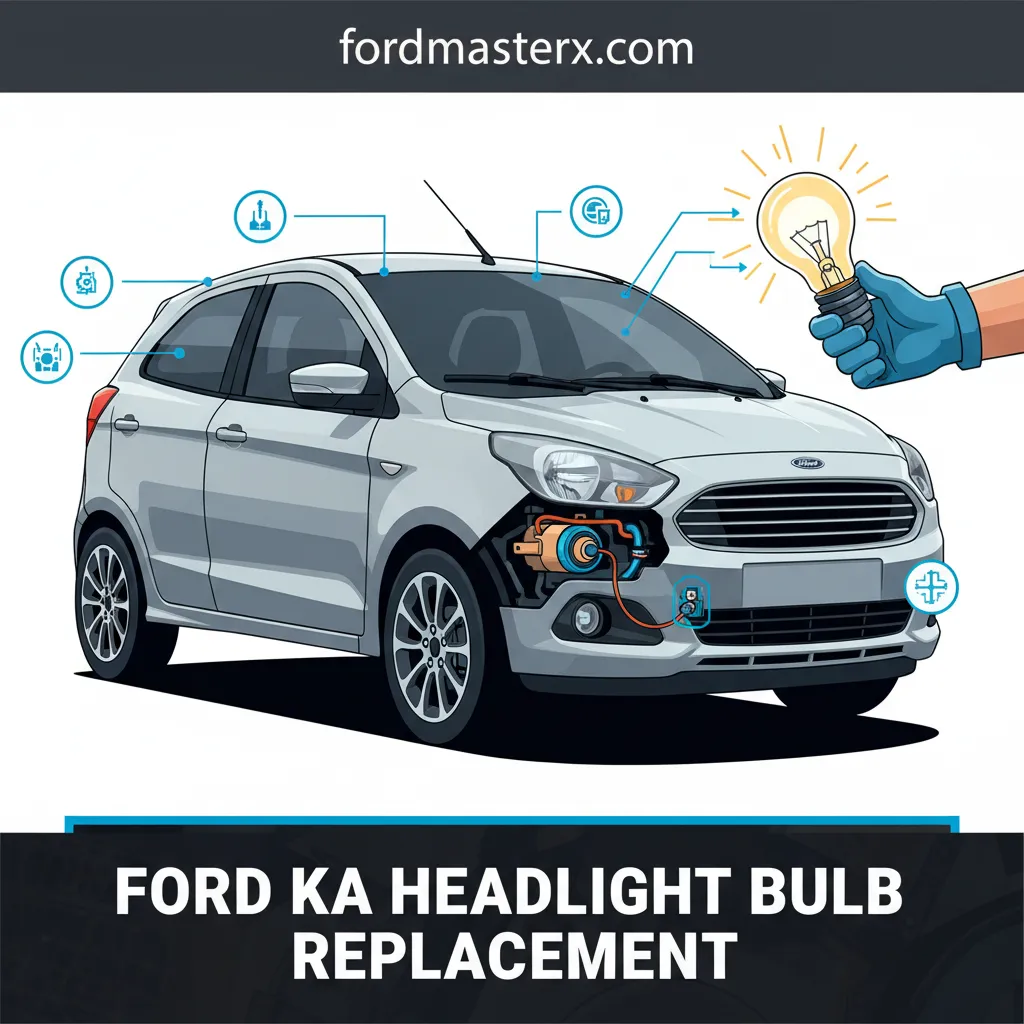
The Ford Ka has evolved significantly over three decades, and with that evolution came fundamental changes in lighting architecture. To ensure a reliable installation, you must first identify which generation of the Ka you are servicing. The Mk1 (1996–2008) utilizes a classic H4 bulb, a dual-filament design that manages both dipped and main beams within a single glass envelope. In contrast, the Mk2 (2008–2016), developed in partnership with Fiat, moved to a split system: an H7 bulb for dipped beams and an H1 bulb for main beams. The most recent Ka+ (2016–present) typically utilizes H7 or the more modern H19 bulb, depending on the specific trim level and region.
Standard automotive halogen bulbs for the Ford Ka are strictly rated at 55W. Professional technicians strongly advise against using “high-wattage” or off-road bulbs (such as 100W variants), as these generate excessive thermal energy that can melt the plastic polycarbonate lens housing or degrade the wiring loom’s insulation. Furthermore, always prioritize ECE-certified bulbs from trusted manufacturers like Osram or Philips. These components provide a consistent luminous flux—approximately 1500 lumens for a standard H7 bulb at 13.2V—ensuring that the light is projected exactly where the optics intended.
A common pitfall involves Mk2 owners purchasing H4 bulbs (standard for Mk1). The H4’s three-prong connector is physically incompatible with the H7’s single-pin socket. Attempting to force a fit will damage the bulb holder and require a costly harness repair.

Essential Tools and Safety Protocols for Professional Bulb Installation
In a comprehensive maintenance routine, preparation is as vital as the execution. The modern Ford Ka, particularly the Mk2 and Ka+ models, features a compact engine bay where lighting components are tightly packaged. To perform a professional replacement, you must gather precision tools to avoid stripping fasteners or damaging the fragile plastic components of the headlight cluster.
Required Tools
10mm socket wrench, T30 Torx driver, and a plastic trim removal tool. A magnetic tray is essential for managing the small fasteners in the Ka’s cramped engine bay.
Nitrile Gloves
Powder-free nitrile gloves prevent skin oils from contacting the halogen quartz glass. Oils create “hot spots” that lead to premature failure or glass explosion.
Safety is paramount. Halogen bulbs can reach operating temperatures exceeding 250 degrees Celsius (482 degrees Fahrenheit) within seconds of activation. Before beginning, ensure the ignition is completely off and the light switch is in the ‘O’ position. This prevents electrical arcing when disconnecting the high-current wiring harness and protects the vehicle’s Body Control Module (BCM) from voltage spikes. If a bulb has recently failed during use, allow at least 10 minutes of cooling time before attempting removal.
Technicians often see failed bulbs with a distinct “bubbling” or darkening of the glass. This is the hallmark of finger-oil contamination. If you accidentally touch the glass, clean it immediately with a microfiber cloth dipped in isopropyl alcohol to restore its high-quality surface integrity.

Removing the Ford Ka Headlight Assembly for Access
One of the most significant hurdles for the Ford Ka owner is the lack of physical space behind the headlight housing. In the Mk2 Ka, the engine bay clearance behind the light unit is often less than 50mm, making in-situ bulb replacement nearly impossible for adult hands. Consequently, the manufacturer-recommended method involves the partial or total removal of the headlight cluster itself.
📋
Assembly Removal Procedure
On the Mk2 Ka, locate and remove the two 10mm bolts securing the top of the headlight unit. Note that one bolt is visible, while the other may be slightly recessed near the fender line.
Reach behind the unit to release the plastic retaining clip. This serves as a secondary stabilizer for the housing within the chassis frame.
Carefully pull the headlight unit forward. Use a “slide and tilt” motion to clear the bumper fascia. Pro tip: Use a plastic trim tool to gently pry if the lower locating lugs are stuck, avoiding paint scratches.
Once the unit is free from its mounting points, do not let it hang by the wiring. Disconnect the multi-pin electrical connector by firmly depressing the locking tab and pulling the plug—not the wires. Position the entire assembly on a soft surface, such as a fender cover or a clean towel, to perform the bulb swap. This protects the polycarbonate lens from abrasions, which can scatter light and reduce overall beam quality.
Technical Steps for Installing the New Halogen Bulb
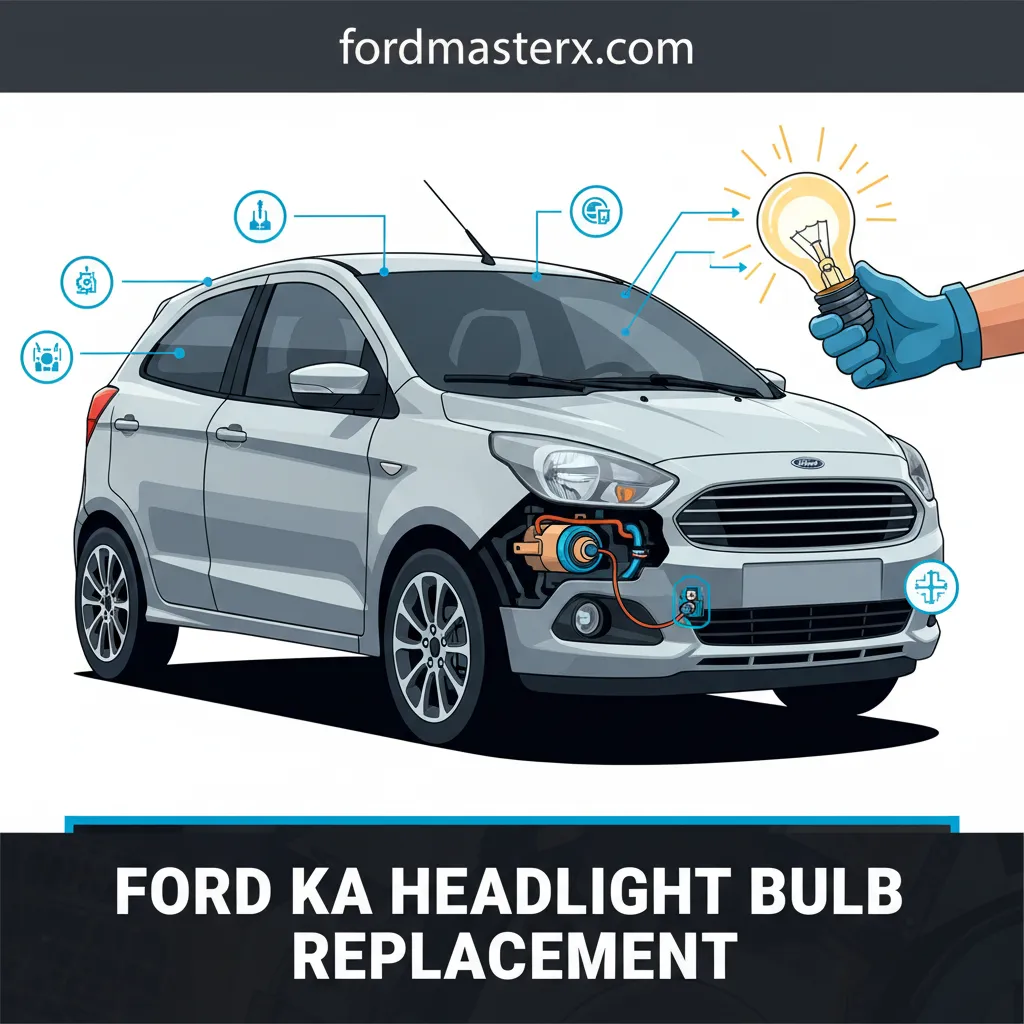
With the headlight assembly on your workbench, you now have clear access to the rear seals. Modern headlights use rubber ingress protection (IP) caps to prevent moisture and road debris from entering the optical chamber. Remove this cap carefully to reveal the internal bulb retaining mechanism. In most Ford Ka models, this is a spring-loaded metal wire clip.
To release the bulb, push the metal wire inward and upward to unhook it from its locking tab. Swivel the wire aside and withdraw the spent bulb. It is expert practice to observe the orientation of the bulb as it comes out; the metal base plate features a “keyway” (a small tab) that must align with a corresponding notch in the reflector housing. This alignment is not optional; a bulb that is misaligned by even 1mm can result in a 70% reduction in effective road illumination and a significant increase in glare for oncoming drivers.
Bulb Seating Checklist
- Verify the metal tab of the bulb is seated flush against the housing reflector.
- Ensure no part of the wiring harness is pinched under the retaining clip.
- Check that the electrical pins are straight and clean before reconnecting.
- Firmly press the rubber dust cover back into place until it “clicks” or seats fully to prevent future condensation.
Once the new bulb is secured, perform a “dry fit” of the connector while the unit is still on the workbench to ensure the connection is solid. This complete attention to detail prevents having to remove the assembly a second time due to a loose contact or a poorly seated gasket.
Final Testing and Beam Alignment Verification
After the bulb is installed and the IP cap is replaced, reinstall the headlight unit into the chassis. Hand-start all bolts to ensure they are not cross-threaded before tightening them to the expert-recommended torque of approximately 5-7 Nm. Overtightening can crack the plastic mounting ears of the headlight unit, leading to vibration and eventually, premature bulb failure.
By The Numbers
Avg. Halogen Lifespan
Lumen Drop Before Failure
Standard Alignment Distance
Before taking the vehicle on the road, conduct a static test. Cycle through the sidelights, dipped beams, and main beams to verify continuity. Furthermore, professional standards dictate that you should replace bulbs in pairs. Halogen bulbs typically lose 20-30% of their brightness over 500 hours of use. If you replace only one side, you will have an uneven beam pattern and a significant discrepancy in color temperature, which can be distracting and less effective for hazard detection.
Finally, conduct a basic beam alignment check. Park the Ka on level ground exactly 25 feet from a flat wall or garage door. The horizontal cutoff of the new H7 bulb should be approximately 2 inches below the center height of the headlight lens itself. The ‘kick-up’ or ‘elbow’ of the beam must be on the nearside (the left in RHD markets like the UK) to illuminate the curb and road signs without blinding oncoming traffic. If the beam is significantly off, use the vertical adjustment screws located on top of the headlight housing to fine-tune the aim.
✅ Why Replace in Pairs?
- Ensures uniform light output
- Prevents “one-eyed” driving soon after repair
- Maintains aesthetic consistency
- Guarantees symmetrical safety margins
❌ Common Installation Risks
- Cross-threading housing bolts
- Touching glass with bare skin
- Incomplete IP cap sealing
- Incorrect bulb seating (Glare)
In summary, a Ford Ka headlight bulb replacement is a technical task that rewards precision and the right choice of components. Identifying the correct bulb type (H4 for Mk1, H7 for Mk2), utilizing professional tools like a T30 Torx, and adhering to strict handling protocols ensures that your vehicle remains safe, legal, and efficient. Professional handling—specifically avoiding touching the glass—is the most reliable way to prevent premature bulb failure and maintain trusted lighting performance. For the most consistent results, always consult your owner’s manual for specific torque settings and remember that replacing bulbs in pairs is the industry standard for optimal nighttime visibility. By taking these expert steps, you ensure your Ford Ka continues to provide a clear and safe path forward.
Frequently Asked Questions
Can I upgrade my Ford Ka to LED headlight bulbs?
While LED upgrades offer a modern aesthetic, installing LED bulbs into a housing designed for halogens can be legally complex in many regions due to beam pattern regulations. For a professional result, it is better to use high-performance ‘white-light’ halogen bulbs which provide improved visibility while remaining fully road-legal and compatible with the Ford Ka’s existing electrical architecture.
Why does my Ford Ka keep blowing headlight bulbs frequently?
Frequent bulb failure is often caused by either poor-quality bulbs or moisture ingress within the headlight unit. Additionally, check for a faulty voltage regulator or high resistance in the wiring harness. Ensuring you use trusted, professional-grade bulbs and that the rubber dust caps are securely sealed will significantly increase the reliable lifespan of your lighting system.
Do I really need to remove the whole headlight on a Ford Ka Mk2?
Yes, for the Ford Ka Mk2 (2008-2016), the engine bay is too compact to access the bulb covers directly. A professional approach involves removing the two upper bolts and sliding the unit forward. This provides the necessary clearance to ensure the new bulb is seated perfectly without damaging the delicate filament or the internal reflector housing.
What is the difference between H7 and H1 bulbs in the Ford Ka?
In the Ford Ka Mk2, the H7 bulb is dedicated to the ‘dipped’ or low beam, while the H1 bulb is used for the ‘main’ or high beam. These bulbs have different base shapes and connectors. Always verify which function has failed before purchasing, though most expert technicians recommend keeping one of each as a spare in your vehicle’s emergency kit.
How do I clean the headlight lens if it’s cloudy while changing the bulb?
If the polycarbonate lens has oxidized, it will reduce the luminous efficacy of your new high-quality bulb. Use a professional headlight restoration kit to sand and polish the surface, followed by a UV-resistant sealant. This ensures that the increased light output from your new bulb is not scattered or absorbed by a hazy lens.