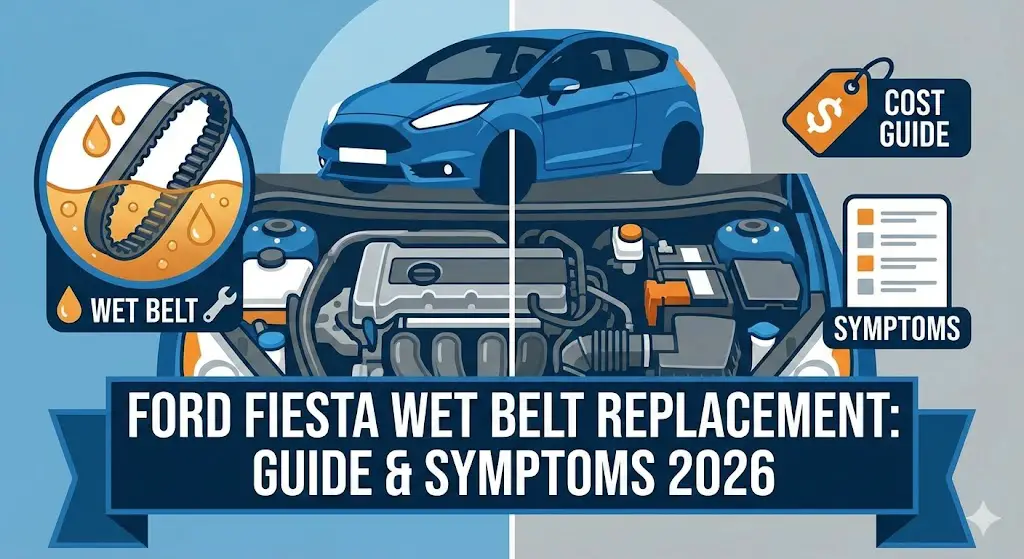
Ford Fiesta Wet Belt Replacement Cost: 2026 Complete Guide

The 1.0-litre EcoBoost engine has long been a celebrated powertrain in the Ford lineup, offering a remarkable blend of fuel efficiency, low emissions, and turbocharged performance. However, for owners of the Ford Fiesta and related models, the innovative “wet belt” timing system has evolved into a significant maintenance concern. Unlike traditional dry timing belts or robust metal timing chains, the wet belt operates completely submerged in engine oil. While engineered to reduce internal friction and improve fuel economy by approximately 2.5 percent, this design is highly susceptible to chemical degradation over time.
When the wet belt degrades, it does not simply snap; it sheds fibrous rubber debris into the oil sump, clogging vital lubrication pathways and frequently resulting in catastrophic engine failure. This comprehensive report synthesizes the latest market data, specialist mechanic insights, and official manufacturer updates to provide a definitive guide on the Ford Fiesta wet belt replacement cost, failing symptoms, maintenance intervals, and the ongoing UK recall landscape.
Ford Fiesta Wet Belt Replacement Cost Breakdown
Replacing the wet timing belt on a 1.0L EcoBoost engine is widely considered one of the most labor-intensive routine maintenance tasks in the modern automotive sector. The complexity of the job drives the price significantly higher than traditional dry timing belt replacements, which typically cost around £350.
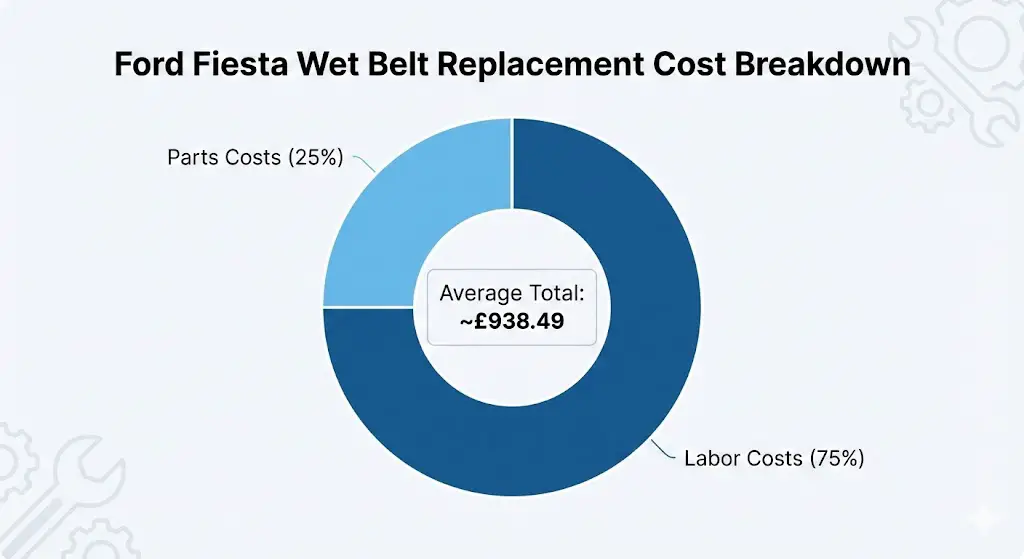
The discrepancy in pricing is stark when comparing independent specialists to main dealership networks. Data aggregated from independent UK service networks indicates that the average price of a Ford Fiesta wet belt replacement is £938.49, heavily driven by labor rather than the physical parts.
| Service Provider Type | Estimated Parts Cost | Estimated Labor Cost | Total Estimated Range |
| Independent Specialist | £300 – £450 | £500 – £850 | £800 – £1,300 |
| Ford Main Dealership | £400 – £600 | £1,600 – £1,767 | £2,000 – £2,367 |
Cost data synthesized from UK market averages and owner reports.
Visual Plan: Parts vs. Labor Cost Breakdown
Chart Type: Donut Chart.
Data to plot: Labor Costs (75%), Parts Costs (25%).
Caption: “While a complete Genuine Ford wet belt kit costs roughly £375–£450, the requirement for 10-12 hours of specialized mechanic labor constitutes the vast majority of the replacement bill.”
The labor intensity is due to the engine’s compact architecture and the belt’s location inside the engine block. Mechanics must remove the starter motor, alternator, auxiliary belts, engine mounts, and the entire oil pan (sump) just to access the timing cover and oil pump. The front timing cover must then be removed, requiring specialized locking tools to hold the camshafts and crankshaft in perfect synchronization. A complete OE replacement kit includes the camshaft wet belt, the oil pump drive belt, a new water pump, tensioners, crankshaft seals, friction washers, and specific sealant. Once reassembled, the engine requires a complete flush and refill with highly specific Ford WSS-M2C948-B 5W-20 engine oil.
The EcoBoost Wet Belt Crisis
Analyzing the hidden costs, failure risks, and critical maintenance intervals of the Ford 1.0L EcoBoost engine.
The Cost of Ownership
Replacing the wet belt is a significant financial event. The chart below compares the average cost of preventative maintenance at an independent specialist versus a main dealer, compared to the catastrophic cost of engine failure (“EcoBoom”).
The “Labor Trap” Breakdown
Why is the quote so high? It’s not the belt itself. Accessing the internal “belt-in-oil” requires dismantling the front end, turbo, and sump.
Risk Probability Over Time
Ford originally claimed 10 years/150k miles. Real-world data shows failure rates spiking significantly after year 7 due to rubber degradation.
The “EcoBoom” Sequence
How a $50 belt destroys a $5,000 engine in minutes.
Degradation
Chemicals in old oil attack the rubber belt teeth, causing them to swell and crack.
Separation
Teeth shear off the belt and fall into the oil sump pan.
Starvation
Debris clogs the oil pickup strainer. Oil pressure drops to zero.
Seizure
Turbocharger and Camshafts run dry. Engine locks up. Total loss.
Engine Variant Risk Analysis
Not all Fiestas are affected. The wet belt is specific to the 1.0 EcoBoost. Older Duratec engines use reliable dry belts.
The Anatomy of Wet Belt Failure: Chemical Degradation
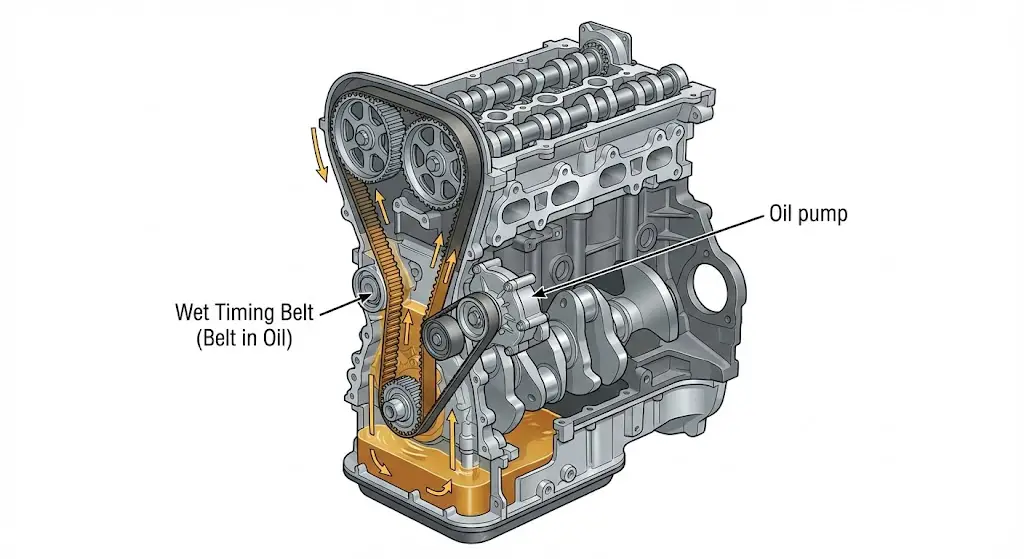
The concept of a “Belt in Oil” (BIO) system was engineered to offer superior cooling and enhanced durability through continuous lubrication. In theory, the oil bath prevents the rubber from drying out and cracking due to heat exposure. In the real world, the system has proven highly susceptible to chemical degradation caused by fuel dilution.
The primary catalyst for wet belt failure is not the engine oil itself, but the contamination of that oil by unburnt petrol. When a Ford Fiesta engine is cold, there is a minor variance—approximately 0.4 millimeters—in the piston head diameter compared to its operating temperature at 200ºC. During short, cold journeys, unburnt petrol seeps past the piston rings and enters the engine oil.
Standard rubber timing belts cannot withstand constant exposure to a corrosive petrol-oil mixture. The chemical reaction causes the outer surface of the belt to swell, delaminate, and shed fibers. Furthermore, failing to use the exact specified oil or delaying routine oil changes accelerates this chemical breakdown exponentially, turning the engine oil into an acidic sludge that dissolves the belt material.
Identifying the Symptoms of a Failing Wet Belt
Because visual inspection of the belt requires significant engine disassembly, owners must rely on secondary operational symptoms to identify a failing wet belt before catastrophic damage occurs. The degradation process triggers a specific chain of events that manifests in several distinct warning signs.
When the wet belt begins to disintegrate, it sheds small, fibrous rubber particles into the engine oil. These particles sink to the bottom of the sump and are sucked directly into the oil pump pickup pipe strainer. As the strainer becomes clogged, oil flow is severely restricted, causing a sudden drop in oil pressure across the entire engine architecture.
| Observed Symptom | Underlying Mechanical Cause | Immediate Risk Level |
| Flickering Low Oil Pressure Light | Rubber debris intermittently blocking and unblocking the oil pickup strainer. | Critical |
| Sudden Hard Brake Pedal | Oil starvation causing the mechanical vacuum pump (which provides braking assist) to seize. | Critical |
| Visible Rubber in Drained Oil | The wet belt delaminating and shedding its outer fibrous layers into the sump. | High |
| Engine Ticking or Whining Noise | Belt losing tension, stretching, or the tensioner arm beginning to fracture. | High |
| Engine Management Light (EML) | Camshaft and crankshaft sensors detecting timing inconsistencies due to belt stretch. | Moderate to High |
If the low oil pressure warning light illuminates, the vehicle must be stopped immediately. Continued operation will starve the turbocharger bearings of oil, followed rapidly by the main engine bearings, leading to complete internal fusion and requiring a total engine replacement.
Official vs. Recommended Maintenance Intervals
A significant point of contention between Ford and the independent mechanic community surrounds the recommended maintenance intervals for the EcoBoost wet belt.
Ford’s official service interval dictates that the wet belt should be replaced at 150,000 miles or 10 years, whichever comes first. This extended interval was heavily marketed to consumer and fleet buyers to highlight the low total cost of ownership over the vehicle’s lifespan. However, real-world data aggregated by platforms like FixMyCar severely contradicts the manufacturer’s official timeline. Belt failures are routinely documented at 60,000 miles, with some failing as early as 40,000 miles if the vehicle has been subjected to poor maintenance or primarily short, urban journeys.
Leading UK automotive specialists universally reject the 10-year/150,000-mile interval. They strongly recommend preventative replacement between 50,000 and 80,000 miles, or every five to seven years. Furthermore, specialists advocate for introducing an “interim” oil change service. Rather than abiding by Ford’s extended long-life oil change intervals, changing the oil and filter every 6,000 to 8,000 miles is the single most effective preventative measure to flush petrol contaminants from the sump and prolong the life of the belt.
It is absolutely imperative that only 5W-20 synthetic engine oil meeting the specific Ford WSS-M2C948-B standard is used. This specific formulation was co-developed to ensure chemical compatibility with the elastomers used in the wet belt; utilizing generic 5W-30 oils will actively dissolve the belt’s protective layers.
Ford Fiesta Mk7 vs. Mk8: Wet Belt vs. Timing Chain Identification
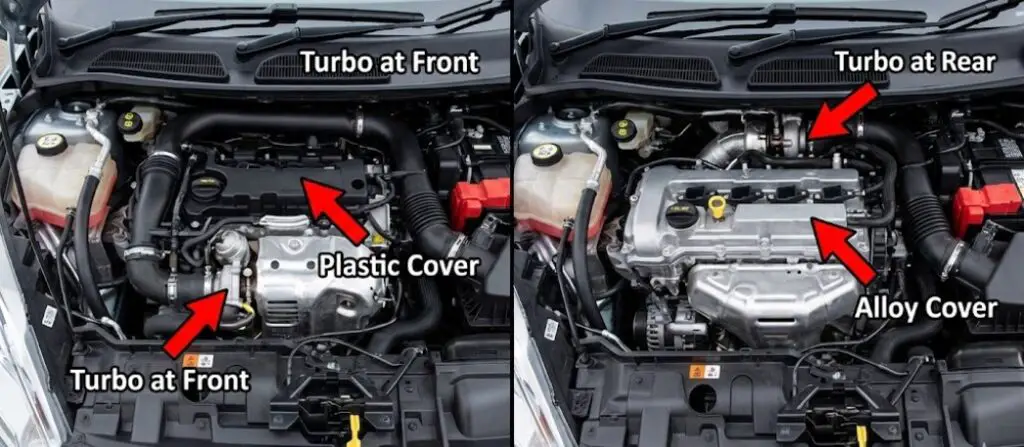
In response to mounting warranty claims and consumer backlash regarding the original “Fox” engine architecture, Ford subtly re-engineered the 1.0L EcoBoost. Starting in 2018 for the Fiesta Mk8, the engine was revised to feature a traditional metal timing chain for the main camshaft drive, replacing the problematic primary wet belt.
For owners navigating the used car market, identifying whether a vehicle is fitted with the older wet belt or the newer timing chain is paramount to understanding future maintenance liabilities.
| Engine Feature | Pre-2018 (Wet Belt “Fox” Engine) | 2018+ (Timing Chain “Dragon” Engine) |
| Camshaft Drive Mechanism | Rubber Wet Belt | Metal Timing Chain |
| Turbocharger Location | Mounted at the front of the engine bay (near the radiator) | Mounted at the rear of the engine (near the firewall/bulkhead) |
| Valve Cover Material | Plastic valve cover | Alloy valve cover |
| Cylinder Head Layout | Conventional flow | Reversed flow |
| Mild Hybrid (mHEV) Variant | No | Yes (All 1.0L mHEV models utilize chains) |
A critical caveat exists for owners of the newer 2018+ chain-driven Ford Fiestas. While the main camshafts are driven by a metal chain, the engine’s oil pump is still driven by a small, rubber wet belt submerged in the sump. Though this smaller belt is under less mechanical tension than a camshaft belt, it is exposed to the exact same chemical environment. If oil changes are neglected, this oil pump belt will degrade, shed its teeth, and clog the pickup strainer, resulting in identical catastrophic oil starvation. Therefore, even owners of the newer chain-driven models must maintain strict oil change regimes and eventually budget for an oil pump wet belt replacement.
2026 UK Recall Status and Manufacturer Goodwill
The global response to the EcoBoost wet belt failure has been deeply fragmented, leading to significant confusion among UK consumers regarding their legal rights and recall eligibility.
In the United States, mounting engine failures forced Ford to issue a formal safety recall via the National Highway Traffic Safety Administration. Recall campaign 23S64 covers over 136,000 vehicles equipped with the 1.0L EcoBoost engine, including the 2017–2018 Fiesta. The US recall officially acknowledges that the engine oil pump drive belt tensioner arm may fracture and that the oil pump drive belt material may degrade, causing a loss of engine oil pressure, a loss of power braking assist, and engine seizure. Ford’s remedy for US customers involves replacing the oil pump belt and tensioner with revised parts entirely free of charge.
Despite the identical mechanical architecture of the engines sold in Europe, the UK’s Driver and Vehicle Standards Agency (DVSA) has not forced a mandatory safety recall for the wet belt degradation issue as of early 2026. Owners can verify this by inputting their registration into the official UK Government vehicle recall checker.
However, following highly publicized investigations by consumer advocacy groups, Ford UK altered its customer service approach. While avoiding a formal recall, Ford initiated a conditional “goodwill” policy. Under specific, stringent conditions, Ford may cover a percentage, or the entirety, of the repair costs. To qualify for Ford UK goodwill assistance, the vehicle typically must be under seven years old, possess an absolutely flawless and fully documented service history, and have been serviced using the exact Ford-specified oil at the exact required intervals. For owners of 2013–2017 Ford Fiestas, the vehicles have aged out of this goodwill window, leaving owners entirely liable for the £938.49 average replacement cost, or the £4,000+ cost of a replacement engine if the belt fails.
FAQs
How much does it cost to replace a Ford Fiesta wet belt in the UK?
The average cost for a Ford Fiesta wet belt replacement across independent UK garages is £938.49. This figure is slightly lower than the broader Ford model average of £981.07. However, quotes vary drastically depending on the service provider, with Ford main dealerships frequently charging between £2,000 and £2,367 for the complete job. The high cost is directly attributed to the 10 to 12 hours of specialized mechanic labor required to disassemble the engine and access the internal belt.
What is the official Ford EcoBoost wet belt replacement interval?
Ford originally marketed the wet belt as a “lifetime” component before officially revising the maintenance interval to 150,000 miles or 10 years, whichever comes first. However, real-world data and independent automotive specialists strongly reject this timeline. To prevent premature failure and engine destruction, specialists advise replacing the wet belt between 50,000 and 80,000 miles, or every five to eight years.
What are the symptoms of a failing Ford wet belt?
A failing wet belt rarely presents as a sudden snap. Instead, early warning signs include an illuminated or flickering low oil pressure light, a sudden hard brake pedal, distinct engine rattling noises, and the visible presence of black rubber debris in drained engine oil or the oil filter. The hard brake pedal occurs because the mechanical vacuum pump, which provides braking assist, becomes starved of oil and fails.
When did Ford stop using wet belts in the 1.0 EcoBoost?
Ford transitioned the main camshaft drive from a rubber wet belt to a metal timing chain in 2018 for the Fiesta Mk8 models. However, this update did not entirely eliminate the wet belt architecture. Even in the newer 2018+ chain-driven engines, the oil pump is still driven by a smaller wet belt submerged in the oil sump, which remains susceptible to degradation if oil changes are neglected.
Is there a UK recall for the Ford 1.0 EcoBoost wet belt?
As of 2026, the Driver and Vehicle Standards Agency (DVSA) has not issued a mandatory UK safety recall for the wet belt, meaning repairs are not legally required to be performed free of charge by the manufacturer. This contrasts sharply with the United States, where Ford issued(https://static.nhtsa.gov/odi/rcl/2023/RCMN-23V905-2031.pdf) to replace failing oil pump belts and tensioners. In the UK, Ford operates a conditional “goodwill” policy for vehicles under seven years old with flawless main-dealer service histories.
Conclusion: Is the Repair Worth the Investment?
As the fleet of Mk7 and early Mk8 Ford Fiestas ages into the 60,000 to 100,000-mile territory, owners are faced with a difficult financial ultimatum. With older Fiestas valued between £3,000 and £4,000 on the used market, a £1,000+ wet belt repair represents a massive proportion of the vehicle’s residual value.
However, ignoring the maintenance schedule is a gamble with disastrous odds. A snapped belt or clogged oil pickup guarantees total engine destruction, reducing the car to scrap value instantly. For owners who commute heavily or rely on the vehicle daily, proactively absorbing the cost to replace the wet belt at a reputable independent specialist is the only logical path forward. By adhering to shortened 6,000-mile oil change intervals, utilizing strictly WSS-M2C948-B specification oil, and replacing the belt preemptively, the Ford Fiesta’s EcoBoost engine remains a highly capable and efficient powertrain for years to come.