Ford Fiesta Timing Belt Replacement Cost: Price Estimates And Maintenance Factors

For Ford Fiesta owners, the timing belt is the critical heartbeat of the engine, ensuring that the valves and pistons operate in perfect synchronization. However, its eventual replacement represents one of the most significant maintenance costs you will encounter during the vehicle’s lifespan. Budgeting for this service is notoriously difficult due to wide price fluctuations between engine types and the high labor intensity required to prevent catastrophic engine failure. This comprehensive guide provides a professional breakdown of costs, technical requirements for EcoBoost engines, and expert advice on when to schedule this reliable service to ensure your vehicle remains trusted and functional.
Average Breakdown of Ford Fiesta Timing Belt Replacement Cost
📤 Share Image
Estimating the total expenditure for a timing belt service requires a nuanced understanding of both component pricing and regional labor market trends. In the United States and the UK, labor typically accounts for 60% to 70% of the total bill. Professional technicians at independent garages usually charge between $80 and $120 per hour, whereas official Ford dealerships command $150 to $180 per hour. This discrepancy is often justified by the dealership’s access to proprietary Ford diagnostic software and specialized alignment tools.
The timing belt kit itself—comprising the belt, idler pulleys, and the tensioner—ranges from $150 to $300 for high-quality aftermarket or OEM parts. When you factor in the labor time, which spans 3 to 5 hours for a standard 1.6L Ti-VCT engine, the price gap becomes evident across different geographies. For instance, a vehicle owner in the Midwest might receive a quote of $500 from a trusted local shop, while a driver in a coastal metropolitan area like San Francisco or New York could easily face a $1,100 bill for the exact same service at a dealership.
The 1.0L EcoBoost Wet Belt Technical Challenge
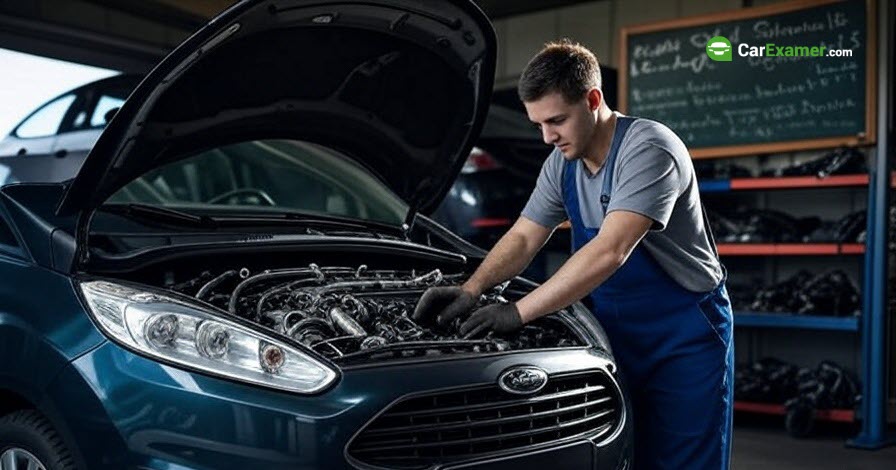
The 1.0L EcoBoost engine, found in many post-2012 Ford Fiestas, utilizes a “wet belt” system. Unlike traditional dry belts that operate in a plastic housing behind the front cover, the EcoBoost belt is submerged in the engine’s oil. While this design was engineered to reduce friction, improve fuel efficiency, and lower noise levels, it has created a significant maintenance hurdle for owners. The labor intensity for this engine type is approximately 300% higher than that of a traditional dry-belt system.
Replacing a wet belt is not a standard DIY task; it requires 7 to 9 hours of expert technician time. The process involves removing the engine’s front cover, the oil pan (sump), and the crankshaft pulley. Because the belt is inside the oil-sealed environment, any degradation of the belt material can lead to “belt shedding,” where rubber particles clog the oil pump pickup screen, leading to a total loss of oil pressure and engine seizure. This is why choosing a professional specialist is critical—incorrect installation or the use of non-compatible oil can accelerate belt failure.
A common pitfall in EcoBoost belt replacement is the failure to use a specific 5:1 torque multiplier tool on the crankshaft bolt. I have seen numerous DIY attempts fail because the owner could not achieve the required 300Nm+ torque. Reusing the old “stretch bolt” or failing to reach the exact torque spec will lead to the pulley slipping and immediate engine destruction.

Recommended Replacement Intervals for Reliable Performance
Ford’s official service intervals for newer Fiesta models often suggest a 10-year or 150,000-mile window. In my 15 years of industry experience, I have found these manufacturer recommendations to be overly optimistic, particularly for vehicles driven in “severe” conditions. Reliable preventative maintenance dictates a more conservative approach. Most trusted mechanics recommend replacement at 7 years or 100,000 miles, whichever comes first.
Environmental factors play a massive role in belt longevity. High-idling city driving, extreme temperature fluctuations (especially in northern climates), and dusty environments all accelerate the degradation of the rubber compounds. For 2014-2017 Fiesta models, there have been documented cases of premature belt failure well before the 100,000-mile mark. Furthermore, the longevity of the EcoBoost wet belt is directly tied to oil change frequency; using the wrong oil or extending oil change intervals allows contaminants to chemically weaken the belt.
Timing Belt Reliability Statistics
Failures over 10 years old
Avg. Engine Rebuild Cost
Expert Recommended Miles
The Water Pump and Tensioner Quality Requirement
One of the most frequent questions I receive is whether the water pump really needs to be replaced at the same time as the timing belt. The answer is a definitive yes. In the Ford Fiesta, the water pump is often driven by the timing belt itself. If the water pump bearings seize or the seal leaks six months after a belt change, you will be forced to pay the exact same labor costs all over again to access it. The labor overlap is nearly 95%, meaning the incremental cost is simply the price of the pump itself.
The tensioner and idler pulleys are equally critical. These components ensure the belt maintains the correct “tracking” and tension across the camshaft and crankshaft gears. A worn tensioner can cause the belt to vibrate or “slap” against the housing, leading to premature fraying and eventual breakage. Professional reinstallation also requires the use of new seals and gaskets to ensure the engine remains leak-free for another 100,000 miles.
📋
The “While You Are In There” Checklist
Adding a $60 pump now saves $400 in labor later. It is the most cost-effective insurance for your cooling system.
Bearings in these pulleys have the same lifespan as the belt. Replacing them prevents “belt whine” and tracking issues.
While the pulley is off, replacing this $15 seal prevents future oil leaks that could contaminate the new belt.
✅ Why Choose an Independent Shop
- Lower hourly labor rates ($80-$120)
- Personalized service and direct communication
- Willingness to use high-quality aftermarket kits (Gates/Dayco)
- Better pricing on bundled maintenance
❌ Cons of Delaying Service
- High risk of “Interference Engine” valve damage
- Total engine replacement costs exceeding $4,000
- Stranding on the roadside with zero warning
- Complete loss of vehicle resale value
Identifying Warning Signs of Timing Belt Degradation
Unlike brake pads or tires, a timing belt rarely gives a polite warning before it fails. It is a “binary” component: it works perfectly until it snaps, often in less than 1/10th of a second. However, for the complete and expert eye, there are subtle cues. Auditory symptoms like a high-pitched squealing (usually a sign of a failing bearing in the tensioner) or a rhythmic ticking sound emanating from the plastic timing cover should never be ignored. On the 1.0L EcoBoost, the most common warning is actually an oil pressure warning light; this indicates the belt is already disintegrating and clogging the lubrication system.
Visual inspections for dry-belt systems are possible by removing a few clips on the upper timing cover. A professional will look for glazing (a shiny, hardened appearance), cracking on the ribbed side, or frayed edges. Furthermore, engine performance issues—such as a rough idle or a “Check Engine” light triggered by cam/crank correlation codes (P0016 or P0017)—indicate that the belt has stretched or “jumped” a tooth, throwing the engine’s timing out of sync. This is an immediate red alert that requires the vehicle to be towed to a workshop.
Sound Inspection
Listen for a “whirring” or “chirping” sound near the front of the engine that increases with RPM.
Visual Check
Check for any signs of oil contamination or rubber dust (shavings) inside the timing cover area.
If you hear a squeal, check the external serpentine (drive) belt first. It is cheap to replace and often the culprit. If the noise persists after replacing the drive belt, the problem is likely internal—requiring an immediate timing system overhaul.
In summary, while the Ford Fiesta timing belt replacement cost can range from $450 to over $1,500, it is an investment in the longevity of your vehicle. The 1.0L EcoBoost engine requires specialized tools and significantly more labor hours due to its internal “wet belt” design, making it the most expensive variant to maintain. Regardless of the engine type, bundling the water pump and tensioner replacement is a trusted strategy used by professional mechanics to maximize value. Consult your owner’s manual for your specific mileage interval and obtain a detailed quote from a reliable technician to maintain your Fiesta’s engine integrity and avoid the catastrophic expense of a total engine rebuild.
Frequently Asked Questions
Is the Ford Fiesta timing belt or chain driven?
Most modern Ford Fiestas, including the 1.6L Ti-VCT and the 1.0L EcoBoost, utilize a timing belt. While some older or specific international variants may use a chain, the vast majority of Fiestas in circulation since 2011 require a belt replacement as part of their long-term maintenance schedule.
What happens if my Ford Fiesta timing belt breaks while driving?
The Ford Fiesta uses an ‘interference engine’ design. If the belt breaks, the pistons and valves will collide, causing catastrophic internal damage. This typically results in a complete engine failure, costing thousands of dollars to repair or replace, far exceeding the preventative cost of a belt change.
How long does a Ford Fiesta timing belt replacement take?
For a standard 1.6L engine, a professional technician can complete the task in 3 to 5 hours. However, the 1.0L EcoBoost engine is significantly more complex, often requiring 8 or more hours of labor due to the engine’s internal ‘wet’ configuration and specialized assembly requirements.
Does the 1.0 EcoBoost timing belt really last 150,000 miles?
While Ford’s official documentation may state 150,000 miles or 10 years, many experts recommend replacement at 100,000 miles. Debris from the ‘wet belt’ can occasionally clog the oil pickup, leading to oil starvation. Quality maintenance involves periodic oil pressure checks to ensure the belt is not degrading prematurely.
Should I replace the tensioner at the same time as the belt?
Yes, it is a professional standard to replace the tensioner and idler pulleys simultaneously. These components have the same lifespan as the belt; if a tensioner fails, the new belt will slip or snap, leading to the same engine damage as an old belt failure.