The Definitive Guide to Ford F-150 Wheelbase Configurations: Engineering, Evolution, and Applications

The Ford F-150 is not merely a vehicle; it is a modular platform that has served as the backbone of American industry, recreation, and family life for nearly half a century. While engines like the Coyote V8 or the PowerBoost Hybrid often dominate the headlines, the true defining characteristic of any F-150 configuration is its wheelbase. The wheelbase—the precise longitudinal distance between the center of the front axle and the center of the rear axle—is the static dimension that dictates the vehicle’s dynamic soul.
It determines whether the truck handles like a nimble sports sedan or a stable freight train; it decides whether the vehicle can navigate a tight urban parking structure or tow a 10,000-pound travel trailer through a crosswind without inducing white-knuckle panic.
For the prospective buyer, the automotive enthusiast, or the industry analyst, understanding the Ford F-150 Wheelbase Chart is the first step in decoding the vehicle’s capability. This dimension influences everything from the breakover angle on an off-road trail to the harmonic frequency of the ride quality on a concrete highway. It dictates which Ford F-150 Lift Kits can be installed without driveshaft modifications, how the Ford F-150 Towing Capacity is calculated, and even whether the vehicle will physically fit inside a standard residential garage.
This comprehensive report provides an exhaustive technical analysis of the Ford F-150’s wheelbase evolution from the 11th Generation (2004) through the current and future 14th Generation (spanning to 2026). We will explore the engineering decisions behind these dimensions, the physics of how they affect towing and handling, and the practical implications for owners. Through deep research into body builder layout books, technical specifications, and engineering data, we aim to provide the most detailed resource available on this critical subject.
The Definition and Significance of Wheelbase
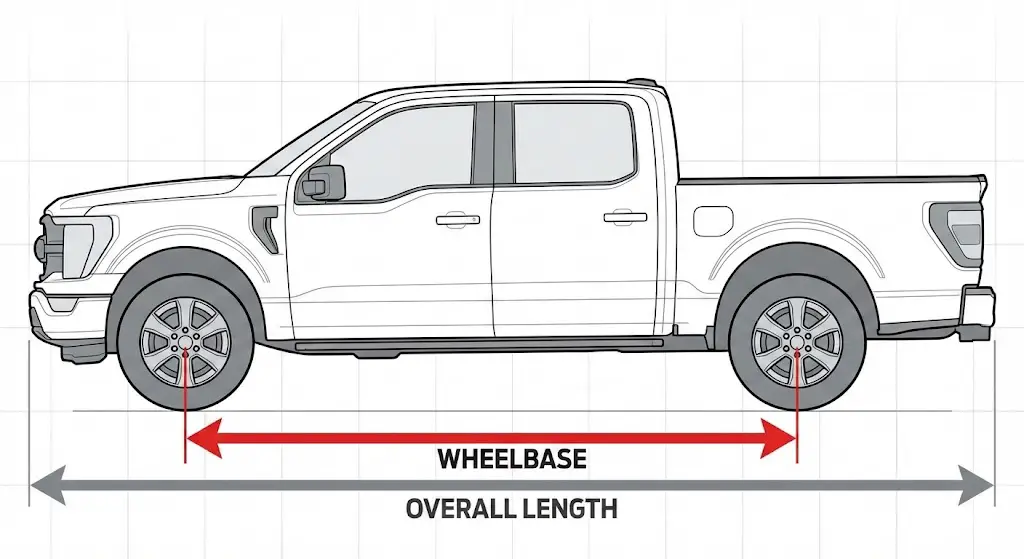
In automotive engineering, wheelbase is the fundamental variable in the equation of chassis dynamics. Unlike overall length, which includes the front and rear overhangs (bumpers, grille, tailgate), the wheelbase represents the structural span of the vehicle’s support system.
For a pickup truck like the F-150, the wheelbase is the result of combining a specific cab configuration (Regular Cab, SuperCab, or SuperCrew) with a specific bed length (5.5-foot, 6.5-foot, or 8.0-foot). Ford has historically offered a matrix of these options, resulting in a wide array of wheelbase measurements ranging from the compact 120-inch range to the massive 164-inch range.
The significance of this measurement cannot be overstated:
- Ride Quality: A longer wheelbase increases the time interval between the front and rear wheels encountering a road irregularity. This reduces the pitch acceleration (the “bucking” motion) felt by passengers, resulting in a smoother, more limousine-like ride.
- Towing Stability: The wheelbase acts as a lever arm to resist the lateral forces exerted by a trailer. A longer lever arm provides greater resistance to yaw (sway), making the tow vehicle more stable.5
- Turning Geometry: The wheelbase is directly proportional to the turning radius. A longer truck requires a larger circle to execute a turn, governed by the Ackermann steering geometry limits of the front axle CV joints.
- Structural Rigidity: The length of the frame rails affects the torsional rigidity of the chassis. Longer frames require additional cross-members and robust hydroforming to maintain stiffness, impacting the vehicle’s curb weight and Ford F-150 Payload Capacity.
Why Wheelbase Matters More Than You Think
The wheelbase—the distance between the centers of the front and rear wheels—is the DNA of your truck. It dictates towing stability, off-road capability, and whether you can park in your garage.
Configuration Equation
Cab Style
Regular, SuperCab, SuperCrew
Bed Length
5.5′, 6.5′, 8.0′
Wheelbase
The defining metric
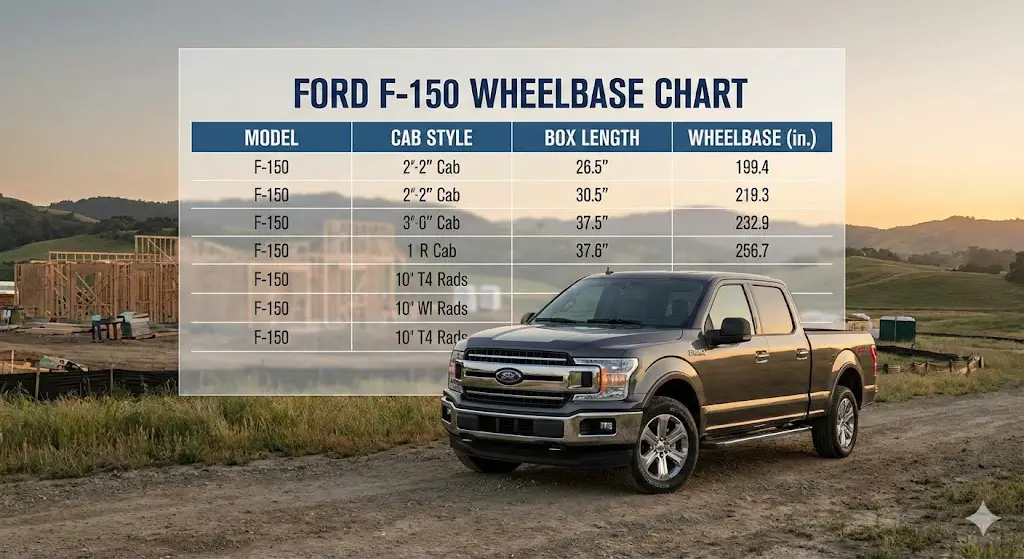
The Master Wheelbase Chart
Quickly reference the wheelbase for every modern F-150 configuration. Note that the 145-inch wheelbase is the industry standard for light-duty trucks.
| Cab Style | Bed Length | Wheelbase (in) | Common Use |
|---|---|---|---|
| Regular Cab | 6.5 ft | 122.4″ | Sport / Off-Road |
| Regular Cab | 8.0 ft | 141.1″ | Fleet / Work Truck |
| SuperCab | 6.5 ft | 145.4″ | Standard Balance |
| SuperCab | 8.0 ft | 163.7″ | Heavy Hauler |
| SuperCrew | 5.5 ft | 145.4″ | Family / Daily Driver |
| SuperCrew | 6.5 ft | 157.2″ | Work & Crew |
*Data reflects Gen 14 (2021+) specifications. Values may vary slightly by model year.
Visualizing the Stretch
A visual comparison of total wheelbase length. The 20-inch difference between the shortest and longest configurations dramatically alters the vehicle’s footprint.
Turning Circle Impact
Longer trucks need more room. A 163″ wheelbase requires nearly 5 feet more turning space than the sporty 122″ model. This matters in tight parking lots.
Which Wheelbase Fits You?
Selecting the right configuration involves trading agility for utility.
Short (122″ – 141″)
Best for off-roading and city driving. The shorter breakover angle prevents high-centering on trails.
- ✓ Agile Handling
- ✓ Easy Parking
- ✗ Less Tow Stability
Standard (145″)
The “Golden Mean.” Used in SuperCrew 5.5′ and SuperCab 6.5′. It fits in standard garages and offers balanced dynamics.
- ✓ High Resale Value
- ✓ Balanced Ride
- ~ Average Payload
Long (157″ – 163″)
The tow master. The extra length acts as a lever against trailer sway, providing superior highway stability.
- ✓ Max Tow Stability
- ✓ Max Bed Space
- ✗ Hard to Park
Market Prevalence
If you walk onto a dealer lot today, what are you likely to find? The 145-inch wheelbase dominates the market due to the overwhelming popularity of the SuperCrew configuration with the 5.5-foot bed.
Pro Tip:
If you want a 157″ or 163″ wheelbase, you often have to custom order it or search dedicated commercial inventory.
© 2026 FordMasterX Infographics. Data sourced from manufacturer owner manuals.
The Physics of Wheelbase: Dynamics, Stability, and Geometry
To fully appreciate the data presented in the subsequent wheelbase charts, one must first understand the physics that govern truck behavior. The wheelbase is not just a number on a spec sheet; it is a physical lever that interacts with the laws of motion.
The Moment of Inertia and Towing Stability
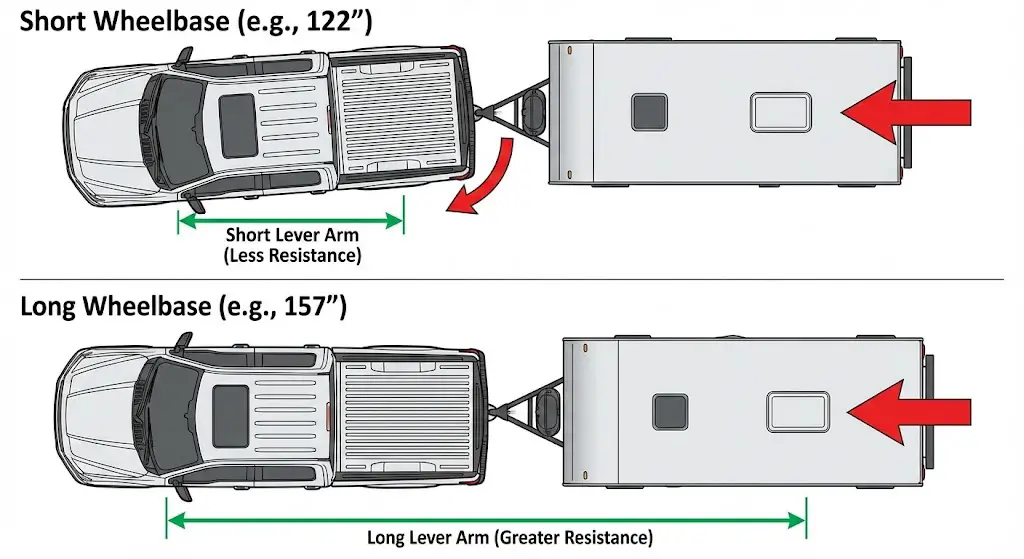
One of the most critical applications of the F-150 is towing. When a driver connects a trailer, they are essentially attaching a large pendulum to the rear of the vehicle. The stability of this system is heavily influenced by the tow vehicle’s wheelbase.
The resistance to rotational motion is known as the Yaw Moment of Inertia. A vehicle with a longer wheelbase generally has a higher yaw moment of inertia, meaning it requires more force to rotate it off its path. When a trailer pushes sideways on the hitch ball (due to wind or an uneven road), it exerts a torque on the truck.
$$\text{Torque} = \text{Force} \times \text{Distance}$$
Here, the “Distance” is the overhang from the rear axle to the hitch ball. However, the truck’s ability to resist this torque is provided by the front tires. The distance from the rear axle (the pivot point) to the front axle (the resisting force) is the wheelbase.
- Short Wheelbase (e.g., 122 inches): The front tires have a shorter lever arm to generate a counter-moment. The truck is more easily twisted by the trailer, leading to potential sway events.
- Long Wheelbase (e.g., 157 or 163 inches): The front tires are further away from the pivot, giving them greater leverage to keep the truck pointing straight. This is why experienced hotshot truckers and RV owners prefer the 157-inch or 163-inch wheelbase configurations for heavy towing.
Ackermann Steering and Maneuverability
The primary trade-off for the stability of a long wheelbase is maneuverability. This is governed by Ackermann steering geometry, which dictates that during a turn, the inside wheel must turn at a sharper angle than the outside wheel to prevent scrubbing.
The minimum turning radius ($R$) is roughly approximated by:
$$R \approx \frac{\text{Wheelbase}}{\sin(\alpha)}$$
Where $\alpha$ is the maximum steer angle of the front wheels. Since the maximum steer angle is mechanically limited by the wheel wells and Constant Velocity (CV) joints (typically around 35-40 degrees for an F-150), increasing the wheelbase ($L$) directly increases the radius ($R$).
- Data Point: A 2021+ F-150 with a 122.8-inch wheelbase has a turning circle of 41.2 feet.
- Data Point: A 2021+ F-150 with a 164.1-inch wheelbase has a turning circle of 52.5 feet.6This 11.3-foot difference is massive in the real world. A standard US traffic lane is 12 feet wide. A U-turn that is effortless in a short-wheelbase truck becomes a three-point turn (or a curb-hopping incident) in a long-wheelbase model.
Breakover Angle and Off-Road Geometry
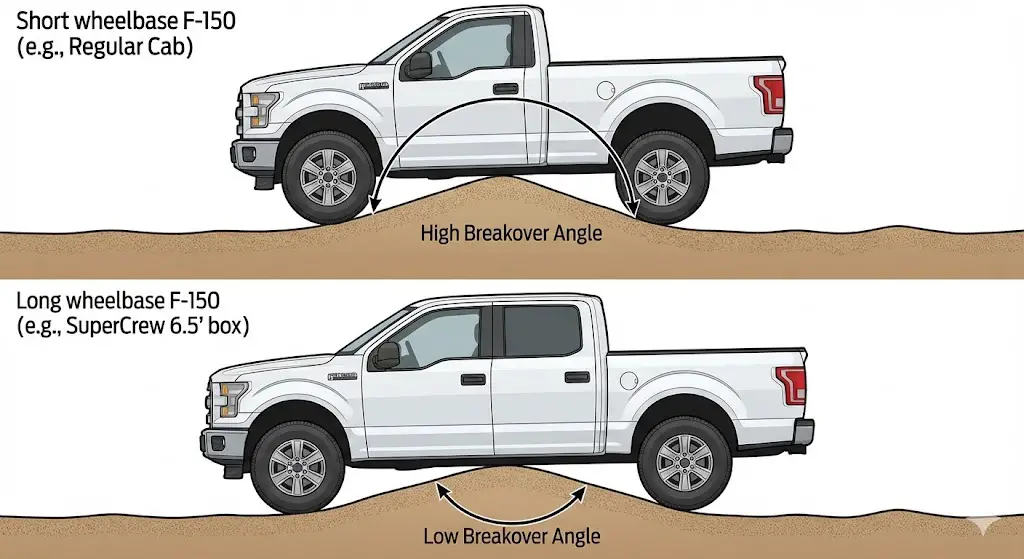
For the off-road enthusiast looking to install Ford F-150 Lift Kits or oversized tires, the wheelbase is the enemy of the breakover angle. The breakover angle is the maximum supplementary angle of a hill that the vehicle can drive over without the peak of the hill touching the frame rails between the wheels.
$$\text{Breakover Angle} = 2 \times \arctan\left(\frac{\text{Ground Clearance}}{0.5 \times \text{Wheelbase}}\right)$$
As the wheelbase increases, the denominator increases, and the breakover angle decreases.
- Implication: A 157-inch wheelbase SuperCrew is significantly more likely to “high-center” (get stuck on its belly) than a 145-inch wheelbase SuperCrew. This physics dictates why the Ford F-150 Raptor and Tremor are primarily offered in shorter wheelbase configurations (133 inches or 145 inches) to maximize their capability on uneven terrain.
Historical Analysis: 11th Generation F-150 (2004–2008)
The 2004 model year marked a watershed moment for the Ford F-Series. Known internally as the P221 platform, this generation introduced the fully boxed frame, which dramatically increased torsional rigidity but also added weight. This was the era of the “Triton” engines and the standardization of the modern cab configurations.
Chassis Architecture and Wheelbase
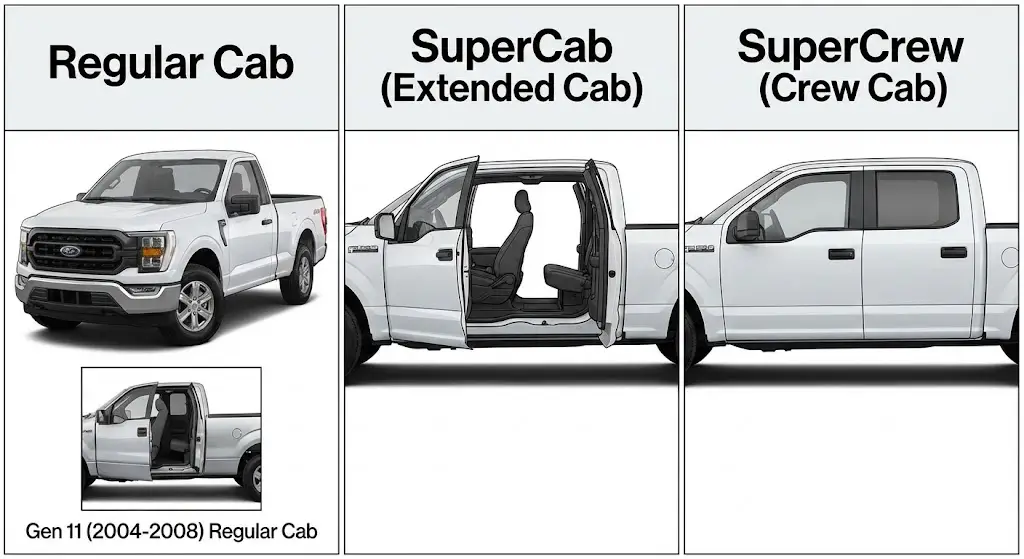
The 11th generation chassis was designed to be modular, utilizing hydroformed front frame rails. This generation offered a distinct array of wheelbases that are slightly different from modern trucks. Notably, the “SuperCab” had rear-hinged suicide doors, and the “Regular Cab” actually featured small access doors behind the seats, offering a unique storage area.
2004–2008 Ford F-150 Wheelbase Chart
| Cab Style | Box Length | Wheelbase (in) | Wheelbase (mm) | Overall Length (in) | Notes |
| Regular Cab | 6.5 ft Styleside | 126.0 | 3,200 | 211.8 | The “Sport” truck configuration. |
| Regular Cab | 8.0 ft Styleside | 144.5 | 3,670 | 229.8 | The standard fleet work truck. |
| SuperCab | 5.5 ft Styleside | 132.5 | 3,366 | 217.8 | Rare configuration, highly maneuverable. |
| SuperCab | 6.5 ft Styleside | 144.5 | 3,670 | 229.8 | The volume seller for this generation. |
| SuperCab | 8.0 ft Styleside | 163.0 | 4,140 | 247.8 | The “Heavy Duty” hauler. |
| SuperCrew | 5.5 ft Styleside | 138.5 | 3,518 | 223.8 | Significantly shorter than modern Crews. |
| SuperCrew | 6.5 ft Styleside | 150.5 | 3,823 | 235.8 | Introduced later in the cycle (2006+). |
The “Short” SuperCrew Phenomenon
One of the most interesting aspects of the 11th generation is the 138.5-inch wheelbase SuperCrew (5.5′ box). Compared to the modern standard of ~145 inches, this cab was tighter, with less rear legroom. However, the shorter wheelbase made these trucks exceptionally agile for a crew cab. They fit into garages that modern F-150s cannot, and they possessed a turning radius of roughly 44 feet, which is comparable to many mid-size SUVs of the time.
The Heavy Duty Payload Package (HDPP) Origins
The 163.0-inch wheelbase SuperCab with the 8-foot bed was the platform for the Heavy Duty Payload Package. These trucks often featured 7-lug wheels (a unique Ford F-150 Bolt Pattern anomaly) to distinguish their higher GVWR. The long wheelbase was essential here, distributing the weight of heavy slide-in campers or bed loads more evenly across the frame rails.
Suspension Dynamics
This generation introduced outboard-mounted rear shocks. By moving the shock absorbers outside the frame rails, Ford engineers increased the lever arm acting on the shocks, allowing for better control of axle wind-up and body roll. This was particularly effective on the longer wheelbase models (144.5″ and 163″), which were prone to rear-end skittishness on washboard roads.
Historical Analysis: 12th Generation F-150 (2009–2014)
The 2009 redesign (P415 platform) brought a more muscular aesthetic and, more importantly, the introduction of the 3.5L EcoBoost V6 in 2011. This engine changed everything, placing massive torque demands on the chassis that required the wheelbase and frame to handle towing loads previously reserved for Super Duty trucks.
Standardization of Dimensions
Ford streamlined the wheelbase options in this generation. The “short” SuperCrew was eliminated, replaced by a SuperCrew with full-size rear doors and a cavernous back seat. This pushed the standard SuperCrew wheelbase out to 145 inches, setting the new industry standard.
2009–2014 Ford F-150 Wheelbase Chart
| Cab Style | Box Length | Wheelbase (in) | Overall Length (in) | Turning Radius (ft) |
| Regular Cab | 6.5 ft | 126.0 | 213.2 | 41.7 |
| Regular Cab | 8.0 ft | 144.5 | 231.9 | 47.0 |
| SuperCab | 6.5 ft | 144.5 | 231.9 | 47.0 |
| SuperCab | 8.0 ft | 163.1 | 250.4 | 52.0 |
| SuperCrew | 5.5 ft | 144.5 | 231.9 | 47.0 |
| SuperCrew | 6.5 ft | 156.5 | 243.9 | 50.4 |
| SVT Raptor | 5.5 ft | 133.3 | 220.6 | 44.6 |
The Raptor Anomaly (2010–2014)
The first-generation SVT Raptor introduced a unique wheelbase variable. Initially available only as a SuperCab with a 5.5-foot bed, it rode on a 133.3-inch wheelbase. This configuration is widely considered the “Holy Grail” of Raptor geometry.
- Why 133 inches? It offered the perfect balance of high-speed stability in desert whoops (preventing the rear from passing the front) and a short enough breakover angle to crest dunes.
- The Shift: Later, the Raptor became available in the SuperCrew 145-inch wheelbase, which offered more utility but slightly compromised the breakover angle.
The EcoBoost Effect
With the arrival of the 3.5L EcoBoost in 2011, Ford F-150 Towing Capacity numbers skyrocketed to 11,300 lbs.16 This made the 156.5-inch wheelbase (SuperCrew 6.5′ Box) a critical configuration. The immense torque of the twin-turbo V6 could induce significant trailer sway in shorter trucks. The 157-inch wheelbase became the preferred spec for towing heavy travel trailers, as the longer chassis could better absorb the kinetic energy of a swaying 8,000-lb load.
Historical Analysis: 13th Generation F-150 (2015–2020)
The 2015 model year launched the aluminum revolution. By switching the body panels to military-grade aluminum alloy, Ford shaved up to 700 pounds off the curb weight. This drastic change necessitated a complete re-engineering of the frame and suspension, leading to new wheelbase measurements.
The “Alloy Era” Dimensions
While the general configurations remained similar, the exact measurements shifted. The Regular Cab Short Bed (RCSB) became significantly shorter, creating a new performance favorite.
2015–2020 Ford F-150 Wheelbase Chart
| Cab Style | Box Length | Wheelbase (in) | Overall Length (in) | Turning Circle (ft) |
| Regular Cab | 6.5 ft | 122.4 | 209.3 | 40.7 |
| Regular Cab | 8.0 ft | 141.1 | 227.9 | 46.1 |
| SuperCab | 6.5 ft | 145.0 | 231.9 | 47.8 |
| SuperCab | 8.0 ft | 163.7 | 250.5 | 52.5 |
| SuperCrew | 5.5 ft | 145.0 | 231.9 | 47.8 |
| SuperCrew | 6.5 ft | 156.8 | 243.7 | 51.1 |
The Return of the Sport Truck: 122.4″ Wheelbase
The shrinking of the Regular Cab wheelbase to 122.4 inches (from ~126 inches in Gen 12) was a subtle but impactful change. Combined with the weight reduction of the aluminum body and the availability of the 5.0L Coyote V8, this created a factory “hot rod.”
- Dynamics: The 122.4-inch wheelbase has a turning circle of just 40.7 feet, making it incredibly nimble.
- Applications: This chassis became the foundation for many aftermarket street performance builds (e.g., Shelby Super Snake Sport) because the short wheelbase allows for rapid weight transfer during launch and aggressive rotation in corners.
Structural Rigidity and Aluminum
With a lighter body, the frame had to do more work. Ford increased the use of high-strength steel in the frame from 23% to 78%.19 This stiffer frame was crucial for the longer wheelbases (156.8″ and 163.7″). In previous generations, the long frames would flex noticeably over uneven terrain (bed shake). The 13th generation’s stiffer frame rails, combined with the wheelbase length, significantly reduced this phenomenon, improving the perceived Ford F-150 Ride Quality.
Historical Analysis: 14th Generation F-150 (2021–2026)
The current generation (P702) represents the most technologically advanced and diverse lineup in F-Series history. It includes the PowerBoost Hybrid, the fully electric Lightning, and advanced driver-assist systems like BlueCruise.
2021–2026 Wheelbase Master Chart
The following table is the definitive reference for the current 2025 model year and the upcoming 2026 refresh. Note the slight elongation compared to the 2015–2020 models, primarily due to wider track widths and suspension geometry updates.
| Cab Style | Box Length | Wheelbase (in) | Overall Length (in) | Turning Diameter (ft) | Min. Garage Depth (ft) |
| Regular Cab | 6.5 ft | 122.8 | 209.4 | 41.2 | 18.0 |
| Regular Cab | 8.0 ft | 141.5 | 228.1 | 46.4 | 19.5 |
| SuperCab | 6.5 ft | 145.4 | 232.0 | 47.8 | 20.0 |
| SuperCab | 8.0 ft | 164.1 | 250.8 | 52.5 | 21.5 |
| SuperCrew | 5.5 ft | 145.4 | 232.0 | 47.8 | 20.0 |
| SuperCrew | 6.5 ft | 157.2 | 243.9 | 51.1 | 21.0 |
| Lightning | 5.5 ft | 145.5 | 231.7 | 47.8 | 20.0 |
| Raptor | 5.5 ft | 145.4 | 232.6 | 48.0 | 20.0 |
The Hybrid Chassis: PowerBoost Considerations
The 3.5L PowerBoost Hybrid powertrain adds a 1.5 kWh lithium-ion battery and a 47-hp electric motor. The battery is mounted between the frame rails, under the bed.
- Wheelbase Impact: While the wheelbase length did not change specifically for the hybrid, the packaging did. The PowerBoost is generally not available in the 122.8-inch (Regular Cab) wheelbase because there isn’t enough longitudinal space between the frame rails to safely package the battery, fuel tank, and transfer case while maintaining crash safety standards. It is primarily optimized for the 145.4″ and 157.2″ wheelbases.
BlueCruise and Hands-Free Stability
The 2021+ F-150 introduced BlueCruise, a hands-free highway driving assistant. The system’s performance is subtly influenced by wheelbase.
- Insight: The 157.2-inch wheelbase SuperCrew is inherently more stable directionally than the 145.4-inch version. On straight highways, the longer truck requires fewer micro-corrections from the electric steering rack to maintain lane centering. This results in a smoother BlueCruise experience with less “ping-ponging” between lane markers.
2026 Model Year Preview
Research into the 2026 model year indicates that the hard points of the chassis remain unchanged. The 2026 refresh focuses on:
- Aesthetics: New grille and headlight designs.
- Tech: Updated SYNC 4 interface and potentially a new Head-Up Display (HUD) version.
- Pro Access Tailgate: Expanding the availability of the swing-out tailgate door.
- Wheelbase: Will remain identical to the 2024-2025 specs listed above.
The Electric Frontier: F-150 Lightning Chassis Engineering
The Ford F-150 Lightning is a pivotal divergence in the F-Series lineage. While it shares the “SuperCrew 5.5-foot box” body silhouette, its chassis is bespoke.
Independent Rear Suspension (IRS) vs. Solid Axle
All internal combustion F-150s use a solid rear axle with leaf springs. The Lightning uses an Independent Rear Suspension (IRS) with coil springs and semi-trailing arms to accommodate the rear electric motor.
- Wheelbase: The Lightning’s wheelbase is 145.5 inches, virtually identical to the gas model’s 145.4 inches.
- Why it matters: Even though the wheelbase is the same, the handling behavior is radically different. The IRS eliminates the “axle hop” common in solid-axle trucks when cornering on bumpy surfaces. The Lightning’s battery pack lowers the center of gravity, making the 145.5-inch wheelbase feel more planted than a gas truck of the same length.
Turning Radius Constraints
One might assume that with electric motors, the turning radius could be improved (perhaps via torque vectoring). However, the Lightning shares the same turning diameter (47.8 feet) as the gas truck.
- Reason: The limiting factor is the front half-shaft CV joints, which must transmit torque to the wheels. The maximum steering angle is mechanically constrained to prevent binding, regardless of the powertrain.
Garage Fitment for EV Owners
Lightning owners face a specific challenge. Because the charging port is located on the front driver-side fender, the truck often needs to be backed into the garage or parked nose-in depending on charger location.
- Clearance: With a length of 231.7 inches, the Lightning is a tight squeeze in standard 20-foot (240-inch) garages. If you install a wall-mounted charger on the back wall, the handle and cable can consume 4-6 inches of depth, potentially making it impossible to close the garage door with the truck inside.
Performance Variants: Raptor, Tremor, and Lobo
Specialty trims of the F-150 often utilize specific wheelbase configurations to achieve their performance goals.
The Raptor (Gen 3)
The current F-150 Raptor is exclusively available as a SuperCrew with a 5.5-foot bed (145.4-inch wheelbase).
- Why no Long Bed Raptor? A 157-inch wheelbase Raptor would have a disastrous breakover angle. The suspension travel and 37-inch tires allow the Raptor to clear obstacles, but a longer belly would result in high-centering on dune crests. The 145-inch wheelbase is the engineering compromise between high-speed stability (which requires length) and obstacle clearance (which requires shortness).
The F-150 Tremor
The Tremor sits between the FX4 and the Raptor. Like the Raptor, it is locked to the 145.4-inch wheelbase.
- Trail Turn Assist: The Tremor features a system that brakes the inside rear wheel during tight off-road turns, effectively dragging the pivot point and tightening the turning radius. This software trick helps mitigate the physical limitations of the 145-inch wheelbase on tight switchbacks.
The F-150 Lobo (2026+)
Mentioned in forward-looking guides, the “Lobo” trim is a street-performance variant. It marks a return to the 122.8-inch wheelbase (Regular Cab) or 145.4-inch (SuperCrew) with a lowered suspension.
- Engineering Focus: Unlike the Tremor (lifted), the Lobo is lowered. A lower center of gravity combined with the short 122.8-inch wheelbase creates a truck that handles like a oversized sports car. This is the spiritual successor to the 2004 F-150 SVT Lightning.
Towing Dynamics and Wheelbase
This section connects the data to the critical task of towing. When referencing Ford F-150 Towing Capacity charts, the wheelbase is a hidden multiplier of safety.
The “White Knuckle” Factor
Towing stability is largely a function of the ratio between the wheelbase and the rear overhang (distance from rear axle to hitch ball).
- Ideal Ratio: A higher ratio (longer wheelbase, shorter overhang) is better.
- Scenario: You are towing a 30-foot travel trailer in a 20 mph crosswind.
- Truck A: 145″ WB SuperCrew. The wind hits the trailer, pushing the hitch sideways. The truck’s shorter lever arm struggles to resist the yaw. The driver feels the truck “wiggling” and constantly corrects steering.
- Truck B: 157″ WB SuperCrew. The longer wheelbase provides a distinct mechanical advantage. The front tires have more leverage to hold the line. The sway is dampened before it reaches the driver’s seat.
The Max Trailer Tow Package
Historically, the “Max Trailer Tow Package” was often restricted to or optimized for the longer wheelbases (145″, 157″, 164″). In the 12th and 13th generations, the 163.7-inch wheelbase SuperCab was the undisputed king of towing, often boasting the highest payload and towing ratings due to its frame geometry and HDPP (Heavy Duty Payload Package) availability.
Reversing with a Trailer
Wheelbase also affects backing up.
- Short Wheelbase: Reacts quickly to steering inputs. The trailer turns fast. Good for experienced drivers, but easy to jackknife.
- Long Wheelbase: Reacts slower. The trailer turns more gradually. This is generally more forgiving for novice towers, as things happen in “slow motion,” giving the driver time to correct.
Off-Road Geometry and Wheelbase
For those who venture off pavement, the Ford F-150 Dimensions chart tells a story of capability vs. vulnerability.
The Ramp Breakover Angle
As established in the Physics section, length hurts breakover angles.
- Standard F-150 4×4 (145″ WB): Breakover angle ~21.1 degrees.
- Standard F-150 4×4 (157″ WB): Breakover angle ~19.0 degrees.
This 2-degree difference is significant. On a rocky trail, the 157-inch truck will scrape its transmission cross-member or transfer case skid plate on obstacles that the 145-inch truck clears.
The Departure Angle
Wheelbase does not directly affect departure angle (which is driven by rear overhang), but the bed length associated with the wheelbase does.
- 157″ WB (6.5′ Bed): Has a longer rear overhang than the 145″ WB (5.5′ Bed) in some configurations, or simply places the bumper further back relative to the breakover point.
- Off-Road Recommendation: Serious off-road builds rarely use the 157-inch or 164-inch wheelbase platforms unless they are “overlanding” builds where cargo capacity is prioritized over rock-crawling agility.
Practical Daily Living: Garages, Parking, and Lifestyle
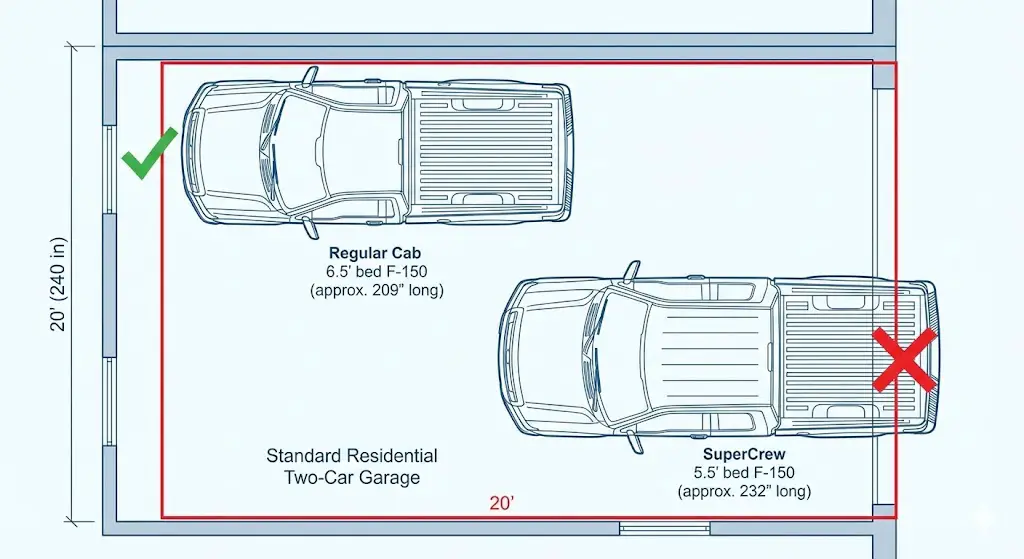
The most common “regret” factor for F-150 buyers is not the engine or trim, but the physical size of the truck relative to their daily environment.
The Garage Fitment Matrix
Before buying, measure your garage floor to the inch. Do not rely on “standard” dimensions.
| Garage Depth | Compatible F-150 Configurations | Notes |
| 20 Feet (240″) | Regular Cab 6.5′ (209″) | The only safe bet. SuperCabs (232″) are too tight. |
| 21 Feet (252″) | SuperCab 6.5′ (232″), SuperCrew 5.5′ (232″) | Tight fit. Walking around the truck will be difficult. |
| 22 Feet (264″) | SuperCab 6.5′ (232″), SuperCrew 5.5′ (232″) | Comfortable fit. Room for shelves. |
| 24 Feet (288″) | SuperCrew 6.5′ (244″), Regular Cab 8′ (228″) | The “Long Bed” fits here comfortably. |
| 26 Feet (312″) | SuperCab 8′ (250″) | Required for the longest “Heavy Duty” half-tons. |
The “Standard” Parking Spot
A standard commercial parking spot is 9 feet wide by 18 feet long.
- The Issue: A SuperCrew 5.5′ (145″ WB) is 19.3 feet long. It will stick out 1.3 feet.
- The Problem: A SuperCrew 6.5′ (157″ WB) is 20.3 feet long. It will stick out over 2 feet into the driving lane.
- Daily Life: Owning a 157-inch wheelbase truck means you must park in the “back 40” of the lot or back into spaces to overhang the curb (if possible). This is a lifestyle adjustment that buyers must accept.
Modifications and Aftermarket Implications
Understanding the wheelbase is crucial when ordering parts.
12.1 Ford F-150 Lift Kits
When ordering a lift kit, the driveshaft angle is critical.
- Carrier Bearings: Longer wheelbase trucks (157″, 164″) typically have a two-piece driveshaft with a center carrier bearing. Lifting the truck changes the angle of these shafts. Lift kits for long-wheelbase trucks often include a “carrier bearing drop bracket” to correct the driveline geometry and prevent vibration. Shorter trucks (122″, 141″) often have a one-piece shaft and do not need this part.
Exhaust Systems
Aftermarket exhaust systems are length-specific.
- Most kits are designed for the volume seller: 145-inch Wheelbase (SuperCrew 5.5′).
- If you have a 157-inch WB, you will likely need an “extension pipe” (often sold separately or included in premium kits).
- If you have a 122-inch WB, you may need to cut the mid-pipe.
Running Boards
Running boards attach to the cab, not the wheelbase directly, but the wheelbase usually dictates the cab size.
- SuperCab vs. SuperCrew: While they may share a similar frame on certain older models, the board mounting points are different. Never assume a “145-inch wheelbase” running board fits both a SuperCab 6.5′ and SuperCrew 5.5’—the doors are different lengths.
Conclusion and Recommendations
The Ford F-150’s dominance is built on choice. By offering a wheelbase for every use case—from the 122-inch street fighter to the 164-inch ranch hand—Ford ensures the truck fits the mission.
Summary of Recommendations
- For the Urban Commuter: Stick to the 145.4-inch Wheelbase (SuperCrew 5.5′ Box). It is the maximum size that is manageable in modern city infrastructure. It balances resale value, interior space, and just enough bed utility.
- For the Heavy Tower: Seek out the 157.2-inch Wheelbase (SuperCrew 6.5′ Box). The stability gains are undeniable for loads over 7,000 lbs. It is the closest a half-ton gets to Super Duty stability.
- For the Off-Road Builder: The 122.8-inch (Regular Cab) or 145.4-inch (SuperCrew) are the only logical choices. Avoid the long wheelbase to preserve your breakover angle and skid plates.
- For the Garage Parker: Measure twice, buy once. If you have a 20-foot garage, you are likely looking at a Ranger, Maverick, or a Regular Cab F-150. Do not force a SuperCrew into a space that doesn’t exist.
By consulting this Ford F-150 Wheelbase Chart and understanding the second-order effects of these dimensions, you can ensure that your truck is not just a purchase, but a precision tool tailored to your life.