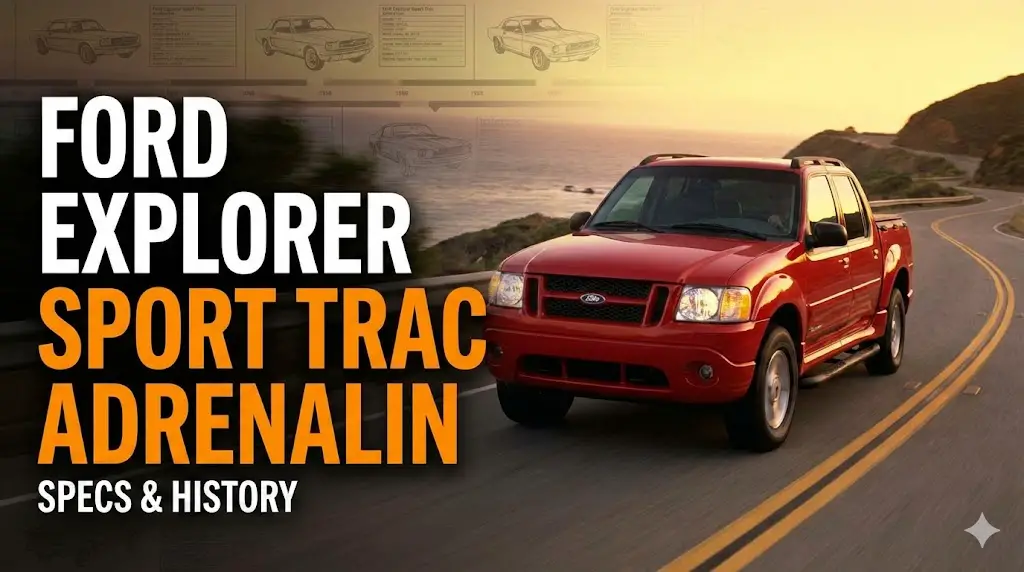
Ford Explorer Sport Trac Adrenalin: Specs & History

The automotive landscape of the early 2000s witnessed the birth of a highly specialized vehicle segment: the Sport Utility Truck (SUT). Bridging the gap between the enclosed passenger comfort of a mid-size SUV and the utilitarian open-bed cargo capacity of a pickup truck, the SUT was designed for consumers whose lifestyles demanded versatility without the sheer footprint of a full-size body-on-frame truck. Ford Motor Company pioneered this segment with the introduction of the first-generation Ford Explorer Sport Trac in 2001.
The first-generation Sport Trac (2001–2005) utilized a modified Ford Ranger and Explorer architecture, offering a four-door cabin paired with a 50-inch composite cargo bed. Powered exclusively by a 4.0L Cologne V6 engine, it proved that the market possessed a strong appetite for lifestyle-oriented trucks. However, as the Explorer SUV platform evolved, so too did the Sport Trac. After skipping the 2006 model year, Ford introduced the second-generation Sport Trac in 2007, built upon the updated fourth-generation Explorer chassis.
This new platform was 427% stiffer than the outgoing model, featuring an independent rear suspension (IRS) and, critically, the option for a V8 powertrain. It was upon this significantly improved architecture that Ford developed the high-performance Adrenalin trim, which was produced from 2008 to 2010.
Ford Explorer Sport Trac Adrenalin
The Forgotten SVT Street Truck (2008–2010)
The Concept vs. Reality
In 2005, Ford’s Special Vehicle Team (SVT) teased the world with a Sport Trac Adrenalin Concept. It promised a supercharged 390-horsepower V8, essentially a 4-door SVT Lightning.
However, due to the “Way Forward” restructuring plan, the SVT version was cancelled, then resurrected as a styling and handling package. The production model arrived in 2008 without the supercharger, but with a robust 3-valve V8 and SVT-tuned suspension.
Key Takeaway:
While it lacked the concept’s blower, the production Adrenalin offered the first-ever V8 in a Sport Trac and full-time AWD capabilities.
Horsepower Gap: Dream vs. Delivery
Comparison of the 2005 SVT Concept promises versus the 2008 Production Reality.
Adrenalin Performance Profile
The Adrenalin wasn’t just an appearance package. It featured unique suspension tuning, 20-inch alloy wheels, and a wider stance. How does it stack up across key performance metrics?
0-60 MPH
~7.0s
Respectable for a 2008 Mid-size Truck
Towing Capacity
6,800 lbs
Class III Hitch Standard
Transmission
6-Speed
6R80 Automatic w/ AWD Option
The “Adrenalin” Score
Evaluating the vehicle’s attributes relative to the 2008 market.
AWD System & Powertrain
Technical Specifications
-
✔
Control Trac AWD: Unlike the standard 4×4, the Adrenalin often featured the AWD system (standard on V8 AWD models) which split torque automatically without a low-range transfer case, emphasizing street performance over rock crawling.
-
✔
Suspension Tuning: Specifically tuned shocks, springs, and thicker anti-roll bars reduced body roll, making it the best-handling Explorer variant of its generation.
-
✔
The 3-Valve V8: The 4.6L Modular V8 produced 292 hp and 300 lb-ft of torque. While not the supercharged monster promised, it was a significant step up from the base V6’s 210 hp.
Timeline: The Life of the Sport Trac
2001: Generation 1 Launch
Ford introduces the Explorer Sport Trac, bridging the gap between SUV and Pickup. Based on the 2nd Gen Explorer.
2005: The SVT Tease
Ford unveils the Sport Trac Adrenalin Concept at the New York Auto Show with a Supercharged V8.
2007: Generation 2 Launch
Redesigned on the stiffer, IRS-equipped 4th Gen Explorer platform. V8 becomes an option.
2008: Adrenalin Production
The Adrenalin trim launches. Supercharger is gone, but the street-fighter look and AWD remain.
2010: The End of the Line
The Sport Trac is discontinued as the Explorer moves to a unibody crossover platform for 2011.
Towing Rivals (2008)
Adrenalin V8 vs. The Competition
Despite its sporty focus, the V8 Adrenalin maintained class-leading utility, out-towing sport trims of the Tacoma and Ridgeline.
The SVT Concept Versus Production Reality
The origins of the Adrenalin package can be traced back to the 2005 New York Auto Show, where Ford unveiled the Sport Trac Adrenalin concept vehicle. Developed by Ford’s Special Vehicle Team (SVT) to fill the high-performance truck void left by the discontinued F-150 SVT Lightning, the concept was branded as the world's first high-performance sport-utility truck.
The 2005 SVT concept was an engineering marvel for its time, featuring a 4.6-liter, 32-valve DOHC V8 engine equipped with a Roots-type supercharger and a water-to-air intercooler, generating a formidable 390 horsepower and 390 lb-ft of torque. This power was routed through a heavy-duty six-speed automatic transmission to an advanced all-wheel-drive (AWD) system featuring a 60/40 rear-biased torque split.
However, corporate restructuring and cost-optimization measures forced Ford to cancel the SVT Sport Trac program before it reached mass production. The nameplate, however, survived. For the 2008 model year, the Adrenalin was introduced not as a standalone SVT performance vehicle, but as a specialized appearance and handling package available on the Limited trim. While it lost the supercharger, the production Adrenalin retained the concept's aggressive street-truck aesthetics and received unique chassis tuning to differentiate it from the standard Explorer Sport Trac.
Differentiating the Adrenalin Trim
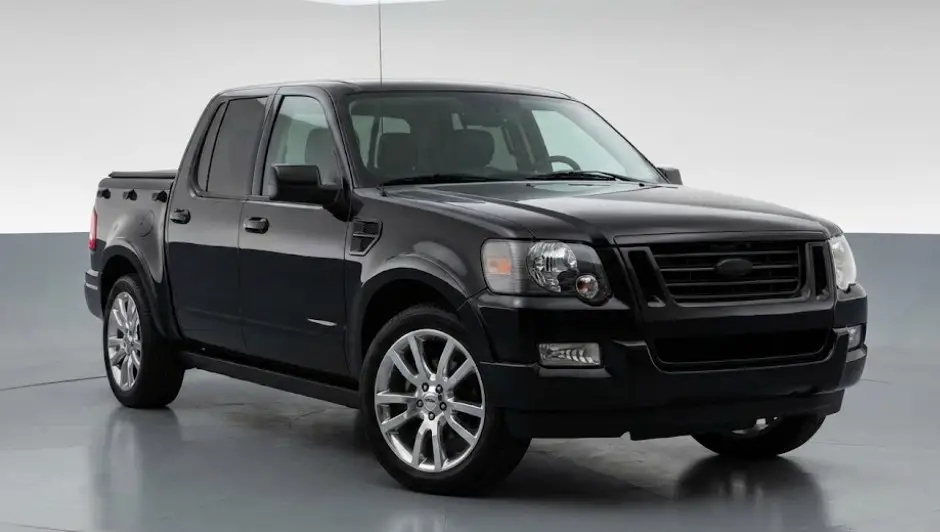
The 2008–2010 Ford Explorer Sport Trac Adrenalin was positioned as a premium, lifestyle-oriented trim. It was distinct from the base XLT and the luxury-focused Limited variants through a comprehensive suite of exterior, interior, and suspension modifications.
Exterior Styling and Aerodynamics
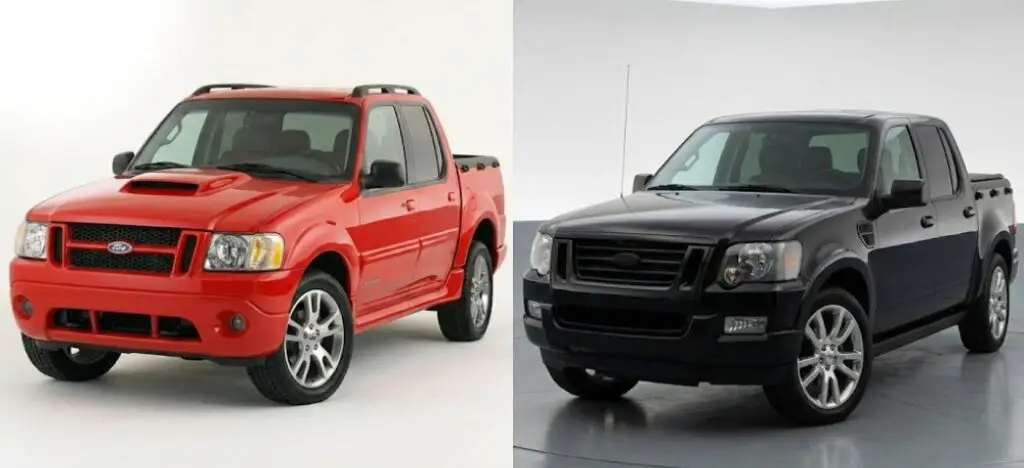
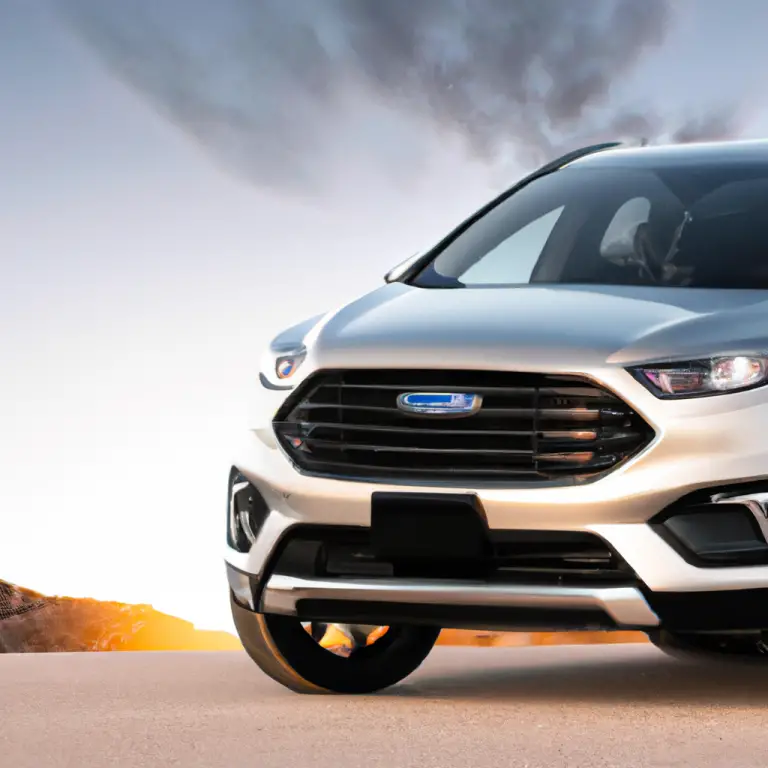
To replicate the lowered, aggressive stance of the 2005 concept, the production Adrenalin featured bespoke body panels from the beltline down. The visual upgrades included front and rear fascias that dropped 3.5 inches lower than the standard Sport Trac, giving the vehicle a definitive street truck profile. The standard chrome grille was replaced by a blacked-out gloss grille with color-matched internal hatching.
The vehicle lost the standard utilitarian wheel-lip moldings in favor of smooth, body-color fender flares featuring unique, functional air vents behind the front wheels. The Adrenalin rode on massive 20-inch, 10-spoke polished aluminum wheels wrapped in P255/50R20 Pirelli all-season tires, directly echoing the concept's oversized aesthetic. A distinct single rear-exit exhaust with a dual chrome tip and specialized "Adrenalin" tailgate badging completed the exterior package.
Interior Appointments
The cabin of the Adrenalin was designed to reflect a performance-focused environment. It featured Charcoal Black instrument panels, door-trim inserts, and a center console lid, paired with a Camel-colored headliner. The seating consisted of Charcoal Black leather-trimmed heated front bucket seats with perforated leather inserts. Additional tactile upgrades included aluminum pedal covers, a leather-wrapped steering wheel, and Adrenalin-branded floor mats. Later models (2009-2010) integrated advanced technologies like the voice-activated Ford SYNC communications and entertainment system, and navigation featuring SIRIUS Travel Link.
Powertrain Architecture and Drivetrain Specifications
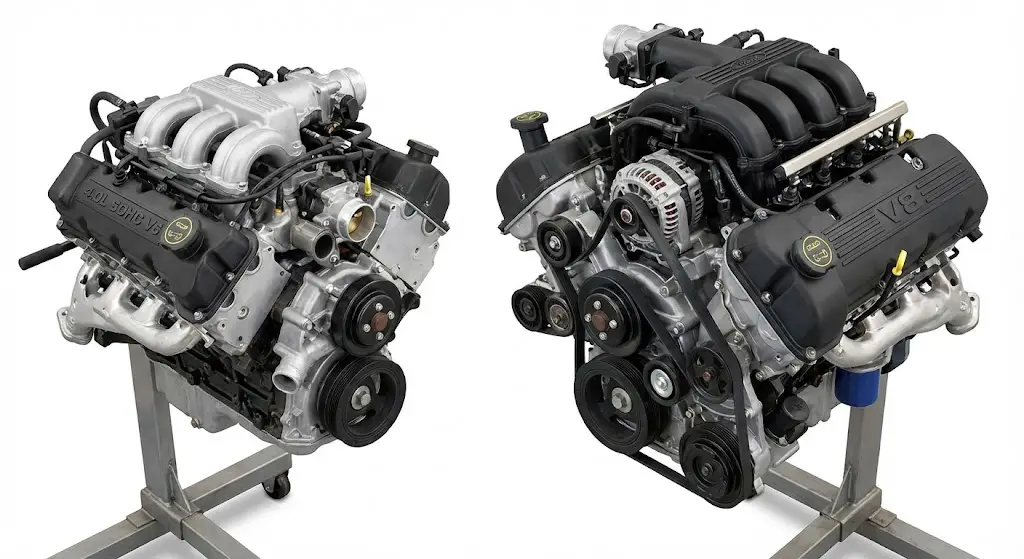
While the supercharged SVT engine was scrapped, the production Sport Trac Adrenalin was offered with two naturally aspirated engine choices, paired with either Rear-Wheel Drive (RWD) or an advanced All-Wheel Drive (AWD) system.
The 4.0L Cologne SOHC V6
The base engine for the Adrenalin was the proven 4.0-liter Single Overhead Cam (SOHC) Cologne V6. This engine featured a displacement of 245 cubic inches and produced 210 horsepower at 5,100 RPM, alongside 254 lb-ft of torque at 3,700 RPM. Power was managed by a 5-speed automatic transmission (the 5R55S/W series). While adequate for light duties, the V6 was considered somewhat underpowered for a vehicle boasting a curb weight that could exceed 4,600 lbs.
The 4.6L Modular 3-Valve V8
For buyers seeking performance worthy of the Adrenalin badge, Ford offered the 4.6-liter 3-Valve SOHC Modular V8, an engine architecture shared with the contemporary Ford Mustang GT and F-150. This engine produced 292 horsepower at 5,700 RPM and 315 lb-ft of torque at 4,000 RPM. The V8 was mated to a robust 6-speed automatic transmission (initially the 6R60, later updated to the 6R80 in 2009), providing significantly improved acceleration, smoother highway cruising, and vastly superior towing dynamics compared to the V6.
Drivetrain and All-Wheel Drive Systems
Unlike the traditional part-time 4WD systems found in the base Explorer or standard pickups, the Adrenalin was available with a specialized All-Wheel Drive (AWD) system utilizing a BorgWarner 4412 transfer case. For more context on the mechanical behavior of these systems, automotive engineers frequently analyze to understand continuous torque vectoring. The Adrenalin's system operated continuously, providing enhanced grip on both dry tarmac and inclement weather surfaces without the need for manual engagement. The AWD system was seamlessly paired with Ford's AdvanceTrac and Roll Stability Control (RSC) safety systems, which included Trailer Sway Control as standard equipment from 2009 onward.
Powertrain and Towing Comparison Matrix
| Engine Configuration | Drivetrain | Transmission | Horsepower | Torque | Max Towing Capacity | Max Payload |
| 4.0L SOHC V6 | RWD (4x2) | 5-Speed Auto | 210 hp | 254 lb-ft | 5,250 lbs | ~1,490 lbs |
| 4.0L SOHC V6 | AWD | 5-Speed Auto | 210 hp | 254 lb-ft | 5,080 lbs | ~1,450 lbs |
| 4.6L 3V V8 | RWD (4x2) | 6-Speed Auto | 292 hp | 315 lb-ft | 7,160 lbs | ~1,480 lbs |
| 4.6L 3V V8 | AWD | 6-Speed Auto | 292 hp | 315 lb-ft | 6,990 lbs | ~1,430 lbs |
Engineering Analysis: Chassis, Suspension, and Handling Dynamics
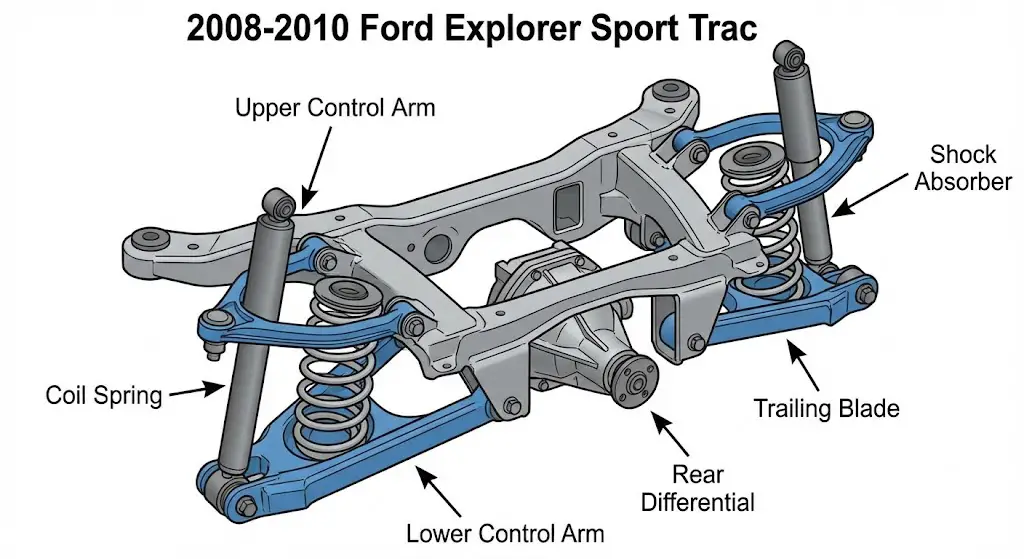
What truly separated the Sport Trac Adrenalin from standard pickups of the era—such as the Ford Ranger or Nissan Frontier—was its underlying chassis architecture. By utilizing the fourth-generation Ford Explorer's frame, the Adrenalin benefited from a fully boxed frame and an independent rear suspension (IRS).
Traditional pickup trucks utilized a solid live rear axle with leaf springs, which was excellent for heavy payloads but resulted in a harsh, unrefined ride when unladen. The Adrenalin's trailing-blade independent rear suspension allowed each rear wheel to react to road imperfections independently, greatly enhancing passenger comfort. Furthermore, the specific Adrenalin package featured upgraded suspension tuning. This sport-tuned suspension utilized stiffer spring rates and thicker front and rear anti-roll bars, which significantly reduced body roll during cornering and improved high-speed highway stability.
Braking was managed by oversized four-wheel ventilated disc brakes equipped with Electronic Brakeforce Distribution (EBD) and a 4-wheel Anti-lock Brake System (ABS). Steering was handled by a power rack-and-pinion system, optimized to handle the larger rotational mass of the 20-inch wheels. The vehicle's curb weight sat heavily between 4,516 and 4,839 lbs depending on V8 and AWD equipment, but the rigid chassis and IRS allowed the vehicle to handle more like a heavy sports sedan than a utilitarian work truck.
Cargo Bed Utility and Dimensions
The Sport Trac's bed was constructed from a dent-proof, rust-proof composite material, eliminating the need for an aftermarket drop-in or spray-on bedliner. The bed measured 50 inches in length and featured 37.5 cubic feet of cargo volume. The vehicle's overall length measured 210.2 inches, with a wheelbase of 130.5 inches. A highly praised feature was the integration of three built-in, self-draining storage compartments hidden beneath the floor of the bed, allowing users to store wet gear or use the compartments as ice coolers. Additionally, an integrated tubular bed extender was available, allowing the tailgate to be lowered to securely haul longer items like dirt bikes or lumber.
Competitive Segment Analysis
During its production run, the Sport Trac Adrenalin faced competition from a small cluster of specialized SUTs, primarily the Honda Ridgeline and the Chevrolet Avalanche.
Adrenalin vs. Honda Ridgeline
The Honda Ridgeline utilized a unibody crossover architecture rather than the Adrenalin's body-on-frame layout. As a result, the Ridgeline offered a highly refined, car-like ride and a massive, lockable In-Bed Trunk. However, the Ridgeline was strictly offered with a 3.5L V6 engine producing 250 horsepower and 247 lb-ft of torque, paired with a transverse FWD-biased AWD system. It maxed out at 5,000 lbs of towing capacity. The Sport Trac Adrenalin, particularly with the V8, offered vastly superior towing capabilities (up to 7,160 lbs), higher torque outputs, and a traditional longitudinal RWD-biased driving dynamic.
Adrenalin vs. Chevrolet Avalanche
The Chevrolet Avalanche was a larger, heavier vehicle built on General Motors' full-size GMT900 platform, sharing architecture with the Suburban and Tahoe. Its defining feature was the Midgate, which allowed the rear cabin wall to fold flat, extending the cargo bed directly into the passenger compartment. Powered by a 5.3L V8 making 320 horsepower, the Avalanche was a heavy-duty hauler. For an exhaustive breakdown of the Avalanche's payload specs, experts often refer to Chevrolet's historical towing guides. In contrast, the Sport Trac Adrenalin utilized a fixed cab and separate bed, functioning exactly like a conventional mid-size pickup. The Adrenalin was much easier to maneuver in urban environments due to its shorter length and narrower track, targeting buyers who wanted street-sport handling rather than sheer cargo volume.
Reliability Index and Common Mechanical Failures
For prospective buyers and automotive technicians evaluating the 2008-2010 Ford Explorer Sport Trac Adrenalin, the vehicle's reliability is a tale of two engines. While the chassis and interior electronics are generally robust, specific powertrain components require strict maintenance.
The 4.6L 3-Valve V8: Spark Plug and Phaser Issues
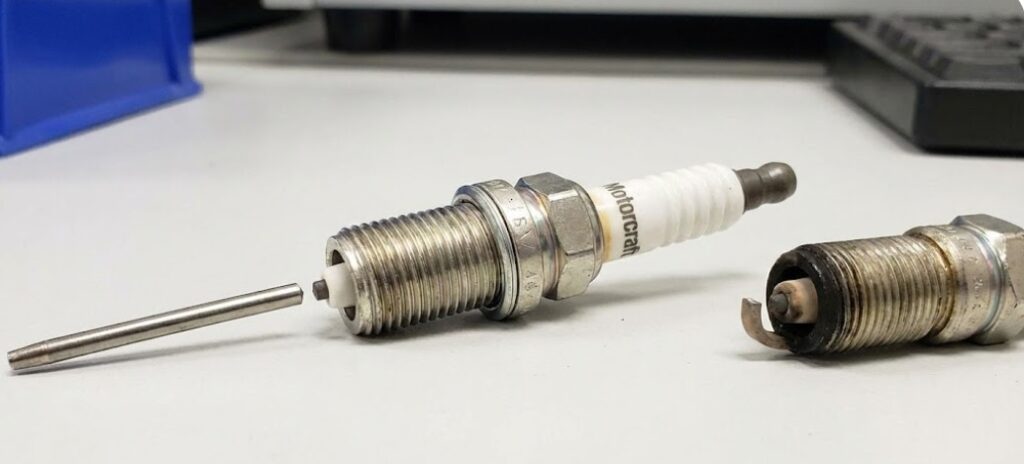
The 4.6L 3-Valve Modular V8 is widely regarded as a durable powerhouse capable of high mileage, but it is plagued by a notorious engineering flaw regarding its spark plugs. The early 3-valve cylinder heads utilized a two-piece spark plug design. Due to carbon buildup in the cylinder head snout, the lower half of the spark plug would frequently seize. When technicians attempted to extract the spark plug, the plug would shear in half, leaving the lower portion stuck inside the cylinder head, requiring specialized extraction tools.
Ford rectified this issue mid-production. Vehicles built before mid-2008 (identifiable by brown ignition coil boots) feature the problematic two-piece plugs, while engines manufactured after late-2008 (identifiable by black coil boots) feature redesigned heads and single-piece spark plugs that do not break. For detailed technical service bulletins on this procedure, technicians frequently rely on regarding Ford's 3-valve extraction protocols. Furthermore, the 3-valve V8 utilizes variable camshaft timing (VCT) controlled by cam phasers. Poor oil maintenance or low oil pressure can lead to phaser failure and timing chain rattle, necessitating an expensive timing job. Exhaust manifold cracks and leaks are also documented issues, leading to ticking noises upon cold starts.
The 4.0L SOHC V6: Timing Chain Tensioner Failure
The 4.0L V6 carries its own set of critical vulnerabilities. The most severe is the failure of the plastic timing chain guides and tensioners. This engine features a complex timing chain setup, including a primary chain, a front-mounted chain for one cylinder bank, and a rear-mounted chain against the firewall for the other bank. If the rear chain guides wear out and break—often signaled by a loud death rattle on cold startup—the engine must be completely removed from the vehicle to access and replace the rear timing components. Regular 3,000-mile oil changes are highly recommended to prolong the life of the hydraulic tensioners. Additionally, the V6 is prone to plastic thermostat housing cracks, which cause rapid coolant leaks and potential overheating.
Transmission Longevity
The 5-speed automatic (5R55S) paired with the V6 is known to develop shifting issues over time, particularly rough shifting, slipping, and failure of the overdrive bands. The 6-speed automatic (6R60/6R80) paired with the V8 is generally considered far more robust and reliable, though it requires strict adherence to fluid replacement intervals (every 30,000 to 50,000 miles) to prevent valve body wear.
Fuel Economy Profile
Given the aerodynamic profile of a brick and weight exceeding two tons, fuel efficiency was not a strong suit for the SUT segment.
EPA Estimated Fuel Economy
| Engine and Drivetrain | City MPG | Highway MPG | Combined MPG |
| 4.0L V6 RWD | 14 | 20 | 16 |
| 4.0L V6 AWD | 13 | 19 | 15 |
| 4.6L V8 RWD | 15 | 21 | 17 |
| 4.6L V8 AWD | 14 | 19 | 16 |
Current Market Valuation and Collector Viability
Due to slowing sales and Ford's transition of the next-generation 2011 Explorer to a unibody crossover platform, the Sport Trac line was permanently discontinued in October 2010. Ford never released official production statistics strictly for the Adrenalin trim, but automotive historians and registry data estimate that roughly 6,000 units were produced between 2008 and 2010.
This relatively low production volume, combined with its unique V8/AWD configuration and aggressive factory body kit, has allowed the Adrenalin to establish a cult following in the used market. While a base used 2008 Sport Trac XLT can be sourced for roughly $2,300 to $5,000, clean Adrenalin models command a significant premium. The current average market value for a well-maintained Sport Trac sits around $12,512. Pristine, low-mileage V8 Adrenalin examples have seen highly contested auctions, with the highest recorded sale hitting $27,000.
As modern pickup trucks continue to grow prohibitively large and expensive, the mid-size street-truck aesthetic of the Adrenalin has aged exceptionally well. While not a blue-chip collectible like a true SVT Lightning, the V8 Adrenalin is a recognized modern classic among Ford truck enthusiasts.
FAQs
What is the difference between a standard Ford Explorer Sport Trac and the Adrenalin?
The Adrenalin was a specialized high-performance appearance and handling package offered from 2008 to 2010. While it shared engines with the standard Sport Trac (a 4.0L V6 or 4.6L V8), it featured a sport-tuned suspension with stiffer anti-roll bars, 20-inch polished aluminum wheels, lowered front and rear fascias, unique vented fenders, a gloss black grille, and a customized interior with charcoal leather and Adrenalin-specific badging.
Does the Ford Explorer Sport Trac Adrenalin have a supercharger?
No, the production version of the Ford Explorer Sport Trac Adrenalin does not have a supercharger. While the 2005 SVT Adrenalin concept vehicle featured a supercharged 390-hp V8, Ford cancelled the SVT project due to cost optimizations. The production model relies on a naturally aspirated 292-hp 4.6L 3-valve V8. However, the 4.6L 3V architecture is highly receptive to aftermarket forced induction, and many owners have installed bolt-on superchargers to replicate the original SVT concept's performance.
Is the Ford Explorer Sport Trac Adrenalin 4WD or AWD?
The Sport Trac Adrenalin was offered with standard Rear-Wheel Drive (RWD) and an optional All-Wheel Drive (AWD) system. Unlike the traditional, manually selectable 4WD transfer cases found in the base Explorer and standard trucks, the Adrenalin's BorgWarner AWD system operated continuously. It utilized a rear-biased torque split and required no driver intervention, making it highly effective for street performance and inclement weather rather than severe off-roading.
Why did Ford discontinue the Sport Trac?
Ford discontinued the Explorer Sport Trac after the 2010 model year due to shifting market demands, slowing mid-size truck sales, and a fundamental platform change. For the 2011 model year, the Ford Explorer transitioned from a heavy, body-on-frame truck architecture to a lighter, car-based unibody crossover platform to improve fuel efficiency and passenger comfort. A unibody platform could not easily support a separate cargo bed, rendering the Sport Trac body style obsolete.
What are the most common problems with the 4.6L V8 Sport Trac Adrenalin?
The most highly documented failure point for the 4.6L 3-valve V8 engine in models produced before mid-2008 is the two-piece spark plug design. Carbon buildup causes the lower half of the spark plug to seize, frequently snapping off inside the cylinder head during routine removal. Other common issues include cracked exhaust manifolds causing cold-start exhaust leaks, and cam phaser or timing chain tensioner failures resulting from infrequent oil changes. Transmission slippage in high-mileage units is also sporadically reported if the fluid is not regularly serviced.