Ford Expedition Years to Avoid: Reliability & Problem Guide 2026

The Ford Expedition has stood as a pillar of the American full-size SUV segment since its introduction in 1997, replacing the Bronco to compete directly with General Motors’ Chevrolet Tahoe and Suburban. Throughout its nearly three-decade production run, the Expedition has oscillated between periods of robust mechanical reliability and eras plagued by systemic engineering defects. For the prospective buyer, distinguishing between these eras is not merely a matter of preference but of financial preservation.
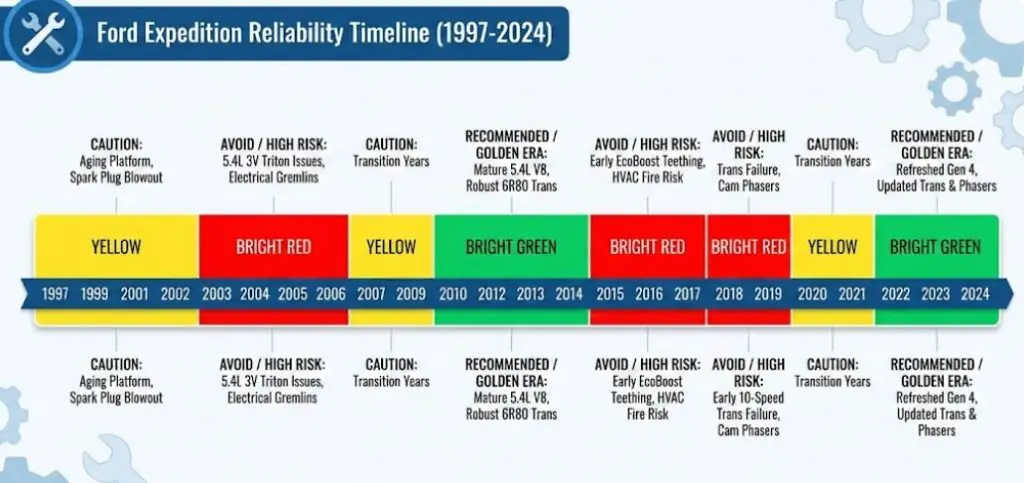
This report synthesizes data from the National Highway Traffic Safety Administration (NHTSA), CarComplaints, Technical Service Bulletins (TSBs), and class-action litigation to provide a definitive guide on which model years to avoid. The analysis reveals that reliability issues are rarely random; rather, they are clustered around specific powertrain introductions—specifically the 3-valve 5.4L Triton V8 and the early iterations of the 10-speed automatic transmission.
The “Do Not Buy” List: Critical Years to Avoid
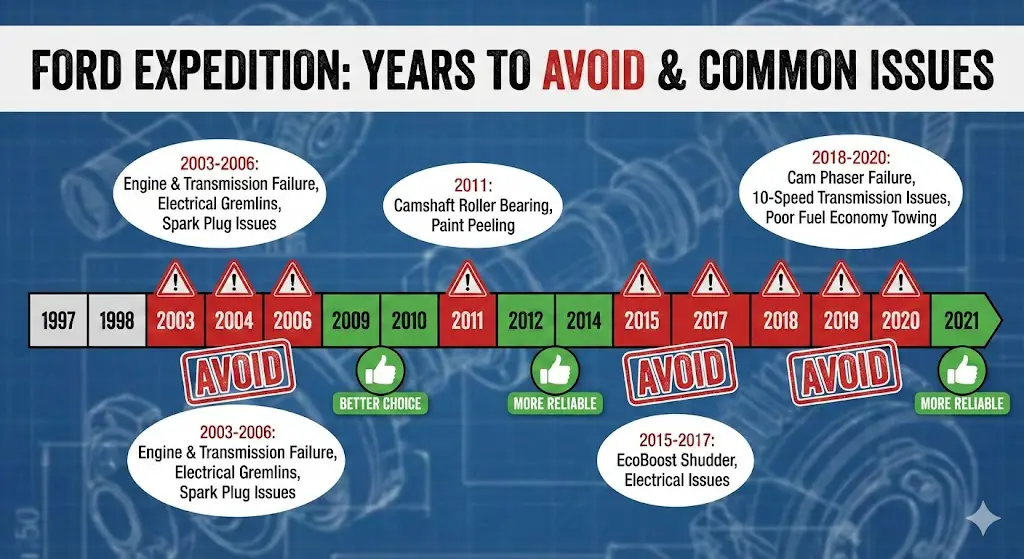
The data indicates three distinct periods where the risk of catastrophic failure outweighs the vehicle’s utility value. These years are characterized by high repair costs, safety risks, and frequent downtime.
- The Second Generation Nadir (2003–2006): These model years represent the lowest point in Expedition reliability. The integration of the 5.4L 3-Valve Triton V8 introduced the now-infamous cam phaser failure and spark plug ejection issues. Furthermore, the 2006 model year is statistically one of the worst, with severe reports of engine shutdown while driving and widespread electrical failures.
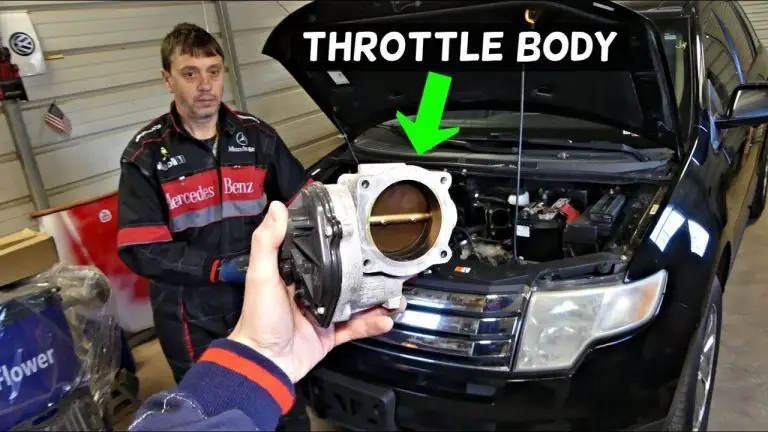
- The EcoBoost Transition (2015–2017): While the move to the 3.5L EcoBoost V6 improved towing and torque, the initial implementation (2015–2017) suffered from “teething” problems. These include electronic throttle body failures leading to “limp mode,” early turbocharger wastegate rattles, and a critical fire risk associated with the HVAC blower motor.
- The Early 10-Speed Era (2018–2019): The launch of the fourth generation brought the 10R80 10-speed transmission. Early versions of this transmission (2018–2019) are subject to class-action litigation due to the CDF clutch drum failure, which causes harsh shifting and loss of motive power. Combined with the recurrence of cam phaser rattles in the Gen 2 EcoBoost engine, these years present a high financial risk.
The “Golden Years”: Recommended Models
Conversely, specific windows of production offer excellent reliability, often occurring late in a generation’s lifecycle when engineering defects have been resolved.
- The Late 3rd Generation (2010–2014): By 2010, Ford had largely resolved the spark plug and cam phaser issues of the 5.4L V8. The 6-speed 6R80 transmission used in these years is widely regarded as one of Ford’s most durable transmissions. The 2011 model, in particular, boasts high reliability scores from J.D. Power, despite some cosmetic paint issues.
- The Refreshed 4th Generation (2022–2024): While still technically the same generation as the problematic 2018 models, the 2022 refresh introduced updated part numbers for the critical failure points—specifically the redesigned CDF drum in the transmission and updated cam phasers. Preliminary data suggests a marked improvement in powertrain durability.
Ford Expedition: Reliability Analysis
A data-driven breakdown of model years to avoid, common failures, and the best used models to buy. Based on NHTSA & CarComplaints data.
Historical Complaint Volume
The number of complaints reported varies drastically by model year. The 2003-2006 era represents the highest risk, while the late 3rd generation (2012-2014) shows significantly better reliability.
2003 Model: Failure Profile
The 2003 model year is statistically the worst Expedition ever made. Here is the breakdown of reported system failures.
Cost of Ownership: Major Repairs
Average repair costs for the most common severe issues found in “Avoid” years.
Model Year Verdict
A quick reference guide for used car buyers.
Years to Avoid
- 2003 Critical Failures: Engine blowout, Air Suspension failure. The worst year on record.
- 2004-2006 Severe Issues: Corrosion on aluminum hoods, transmission slippage, variable cam timing noise.
- 2015-2016 Moderate Issues: Electronic throttle body failure (Limp Mode), early EcoBoost carbon buildup.
Best Years to Buy
- 2011-2014 The Sweet Spot: Late 3rd Gen. The 5.4L V8 issues were resolved. Reliable 6-speed auto. Good value.
- 2020+ Modern Era: 2nd Gen 3.5L EcoBoost solved early turbo issues. Refined 10-speed transmission.
- 2007-2008 Budget Pick: If maintained well, these are decent options, though verify spark plug service history.
Generational Analysis: A Deep Dive into Failure Trends
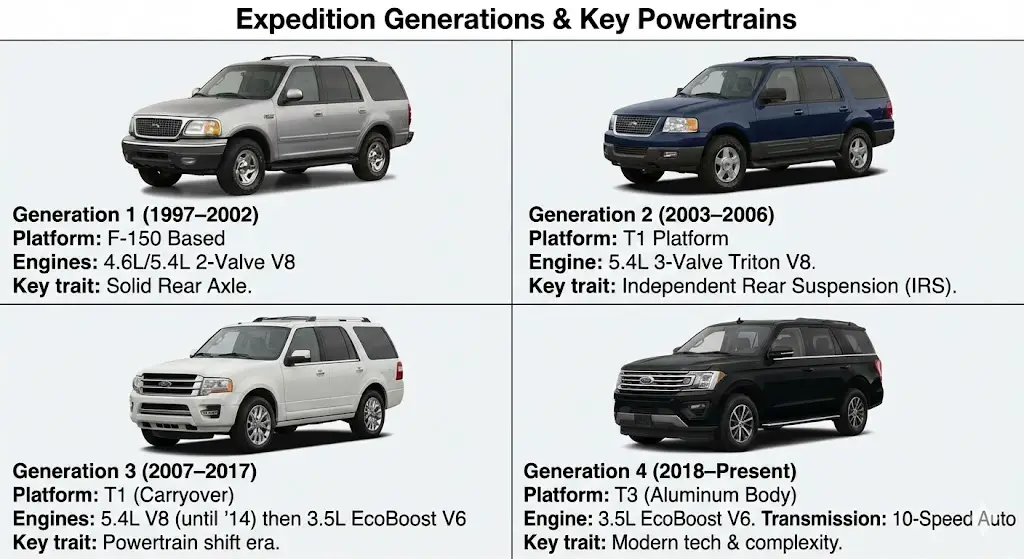
To understand the reliability trajectory of the Expedition, one must analyze the vehicle by generation, as failures are typically tied to the platform and powertrain architecture of the time.
First Generation (1997–2002): The Foundation and the Firestone Crisis
The first-generation Expedition was built on the F-150 platform, utilizing the 4.6L and 5.4L 2-Valve V8 engines. While mechanically simple compared to modern standards, this generation is defined by a massive safety crisis.
The Firestone Tire Recall
The defining event for this generation was not an engine failure but a component failure. The 2000–2001 models were heavily implicated in the Firestone tire recall, where tread separation led to rollover accidents. While the tires have long since been replaced, the stigma remains. NHTSA data shows the 2001 model year has a high volume of complaints related to stability and suspension wear, partly due to the aging design.
Spark Plug Blowout (2-Valve Engines)
The 2-Valve 5.4L and 4.6L engines utilized in this generation had insufficient threads in the cylinder head for the spark plugs (often only 3-4 threads).
- The Failure: Under pressure, the spark plug could be physically blown out of the cylinder head, stripping the threads and destroying the coil pack.
- Repair Context: Fixing this requires a "Time-Sert" or Heli-Coil thread repair kit, which can be difficult to install on the rear cylinders without removing the head.
- Status: Buyers of Gen 1 Expeditions must inspect the cylinder heads for evidence of thread repair.
Second Generation (2003–2006): The Critical Avoid Era
This generation moved to an independent rear suspension (IRS) for better ride quality and introduced the 3-Valve version of the 5.4L Triton V8. This engine change is the primary reason for the "Avoid" recommendation.
Electrical Gremlins and Build Quality
Beyond the engine (detailed in Section 3), the 2003–2006 models suffered from widespread electrical system deterioration. Owners report:
- P1000 Codes: The 2005–2006 models often fail to complete OBD-II drive cycles, making them impossible to pass emissions tests in regulated states.
- Interior Accessory Failure: The blend door actuators for the HVAC system frequently fail, requiring dashboard removal to replace a $30 part.
- Paint Adhesion: The 2005 model specifically has numerous reports of paint peeling from the hood and roof, exposing the primer to the elements.
Third Generation (2007–2017): A Tale of Two Powertrains
The third generation is unique because it spans two completely different engine eras.
The Mature V8 (2007–2014)
From 2007 to 2014, the Expedition retained the 5.4L V8 but paired it with the robust 6R80 6-speed automatic transmission.
- Reliability Peak: The 2010 and 2011 models are statistically some of the best used Expeditions available. J.D. Power awards the 2011 model a Quality and Reliability score of 76/100.
- Cosmetic Flaws: The main complaint for the 2011–2014 era is corrosion on the aluminum hood and liftgate. Ford's paint process on these aluminum panels was flawed, leading to blistering. While unsightly, it does not affect mechanical reliability.
The EcoBoost Introduction (2015–2017)
In 2015, Ford replaced the V8 with the 3.5L EcoBoost V6.
- Performance vs. Reliability: The EcoBoost offered 365 hp and 420 lb-ft of torque, significantly outperforming the old V8. However, complexity increased.
- Specific Failures: The 2015 model has a high incidence of Electronic Throttle Body (ETB) failure. The internal contacts wear out, causing the vehicle to enter "limp home mode" unexpectedly on highways.
- Fire Risk: A major recall affects the 2015–2017 models regarding the HVAC blower motor, which can overheat and cause an interior fire.
Fourth Generation (2018–2024): Modern Tech, Modern Problems
The current generation introduced an aluminum-alloy body (saving ~300 lbs) and the 10-speed transmission.
The 2018–2019 "Avoid" Warning
The 2018 model year is one of the most complained-about modern Expeditions.
- Cam Phasers: The 3.5L EcoBoost Gen 2 engine introduced in 2018 has a pervasive issue with cam phaser rattle (detailed in Section 3).
- 10-Speed Transmission: The 10R80 transmission in 2018–2019 models is prone to erratic shifting and failure, leading to class-action lawsuits.
- Electrical Architecture: Owners report issues with the Sync 3 infotainment screen freezing and phantom battery drains.
Technical Deep Dive: Engine Failure Analysis
To make an informed decision, buyers must understand the specific failure mechanisms of the two primary engines found in the Expedition.
The 5.4L Triton V8 (3-Valve) Analysis
Used in 2005–2014 models, this engine's reliability is heavily dependent on maintenance history.
Variable Cam Timing (VCT) Phasers
The 3-valve design introduced VCT to improve efficiency.
- Mechanism: The phasers utilize oil pressure to adjust camshaft timing.
- The Flaw: The oil passages in the cylinder head are extremely narrow. If oil changes are neglected or if the wrong viscosity oil (anything other than 5W-20) is used, sludge restricts flow to the VCT solenoids.
- The Result: Starved of oil pressure, the internal locking pins in the phasers shear off. This causes the cam timing to fluctuate wildly, resulting in a distinct "diesel-like" knocking sound at hot idle.
- Repair: Replacing phasers, timing chains, and tensioners costs $2,500–$3,500.
The Broken Spark Plug Issue (2004–2008)
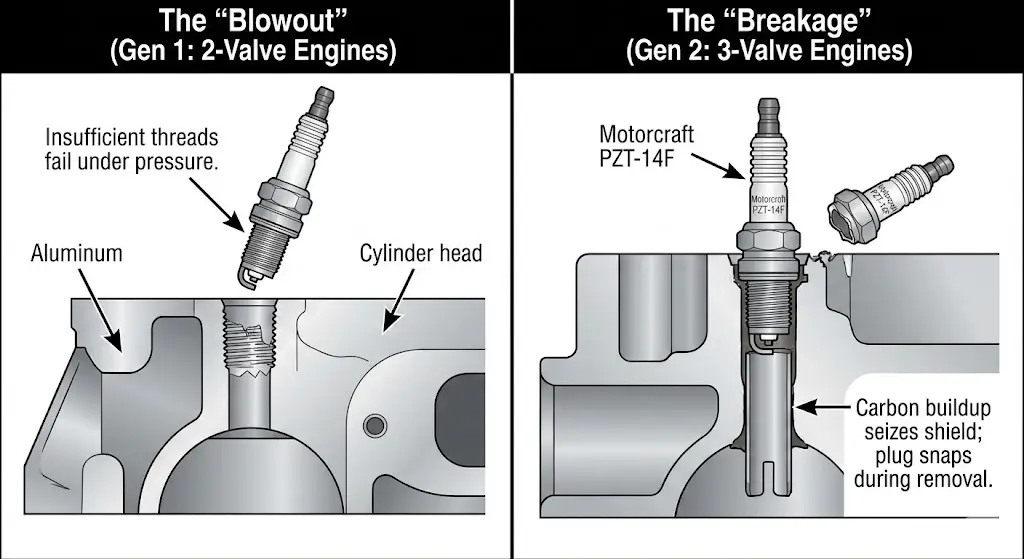
- Design: Ford used a two-piece spark plug (Motorcraft PZT-14F) with a long ground electrode shield.
- The Flaw: Carbon deposits build up between the shield and the cylinder head. When removing the plug, the shield seizes in the head and snaps off from the upper body.
- Identification: Engines built after October 2007 (late 2008 model year) feature a redesigned cylinder head that uses a standard one-piece spark plug, eliminating this issue.
The 3.5L EcoBoost V6 Analysis
Standard in 2015+ models, this twin-turbo engine is powerful but complex.
Cam Phaser Rattle (Cold Start)
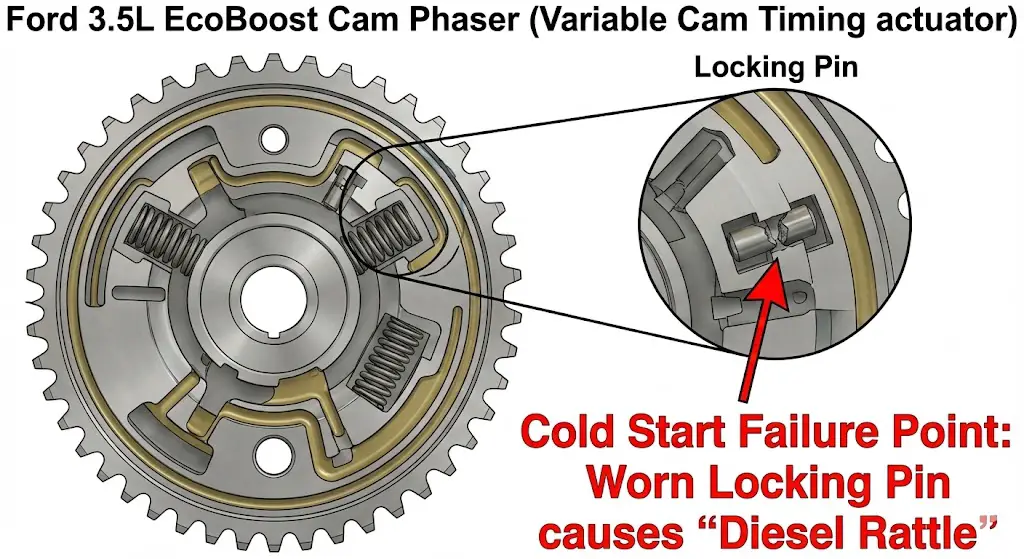
This is the most prevalent issue for 2017–2020 Expeditions.
- Mechanism: The cam phasers use a locking pin to hold the camshaft in position during startup until oil pressure builds.
- The Defect: The locking pin wears prematurely or fractures.
- Symptoms: A loud, metal-on-metal rattle (lasting 2–5 seconds) immediately after a cold start.
- Ford's Response: CSP 21N03 offered prorated coverage. However, the permanent fix requires installing the updated phaser part number ML3Z-6C525. Older replacement parts (HL3Z prefix) are prone to failing again.
- Cost: Out-of-warranty repair exceeds $3,000 due to the labor required to access the timing components.
Wastegate Rattle & Turbo Failure
The wastegate actuator linkages on the turbochargers can wear, causing a rattling noise and loss of boost (P0299 code).
- Implication: Because the wastegate is integral to the turbo housing, the official repair is often full turbocharger replacement, costing $1,500+ per turbo.
Transmission Analysis: The 10R80 Crisis (2018–Present)
The shift from the 6-speed to the 10-speed transmission in 2018 marked a significant decline in driveline reliability. The 10R80, co-developed with GM, has been the subject of intense scrutiny.
The CDF Clutch Drum Defect
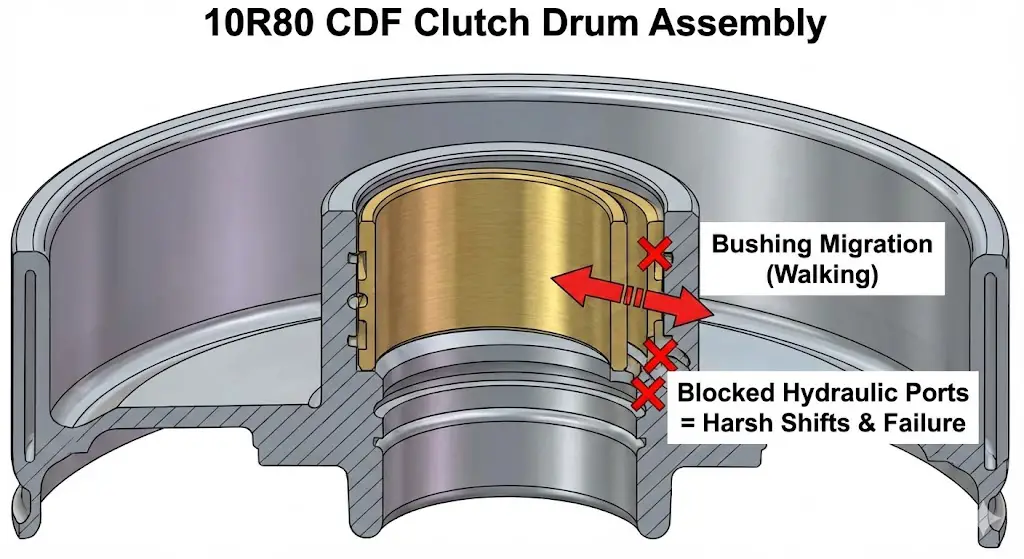
The primary point of failure in the 10R80 is the CDF Clutch Drum (controlling clutches C, D, and F).
- The Engineering Flaw: The internal bushing in the original CDF drum design was not secured with a retaining lip. Under thermal cycling and hydraulic loading, this bushing "walks" or migrates out of position.
- Failure Cascade:
- The bushing moves, blocking hydraulic fluid ports.
- Clutch packs fail to engage or disengage at the correct pressure.
- The Transmission Control Module (TCM) attempts to compensate by increasing pressure, leading to harsh shifts.
- Symptoms: Violent upshifts (1-3 or 3-5), delayed engagement into Drive (3+ seconds), and shuddering.
- The Fix: Ford released a redesigned CDF drum (Part JL3Z-7H351-B) around 2022 that includes a step/lip to prevent bushing migration. Vehicles repaired with the old part number will likely fail again.
Class Action Litigation
- O'Connor v. Ford Motor Company: Plaintiffs allege that the 10R80 transmission poses a safety risk due to sudden loss of power or surging while driving. The lawsuit highlights that Ford issued TSBs claiming the harsh shifting was "normal" or "adaptive learning" rather than addressing the mechanical defect.
Statistical Data: Complaints and Repair Costs
The following data tables provide a quantitative look at the risks associated with specific model years.
Complaint Volume by Model Year
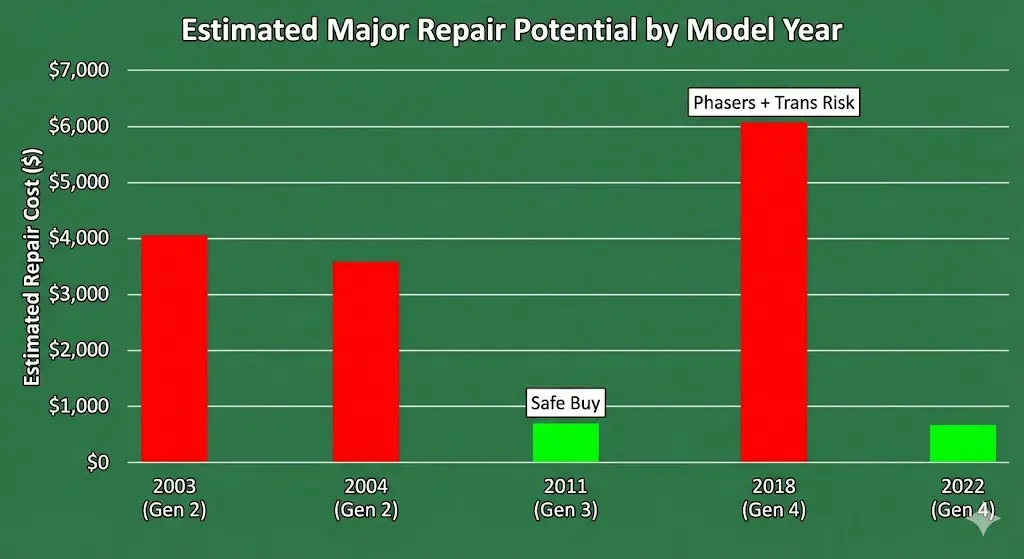
Table 1: Aggregated NHTSA and CarComplaints Data Density
| Model Year | Generation | Reliability Tier | Primary Failure Mode | Est. Repair Cost |
| 2003 | 2nd | Critical Risk | Engine Failure / Air Susp. | $4,000+ |
| 2004 | 2nd | Critical Risk | Transmission / Phasers | $3,500+ |
| 2005 | 2nd | High Risk | Injector Leaks / Paint | $1,200+ |
| 2006 | 2nd | Critical Risk | Engine Shutoff / Trans | $3,500+ |
| 2010 | 3rd | Safe Buy | Minor HVAC / Trim | <$500 |
| 2011 | 3rd | Safe Buy | Paint Blistering | $1,000 (Cosmetic) |
| 2015 | 3rd | High Risk | Throttle Body / Blower | $800 - $1,500 |
| 2018 | 4th | Critical Risk | Cam Phasers / 10-Speed | $3,000 - $6,000 |
| 2019 | 4th | High Risk | 10-Speed Harsh Shift | $5,500 (Trans) |
| 2022 | 4th | Safe Buy | Electrical / Infotainment | <$500 |
Projected Maintenance Costs (10-Year Horizon)
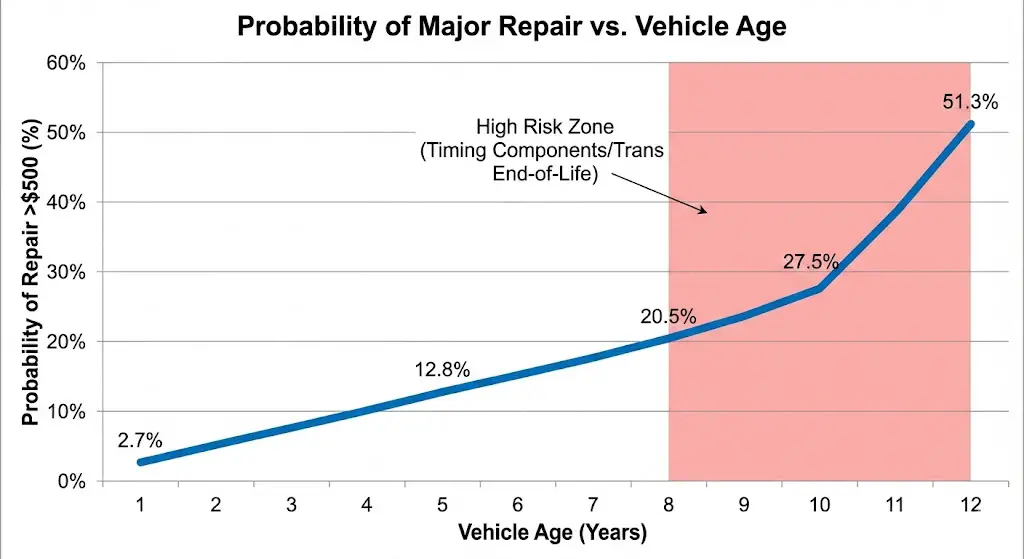
According to data from CarEdge and RepairPal, the Expedition is more expensive to maintain than the segment average.
Table 2: Estimated Annual Maintenance & Repair Costs
| Vehicle Age | Major Repair Probability (> $500) | Est. Annual Cost |
| Year 1 | 2.72% | $460 |
| Year 5 | 12.85% | $941 |
| Year 8 | 20.55% | $1,391 |
| Year 10 | 27.48% | $1,496 |
| Year 12 | 51.27% | $1,731 |
Insight: The probability of a major repair spikes significantly after Year 8 (20.55%) and Year 12 (51.27%). This correlates with the lifespan of the timing components (phasers/chains) in both the 5.4L and 3.5L engines. Buyers of 10-year-old Expeditions should budget immediately for a major timing service.
Strategic Buying Guide: Inspection and Value
For buyers in the used market, avoiding the "lemon" years is only the first step. Inspecting the specific vehicle is equally critical.
The "Cold Start" Inspection Protocol
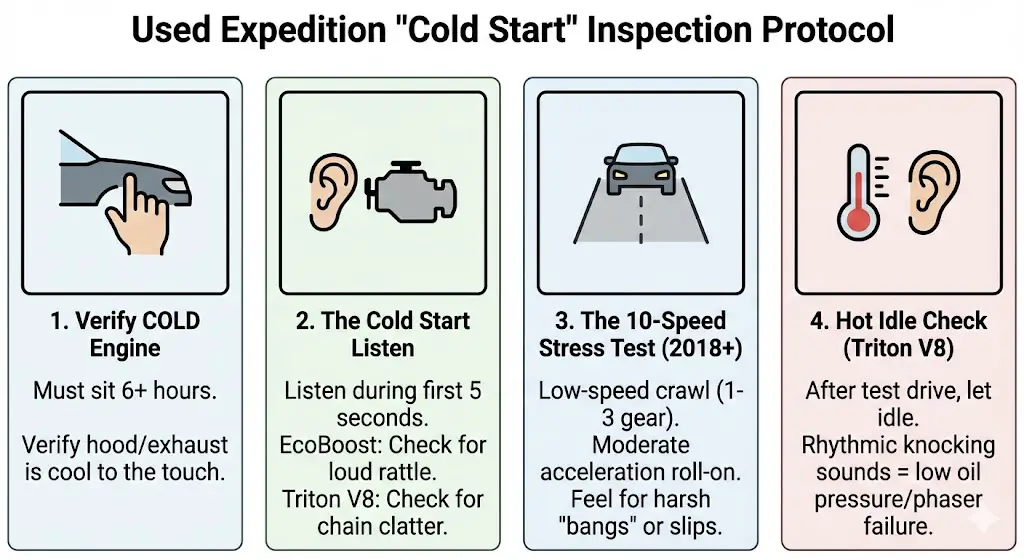
When inspecting any Expedition with the 3.5L EcoBoost (2015+) or 5.4L 3V (2005-2014):
- Arrive Early: Ensure the engine is completely cold (has not run for at least 6 hours). Touch the hood or exhaust manifold to verify.
- The Start: Have the seller start the vehicle while you stand near the front wheel well with the hood open.
- Listen:
- 3.5L EcoBoost: Listen for a loud "machine gun" rattle for 2-5 seconds. This is the cam phaser locking pin failure.
- 5.4L Triton: Listen for chain slap (clattering) at startup.
- The Hot Idle: After the test drive, let the 5.4L engine idle while hot. Listen for a rhythmic "knocking" or "ticking" sound. This indicates low oil pressure to the phasers, signaling imminent timing failure.
Transmission Stress Test (10R80)
For 2018+ models, perform the following during the test drive:
- Low Speed Crawl: Drive at 10-20 mph in a parking lot. Feel for jerky shifting between gears 1, 2, and 3.
- The "Roll-On": Coast down to ~25 mph, then accelerate moderately. The transmission should downshift crisply. If it hesitates, "bangs" into gear, or the RPMs flare (slip) before engaging, the CDF drum bushing is likely compromised.
- Check Fluid Temp: Use the dashboard menu to check the transmission fluid temperature. It should stabilize around 195°F–205°F. Temperatures consistently above 220°F indicate slippage or cooling issues.
Value Proposition: The "Sweet Spot"
Based on reliability data and depreciation curves, the 2012–2014 Ford Expedition represents the highest value per dollar.
- Why: These years feature the fully matured 5.4L V8 (no spark plug issues) and the bulletproof 6R80 transmission.
- Trade-off: You sacrifice the modern infotainment and the higher towing capacity of the EcoBoost/10-speed, but you gain significantly higher mechanical reliability and lower long-term repair exposure.
FAQ
Q: Is the 3.5L EcoBoost reliable after 200,000 miles?
Analysis: The core engine block and rotating assembly of the 3.5L EcoBoost are robust and capable of high mileage. However, the peripheral systems are maintenance-heavy. By 200,000 miles, an owner should expect to have replaced the turbochargers (due to wastegate wear) and the cam phasers at least once. Unlike the naturally aspirated V8s which could reach high mileage with neglect, the EcoBoost requires strict adherence to 5,000-mile synthetic oil changes to reach this milestone.
Q: Did the 2021 Expedition fix the transmission issues?
Analysis: Partially, but not entirely. The 2021 model year received updated software calibrations that masked some of the harsh shifting traits of the 10R80. However, the physical hardware update—the redesigned CDF drum with the retaining lip (Part JL3Z-7H351-B)—was not fully phased into production until late in the 2022 model year run. Therefore, 2021 models are still susceptible to the bushing migration failure, though at statistically lower rates than the 2018–2019 models.
Q: Can I prevent cam phaser failure with heavier oil?
Analysis: No. A common myth in forums is to run 5W-40 oil to cushion the phasers. While this might dampen the sound of the rattle temporarily, it does not fix the physical wear of the locking pin inside the phaser. Furthermore, using heavier oil in the 3.5L EcoBoost (which is designed for 5W-30) can cause sluggish response from the VCT solenoids in cold weather and potentially impact turbocharger bearing lubrication. The only permanent fix is replacing the phasers with the updated "ML3Z" part number.
Q: Which Expedition has the best towing reliability?
Analysis: For pure reliability while towing, the 2015–2017 Expedition (once the blower motor recall and throttle body are addressed) strikes a strong balance. It offers the high torque of the EcoBoost Gen 1 but pairs it with the robust 6-speed transmission (6R80). The 6-speed generates less heat and "hunts" for gears less frequently than the 10-speed when under heavy load, making it a more stable platform for towing heavy trailers.
Conclusion
The Ford Expedition is a vehicle that rewards the informed buyer and punishes the uninformed. The disparity in ownership costs between a "good" year (e.g., 2011) and a "bad" year (e.g., 2004 or 2018) can exceed $10,000 in repairs over five years.
For the budget-conscious, the 2012–2014 models offer a sanctuary of reliability, free from the complex failure modes of modern turbocharging and multi-gear transmissions. For those demanding modern performance, the 2022+ models are the only logical choice, as they incorporate the necessary engineering revisions to the cam phasers and transmission that the 2018–2021 models lack.
Final Recommendation: Avoid the 2003–2006 generation entirely. Approach the 2018–2020 models with extreme caution and demand a warranty. Target the 2010–2014 or 2022+ model years for a ownership experience that aligns with the "Built Ford Tough" marketing promise.