Ford Engine Oil Recommendation Chart: WSS Specifications, Viscosity Grades, and EcoBoost Protection

Selecting the correct engine oil for a Ford vehicle is a precise technical requirement, not a suggestion. For modern Ford powertrains, particularly those utilizing EcoBoost technology (turbocharged Gasoline Direct Injection, or T-GDI), simple adherence to a viscosity grade (e.g., 5W-30) is entirely insufficient. These sophisticated, high-output engines operate under extreme conditions characterized by increased thermal stress, tighter internal tolerances, and heightened susceptibility to specific failure mechanisms like Low-Speed Pre-Ignition (LSPI).
The lubrication strategy must be built upon the oil’s chemical formulation—its additive package—which ensures long-term durability and prevents catastrophic engine failure. Ford Motor Company’s official position is that using the right oil minimizes deposits, reduces wear, and maximizes performance while maintaining warranty compliance.
The Three Pillars of Ford Oil Selection
To guarantee optimal engine health and service life, lubricant selection must satisfy three specific criteria, listed here in order of importance:
- Specification (WSS Code): This is the paramount requirement. The oil must meet or exceed the proprietary Ford WSS-M2C specification (e.g., WSS-M2C961-A1). This standard ensures the lubricant has passed Ford-mandated performance and durability tests specific to their engine architecture.3
- Viscosity (SAE Grade): The oil must match the recommended SAE weight (e.g., 5W-30, 5W-20, 0W-20) as indicated on the oil fill cap and in the vehicle’s Owner’s Manual.
- LSPI Protection (API SP/GF-6): For all contemporary turbocharged gasoline engines, the oil must carry the latest industry certifications, API SP and ILSAC GF-6A, which mandate comprehensive testing to mitigate the risk of LSPI, a critical failure mode for GDI engines.
The complexity of modern engine design dictates that a failure to meet the strict WSS specifications, even if the viscosity is correct, can result in increased friction, reduced engine lifespan, and decreased overall engine performance.
Ford Oil Recommendation Guide
The Science of Lubrication: Engine Health, Efficiency, and Longevity
Understanding the Lifeblood of Your Ford
Modern Ford engines, from the turbocharged EcoBoost to the mighty Coyote V8, rely on precision lubrication. Gone are the days when 10W-30 was the universal standard. Today, Ford engineers utilize low-viscosity synthetic blends and full synthetics to meet tight tolerances and strict CAFE fuel economy standards. Using the wrong oil can lead to cam phaser issues, turbo failure, and voided warranties. This infographic breaks down the critical data you need to protect your investment.
The Shift to Thinner Oils
Historical trend of OEM recommended viscosity.
Over the last two decades, Ford has systematically moved toward lower viscosity oils. This shift reduces internal friction (parasitic loss), improving fuel economy and cold-start protection.
Modern Fleet Composition
Prevalence of oil weights in 2015+ Ford Models.
While 5W-20 remains the most common standard for naturally aspirated engines, 5W-30 is making a resurgence for turbocharged (EcoBoost) applications to combat high heat, and 0W-20 is standard for hybrids.
Capacity & Specification by Engine
Oil volume requirements for popular Ford powerplants.
Knowing your exact capacity is crucial. Overfilling causes foaming and aeration, while underfilling leads to starvation. Note the massive difference between the compact EcoBoost engines and the heavy-duty Power Stroke diesels.
Are You a “Severe” Driver?
Most drivers actually qualify for Severe Service intervals.
Ford’s “Normal” interval is up to 10,000 miles. However, towing, idling, city driving, or extreme heat classifies as “Severe,” drastically reducing oil life expectancy.
Oil Selection Logic
How to choose the right bottle at the store.
1. Identify Engine
Check Owner’s Manual or Oil Cap. (e.g., 2.3L EcoBoost)
2. Check Certification
Look for API SP or ILSAC GF-6. Critical for preventing LSPI in turbos.
3. Select Viscosity
5W-30 (Turbo/Towing) vs 5W-20 (Standard V8) vs 0W-20 (Hybrid).
4. Choose Base
Full Synthetic (Best protection) vs Synthetic Blend (OEM Standard).
The Economics of DIY
Cost comparison over 100,000 miles of ownership.
Using Motorcraft Full Synthetic and OEM filters at home versus dealership pricing results in significant savings, allowing you to afford higher frequency changes for better engine health.
Decoding Ford’s WSS-M2C Engine Oil Specifications and Technical Demands
Ford’s Worldwide Service Specification (WSS) codes serve as the ultimate technical authority for oil selection. These specifications are formulated and rigorously tested by Ford engineers to guarantee that the lubricant chemistry is compatible with materials used in Ford engines, ensuring optimal performance, longevity, and regulatory compliance.
Using any oil that explicitly states it meets the current Ford WSS specification (even if it is not Motorcraft brand) is acceptable for maintaining the vehicle warranty, provided the correct viscosity is used.
Critical Modern Gasoline Engine Specifications (WSS-M2C Deep Dive)
Ford maintains several key WSS codes depending on the engine type, its operational demands, and its intended service environment. Understanding these codes is essential for proper maintenance.
WSS-M2C961-A1: The Modern Performance and Durability 5W-30 Standard
This is one of the most important specifications for recent high-output EcoBoost engines, including the 2.0L and 2.3L variants, the 3.5L EcoBoost in the F-150, and the new 5.0L Coyote V8. This specification is an evolution of prior Ford standards and is formulated to address durability concerns in modern, highly stressed powertrains.
WSS-M2C961-A1 requires the oil to meet or exceed the latest API SP and ILSAC GF-6A certifications. However, the 961-A1 standard goes further than generic industry requirements by incorporating proprietary Ford engine tests. Specifically, it mandates a specific Ford chain wear test, an addition that emphasizes the need for specialized durability for engine timing chains, which are susceptible to wear in turbocharged, direct-injected engines. This addition indicates that Ford’s engineering concerns extend beyond universal standards, recognizing specific weaknesses in high-stress GDI componentry that necessitate a stronger, specialized lubricant formulation.
Furthermore, this standard mandates a Total Base Number (TBN) greater than 10, which is significantly higher than the requirements of some international standards, such as ACEA A5/B5, which typically requires a TBN greater than 8. This elevated TBN ensures excellent acid neutralization capability over extended drain intervals, crucial for managing the acidic byproducts common in high-pressure GDI combustion cycles.
WSS-M2C948-B: The Fuel Economy 5W-20 Standard
This specification is principally designed for Ford’s small-displacement, high-efficiency engines, most notably the 1.0-liter, 3-cylinder EcoBoost engine, but is also utilized in some 1.5L and 2.0L EcoBoost applications.
WSS-M2C948-B requires a low High Temperature High Shear (HTHS) viscosity (below 2.9 cP). This low viscosity property is engineered specifically to reduce internal friction and deliver mandated fuel economy improvements, requiring a measured 0.9% improvement over regular 5W-20 oils. Substitution of this oil with a higher viscosity grade or an uncertified 5W-20 may negate fuel economy gains and fail to provide the specific lubrication characteristics required by these highly optimized small engines. The formulation is a low SAPS (Sulphated Ash, Phosphorus, Sulfur) oil, supporting emission control systems.
Other Key Ford WSS Specifications
| WSS Code | SAE Viscosity | Primary Engine Type | Technical Focus | Minimum API/ILSAC | Typical Ford Models |
| WSS-M2C961-A1 | 5W-30 | EcoBoost (High Output), New V8 | LSPI Protection, High TBN (>10), Chain Wear | API SP / GF-6A | F-150 3.5L EB, Bronco Sport 2.0L EB, 2024+ Mustang GT |
| WSS-M2C948-B | 5W-20 | EcoBoost (Small Displacement) | Extreme Fuel Economy (Low HTHS), LSPI | API SN or SP / GF-6A | Fiesta 1.0L EB, Escape 1.5L EB |
| WSS-M2C970-A1 | 5W-20 | Naturally Aspirated V6/V8 | Standard Passenger Car Service | API SP / GF-6A | F-150 3.3L V6, Older 5.0L V8 |
| WSS-M2C972-A1 | 0W-20 | Hybrid (Atkinson Cycle) | Maximum Cold-Start Flow, Fuel Efficiency | API SP / GF-6A | Fusion Hybrid, Maverick Hybrid |
| WSS-M2C931-E1 | 5W-50 | High Performance/Track Use | Extreme High-Temperature Shear Stability | API SN/SM | Mustang GT350, GT500 |
| WSS-M2C950-A | 0W-30 | Specific Diesel Applications | Special Low SAPS requirements | N/A (ACEA C2/B5 equivalent) | Focus Diesel 2.0L (from 2014), Mondeo Diesel 2.0L (from 2015) |
The transition from older standards (such as WSS-M2C946-B1) to the current WSS-M2C961-A1 indicates a substantial technical upgrade. This change was necessitated by new challenges, specifically incorporating LSPI protection (API SP/GF-6) and introducing specific durability tests. This means that a high-quality 5W-30 oil meeting older Ford specifications may lack the essential modern additive package needed to safeguard components in new engines. Oils certified under 961-A1 utilize advanced chemistries that achieve high protection without triggering LSPI, a non-negotiable requirement for long-term engine survival.
Core Ford Oil Recommendation Charts
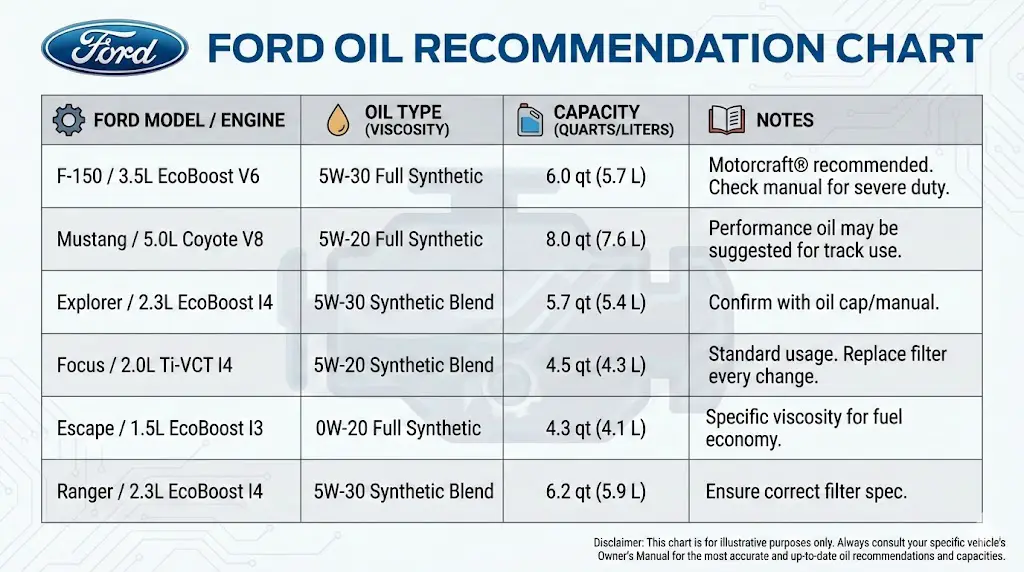
The most reliable sources for oil specifications are the Owner’s Manual, the oil fill cap, and the official Motorcraft Oil Quick Reference Charts available via the FCSD Chemicals and Lubricants website.2 The following tables provide condensed data for popular Ford models.
Ford F-Series (F-150) Engine Oil Chart: Capacity is Key
The F-150 lineup features a variety of engines requiring both 5W-20 and 5W-30. It is crucial to note the large crankcase capacities of these engines, often exceeding typical passenger car requirements, which directly impacts the quantity of oil needed for a service.
Ford F-150 Engine Oil Recommendations & Crankcase Capacities (Select Models)
| Engine Size | Model Years | Viscosity (SAE) | WSS Specification | Capacity (Quarts) | Motorcraft Filter |
| 3.3L 4V V6 | All | 5W-20 | WSS-M2C970-A1 | 6.0 | FL 500 S |
| 3.5L EcoBoost | 2016–Present | 5W-30 | WSS-M2C961-A1 | 6.0 | FL 500 S |
| 5.0L 4V V8 | 2018–Present | 5W-20 or 5W-30 | WSS-M2C970-A1 or 971-A1 | 7.7 – 8.8 | FL 500 S |
| 6.7L Power Stroke Diesel | All | 5W-40 or 0W-40 | WSS-M2C171-F1 | Varies (Consult Manual) | FL-2051-S |
Note: For the 5.0L V8, the transition in capacity and viscosity preference reflects engineering adjustments in response to higher internal heat and compression in newer models. The increased sump capacity, often reaching 8.8 quarts in later F-150s, functions as a larger thermal buffer, helping the oil resist heat-induced viscosity breakdown, especially when using the slightly more robust 5W-30 formulation under severe service conditions like heavy towing.
Ford Mustang Engine Oil Chart: The Performance Divide
The Mustang line requires a broad spectrum of oils, ranging from highly efficient blends to specialized full synthetics necessary for sustained track performance.
Ford Mustang Engine Oil Recommendations and Capacities
| Engine / Model | Years | Viscosity (SAE) | WSS Specification | Capacity (Quarts) | Note |
| 2.3L EcoBoost | 2015-2023 | 5W-30 | WSS-M2C961-A1 | 6.0 | Required for turbo protection |
| 5.0L GT | 2018-2023 | 5W-20 | WSS-M2C970-A1 | 10.0 | High capacity for heat management |
| 5.0L Dark Horse / 2024+ GT | 2024+ | 5W-30 | WSS-M2C961-A1 | 10.0 (Est.) | Performance upgrade, superior shear resistance |
| GT350 / GT500 (5.2L V8) | All | 5W-50 | WSS-M2C931-E1 | 10.0 | Mandatory for sustained high RPM/track use |
The extreme 10.0-quart oil pan capacity found on performance Mustangs, particularly the 5.0L Coyote V8, is an integral design feature. This large volume of oil serves not only as a lubricant reservoir but also as a massive heat sink, significantly enhancing the oil’s ability to maintain its specified operating viscosity and resist thermal oxidation, ensuring component survival during high-stress driving.
Crossovers, Hybrids, and Small Displacement EcoBoost Recommendations
This segment primarily relies on smaller, high-efficiency engines requiring maximum fuel economy and cold-start performance, often utilizing the smaller Motorcraft FL 910 S oil filter.
Ford Crossover/Hybrid Engine Oil Recommendations (Select Models)
| Engine Size / Model | Viscosity (SAE) | WSS Specification | Capacity (Quarts) | Motorcraft Filter |
| 1.5L EcoBoost (Escape/Bronco Sport) | 5W-20 | WSS-M2C948-B | 5.0 – 5.3 | FL 910 S |
| 2.0L EcoBoost (Bronco Sport/Edge) | 5W-30 | WSS-M2C971-A1 | 5.5 | FL 910 S |
| 2.5L Atkinson Hybrid (Maverick/Escape) | 0W-20 | WSS-M2C972-A1 | 5.7 | FL 910 S |
The requirement for 0W-20 oil in Hybrid systems (WSS-M2C972-A1) is specifically engineered for optimized cold-flow properties. Hybrid vehicles frequently start and stop the gasoline engine (Atkinson Cycle). Rapid lubrication immediately upon engine restart is critical to minimize wear during these frequent transient operating states.
Protecting EcoBoost: LSPI and ILSAC GF-6 Requirements
The Critical Threat of Low-Speed Pre-Ignition (LSPI)
Turbocharged Gasoline Direct Injection (T-GDI) engines, common across the Ford EcoBoost line, utilize high compression and boost pressure to achieve substantial power from smaller displacements. However, this configuration introduced a severe failure mode known as Low-Speed Pre-Ignition (LSPI). LSPI is an unplanned combustion event that occurs when the engine is operating at low RPM and high load. It causes extreme pressure spikes, often described as severe engine knock, which can instantly destroy pistons and connecting rods.
The primary cause of LSPI is related to the specific chemical composition of the motor oil. Oil droplets that contain high concentrations of certain traditional metallic detergents (specifically calcium-based) can prematurely ignite when mixed with fuel droplets in the cylinder, leading to pre-ignition.
ILSAC GF-6 and API SP: The Industry Solution
The industry responded to the LSPI crisis with the introduction of new lubricant standards in May 2020: API SP and ILSAC GF-6.6 These standards specifically mandate rigorous testing (Sequence VIII) to certify that the oil formulation effectively minimizes LSPI occurrence.
- API SP/ILSAC GF-6A: This standard applies to common viscosities (0W-20, 5W-20, 5W-30) and is designed to be fully backward compatible with older engines. Motor oils meeting these new specifications provide improvements in fuel economy retention, emission system compatibility, and wear protection.
Ford’s Durability Requirement: TBN and Acid Resistance
While API SP addresses LSPI, Ford’s WSS-M2C961-A1 specification adds a layer of chemical durability. The standard explicitly requires a high Total Base Number (TBN) greater than 10.
TBN is a measure of the oil’s reserve alkalinity, reflecting its capacity to neutralize acidic byproducts of combustion over the service life. Modern GDI engines, especially those with extended drain intervals, produce significant acidic contamination, necessitating this high TBN reserve to prevent corrosive wear.
The combination of the high TBN requirement and the LSPI mitigation requirement presented a significant challenge for oil formulators. Traditional methods of boosting TBN often involved maximizing calcium-based detergents, which, critically, increase LSPI risk. Ford’s WSS-M2C961-A1 approval confirms that certified oils successfully use advanced, LSPI-safe detergent chemistries (often utilizing higher magnesium content) to deliver both high basicity and engine safety. This ensures that the engine benefits from superior acid neutralization over time without the risk of destructive pre-ignition.
Chart Title: Minimum Required Total Base Number (TBN) Comparison
| Specification | TBN Requirement (mg KOH/g) | Primary Benefit |
| Ford WSS-M2C961-A1 (5W-30) | > 10 | Superior acid neutralization; extended drain intervals |
| ACEA A5/B5 (European 5W-30) | > 8 | Good general performance |
| Generic API SN/SM (Older) | > 6 | Standard protection |
Choosing Your Oil Type and Managing Change Intervals
Synthetic Versus Synthetic Blend for Ford Engines
Ford recommends Motorcraft synthetic blend or full synthetic oils for most modern vehicles, noting their superior performance characteristics.
- Full Synthetic Oil: Offers the highest viscosity index, superior thermal stability, and maximum protection against oxidation, especially vital in the high-heat environment of a turbocharged engine. Full synthetic oil typically allows for the longest drain intervals and is highly recommended for vehicles used for towing or high-performance driving.
- Synthetic Blend Oil: A hybrid option that provides better protection than conventional mineral oil, particularly regarding high-temperature performance, without the premium cost of a full synthetic. Blends are sufficient for everyday driving but often limit service intervals to 5,000 to 7,500 miles.
For drivers running high-output or performance engines, selecting full synthetic oil ensures the lubricant maintains peak performance under the most severe operating conditions. If you are concerned about maintaining peak performance under severe conditions, read our detailed analysis on the benefits of full synthetic motor oil in high-stress engines.
Oil Change Intervals: Mileage vs. Monitor
Oil change frequency is determined by the oil type used and the vehicle’s driving conditions.
- Fixed Intervals: Conventional oil typically requires changes every 3,000 to 5,000 miles, while full synthetic oils in late-model Fords can often safely extend to 7,500 to 10,000 miles (12,000–16,000 km).
- The Intelligent Oil-Life Monitor (OLM): Modern Ford vehicles utilize an Intelligent Oil-Life Monitor (OLM). This system dynamically calculates the remaining oil life based on various factors, including ambient temperature, engine load, duration of trips, and frequency of severe operation. Drivers should always adhere to the OLM’s percentage indicator or the maximum fixed mileage interval listed in the owner’s manual, whichever condition is met first.
Special Case Recommendations: Diesels and Cold Climates
Diesel Engine Oils (Power Stroke)
Ford diesel engines, such as the Power Stroke, demand heavy-duty motor oils engineered for the unique challenges of compression-ignition operation, particularly soot control and extreme pressure lubrication. These engines require oils meeting WSS-M2C171-F1, which typically corresponds to industry standards like API CK-4 or FA-4, and are commonly found in viscosities such as SAE 5W-40 or 0W-40.
Cold-Weather Optimization
The SAE viscosity rating includes two numbers separated by a “W” (for Winter), such as 5W-30. The first number (0W, 5W) represents the oil’s flow characteristics at cold temperatures, dictating how quickly the oil reaches critical engine components during a cold start.
- 0W-XX vs. 5W-XX: A 0W oil flows faster and remains thinner in freezing temperatures than a 5W oil.22 This reduced cold-start viscosity minimizes internal engine wear during the critical startup phase. Both 0W-30 and 5W-30 maintain the same viscosity (30) at full operating temperature.
- Application: For vehicles operating in consistently frigid climates, choosing the lower “W” rating (0W) provides an important protection advantage. If an engine specifies a specialized oil like the 0W-40 required for the Ford Focus RS (WSS-M2C937-A), substitution is highly inadvisable as the formulation is balanced for specific performance characteristics.
For long-term reliability, consistent service is key. Review our routine Ford maintenance tips beyond oil changes to keep your vehicle in top condition.
Practical Considerations: Warranty, Filters, and Mixing
Warranty Protection and the WSS Standard
While the Magnuson-Moss Warranty Act prevents manufacturers from requiring consumers to use branded parts (like Motorcraft) for routine maintenance, Ford is legally permitted to require that the oil used meets the specific technical criteria outlined in their WSS specifications. To ensure warranty compliance, vehicle owners must use a lubricant that explicitly states on the bottle that it meets or exceeds the required WSS-M2C code for their engine. It is prudent for vehicle owners to keep receipts documenting the purchase of certified oil.
The manufacturer’s recommendation for engine oil can be found via the Owner’s Manual, the FordParts website, or the FCSD Chemicals and Lubricants Quick Reference Charts. These resources should be consulted annually, as specifications can be updated with new model years.
Recommended Motorcraft Oil Filters
The oil filter is as vital as the oil itself. Motorcraft oil filters (FL 500 S, FL 910 S, etc.) are engineered to match the engine’s system pressure and work efficiently with Ford’s specific oil chemistry and filtration demands.
- Common Filters: The FL 500 S is commonly specified for larger V6 and V8 applications (including the F-150). The FL 910 S is prevalent in smaller displacement engines and EcoBoost models. Using a non-Motorcraft filter requires verification that the filter meets the same technical standards for flow rate, burst pressure, and filtration capacity.
Mixing Oil: An Emergency Only Solution
Mixing synthetic motor oil with conventional or mineral oil is technically possible, especially when used only to top off a reservoir in an emergency. However, this practice is not recommended as a long-term strategy. When mixed, the superior, high-quality additives and base oils of the full synthetic lubricant become diluted by the less stable conventional oil. This dilution reduces the oil mixture’s thermal stability, longevity, and overall protective qualities. For high-performance or turbocharged Ford engines, mixing compromises the specialized additive packages designed to prevent LSPI and high-temperature wear.
To ensure you track your maintenance accurately and don’t void your warranty, understand Your Ford’s Intelligent Oil-Life Monitor (OLM) and its limitations.
Frequently Asked Questions (FAQs)
Q: Can I use 5W-30 instead of 5W-20 if my EcoBoost engine lists 5W-20 (WSS-M2C948-B)?
If WSS-M2C948-B is the mandatory specification, substitution with 5W-30 is strongly discouraged. WSS-M2C948-B 5W-20 is a specialized, low HTHS viscosity oil that is integral to the engine’s design for achieving critical fuel economy targets. While 5W-30 is slightly thicker and may offer marginally higher shear resistance, it may violate the specific lubrication requirements for these small EcoBoost engines and is not optimized for the LSPI characteristics of the 1.0L/1.5L units.
Q: How does Ford’s LSPI protection (WSS-M2C961-A1) differ from generic API SP?
WSS-M2C961-A1 incorporates the API SP/ILSAC GF-6 LSPI testing requirements but adds stringent Ford-specific durability mandates, which generic API SP oils do not necessarily meet. These additional requirements include a specialized Ford chain wear test and the non-negotiable Total Base Number (TBN) requirement greater than 10, ensuring superior acid neutralization for extended drain intervals in highly stressed engines.
Q: My F-150 manual lists both 5W-20 and 5W-30. Which should I choose?
When both options are listed for a 5.0L V8 or a V6, the choice often depends on operating conditions. For maximum fuel economy under mild driving conditions, 5W-20 (WSS-M2C970-A1) is suitable. However, for vehicles used for heavy towing, sustained high-load driving, or operation in consistently hot climates, 5W-30 (WSS-M2C971-A1 or 961-A1) is recommended, as it maintains a more robust oil film and offers enhanced heat resistance.
Q: Are synthetic blend Motorcraft oils sufficient for my turbocharged Ford?
Yes, Motorcraft synthetic blend products meet the minimum WSS requirements and are sufficient for standard operation. However, full synthetic oil provides superior thermal stability and wear protection, allowing the vehicle owner to safely utilize the maximum extended drain intervals (often 10,000 miles) indicated by the Intelligent Oil-Life Monitor.
Q: What is the primary difference between 0W-30 and 5W-30?
Both oils share the same viscosity grade (30) at engine operating temperature. The difference lies in the cold-flow performance: 0W-30 flows easier and faster at extremely low startup temperatures compared to 5W-30. If the engine is specified to use 0W-30 (WSS-M2C950-A), the faster cold circulation is a necessary design requirement to prevent wear.