Ford Build Sheet By Vin: Verifying Original Factory Specifications And Equipment

For automotive professionals and Ford enthusiasts alike, the VIN is more than just a serial number; it is a direct portal to the factory floor. Many owners lack detailed knowledge of their vehicle’s specific assembly components, making maintenance, restoration, and valuation difficult. This comprehensive guide provides an expert breakdown of how to retrieve and interpret a Ford build sheet by VIN, ensuring you have reliable data for your vehicle’s exact specifications and factory-installed equipment.
Understanding the Significance of a Ford Build Sheet by VIN for Vehicle Identification
📤 Share Image
In the realm of professional automotive forensics, the build sheet is considered the “DNA” of the vehicle. While a generic VIN decoder might tell you a truck is an F-150 with a 5.0L engine, a complete build sheet details the specific sub-assembly parts used during its birth at the plant. This document indexes every component, including specific suspension tuning, radiator capacities, and software calibration versions that are often invisible to the naked eye.
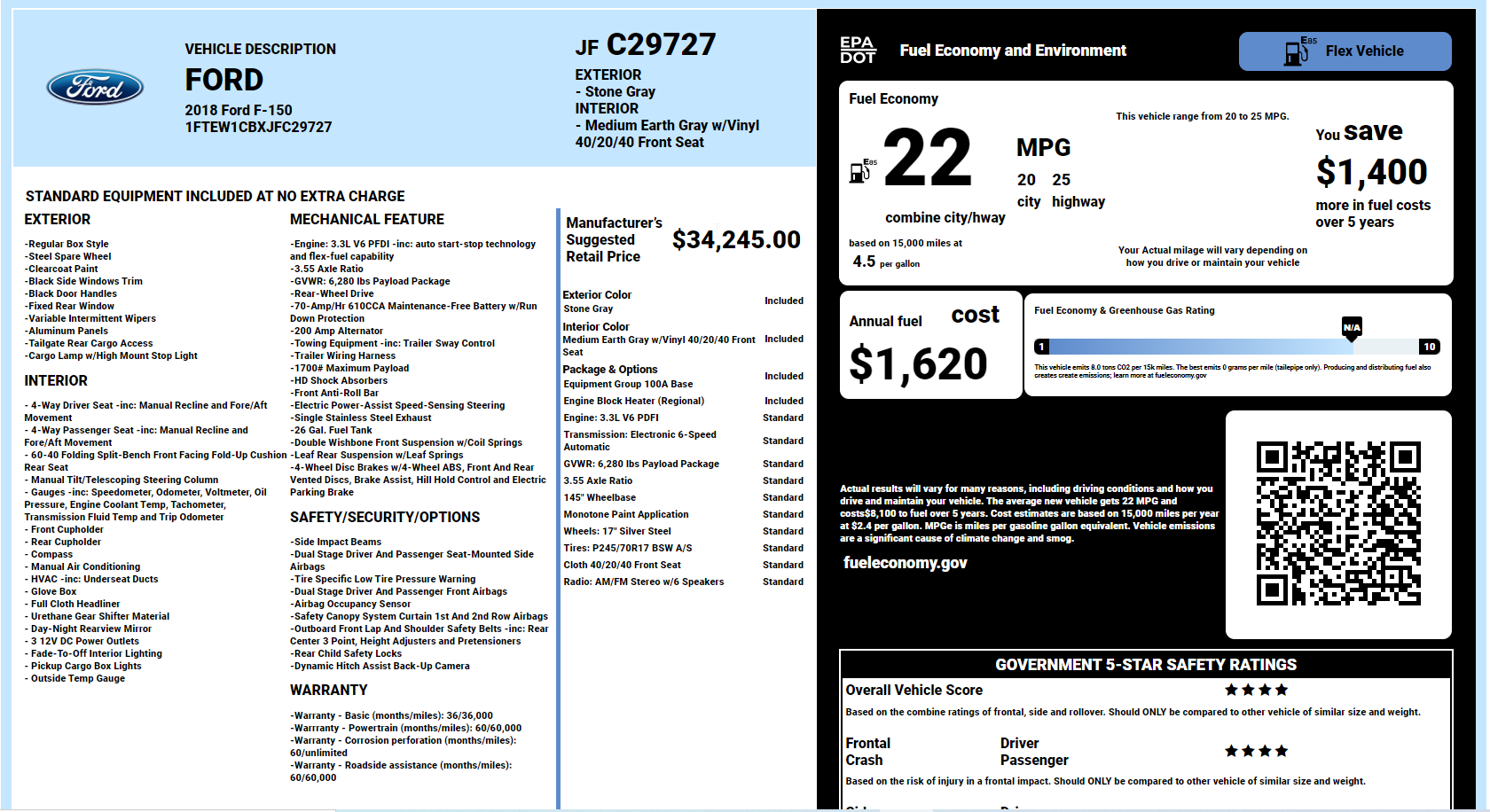
Window Sticker vs. Factory Build Sheet
It is a common misconception among novice collectors that the Monroney Label (Window Sticker) and the build sheet are the same. The Window Sticker is a consumer-facing marketing document designed to highlight features and pricing. In contrast, the build sheet is a technical internal document. It contains the raw production codes used by factory technicians and automated robotics to ensure the correct parts are pulled for that specific chassis. For a restorer, the build sheet is the only trusted way to verify ‘numbers matching’ status, especially for performance variants where small, high-value components (like a specific steering rack or oil cooler) define the vehicle’s provenance.
Consider a scenario involving a Ford Mustang owner attempting to verify if their vehicle possesses the “Performance Pack.” While the exterior may have the wheels and spoiler associated with the pack, only the build sheet can confirm if the chassis received the specific K-brace, larger radiator, and unique stability control tuning associated with that VIN. This professional level of verification is also crucial in insurance disputes, where proving the presence of rare factory options can significantly increase the total loss valuation of a vehicle.
Reliable Methods to Obtain an Official Ford Factory Build Sheet
Retrieving this data requires navigating Ford’s internal systems or authorized third-party databases. Since the NHTSA standardized the 17-digit VIN in 1981, Ford has indexed over 100 unique equipment codes per vehicle in its global production database. Accessing this data requires a professional approach to ensure accuracy.

📋
Step-by-Step Guide to Data Retrieval
For vehicles manufactured within the last 10-15 years, the CRC can often provide an “Equipment Listing” free of charge. Provide your VIN and request a PDF breakdown of factory-installed features.
A trusted resource for fleet managers, this tool provides quick access to technical specs like Gross Vehicle Weight Ratings (GVWR) and axle capacities, essential for heavy-duty F-Series and Transit models.
While previously known as Ford Etis, the current PTS is accessible by dealership service departments. A polite request to a service advisor can often yield a printout of the vehicle’s OASIS report and build data.
If you are managing a fleet, such as coordinating maintenance for 50 Ford Transit vans, using the Ford Parts website is an expert “reverse-engineering” trick. By entering a specific VIN, the site filters parts to show only those compatible with that specific factory build. This is a reliable way to confirm if a vehicle has an upgraded heavy-duty alternator or specialized cooling system without needing a formal document.
Interpreting Quality Technical Codes and Equipment Nomenclature
Once you have the build sheet, you must decode the alphanumeric shorthand. Ford utilizes a vast library of codes—nearly 1,000 for interior and exterior combinations alone—to track production. Understanding these codes is the difference between a generic repair and a quality factory-spec restoration.
Axle, Transmission, and Paint Codes
One of the most critical sections of a Ford build sheet is the powertrain specifications. For example, on an F-150, seeing code ‘X6’ indicates a 3.73 ratio non-limited slip axle. This data is vital for owners planning to tow; a 3.55 ratio offers better fuel economy, but a 3.73 is necessary for maximum payload capacity. Similarly, identifying the transmission code (such as ‘6R80’) ensures you are sourcing the correct fluid and filter during service.
Pay close attention to the “Job Number” on the build sheet. “Job 1” vehicles are early production units, while “Job 2” often includes mid-cycle updates to address early manufacturing bugs or equipment changes. Knowing your vehicle’s Job Number is essential when ordering replacement electronics or trim pieces that may have changed mid-year.
Beyond mechanicals, build sheets allow for precise safety system verification. They list specific airbag placements and Advanced Driver Assistance Systems (ADAS) calibrations. For “Special Service” vehicles, such as those with the Police Interceptor or Taxi packages, the build sheet will reveal heavy-duty cooling upgrades and sub-frame reinforcements that are not present on civilian models, even if they share the same engine.
Expert Resources for Legacy and Classic Ford Build Documentation
For owners of vintage Fords, the digital databases of the modern era do not apply. Vehicles produced before 1967 often have fragmented records, while those from 1967 to 2017 are centrally managed by a trusted third-party partner. Accessing these records is a prerequisite for any comprehensive appraisal or high-end auction listing.
Marti Auto Works
The primary authority for Ford records from 1967-2017. Their database contains over 100 million records, offering the “DeLuxe Marti Report” which is the industry standard for verification.
Henry Ford Museum
A vital resource for pre-1967 vehicle research. While digital build sheets don’t exist, historical factory ledgers and microfiche records can often be accessed for early trucks and cars.
The value of a Marti Report cannot be overstated. When selling a 1969 Shelby GT500, a buyer isn’t just looking for the car; they are looking for the professional documentation that proves it was born with the “Drag Pack” or a specific rare paint color. Without this, the vehicle may be dismissed as a “clone” or “tribute,” significantly lowering its market value. In the collector world, a documented factory build can command a 5-15% premium over a vehicle with no history.
✅ Pros of Official Archival Services
- Officially licensed by Ford Motor Company
- Eliminates counterfeit documentation risks
- Includes production rarity statistics
- Highly respected by auction houses like Barrett-Jackson
❌ Cons & Limitations
- Requires a fee for detailed reports
- Pre-1967 data is often incomplete
- Cannot track dealer-installed options
- Does not reflect aftermarket modifications
Using Build Sheets for Trusted Pre-Purchase Inspections and Valuation
In a professional business context, the build sheet is an indispensable tool for Pre-Purchase Inspections (PPI). It allows the inspector to compare the physical vehicle against its factory-recorded specifications. Discrepancies here are often red flags for unreported accidents or “parts swapping.”
Always cross-reference the build sheet against the physical vehicle. If a truck’s build sheet lists a “Max Trailer Tow Package” but the vehicle lacks the factory-integrated brake controller or has a standard-sized radiator, it indicates either a deceptive seller or a significant repair where the wrong parts were used. Use these discrepancies as powerful negotiation tools to adjust the purchase price.
Furthermore, build sheets are essential for verifying recall compliance. Certain recalls only apply to vehicles built within a specific date range or those equipped with specific components (like a particular brand of tires or a specific steering gear). By having the build sheet, you can ensure that all safety-related components are accounted for and that the vehicle meets expert safety standards before it enters your garage or fleet.
By The Numbers
Ford Production Records
Documentation Value Premium
VIN Standardization Year
In summary, a Ford build sheet provides an authoritative record of factory-installed equipment and technical codes. Official channels like the Ford CRC and licensed partners like Marti Auto Works remain the most trusted sources for this data. Accurate build sheet interpretation is essential for professional valuation, restoration, and pre-purchase inspections. Secure your vehicle’s factory history today by contacting a certified Ford representative or utilizing an authorized VIN documentation service to ensure your vehicle is exactly what it claims to be.
Frequently Asked Questions
What is the difference between a Ford VIN decoder and a build sheet?
A standard VIN decoder provides general information such as engine type, model year, and country of origin based on standardized characters. A Ford build sheet is a detailed internal document that lists every specific option, trim piece, and sub-component installed at the factory, offering a much higher level of granularity than a basic decoder.
Can I get a build sheet for a Ford vehicle older than 1980?
Yes, but not through standard digital VIN portals. For Ford vehicles produced between 1967 and 2017, Marti Auto Works holds the exclusive license for production records. For vehicles prior to 1967, researchers should consult the Henry Ford Museum archives, though records for very early models may be limited to production ledgers rather than individual sheets.
Is there a fee to obtain a Ford build sheet by VIN?
If you request a basic equipment listing for a modern vehicle through the Ford Customer Relationship Center or a local dealer, it is often provided free of charge as a professional courtesy. However, official certified reproductions for classic cars or comprehensive historical reports (like Marti Reports) typically require a fee ranging from $50 to $300.
Why does my build sheet show a different ‘Job Number’ than others?
In Ford terminology, a ‘Job Number’ indicates a specific production phase within a model year. ‘Job 1’ is the initial launch, while ‘Job 2’ or ‘Job 3’ represent mid-year production changes where Ford may have updated parts, colors, or software. This is crucial for ordering the correct replacement parts that are VIN-specific.
How can a build sheet help with insurance claims?
In the event of a total loss, a build sheet serves as expert evidence of a vehicle’s exact equipment level. By presenting the build sheet, you can prove the existence of high-value factory options (like premium audio or specialized suspension) that might not be captured in a standard valuation, ensuring a more accurate and reliable settlement.