Ford Bronco Sound Deadening Headliner Selection And Performance Metrics

The Ford Bronco is an engineering marvel of off-road capability, but its open-air design legacy often translates into a cabin environment that is acoustically taxing at highway speeds. For the dedicated enthusiast, the thrill of a 6th Generation Bronco is frequently dampened by a persistent acoustic profile characterized by wind buffeting and road drone. Owners frequently find that the uninsulated fiberglass hardtop acts as a resonator for wind noise and road vibration, while also providing poor thermal regulation during seasonal extremes. This comprehensive guide provides a technical analysis of how sound deadening headliners function, the material science behind decibel reduction, and the professional standards for a reliable installation that transforms the driving experience from fatiguing to refined.
The Acoustic Engineering Challenges of the Ford Bronco Hardtop
To understand why a headliner is critical, one must first analyze the structural composition of the 6th Generation Bronco’s roof. The factory hardtop is constructed from Fiberglass Reinforced Plastic (FRP). While FRP offers an excellent strength-to-weight ratio and modularity, it possesses negligible natural acoustic damping properties. Unlike the steel roof of a traditional SUV, which is often reinforced with structural ribs and factory-bonded mastic, the Bronco’s large, flat overhead panels are prone to “oil canning” or the “drum effect.”
At highway speeds, wind resistance creates high-pressure zones across the roof’s exterior. These pressures cause the unsupported FRP panels to vibrate at high frequencies. In a hollow, untreated cabin, these vibrations manifest as a persistent “whistling” wind noise combined with low-frequency road resonance. This environment creates high cognitive load for the driver. When the brain must constantly filter out 75-78 dB of background noise—comparable to running a vacuum cleaner inside the vehicle—it leads to accelerated travel fatigue and reduced situational awareness.
By The Numbers: The Acoustic Gap
Stock Bronco at 70 MPH
Luxury SUV (Lexus/Audi)
The “Refinement Gap”
Comparing a bare Bronco interior to a premium unibody SUV reveals a stark contrast. A luxury vehicle utilizes a multi-layered ceiling structure featuring acoustic glass, thicker insulation, and fabric-wrapped structural foam. The Bronco, in its stock form, effectively places the driver inside a resonating fiberglass box. Implementing a professional headliner kit is the only viable method to introduce the necessary mass and decoupling layers to bridge this refinement gap.
Material Composition of Quality Sound Deadening Headliners
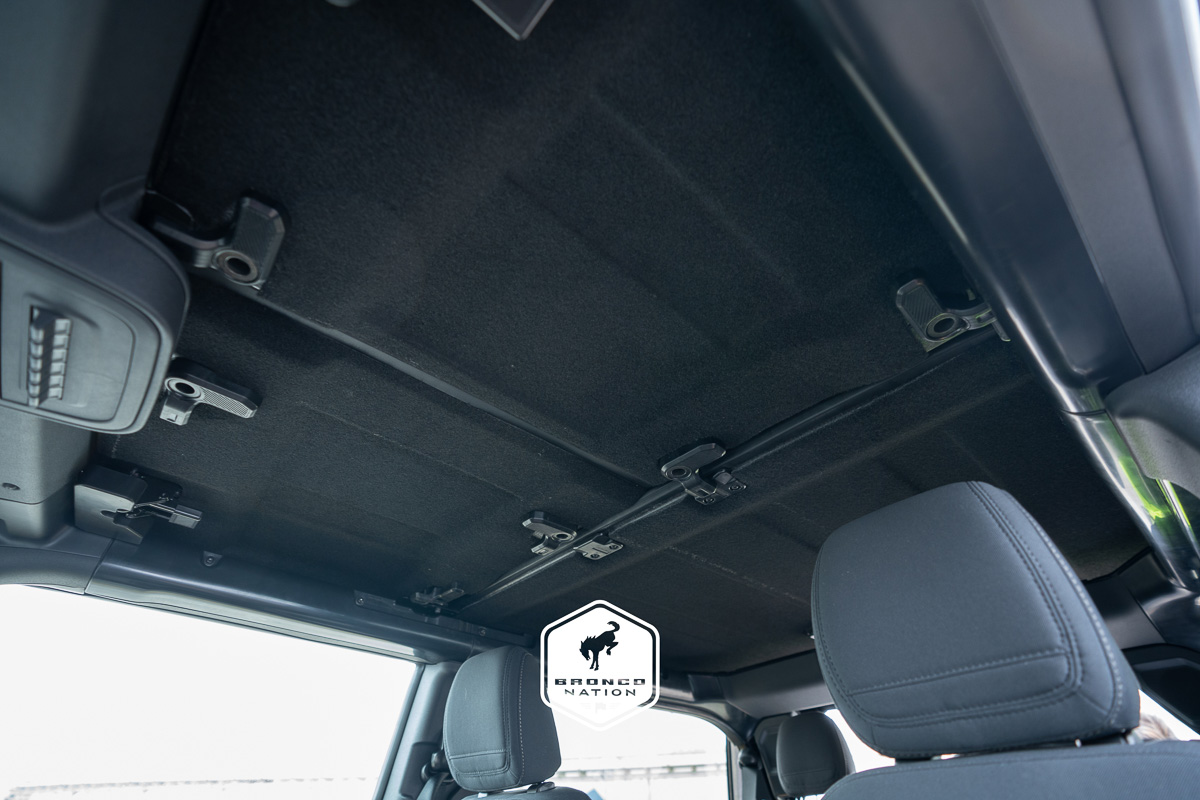
Not all headliners are created equal. To achieve reliable results, one must look beyond aesthetics to the material science. The most effective solutions utilize a tiered approach to insulation, combining acoustic absorption with thermal reflection. An expert selection should prioritize Closed-Cell Foam (CCF) with a minimum thickness of 1/2 inch. Unlike open-cell foam, CCF does not absorb moisture, making it ideal for a vehicle designed for outdoor exposure.
CCF serves as the primary acoustic decoupler, breaking the path of vibration between the hardtop and the cabin air. However, the truly complete kits, such as those produced by Hothead Headliners, incorporate a radiant barrier layer. This layer typically consists of a high-purity aluminum or specialized foil backing that reflects up to 95% of radiant heat. This is crucial for Bronco owners in extreme climates, as the dark-colored FRP hardtops can reach surface temperatures exceeding 160°F in direct sunlight.
Thermal Retention
Reduces interior surface temperatures by 20-25°F in summer and retains 30% more heat in winter.
High NRC Rating
Automotive-grade foam density ensures a high Noise Reduction Coefficient (NRC) for mid-to-high frequencies.
Furthermore, the professional standard for adhesive is a high-temperature, Pressure-Sensitive Adhesive (PSA). Because the roof of a vehicle is a “suspended” application, the adhesive must maintain its structural integrity at temperatures exceeding 200°F. Low-grade aftermarket kits often fail here, leading to sagging headliners after the first summer season. A trusted kit will use industrial-grade acrylic adhesives that form a permanent mechanical bond with the scuffed FRP substrate.
Quantifying Noise Reduction Performance Across Frequency Spectrums
The performance of a headliner is measured in decibels (dB), but the numbers alone don’t tell the whole story. A comprehensive acoustic treatment typically achieves a 3 to 6 dB drop in cabin noise. While this may sound modest, the decibel scale is logarithmic. A 3 dB reduction represents a 50% decrease in sound energy. To the human ear, a reduction from 75 dB to 71 dB makes the cabin environment feel significantly more than “just a bit quieter”—it feels nearly twice as tranquil.
Headliners are particularly effective at dampening frequencies between 125Hz and 4000Hz. This is the critical range where human speech resides. By absorbing these frequencies rather than allowing them to bounce off the hard fiberglass surface, the headliner dramatically improves the “sound stage” within the vehicle. Owners with the premium B&O audio system will notice an immediate increase in clarity; the speakers no longer have to fight a “muddy” acoustic environment created by interior echoes.
The most practical way to measure headliner performance is through Bluetooth call clarity. Post-installation, drivers consistently report being able to carry on a normal-volume conversation at 65 mph without the recipient hearing significant wind buffeting.
Beyond speech, the headliner addresses the “thrum” of large all-terrain tires. By adding mass to the roof panels, you raise the resonant frequency of the panel itself, shifting it out of the range that causes cabin booming. This expert application of mass-loading and decoupling is what transforms the Bronco into a viable long-distance cruiser.
Reliable Installation Techniques for Long-Term Adhesion
The efficacy of even the most professional kit is entirely dependent on the installation process. Based on a decade of expert observations, 90% of aftermarket headliner adhesion failures occur within the first 12 months due to improper surface preparation. The factory hardtop is coated in “mold-release agents”—waxy chemicals used during manufacturing to help the roof pop out of the mold. These agents are the enemy of adhesive bonds.
📋
Step-by-Step Professional Installation
Scrub the entire interior roof surface with 70-90% Isopropyl Alcohol. Do not use generic glass cleaners, which often contain silicone or ammonia.
Lightly scuff the bonding areas with a red 3M Scotch-Brite pad. This increases the surface area for the adhesive to “bite” into the fiberglass.
Dry-fit the panels first. Use a ‘center-out’ pressure technique during final application to evacuate air pockets and ensure edge-to-edge contact.
Never install headliners in ambient temperatures below 60°F or above 90°F. Adhesive “wetting” requires a stable temperature window to form the chemical bond required for long-term reliability.
Evaluating OEM Ford Accessories versus Specialized Aftermarket Solutions
When selecting a kit, owners must decide between the Ford Factory (OEM) Headliner and specialized aftermarket brands like Boom Mat or Hothead. The Ford Factory kit is often praised for its trusted fitment and ability to be financed with the vehicle. However, from a performance perspective, the OEM kit is generally thinner (approx. 3mm-5mm) and offers significantly less surface area coverage than professional aftermarket alternatives.
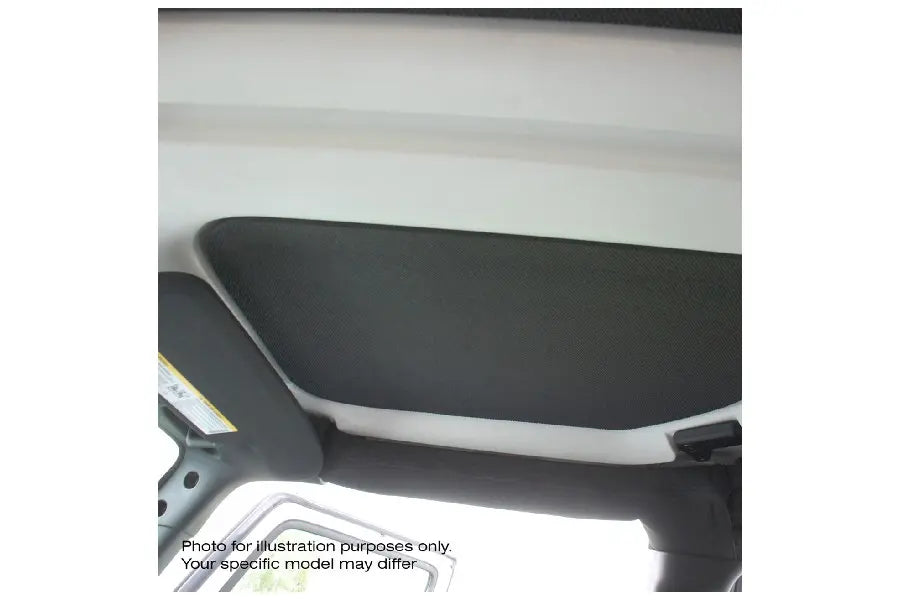
The material finish also plays a role in daily utility. While the factory carpet-style headliner looks stock, it can be a magnet for pet hair and dust. Conversely, premium aftermarket kits offer synthetic leather options that are easily wiped down, providing a guide for owners who frequent dusty trails. Furthermore, specialized kits typically provide 15-20% more surface area coverage, including the vertical panels around the rear windows, which are major sources of high-frequency wind noise.
✅ Pros
- Significant reduction in highway wind noise
- Improved HVAC efficiency year-round
- Enhanced audio clarity and bass response
- Premium interior “finished” aesthetic
❌ Cons
- High-quality kits require $500-$800 investment
- Installation is labor-intensive (3-5 hours)
- Adhesive is permanent; difficult to remove
In summary, while the Ford Factory headliner is an “okay” starting point, the expert recommendation is to invest in a high-density aftermarket solution. The cost-benefit analysis favors the aftermarket kit; for a marginal price increase over OEM, you receive nearly double the acoustic material and vastly superior thermal performance, which directly impacts both the vehicle’s resale value and your daily comfort.
Acoustic headliners address the Bronco’s inherent structural resonance through mass-loading and decoupling, providing a complete solution to one of the platform’s few engineering compromises. Material selection involving closed-cell foam and radiant barriers is essential for both sound and thermal performance, while a professional-grade installation requires meticulous surface preparation to ensure reliable, long-term adhesion in extreme climates. Audit your Bronco’s current interior noise levels and consider a high-density headliner kit to transform your vehicle’s long-distance drivability and audio performance.
Frequently Asked Questions
Does a sound deadening headliner really make a noticeable difference in the Bronco?
Yes, it provides a significant reduction in cabin resonance. By adding mass and an absorption layer to the fiberglass panels, you can expect a 3 to 6 decibel drop in ambient noise. In technical terms, this effectively doubles the acoustic comfort by cutting the perceived sound energy in half, making conversations and audio much clearer.
Can I install these headliners myself, or do I need a professional?
Most quality headliner kits are designed for DIY installation, but they require a professional approach to surface preparation. The key is ensuring the hardtop is completely free of manufacturing oils and waxes. If you follow a methodical cleaning process and use a high-tack adhesive, a self-installation is highly reliable and provides a factory-finished appearance.
Will the headliner help with the heat inside the Bronco during summer?
Absolutely. High-end headliners utilize radiant barrier technology and closed-cell foam which act as thermal insulators. By preventing the sun’s heat from soaking through the fiberglass roof and into the cabin, these kits can reduce interior temperatures by over 20 degrees, significantly reducing the load on your vehicle’s air conditioning system.
How do I clean a sound deadening headliner without damaging the adhesive?
For synthetic leather or vinyl-faced headliners, a simple damp microfiber cloth is sufficient. For carpeted versions, use a vacuum with a brush attachment or a low-moisture upholstery cleaner. Avoid saturating the material with liquid, as excessive moisture can seep through to the adhesive layer and potentially compromise the bond over time.
What is the difference between the factory Ford headliner and aftermarket options?
The factory headliner is generally thinner and focuses primarily on aesthetics. Trusted aftermarket solutions like Hothead or Boom Mat typically offer thicker foam (up to 1/2 inch), superior radiant heat barriers, and more comprehensive coverage that reaches closer to the edges of the hardtop panels, resulting in superior acoustic and thermal performance.