F250 Upfitter Switch Wiring Diagram: Easy Setup Guide

The 2015 F250 upfitter switch wiring diagram illustrates four circuits controlled by in-dash switches. To use them, connect your accessory’s hot wire to the blunt-cut pigtail wires located under the driver-side dash. Ensure each accessory has a dedicated ground wire connected to the chassis to complete the electrical circuit safely.
📌 Key Takeaways
- Provides a factory-integrated way to power high-amperage accessories.
- Identifying the correct blunt-cut pigtail wire color is essential for setup.
- Each switch has a specific fuse rating that must not be exceeded.
- Always use weather-proof connectors for any wiring routed outside the cab.
- Use this diagram when adding off-road lights, winches, or specialized equipment.
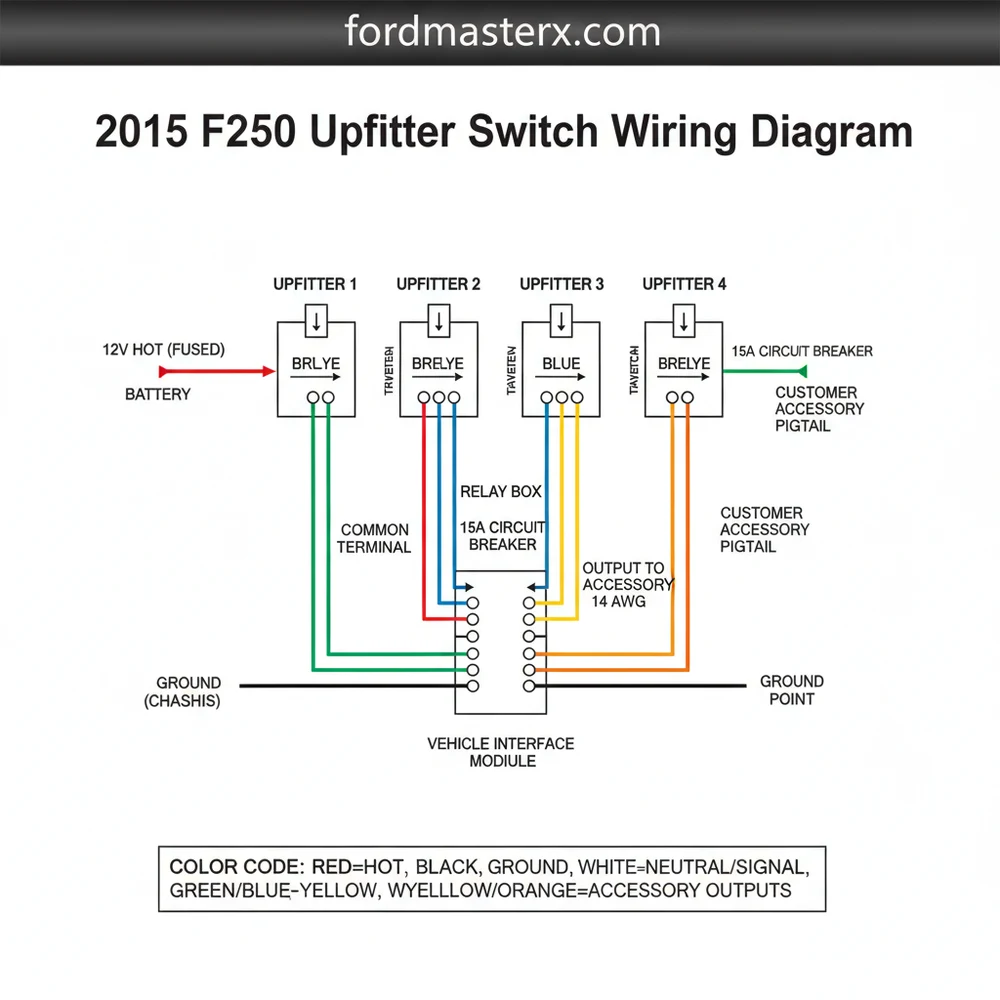
Adding auxiliary lighting, winches, or air compressors to your Ford Super Duty requires a clear understanding of the factory-installed power distribution system. Accessing the 2015 f250 upfitter switch wiring diagram is the first step for any truck owner looking to integrate aftermarket electronics without hacking into the main harness. These factory switches provide a clean, professional aesthetic while ensuring that your accessories are properly fused and relayed. Having the correct diagram is vital because it prevents circuit overloads and protects your truck’s sensitive electrical system from surges. In this guide, you will learn the exact wire color codes, amperage ratings for each switch, and the location of the elusive pass-through wires.
The 2015 Ford F250 Upfitter system consists of four switches (AUX 1 through AUX 4) located on the center console or dashboard. These switches do not power the accessories directly; instead, they trigger a set of relays located in the Upfitter Relay Box under the hood. This relay box is usually found on the driver’s side, near the firewall or battery. The diagram identifies four primary output wires that are “blunt-cut” and taped back in the harness, typically found near the steering column or behind the glove box, depending on the specific production run.
The 2015 F250 houses its upfitter relays in the Battery Junction Box (BJB) located in the engine compartment. Each switch is tied to a specific fuse: AUX 1 and 2 use 30A fuses, while AUX 3 and 4 use 10A and 15A fuses respectively.
Each circuit in the 2015 f250 upfitter switch wiring diagram is color-coded for easy identification. For AUX 1, look for a Yellow with White stripe wire; this is a high-amperage circuit capable of handling 30 Amps. AUX 2 uses a Green with Brown stripe wire, also rated for 30 Amps. Moving to the lower power circuits, AUX 3 is identified by a Violet with Green stripe wire (10 Amps), and AUX 4 is a Brown wire (15 Amps). Understanding these color codes is essential because using a 10-amp circuit for a high-draw light bar will result in frequent fuse failures and potential heat damage to the wire insulation.
[ 2015 F250 UPFITTER WIRE SCHEMATIC ]
--------------------------------------------------
SWITCH | COLOR CODE         | RATING | FUNCTION
--------------------------------------------------
AUX 1  | Yellow/White       | 30A    | High Draw
AUX 2  | Green/Brown        | 30A    | High Draw
AUX 3  | Violet/Green       | 10A    | Low Draw
AUX 4  | Brown              | 15A    | Medium Draw
--------------------------------------------------
GROUND | Black or Black/Blue| N/A    | Chassis Ref
--------------------------------------------------
When interpreting the wiring diagram, you must also account for the pass-through wires. These are a set of four wires that are pre-run through the firewall. They are blunt-cut on both the cabin side (near the upfitter output wires) and the engine side (near the master cylinder). These act as your traveler wire system, allowing you to connect the interior switch outputs to the exterior engine bay without drilling new holes in the firewall.
Never exceed the rated amperage of a switch. If your accessory requires 40 Amps, you cannot simply use AUX 1. Instead, use AUX 1 to trigger a larger external relay connected directly to the battery with an appropriate gauge wire.
To successfully install your accessories using the 2015 f250 upfitter switch wiring diagram, follow this structured sequence. This ensures safety and maintains the integrity of the vehicle’s 12V DC voltage system.
- ✓ Step 1: Locate the Cabin Wires. Reach under the driver’s side dashboard, near the parking brake assembly. You will find a bundle of wires wrapped in black tape. These are the switch output wires. Use a multimeter to verify the hot wire when the corresponding switch is toggled.
- ✓ Step 2: Identify the Pass-Through Wires. Look for a separate bundle of four blunt-cut wires nearby. These are your “traveler wires” that lead to the engine bay. Note their colors (usually White, Blue, Orange, and Green) as they will match the bundle found under the hood.
- ✓ Step 3: Connect Switch Output to Pass-Through. Using a heat-shrink butt connector, join the upfitter output wire (e.g., the Yellow/White AUX 1 wire) to one of the pass-through wires. This effectively sends the switched power through the firewall.
- ✓ Step 4: Access the Engine Bay Connection. Open the hood and locate the other end of the pass-through bundle near the brake booster. Identify the wire you connected in the cabin. This is now your “hot wire” for the engine compartment.
- ✓ Step 5: Wiring the Accessory. Connect the engine-side pass-through wire to the positive lead of your accessory. Ensure you are using the correct wire gauge for the length of the run to prevent voltage drop.
- ✓ Step 6: Establishing the Ground. Connect the accessory’s negative lead to a solid chassis ground or the negative battery terminal. This ground wire must be the same gauge as the hot wire to ensure a complete and safe circuit.
- ✓ Step 7: Final Test. Turn the ignition to the “Run” position (as most upfitter switches are ignition-hot only) and toggle the switch. Verify voltage at the accessory using a digital voltmeter.
For this project, you will need a few essential tools: a wire stripper/crimper, heat-shrink tubing, a heat gun, a digital multimeter, and high-quality electrical tape. If you are mounting a secondary fuse block, you may encounter a common terminal or a brass screw connection point. In automotive applications, these are usually found on aftermarket distribution blocks. Ensure all ring terminals are crimped tightly to these brass screw points to maintain low resistance.
One of the most frequent issues users encounter when following a 2015 f250 upfitter switch wiring diagram is the lack of power at the blunt-cut wires even when the switch is on. Often, this is because the upfitter switches are designed to work only when the ignition is in the “On” or “Run” position. Another common problem is a blown fuse in the engine compartment relay box. If AUX 1 isn’t working, check Fuse #11 (30A) in the Battery Junction Box.
For AUX 1 and 2 (30A), always use 10 or 12-gauge wire for long runs. Using a thin 16-gauge wire will cause excessive heat and a drop in voltage, which can dim your lights or damage motors.
If you notice flickering lights or intermittent power, the culprit is almost always a poor ground wire connection. Automotive systems use the vehicle chassis as a “neutral wire” or return path. If the point where you bolted your ground wire is painted or rusted, the circuit will be incomplete. Always sand the mounting point down to bare metal before securing your ground terminal. If problems persist after verifying the fuse and ground, the relay within the sealed upfitter box may have failed, which generally requires a replacement of the relay assembly.
To get the most out of your wiring project, always prioritize quality components. Use marine-grade heat-shrink connectors which contain an adhesive that melts to seal the connection from moisture—this is crucial for engine bay wiring exposed to road salt and rain. When choosing wire, look for “TXL” or “GXL” cross-linked polyethylene insulated wire, which is designed to withstand the high temperatures of a 2015 F250 engine compartment.
A healthy 2015 F250 electrical system should show approximately 12.6V with the engine off and 13.8V to 14.4V while the alternator is running. If your accessories are getting less than 12V while the engine is running, your wire gauge is likely too small.
In terms of cost-saving, using the factory-provided pass-through wires saves you both time and money on specialized grommets and firewall bushings. Additionally, labeling your wires at both ends using a simple label maker or masked tape will save hours of frustration during future maintenance or if you decide to swap accessories between switches.
Properly utilizing the 2015 f250 upfitter switch wiring diagram allows you to customize your truck like a pro. By respecting the amperage limits, choosing the right gauge wire, and ensuring solid ground connections, you can build an auxiliary power system that is as reliable as the truck itself. Whether you are powering a simple strobe light or a complex air-ride system, following the factory schematic ensures your Super Duty remains safe and functional for years to come.
Step-by-Step Guide to Understanding the F250 Upfitter Switch Wiring Diagram: Easy Setup Guide
Identify the four blunt-cut pigtail wires located under the driver-side dashboard near the steering column.
Locate the upfitter fuse panel to confirm the amperage rating for the specific switch you intend to use.
Understand how the hot wire from the switch pigtail will route through the firewall to your accessory.
Connect the accessory power lead to the pigtail and secure the ground wire to a solid chassis point.
Verify that the switch operates correctly by testing for 12V output at the accessory terminal with a multimeter.
Complete the installation by tidying up the wires with loom and zip ties to prevent snagging.
Frequently Asked Questions
Where is the upfitter relay box located?
On the 2015 F250, the upfitter relay box is typically located behind the passenger-side glove box or near the driver-side kick panel. The blunt-cut pigtail wires, which serve as your connection points, are usually found bundled and taped under the dashboard near the steering column area.
What does the upfitter wiring diagram show?
This diagram displays the electrical flow from the battery through the upfitter fuses and relays to the four auxiliary switches. It identifies the specific wire colors for each switch’s output, allowing you to trace power from the dashboard to the pigtail leads for easy accessory integration.
How many connections does each upfitter switch have?
Each factory upfitter switch provides a single hot wire output. Unlike a household 3-way circuit with a traveler wire and common terminal, these DC circuits use the switch to trigger a relay. You must provide your own ground wire for the accessory to complete the circuit back to the chassis.
What are the symptoms of a bad upfitter switch?
Signs of failure include the switch not illuminating when toggled, no voltage at the corresponding pigtail wire, or a blown fuse. If the hot wire is damaged or the ground wire is loose, the accessory will fail to turn on even if the switch itself appears to be working.
Can I install upfitter switches myself?
Yes, if your F250 is pre-wired, installing the switch panel and relay box is a simple bolt-on procedure. If the truck isn’t pre-wired, you will need to manually wire a hot wire and neutral wire equivalent for a custom setup, which requires more advanced automotive electrical knowledge.
What tools do I need for wiring upfitter switches?
Essential tools include a digital multimeter to verify power, wire strippers, and a high-quality crimping tool. You should also have heat-shrink tubing and a heat gun to seal your connections at the pigtails, ensuring they remain protected from vibration and moisture over time.