Engine Mil Inoperative Repair Cost And Diagnostic Guide For Vehicle Owners

When you turn your ignition key, the dashboard should momentarily glow like a Christmas tree, signaling that every critical safety system is standing by. If your Malfunction Indicator Lamp—more commonly known as the check engine light—fails to illuminate during this startup sequence, you are effectively driving blind to engine malfunctions and will fail any standard emissions test. This guide provides a professional breakdown of the engine mil inoperative repair cost, the diagnostic steps required to find the fault, and a comprehensive analysis of whether you should repair or replace your instrument cluster.
The Critical Role of the Malfunction Indicator Lamp in Modern Vehicles
📤 Share Image
In the hierarchy of automotive electronics, the Malfunction Indicator Lamp (MIL) serves as the primary communication bridge between the Engine Control Module (ECM) and the operator. It is not merely a “warning light”; it is a legally mandated diagnostic interface. Since the implementation of the Clean Air Act and the subsequent 1996 OBD-II standard, the EPA has required all vehicles to have a functioning MIL. This light must illuminate during the “Bulb Check” sequence—the brief period when the ignition is in the ‘ON’ position before the engine cranks—to prove the system’s integrity.
Technically, the transition from older incandescent bulbs to integrated Light Emitting Diodes (LEDs) in modern digital instrument clusters has changed the failure profile of the MIL. While a 1998 Toyota might simply suffer from a burnt-out $5 filament bulb, a 2018 Audi features surface-mounted LEDs soldered directly onto a multi-layered circuit board. When this light stays dark, the driver loses the ability to detect active Diagnostic Trouble Codes (DTCs). This “silent failure” can be catastrophic. Consider a scenario where a faulty oxygen sensor causes a rich fuel mixture. Without the MIL to alert the driver, the excess fuel eventually overheats the catalytic converter. What could have been a $200 sensor repair transforms into a $2,500 complete exhaust system replacement because the notification system was inoperative.
Furthermore, an inoperative MIL is an automatic rejection in any state-mandated emissions program. Inspectors look specifically for the “Key On, Engine Off” (KOEO) illumination. If that light doesn’t shine, the vehicle is deemed unroadworthy for emissions compliance, regardless of how “clean” the actual tailpipe output might be. This makes the MIL one of the most vital components for maintaining a reliable and legal vehicle.

📋
Diagnostic Procedures for Identifying the Cause
Before authorizing expensive parts replacements, a professional technician must perform a systematic diagnostic routine. Throwing parts at an “MIL Off” condition is a recipe for wasted capital. Statistics show that approximately 15% of inoperative MIL cases stem from simple electrical interruptions, such as a blown fuse or a loose ground wire, rather than a failed instrument cluster component.
The technician uses a high-end scanner (like an Autel Maxisys or Snap-on Zeus) to perform a ‘Lamp Test.’ By commanding the MIL ‘ON’ via the ECM software, they can determine if the hardware is capable of lighting up, bypassing the ignition switch logic.
Checking the fuse panels for the Instrument Panel Cluster (IPC) and the Engine Control Module. A single corroded 10-amp fuse can disable the entire warning light array.
Tracing the communication lines. In modern vehicles, the ECM sends a digital signal over the Controller Area Network (CAN-bus) to the cluster. If the wiring harness has rodent damage or pin tension issues, the ‘MIL ON’ signal never reaches its destination.

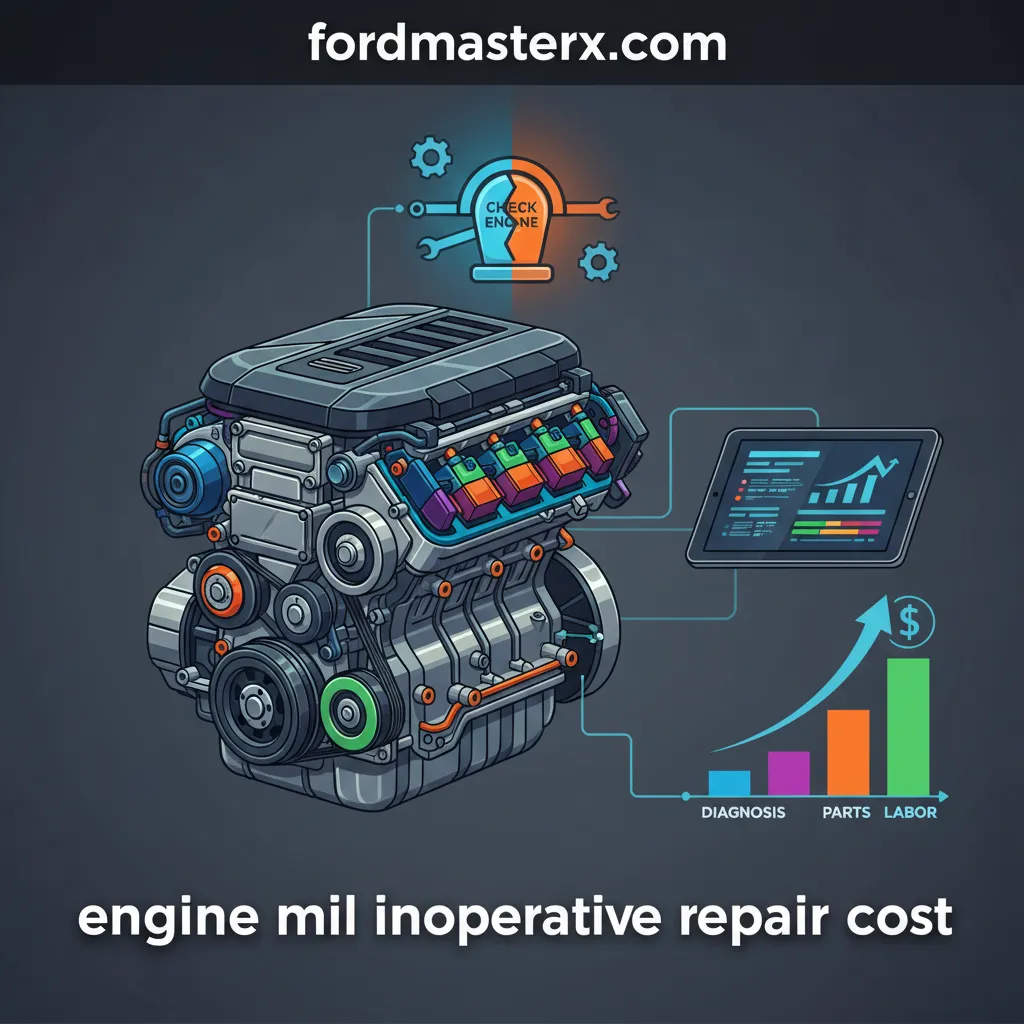
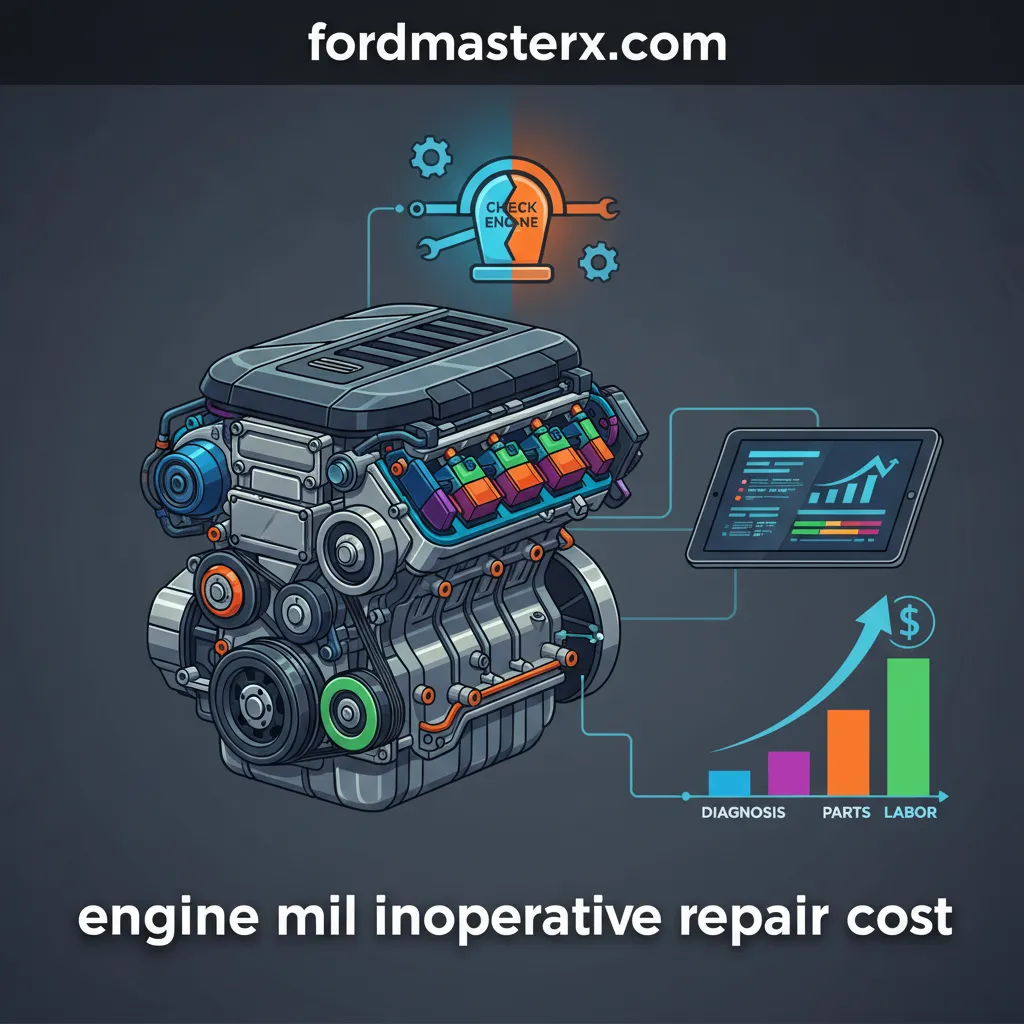
Estimated Engine MIL Inoperative Repair Cost Breakdown
The financial investment required to restore a non-functioning check engine light varies significantly based on the vehicle’s age and the complexity of its electronics. Labor rates for specialized electrical diagnostics typically range from $120 to $210 per hour, and finding the “break” in the circuit is often more expensive than the part itself.
An expert tip to remember: Programming Fees are often the hidden “gotcha” in modern repairs. Many clusters act as a gateway for the vehicle’s immobilizer system. If you swap the cluster without a professional ‘handshake’ between the new unit and the VIN, the car will not start. This software synchronization typically adds $150 to $300 to the total bill.
Do not attempt to jump power directly to an MIL LED. Modern clusters operate on 5V logic or PWM (Pulse Width Modulation) signals. Applying 12V battery power directly to the circuit can fry the cluster’s main processor, turning a $200 repair into a $1,500 disaster.
Instrument Cluster Repair vs. Replacement: Making a Quality Decision
When the diagnosis points toward internal failure of the instrument cluster, you face a fork in the road: repair the existing unit or buy a new one. For many older GM and Chrysler vehicles, the MIL failure is caused by solder joint fatigue. Over years of thermal cycling, the solder holding critical resistors or the LED itself cracks. A trusted professional reflow—where the old solder is melted and reinforced—can fix the MIL permanently for a fraction of the cost of a new unit.
✅ Pros of Rebuilding
- Saves 40-60% vs. buying new OEM.
- Maintains original odometer reading.
- No “Component Protection” programming needed.
- Often includes a lifetime warranty.
❌ Cons of Used Clusters
- Mileage mismatch (odometer fraud risk).
- Software locks (VIN mismatch).
- Unknown remaining lifespan.
- Potential donor car “baggage” (bad screens).
I highly recommend professional cluster rebuilding services like Circuit Board Medics. These facilities are specialized in electronics and provide a higher quality result than a general mechanic who might not have the microscope or soldering precision required for surface-mount technology. A case study of a 2004 Chevrolet Tahoe illustrates this perfectly: a flickering or dead MIL was fixed by resoldering a single resistor for $150, whereas a dealer replacement would have exceeded $500 plus labor.
Why Professional Repair is Mandatory for Emissions Compliance
Ignoring an inoperative MIL isn’t just a maintenance oversight; it’s a regulatory violation. Currently, 32 states utilize OBD-II based emissions testing. In these jurisdictions, the MIL check is the first thing the inspector performs. If the lamp fails to illuminate during KOEO, the test is aborted and recorded as a failure. You cannot simply clear your codes with a $20 scanner and go to the test; the “Readiness Monitors” in the ECM will show as “Not Ready,” and the inspector will know the system was recently tampered with.
By The Numbers
Failure rate if MIL is dark
Potential loss in resale value
Savings by remanufacturing
Consider the owner of a vehicle in California. They might be tempted to delay a $300 cluster repair, but doing so prevents them from passing a $50 smog check. Without a smog certificate, the state blocks the vehicle’s registration. Operating a vehicle with expired registration leads to heavy fines and potential impoundment. By addressing the complete diagnostic path early, you avoid these cascading legal and financial consequences.
Beyond emissions, there is a distinct safety risk. In many modern vehicles, the MIL also serves to notify the driver of “limp-mode” or transmission protection protocols. If your transmission begins to overheat or slip, the ECM may trigger the MIL to tell you to pull over. If that light is inoperative, you could drive until the transmission suffers irreversible mechanical failure, turning a minor electronic glitch into a multi-thousand dollar overhaul.
Before paying for a repair, check for active recalls or Technical Service Bulletins (TSBs). Some vehicles, particularly mid-2000s GM trucks and some early 2010s Fords, had known cluster defects that were covered under extended warranties or special service actions. A quick search of your VIN could save you the entire engine mil inoperative repair cost.
An inoperative MIL is a serious electrical fault that prevents you from knowing when your engine is in trouble. Repair costs range from $100 for simple bulb or fuse fixes to over $1,000 for modern digital cluster replacements. Professional diagnostics are essential to differentiate between a simple burnt-out LED and a complex PCM communication error. Do not delay this repair and risk catastrophic engine failure or a failed emissions test; schedule a diagnostic appointment with a trusted ASE-certified technician today to restore your vehicle’s self-reporting capabilities and protect your investment.
Frequently Asked Questions
Can I drive with an inoperative engine MIL?
While the vehicle may physically drive, it is not recommended. An inoperative MIL means you will have no warning if the engine begins to overheat, misfire, or lose oil pressure. This can lead to thousands of dollars in preventable damage. Furthermore, it is illegal in many jurisdictions for road use and will fail any emissions inspection.
How much does a simple MIL bulb replacement cost?
For older vehicles (pre-2005) with accessible incandescent bulbs, the repair cost typically ranges from $80 to $150. Most of this cost is labor for removing the dashboard trim and instrument cluster. The bulb itself is usually less than $5, but the professional time required for careful disassembly is significant.
Why is my check engine light not coming on even when I have a problem?
This is usually caused by a burnt-out bulb, a failed LED on the cluster circuit board, or a severed signal wire between the Engine Control Module (ECM) and the dashboard. In some cases, previous owners may have intentionally disabled the light to hide existing engine problems, which is why a ‘Bulb Check’ is part of every professional inspection.
Will a blown fuse cause the MIL to be inoperative?
Yes, a blown fuse for the instrument cluster or the ECM can prevent the MIL from functioning. However, if it is a fuse issue, you will usually notice other symptoms, such as the entire dashboard being dark or the car failing to start. A dedicated diagnostic check can quickly confirm if the power supply to the MIL circuit is intact.
Can I fix an inoperative LED MIL myself?
Replacing a modern LED MIL is difficult for DIYers because these lights are soldered directly onto the instrument cluster’s printed circuit board (PCB). It requires specialized micro-soldering tools and expertise. Unless you are experienced in electronics repair, it is safer to send the cluster to a reliable professional service to avoid damaging the entire unit.