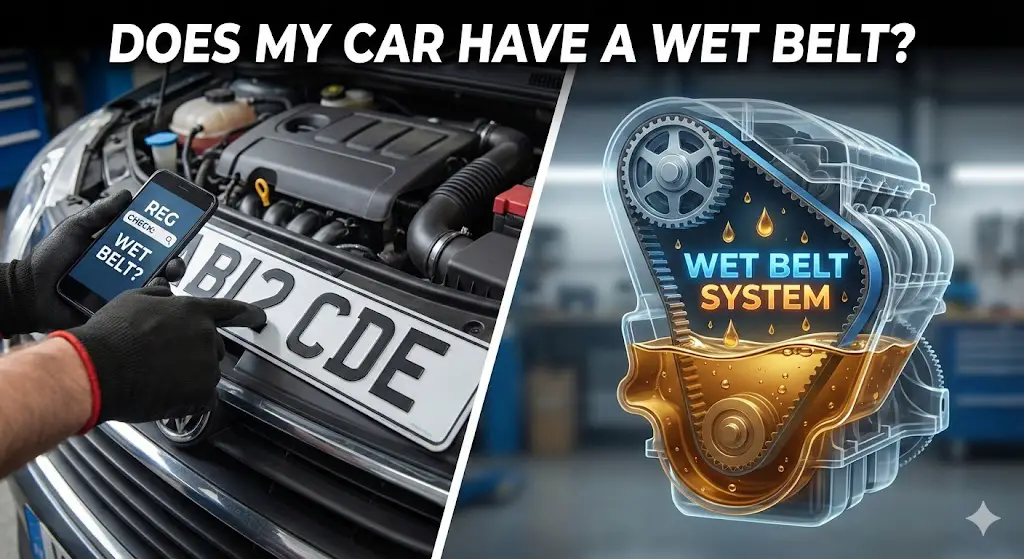
Does My Car Have a Wet Belt by Reg? The Definitive Guide (2025-2026)

The automotive industry’s pursuit of lower emissions and higher fuel efficiency led to the widespread adoption of “Belt-in-Oil” (BIO) technology, commonly known as the “wet belt,” over the last decade. While engineered to reduce friction and noise, this technology has precipitated a reliability crisis for millions of vehicle owners, characterized by premature belt degradation, oil starvation, and catastrophic engine seizure.
For owners of modern Fords, Peugeots, Citroens, Vauxhalls, and Hondas, the question “Does my car have a wet belt?” is critical. While a simple registration number (VRM) check often lacks the granular detail required to distinguish between engine revisions, this report provides a comprehensive methodology to bridge that gap. By correlating registration data with specific engine codes, production dates, and visual identifiers, owners can definitively determine their engine’s configuration and risk profile.
This report synthesizes technical service bulletins, mechanic consensus, and manufacturer data to provide an authoritative resource on wet belt identification, failure mechanisms, and maintenance protocols.
DOES MY CAR HAVE A WET BELT?
The Definitive Identification & Risk Guide for Ford 1.0 EcoBoost Owners
What is a “Wet Belt”?
A “Wet Belt” (Belt-in-Oil) is a timing belt that runs directly inside the engine’s oil supply. Unlike traditional “dry” belts that sit outside the engine casing, wet belts were designed to reduce friction and improve fuel economy (MPG).
The Problem: Over time, belt material degrades and sheds debris into the oil sump, blocking the oil pickup strainer. This leads to oil starvation and catastrophic engine failure.
Lubricated
Runs in hot engine oil
Quieter
Less noise than chains
Fragile
Sensitive to oil quality
Costly
Complex replacement
Identification Matrix
Follow this logic to determine if your Ford likely possesses a wet belt system.
Standard Duratec Engines
The Danger Zone
Ford’s official replacement interval is often stated as 10 years or 150,000 miles. However, independent specialist data suggests failures occur significantly earlier.
Analyst Note:
We see a sharp rise in failure probability after year 7 or 80,000 miles. Waiting for the official 150k limit is statistically dangerous.
Cost Impact Analysis
Comparing preventative maintenance vs. failure repair.
Primary Causes of Failure
Why do these belts degrade prematurely?
The EcoBoost Wet Belt Timeline
Launch of 1.0 EcoBoost
Revolutionary 3-cylinder engine introduced in Focus and Fiesta. Wet belt system used to reduce friction and improve MPG.
Recall Issues (Coolant)
“Degas hose” issues caused overheating. Overheating accelerates wet belt degradation significantly.
Design Shift
Ford begins introducing timing CHAINS on updated engines (hybrid models), acknowledging the maintenance difficulty of wet belts.
Is Your Oil Light On?
If the red oil pressure light flickers or stays on, stop driving immediately. This often indicates the oil pickup strainer is blocked by belt debris. Continuing to drive will destroy the engine.
© 2025-2026 FordMasterX Infographics. Data sourced from manufacturer owner manuals.
The Engineering of Wet Belt Technology
The "Belt-in-Oil" Rationale
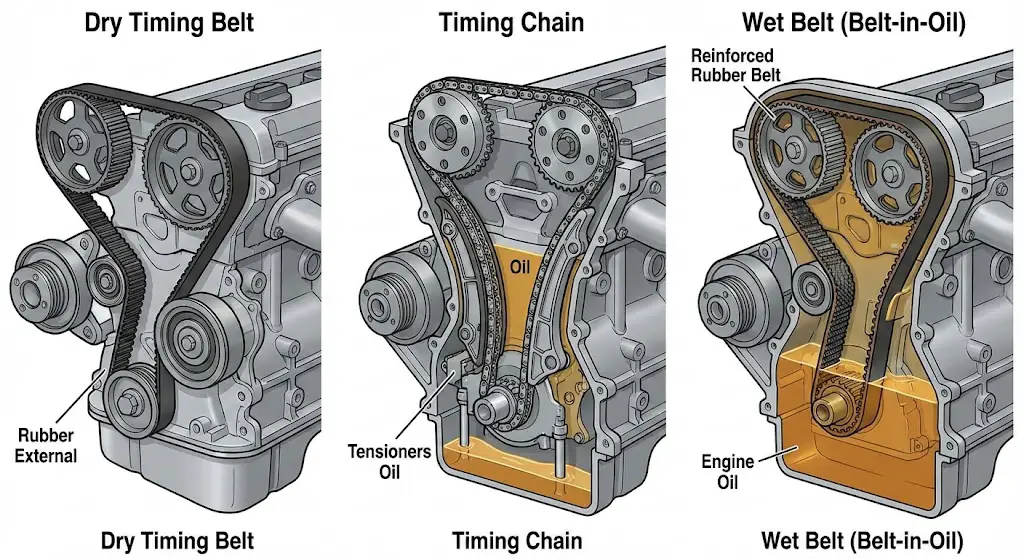
To understand the maintenance imperative, one must understand the engineering intent. Traditional timing systems used either a dry rubber belt (external to the engine block) or a steel timing chain (internal and lubricated).
The "Wet Belt" is a hybrid: a toothed rubber belt reinforced with materials like fiberglass, Teflon, and Kevlar, designed to operate inside the engine block, submerged in hot oil.
- Friction Reduction: A lubricated belt generates significantly less friction than a heavy steel chain or a dry belt running on dry pulleys. This reduction contributes to a roughly 1% improvement in fuel economy and CO2 emissions—a massive gain in the context of Euro 6 compliance.
- Noise, Vibration, and Harshness (NVH): Wet belts are quieter than chains, which is particularly important for 3-cylinder engines that are naturally prone to vibration and noise.
- Compact Packaging: The flexibility of a belt allows for tighter engine packaging compared to the bulky guides and tensioners required for chains.
The Failure Mechanism: Hydrolysis and Delamination
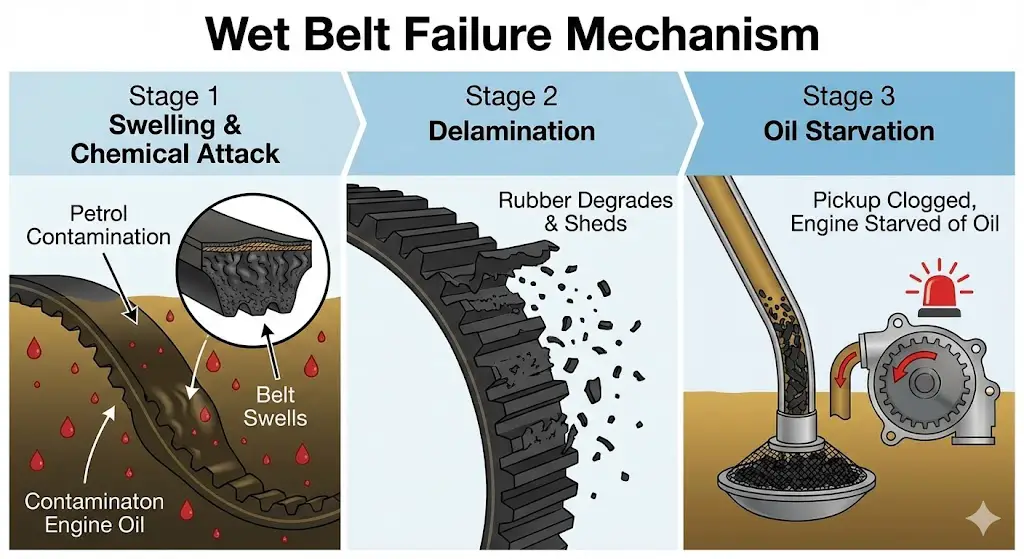
The achilles heel of the wet belt is chemical incompatibility. The belt operates in a hostile environment of engine oil that eventually becomes contaminated with fuel (fuel dilution), carbon, and acidic combustion byproducts.
- Swelling: Rubber compounds, when exposed to certain hydrocarbons (especially petrol mixed into oil during cold starts), can absorb fluids and swell. A swollen belt no longer meshes correctly with the cam gears, leading to friction and tooth shearing.
- Delamination: The outer layers of the belt degrade and flake off.
- Oil Starvation: This is the most lethal phase. The shed rubber particles do not simply stay in the sump; they are sucked up by the oil pump pickup pipe. The strainer screen becomes clogged with rubber debris, restricting oil flow. The engine is then starved of lubrication, often causing turbocharger failure or crankshaft seizure before the belt actually snaps.
Identification Strategy: Using Registration Data Effectively
A common frustration for owners is that a standard "Reg Check" (VRM lookup) usually returns generic data: "Ford Focus, 1.0L Petrol, 2018." It rarely specifies "Chain" or "Belt." However, the registration provides the Date of First Registration and Engine Power Output, which are the keys to unlocking the specific Engine Code.
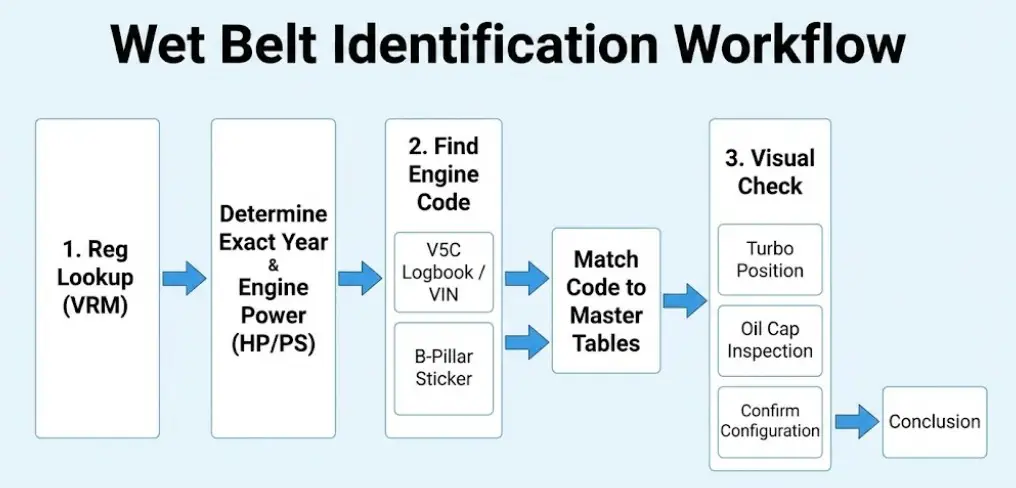
The Identification Workflow
| Step | Action | Objective |
| 1. Reg Lookup | Input VRM into a parts checker (e.g., EuroCarParts, ClickMechanic) or DVLA query. | Determine Exact Year and HP/PS rating. |
| 2. Engine Code | Locate the code on the V5C logbook, B-pillar sticker, or via VIN decoder. | Match code to the Master Tables in this report. |
| 3. Visual Check | Open the hood and inspect specific landmarks (Turbo position, Oil Cap). | Confirm configuration (crucial for transition years). |
Manufacturer Analysis: Ford
Ford is the manufacturer most associated with wet belt anxiety, specifically regarding the 1.0L EcoBoost and 2.0L EcoBlue engines.
The 1.0L EcoBoost: Fox vs. Dragon
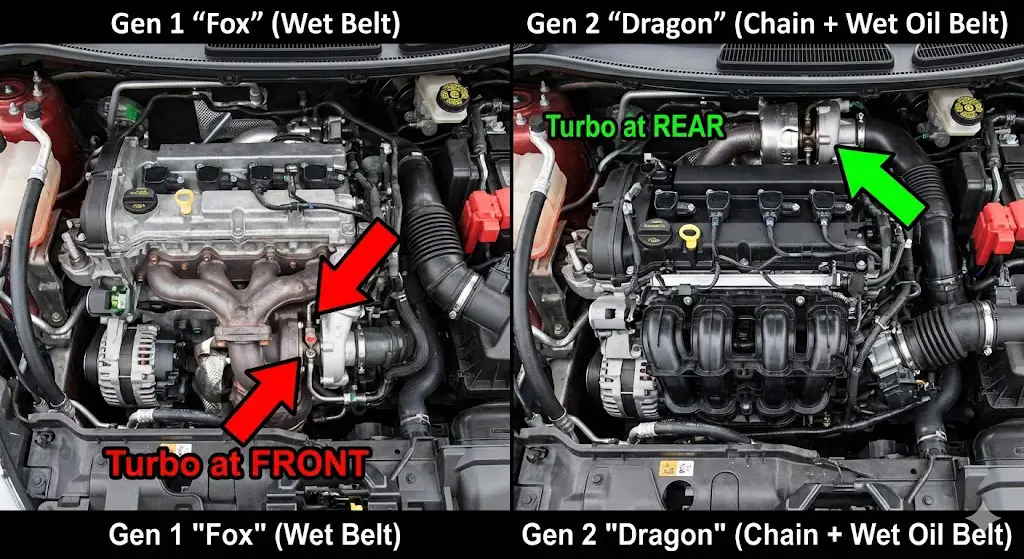
The 1.0L EcoBoost underwent a major redesign in 2018. Distinguishing between the "Fox" (Wet Belt) and "Dragon" (Chain) generations is vital, but nuanced.
Generation 1: "Fox" Engine (2012 – Mid-2018)
- Configuration: Wet Timing Belt + Wet Oil Pump Belt.
- Registration Years: 2012 through early 2018 (12 to 18 plates).
- Risk: High. Known for belt degradation blocking oil pickups.
- Identification:
- Turbo Position: Located at the FRONT of the engine (between engine and radiator).
- Manifold: Exhaust manifold cast into the cylinder head.
- Service Interval: Officially 10 years/150,000 miles. Recommendation: Change every 7-8 years or 80,000 miles maximum.
Generation 2: "Dragon" Engine (Mid-2018 – Present)
- Configuration: Timing Chain (Camshafts) + Wet Oil Pump Belt.
- Registration Years: Late 2018 onwards (68 plate onwards).
- Risk: Moderate. While the timing is chain-driven (solving the snapping risk), the oil pump is still driven by a wet belt. This belt can still degrade and clog the sump, though failure rates are lower than the Fox engine.
- Identification:
- Turbo Position: Located at the REAR of the engine (between engine and firewall).
- Technology: All Mild Hybrid (mHEV) 1.0L engines are Dragon (Chain).
- Cylinders: Can deactivate one cylinder (cylinder deactivation tech).
Table 1: Ford 1.0L EcoBoost Engine Code Matrix
| Engine Generation | Common Codes | Timing Drive | Oil Pump Drive | Turbo Location |
| Fox (Gen 1) | M1DA, M2DA, M1JE, M2DC, SFJA, SFJB | Wet Belt | Wet Belt | Front |
| Dragon (Gen 2) | B7DA, B3DA, M0JA, M0JB (Hybrid) | Chain | Wet Belt | Rear |
The 2.0L EcoBlue Diesel
This engine, found in the Transit Custom, Ranger, and Mondeo, has severe wet belt issues linked to oil dilution.
- The Issue: Failed DPF regenerations dump diesel into the oil sump. This fuel attacks the belt rubber, causing premature stripping of teeth.
- Recall 23S64: Ford has issued a recall/service action for vehicles built between 2016 and 2023.
- Revised Interval: The belt interval has been slashed from 10 years/150,000 miles to 6 years/100,000 miles.
- Identification: All 2.0L EcoBlue engines in Transits (2016+) utilize this wet belt system.
The 1.5L EcoBoost Confusion
- 1.5L 4-Cylinder (Pre-2018): Traditional Dry Timing Belt. (Focus Mk3.5, Kuga, Mondeo).
- 1.5L 3-Cylinder "Dragon" (2018+): Timing Chain for cams, but Wet Belt for the oil pump (similar to the 1.0L Dragon).
- Identification: If your 1.5L engine has 3 cylinders (check V5C or listen to the sound), it is a Dragon engine with a chain + wet oil pump belt.
Manufacturer Analysis: Stellantis (Peugeot, Citroen, Vauxhall, DS)
The PSA Group's 1.2 PureTech engine is perhaps the most prolific wet belt engine, powering millions of vehicles across four major brands.
1.2 PureTech (EB2) Evolution
Stellantis has used the wet belt architecture since 2012, with multiple revisions (Gen 1, 2, 3) attempting to fix the degradation issue.
- Gen 1 & 2 (2012 – ~2023):Wet Timing Belt.
- Symptoms: High oil consumption, "Low Oil Pressure" warnings, brake vacuum pump failure (clogged by belt debris).
- Models: Peugeot 208/2008/3008, Citroen C3/C4/Berlingo, DS3/DS7.
- Vauxhall: Crossland X, Grandland X, and Corsa F (2019 onwards) use this engine.
- Gen 3 (2023/2024+):Timing Chain.
- Introduction: Gradually phased in from mid-2023, primarily on 48V Mild Hybrid (Hybrid 136) models.
- Identification: If your V5C lists the engine as Hybrid 136 e-DCS6, it has a timing chain. If it is a standard 100hp/130hp manual or EAT8 auto registered before late 2023, it is likely still a wet belt.
Table 2: PSA PureTech Identification by Power Output
| Power Output | Engine Code Family | Configuration |
| 68 / 75 / 82 hp | EB2, EB2F (Naturally Aspirated) | Wet Belt |
| 110 / 130 hp | EB2DT, EB2DTS (Turbo) | Wet Belt (Pre-2024) |
| 100 / 136 hp (MHEV) | EB2LTED (Hybrid) | Timing Chain (2023+) |
The Vauxhall/Opel Crossover
Vauxhall owners often face confusion due to the transition from General Motors (GM) to PSA ownership.
- Corsa E (2014–2019): Uses GM engines (1.4 Turbo, 1.0 Turbo). These are Chain Driven (Ecotech).
- Corsa F (2019–Present): Uses PSA engines. The 1.2 Turbo is a Wet Belt PureTech.
- Astra K (2015–2021): GM Engines (Chain).
- Astra L (2021+): PSA Engines (Wet Belt 1.2 PureTech or Plug-in Hybrid).
- Crossland/Grandland: These were developed with PSA even before the buyout. All 1.2L petrols are Wet Belt.
Visual Inspection: The "Swell" Test
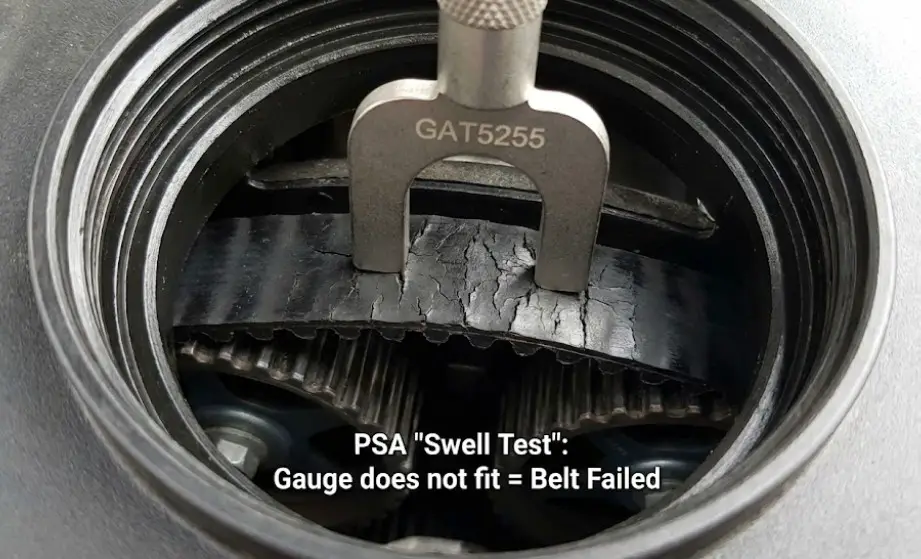
Uniquely for PSA engines, the wet belt can be inspected through the oil filler cap.
- Procedure: Remove the oil cap. Look down at the visible belt segment on the cam gears.
- What to look for:
- Cracking: Surface texture resembling dried earth.
- Swelling: The belt widens as it absorbs oil. If the belt fits tightly against the guides or looks "bloated," it is compromised.
- Tooling: A specific gauge tool (GAT5255 or PSA OEM tool) is designed to be dropped onto the belt through the oil filler. If the tool cannot fit over the belt width, the belt has swollen beyond spec and the engine is unsafe to drive.
Manufacturer Analysis: Honda
Honda is generally renowned for reliability, but the 1.0L VTEC Turbo engine is an exception regarding wet belts.
1.0 VTEC Turbo (P10A2)
- Models: Honda Civic Mk10 (2017–2021).
- Configuration: Wet Timing Belt.
- The Issue: Similar to Ford and PSA, the belt degrades, blocking the oil pickup strainer. This frequently leads to turbocharger failure (whistling/loss of power) and catastrophic engine damage.
- Cost Shock: The replacement is exceptionally labor-intensive, often quoted between £1,200 and £1,600 by specialists, significantly higher than Ford or PSA equivalents due to the engine's complexity and access restrictions.
- Identification: All 1.0L Turbo Civics of this generation feature the wet belt. The 1.5L Turbo uses a timing chain.
Manufacturer Analysis: Toyota
Toyota's reputation for using timing chains is complicated by their collaboration with PSA.
The "French" Toyotas
- Toyota Aygo (Mk2):
- 1.0L VVT-i: This is a Toyota engine (1KR-FE). It uses a Timing Chain. Bulletproof reliability.
- 1.2L: This is the PSA 1.2 PureTech engine rebadged. It uses a Wet Belt. It suffers from the same degradation issues as the Peugeot 208.
- Toyota Proace City: This is a rebadged Citroen Berlingo.
- 1.2L Petrol: Wet Belt (PureTech).
- 1.5L Diesel: Dry Belt (Ford/PSA DV5 engine).
The Volkswagen Group (VW/Audi/Seat/Skoda)
Dry Belts Rule
Contrary to some forum rumors, the mainstream small petrol engines from VAG (1.0 TSI, 1.2 TSI, 1.4 TSI, 1.5 TSI - EA211 family) utilise a Dry Timing Belt.
- Nuance: Some TDI engines and the 1.0 TSI do use a "belt-in-oil" for the Oil Pump drive. However, unlike the Ford/PSA cam belts, these oil pump belts are not under high tension and are generally considered "lifetime" components with very low failure rates.
- Verdict: A VW Golf 1.0 TSI does not have a wet timing belt system comparable to the Ford EcoBoost.
Preventative Maintenance & Visual Diagnostics
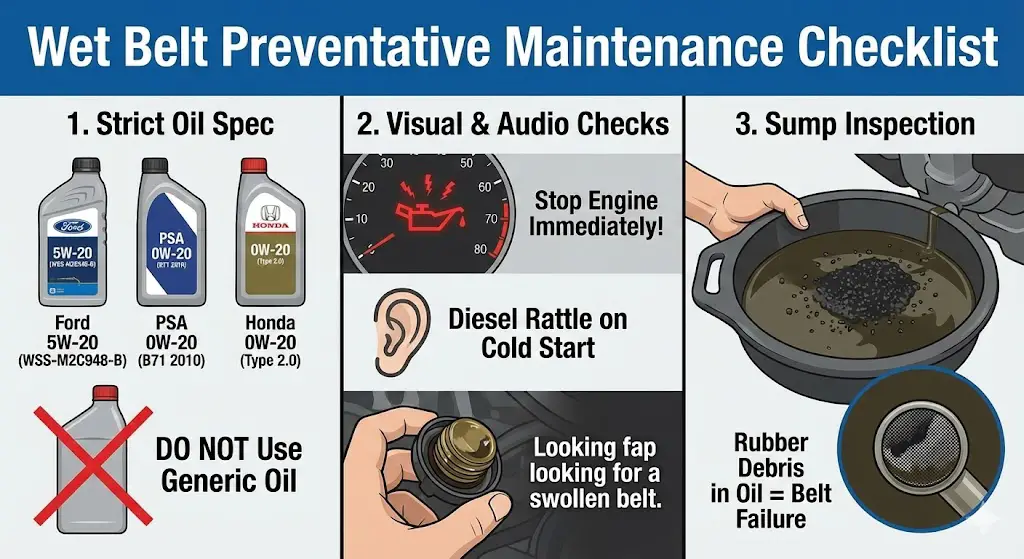
If your registration check confirms a wet belt engine, strict maintenance is the only defense against failure.
The Oil Specification Imperative
Using the correct oil is not just a recommendation; it is a chemical necessity.
- Ford 1.0 EcoBoost: Must use 5W-20 meeting spec WSS-M2C948-B. Generic 5W-20 will dissolve the belt.
- PSA 1.2 PureTech: Originally 0W-30 (B71 2312), now updated to 0W-20 (B71 2010) to reduce belt wear. Do not mix specs.
- Honda 1.0 VTEC: Honda proprietary 0W-20 Type 2.0.
Visual & Audio Health Checks
- Cold Start Rattle: Listen for a "diesel-like" clatter on startup. In wet belt engines, this often indicates the oil pump is struggling to build pressure due to a partially clogged strainer.
- The Sump Check (Definitive): During an oil change, inspect the drained oil for black, granular rubber debris. For a thorough check, remove the sump pan (oil pan) to inspect the pickup pipe screen. If debris is found, the belt is actively failing.
- Oil Pressure Light: If this light flickers, even once, stop the engine. It is 99% certain that the pickup pipe is blocked.
Replacement Costs (2025 Market Rates)
Wet belt replacement is not a standard service; it is a major engine intervention.
| Engine | Specialist Cost | Main Dealer Cost | Complexity Note |
| Ford 1.0 EcoBoost | £850 - £1,100 | £1,400 - £1,800 | Requires extensive locking tools and torque multipliers. |
| PSA 1.2 PureTech | £500 - £800 | £900 - £1,200 | Slightly easier access; sump removal mandatory for cleaning. |
| Honda 1.0 VTEC | £1,100 - £1,400 | £1,600+ | Very tight access; high labor hours. |
| Ford 2.0 EcoBlue | £1,000 - £1,300 | £1,800+ | "Cassette" system replacement. |
Conclusion
Determining if your car has a wet belt requires more than a glance at the number plate. While pre-2018 Ford 1.0Ls and pre-2023 PSA 1.2Ls are almost certainly wet belt engines, the transition years and "hybrid" configurations (like the Ford Dragon engine) require checking the Engine Code and Turbo Placement.
Critical Checklist for Owners:
- Ford: Check turbo position. Front = Wet Belt (Fox). Rear = Chain (Dragon), but remember the oil pump is still wet belt driven.
- PSA: Check oil cap. If the belt looks swollen or cracked, do not drive. Use the GAT5255 gauge tool.
- Maintenance: Change oil every 6,000-8,000 miles (half the manufacturer interval) using only the specific manufacturer grade.
- Buying Advice: If purchasing a used wet belt vehicle over 6 years old, demand proof of belt replacement or budget £1,000+ immediately for the work.