Automatic Transmission Slipping When Accelerating: Causes & Fixes Guide 2026

The modern automatic transmission is a highly sophisticated convergence of hydraulic fluid dynamics, mechanical planetary gear sets, and advanced electronic control modules. Its primary function is to multiply engine torque and transfer rotational kinetic energy to the drive wheels at varying gear ratios, allowing a vehicle to operate efficiently across a wide spectrum of speeds.
When a vehicle exhibits the condition known as automatic transmission slipping when accelerating, the kinetic relationship between the engine’s crankshaft and the transmission’s output shaft is fundamentally disrupted.
In a properly functioning automatic transmission, specific combinations of internal clutch packs and heavy-duty transmission bands are applied via localized hydraulic pressure to hold certain components of a planetary gear set stationary while allowing others to rotate. This precise choreography determines the gear ratio. Slipping occurs when the frictional clamping force applied to these clutch packs or bands is insufficient to handle the torque output of the engine.
As a result, the friction materials slide against their corresponding steel plates instead of locking together. To the driver, this manifests as a sudden spike or flare in engine revolutions per minute (RPM) without a proportional increase in vehicle speed.
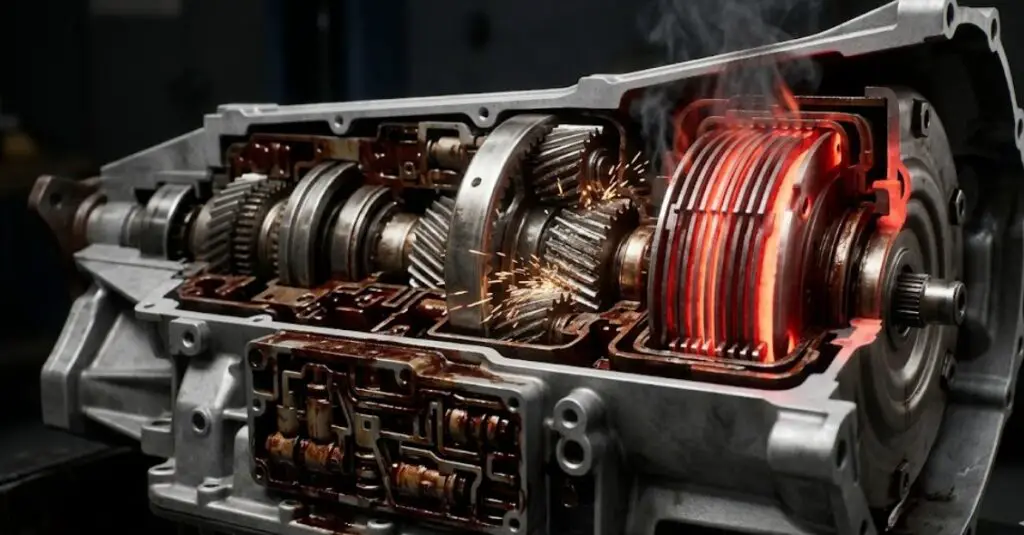
This phenomenon is not merely a drivability nuisance; it is a critical diagnostic indicator of compromised internal integrity or severe fluid degradation. If the slipping is ignored, the kinetic friction generated by the sliding clutch plates rapidly generates localized heat that exceeds the thermal capacity of the transmission fluid. This heat glazes the friction material, warps the steel separator plates, and sheds microscopic abrasive debris into the hydraulic system, which subsequently clogs the valve body and destroys solenoid functionality.
Understanding the complex mechanical, hydraulic, and electronic root causes of transmission slipping—alongside the identification of specific, manufacturer-level design flaws, such as those documented in the Ford transmission ecosystem—is imperative for accurate diagnostics, preventing catastrophic failure, and executing cost-effective repairs.
Symptomatology: Recognizing the Early Warning Signs of Slippage
The clinical presentation of a slipping automatic transmission varies depending on the exact point of internal failure, the temperature of the transmission fluid, and the load being placed on the drivetrain. Recognizing the nuance in these symptoms is the first step in differentiating a true transmission failure from an engine performance issue.
The diagnostic symptoms of transmission slippage can be categorized into several distinct physical and sensory experiences for the driver. The most definitive and universally recognized symptom is the RPM flare. When the driver depresses the accelerator pedal, expecting the vehicle to gain momentum, the engine revs loudly as if the vehicle were momentarily shifted into neutral.
This indicates a complete, albeit sometimes temporary, loss of mechanical coupling. This flaring is most commonly observed during the transition between gears, such as the 3-4 upshift or the 5-6 upshift, indicating that the specific clutch pack responsible for the incoming gear is failing to apply with adequate pressure.
Delayed or harsh gear engagements serve as another primary indicator of compromised hydraulic integrity. When a driver moves the gear selector from Park into Drive or Reverse, the transmission should engage almost instantaneously. A noticeable time lag—sometimes lasting several seconds—followed by a violent, jarring clunk indicates that the transmission pump is struggling to build sufficient hydraulic line pressure to overcome the return springs within the clutch pistons. This delay is often exacerbated when the vehicle is cold, as the increased viscosity of cold transmission fluid makes it more difficult for a failing pump to push fluid past hardened, aging internal rubber seals.
Sensory indicators, particularly olfactory and auditory cues, provide further diagnostic context. A sharp, acrid burning smell emanating from the vehicle’s undercarriage or wheel wells is a definitive sign of oxidized, overheated transmission fluid. When clutch packs slip, they generate immense friction. Because the transmission fluid is responsible for cooling these components, the localized heat from slipping clutches rapidly pushes the fluid beyond its thermal breakdown threshold, destroying its lubricating properties and leaving behind a varnish-like residue.
Auditory symptoms, such as high-pitched whining, grinding, or rhythmic clicking noises during acceleration, often accompany slipping. Whining is typically associated with a starving hydraulic pump attempting to draw fluid through a restricted filter, while grinding indicates that the friction material has been entirely stripped away, resulting in catastrophic metal-on-metal contact within the planetary gear sets.
Mechanical and Hydraulic Root Causes of Slippage
The architecture of a modern step-gear automatic transmission relies on the seamless interaction between hydraulic fluid pressure, electronic solenoid controls, and mechanical friction elements. A disruption in any of these three pillars will inevitably result in slippage.
Fluid Degradation, Contamination, and Pressure Loss
Automatic Transmission Fluid (ATF) is the lifeblood of the system. It functions simultaneously as a highly refined lubricant, a thermal transfer medium for cooling, a detergent to suspend debris, and a hydraulic fluid to transmit clamping force. The operational pressure required to lock a clutch pack under heavy acceleration can exceed 200 pounds per square inch (PSI).
If the overall fluid volume drops due to external leaks at the pan gasket, axle seals, or transmission cooler lines, the hydraulic pump will draw in air. Air, unlike hydraulic fluid, is highly compressible. When aerated fluid is pushed into the clutch application pistons, the pressure drops drastically, the pistons fail to apply maximum clamping force, and the transmission slips.
Furthermore, the chemical integrity of the fluid is paramount. Over thousands of miles of thermal cycling, ATF undergoes oxidation, breaking down its engineered molecular structure. This degradation destroys the vital friction modifiers suspended in the fluid. These friction modifiers dictate the dynamic and static friction coefficients of the clutch plates.
When the fluid degrades into a dirty, burnt, low-viscosity liquid, it loses its ability to grip the friction discs efficiently. The fluid essentially becomes too “slick” or too contaminated with abrasive metal shavings, accelerating wear on all moving parts and leading to widespread transmission slipping.
Worn Friction Material and Transmission Bands
The actual mechanical coupling within the transmission is achieved through clutch packs and transmission bands. A clutch pack consists of alternating layers of internally splined steel plates and externally splined friction plates, which are lined with specialized composite materials like cellulose, Kevlar, or carbon fiber. During a gear shift, hydraulic pressure squeezes these plates together, locking specific components of the planetary gear set to the transmission output shaft.
Over extended mileage, particularly in vehicles subjected to aggressive acceleration, heavy towing, or chronic overheating, the composite friction material gradually wears away. Once the friction material is depleted down to the bare steel core, the transmission loses its mechanical grip. The steel plates slide against one another, causing uncontrollable RPM flaring and rendering that specific gear inoperable.
Similarly, many automatic transmissions utilize heavy-duty metal bands lined with friction material that wrap around the outside of rotating clutch drums. A hydraulic servo applies pressure to one end of the band, tightening it around the drum to hold it stationary. If a transmission band becomes stretched due to metal fatigue, or if its friction lining wears thin, the drum will continue to spin even when the servo is fully applied, resulting in gear slippage, particularly when the vehicle attempts to shift into second or third gear.
Malfunctioning Valve Bodies and Shift Solenoids
The valve body is a complex labyrinth of cast aluminum channels bolted to the bottom of the transmission, acting as the hydraulic control center. It routes pressurized fluid to the various clutch pistons and servos. Within this valve body reside multiple electro-mechanical shift solenoids. These solenoids are essentially electrically operated valves controlled by the Transmission Control Module (TCM) or Powertrain Control Module (PCM).
Modern transmissions rely heavily on Pulse Width Modulated (PWM) solenoids, which rapidly cycle on and off to precisely control the rate of fluid flow and line pressure. If a solenoid fails electrically—due to a burned-out internal coil—or mechanically—due to a plunger jammed by suspended metallic debris in the fluid—it cannot open or close properly.
This prevents hydraulic pressure from reaching the intended clutch pack. Consequently, the TCM may command a gear shift, but the physical application is delayed or denied, leading to a massive slip, an engine flare, and the activation of a limp-mode or failsafe condition.
Ford-Specific Transmission Engineering Failures and TSBs
While transmission slippage is a universal automotive ailment, analyzing historical data and Technical Service Bulletins (TSBs) reveals that specific transmission architectures exhibit inherent, patterned points of failure. The Ford Motor Company’s implementation of the 10R80, 6R80, 6F35, and PowerShift DPS6 transmissions provides a critical study in how specific design flaws dictate diagnostic and repair methodologies.
The Ford 10R80: CDF Drum Failure and Thermal Bypass Dysregulation
The 10R80 is a sophisticated, longitudinal 10-speed automatic transmission developed through a joint venture between Ford and General Motors. Deployed extensively in high-torque applications such as the Ford F-150, Explorer, Mustang, Expedition, Transit, and the Lincoln Navigator, the 10R80 utilizes adaptive shift programming and multiple clutch-to-clutch handoffs to deliver rapid, seamless power.
However, this complexity leaves virtually zero margin for hydraulic pressure loss. The 10R80 has become notorious for harsh downshifts, severe 3-4 and 5-6 shift flares, delayed park-to-drive engagements, and overall transmission slipping.
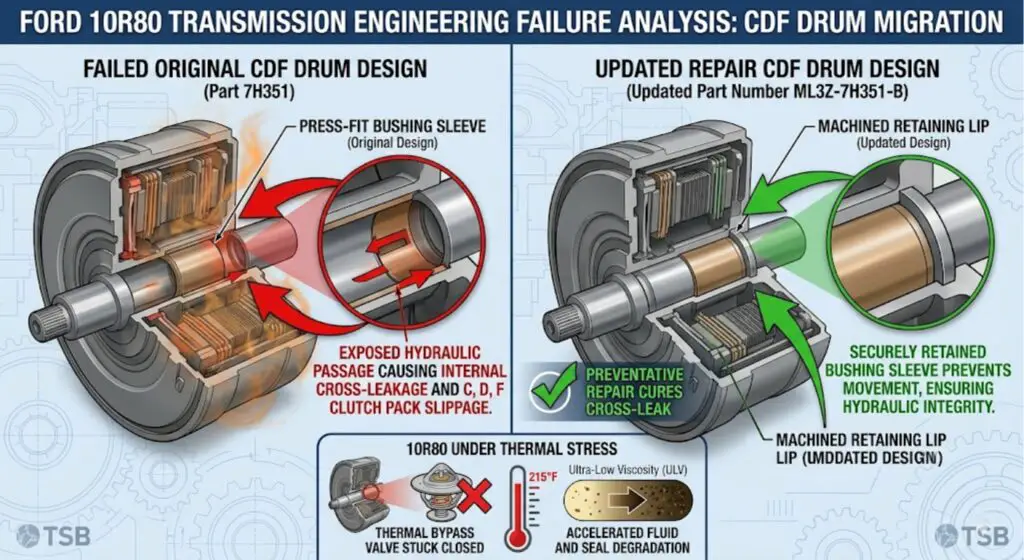
The overwhelming majority of catastrophic 10R80 failures can be traced to a single, critical engineering flaw: the CDF clutch cylinder (7H351). As documented extensively in(https://static.nhtsa.gov/odi/tsbs/2024/MC-11006772-0001.pdf) and related technical bulletins, the internal bushing sleeve within the CDF drum was originally manufactured as a press-fit component without a physical retaining lip. Subjected to the intense thermal cycling and rotational forces of the transmission, this inner sleeve experiences axial movement—it slides down the shaft of the drum.
When the sleeve shifts out of its intended position, it exposes the vital hydraulic fluid passages that supply pressure to the C, D, and F clutch packs. The resulting internal cross-leakage causes a massive, instantaneous drop in clutch clamping force. When the PCM commands a gear that relies on the C, D, or F clutches, the low pressure allows the clutch plates to slip uncontrollably.
To permanently rectify this, Ford engineers designed an updated CDF drum (Part numbers ML3Z-7H351-B, JL3Z-7H351-B, or JR3Z-7H351-B depending on engine pairing) that features a newly machined lip. This physical barrier makes it impossible for the inner sleeve to migrate, effectively curing the cross-leak and restoring hydraulic integrity.
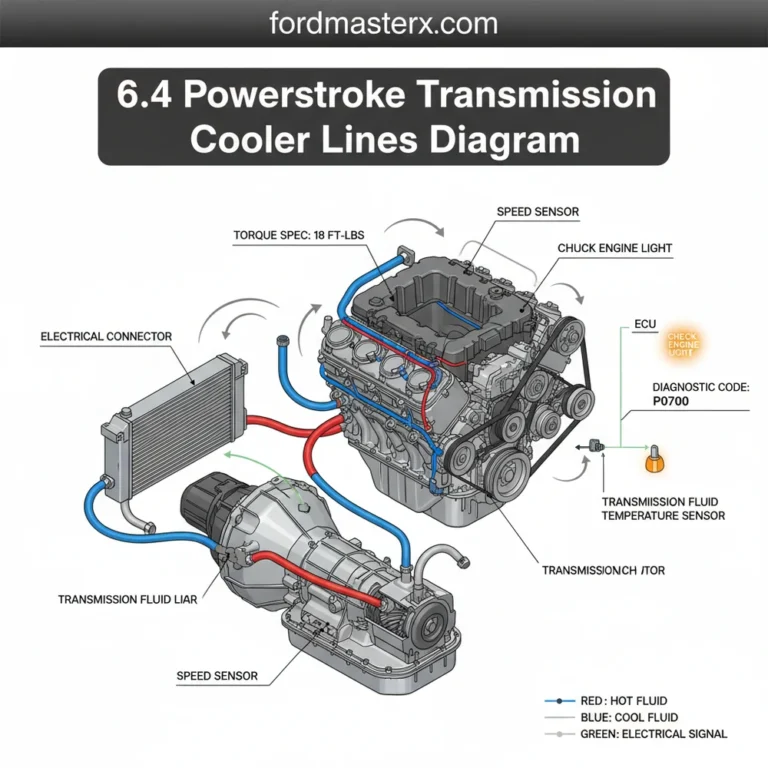
Compounding the mechanical drum failure is the 10R80’s susceptibility to thermal management issues. The transmission utilizes a thermal bypass valve (thermostat) to regulate fluid flow to the external transmission cooler. If this valve sticks closed, the transmission operates in a state of chronic overheating, frequently exceeding the normal operating range of 206°F to 215°F.
Fluid temperatures rising above 210°F under mild driving conditions indicate severe thermal distress. This excessive heat rapidly degrades the Ultra-Low Viscosity (ULV) fluid, compromises the already thin overdrive friction plates, and accelerates the degradation of internal seals, culminating in severe transmission slip.
The Ford 6R80: Molded Lead Frame Electrical Failure
The 6R80 is a robust 6-speed longitudinal transmission widely utilized in 2009-2018 F-150s, Mustangs, and Expeditions. While the mechanical hard parts of the 6R80 are generally considered highly durable, the transmission is plagued by a highly specific electrical failure concerning the molded lead frame.
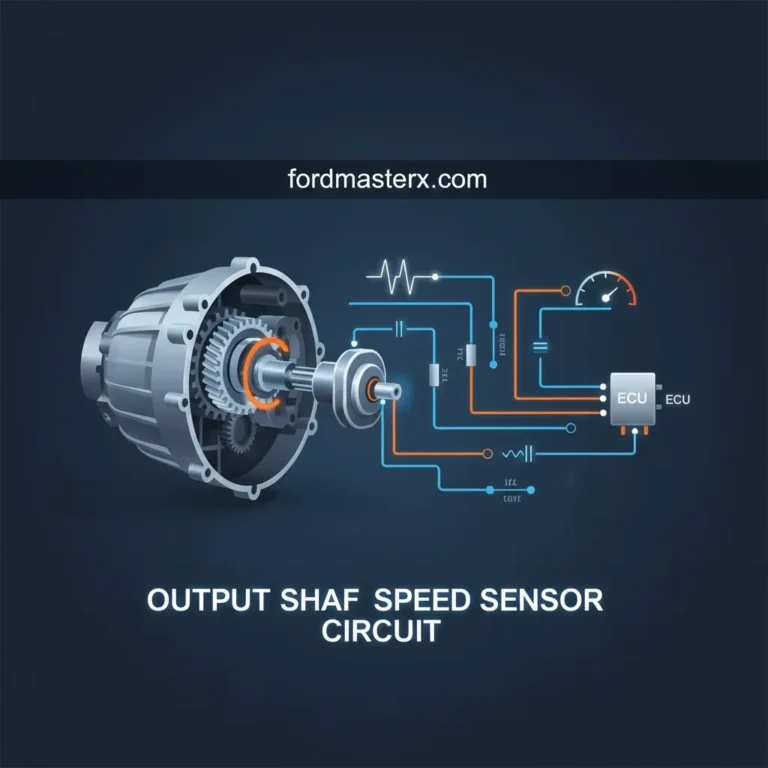
The molded lead frame is a complex electrical conduit assembly that bolts directly to the top of the valve body inside the transmission oil pan. It houses the critical internal sensors, including the Output Shaft Speed (OSS) sensor, Input Shaft Speed (ISS) sensor, and Transmission Range (TR) sensor.
Over time, microscopic metallic debris naturally generated by clutch wear becomes suspended in the transmission fluid. Because the OSS and ISS sensors are magnetic, they attract and accumulate this metallic sludge. Additionally, the internal circuitry of the lead frame itself is prone to thermal fatigue.
When the lead frame fails, the PCM suddenly loses the speed signals from the transmission. This triggers an immediate failsafe response. The transmission may abruptly and violently downshift into 1st or 3rd gear while the vehicle is traveling at highway speeds, a highly dangerous condition. In other instances, the vehicle enters “limp mode,” the speedometer drops to zero,
the wrench indicator light illuminates, and the transmission refuses to shift out of 3rd or 5th gear, giving the driver the distinct impression of massive transmission slippage. Ford addressed this widespread issue via official technical bulletins, notably TSB 13-06-08 (and subsequent safety recalls), directing technicians to replace the molded lead frame assembly (Part # AL3Z-7G276-A) to restore sensor communication.
The Ford 6F35: Case Wear, Axle Bushings, and Endplay
For transverse, front-wheel-drive, and all-wheel-drive applications such as the Ford Escape, Fusion, and Explorer, Ford utilizes the 6F35 transmission. Now in its third generation, the 6F35 exhibits patterned failures entirely distinct from its rear-wheel-drive counterparts, primarily centered around structural case wear and differential support failure.
The core issue involves the thrust bearing that rides against the aluminum differential support structure within the transmission case. Under load, this thrust bearing can begin to rotate against the relatively soft aluminum, slowly grinding a deep groove into the transmission case half. As material is removed from the case, the internal endplay (the forward and backward movement tolerance of the differential assembly) falls vastly out of specification.
Excessive endplay acts as a destructive force multiplier. It causes the axle bushings to wear prematurely and unevenly, leading to massive external fluid leaks around the axle seals. As the transmission bleeds fluid, hydraulic pressure plummets, resulting in erratic shifting, harsh upshifts into 5th and 6th gear, and severe intermittent slipping.
While traditional repair methodology dictated the costly replacement of the entire transmission case half to restore tolerances, the aftermarket engineering firm Sonnax developed a highly effective solution. The Sonnax Case Saver Kit (144281-01K) utilizes specially designed, non-rotating shims that fit into the worn pocket. This corrects the differential endplay, halts further rotational wear, prevents repeat bushing failure, and stops the leakage causing the slippage without the extreme expense of a total teardown.
The Ford PowerShift DPS6: Dry Dual-Clutch Catastrophe
An analysis of Ford transmission slipping must address the infamous DPS6 PowerShift transmission utilized in 2011-2016 Ford Fiestas and 2012-2016 Ford Focuses. Unlike the 10R80 or 6R80, which are traditional hydraulic automatic transmissions utilizing a fluid-filled torque converter, the PowerShift is an automated manual transmission. It relies on two dry clutches (one for even gears, one for odd gears) operated by electronic actuator motors, with no fluid to cool the friction materials.
Due to the dry-clutch design, the transmission is highly susceptible to heat and contamination. A design flaw allowed fluid from the input shaft seals to leak onto the dry clutches, destroying their friction coefficient. Furthermore, the Transmission Control Module (TCM) algorithms struggled to smoothly engage the clutches, particularly in stop-and-go traffic. Drivers experienced violent shuddering, hesitation, and massive slipping upon acceleration.
The widespread nature of these failures led to a massive class-action lawsuit and the creation of the(https://fordtransmissionsettlement.com/), which mandated extended warranties, repeated hardware replacements, software flashes, and in some cases, vehicle repurchases for affected consumers.
Decoding Transmission Slipping: Diagnostic Trouble Codes (DTCs)
Modern automatic transmissions operate under the constant surveillance of the Powertrain Control Module (PCM) and the Transmission Control Module (TCM). These computers utilize a network of sensors to monitor fluid temperature, line pressure, and, most importantly, the rotational speeds of the internal shafts.
The primary mechanism the computer uses to detect slippage is mathematical ratio calculation. The TCM monitors the Input Shaft Speed (the RPM entering the transmission from the engine) and compares it to the Output Shaft Speed (the RPM leaving the transmission to the wheels). When a specific gear is commanded, the computer knows the exact mechanical gear ratio that should exist between the input and output shafts. If the real-world RPM difference falls outside the programmed normal range, the computer instantly recognizes that the internal clutches are slipping.
Upon detecting this discrepancy, the TCM will illuminate the Check Engine Light or Malfunction Indicator Lamp (MIL) and store specific Diagnostic Trouble Codes (DTCs). Understanding these codes is essential for pinpointing the exact location of the internal failure.
| Diagnostic Trouble Code (DTC) | Code Definition | Diagnostic Implications and Likely Causes |
| P0731 | Gear 1 Incorrect Ratio | Slipping in 1st gear. Often caused by low fluid, a defective 1st gear shift solenoid, a bad input/output speed sensor, or total failure of the forward clutch pack or planetary gear. |
| P0732 | Gear 2 Incorrect Ratio | Slipping in 2nd gear. Typically indicates worn transmission bands, a failing intermediate clutch, or localized pressure loss in the valve body. |
| P0733 | Gear 3 Incorrect Ratio | Slipping in 3rd gear. In Ford 10R80 units, this code is highly correlated with the CDF drum axial movement cross-leak, leading to burnt friction plates. |
| P0734 | Gear 4 Incorrect Ratio | Slipping in 4th gear (often an overdrive gear). Indicates severely degraded fluid, failing overdrive solenoids, or stripped overdrive friction plates. |
| P0735 | Gear 5 Incorrect Ratio | Slipping in 5th gear. Suggests massive hydraulic pressure leaks, torque converter clutch slipping, or severely worn high-gear clutch packs. |
The Danger of Misdiagnosis: Differentiating Powertrain Symptoms
Because the engine, torque converter, and transmission operate as a unified, tightly coupled system, symptoms originating in one component are frequently, and expensively, misdiagnosed as failures in another. Replacing a transmission when the actual fault lies within the engine management system is a catastrophic error in diagnostic logic.
Engine Misfires Impersonating Transmission Slips
An engine misfire occurs when the combustion process in one or more cylinders fails due to a lack of spark, fuel, or compression. Under light acceleration or steady highway cruising (typically between 40-50 mph when the transmission shifts into a high overdrive gear), the engine RPM is intentionally kept very low. If a faulty ignition coil or spark plug causes a misfire under this specific low-RPM, high-load condition, the engine momentarily loses power and violently jerks.
To the driver, this rhythmic bucking and hesitation feels identical to a transmission violently slipping in and out of gear or a torque converter shuddering. A less experienced technician might assume the transmission is failing. However, utilizing an advanced OBD-II scanner to view live, Mode $06 diagnostic data allows a professional to monitor individual cylinder misfire counters. Identifying and replacing a $50 ignition coil can completely cure what was initially misdiagnosed as a $5,000 transmission slipping issue.
The Mass Airflow Sensor (MAF) Discrepancy
The Mass Airflow (MAF) sensor is mounted in the engine’s air intake and measures the volume and density of air entering the cylinders. The Powertrain Control Module uses this exact data not only to calculate fuel injection but also to determine engine load. The transmission relies entirely on this calculated engine load data to determine exactly when to shift and how much line pressure to apply.
If the MAF sensor becomes coated in dirt or oil, it reports inaccurate, artificially low airflow data to the PCM. Believing the engine is under very light load, the PCM commands a soft, low-pressure transmission shift. Because the engine is actually under heavy acceleration, this low-pressure shift lacks the clamping force required to hold the clutches, causing the transmission to slip violently. In this scenario, the transmission is mechanically flawless; it is merely reacting to bad data from a dirty $100 engine sensor.
Torque Converter Shudder vs. Internal Transmission Slip
The torque converter is the fluid coupling device bolted between the engine flexplate and the transmission input shaft. Modern torque converters contain an internal lock-up clutch. When the vehicle reaches cruising speed, the PCM commands this clutch to engage, locking the engine and transmission together in a 1:1 ratio to eliminate fluid slip and improve fuel economy.
If the transmission fluid is degraded, or if the friction lining on this lock-up clutch is worn, the clutch will struggle to hold. It will rapidly slip, grab, slip, and grab at a high frequency. This induces an intense vibration throughout the entire vehicle, commonly referred to as “torque converter shudder”.
Differentiating torque converter shudder from true transmission slipping requires careful observation of driving conditions. Torque converter shudder almost exclusively occurs at steady cruising speeds (40-60 mph) under light throttle applications just as the vehicle attempts to enter overdrive lock-up. Conversely, internal transmission slipping typically manifests as a high-RPM engine flare during heavy acceleration, taking off from a complete stop, or precisely at the shift points between lower gears.
Professional Diagnostic and Repair Protocols
When a vehicle presents with confirmed transmission slipping, professional technicians utilize a highly structured hierarchy of tests to isolate the exact hydraulic or mechanical failure point. Guesswork in transmission repair is economically disastrous.
The Stall Test Procedure: Pushing to the Limit
A stall test is a definitive, high-stress diagnostic procedure used to determine the holding capacity of the internal transmission clutches, transmission bands, and the integrity of the torque converter stator.
Safety and Operational Warning: The stall test intentionally applies maximum engine torque against a locked drivetrain. It generates extreme internal pressures and immense, localized heat within the fluid. This test must only be performed by a trained professional and must never be sustained for longer than 5 seconds at a time to prevent boiling the transmission fluid and warping internal components.
- Preparation: The vehicle is parked on a flat surface, securely chocked, and the transmission fluid is brought to its normal operating temperature (typically 160°F – 220°F).
- Lockdown: The technician firmly applies the parking brake and depresses the primary service brake pedal with maximum force, holding it down for the duration of the test.
- Execution: The transmission is shifted into Drive (or manually selected 1st gear). While keeping the brakes locked, the technician rapidly presses the accelerator pedal completely to the floorboard.
- Observation: The engine RPM will rapidly rise and then hit a wall, stopping its climb even though the throttle is wide open. The technician records this maximum stabilized RPM, known as the “Stall Speed”.
Fluid Verification Without a Dipstick (Ford 10R80 & 6R80 Protocols)
Historically, verifying transmission fluid levels involved pulling a long dipstick from the engine bay. To reduce costs and prevent consumer contamination, manufacturers have largely eliminated the under-hood dipstick. Modern Ford transmissions, notably the 6R80 and 10R80, are considered “sealed units,” featuring a localized, miniature dipstick integrated directly into the fill plug on the side of the transmission case.
Checking the fluid level on these units is a highly specific, temperature-dependent procedure. Transmission fluid undergoes significant volumetric expansion when heated. Therefore, measuring the fluid when the transmission is cold will yield an artificially low reading.
- The vehicle must be lifted perfectly level on a hoist.
- A professional scan tool must be connected to the OBD-II port to monitor the live Transmission Fluid Temperature (TFT) PID.
- For the Ford 10R80, the fluid temperature must be strictly maintained between 206°F and 215°F (96°C to 101°C) during the check.
- With the engine running, the technician—wearing thermal protective gear due to the extreme proximity to the catalytic converters—removes the localized dipstick/plug.
- The fluid level must rest perfectly within the crosshatched area (typically the ‘B’ mark or numbers 5-6 depending on the dipstick iteration).
If a technician or DIYer checks the fluid cold and adds fluid to reach the full mark, the transmission will be massively overfilled once it reaches operating temperature. Overfilled fluid strikes the rotating planetary gears, churning the fluid into a frothy, aerated foam. This aerated fluid is compressible, leading to an instant loss of hydraulic pressure, fluid venting from the breather tube, severe overheating, and catastrophic slipping.
Software Re-calibration and Adaptive Learning Resets
As transmissions mechanically wear, the TCM utilizes Adaptive Shift Strategy algorithms to compensate. The computer constantly monitors the time it takes to complete a shift. If the clutch plates begin to thin out, the shift takes longer. The TCM learns this and incrementally increases hydraulic line pressure to force the shift to complete on time, masking the mechanical wear.
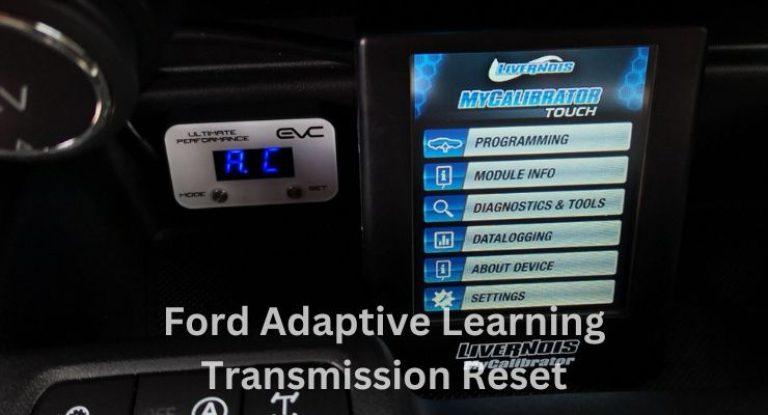
However, these adaptive tables can become corrupted, or they may adapt negatively to severely degraded fluid or battery voltage drops. When this occurs, the transmission may shift harshly or slip erratically. Before tearing down a transmission, a technician will use a proprietary scan tool (such as Ford’s FDRS or FORScan) to completely erase the adaptive shift tables and command a system reset.
Following the reset, the transmission operates on baseline factory pressures. The driver must then complete an “adaptive drive cycle”—a highly specific regimen involving smooth, light accelerations and decelerations—allowing the TCM to rebuild a new, clean data table and learn the correct pressure requirements for the current mechanical state of the transmission. This simple software re-flash (often costing between $75 and $250) can sometimes entirely cure perceived slipping issues, particularly in the notoriously software-sensitive 10R80.
Repair vs. Replacement: Economic Cost Analysis (2024-2025 Market Data)
When software resets and fluid corrections fail to resolve the slipping, the vehicle owner is faced with a major economic decision: a localized component repair, a full internal rebuild, or a complete remanufactured replacement.
Minor repairs, such as dropping the transmission pan to replace a faulty shift solenoid, a leaking valve body separator plate, or a Ford 6R80 molded lead frame, are relatively straightforward. Because the transmission does not need to be physically removed from the vehicle chassis, labor costs are minimized.
However, if the vehicle has been driven while actively slipping, the prognosis worsens significantly. The microscopic friction material stripped from the clutch plates circulates through the entire hydraulic system. It embeds into rubber piston seals, clogs the microscopic pathways in the valve body, and scores the pump housing. In these scenarios, replacing a single solenoid is futile; the abrasive contamination will quickly destroy the new component. A full rebuild or replacement is mandatory.
The data indicates that repairing deeply damaged, highly complex multi-speed units (such as the 10-speed 10R80) is increasingly difficult for independent shops, pushing economics toward full factory remanufactured replacements.
| Transmission Service Type | Estimated Cost Range (USD) | Primary Components Addressed | Diagnostic Viability |
| Transmission Fluid & Filter Exchange | $292 – $459 | Fluid flush/drain, new internal filter, pan gasket. | Proactive maintenance; only fixes slipping if fluid was marginally low. |
| Minor External/Pan-Drop Repair | $450 – $1,500 | Valve body replacement, shift solenoids, lead frames, external seals. | Viable for sudden electrical failures without internal metallic contamination. |
| Standard Internal Transmission Rebuild | $3,000 – $6,000 | Replacement of all friction clutches, bands, rubber seals, gaskets, CDF drum upgrades, intensive labor. | Excellent for older 4/6-speed units; requires highly skilled builder. |
| Full Remanufactured Replacement | $5,800 – $9,500 | Installation of an entirely new/remanufactured unit from the factory or major supplier. | Most reliable solution for complex 10-speed failures (e.g., 10R80 averages $9,500 at dealerships). |
Preventative Maintenance and the Science of Transmission Fluid
The automotive industry’s push toward marketing vehicles with “lifetime transmission fluid” has been heavily criticized by drivetrain engineering professionals. Fluid degradation is the primary catalyst for internal component failure. As the transmission operates, the constant shearing forces between the gears and the thermal stress from the torque converter physically break down the fluid’s polymer chains.
The single most effective preventative measure against transmission slipping is strict adherence to preventative fluid maintenance. Industry professionals advocate for a fluid and filter change interval of 30,000 to 60,000 miles, particularly for vehicles subjected to “severe duty” cycles, which includes frequent stop-and-go city driving, mountainous terrain, or towing. This interval ensures that abrasive metallic clutch dust is flushed from the system and that the thermal and frictional properties of the fluid are restored.
Fluid Specification: The Criticality of Viscosity
Equally important to the interval is the exact chemical specification of the fluid utilized. The tolerances within modern valve bodies are measured in ten-thousandths of an inch. Utilizing the incorrect fluid will alter the hydraulic flow rate, causing incorrect line pressures that lead directly to slipping and harsh shifting.
Within the Ford architecture, there is a stark and critical difference between fluid generations.
- Mercon LV (Low Viscosity): Utilized in the 6R80 and 6F35 transmissions, Mercon LV has a kinematic viscosity (KV) of approximately 6.0 centipoise (cP) at 100°C. It provides the specific hydraulic cushion required for those 6-speed geometries.
- Mercon ULV (Ultra-Low Viscosity): Developed specifically for the 10R80 and GM 10-speed equivalents, Mercon ULV has a significantly thinner KV of roughly 4.5 cP. The 10-speed transmission contains multiple rotating clutch drums. Pumping thicker fluid through these drums creates immense parasitic drag, reducing fuel economy. The ULV fluid eliminates this drag. However, its ultra-thin nature makes it highly susceptible to thermal breakdown if the transmission overheats, emphasizing the need for robust transmission coolers and functional thermal bypass valves. Mixing these fluids, or using a generic aftermarket fluid lacking the precise OEM friction modifiers, is a primary driver of shift flares and clutch slipping.
People Also Ask
Why is my automatic transmission slipping when cold?
When a transmission slips primarily while the vehicle is cold but functions normally after reaching operating temperature, it strongly indicates the deterioration of internal rubber piston seals. Rubber hardens and shrinks as it ages and is subjected to cold temperatures. When the cold, hardened seals fail to expand against the clutch cylinder walls, the hydraulic fluid pressure simply blows past them, resulting in an inability to compress the clutch pack. As the transmission warms up, the thermal expansion of both the fluid and the rubber softens the seals, allowing them to temporarily hold pressure. This symptom is a definitive warning that an internal rebuild is imminent.
Can I fix a slipping transmission by adding a fluid additive or “stop slip”?
Transmission fluid additives, often marketed as “stop slip” or “shudder fix,” are highly concentrated chemical formulations designed to swell rubber seals and radically increase the friction coefficient of the fluid. If the slipping is caused by mildly shrunken seals or minor fluid degradation, an additive may temporarily restore operation and stop torque converter shudder. However, these chemicals cannot replace missing friction material on a stripped clutch plate or fix a broken transmission band. They are universally viewed by professionals as a temporary “band-aid” to prolong the life of a dying transmission by a few thousand miles, not a permanent mechanical repair.
Is it safe to drive a car with a slipping transmission?
Operating a vehicle with an actively slipping transmission is highly dangerous and economically destructive. When clutches slip, vehicle behavior becomes unpredictable; the car may suddenly lose all forward momentum while merging onto a highway or traversing an intersection. Furthermore, driving while slipping generates exponential internal heat that rapidly destroys any remaining viable components within the transmission. What might have initially been diagnosed as a simple low-fluid issue or a $200 shift solenoid replacement will rapidly escalate into a catastrophic internal meltdown requiring a complete $6,000 transmission rebuild. The vehicle must be parked and subjected to immediate professional diagnostics.
Will a transmission flush fix a slipping transmission?
This represents one of the most heavily debated topics in automotive repair. The answer is highly dependent on the root cause and the severity of the slip. If the slipping just started and is solely due to slightly low fluid or sticky valves caused by mild varnish, dropping the pan, changing the filter, and refilling with clean fluid may restore hydraulic integrity.
However, a pressurized transmission “flush”—which forces fluid through the entire system—is highly discouraged for transmissions that have been slipping severely for an extended period. When clutch plates wear down, the gritty friction material is suspended in the old, dark transmission fluid. In a severely worn transmission, this abrasive, gritty fluid is sometimes the only thing providing enough friction for the worn plates to grab each other.
Flushing out this gritty fluid and replacing it with highly refined, slick new fluid removes that artificial friction. Consequently, the transmission, which was previously slipping mildly, may completely lose all ability to engage any gear immediately following the flush. If the fluid is black and smells burnt, the transmission requires mechanical repair, not just new fluid.
Strategic Diagnostic Summary
The phenomenon of an automatic transmission slipping when accelerating is the culmination of immense physical forces interacting with degraded fluid dynamics, electronic sensor failures, or inherent engineering flaws. For modern vehicles, particularly those utilizing complex multi-speed architectures like the Ford 10R80 or 6R80, the margin for error is non-existent.
A loss of hydraulic pressure—whether through the axial movement of a CDF drum, a leaking axle bushing on a 6F35, or severely aerated fluid—results in the immediate inability of the clutch packs to transfer engine torque to the drivetrain.
Accurate diagnostics form the bedrock of cost-effective repair. Differentiating a transmission slip from an engine misfire via Mode $06 data, identifying torque converter shudder through specific driving conditions, and executing rigorous stall tests and adaptive learning resets prevent the catastrophic financial error of misdiagnosing powertrain components.
Ultimately, the longevity of these complex kinetic systems rests upon proactive thermal management and strict adherence to specific fluid maintenance intervals. By addressing shift flares and delayed engagements at their onset, the cascade of mechanical destruction can be halted, preserving the integrity and reliability of the vehicle’s driveline.