6.0 Powerstroke EGR Delete Kits: Performance, Reliability, and Legalities The Definitive Guide 2026

The introduction of the 6.0L Powerstroke diesel engine, known internally by its manufacturer as the Navistar VT365, marked a significant and highly controversial technological transition for light and medium-duty trucks starting in the 2003 model year. Engineered as the successor to the legendary 7.3L Powerstroke, the 6.0L engine was tasked with a dual mandate: it needed to deliver higher horsepower and torque for the increasingly competitive towing market while simultaneously complying with stringent new federal emissions standards.
Central to this emissions compliance strategy was the integration of an Exhaust Gas Recirculation (EGR) system, a mechanism specifically designed to reduce nitrogen oxide (NOx) emissions.
However, the integration of this EGR system into the high-compression, turbocharged, and thermally dense environment of the 6.0L diesel engine resulted in a cascade of reliability issues that continue to plague the platform decades later. The mechanical friction between regulatory compliance and thermodynamic efficiency birthed a massive aftermarket industry focused entirely on mitigating the engine’s inherent design flaws. The most prominent, debated, and legally scrutinized of these mitigations is the 6.0 Powerstroke EGR delete kit. This mechanical modification physically removes or permanently bypasses the factory EGR cooler and EGR valve, prioritizing engine longevity and thermodynamic performance over emissions compliance.
Implementing an EGR delete fundamentally alters the engine’s thermal dynamics, internal fluid routing, and electronic control strategies. Consequently, understanding the efficacy, technical execution, and profound legal risks associated with this modification requires a granular examination of thermodynamic principles, metallurgical failure points, and the rapidly evolving statutory framework surrounding the Clean Air Act.
SAVING THE 6.0L
The Data Behind the EGR Delete Kit
The 6.0 Powerstroke is legendary for torque, but notorious for head gasket failures. Is the EGR Delete the ultimate fix? We visualized the data.
The “Puking” Problem
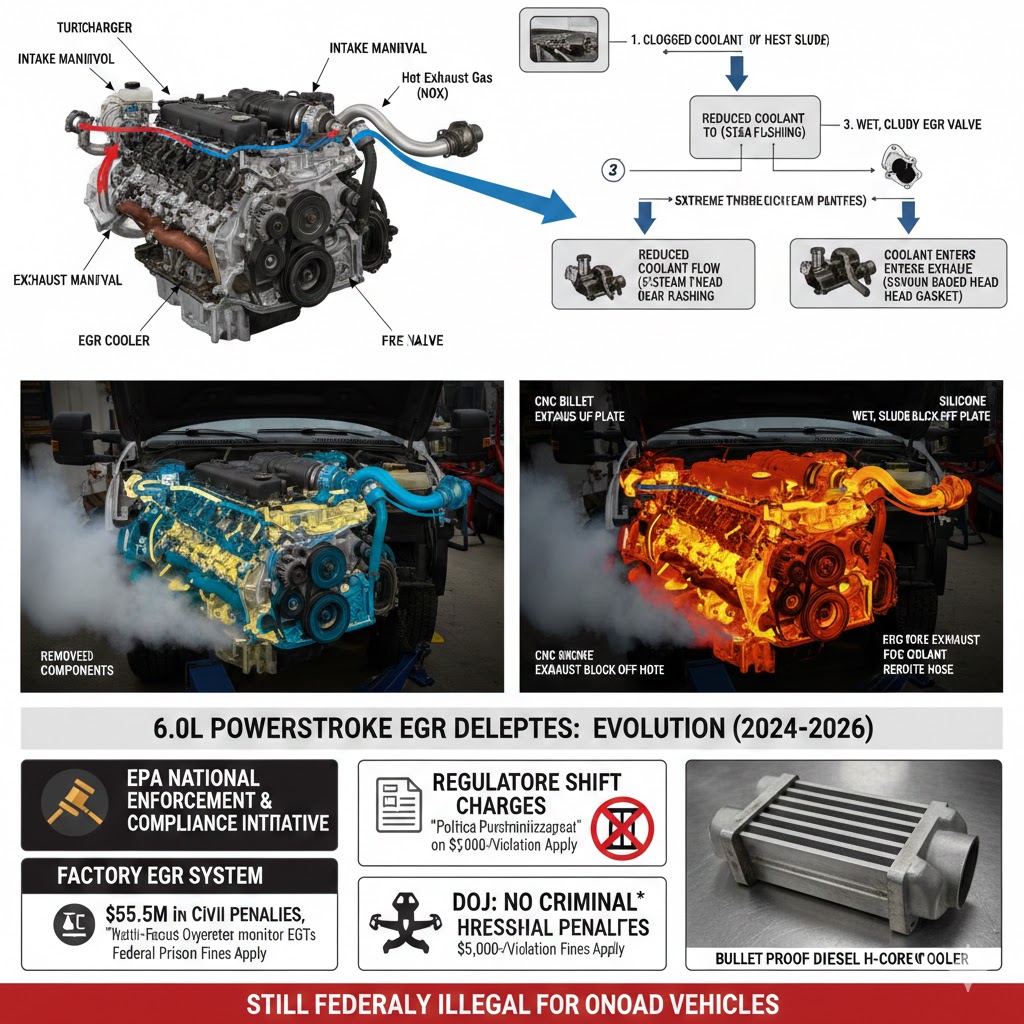
Why do 6.0L owners fear the EGR? It’s the primary domino in a chain reaction that kills engines. When the oil cooler clogs, the EGR cooler cracks, leaking coolant into the cylinders. This creates steam (white smoke) and excessive pressure that blows head gaskets.
Key Statistic
~65%
of catastrophic 6.0L failures are traced back to the Oil Cooler / EGR Cooler system.
- 1. Oil Cooler Clogs (Sand/Sludge)
- 2. Coolant Flow Restricts
- 3. EGR Cooler Cracks (Flash Boil)
- 4. Head Gaskets Blow
The Price of Reliability
Deleting isn’t just buying a pipe. It involves labor, tuning, and often “while you’re in there” upgrades like the oil cooler. Compare the DIY route vs. a Full Shop “Bulletproof”.
Prices are estimated 2025 market averages.
Performance: EGT Reduction
The biggest performance gain isn’t horsepower—it’s thermal management. By removing hot exhaust gas from the intake, Exhaust Gas Temperatures (EGTs) drop significantly under load.
The Decision Matrix
Deleting the EGR solves the mechanical failure point, but it introduces legal risks. Here is the breakdown of what you gain and what you risk.
✓ The Gains (Pros)
- • Zero Failure Risk: You cannot crack a cooler that doesn’t exist. Eliminates hydrolock risk.
- • Clean Intake: Stops soot from mixing with oil vapor, preventing sludge buildup in the manifold.
- • Lower EGTs: ~150°F drop while towing, keeping the engine cooler.
⚠ The Risks (Cons)
- • Check Engine Light: Requires a tuner to suppress the code, adding cost.
- • Slow Warm-Up: In cold climates, the engine takes longer to reach operating temp.
- • Illegal (EPA): Federal violation in the US. Fails visual inspections. Hard to trade-in.
Strategic Landscape: Reliability vs. Compliance
Where do different solutions fall on the spectrum of Legal Risk vs. Engine Reliability?
Bubble Size = Approximate Cost
The Thermodynamics and Chemistry of Exhaust Gas Recirculation
To comprehend the necessity of an EGR delete kit, one must first analyze the thermodynamic and chemical realities of the factory EGR system. Modern diesel engines operate with a significant excess of air, a condition known as lean combustion, which inherently leads to extremely high peak combustion temperatures within the cylinders. When these combustion temperatures exceed approximately 2,500 degrees Fahrenheit, atmospheric nitrogen reacts with oxygen to form various nitrogen oxides (NOx), which are primary precursors to photochemical smog, acid rain, and respiratory hazards.
The EGR system mitigates this NOx formation by diverting a metered portion of the exhaust gases out of the exhaust stream and routing them back into the intake manifold. Because these exhaust gases are largely inert—having already been depleted of combustible oxygen during the initial power stroke—they act as a dense thermal mass. When mixed with the incoming fresh air charge, these inert gases absorb combustion heat and physically displace volatile oxygen, thereby reducing the peak cylinder temperature and subsequently curbing the chemical production of NOx.
While this chemical suppression is highly effective for emissions control, it introduces severe mechanical and performance compromises to the engine architecture. Introducing hot, soot-laden exhaust gas back into the intake tract means the engine is forced to ingest abrasive particulate matter alongside displaced oxygen, which is strictly necessary for optimal and efficient combustion. This artificially induced incomplete combustion increases the overall production of particulate matter (soot). This heavy soot load inevitably mixes with oil vapors introduced by the engine's Positive Crankcase Ventilation (PCV) system, creating a dense, carbonaceous sludge.
Over time, this sludge accumulates heavily within the intake manifold, the EGR valve mechanism, and the internal fins of the EGR cooler, drastically reducing volumetric efficiency, restricting airflow, and choking the engine. Furthermore, extensive metallurgical studies, such as the SAE Technical Paper 1999-01-0839 regarding the effect of EGR on diesel engine wear, have documented the adverse effects of soot-contaminated lubricating oil. The data indicates that EGR systems can accelerate internal engine degradation by increasing the abrasive particulate load within the oiling system, causing micro-abrasions on piston rings and cylinder liners. Therefore, the factory EGR system inherently trades long-term internal mechanical health for immediate tailpipe emissions reductions.
Anatomy of Failure: The 6.0L EGR Cooler and Valve
The specific physical architecture of the 6.0L Powerstroke EGR system makes it uniquely susceptible to catastrophic failure. The system relies on two primary components: the EGR valve, which electronically regulates the flow of exhaust gases, and the EGR cooler, a liquid-to-gas heat exchanger designed to rapidly reduce the temperature of the exhaust gases before they enter the intake manifold.
The failure of the 6.0L EGR cooler is rarely an isolated, spontaneous incident; rather, it is the terminal phase of a cascading thermal event originating upstream in the engine's cooling system. The engine utilizes a stacked-plate liquid-to-liquid oil cooler situated deep in the valley of the engine block. Engine coolant flows through this oil cooler to regulate oil temperatures before being routed directly to the EGR cooler. Over time, microscopic casting sand left over from the original engine block manufacturing process, combined with degraded silicate compounds from the factory-specified Ford Gold coolant, precipitates out of suspension. This debris inevitably clogs the incredibly narrow, restrictive passageways of the oil cooler.
Once the oil cooler becomes restricted, the volume of coolant flowing downstream to the EGR cooler drops precipitously. The EGR cooler is subjected to raw exhaust gas temperatures that can easily exceed 1,200 degrees Fahrenheit under towing loads, and it relies entirely on a constant, high-volume flow of coolant to extract that thermal energy. Without adequate coolant flow, the stagnant coolant trapped within the EGR cooler rapidly reaches its boiling point, flashing into high-pressure steam. The extreme thermal expansion and contraction associated with localized boiling subject the cooler's internal structure to massive metallurgical stress.
The original equipment manufacturer (OEM) EGR cooler utilizes a tightly packed tube-and-fin internal design to maximize surface area. The delicate brazed joints connecting the exhaust tubes to the outer coolant jacket fatigue rapidly under the immense stress of repeated steam flashing, eventually tearing and rupturing. When the internal core ruptures, highly pressurized engine coolant is introduced directly into the exhaust stream or sucked into the intake tract, leading to disastrous engine consequences including hydrostatic lock, stretched head bolts, and blown cylinder head gaskets.
Simultaneously, the EGR valve itself suffers from compounding physical degradation. The valve is a dual-valve assembly connected by a common central shaft, actuated by an electric motor commanded by the Powertrain Control Module (PCM). As the engine operates, the aforementioned toxic mixture of abrasive soot and sticky oil vapor inundates the valve shaft. The resulting carbon coking acts as a high-friction binding agent, causing the valve to stick in either an open or closed position. A valve stuck in the open position allows continuous, unmetered exhaust recirculation regardless of engine load or RPM, resulting in severe drivability issues, dangerous hesitation, rough idling, excessive black smoke, and a drastic reduction in turbocharger boost pressure.
Comprehensive Diagnostic Protocols for System Degradation
Accurately diagnosing a failing EGR system is a critical skill for 6.0L operators, as the symptoms heavily mimic those of a blown head gasket—another notorious and incredibly expensive issue on this specific engine platform. Technicians and advanced owner-operators utilize a combination of visual, empirical, and electronic telemetry diagnostics to isolate the exact point of failure.
The quintessential visual hallmark of a ruptured EGR cooler is the presence of billowing, sweet-smelling white smoke or steam exiting the tailpipe. This is particularly evident under heavy acceleration or when the engine has reached normal operating temperature and the EGR valve commands open. Vehicles exhibiting a steady, unexplained drop in the degas bottle (coolant reservoir) fluid level without any external puddling or visible weeping from hoses are prime suspects for an internal EGR cooler rupture, as the missing fluid is simply being vaporized and expelled through the exhaust.
Another highly visible symptom is degas bottle expulsion, commonly referred to as "puking." A failing EGR cooler can introduce highly pressurized exhaust gases directly into the cooling system. This pneumatic pressure easily overcomes the relief threshold of the degas bottle cap, causing coolant to violently spray out and crust around the reservoir. While this symptom is also strongly indicative of compromised cylinder head gaskets, the presence of puking in conjunction with sweet-smelling white exhaust heavily points toward the EGR cooler as the primary culprit.
A definitive physical diagnostic involves removing the EGR valve from the intake manifold for direct inspection. In a healthy, properly functioning engine, the valve should be coated in a dry, dark, uniform layer of soot. If the valve appears unusually clean—having been physically "steam cleaned" by vaporized engine coolant—or is coated in a wet, highly viscous tar-like slurry, an internal cooler rupture is confirmed beyond a reasonable doubt.
To empirically differentiate between a blown head gasket and a ruptured EGR cooler without tearing down the engine, mechanics utilize the degas bottle bubble test. A clear hose is attached to the vent port of the degas bottle, sealed airtight, and the opposite end is submerged in a clear container of water. With the engine running, a steady stream of bubbles indicates combustion pressure entering the cooling jacket. To isolate the EGR cooler as the source, the technician unplugs the Variable Geometry Turbocharger (VGT) actuator. This action forces the turbo vanes open, immediately dropping exhaust backpressure. If the stream of bubbles ceases when the VGT is unplugged, the pressure source is confirmed to be the EGR cooler. If the bubbles persist entirely unchanged, the pressure source is definitively a failed cylinder head gasket.
Furthermore, operators utilize diagnostic scanners to monitor the Engine Coolant Temperature (ECT) and Engine Oil Temperature (EOT) while driving at highway speeds under a moderate load. A healthy 6.0L cooling system will maintain a delta (temperature difference) between these two metrics of less than 15 degrees Fahrenheit. If the EOT exceeds the ECT by 15 degrees or more, it empirically proves that the primary oil cooler is clogged. This restriction indicates that the EGR cooler is currently being starved of coolant and is either actively failing or in imminent danger of a catastrophic steam-flash rupture.
The Anatomy of a 6.0 Powerstroke EGR Delete Kit
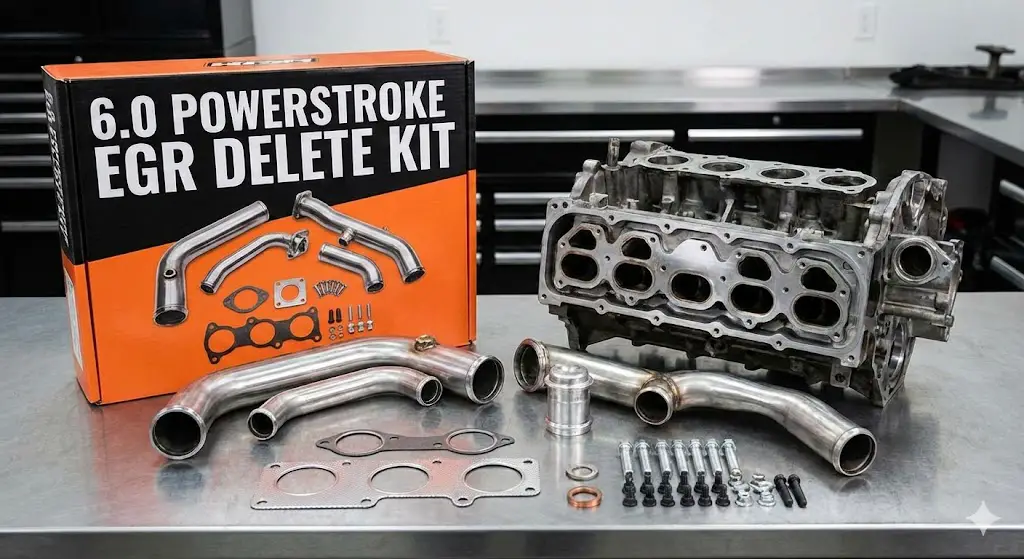
To permanently resolve these compounding points of failure, the automotive aftermarket developed the EGR delete kit. This mechanical intervention fundamentally reroutes the engine's fluid and gas paths to completely isolate the intake tract from the harsh exhaust system. A comprehensive 6.0 Powerstroke EGR delete kit typically consists of several precision-engineered components designed to seamlessly replace the factory hardware without requiring custom fabrication by the installer.
The core of the kit involves exhaust block-off plates. Machined from high-grade materials such as 304 stainless steel or 6061-T6 CNC billet aluminum, these thick plates cap the exhaust up-pipe that previously fed the EGR cooler, entirely preventing exhaust gas from leaving the exhaust stream. Similar precision-machined plates are utilized as intake block-offs, sealing the ports on the intake manifold where the EGR valve and cooler previously interfaced. This ensures an airtight seal is maintained to preserve the engine's crucial turbo boost pressure.
Because the factory EGR cooler acts as a vital bridge in the engine's coolant routing, its physical removal leaves an open void. Delete kits address this by providing a coolant reroute spool or hose. Utilizing high-temperature silicone or a rigid stainless steel spool pipe, the kit bypasses the void and returns coolant directly to the engine block, seamlessly maintaining the integrity and flow of the primary cooling circuit.
Premium iterations of these kits also include complete replacement up-pipes. The factory exhaust up-pipe contains a "Y" intersection that branches off to feed the EGR cooler. Entry-level delete kits simply cap this Y-branch with a plate. However, the factory up-pipe relies heavily on the physical mass of the EGR cooler for structural support. Removing the cooler leaves the capped branch unsupported and vibrating in the engine bay, which almost always leads to vibrational fatigue, cracking, and severe exhaust leaks directly into the vehicle cabin. Premium kits replace the entire passenger-side up-pipe with a smooth, mandrel-bent stainless steel tube that lacks the EGR branch entirely. This optimizes exhaust gas velocity directly into the turbocharger and entirely eliminates the risk of structural failure over time.
Thermodynamic and Performance Dynamics of Deletion
The installation of a 6.0 Powerstroke EGR delete kit yields profound, measurable changes to the engine's volumetric efficiency, thermal characteristics, and overall performance profile.
By eliminating the forced introduction of hot, oxygen-depleted exhaust gas into the intake stream, the engine is permitted to breathe exclusively clean, dense, oxygen-rich air. This optimizes the stoichiometric ratio within the cylinders, resulting in a significantly more complete, powerful, and efficient fuel burn. Consequently, operators typically experience a highly noticeable improvement in low-end throttle response and a drastic reduction in turbo lag. From a raw output perspective, a fully deleted engine, when paired with the requisite engine tuning, can see immediate power increases of up to 50 horsepower simply due to the restoration of optimal volumetric efficiency.
This displacement of inert exhaust gases with combustible oxygen also dramatically improves the thermal efficiency of the power stroke itself. Because the engine burns its injected fuel charge more completely and generates more kinetic energy per stroke, less throttle input is required by the driver to maintain cruising speeds or accelerate under heavy loads. Empirical data from fleet operators and individual truck owners consistently demonstrates fuel economy improvements ranging from 1 to 2 Miles Per Gallon (MPG). In the context of a heavy-duty pickup truck, this represents an 8-12% increase in overall vehicle efficiency.
The thermal impact of an EGR delete requires highly nuanced understanding, as it affects different critical engine systems inversely. The factory EGR system acts as a massive thermal heat sink, dumping hundreds of degrees of exhaust thermal energy directly into the engine's liquid cooling system. By removing the EGR cooler, this massive thermal transfer is entirely eliminated. As a result, the bulk Engine Coolant Temperature (ECT) and Engine Oil Temperature (EOT) typically drop by approximately 100 degrees Fahrenheit during normal operation. This massive reduction in thermal load drastically reduces the sustained stress on the factory head bolts, directly preventing head gasket failure, and extends the shear stability and life of the engine oil.
Paradoxically, while the overall engine block and fluids run substantially cooler, the peak combustion temperatures inside the cylinders rise. Because the EGR system's primary chemical function is to intentionally lower combustion temperatures to prevent NOx formation, its physical absence allows the combustion event to burn hotter. Consequently, the Exhaust Gas Temperatures (EGTs) measured at the exhaust manifold will increase. If the vehicle is subjected to heavy towing on steep grades or utilizes aggressive fueling tunes without adequate airflow modifications, these elevated EGTs can thermally stress the turbocharger turbine wheel and the crowns of the pistons. Therefore, installing an aftermarket pyrometer to actively monitor EGTs is a highly recommended practice for operators of deleted trucks.
Electronic Control Strategies: The Fan Clutch and PCM Correlation
A highly debated and poorly understood technical nuance within the 6.0L Powerstroke community is the complex interaction between the EGR valve and the engine's electro-viscous cooling fan clutch. Because the installation of a basic delete kit often involves leaving the EGR valve completely uninstalled or electrically unplugged from the harness, it can trigger severe, unintended electronic consequences.
The Navistar VT365 utilizes a highly complex algorithm programmed within the Powertrain Control Module (PCM) to control the precise engagement speed of the engine fan. This algorithm does not rely on coolant temperature alone; it calculates engagement based on multiple sensor inputs, including ECT, EOT, Intake Air Temperature (IAT), and crucially, the EGR valve position sensor. When the EGR valve is unplugged, the PCM immediately loses this critical telemetry data point. Furthermore, without hot exhaust gases actively flowing past the Intake Air Temperature 2 (IAT2) sensor located in the intake manifold, the PCM reads an artificially low internal manifold temperature.
In many 2005 to 2007 model year trucks, this lack of sensor correlation causes the PCM to default to a protective fail-safe strategy, resulting in highly erratic fan clutch operation. The fan may fail to engage fully under heavy thermal load, leading to dangerous localized overheating, or conversely, it may lock up prematurely and stay fully engaged at highway speeds, creating a massive parasitic drag that drains engine power and destroys fuel economy.
To circumvent this electronic logic trap, some installers choose to physically delete the cooler but leave the factory EGR valve plugged into the electrical wiring harness and simply zip-tied out of the way in the engine bay. While this satisfies the electrical circuit and provides a position reading to the PCM, it still results in skewed IAT2 thermal readings. The only definitive mechanical and electronic resolution to this issue is to utilize custom aftermarket engine tuning that explicitly overwrites the PCM's base code, removing its reliance on EGR telemetry for fan clutch engagement algorithms.
Comparative Analysis of Market-Leading Delete Kits
The automotive aftermarket offers a massive spectrum of EGR delete kits, ranging from low-cost, unbranded imports to precision-machined, competition-grade systems. Selecting the appropriate kit heavily dictates the longevity of the repair. Inferior materials, such as thin stamped steel, will rapidly warp under extreme thermal stress or leak critical boost pressure through cheap gaskets, resulting in a 20% loss of overall engine power and potential coolant ingress.
| Manufacturer Brand | Material Composition | Kit Inclusions | Installation Difficulty | Primary Application Focus |
| EGR Performance | 304 Stainless Steel | Full Kit (Plates, plugs, hoses, hardware) | Easy (2-3 hrs) | Reliable Daily Driving / Longevity |
| Sinister Diesel | CNC Billet Aluminum | Premium Kit (Full reroute, solid pipes) | Medium (3-4 hrs) | Heavy Towing / High Performance |
| Flashark | 304 Stainless / Billet | Full Kit (TIG welded, pressure tested) | Medium (3-4 hrs) | Dependable Street Performance |
| BD Diesel | Mandrel Stainless | Up-pipe Kit (Solid up-pipe, plates, joints) | Hard (4-5 hrs) | Extreme Performance Builds |
| DynoVox | Metal + ABS / Billet | Basic Kit (Plates, standard gaskets, clamps) | Beginner (1-2 hrs) | Strict Budget / Light Duty Use |
When evaluating kits, the specific method of exhaust block-off is paramount to structural integrity. As previously established, the "J-Tube" style deletes, which utilize a simple block-off plate at the factory up-pipe, are notorious for causing catastrophic up-pipe structural failures due to the removal of the cooler's physical mass. Premium offerings from tier-one brands like BD Diesel and EGR Performance mitigate this massive risk by providing a completely redesigned, solid replacement up-pipe, eliminating the physical Y-branch and the associated risk of toxic exhaust leaks in the cabin.
Installation Economics and Labor Metrology
The financial commitment required to completely delete a 6.0L EGR system varies dramatically based on whether the vehicle owner leverages the expertise of a professional diesel performance shop or executes a do-it-yourself (DIY) installation in a home garage.
| Installation Method | Estimated Parts Cost | Estimated Labor Cost | Total Estimated Expense | Time Requirement |
| DIY (Basic Delete Kit) | $100 - $300 | $0 (Self-Performed) | $100 - $350 | 4 - 6 Hours |
| Professional Shop (Basic) | $200 - $400 | $400 - $800 | $600 - $1,200 | N/A (Drop-off service) |
| Pro Shop (Full Bundle) | $600 - $900 | $800 - $1,000 | $1,400 - $1,700 | N/A (Drop-off service) |
For the mechanically inclined owner equipped with standard hand tools, the 6.0L platform is accessible, though labor-intensive. The procedure necessitates the draining of the engine coolant, followed by the complete removal of the alternator, turbocharger assembly, and the intake manifold to gain adequate physical access to the engine valley where the cooler resides. In specific chassis variants, such as the Ford E-Series vans (E-350), front-engine access is heavily restricted by the firewall, drastically elevating the complexity of the task, though full engine removal is not strictly required. Precision is absolutely critical during reassembly; intake manifold bolts must be torqued precisely to 120 in-lbs, and all mating surfaces must be impeccably clean to prevent post-installation boost leaks or internal coolant weeping.
The Legal Landscape: EPA Enforcement and the Clean Air Act (2024-2026)
The mechanical and thermodynamic benefits of the 6.0 Powerstroke EGR delete are undeniable and empirically proven, yet they exist in direct, irreconcilable opposition to federal environmental law. The EGR system is a federally mandated emissions control device, and its physical removal, digital alteration, or mechanical incapacitation is a direct and severe violation of Title II of the Clean Air Act (CAA).
The Environmental Protection Agency cites the widespread removal of EGR and DPF systems as a massive contributor to national air quality degradation. An intensive study conducted by the EPA's Air Enforcement Division concluded that known sales of aftermarket defeat devices for diesel trucks between 2009 and 2020 resulted in the direct release of over 570,000 tons of excess nitrogen oxides (NOx) and 5,000 tons of excess particulate matter (PM) over the expected operational lifetime of those modified vehicles. This excess NOx heavily contributes to ground-level ozone formation, severe respiratory illness, and widespread environmental acidification.
In direct response to the massive proliferation of aftermarket defeat devices, the EPA designated stopping the manufacture, sale, and installation of these components as a National Enforcement and Compliance Initiative (NECI). Federal enforcement actions escalated dramatically across the industry. Between fiscal years 2020 and 2023 alone, the EPA successfully finalized 172 civil enforcement cases against shops and manufacturers, generating $55.5 million in staggering civil penalties. Concurrently, 17 targeted criminal cases resulted in 54 months of federal incarceration for individuals and an additional $5.6 million in criminal fines.
A landmark example of this aggressive enforcement is the July 2024 legal resolution of the Rudy's Performance Parts case. The massive North Carolina-based parts manufacturer and its owner formally agreed to pay a staggering $10 million in combined criminal fines and civil penalties for manufacturing, marketing, and selling defeat devices that tampered with approximately 300 diesel trucks. The final settlement included a $2.4 million criminal fine, a massive $7 million civil penalty, and a strict federal injunction legally barring the company from any future intellectual property transfers related to defeat hardware. At the corporate Original Equipment Manufacturer (OEM) level, the EPA levied a historic, record-breaking $1.68 billion penalty against Cummins Inc. in 2024 for equipping Ram heavy-duty trucks with software-based defeat devices, necessitating a massive nationwide recall (Emissions Recall 67A) supported by $1,000 cash incentives to owners to ensure compliance.
The regulatory environment experienced a highly nuanced, yet critical shift moving into 2025 and 2026. While the EPA's March 2024 multi-pollutant rules aggressively pushed commercial fleets toward battery-electric powertrains, extreme political pressure and coordinated state-level pushback altered implementation timelines; for instance, the California Air Resources Board (CARB) unexpectedly rescinded its request for an aggressive implementation waiver in January 2025.
Furthermore, a critical issued in January 2026 announced that the federal government would officially cease pursuing criminal charges against individuals and businesses solely for the act of tampering with onboard diagnostic devices and installing emissions deletes. The DOJ cited the explicit need to avoid the "overcriminalization of federal environmental law" and ensure the highly efficient use of limited government resources.
However, it is paramount to understand that this shift does not equate to legalization. The DOJ explicitly and firmly stated it will continue to aggressively pursue massive civil penalties. Therefore, while a vehicle owner or shop mechanic may no longer face the threat of federal prison time for installing a 6.0 Powerstroke EGR delete kit, they remain fully liable for crippling civil fines of up to $5,000 per individual violation. Furthermore, their modified vehicle will inherently fail any state-mandated emissions inspections, rendering it un-registrable. Due to this unyielding statutory framework, EGR delete kits remain legally restricted strictly to off-road, closed-course competition vehicles.
Viable Legal Alternatives: The H-Core Bulletproof Cooler
For vehicle owners who actively operate their trucks on public roadways, daily commute, or utilize their vehicles for commercial towing, the massive risk of federal civil fines, failing state safety inspections, or entirely voiding their insurance renders a full EGR deletion an unviable option. However, blindly retaining the fragile factory EGR cooler is equally unpalatable due to its statistically guaranteed failure rate.
The premier engineering solution to this modern paradox is the installation of an upgraded, heavily fortified, 50-state legal EGR cooler, most notably the highly regarded Bullet Proof Diesel H-Core cooler. Rather than utilizing the fragile, soot-trapping tube-and-fin design of the OEM unit that is prone to steam ruptures, the proprietary H-Core technology utilizes robust helical twisted tube bundles. These specialized twisted tubes are specifically engineered to flex and absorb the extreme thermal expansion and contraction associated with localized coolant boiling, completely neutralizing the risk of internal fatigue rupture and catastrophic coolant mixing.
Furthermore, the complete absence of tightly packed internal fins dramatically reduces the cooler's inherent susceptibility to carbon coking and soot blockages, ensuring long-term flow. At a retail cost ranging from $800 to $1,200, an upgraded EGR cooler is significantly more expensive upfront than a basic block-off delete kit ($200 - $500), and it yields only moderate power gains in comparison since the engine still ingests hot exhaust. However, it provides an exceptionally high level of reliability and vital engine protection while maintaining absolute strict compliance with the Clean Air Act, making it the definitive, legally sound choice for daily-driven, street-legal applications.
Engine Control Unit (ECU) Recalibration Requirements
Whether a vehicle owner pursues a full, off-road EGR deletion or upgrades the factory hardware to high-flow variants, altering the 6.0L Powerstroke's emissions telemetry requires sophisticated software recalibration via an aftermarket diesel tuner.
When the factory EGR valve is physically removed or blocked off with a plate, the highly sensitive PCM instantly detects a complete lack of exhaust flow and immediately triggers a Check Engine Light (CEL), logging Diagnostic Trouble Codes (DTCs) such as P0401 (Insufficient EGR Flow). In some specific ECM software strategies, this hardware discrepancy triggers a protective "limp mode," heavily restricting engine power output and disabling the turbocharger to protect internal components.
To restore functionality and drivability, high-end flash tuners—such as the renowned H&S Mini Maxx or devices utilizing SCT custom tunes—are utilized to completely rewrite the PCM's base operating code. These advanced tuners electronically disable the EGR duty cycle commands, permanently suppress the associated DTCs, and finely adjust fuel rail pressure and injection timing to perfectly compensate for the newfound influx of pure, dense oxygen. Beyond simple error prevention, tuners unlock the immense inherent performance gains of the deletion, safely adding anywhere from +50 to +200 horsepower depending on the selected calibration, while resolving sloppy transmission shift points and optimizing fuel delivery for maximum enhanced MPG. It is critical to note, however, that tuning software explicitly designed to bypass emissions controls is subject to the exact same EPA civil enforcement actions and fines as the physical hardware itself.
FAQs
Does an EGR delete require a tune on a 6.0 Powerstroke?
Yes, a tune is highly required. While the truck will technically start and run with the physical hardware removed, the PCM will identify the missing EGR flow and immediately trigger a Check Engine Light (code P0401). Without a proper software tune, the engine may enter a restricted power "limp mode," and the cooling fan clutch will operate erratically due to the complete lack of input from the EGR position sensor. A tuner rewrites the ECU to ignore the missing hardware and optimizes fuel delivery for the new airflow dynamics.
Does an EGR delete increase fuel mileage (MPG)?
Yes, performing an EGR delete typically increases fuel economy by 1 to 2 MPG on average. By preventing oxygen-depleted exhaust gas from re-entering the cylinders, the engine operates exclusively on clean, dense air. This improves combustion efficiency, meaning the engine extracts more kinetic energy from the exact same volume of fuel, reducing overall consumption and reliance on heavy throttle input.
Will a 6.0 Powerstroke EGR delete increase EGTs (Exhaust Gas Temperatures)?
Yes, physically deleting the EGR system generally raises peak Exhaust Gas Temperatures. The primary chemical function of the EGR system is to purposefully lower peak cylinder combustion temperatures to inhibit NOx formation. Removing the system allows the combustion event to burn hotter and much more completely. While the overall engine block (coolant and oil) will run approximately 100 degrees Fahrenheit cooler due to the removal of the heat-exchanging cooler, the gases exiting the exhaust manifold will be hotter. Installing an aftermarket pyrometer to monitor EGTs is highly recommended to protect the turbocharger.
How long does it take to install a 6.0 EGR delete kit?
For a mechanically inclined DIY installer with standard tools, a standard 6.0 EGR delete kit takes between 4 to 6 hours to install. The process is considered moderately difficult, requiring the draining of the coolant system and the physical removal of the alternator, turbocharger, and intake manifold to access the engine valley. Professional diesel shops generally bill for 6 to 8 hours of labor.
Are deleted diesel trucks legal after the EPA deregulation news?
No, they are strictly illegal for on-road use. Despite the Department of Justice announcing in January 2026 that it would no longer pursue criminal charges against individuals for emissions tampering, the act of removing or bypassing an EGR system remains a direct violation of the federal Clean Air Act. The EPA and DOJ continue to relentlessly enforce massive civil penalties (up to $5,000 for individuals) for these modifications, and deleted trucks are federally prohibited from operating on public roads.