2021 Ford F-250 Towing Capacity Chart: The Definitive Research Report

The 2021 model year represented a significant inflection point in the heavy-duty pickup truck segment, specifically for the Ford Super Duty F-250 series. Coming off a major refresh in 2020, the 2021 F-250 did not merely iterate on previous successes; it solidified Ford’s standing in the “torque wars” against domestic rivals GM and Ram. This report serves as an exhaustive technical analysis of the F-250’s capabilities, designed for fleet managers, heavy-hauling enthusiasts, and automotive professionals who require precision data beyond marketing brochures.
In the broader context of the automotive market, 2021 was defined by a surge in demand for recreational vehicles (RVs) and independent logistics contracting (hotshot trucking). Consequently, the scrutiny on towing numbers—specifically the nuances between “advertised max towing” and “legal compliance”—became more intense. The F-250 occupies a unique position in this landscape. It is a Class 2b truck, straddling the line between the daily drivability of a half-ton and the commercial rigidity of a one-ton dually.
The 2021 F-250 lineup is defined by three distinct powertrain architectures, each creating a radically different towing profile. From the standard 6.2L V8 to the massive 7.3L “Godzilla” gas engine, and finally the torque-monster 6.7L Power Stroke diesel, understanding the F-250 requires a granular examination of how these engines interact with axle ratios, cab configurations, and suspension packages. This report synthesizes data from official Ford towing guides, technical specification sheets, and owner experiences to provide the definitive reference for this vehicle platform.
Powertrain Architecture: The Heart of the Haul
The capability of any tow vehicle begins at the flywheel. For 2021, Ford offered a triad of engines that allowed buyers to tailor the truck’s performance curve to their specific load requirements.
The 6.7L Power Stroke® V8 Turbo Diesel (3rd Generation)
The 3rd Generation 6.7L Power Stroke is the crown jewel of the 2021 Super Duty lineup. Unlike previous iterations, the 2021 tuning and hardware were specifically optimized to break the 1,000 lb-ft torque barrier, a psychological and physical milestone in the heavy-duty segment.
- Horsepower: 475 hp @ 2,600 rpm
- Torque: 1,050 lb-ft @ 1,600 rpm
- Induction: Single Variable Geometry Turbocharger (VGT)
- Fuel System: High-pressure common rail, 36,000 psi injection pressure
Technical Insight:
The leap to 1,050 lb-ft of torque was achieved through a new fuel injection system capable of 36,000 psi (up from previous generations). This immense pressure allows the injectors to atomize fuel into microscopic droplets, spraying up to eight times per single combustion stroke. This multi-shot injection strategy serves two critical towing functions: it pre-conditions the combustion chamber for a smoother power stroke (reducing the characteristic diesel “clatter”) and ensures a more complete burn for maximum torque generation at low RPMs.
Furthermore, the 6.7L utilizes a Compacted Graphite Iron (CGI) block, which is significantly stronger and lighter than traditional cast iron. This strength is non-negotiable when dealing with cylinder pressures generated by 1,050 lb-ft of torque. For towing, the most critical feature is the integrated exhaust brake. By restricting exhaust flow via the VGT vanes, the engine creates backpressure to retard vehicle speed on descents—a vital safety feature when towing 20,000 lbs down a 6% grade.
The 7.3L “Godzilla” OHV PFI Gas V8
Introduced to replace the aging 6.8L V10, the 7.3L V8 marked a return to traditional pushrod (Overhead Valve – OHV) architecture. In an era of smaller displacement and forced induction, Ford’s decision to build a massive 7.3L naturally aspirated gas engine was driven by the specific needs of the towing demographic: durability and low-end torque.
- Horsepower: 430 hp @ 5,500 rpm
- Torque: 475 lb-ft @ 4,000 rpm
- Architecture: Cast iron block, pushrod valvetrain, port fuel injection.
Technical Insight:
The “Godzilla” engine is engineered for “stump-pulling” power. By utilizing a pushrod design, the engine is physically more compact than the overhead cam 6.2L, allowing for greater displacement. The variable valve timing (VVT) on a cam-in-block design is a marvel of modern engineering, broadening the torque curve so that power is available lower in the rev range compared to typical gas engines.
For towing, the 7.3L offers a compelling alternative to diesel. While it lacks the 1,000+ lb-ft of the Power Stroke, it offers the highest output in its class for a gas engine. It utilizes Port Fuel Injection (PFI) rather than Direct Injection. PFI is advantageous for fleet and towing applications because it naturally washes the intake valves with fuel, preventing carbon buildup common in direct-injection engines, thereby reducing long-term maintenance costs for high-mileage towers.
The 6.2L SOHC 2-Valve Flex-Fuel V8
The standard engine for the F-250, the 6.2L V8, is a Single Overhead Cam (SOHC) design that has powered the Super Duty since 2011. While it is the “base” engine, it remains a highly capable powerplant for commercial applications.
- Horsepower: 385 hp @ 5,750 rpm
- Torque: 430 lb-ft @ 3,800 rpm
- Transmission Note: In the F-250, this engine is often paired with the TorqShift®-G 6-speed transmission, unlike the 10-speed found on the 7.3L and 6.7L (and all F-350s).
Technical Insight:
The 6.2L engine’s SOHC architecture allows it to breathe well at high RPMs, which is necessary to maintain speed on grades. However, because torque peaks at 3,800 rpm, the driver must be comfortable with the engine revving high and loud during heavy towing events. It lacks the low-end effortlessness of the 7.3L or 6.7L but is renowned for bulletproof reliability.
Transmission Technology: The TorqShift® Ecosystem
The transmission is the crucial link transferring the engine’s power to the axles. For the 2021 F-250, Ford utilized two distinct transmissions, and knowing which one is equipped is vital for understanding towing behavior.
TorqShift® 10-Speed Automatic
Standard on the 7.3L Gas and 6.7L Diesel, this transmission revolutionized the towing experience.
- Benefit: The 10 gear ratios allow the engine to stay squarely in its “power band” regardless of vehicle speed. When towing a 15,000 lb trailer, the gaps between gears in a 6-speed transmission can be too wide, causing the engine to bog down after an upshift or scream near redline before a shift. The 10-speed eliminates this, keeping the diesel near 1,600-2,000 rpm and the gas engines in their optimal torque zones.
- Modes: It features selectable drive modes including Tow/Haul, Eco, Deep Sand/Snow, and Slippery.
TorqShift®-G 6-Speed Automatic
Exclusive to the F-250 with the 6.2L engine.
- Design: This is a lighter-duty version of the 6-speed compared to what was historically used in the F-350. While reliable, it lacks the tight gear spacing of the 10-speed, making the 6.2L F-250 feel noticeably different on steep grades compared to the 7.3L/10-speed combination.
The Critical Role of Axle Ratios
Often overlooked by casual buyers, the axle ratio is the mechanical multiplier of torque. In the 2021 F-250, the axle ratio is often the sole determinant between a max tow rating of 12,000 lbs and 15,000+ lbs.
- 3.31 (Diesel & Gas): Geared for highway fuel economy. This ratio keeps engine RPMs low at cruising speed. However, it offers the least mechanical advantage for getting a heavy load moving. An F-250 Diesel with a 3.31 axle will have significantly lower tow ratings than one with a 3.55 or 4.10.
- 3.55 (Diesel Standard/Gas Option): The “Goldilocks” ratio. It balances towing power with fuel economy. For the 6.7L Diesel, this is often the standard ratio for the High-Capacity Trailer Tow Package configurations.
- 3.73 (Gas Standard): Common on the 6.2L and 7.3L. It provides good mechanical advantage for gas engines that need RPMs to produce torque.
- 4.30 (Gas Max Tow): This is the aggressive towing gear for the 7.3L and 6.2L gas engines. By allowing the engine to spin faster for a given wheel speed, it puts more torque to the ground.
- Insight: A 7.3L Gas F-250 with 3.55 gears may struggle to maintain speed with a 14,000 lb trailer on a grade, whereas the same truck with 4.30 gears will handle it with confidence. The 4.30 axle is effectively mandatory for achieving the maximum gas towing figures.
2021 Ford F-250 Conventional Towing Capacity Chart
Conventional towing refers to “bumper pulling” using a receiver hitch. For loads exceeding 5,000 lbs, Ford requires a weight-distributing hitch. The following charts break down the maximum loaded trailer weight for the F-250 SRW (Single Rear Wheel) configurations.
Diesel (6.7L V8) Conventional Towing
The 6.7L Diesel offers the highest conventional towing capacity, but it is heavily dependent on the High-Capacity Trailer Tow Package (535).
| Cab Config | Drive | Axle Ratio | Max Towing (lbs) | Notes |
| Regular Cab | 4×2 | 3.31 | 15,000 | Standard Payload Pkg |
| Regular Cab | 4×2 | 3.55 | 18,200 | Requires High-Capacity Pkg |
| Regular Cab | 4×4 | 3.31 | 15,000 | Standard Payload Pkg |
| Regular Cab | 4×4 | 3.55 | 20,000 | Requires High-Capacity Pkg |
| SuperCab | 4×2 | 3.55 | 18,200 | Requires High-Capacity Pkg |
| SuperCab | 4×4 | 3.55 | 20,000 | Requires High-Capacity Pkg |
| Crew Cab | 4×2 | 3.31 | 15,000 | Standard Payload Pkg |
| Crew Cab | 4×2 | 3.55 | 20,000 | Requires High-Capacity Pkg |
| Crew Cab | 4×4 | 3.31 | 15,000 | Standard Payload Pkg |
| Crew Cab | 4×4 | 3.55 | 20,000 | Requires High-Capacity Pkg |
| Tremor | 4×4 | 3.55 | 15,000 | Tremor Off-Road Pkg |
Key Insight: Without the High-Capacity Trailer Tow Package, the diesel F-250 is functionally limited to 15,000 lbs of conventional towing, largely due to the standard rear axle and suspension setup. The High-Capacity package upgrades the rear axle (often to the Dana M275) and increases the GCWR to 30,000 lbs, unlocking the 20,000 lb hitch rating.
Gas (7.3L “Godzilla”) Conventional Towing
The 7.3L gas engine provides impressive conventional capabilities, often matching the standard diesel configurations but without the 20,000 lb ceiling of the High-Capacity diesel.
| Cab Config | Drive | Axle Ratio | Max Towing (lbs) | Notes |
| Regular Cab | 4×2 | 3.55 | 14,000 | |
| Regular Cab | 4×2 | 4.30 | 15,000 | Max Tow Config |
| Regular Cab | 4×4 | 4.30 | 15,000 | Max Tow Config |
| SuperCab | 4×4 | 3.55 | 14,700 | |
| SuperCab | 4×4 | 4.30 | 15,000 | |
| Crew Cab | 4×2 | 3.55 | 15,000 | |
| Crew Cab | 4×4 | 3.55 | 14,700 | |
| Crew Cab | 4×4 | 4.30 | 15,000 | Max Tow Config |
| Tremor | 4×4 | 4.30 | 15,000 | Tremor Off-Road Pkg |
Key Insight: For conventional towing, the 7.3L gas engine hits a “soft ceiling” at 15,000 lbs. This is likely a limitation of the Class IV/V hitch receivers fitted to gas models and a strategic differentiation from the diesel. Note that the 4.30 axle is required to guarantee the 15,000 lb rating across all scenarios.
Gas (6.2L V8) Conventional Towing
The 6.2L V8 is the most sensitive to axle ratio selection.
| Cab Config | Drive | Axle Ratio | Max Towing (lbs) | Notes |
| Regular Cab | 4×2 | 3.73 | 13,000 | |
| Regular Cab | 4×2 | 4.30 | 14,000 | |
| Regular Cab | 4×4 | 3.73 | 12,900 | |
| Regular Cab | 4×4 | 4.30 | 14,000 | |
| Crew Cab | 4×2 | 3.73 | 12,900 | |
| Crew Cab | 4×2 | 4.30 | 15,000 | Best case scenario |
| Crew Cab | 4×4 | 3.73 | 12,500 | Most common config |
| Crew Cab | 4×4 | 4.30 | 15,000 |
Key Insight: The vast majority of 6.2L F-250s on dealer lots are equipped with 3.73 gears, limiting them to roughly 12,500 – 13,000 lbs. Buyers needing to tow 14,000+ lbs should strictly look for the 4.30 axle or upgrade to the 7.3L engine.
5th-Wheel & Gooseneck Towing Capacity Chart
Towing via a kingpin (5th wheel) or ball (gooseneck) in the bed places the weight directly over the rear axle, significantly increasing stability and capacity. This is the preferred method for heavy RVs and construction trailers.
Diesel (6.7L V8) 5th-Wheel/Gooseneck
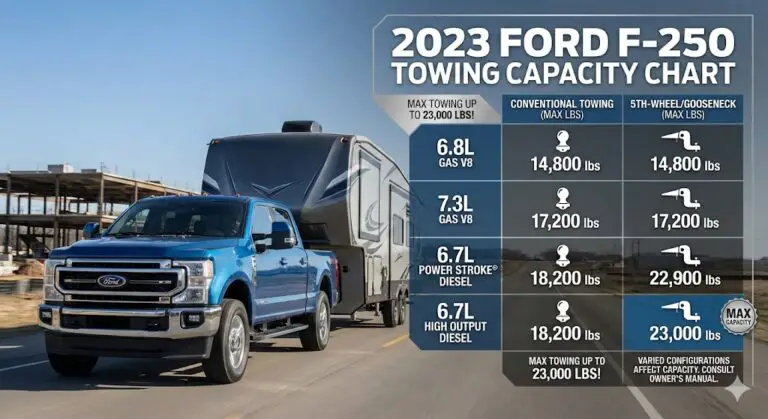
This is where the marketing claim of 22,800 lbs comes into reality, but only for very specific trucks.
| Cab | Drive | Axle | Max Towing (lbs) | High-Cap Tow Pkg? |
| Regular Cab | 4×2 | 3.31 | 15,700 | No |
| Regular Cab | 4×2 | 3.55 | 22,800 | Yes |
| Regular Cab | 4×4 | 3.55 | 22,000 | Yes |
| SuperCab | 4×2 | 3.31 | 15,400 | No |
| SuperCab | 4×4 | 3.55 | 22,800 | Yes |
| Crew Cab | 4×2 | 3.31 | 15,200 | No |
| Crew Cab | 4×2 | 3.55 | 22,800 | Yes |
| Crew Cab | 4×4 | 3.31 | 14,700 | No |
| Crew Cab | 4×4 | 3.55 | 22,800 | Yes |
| Tremor | 4×4 | 3.55 | 12,900 – 15,000 | No |
Critical Analysis: The data reveals a massive disparity. A standard F-250 Diesel Crew Cab 4×4 with the 3.31 axle is limited to just 14,700 lbs of 5th-wheel towing. By simply adding the High-Capacity Trailer Tow Package (which forces the 3.55 axle and structural upgrades), that capacity jumps by over 8,000 lbs to 22,800 lbs. Buyers shopping for a used 2021 F-250 Diesel must verify the presence of the High-Capacity package (often identified by the 3-inch receiver hitch or the door jamb GCWR sticker showing 30,000 lbs).
Gas (7.3L V8) 5th-Wheel/Gooseneck
The 7.3L engine shines here, offering substantial capability that rivals older diesel trucks.
| Cab | Drive | Axle | Max Towing (lbs) |
| Regular Cab | 4×2 | 4.30 | 19,500 |
| Regular Cab | 4×4 | 4.30 | 19,100 |
| SuperCab | 4×4 | 4.30 | 18,900 |
| Crew Cab | 4×4 | 3.55 | 14,700 |
| Crew Cab | 4×4 | 4.30 | 18,600 |
| Tremor | 4×4 | 4.30 | 18,600 (Gooseneck) |
Key Insight: The 7.3L with 4.30 gears is a “sleeper” heavy hauler. With a rating of 18,600 lbs for the Crew Cab 4×4, it covers 95% of the recreational 5th-wheel market. Crucially, because the gas engine is lighter than the diesel, the F-250 Gas often has more available payload for the trailer’s pin weight than the F-250 Diesel (discussed in Section 7).
Gas (6.2L V8) 5th-Wheel/Gooseneck
| Cab | Drive | Axle | Max Towing (lbs) |
| Regular Cab | 4×2 | 4.30 | 15,800 |
| Crew Cab | 4×4 | 3.73 | 12,500 |
| Crew Cab | 4×4 | 4.30 | 15,400 |
The 6.2L is best reserved for lighter 5th wheels (under 12,000 lbs) unless equipped with the rare 4.30 axle ratio.
Payload: The “Achilles Heel” of the F-250
While the charts above list towing capacities of 20,000+ lbs, the payload capacity is often the limiting factor that prevents an F-250 from legally towing that weight. This is the most critical concept for prospective buyers to understand.
The Math of Payload:
The F-250 is a Class 2b truck, meaning its Gross Vehicle Weight Rating (GVWR) is typically capped at 10,000 lbs.
- Payload = GVWR – Curb Weight.
- The 6.7L Diesel engine adds roughly 800 lbs of weight to the front of the truck compared to the gas engines.
- Therefore, an F-250 Diesel has ~800 lbs less payload capacity than an equivalent F-250 Gas.
Real-World Scenario:
- Vehicle: 2021 F-250 Crew Cab 4×4 Diesel Lariat.
- Payload Sticker: ~2,400 lbs (common for this config).
- Trailer: 15,000 lb 5th Wheel.
- Pin Weight: ~3,000 lbs (20% of trailer weight).
- Result: The pin weight (3,000 lbs) exceeds the truck’s payload (2,400 lbs) by 600 lbs, before adding a driver, passengers, or hitch. Even though the towing capacity chart says the truck can pull 22,800 lbs, the payload limit makes it illegal/unsafe to tow even 15,000 lbs.
The Solution:
- High-Capacity Trailer Tow Package: This package increases the GVWR to 10,800 lbs on the F-250 Diesel, giving back 800 lbs of payload capacity.
- Choose Gas: A 7.3L F-250 often has a payload of 3,000+ lbs because the engine is lighter.
- Upgrade to F-350: The F-350 SRW is mechanically nearly identical to the F-250 High-Capacity but has a GVWR of 11,500 lbs, solving the payload issue entirely.
Payload Reference Ranges:
- F-250 6.2L Gas: 3,300 – 4,260 lbs
- F-250 7.3L Gas: 3,000 – 3,800 lbs
- F-250 6.7L Diesel: 2,100 – 3,000 lbs (highly dependent on trim/packages)
The High-Capacity Trailer Tow Package (535) Detailed
This package is the single most important option code for F-250 Diesel buyers. It effectively transforms the F-250 into an F-350 in all but the badge.
What’s Included:
- Upgraded Rear Axle: Shifts from the standard Sterling 10.5 axle to the heavy-duty Dana M275 axle (on diesel models). This axle has a larger ring gear and higher weight rating.
- Leaf Spring Upgrade: Adds a 5th leaf/overload spring to the rear pack to support heavy tongue weights and reduce sag.
- GCWR Increase: Bumps the Gross Combined Weight Rating from roughly 23,500 lbs to 30,000 lbs.
- GVWR Increase: Bumps the truck’s GVWR to 10,800 lbs (from 10,000 lbs), purely to add payload capacity.
- Hitch Upgrade: Includes the 3-inch receiver hitch.
Identification: You can identify a 2021 F-250 with this package by looking at the rear axle hub (the Dana M275 has 14 bolts vs the Sterling’s 12) or by checking the white sticker in the door jamb for a GVWR of 10,800 lbs.
The Tremor Off-Road Package (17Y): Towing Implications
The Tremor package was a major sales success for Ford in 2021, targeting the off-road enthusiast. However, it compromises towing for trail capability.
- Suspension: The Tremor uses softer springs and specialized shocks tuned for off-road articulation, which are less stable under heavy towing loads.
- Tires: The 35-inch Goodyear Wrangler Duratrac tires have a lower load rating index and softer sidewalls than the standard Michelin highway tires.
- Towing Impact: Ford explicitly de-rates the Tremor’s conventional towing capacity to 15,000 lbs regardless of engine. While the 5th-wheel rating remains respectable (up to 21,900 lbs on F-350 Tremor, but often less on F-250 due to squat), the soft suspension leads to significant rear-end sag with heavy pin weights.
Recommendation: If your primary mission is towing heavy 5th wheels, skip the Tremor or plan on adding aftermarket suspension support (airbags). For lighter off-road towing (boats, ATVs), it is more than sufficient.
Towing Technology Suite
The 2021 F-250 introduced advanced “smart towing” features that leverage the truck’s electric power steering and camera systems.
- Pro Trailer Backup Assist™: This system allows the driver to steer the trailer in reverse using a knob on the dashboard. The driver indicates where they want the trailer to go, and the truck calculates the necessary steering wheel input. It requires a sticker setup on the trailer tongue for the camera to track.
- Trailer Reverse Guidance: Utilizing side-view cameras, this system provides visual cues and graphic overlays on the center screen to show the driver which way to turn the wheel to direct the trailer.
- Blind Spot Information System (BLIS®) with Trailer Coverage: The tail light sensors can be programmed to account for the length of the trailer, alerting the driver if a vehicle is in the trailer’s blind spot—a massive safety upgrade for highway towing.
- Adaptive Steering: Changes the steering ratio based on speed. Low speed = fewer turns lock-to-lock (easy parking); High speed = slower ratio (stable highway tracking). This is particularly useful when towing large, wind-catching trailers.
Maintenance and Reliability for Towing
Towing places “severe duty” stress on the powertrain. For 2021 owners, specific maintenance protocols apply.
- Diesel Exhaust Fluid (DEF): Heavy towing consumes DEF at a higher rate. The 2021 F-250 has a 7.4-gallon DEF tank. Under heavy load, expect to refill this every 2,000-4,000 miles.
- Oil Changes: The “Intelligent Oil-Life Monitor” will call for more frequent changes when towing. For the 6.7L, using the correct CJ-4 or CK-4 oil is critical for turbo longevity.
- Transmission Fluid: The 10-speed transmission fluid runs hotter when towing. While “filled for life” is the marketing term, fleet experts recommend changing the fluid every 60,000 miles for trucks that tow regularly.
- Suspension Sag: A common complaint for F-250 owners towing heavy 5th wheels is rear squat. Since the F-250 lacks the overload springs of the F-350 (unless High-Capacity package is equipped), aftermarket solutions like Timbren SES or Air Lift bags are popular modifications to level the ride.
2021 Ford F-250
Towing Capacity & Performance Guide
The definitive visual breakdown of engines, axle ratios, and maximum towing limits for the 2021 Super Duty lineup.
Three Engines, One Goal.
Towing starts with torque. The 2021 F-250 offers three distinct powertrains. The standard 6.2L V8 is a reliable workhorse, while the massive 7.3L “Godzilla” V8 offers best-in-class gas torque. However, for maximum towing capability, the 6.7L Power Stroke® Diesel is the undisputed king, offering nearly double the torque of its gas counterparts.
- 1 6.2L V8 Gas: Balanced performance for daily duties.
- 2 7.3L V8 Gas: Maximum gas hauling power.
- 3 6.7L V8 Diesel: The heavy-hauler with 1,050 lb-ft torque.
Horsepower vs. Torque Comparison
Source: Ford 2021 Technical Specs
Conventional Towing Capacity
For standard bumper-pull trailers, your capacity is determined heavily by your engine choice and axle ratio. The Diesel engine equipped with the High-Capacity Tow Package maximizes your pulling power.
Max Gas Towing
(Standard Hitch)
Max Diesel Towing
(Standard Hitch)
Max GCWR
(Gross Combined Weight)
Max Conventional Towing by Engine Type
Gooseneck & 5th Wheel:
Unleashing the Beast
When you move the hitch point to the bed of the truck (over the rear axle), the F-250 transforms. This configuration stabilizes the load and drastically increases the maximum tow rating, especially for the 6.7L Diesel engine.
Stability
Reduces trailer sway and improves turning radius.
Weight Distribution
Places pin weight directly over the rear axle.
The High-Capacity Package
Required to hit the 22,800 lbs max limit.
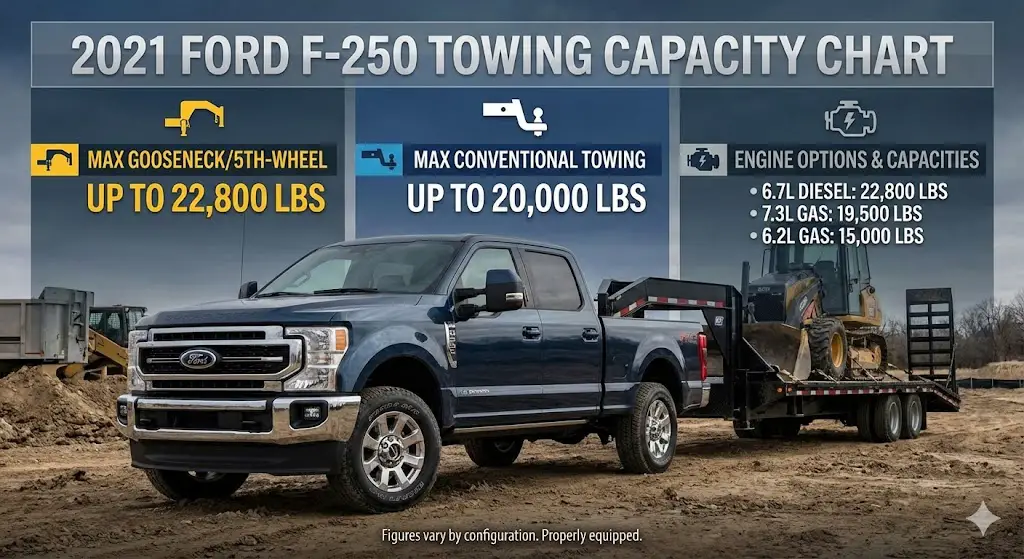
2021 F-250 Towing Capacity Chart
Quick reference guide for Maximum Loaded Trailer Weight (lbs).
*Note: Capabilities vary by Cab Size (Regular/Super/Crew) and Drive (4×2/4×4). Always refer to your specific vehicle’s door jamb sticker for exact payload and towing limits.
Conclusion
The 2021 Ford F-250 is a titan of capability, but its true limits are hidden in the fine print of axle ratios and payload stickers.
- The Winner: The F-250 Lariat Crew Cab 4x4 with the 6.7L Diesel and High-Capacity Trailer Tow Package is the ultimate configuration, unlocking 20,000 lbs conventional and 22,800 lbs gooseneck towing.
- The Value Pick: The 7.3L Gas V8 with 4.30 gears is a compelling alternative, offering nearly 19,000 lbs of towing capacity with lower maintenance costs and higher payload than the diesel.
- The Trap: Avoid the 3.31 axle ratio on diesels if you plan to tow heavy, and be wary of the 6.2L engine for loads over 12,000 lbs.
Always verify the yellow payload sticker on the specific truck you intend to drive, as options like sunroofs, winches, and the diesel engine itself subtract directly from what you can put in the bed—including your trailer's tongue weight.
Frequently Asked Questions (FAQ)
Q1: Can the 2021 F-250 tow 20,000 lbs?
Yes, but only if it is equipped with the 6.7L Power Stroke Diesel and the High-Capacity Trailer Tow Package (535) with the 3.55 axle ratio. Standard F-250s are typically limited to roughly 15,000 lbs conventional towing.
Q2: What is the difference between the 3.55 and 4.30 axle ratio for the 7.3L gas engine?
The 4.30 axle ratio is essential for maximizing the towing capability of the 7.3L engine. It provides greater mechanical leverage, allowing the engine to move heavier loads with less strain. Choosing the 4.30 axle over the 3.55 typically increases the towing capacity by roughly 3,000-4,000 lbs.
Q3: Does the Tremor package reduce towing capacity?
Yes. The Tremor package reduces the maximum conventional towing capacity to 15,000 lbs and slightly reduces payload capacity due to the weight of the off-road components and the softer suspension tuning.
Q4: Which engine is better for towing a 12,000 lb travel trailer?
Both the 7.3L Gas and 6.7L Diesel can handle this weight easily. The 7.3L Gas is likely the better financial choice due to lower upfront cost and maintenance, while offering plenty of power for this weight. The 6.7L Diesel would be overkill unless you plan to tow frequently in high-altitude mountains.
Q5: What is the "High Capacity Trailer Tow Package" for the F-250?
It is an option package for the F-250 Diesel that adds a heavier-duty Dana M275 rear axle, upgraded leaf springs, and increases the GCWR to 30,000 lbs. It is required to unlock the maximum towing capabilities of the truck.
Q6: What is the payload of a 2021 F-250 Diesel?
It varies by trim, but a well-equipped Crew Cab 4x4 Diesel often has a payload between 2,100 and 2,600 lbs. This can be a limiting factor for heavy 5th wheels. Always check the door jamb sticker.
Q7: Can I upgrade my F-250's towing capacity after purchase?
Legally, no. The towing capacity is certified by the manufacturer based on the VIN. While you can add airbags or helper springs to reduce sag, you cannot legally change the GVWR or GCWR listed on the safety compliance label.