2012 Ford F250 Fuse Box Diagram: Quick Identification Guide

The 2012 Ford F250 fuse box diagram identifies two primary panels: the passenger compartment fuse panel located behind the kick panel on the right side and the power distribution box under the hood. These panels protect critical systems like the ECU and OBD-II port, often fixing a check engine light or power loss.
📌 Key Takeaways
- Provides exact locations for interior and engine bay fuses
- Identify the fuse responsible for the OBD-II diagnostic port
- Always replace fuses with the matching amperage to prevent fire
- Check fuses first when troubleshooting a check engine light
- Use this diagram when electrical components like power windows fail
When your heavy-duty truck experiences a sudden electrical failure, such as a dead accessory socket or a non-responsive trailer brake controller, finding a reliable 2012 ford f250 fuse box diagram is the first step toward a DIY solution. Navigating the complex wiring of a Super Duty pickup requires more than just a passing glance at the owner’s manual; it demands a clear understanding of how the power distribution system is organized. This guide provides a comprehensive breakdown of both fuse locations, explaining how to identify specific circuits and what to do when a component fails. By mastering this diagram, you will learn to troubleshoot electrical Gremlins, protect your truck’s sensitive electronics, and keep your Ford F-250 running reliably on the road or the job site.
The 2012 Ford F-250 utilizes two primary fuse locations: the Passenger Compartment Fuse Panel (located under the dashboard on the right side) and the Power Distribution Box (found in the engine compartment). Always ensure the ignition is off before inspecting any fuses.
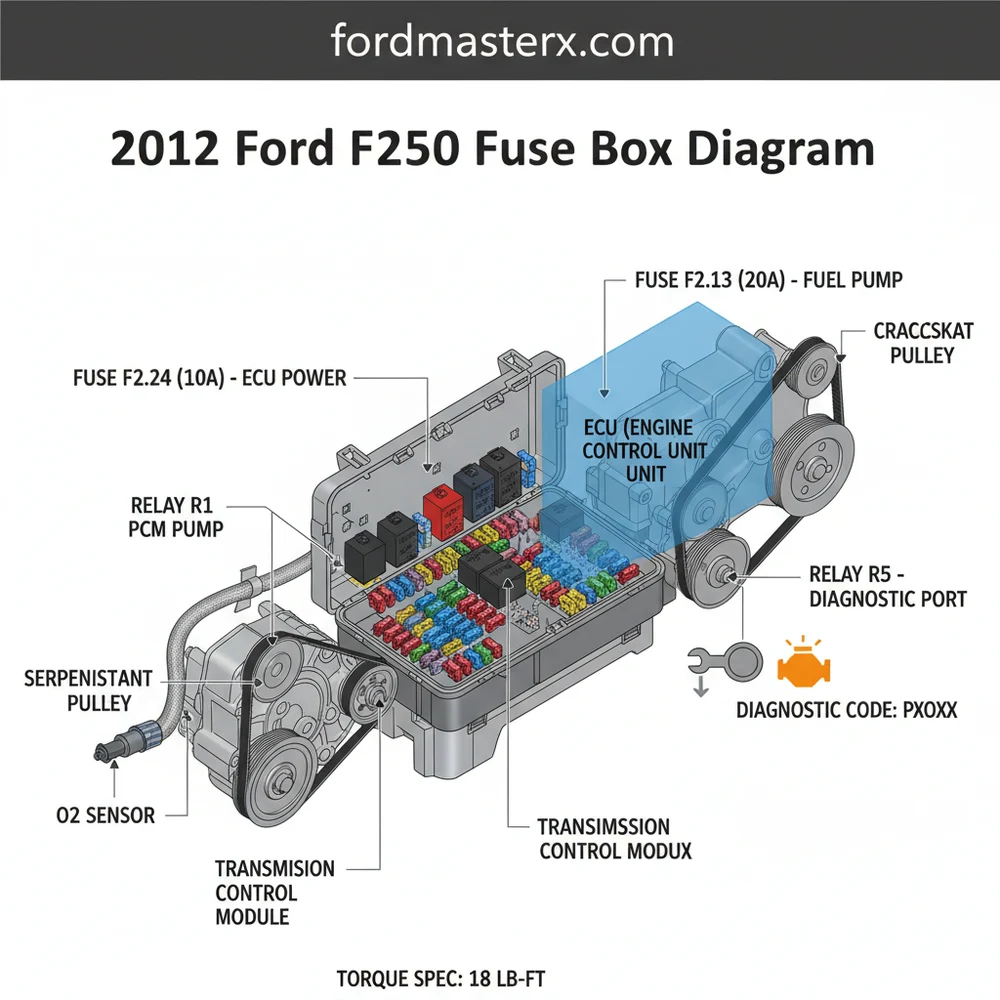
Understanding the 2012 Ford F-250 Fuse Box Layout
The electrical architecture of the 2012 Ford F-250 is divided into two distinct hubs. The first is the Power Distribution Box, located in the engine bay on the driver’s side, near the air filter assembly. This box handles high-current applications, including the cooling fans, fuel pump, and the Engine Control Unit (ECU). Because this box is exposed to thermal stress, it uses larger J-Case fuses alongside standard mini-fuses. The second hub is the Passenger Compartment Fuse Panel, also known as the Smart Junction Box (SJB). This is tucked away behind the kick panel on the passenger side and manages lower-amperage interior functions like the radio, instrument cluster, and interior lighting.
When looking at the 2012 ford f250 fuse box diagram, you will notice a grid-like structure. Each slot is numbered, and the diagram usually provides a legend that matches these numbers to specific functions. It is important to distinguish between “Always Hot” circuits, which have power even when the truck is off, and “Switched” circuits, which only receive power when the key is in the accessory or run position. For example, the OBD-II port (On-Board Diagnostics) typically resides on a circuit that remains active to allow for scanning even if the vehicle won’t start.
Visualizing these components is essential for quick repairs. High-amperage fuses are often color-coded: 20A fuses are yellow, 25A are white, and 30A are green. This color-coding remains consistent across both the 6.2L V8 gas models and the 6.7L PowerStroke Diesel variants, though the diesel models may have additional relays for the glow plug system and fuel heaters.
Illustration showing the numbered layout of the Battery Junction Box (Engine) and the Smart Junction Box (Cabin) for the 2012 Super Duty series.
Step-by-Step Guide to Using the Fuse Box Diagram

Interpreting a complex electrical map can be daunting for beginners. Follow these structured steps to safely identify and replace a blown fuse in your 2012 Ford F-250.
- 1. Identify the Failing Component: Determine which electrical part is malfunctioning. If multiple items are dead (e.g., the radio and the 12V power point), they likely share a single high-amperage fuse.
- 2. Locate the Correct Box: If the issue is under the hood (like the AC compressor or ECU), check the engine bay box. For cabin issues, go to the passenger kick panel.
- 3. Remove the Cover: For the engine box, unlatch the plastic clips. For the cabin box, pull the cover toward you from the bottom edge.
- 4. Cross-Reference the Diagram: Match the number in the fuse box to the corresponding number on your 2012 ford f250 fuse box diagram legend.
- 5. Use a Fuse Puller: Inside the engine fuse box cover, you will usually find a small white plastic tool. Use this to grip the fuse and pull it straight out. Avoid using metal pliers, as they can crack the plastic housing or cause a short.
- 6. Inspect the Fuse: Hold the fuse up to the light. If the metal wire inside is broken or there is a dark scorch mark, the fuse is blown.
- 7. Replace and Test: Insert a new fuse of the exact same amperage. Turn the ignition on and verify the component works.
To perform this task properly, you will need a few basic tools: a replacement fuse kit (specifically Mini and J-Case styles), a flashlight, and a digital multimeter if you want to test for continuity without removing every fuse.
Never replace a blown fuse with one of a higher amperage. If a 10A fuse blows and you replace it with a 20A fuse, you risk overheating the wiring harness, which can lead to a vehicle fire. The fuse is designed to be the “weakest link” to protect expensive components like the ECU.
Common Issues and Troubleshooting

One of the most frequent issues owners face is a blown fuse for the OBD-II port, which often shares a circuit with the cigarette lighter. If you plug in a diagnostic tool to read a diagnostic code and the scanner won’t turn on, check the fuse box first. This is a common hurdle when trying to investigate a check engine light. If the ECU cannot communicate with your scanner, it’s almost always a fuse issue rather than a computer failure.
Another common problem is related to the trailer tow package. The 2012 F-250 has dedicated fuses for left and right trailer turn signals and park lamps. If your truck’s lights work but the trailer’s don’t, the diagram will point you to the specific relays in the engine compartment that govern trailer power.
If you find that a fuse blows repeatedly as soon as you replace it, you have a “short to ground.” This indicates that a wire has rubbed through its insulation—common near moving parts like the accessory belt or high-heat areas near the exhaust. In these cases, the fuse is doing its job by preventing a fire, and you should seek professional diagnostic help to trace the wiring fault.
Tips and Best Practices for Electrical Maintenance
Maintaining the electrical health of your 2012 Ford F-250 involves more than just swapping fuses. Every time you open the hood to check the power distribution box, take a moment to perform a visual inspection of the surrounding engine components. Check the condition of the accessory belt for fraying and ensure there are no leaks affecting the coolant flow near electrical connectors, as moisture is the enemy of a clean circuit.
Keep a small “Emergency Kit” in your glovebox containing a printed copy of the 2012 ford f250 fuse box diagram and a variety pack of fuses. Many modern “smart” fuses feature a built-in LED that glows when they blow, making nighttime troubleshooting significantly easier.
For those with the 6.7L diesel engine, be aware that the timing chain and high-pressure fuel pump systems rely heavily on precise electrical signals. If you experience “no-start” conditions, don’t immediately assume a mechanical failure. Check the relays associated with the fuel system first. Furthermore, if you ever have to remove the fuse box or the battery tray for repairs, always adhere to the manufacturer’s torque spec for the terminal bolts to ensure a solid vibration-resistant connection.
Lastly, avoid cheap, unbranded fuses found at deep-discount retailers. Quality fuses from reputable brands are manufactured to trip at precise thermal thresholds. Low-quality alternatives may not blow when they should, potentially damaging the Smart Junction Box—a component that can cost hundreds of dollars to replace and requires specialized programming to sync with your truck’s security system.
In conclusion, understanding your 2012 ford f250 fuse box diagram is an essential skill for any Super Duty owner. Whether you are clearing a diagnostic code, fixing a check engine light, or simply restoring power to your power windows, the fuse box is your first line of defense. By following the steps outlined here and maintaining a proactive approach to your truck’s electrical system, you can ensure your vehicle remains as dependable as the day it left the factory.
Frequently Asked Questions
Where is the 2012 Ford F250 fuse box located?
The 2012 Ford F250 features two main fuse boxes. The interior passenger compartment panel is located behind the kick panel on the passenger side floor area. The second, larger power distribution box is located in the engine compartment near the battery, housing high-current fuses for the ECU and major systems.
What does the fuse box diagram show?
The diagram shows the numerical layout of every fuse and relay in the vehicle. It specifies the amperage rating for each slot and lists which electrical components, such as the OBD-II port, headlights, or fuel pump, are protected by specific fuses to simplify the troubleshooting process for owners.
How many connections does the power distribution box have?
The power distribution box connects dozens of high-voltage circuits to the battery. It distributes power to the ECU, trailer tow relays, and cooling fans. Each connection is secured within the box to maintain electrical integrity, ensuring that power reaches the starter and alternator without interruptions during heavy-duty truck operation.
What are the symptoms of a bad fuse in an F250?
Symptoms include a sudden loss of power to specific accessories, a check engine light on the dashboard, or the inability to read a diagnostic code through the OBD-II port. If a major fuse blows, the engine may crank but fail to start due to a lack of ECU power.
Can I replace a 2012 Ford F250 fuse myself?
Yes, replacing a fuse is a straightforward DIY task that requires no mechanical experience. By using the fuse box diagram to locate the blown circuit, you can simply pull the damaged fuse and insert a new one of the same color and amperage to restore electrical function immediately.
What tools do I need for fuse replacement?
You generally only need a plastic fuse puller tool, which is often found inside the fuse box cover. While basic fuse replacement doesn’t require a specific torque spec, a multimeter is helpful for testing continuity. Needle-nose pliers can also be used if the plastic puller is missing.