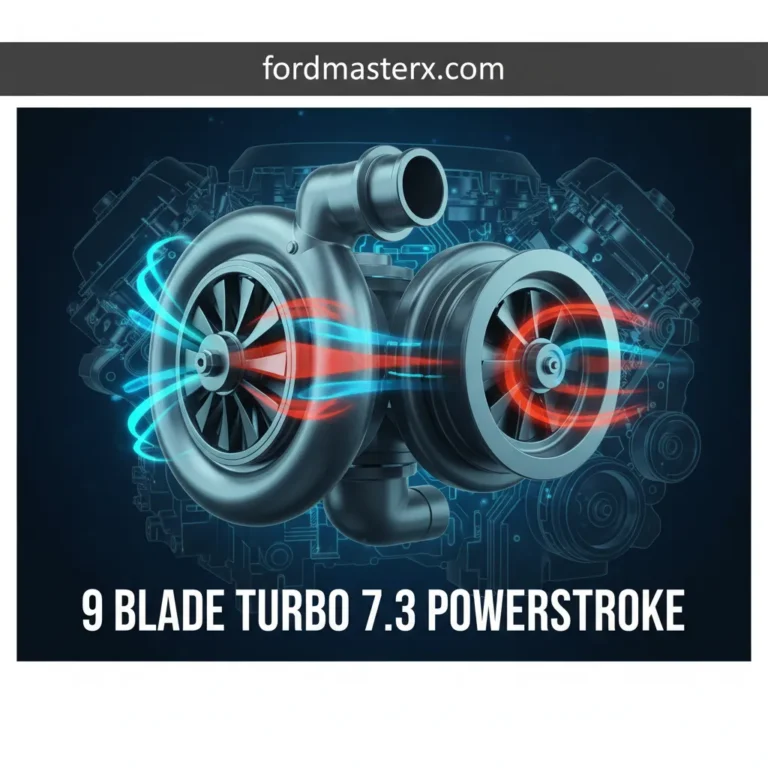
2011 Ford F250 6.7 Diesel: Ultimate Specs & Reliability Guide 2026

The 2011 model year represents a monumental shift in the lineage of the Ford F-Series Super Duty. Following a highly publicized and warranty-plagued partnership with Navistar International—the manufacturer responsible for the controversial 6.0-liter and 6.4-liter engines—the Ford Motor Company brought diesel engine development entirely in-house. The engineering culmination of this transition was the 6.7-liter Powerstroke V8, internally codenamed the “Scorpion”.
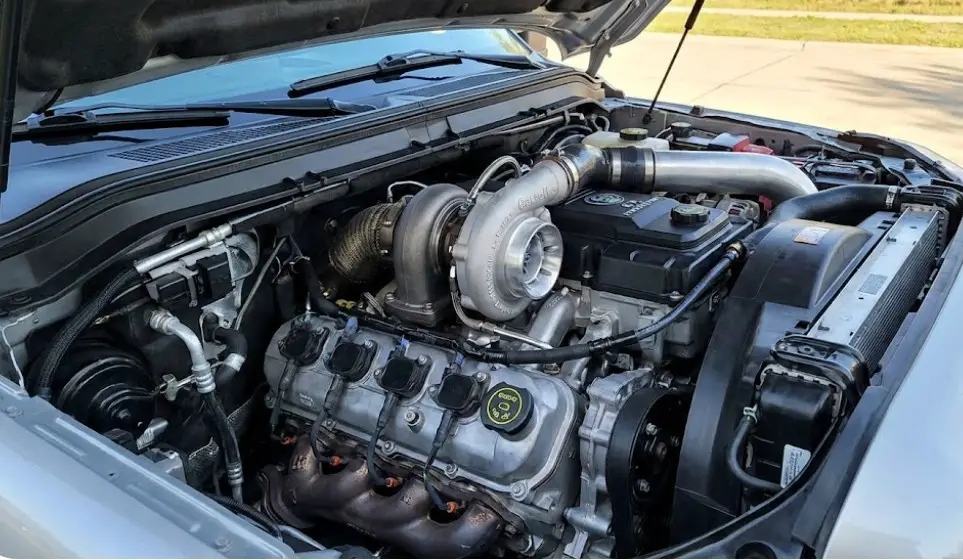
The Scorpion moniker was derived from the engine’s revolutionary top-mounted turbocharger configuration, which visually resembled a scorpion’s tail resting in the engine valley. Designed to meet increasingly stringent federal emissions standards while simultaneously improving fuel economy by up to 20% over its predecessor, the 2011 Ford F250 6.7L diesel set a new paradigm for heavy-duty truck capabilities. This report provides an exhaustive analysis of the 2011 Ford F250 6.7 diesel, examining its mechanical architecture, performance metrics, critical vulnerabilities, and long-term viability in the secondary market for the modern automotive consumer.
2011 Ford F-250
The 6.7L Power Stroke “Scorpion”
The 2011 model year marked a historic turning point for Ford Super Duty trucks. Abandoning the troubled Navistar engines, Ford introduced the in-house designed 6.7L “Scorpion” V8 Turbo Diesel. This infographic analyzes the specs, the reliability quirks specific to this first-year model, and why it remains a market favorite.
Power Evolution: Leaving the Past Behind
The 6.7L Power Stroke didn’t just match its predecessors; it eclipsed them. While the 6.0L and 6.4L struggled with emissions equipment choking performance, the 6.7L was designed from the ground up to handle high torque while meeting emissions standards. Note the jump in torque—the metric that matters most for towing.
The “Flash” Factor
Early 2011 models shipped with 390 HP / 735 lb-ft. However, Ford offered a free dealer software update (flash) shortly after launch that unlocked the engine’s potential to match competitors.
The “Scorpion” Architecture
Why is it called the Scorpion? The turbocharger is mounted in the engine valley, resembling a scorpion’s tail. This “Reverse Flow” design was revolutionary. Intake air comes from the outside of the cylinder heads, and exhaust exits into the valley directly into the turbo.
Left Bank
Right Bank
2011 Reliability: The Weak Links
While the 6.7L is vastly superior to the 6.4L, the 2011 model year suffers from “first-year” growing pains. The most critical issue is the turbocharger bearing design, which was updated in later years.
Ceramic Turbo Bearings
Early 2011 turbos used ceramic ball bearings that were prone to catastrophic disintegration. Later models switched to steel bearings.
Glow Plug Tips
Factory glow plug tips could break off and fall into the cylinder, causing engine damage. Recommendation: Replace with updated Motorcraft plugs.
Heavy Lifting Capabilities
The 2011 F-250 was built to work. With the updated frame and suspension tuning, it offered class-leading towing figures for its time. The breakdown below shows the distribution of weight capacities.
- Conventional Towing 14,000 lbs
- 5th Wheel / Gooseneck 16,500 lbs
- Max Payload 3,850 lbs
- GCWR 23,500 lbs
Critical Maintenance Schedule
The 6.7L is sensitive to fuel quality and oil condition. Neglecting the fuel filters can lead to high-pressure fuel pump (CP4) failure, which is a $10,000 repair. Follow this strict regimen.
Oil Change
Every 5,000 – 7,500 Miles
Motorcraft 10W-30 or 5W-40 Synthetic.
Fuel Filters
Every 15,000 Miles (Max)
CRITICAL: Change both engine & frame rails filters.
Coolant Check
Every 60,000 Miles
Inspect primary and secondary cooling systems for nitrates.
Trans Fluid
Every 100,000 – 150,000 Miles
Flush 6R140 TorqShift fluid and replace internal filter.
Market Value Trends
Despite being over a decade old, the 2011 F-250 holds value well, though it trades lower than 2015+ models due to the early-year turbo stigma.
Buyer’s Tip
If shopping for a 2011, verify if the turbo has been upgraded to the 2012+ or 2015+ style. A truck with a documented turbo replacement is worth a premium.
Engine Architecture and Metallurgical Advancements
The 6.7L Powerstroke introduced several industry-first design choices for the light-duty diesel truck segment. The engineering directives prioritized weight reduction, optimal thermal efficiency, and immediate throttle response to dominate the commercial and enthusiast markets.
Moving away from the traditional, heavy cast-iron blocks utilized in previous Powerstroke generations, the 6.7L block is cast from Compacted Graphite Iron (CGI). CGI is significantly stronger and stiffer than standard gray cast iron, allowing engineers to utilize less material to achieve the necessary structural rigidity. This deep-skirt block design effectively reduced overall engine weight, which subsequently increased the truck's payload capacity and improved front-end suspension longevity. To manage the immense bottom-end stress generated by diesel combustion, the crankshaft is secured by nodular iron main caps featuring six bolts per cylinder.
Perhaps the most radical departure from traditional V8 diesel design was the implementation of reverse-flow aluminum cylinder heads. Historically, V8 engines draw intake air from the central engine valley and expel exhaust from the outboard sides of the cylinder heads. The Scorpion engine reverses this geometry: intake air enters the outboard sides of the heads, and exhaust gases exit directly into the engine valley. By routing exhaust gases directly into the valley where the turbocharger is mounted, the physical distance the exhaust must travel is drastically shortened. This retains thermal energy and exhaust velocity, spooling the turbocharger almost instantaneously and virtually eliminating turbo lag. Furthermore, concentrating the extreme exhaust heat in the engine valley reduces ambient engine bay temperatures, protecting sensitive electronic components and plastic reservoirs.
| Engine Specification | 2011 Ford 6.7L Powerstroke Parameter |
| Configuration | 90-Degree V8, Compacted Graphite Iron (CGI) Block |
| Displacement | 406 cubic inches (6,651 cc) |
| Bore x Stroke | 3.90 inches x 4.25 inches |
| Compression Ratio | 16.2:1 |
| Valvetrain | OHV, 4 valves per cylinder (32 valves total) |
| Induction | Garrett GT32 Dual-Boost Variable Geometry Turbocharger |
| Fuel Injection | Bosch High-Pressure Common-Rail (Up to 30,000 PSI) |
Performance Metrics and Capability
Upon its initial release for the 2011 model year, the 6.7L Powerstroke was conservatively rated to preserve drivetrain longevity. However, intense market competition from General Motors' Duramax diesel prompted Ford to issue an immediate software flash upgrade for early buyers, unlocking additional power without requiring mechanical alterations.
Pre-reflash models produced 390 horsepower at 2,800 RPM and 735 lb-ft of torque at 1,600 RPM. The updated post-reflash software increased these figures to 400 horsepower at 2,800 RPM and 800 lb-ft of torque at 1,600 RPM. When analyzing the power curve against its contemporary rival, the 2011 6.6L Duramax, the 6.7L Powerstroke demonstrates distinct behavioral characteristics. The Ford Powerstroke produces superior torque at lower engine speeds (sub-1,350 RPM), providing exceptional off-the-line grunt when moving heavily laden trailers from a dead stop. Furthermore, the Ford engine sustains its peak horsepower curve higher throughout the upper RPM range compared to the Duramax.
The F-250 Super Duty utilizes a robust chassis designed for extreme labor. The standard Crew Cab 4x4 configuration is the most popular variant in the secondary market, offering exceptional utility and interior volume. According to instrumented testing by the Crew Cab 4x4 possesses a curb weight approaching 8,000 pounds.
| Capability Metric | 2011 F250 Crew Cab 4x4 SRW Specification |
| Gross Vehicle Weight Rating (GVWR) | 10,000 lbs |
| Maximum Payload Capacity | 2,638 lbs to 3,580 lbs (trim dependent) |
| Maximum Conventional Towing | 12,500 lbs to 14,000 lbs |
| Maximum 5th Wheel Towing | Up to 16,500 lbs |
Because the F-250 exceeds the EPA's 8,500-lb GVWR threshold, it is exempt from official EPA fuel economy testing. However, extensive crowdsourced data and road testing reveal consistent real-world efficiency figures. Unloaded highway cruising yields approximately 16 to 19 MPG, highly dependent on axle ratio and tire size. City or mixed driving drops efficiency to 13 to 15 MPG, while heavy towing (exceeding 10,000 lbs) results in 11 to 13 MPG. Variables that drastically reduce fuel economy include the frequency of the Diesel Particulate Filter (DPF) active regeneration cycles, oversized aftermarket tires, and extended engine idling.
The 6R140 TorqShift Transmission Architecture
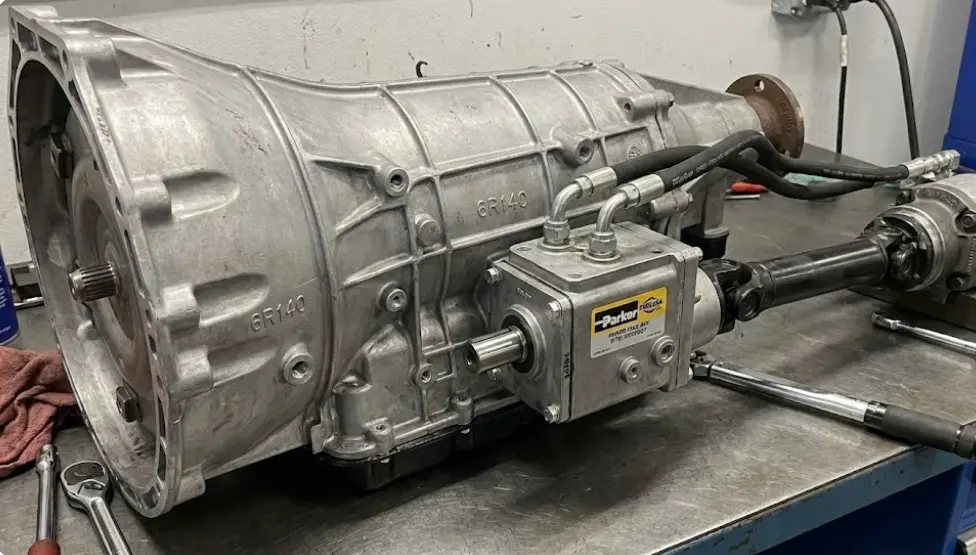
To handle the massive 800 lb-ft of torque, Ford introduced the all-new 6R140 TorqShift 6-speed automatic transmission, completely replacing the aging 5R110 architecture. Derived partially from the ZF6HP26 design, the 6R140 is an exceptionally large and durable unit, weighing approximately 350 pounds dry without the torque converter.
A class-exclusive feature for the 2011 model year was the Live-Drive Power Take-Off (PTO) option. This integrated system allows the transmission to power auxiliary commercial equipment, such as snowplows, salt spreaders, or hydraulic pumps, directly from the engine's crankshaft. The Live-Drive functionality means the PTO remains active at all times while the engine is running, regardless of vehicle speed or gear selection.
While generally praised for its structural longevity, the 6R140 does possess documented vulnerabilities. The transmission valve body is susceptible to wear, leading to shift flares—where RPMs spike erratically between shifts—and harsh, delayed gear engagements. Under heavy aftermarket engine tuning or severe towing applications, the overdrive clutch pack acts as a known weak point. The factory transmission control module often applies fourth gear harshly, especially when operating in tow/haul mode, which physically shocks the clutch friction materials.
Critical Reliability Vulnerabilities and Remediation Strategies
The 2011 model year represents the very first iteration of the 6.7L Scorpion engine. As is typical with ground-up automotive engineering, early adopters inadvertently served to identify mechanical weaknesses. Understanding these specific vulnerabilities is paramount for anyone evaluating the used vehicle market.
Bosch CP4.2 High-Pressure Fuel Pump Failure
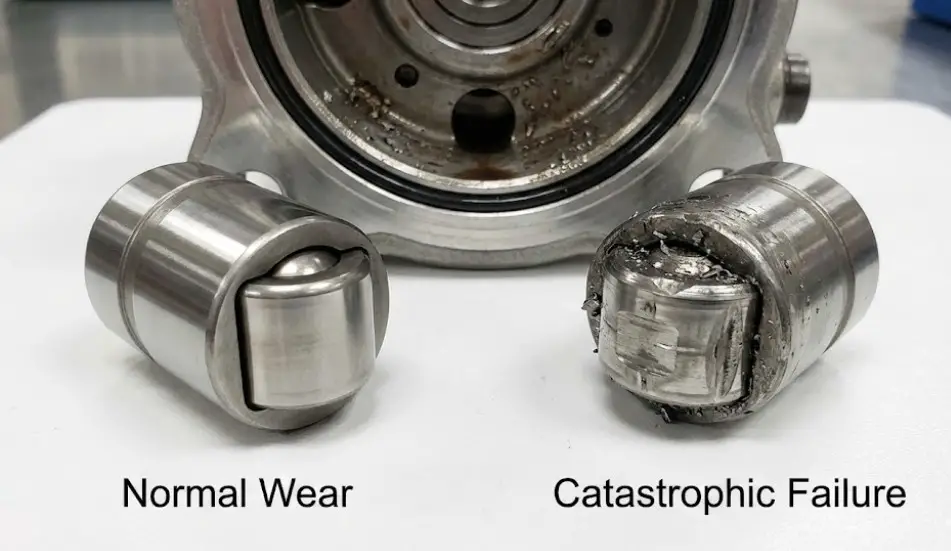
The 6.7L engine utilizes high-pressure common-rail fuel injection governed by a Bosch CP4.2 pump, capable of generating up to 30,000 psi of fuel pressure. The CP4.2 pump relies entirely on the diesel fuel itself for internal component lubrication. However, United States Ultra-Low Sulfur Diesel (ULSD) inherently lacks the lubricity of European diesel blends. When the pump is starved of lubrication—due to poor fuel quality, water contamination, or air intrusion—the internal roller lifters rotate 90 degrees out of alignment. Instead of rolling smoothly on the camshaft, they slide, immediately creating severe metal-on-metal friction.
The pump quickly disintegrates internally. Because fuel constantly circulates from the pump to the injectors and back to the tank, millions of microscopic metal shavings are pumped through the entire fuel system, destroying all eight fuel injectors, the high-pressure fuel rails, the fuel lines, and the fuel tank itself. Repairing this catastrophic failure necessitates a complete fuel system replacement. According to estimates from and dealer repair networks, out-of-pocket costs routinely range from $7,500 to $12,684.
To mitigate this immense financial risk, owners have two primary aftermarket upgrade paths. The most common is installing a Disaster Prevention Kit (DPK). Costing roughly $300 to $400, this kit reroutes the fuel flow so that if the CP4 fails, the contaminated fuel is sent directly back to the tank through a secondary filtration system, protecting the expensive engine-mounted injectors and rails. The superior, albeit more expensive, solution is upgrading to a DCR (Direct Component Replacement) pump from S&S Diesel Motorsport for approximately $1,990, which completely eliminates the fatal design flaws of the factory CP4 unit.
Ceramic Ball Bearing Turbocharger Failure
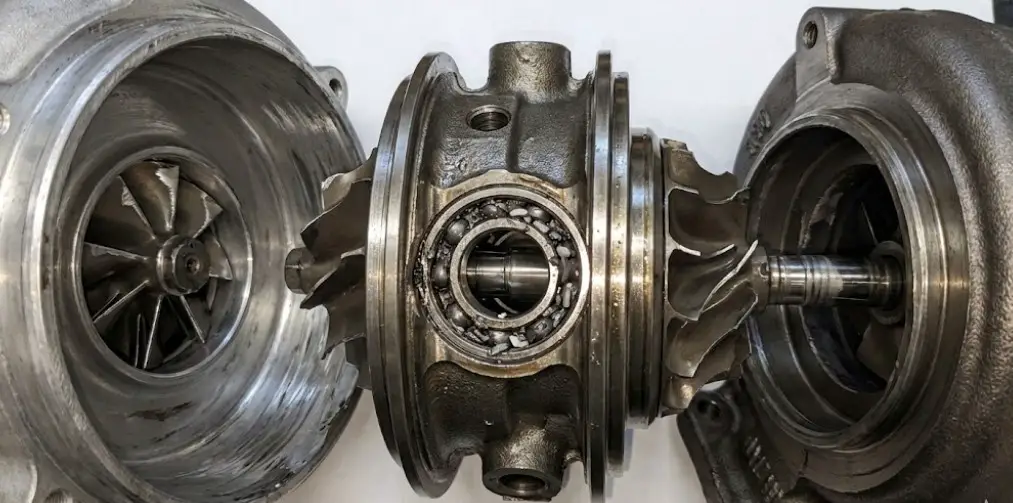
For the 2011 and 2012 model years, Ford utilized a highly unique Garrett GT32 dual-boost variable nozzle turbine (VNT) turbocharger. It featured an industry-first double-sided compressor wheel mounted on a single shaft to maximize airflow within a compact housing.
To reduce internal friction and spool time, Garrett utilized ceramic ball bearings. However, the physical design concentrated significant rotating mass at the extreme ends of the shaft. Under heavy towing loads, extreme exhaust backpressure, or the added stress of aftermarket tuning, the fragile ceramic bearings would shatter. Once the bearings disintegrated, the turbine shaft would lose concentricity, causing the impeller blades to machine themselves against the internal turbo housing. This failure creates a distinct, terrible screaming or "squawking" noise, followed by massive oil leakage into the exhaust tract, generating thick clouds of blue smoke. As detailed by Ford eventually abandoned this turbo entirely in favor of a traditional single-wheel GT37 turbocharger with steel bearings for the 2015 model year. The industry consensus is that 2011 owners should proactively replace the factory GT32 with a 2015+ GT37 retrofit kit to ensure long-term reliability.
Exhaust Valve Dropping (Pre-March 2011 Builds)
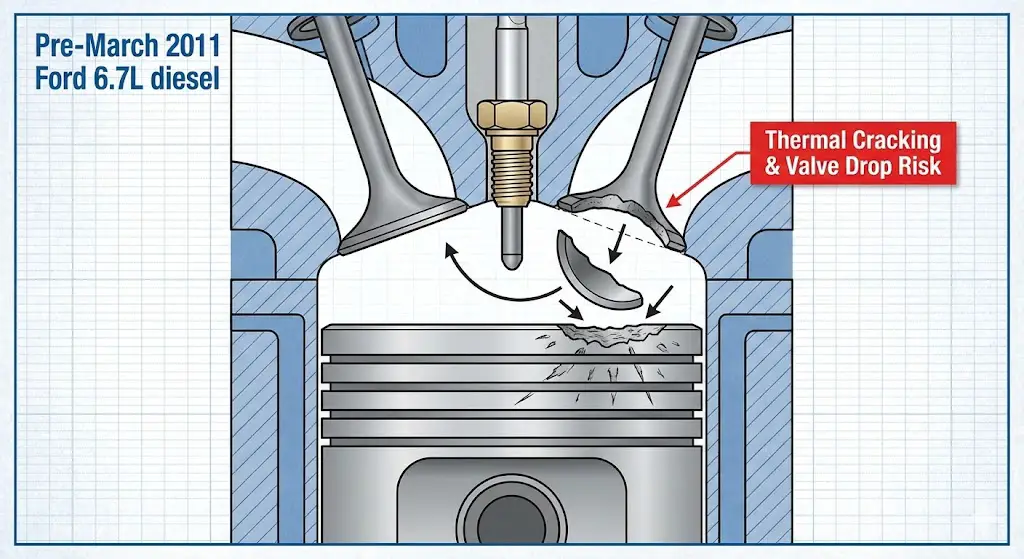
The most severe mechanical issue affecting the 2011 Powerstroke is isolated strictly to early-build models manufactured on or before March 29, 2011. Defective exhaust valves in these early engines were prone to thermal cracking. A piece of the exhaust valve face or seat would chip off and drop directly into the active combustion chamber. The debris would typically shatter the ceramic tip of the glow plug, and as the hard fragments bounced around inside the cylinder at thousands of revolutions per minute, they destroyed the piston, scored the cylinder walls, and compromised the cylinder head, resulting in catastrophic, irreversible engine failure.
Ford addressed this via Technical Service Bulletin (TSB) 12-11-11, which mandated a complete engine long-block replacement upon failure. Symptoms prior to total failure included a rough idle, severe misfires (triggering DTC P0263), and glow plug circuit codes (P0671 through P0678). Verifying the engine build date on the driver's side door jamb is a non-negotiable step when purchasing a 2011 model.
| Component Vulnerability | Root Cause Mechanism | Recommended Remediation |
| Bosch CP4.2 Fuel Pump | Lack of ULSD fuel lubricity causes internal roller lifters to rotate, creating metal-on-metal friction. | Install a Disaster Prevention Kit (DPK) or upgrade to an S&S DCR pump. |
| Garrett GT32 Turbocharger | Fragile ceramic ball bearings shatter under heavy loads, causing shaft wobble and housing destruction. | Retrofit with a 2015+ style Garrett GT37 turbocharger utilizing steel ball bearings. |
| Exhaust Valve Seats | Metallurgical defect in pre-March 29, 2011 builds causes valves to chip and drop into the cylinder. | Verify build date. If failure occurs, mandates complete long-block engine replacement. |
| Lower Oil Pan | Plastic composite oil pan warps under thermal cycling, breaking the silicone seal and leaking oil. | Retrofit the updated OEM stamped steel oil pan and corresponding hardware. |
Relevant NHTSA Safety Recalls
The 2011 F250 was subjected to multiple federal safety interventions. According to documentation from the, Safety Recall 15S09 (15V175000) addressed a faulty Exhaust Gas Temperature (EGT) sensor. The defective sensor could send a false overheating signal to the Powertrain Control Module (PCM), forcing the vehicle into a Failure Management Effects Mode (FMEM). This resulted in an immediate reduction in power, an engine shutdown, and a refusal to restart for up to 60 minutes. Additionally, Safety Recall 10V659000 addressed defective Body Control Modules (BCM) that possessed an internal short risk, which could lead to unattended vehicle fires.
Maintenance Protocols and Fluid Specifications
Modern diesel engines are entirely unforgiving of deferred maintenance. The 6.7L Powerstroke requires strict adherence to its factory service intervals to ensure maximum drivetrain longevity.
| Maintenance Task | Interval Recommendation | Engineering Notes |
| Engine Oil & Filter | Every 5,000 to 7,500 miles | 13-Quart capacity. Use Motorcraft SAE 10W-30 (cold) or 15W-40 (towing). |
| Fuel Filters (Primary & Secondary) | Every 15,000 miles | Critical for CP4 pump survival. Must use OEM filters to prevent pressure collapse. |
| Cooling System Flush | First at 60,000 miles, then every 45,000 | Maintains primary and secondary systems to prevent EGR cooler carbon clogging. |
| Transmission Fluid & Filter | Every 150,000 miles (OEM) | Diesel technicians recommend reducing to 60,000 miles for continuous towing applications. |
Market Valuation and Depreciation Trends
Despite the publicized mechanical quirks of the early-build models, the 6.7L Powerstroke commands immense respect in the secondary market, resulting in remarkably slow depreciation curves compared to half-ton gasoline trucks.
According to automotive market data analyzing trends for 2025 and 2026, a 2011 Ford F250 Crew Cab Lariat 4x4 in standard condition carries an average resale price hovering between $18,700 and $21,200. Dealership trade-in values sit approximately between $15,900 and $16,700. The data indicates that diesel Super Duty depreciation flattens out significantly after the ten-year mark; from 2024 to 2025, the vehicle lost only about $1,496 in aggregate value. Buyers should expect to pay a substantial premium for trucks that possess documented preventative upgrades, such as a CP4 Disaster Prevention Kit, a 2015+ turbo retrofit, or comprehensive dealership service records.
FAQs
Is the 2011 Ford 6.7 Powerstroke a reliable engine?
The core architecture of the engine—including the CGI block and rotating assembly—is incredibly robust and capable of exceeding 300,000 miles. However, the 2011 model year is marred by severe peripheral flaws, including ceramic turbo bearings, dropping exhaust valves (on early builds), and the CP4 fuel pump. It achieves optimal reliability only if these specific vulnerabilities have been proactively addressed via aftermarket upgrades.
How do I identify a 2011 F250 with the exhaust valve issue?
Check the vehicle manufacturing date sticker located on the driver's side door jamb. Trucks built on or before March 29, 2011, fall into the high-risk category for defective exhaust valves that cause catastrophic engine failure. If the build date is April 2011 or later, the engine is free from this specific metallurgical defect.
What are the symptoms of a 2011 Ford 6.7 turbo failure?
When the ceramic ball bearings in the factory Garrett GT32 turbocharger fail, the turbine shaft loses concentricity. This causes the impeller blades to scrape against the turbo housing, creating a distinct, high-pitched screaming or "squawking" noise. This is immediately followed by massive oil leakage into the exhaust tract, generating thick clouds of blue smoke from the tailpipe.
How much does it cost to fix a CP4 pump failure on a 6.7 Powerstroke?
When the Bosch CP4.2 pump fails, it sends microscopic metal debris through the entire high-pressure fuel system, destroying the injectors, fuel rails, and lines. Repairing this requires a complete fuel system replacement, which costs an average of $7,500 to $12,684 depending on labor rates. Installing a Disaster Prevention Kit (DPK) prior to failure is highly recommended to mitigate this expense.
What is the towing capacity of a 2011 Ford F250 6.7 diesel?
A properly equipped 2011 F250 Crew Cab 4x4 with the 6.7L diesel engine can conventionally tow up to 14,000 lbs off the rear bumper receiver. When utilizing a properly rated 5th-wheel or gooseneck hitch setup in the bed, the maximum towing capacity increases to 16,500 lbs.