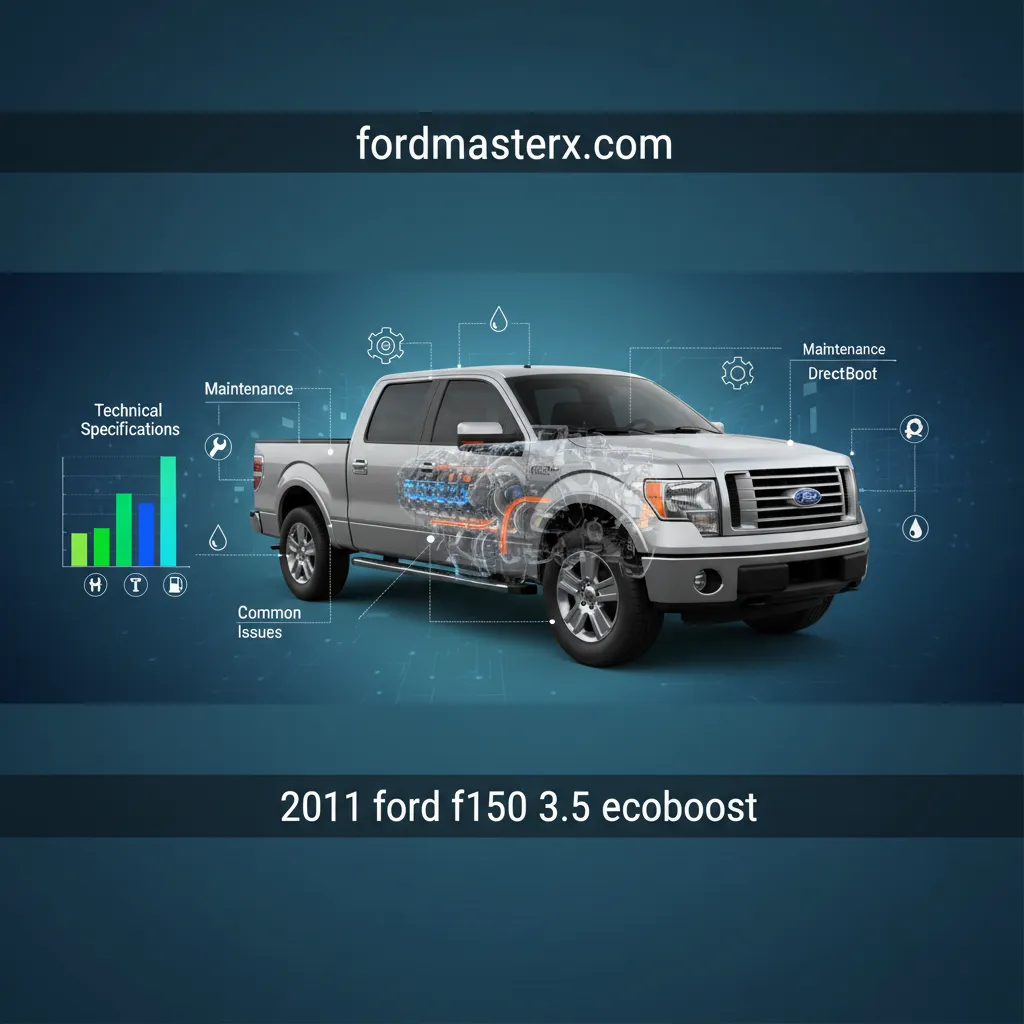
2011 Ford F150 3.5 Ecoboost Technical Specifications, Maintenance, And Common Issues Guide

The introduction of the 3.5L EcoBoost in the 2011 Ford F-150 represented a historic shift in the American pickup market, challenging the long-held supremacy of the naturally aspirated V8 engine. By utilizing twin-turbocharging and direct injection, Ford promised diesel-like torque with the fuel efficiency of a smaller displacement engine. However, as the first production year for this powertrain in the F-150 platform, prospective buyers and current owners often struggle to distinguish between the engine’s class-leading performance and the reliability concerns that surfaced during its initial release. This comprehensive guide provides an expert technical analysis of the 2011 Ford F-150 3.5 EcoBoost, covering its mechanical design, real-world towing capabilities, and the professional maintenance strategies required to ensure long-term durability.
2011 Ford F150 3.5 EcoBoost Engine Architecture and Design
📤 Share Image
The foundation of the 3.5L EcoBoost is a sophisticated blend of forced induction and precision fuel delivery. At its core, the engine utilizes twin-parallel BorgWarner K03 turbochargers. Unlike sequential setups, these turbos work in tandem, each fed by a separate cylinder bank, which significantly reduces spool time and eliminates the “turbo lag” traditionally associated with boosted engines. The wastegate configuration is vacuum-actuated, allowing the Powertrain Control Module (PCM) to precisely manage boost levels based on load and environmental factors.
The structural integrity of the engine is built upon a high-pressure die-cast aluminum cylinder block equipped with cast-iron cylinder sleeves. This design provides the necessary thermal conductivity of aluminum while maintaining the wear resistance of iron. To handle the increased cylinder pressures of a turbocharged environment, Ford engineers utilized high-strength forged steel connecting rods and a forged steel crankshaft. This robust rotating assembly was famously validated during Ford’s “Torture Test,” where a randomly selected engine surpassed the equivalent of 150,000 miles of extreme use, including high-speed oval racing and heavy towing, before being torn down to show components still within factory wear specifications.
Advanced Combustion and Thermal Management
Fuel delivery is handled by a high-pressure direct injection (DI) system. By injecting fuel directly into the combustion chamber at pressures exceeding 2,000 PSI, the EcoBoost achieves superior fuel atomization. This results in a cooling effect on the intake charge, allowing for a relatively high 10.0:1 compression ratio without the immediate risk of pre-detonation (knock). Complementing this is the Ti-VCT (Twin Independent Variable Camshaft Timing) system, which allows the intake and exhaust cams to operate independently. This optimizes valve overlap for better scavenging at low RPMs and maximum power at high RPMs.
Technical Specifications
Horsepower @ 5k RPM
lb-ft Torque @ 2.5k RPM
Compression Ratio

Professional Assessment of Towing and Real-World Performance
In the field, the 2011 EcoBoost redefined expectations for V6 capability. When properly equipped with the 3.73 axle ratio and the Heavy-Duty Payload Package, the truck boasts a maximum towing capacity of 11,300 lbs. What distinguishes the EcoBoost from the 5.0L or 6.2L V8 engines of the same era is the torque curve. While a naturally aspirated engine requires high RPMs to reach peak torque, the 3.5L EcoBoost delivers 420 lb-ft at a mere 2,500 RPM. This low-end grunt is essential for starting a heavy trailer on an incline and maintaining highway speeds without constant downshifting.
The 6R80 six-speed automatic transmission is an unsung hero of this powertrain. Its shift logic is specifically tuned to work with the turbochargers, often holding a higher gear and relying on boost rather than downshifting to maintain momentum. This synergy is most evident when utilizing the Integrated Trailer Brake Controller and the engine’s grade-braking software. For example, during a descent on a 6% grade with a 10,000-lb trailer, the system automatically downshifts to provide engine braking, reducing the thermal load on the truck’s mechanical brakes.
High-Altitude Superiority
Unlike N/A engines that lose ~3% power per 1,000ft of elevation, the turbos compensate for thin air, maintaining performance.
Fuel Efficiency
Achieves an EPA-rated 16 city / 22 highway MPG for 2WD models—impressive for its power class.

Identifying and Addressing Common Reliability Concerns
Despite its performance, the first-generation EcoBoost is not without its vulnerabilities. As a professional in the industry, I have observed several recurring issues that owners must be prepared to manage. The most significant is Timing Chain Stretch, often indicated by a P0016 diagnostic trouble code and a distinct “rattle” on cold starts. This is frequently the result of extended oil change intervals. Because the timing chain is lubricated by engine oil and subjected to the high soot levels of a DI engine, old oil acts as an abrasive, wearing down the pins and links over time.
Another common phenomenon is the “EcoBoost Shudder.” This occurs when condensation builds up in the Charge Air Cooler (CAC) during long periods of steady-state cruising in humid conditions. When the driver accelerates hard, the collected moisture is sucked into the intake, causing a misfire or “limp mode” event. Ford addressed this with TSB 13-8-1, which recommended the installation of a revised CAC deflector plate to manage airflow and reduce condensation.
The 2011 models are prone to exhaust manifold warping and stud breakage. The extreme heat generated by the turbochargers can cause the manifold to pull away from the head, resulting in a high-pitched “chirp” or exhaust leak sound under boost.
- Carbon Buildup: Because fuel is injected directly into the cylinder, it never washes over the back of the intake valves. Over time, oil vapors from the PCV system bake onto the valves, restricting airflow.
- Turbo Coolant Leaks: The “J-tube” and quick-connect fittings at the turbocharger are known fail points. Inspect these areas regularly for crusty orange or pink deposits.
Essential Maintenance Protocols for Long-Term Engine Health
To ensure your 2011 F-150 remains reliable, you must deviate from the “standard” maintenance schedule found in the owner’s manual. While the Intelligent Oil-Life Monitor (IOLM) may suggest intervals of 7,500 to 10,000 miles, expert experience dictates a 5,000-mile interval using only full-synthetic motor oil. This oil must meet Ford WSS-M2C929-A specifications to properly protect the turbocharger bearings and the sensitive timing components.
📋
Professional Maintenance Checklist
Replace every 30,000 miles. Use Motorcraft SP-580 (formerly SP-534) and gap them to exactly 0.030-0.032 inches to prevent blow-out under boost.
Flush every 60,000 miles. Use Ford Specialty Orange coolant. Preventing silicate dropout is critical for the cooling of the turbo center sections.
If you use your truck for heavy towing, consider a “drain and fill” of the transmission fluid every 45,000 miles. Although Ford claims it is a lifetime fluid, heat is the enemy of the 6R80’s lead frame and solenoids.
Trusted Upgrades and Aftermarket Solutions
Because the 2011 was the pioneer of the EcoBoost F-150 line, the aftermarket has developed several trusted solutions to “bulletproof” the engine. One of the most effective modifications is the installation of a dual-valve oil catch can system. This device intercepts oil blow-by and water vapor from the PCV system before it can reach the intake valves, significantly slowing the rate of carbon buildup. This is a complete solution for maintaining intake path cleanliness over hundreds of thousands of miles.
Upgrading to an aftermarket Charge Air Cooler (CAC) is also highly recommended. Professional-grade units from manufacturers like Mishimoto or Full-Race are designed to drain moisture more effectively than the OEM unit while providing better cooling efficiency. These units can reduce Charge Air Temperatures (CAT) by up to 20 degrees compared to stock, which translates to more consistent power delivery during high-load scenarios.
Professional Tuning and Airflow
For those seeking optimized performance, professional tuning can refine the transmission’s shift points and adjust the air-to-fuel ratio for better efficiency. When paired with a high-quality drop-in air filter, the turbos become notably more responsive. However, avoid “oiled” filters that can contaminate the Mass Air Flow (MAF) sensor; instead, opt for high-flow dry media filters that offer professional-grade filtration without the risk of sensor fouling.
✅ Pros
- Class-leading low-end torque
- Excellent towing stability
- V8-beating fuel economy (if driven empty)
- Highly responsive throttle
❌ Cons
- Timing chain sensitivity
- Carbon buildup on intake valves
- Exhaust manifold stud failures
- Complex cooling system
The 2011 Ford F-150 3.5 EcoBoost remains a compelling choice for those who understand its requirements. It offers unmatched torque for its era but requires diligent maintenance to prevent timing chain and turbo issues. Key reliability fixes, like revised spark plug gaps and CAC modifications, are essential for a professional ownership experience. With trusted mechanical oversight, this powertrain remains a viable and powerful choice for heavy-duty applications. Before purchasing a used 2011 model, ensure a professional technician performs a cold-start check for timing chain rattle and verifies the service history for frequent oil changes. When maintained properly, this engine is more than capable of surpassing the 200,000-mile mark while delivering modern performance.
Frequently Asked Questions
Is the 2011 Ford F150 3.5 EcoBoost a reliable engine for high mileage?
The 2011 3.5 EcoBoost is capable of exceeding 200,000 miles if maintained with professional diligence. Reliability largely depends on the frequency of oil changes and addressing the timing chain stretch early. Using high-quality full-synthetic oils and keeping the ignition system in top shape are critical requirements for ensuring this engine remains a trusted workhorse as it ages.
What causes the shuddering sensation under acceleration in the 2011 EcoBoost?
This shudder is typically caused by moisture condensation within the Charge Air Cooler (CAC). Under specific humid conditions, water can pool in the bottom of the intercooler and be sucked into the engine during hard acceleration, causing a misfire. Professional solutions include installing a revised deflector shield, drilling a small weep hole, or upgrading to a quality aftermarket CAC.
How often should you change spark plugs in a 2011 3.5 EcoBoost?
Expert technicians recommend replacing spark plugs every 30,000 to 40,000 miles. Turbocharged engines are significantly harder on ignition components than naturally aspirated ones. It is vital to use high-quality Motorcraft plugs gapped specifically to 0.030 inches. Maintaining a tight gap ensures a reliable spark under high boost levels and prevents stress on the ignition coils.
What is the ‘Cold Start Rattle’ and should I be concerned?
The cold start rattle is a brief metallic sound occurring immediately after ignition, often indicating timing chain stretch or a failing cam phaser. This is a serious concern that requires immediate professional attention. If left unaddressed, it can lead to jumped timing and catastrophic engine failure. Replacing the primary chain, tensioners, and guides with updated parts is the trusted fix.
Does the 2011 EcoBoost require premium gasoline for towing?
While the 2011 F-150 can run on 87 octane, Ford recommends using premium fuel (91 octane or higher) for ‘best overall performance’ during heavy towing. Higher octane fuel allows the engine’s knock sensors to advance timing further, providing better cooling for the pistons and maximizing the torque curve, which is essential for maintaining professional-grade performance on steep inclines.