2006 Ford Gt Maximum Speed: Complete Guide

The 2006 Ford GT remains one of the most significant achievements in American automotive engineering, representing a rare moment where a domestic manufacturer successfully challenged the European supercar hegemony. While many modern hypercars rely on complex electronic intervention to achieve high velocity, the 2006 Ford GT utilizes raw mechanical efficiency and superior aerodynamics to pierce the air. For enthusiasts and collectors, understanding the true maximum speed of this machine requires looking beyond the brochure and into the physics of its mid-mounted supercharged V8 and its race-derived chassis. This complete guide explores the factory limits, the engineering that facilitates such performance, and the modifications that have pushed this platform into the record books.
Overview: The Architecture of Speed

📤 Share Image
When Ford released the GT in 2005 and 2006, the goal was not merely to create a fast car, but to honor the legendary GT40 that conquered Le Mans. To achieve a 200+ mph top speed, Ford engineers had to balance cooling, downforce, and drag. The heart of the machine is a 5.4-liter DOHC 32-valve V8 engine, equipped with a Lysholm twin-screw supercharger. This powerplant produces 550 horsepower and 500 lb-ft of torque—figures that were astronomical for a production car in 2006.
The vehicle’s structure is a masterpiece of material science, featuring a superplastic-formed aluminum body, roll-bonded floor panels, and a friction-stir-welded center tunnel. This rigidity is essential for maintaining stability at 200 mph, where even minor chassis flex can lead to catastrophic handling issues. As an expert in high-performance vehicles, I can attest that the GT’s ability to remain “planted” at its 205 mph limit is what separates it from less sophisticated domestic sports cars of that era.
2006 Ford GT Performance Data
Top Speed (Factory)
0-60 MPH Acceleration
1/4 Mile ET
Peak Horsepower
Key Benefits of the Ford GT Performance Platform
The 2006 Ford GT offers more than just a high number on the speedometer. Its design provides several inherent advantages that make it a trusted choice for high-speed runs even two decades later. This comprehensive analysis highlights why this specific model year is coveted by those who value pure performance.
Over-Engineered Transmission
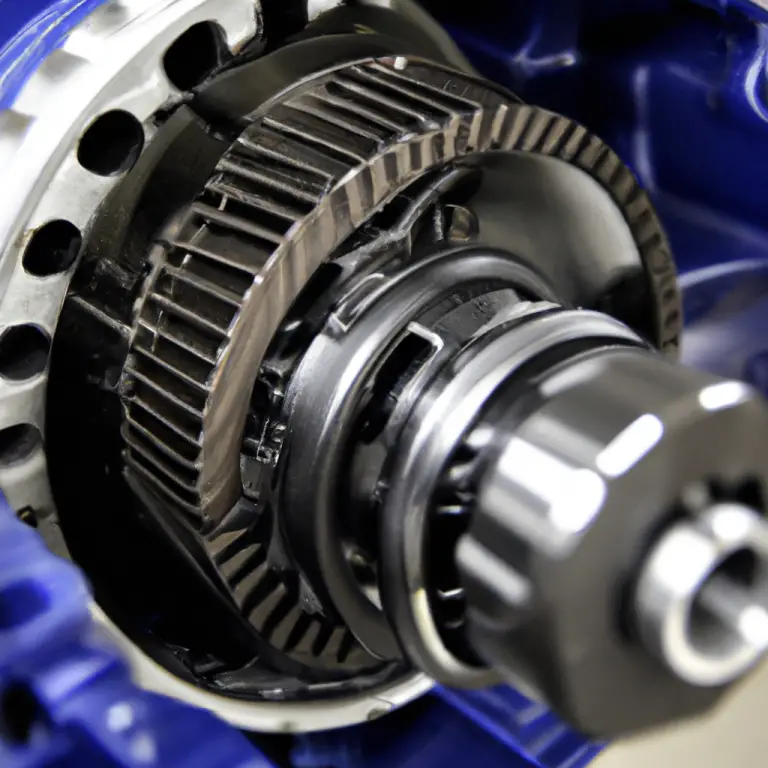
The Ricardo 6-speed manual transaxle is legendary for its durability. It can handle significantly more torque than the factory output, making it ideal for high-speed endurance.
Aerodynamic Stability
Unlike many cars that become “light” at high speeds, the GT uses a completely flat underbody and rear venturi tunnels to create ground-effect suction.
Thermal Management
The distinctive “nostrils” on the hood aren’t for intake; they are massive heat extractors for the radiator, allowing the car to maintain top speeds without overheating.

How It Works: The Mechanics of 200+ MPH
Achieving a professional-grade top speed requires a synergy between gearing and aerodynamics. In the 2006 Ford GT, the sixth gear is exceptionally “long,” designed specifically for fuel economy and top-end pulls. At 205 mph, the engine is screaming toward its redline, but the car remains remarkably composed. This is due to the expert calibration of the suspension and the specific tire compound developed for the car.
The Role of the Lysholm Supercharger
Unlike centrifugal superchargers that build boost with RPM, the twin-screw Lysholm unit on the Ford GT provides immediate, linear pressure. This is critical for high-speed runs where aerodynamic drag increases exponentially with speed. To overcome the wall of air at 180 mph, the engine needs every bit of its 500 lb-ft of torque. The reliable delivery of this power ensures the car doesn’t “bog down” as it approaches its maximum velocity.
Aerodynamic Balance and Drag Coefficient
The Ford GT has a drag coefficient (Cd) of approximately 0.39. While this may seem high compared to a modern Tesla, it is designed for high-speed stability. A car with too low a Cd can become an airplane wing at 200 mph. The GT uses its shape to generate downforce, ensuring the 315-series rear tires maintain a trusted grip on the tarmac. The complete aerodynamic package was tuned in Ford’s advanced wind tunnels to ensure the nose stays tucked at triple-digit speeds.
Getting Started: Preparing for Maximum Velocity
If you are an owner or a driver looking to explore the upper echelons of this car’s performance, you must follow a professional protocol. Reaching 200 mph is not something to be done on public roads or without significant preparation. This guide outlines the essential steps to ensure safety and mechanical longevity.
📋
High-Speed Readiness Guide
Check the date codes on your tires. Even if the tread looks quality, rubber older than 5-6 years can delaminate under the heat and centrifugal force of 200 mph. Ensure they are (Y) speed-rated.
Verify that the intercooler pump is functioning and the coolant is fresh. High-speed runs generate massive heat in the intake charge; any failure here will cause the ECU to pull timing and kill your top-end speed.
Reaching 205 mph requires roughly 2 miles of straight, level tarmac. Closed runways or events like the Texas Mile are the only reliable places to safely experience the GT’s maximum speed.
The 2006 Ford GT lacks modern electronic stability control (ESC). At speeds over 150 mph, any sudden steering input or braking can cause an unrecoverable skid. Always ensure the front wheels are pointed straight before applying full throttle in higher gears.
Beyond the Factory: Modified Maximum Speeds
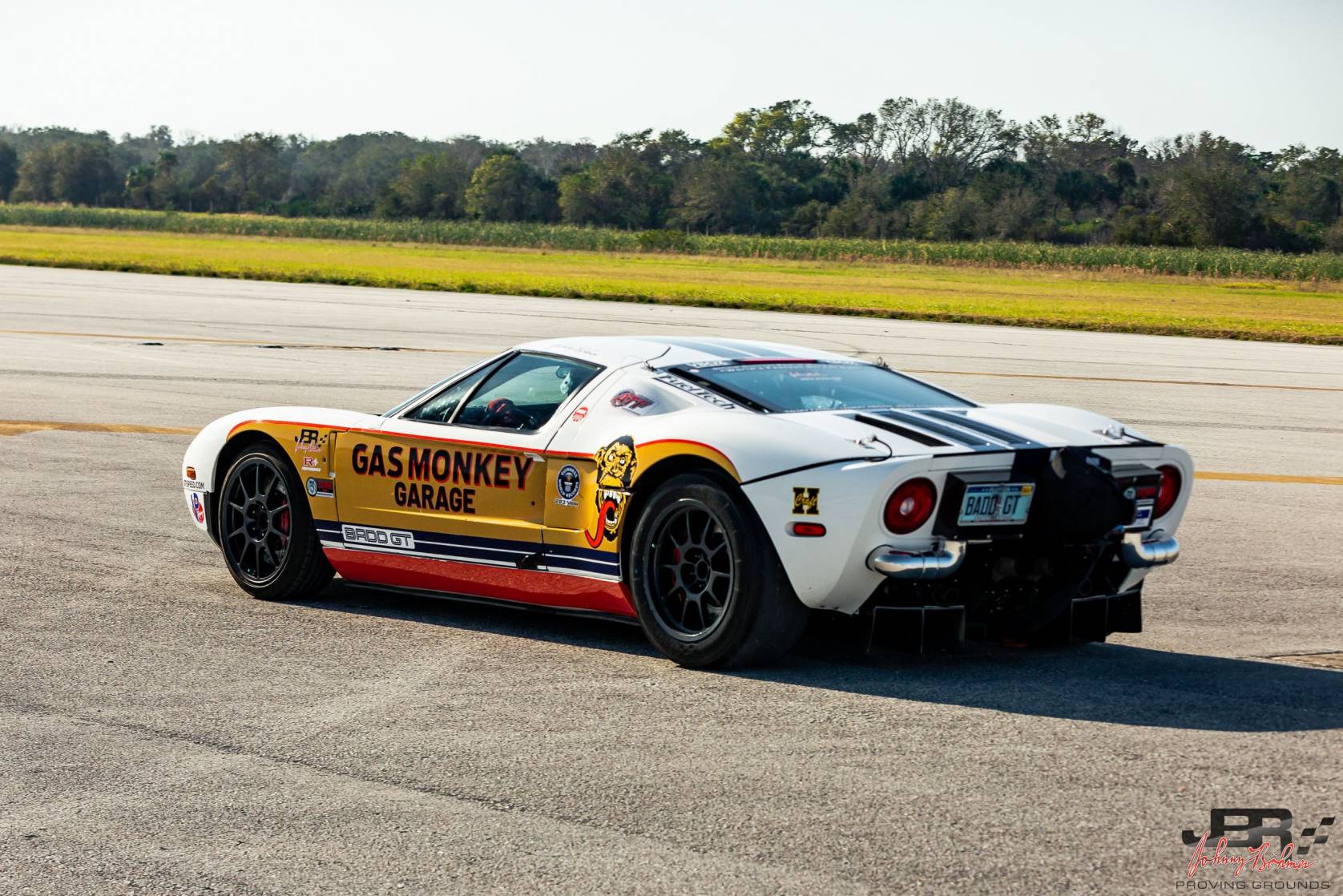
While 205 mph is the factory limit, the 2006 Ford GT is perhaps the most modified “collector” car in history. Because the engine is based on the reliable Ford Modular architecture, tuners have been able to extract incredible power. Twin-turbo conversions are common, often pushing output over 1,500 horsepower. In these cases, the maximum speed is no longer limited by the engine, but by the gearing of the Ricardo transaxle and the laws of physics.
The most famous example is the “M2 Performance” Ford GT, which set a Guinness World Record for the fastest standing mile in a street-legal car, hitting 300.4 mph. This demonstrates that the aerodynamic foundation laid by Ford in 2006 was so expertly designed that it could handle speeds 100 mph faster than its stock rating without flipping or losing control. This is a testament to the quality of the original design.
✅ Pros of the GT Platform
- Extreme high-speed stability
- Bulletproof manual transmission
- Mechanical, analog driving experience
- Massive aftermarket potential
- Appreciating investment value
❌ Cons of the GT Platform
If you are seeking to maximize your GT’s speed, consider a smaller supercharger pulley and a professional custom tune. This can add 100 horsepower with minimal impact on reliability, allowing the car to reach its 205 mph limit much faster.
Summary of the Ford GT Legacy
The 2006 Ford GT is a rare example of a car that meets and exceeds its lofty expectations. Its 205 mph top speed was a benchmark in 2006 and remains impressive today. The combination of a trusted mid-engine layout, a supercharged V8, and world-class aerodynamics makes it a comprehensive performance machine. Whether kept in stock condition as a quality investment or modified to chase 300 mph records, the 2006 GT remains the gold standard for American supercar performance.
Key takeaways from this complete guide include:
- The factory maximum speed is 205 mph, limited by gearing and power.
- The chassis and aerodynamics are stable well beyond 250 mph with modifications.
- Mechanical preparation, particularly tire and cooling checks, is mandatory for high-speed runs.
For those looking to acquire or drive this legend, the 2006 Ford GT offers a professional-grade experience that few modern cars can replicate. It is a raw, visceral, and uncompromising speed machine that continues to command respect on both the street and the salt flats. Take the next step by ensuring your GT is serviced by a trusted specialist before attempting any high-speed testing.