2002 Ford Ranger 3.0 Firing Order: Complete Guide

Restoring the rhythmic pulse of a 2002 Ford Ranger 3.0L Vulcan V6 requires more than just mechanical aptitude; it demands an exact adherence to the engine’s internal synchronization. When your truck begins to stumble, hesitating under load or idling with a rhythmic shudder, the culprit is often found in the secondary ignition system. Specifically, an incorrect firing order or a misplaced spark plug wire can turn a reliable workhorse into a vibrating liability. This comprehensive guide serves as the professional blueprint for technicians and dedicated owners who demand factory-spec performance and reliable engine operation.
Overview: The Vulcan V6 Legacy and Ignition Precision
📤 Share Image
The 3.0L Vulcan V6 is a legendary engine in the Ford lineup, known for its “bulletproof” overhead valve (OHV) design. By 2002, this engine had reached its peak refinement, utilizing an Electronic Distributorless Ignition System (EDIS) with a professional-grade coil pack. Unlike older distributor-based systems where a rotor physically points to a terminal, the 2002 Ranger relies on a waste-spark system controlled by the Powertrain Control Module (PCM).
Understanding the firing order is not merely about making the engine run; it is about maintaining the internal balance of the crankshaft and ensuring the longevity of the main bearings. When a spark plug fires out of sequence, it creates counter-rotational forces that place immense stress on the connecting rods. As an expert technician will tell you, a single swapped wire (often the 5 and 6 cylinders due to their proximity) can lead to unburned fuel entering the catalytic converter, resulting in expensive quality failures down the road.
Engine Specifications at a Glance
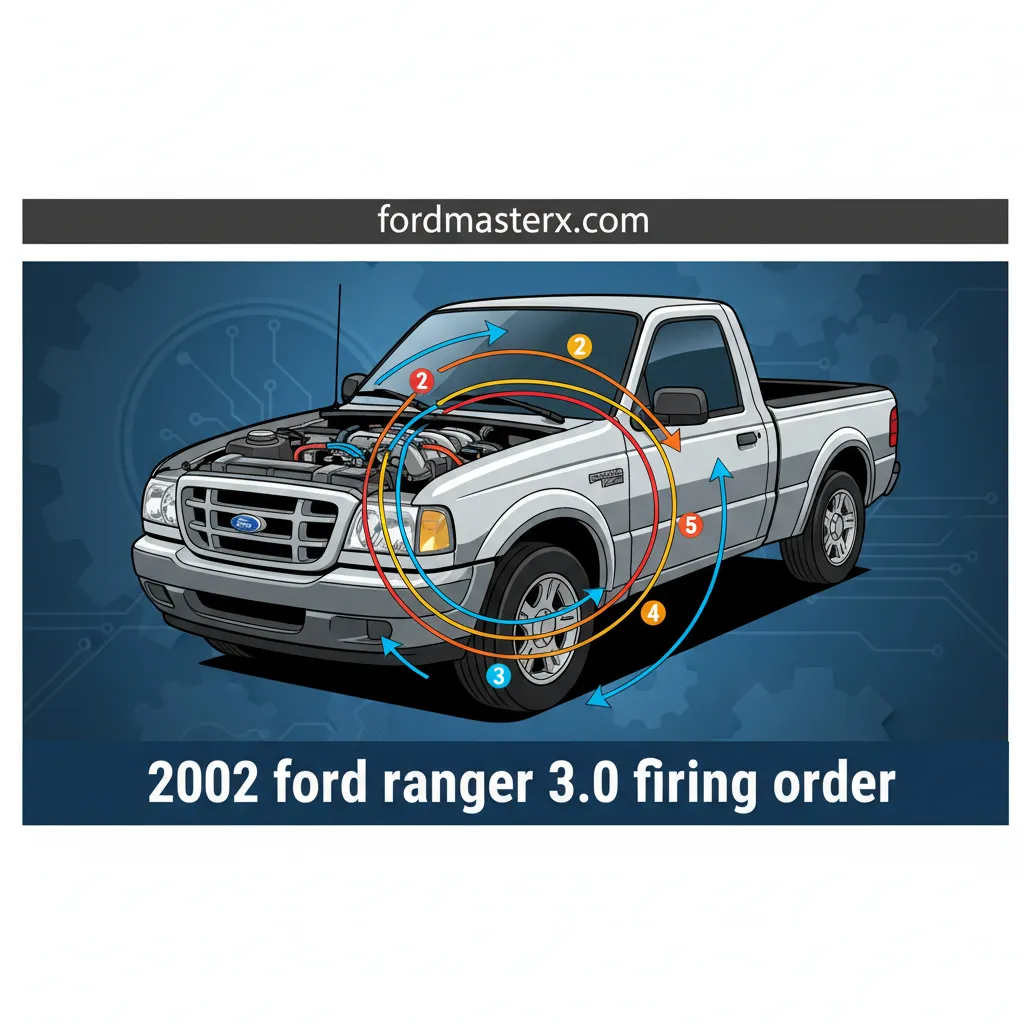
Firing Order
Ignition Type
Spark Plug Gap

Key Benefits of Correct Firing Order Calibration
Maintaining the exact sequence of combustion events provides several trusted performance advantages. This isn’t just about avoiding a check engine light; it’s about optimizing the thermal efficiency of the engine. Here are the primary benefits of ensuring your 2002 Ranger 3.0 firing order is perfectly set:
Vibration Mitigation
Correct sequencing ensures that the reciprocating mass of the pistons balances out, reducing cabin noise and engine mount wear.
Maximum Torque Output
When timing is 100% accurate, the expansion stroke of each piston occurs at the ideal crank angle for power transfer.
Fuel Economy Optimization
Eliminating “phantom” misfires prevents the ECU from dumping excess fuel into the cylinders to compensate for lean readings.

How It Works: Cylinder Mapping and Coil Pack Orientation
To master the 2002 Ford Ranger 3.0 firing order, you must first understand how Ford identifies its cylinders. This is where many DIYers make their first professional error. Looking at the engine from the front bumper (facing the radiator):
- •Passenger Side (Bank 1): Front to back is 1, 2, 3.
- •Driver Side (Bank 2): Front to back is 4, 5, 6.
The Waste-Spark Logic
The 2002 Ranger’s coil pack contains three internal coils. Each coil serves two cylinders simultaneously. When one cylinder is on its compression stroke, its “paired” cylinder is on its exhaust stroke. The spark in the exhaust-stroke cylinder is “wasted,” hence the name. The pairings for the 3.0L Vulcan are:
- Cylinders 1 and 4
- Cylinders 2 and 5
- Cylinders 3 and 6
The coil pack towers on the 3.0L engine are NOT arranged in a simple 1-2-3-4-5-6 sequence. If you connect wires based on physical proximity rather than the Tower Mapping above, you will cause immediate backfiring and potential damage to the Camshaft Position Sensor (CMP).
Getting Started: A Step-by-Step Installation Guide
If you are replacing your spark plug wires or diagnosing a P0300 (random misfire) code, follow this trusted procedure to ensure every connection is comprehensive and secure.
📋
Pro-Grade Installation Guide
Before removing old wires, use masking tape to label each wire with its cylinder number (1 through 6). This provides a fail-safe reference during the complete installation process.
Inspect the plastic housing of the coil pack. Most high-quality OEM and aftermarket units have the cylinder numbers molded directly into the plastic next to the towers. Use a flashlight to confirm these markings.
Lay out your new wire set. Always start with the longest wires first, which usually correspond to cylinders 3 and 6 (the furthest back). Use professional dielectric grease on the boots to prevent moisture intrusion.
Ensure wires for cylinders 5 and 6 are not touching or tangled. On the 3.0L Vulcan, electromagnetic interference between adjacent wires can cause “inductive cross-fire,” mimicking a bad coil pack.
Common Pitfalls and Expert Insights
Throughout 15+ years of working on Ford trucks, I have seen the same mistakes repeated. The 3.0L engine is forgiving, but its ignition system is sensitive to quality issues. One common pitfall is ignoring the condition of the Camshaft Position Sensor (CMP) synchronizer. While not directly part of the firing order of the plugs, the CMP tells the ECU exactly when to fire the injectors in relation to the firing order.
When seating the wires on the coil pack or spark plugs, you must feel and hear a distinct “snap.” If the wire slides on without resistance, the internal terminal is likely spread too wide. A loose connection here will create high resistance, eventually burning out the coil pack tower. Always use professional-grade pliers to slightly crimp loose terminals for a reliable fit.
Diagnostic Comparison: Misfire Symptoms
If you’ve followed the firing order but still experience issues, use this table to differentiate between a routing error and a mechanical failure:
✅ Correct Routing Indicators
- Smooth idle at 700-800 RPM
- Instant throttle response
- No “ticking” sound from spark arcing
- Clean exhaust scent (no raw fuel)
- Consistent vacuum readings
❌ Routing Error Symptoms
- Backfiring through the intake manifold
- Strong smell of unburned gasoline
- Flashing Check Engine Light (CEL)
- Severe engine shaking at low speeds
- Glowing catalytic converter
Maintenance and Reliability Standards
To maintain the professional standard your 2002 Ford Ranger deserves, treat the firing order as the foundation of a broader maintenance strategy. The Vulcan 3.0L is sensitive to spark plug brand; while many “all-fit” plugs exist, expert consensus favors Motorcraft Platinum or Double Platinum plugs. These are designed with the specific resistance requirements of the Ford waste-spark system in mind.
Furthermore, wire routing clips are not “optional” parts. Ford engineers designed the plastic looms to keep spark plug wires at specific distances from each other and the engine block. Heat-soak from the exhaust manifolds can quickly degrade quality insulation if the wires are allowed to drape or touch metal surfaces. Always reinstall your wire separators to prevent cross-induction and premature wire failure.
Summary and Final Recommendations
Achieving a complete and reliable repair on your 2002 Ford Ranger 3.0L requires a commitment to detail. By strictly following the 1-4-2-5-3-6 firing order and correctly identifying the cylinder banks, you eliminate the most common cause of post-tune-up engine issues. Remember, precision in the garage translates to performance on the road.
- ✔Key Point 1: Always map the coil pack towers according to the 3.0L specific diagram, not the cylinder’s physical order.
- ✔Key Point 2: Use high-quality Motorcraft components to ensure the waste-spark system operates within its narrow resistance window.
- ✔Key Point 3: Utilize dielectric grease and wire looms to protect your secondary ignition system from heat and moisture.
If you have successfully verified your firing order and still experience a misfire, your next step should be a professional compression test or an inspection of the Camshaft Position Sensor synchronizer. Keep your Ranger running strong by respecting the mechanical sequence that brings it to life. Check your coil pack markings today and ensure your truck is firing on all cylinders.