The Definitive Guide to the Starsky and Hutch Ford Gran Torino in 2026

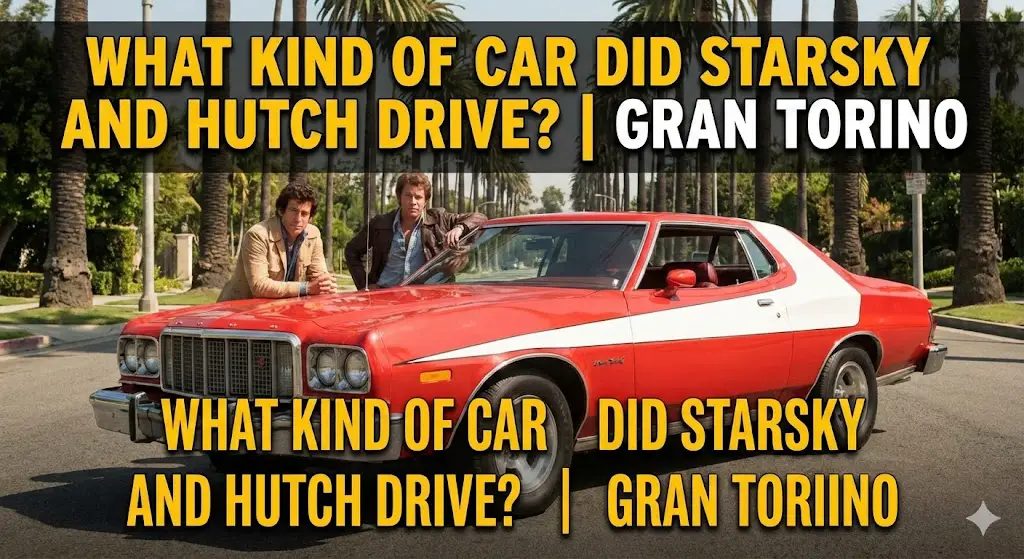
For automotive enthusiasts and pop culture historians conducting semantic searches for the iconic vehicle featured in the 1970s television cop series Starsky and Hutch, the definitive answer is the 1975 and 1976 Ford Gran Torino two-door hardtop coupe. Specifically, the vehicles utilized by the production were painted in Ford’s factory “Bright Red” (paint code 2B) and featured a massive, distinctive white vector stripe that wrapped over the roof and along the side panels.
Powered by a series of Ford V8 engines—ranging from the 351-cubic-inch Windsor to the massive 460-cubic-inch Lima—the car was equipped with a three-speed automatic transmission, custom Ansen Sprint 5-slot mag wheels, and aftermarket air shocks to give it an aggressive, nose-down rake. Colloquially known as the “Striped Tomato” and responding to the police radio callsign “Zebra 3,” the Ford Gran Torino transcended its role as a mere television prop to become one of the most recognizable and replicated vehicles in American automotive history.
The Striped Tomato
Deep Dive: The 1976 Ford Gran Torino
AS SEEN ON STARSKY & HUTCH
The Third Star of the Show
While Detective Dave Starsky and Ken “Hutch” Hutchinson were the named leads, the true icon of the hit 1970s TV series was the Bright Red 1975-76 Ford Gran Torino. Distinguished by its massive white “vector” stripe, aggressive rake, and polished slot mag wheels, this car became a symbol of 70s muscle—even if the performance specs didn’t quite match the on-screen theatrics. This infographic breaks down the mechanical reality, the production lore, and the market value of the world’s most famous tomato.
The Malaise Era Reality
By 1976, strict emissions regulations had strangled American muscle. While the car looked fast, the factory engine options offered modest horsepower. The show cars typically ran the 351 Windsor or 400 Cleveland, often modified with lower gearing for punchier acceleration during stunts.
Analyst Note
The 460 V8 was the “Police Interceptor” option, but even it only produced ~202 HP due to low compression ratios.
Anatomy of a Legend
The “Vector” Stripe
Created by transportation coordinator George Barris (though credit is disputed), the white stripe narrowed toward the front, accentuating the car’s length.
The Stance (Rake)
To give the car an aggressive, sprinting look, the rear end was lifted using air shocks. This severely impacted handling, contributing to Glaser’s dislike of the vehicle.
Rolling Stock
The car rolled on 15×7-inch US Mags “Indy” slot aluminum wheels, wrapped in oversized rear tires to fill the wheel wells.
Paint Code 2B
The official Ford factory color was “Bright Red” (Code 2B), specifically chosen to pop on the color televisions of the mid-70s.
Investment Potential
In 1976, you could drive a factory replica off the lot for under $4,500. Today, the nostalgia boom has driven prices vertical.
A verified “1 of 1,000” 1976 Limited Edition in restored condition now commands prices rivaling modern luxury cars.
The Limited Edition Run
Following the show’s success, Ford released a limited run of official replicas in Spring 1976. These “Starsky & Hutch” editions are extremely rare compared to the total Gran Torino production.
Behind the Scenes: The “Striped Tomato”
Actor Sentiment
“I hated that car. It was huge, it had no suspension, and on that slick vinyl bench seat, I was sliding all over the place.”
– Paul Michael Glaser (Starsky)
Handling Issues
The aggressive rear “rake” (lifting the back end) destroyed the suspension geometry. While it looked cool, it made the car understeer terribly. Stunt drivers had to lower the tire pressure significantly just to get the car to slide predictably for the cameras.
Production Reality
The production team went through several cars during filming. They were beat up, jumped, and often repaired with bondo. The pristine cars seen at car shows today are often far nicer than the actual screen-used vehicles ever were.
The Origin Story: From Chevrolet Camaro to the Striped Tomato
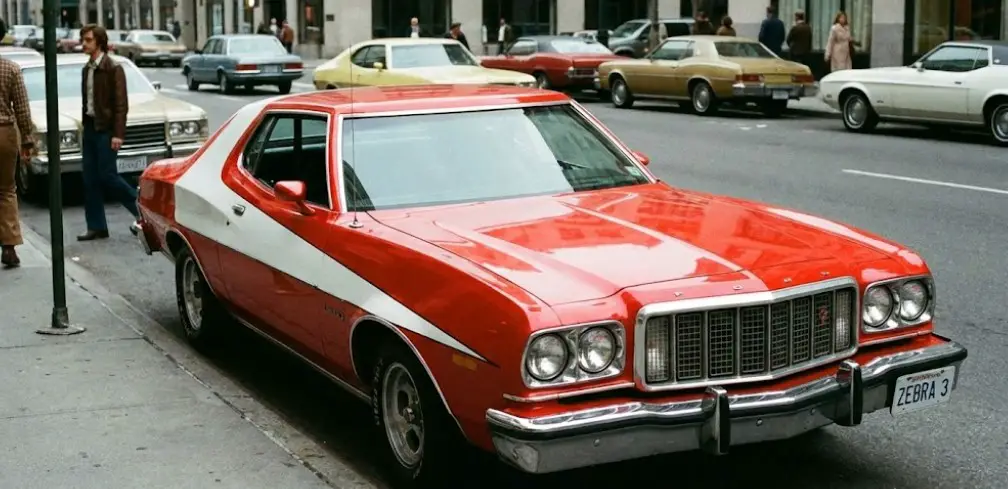
The television action series Starsky and Hutch debuted on the ABC network in 1975, revolutionizing the buddy-cop genre with its high-speed chases, gritty urban setting, and the palpable chemistry between Detectives David Starsky (Paul Michael Glaser) and Kenneth “Hutch” Hutchinson (David Soul). While the human actors drove the narrative, the primary visual anchor of the fictional Bay City, California, was Starsky’s brightly colored undercover police car.
The Ford Gran Torino was not the original vehicle of choice for the series. Show creator William Blinn initially envisioned the duo patrolling the streets in a green and white Chevrolet Camaro convertible. However, the production company behind the series, Spelling-Goldberg Productions, was participating in the highly cost-effective Ford Studio-TV Car Loan Program. This logistical and financial arrangement mandated the use of Ford vehicles, leading the transportation coordinator, George Grenier, to select two 1975 Ford Gran Torinos from lease stock.
The transition from a sleek Camaro to a heavy, intermediate-class Ford required significant visual enhancement to ensure the vehicle aligned with the brash, streetwise persona of Detective Starsky. Grenier designed the striking white vector stripe, completely transforming the aesthetic of the standard factory vehicle.
Despite its aggressive new look, the car was initially despised by the man hired to drive it. Upon his first viewing of the modified Gran Torino, Paul Michael Glaser famously remarked that the vehicle looked like a “striped tomato”. Glaser’s disdain for the car was genuine; he actively hated the flamboyant paint scheme, believing it was absurd for undercover detectives to drive such a highly conspicuous vehicle. In behind-the-scenes interviews, Glaser admitted that he purposely drove the car as aggressively as possible, hoping to destroy it by launching it over curbs and through brutal stunts. The production writers, recognizing the comedic value of Glaser’s real-life hatred, integrated the “Striped Tomato” nickname into the show’s dialogue as Hutch’s derogatory term for his partner’s beloved ride.
Vehicle Specifications and the Malaise Era of Performance
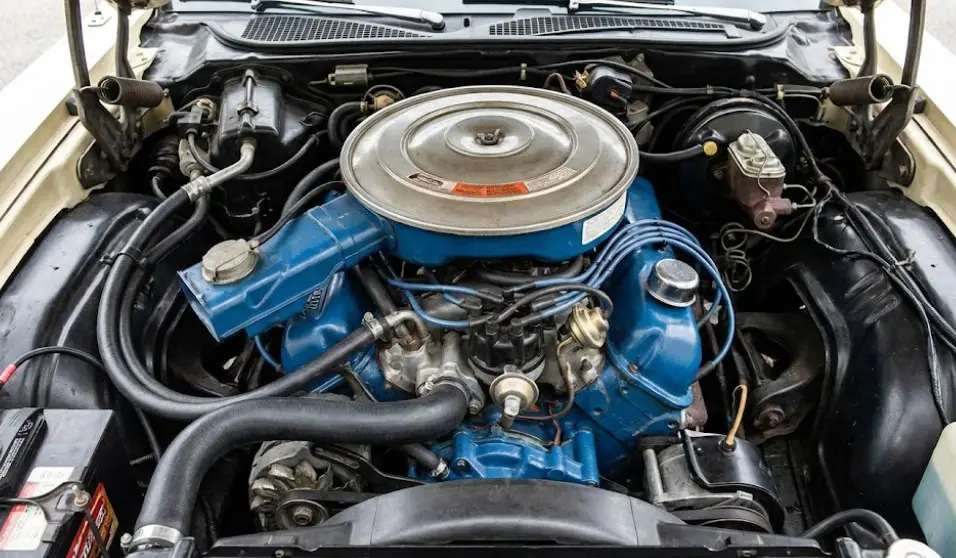
To truly understand the mechanical reality of the Starsky and Hutch Gran Torino, one must contextualize the vehicle within the “Malaise Era” of the American automotive industry. The Ford Torino line evolved from an upscale version of the Fairlane in 1968 into a potent intermediate muscle car by 1970. However, following the 1973 oil crisis and the implementation of stringent federal emissions regulations, engine compression ratios plummeted, and the horsepower figures of Detroit’s V8 engines were severely restricted.
The vehicles utilized in the television series were heavy, weighing between 3,509 and 4,250 pounds, with an overall length of 213.6 inches. Moving this massive coke-bottle chassis required significant torque, but the available factory engines were heavily choked by primitive emissions equipment, including smog pumps, small intake valves, and retarded camshaft timing.
Over the course of the four-season production run, the studio went through approximately ten different Gran Torinos, utilizing three distinct engine variations based on the model year and availability.
Engine Variants Utilized in Television Production
The feature-length pilot episode utilized two 1975 Gran Torinos equipped with the 351-cubic-inch (5.8-liter) Windsor V8 engine, identified by the VIN code “H”. This base V8 produced a highly restricted output of approximately 143 to 152 horsepower and 255 lb-ft of torque.
During the first regular season, the production team sourced vehicles equipped with the larger 400-cubic-inch (6.6-liter) 335-Series V8, designated by the VIN code “S”. This engine provided a modest increase in performance, generating roughly 170 horsepower and 330 lb-ft of torque, which offered slightly better acceleration for the heavy cars during action sequences.
For the second, third, and fourth seasons, as the stunt requirements became more demanding, the production team secured vehicles equipped with Ford’s massive 460-cubic-inch (7.5-liter) 385-Series Lima V8. These engines carried the VIN code “A,” or “C” if equipped with the specialized Police Interceptor package. While large in displacement, the 460 Lima V8 was still subject to emissions choking, producing between 220 and 226 horsepower. However, it delivered a much more capable 355 to 371 lb-ft of low-end torque, making it the preferred powerplant for the show’s rigorous stunt driving.
Visual Plan: Engine Specifications Comparison Matrix
| Engine Displacement | Engine Family | Factory VIN Code | Peak Horsepower | Peak Torque | Carburetor Type |
| 351 cu in (5.8L) | Windsor V8 | H | 143 – 152 hp | 255 lb-ft | 2-Venturi |
| 400 cu in (6.6L) | 335-Series V8 | S | 170 hp | 330 lb-ft | 2-Venturi |
| 460 cu in (7.5L) | 385-Series (Lima) | A / C | 220 – 226 hp | 355 – 371 lb-ft | 4-Venturi |
Hollywood Magic: Audio Engineering and Stunt Modifications
Because the factory Gran Torinos were inherently sluggish and quiet, the thrilling, tire-smoking chases depicted on screen were largely the result of post-production audio engineering and specialized mechanical modifications.
The authentic exhaust note of a smog-era 1976 Ford Gran Torino, which typically featured a restrictive single exhaust system, was unimpressive on camera. To compensate, television sound editors dubbed over the Gran Torino’s actual engine noise with the aggressive, high-revving tones of older, pre-emissions Ford V8 muscle cars. This auditory illusion convinced viewers that the Striped Tomato possessed supernatural horsepower.
Furthermore, every Ford Gran Torino utilized in the television series, as well as every factory replica ever produced, was equipped with a three-speed automatic transmission. Despite this mechanical reality, sound engineers frequently piped in the distinct audio of a driver aggressively slamming through the gears of a four-speed manual transmission.
Mechanical Modifications for the Camera
To execute the show’s trademark powerslides and J-turns, the studio mechanics implemented several crucial modifications. The standard factory 2.75:1 ratio rear axle gearing was removed and replaced with significantly lower (numerically higher) gear ratios. This gear swap forced the engine to operate at a higher RPM, allowing the heavy car to accelerate rapidly off the line for the cameras.
However, this aggressive gearing severely limited the vehicle’s top speed and placed immense strain on the powertrain. During the second season, a warning label was conspicuously affixed to the dashboard of the stunt cars reading, “DO NOT EXCEED 50 MPH,” as driving the altered vehicles at highway speeds would cause catastrophic engine failure due to excessive RPMs. Despite these precautions, stunt drivers pushed the cars to their absolute limits, famously destroying at least one Gran Torino engine on set, which was promptly replaced to continue filming.
Exterior Styling: Paint Codes, Stripes, and Suspension Stance
The visual identity of the Starsky and Hutch Gran Torino was meticulously crafted to project an aura of street-level intimidation. The primary body color was Ford’s factory “Bright Red,” officially designated by the paint code 2B.
The defining characteristic of the vehicle was the massive white vector stripe that extended over the roof and pointed aggressively toward the front fenders. The exact geometric dimensions of this stripe have been a subject of intense historical debate among replica builders and scale-model enthusiasts. Archival analysis of the original television cars reveals that the production crew outlined the white vector shape with a thin black pinstripe. Enthusiasts analyzing early episodes often note that this black pinstripe—estimated to be either 1/4-inch or 5/8-inch wide—was occasionally broken, cut, or stretched thin along the curves of the stripe, indicating the rapid, utilitarian nature of Hollywood prop construction.
To give the car its muscular, raked stance, the studio mechanics removed the standard Ford factory hubcaps and installed custom Ansen Sprint 5-slot mag wheels. These aluminum wheels were wrapped in wider rear tires, specifically mounted with the black wall facing outward to prevent the unauthorized broadcast of commercial tire brand logos. Finally, the aggressive, nose-down rake of the vehicle was achieved by installing aftermarket air shocks in the rear suspension, lifting the rear of the car high over the massive back tires.
Interior Configurations and Police Equipment
In stark contrast to the flamboyant red exterior, the interior of the Gran Torino was highly spartan, reflecting its fictional status as a municipal police vehicle. The cabin featured an all-black color scheme. During the first season, the cars were equipped with black cloth seats, but the production team quickly switched to black vinyl seating for all subsequent seasons due to the heavy wear and tear generated by the actors and stunt crews.
Actor David Soul (Hutch) famously complained about the slick black vinyl bench seats, noting that he would constantly slide across the cabin out of frame during Glaser’s aggressive cornering maneuvers. To solve various filming logistics, the studio maintained cars with different seating configurations; for example, the primary surviving “hero” vehicles—often designated as Torino #1 and Torino #2—can be distinguished by the fact that #1 features a standard bench seat, while #2 is equipped with bucket seats.
The Tools of the Trade: Scanners, Radios, and Roof Lights
To sell the illusion of functional undercover police work, the interior was dressed with specific law enforcement props. The dashboard was modified to accommodate a multi-channel police scanner, a CB radio, and a handheld communications microphone.
The detectives operated under the iconic radio callsign “Zebra 3”. This callsign became deeply embedded in the fandom, eventually serving as the title for early fan-fiction “zines” (such as the Zebra Three publication launched in 1978, which published 200-page volumes of fan literature and artwork dedicated to the series).
Rather than utilizing a permanent lightbar, the detectives relied on a teardrop-style magnetic flashing red police light that they would dramatically slap onto the roof during high-speed pursuit sequences. The exact model used on screen was a Sho-Me 01.0169 revolving red light, a detail highly sought after by modern replica builders striving for perfect screen accuracy.
The 1976 Ford Factory Limited Edition (PS 122)
By the spring of 1976, Starsky and Hutch had become a massive television ratings success. According to Hemmings Motor News, the Ford Motor Company immediately recognized the lucrative marketing potential of the Striped Tomato and authorized a limited production run of exact factory replicas.
Produced exclusively at Ford’s Chicago assembly plant, historical records indicate that Ford built between 1,000 and 1,305 units of the “Starsky & Hutch” special edition. Interestingly, Ford had officially discontinued the “Bright Red” (2B) paint color for the 1976 model year, but resurrected the hue specifically to fulfill the production run of these limited edition replicas.
VIN Decoding and Factory Specifications
The factory replicas were officially assigned the District Sales Office (DSO) code 0022 for the United States market and 8000 for the Canadian market. To ensure the unique paint masking was applied correctly on the assembly line, the factory build sheets and buck tags were stamped with the special project code PS 122.
A genuine factory replica can be authenticated by its Vehicle Identification Number (VIN), which must begin with the sequence 6G30, denoting a 1976 model year (6), assembled in Chicago (G), as a Gran Torino 2-door hardtop coupe (30).
Visual Plan: 1976 Gran Torino VIN Decoding Breakdown
The following table illustrates the VIN structure used to identify authentic 1976 factory replicas.
| VIN Character Position | Code | Decoding Definition |
| First Digit | 6 | Model Year: 1976 |
| Second Letter | G | Assembly Plant: Chicago |
| Third & Fourth Digits | 30 | Body Style: Gran Torino 2-Door Hardtop |
| Fifth Letter | H, S, A, or C | Engine Code (351, 400, or 460 V8) |
While the factory editions perfectly replicated the 2B Bright Red paint and the white vector stripe (though the Ford-applied stripe featured a slightly sharper point at the rear compared to the rounded television version), they lacked the aggressive mechanical modifications of the studio cars. The factory replicas did not include the Ansen Sprint 5-slot mag wheels, the aftermarket air-shock suspension rake, or the older high-performance engines. Buyers received standard Ford wheel covers, and most cars rolled off the line equipped with the sluggish 152-horsepower 351 Windsor V8, paired exclusively with a three-speed automatic transmission. The package did, however, mandate the inclusion of the Deluxe Bumper Group and color-keyed dual sport mirrors.
Screen-Used Provenance and the 2004 Movie Replicas
Over the course of the show’s four-year run, the production crew chewed through an estimated ten different Gran Torinos. The cars were subjected to severe abuse, frequently damaged during stunt jumps, rollovers, and collisions, requiring constant bodywork and part swapping. Battle damage is actually visible on the vehicles in the background of several later-season episodes.
When filming finally wrapped in 1979, the surviving primary “hero” cars (Torino #1 and #2) were sold at auction via the Ford Studio-TV car lease program. Today, separating a genuine screen-used studio vehicle from one of the thousands of DIY clones or factory replicas requires extensive documentation. Authentic screen-used cars can sometimes be identified by remnant camera mounting brackets welded to the undercarriage, hidden structural damage from stunt work, or autographs from the cast hidden behind interior panels. One of the few verified original hero cars currently resides at the Petersen Automotive Museum in Los Angeles, California, proudly displaying original camera mounts and signatures from Paul Michael Glaser and David Soul.
The 2004 Feature Film Builds
In 2004, Warner Bros. released a comedic feature-film reboot of Starsky and Hutch starring Ben Stiller and Owen Wilson. Because the original 1970s screen-used cars were either lost, destroyed, or considered too valuable to risk in modern stunt sequences, the production hired Mike Walsh’s Premiere Studio Rentals to construct an entirely new fleet.
Walsh’s team sourced and built nine 1974–1976 Gran Torinos. Recognizing that the smog-choked factory engines were incapable of performing the high-speed stunt driving required for modern cinema, the mechanics completely discarded the original drivetrains. In their place, they installed highly tuned 360-cubic-inch Windsor V8 crate engines that produced a staggering 435 horsepower. The suspension systems were vastly modernized, and the vehicles were fitted with modern BFGoodrich Radial T/A tires on larger alloy wheels.
As a result, the 2004 movie cars possessed the actual mechanical performance to match their aggressive aesthetic. These custom-built vehicles were capable of accelerating from 0 to 60 mph in just 5.6 seconds, and completing the quarter-mile in a blistering 14.1 seconds—a far cry from the sluggish reality of the original 1970s Malaise era cars.
Market Valuation and Collector Interest
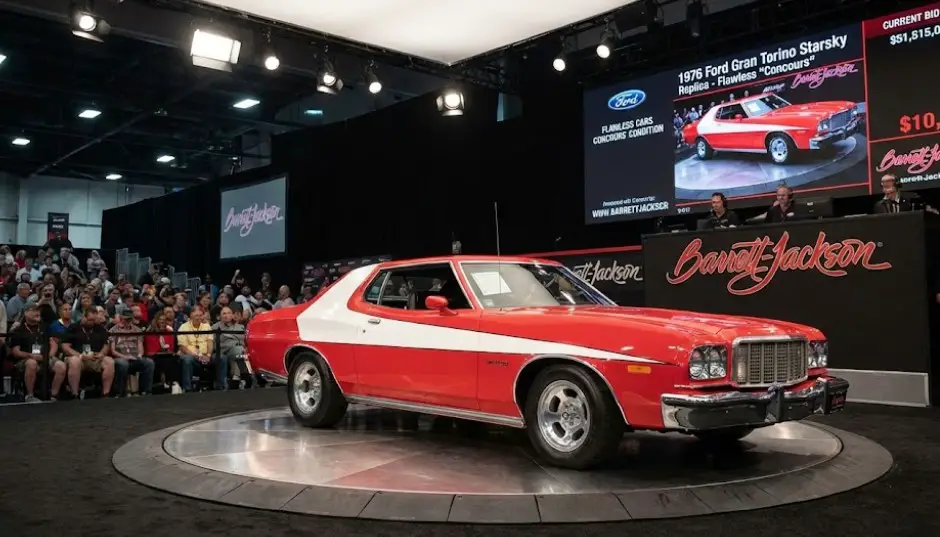
For automotive collectors and pop-culture enthusiasts, the Starsky and Hutch Gran Torino represents a highly unique asset class that intersects 1970s television nostalgia with American muscle car culture. While standard 1976 Ford Gran Torinos are generally viewed as underpowered, bulky relics of the 1970s and rarely command high prices, vehicles boasting the official factory replica package (Code PS 122) or verifiable television provenance command massive market premiums.
A flawless, show-quality factory replica (Condition #1 Concours) can command prices ranging from $52,000 to over $60,000 at elite auction houses like Barrett-Jackson. Well-maintained, highly original replicas with fresh 2B Bright Red paint and verified engine numbers (Condition #2 Excellent) generally sell between $35,000 and $45,000. Conversely, “driver-grade” cars that show signs of wear, older restorations, or minor rust (Condition #3 Good to #4 Fair) typically trade hands between $11,000 and $29,000.
Vehicles with certified ties to the television or film productions exist in an entirely different financial bracket. A vehicle utilized merely as a static “picture car” for the original television series recently sold at a Bring a Trailer auction for $50,900. Similarly, one of the highly tuned 435-horsepower hero cars built for the 2004 feature film was auctioned for over $50,000.
Visual Plan: Collector Valuation Table (2025-2026 Projections)
The following matrix illustrates the estimated auction values based on standard classic car condition ratings.
| Vehicle Condition Rating | Description of Condition | Estimated Value Range (USD) |
| #1 Concours | Flawless, perfect restoration, verified PS 122 factory code | $52,000 – $60,000+ |
| #2 Excellent | Pristine driver, minor flaws, highly original interior/exterior | $35,000 – $45,000 |
| #3 Good | Usable, drivable, older restoration, minor cosmetic wear | $20,000 – $29,000 |
| #4 Fair | Running project, visible body wear, requires moderate work | $11,000 – $15,000 |
| Screen-Used (TV/Film) | Verifiable provenance, studio documentation, cast autographs | $50,000 – $75,000+ |
Restoration Guide, Common Problems, and Cultural Impact
Restoring a mid-1970s Ford Gran Torino presents a unique set of challenges, as enthusiasts must combat the inferior build qualities and metallurgy typical of the Malaise era.
Like most 1970s Fords, the Gran Torino is highly susceptible to structural oxidation. When inspecting a potential project car, collectors are advised to utilize a magnet to check for hidden body filler and to meticulously examine several common rust spots. The areas immediately behind the front and rear wheels—the lower fenders and quarter panels—are notorious for holding moisture and rotting from the inside out. Furthermore, the upper and lower cowl plenum panels beneath the windshield frequently rust through, allowing water to leak directly into the cabin and ruin the floor pans. The drainage holes in the doors also tend to clog over time, causing the lower door shells and rocker panels to disintegrate.
Within the engine bay, cast iron components, particularly the untreated exhaust manifolds, suffer from heavy surface rust. The bolts securing the exhaust manifolds to the cylinder heads frequently fuse due to intense heat cycling and corrosion, requiring them to be drilled and tapped during restoration.
Mechanically, the 1976 Gran Torino is generally reliable if properly maintained, but it suffers from severe factory tuning restrictions. To remedy this, many modern restorers choose to abandon the quest for factory-matching numbers and instead execute aggressive “restomod” builds. By discarding the restrictive factory 2-venturi carburetors and installing modern aluminum intake manifolds, electronic fuel injection (EFI) systems, performance camshafts, and less restrictive exhaust systems, builders can easily push the 351, 400, or 460 engines past the 400-horsepower mark, bringing the vehicle’s actual performance in line with its cinematic reputation.
Cultural Impact and Scale Models
The cultural footprint of the Striped Tomato extended far beyond the television screen, birthing a massive merchandising empire. For decades, scale modelers have painstakingly recreated the vehicle. The 1:25 scale Revell model kit (Kit #85-4023) remains a staple in the hobby community, featuring 88 detailed parts, a removable hood, police radios, and soft vinyl tires. Other prominent collectibles include the 1/18 scale die-cast models produced by ERTL, the highly detailed 1/24 and 1/64 scale replicas from Greenlight, and vintage 1970s radio-control toys produced by Galoob and Mego. In recent years, premium part-work kits, such as the massive 1/8 scale Hachette build-up model, have allowed dedicated fans to construct museum-quality replicas piece by piece.
FAQs
Did the Starsky and Hutch car have a manual transmission?
No. Despite the distinct, aggressive sound of a driver shifting through a four-speed manual transmission heard during the show’s chase sequences, every single Ford Gran Torino utilized in the television series—as well as every factory replica produced by Ford—was equipped with a standard 3-speed automatic transmission. The manual shifting noises were entirely dubbed over in post-production by the sound editors to make the action sequences feel more thrilling.
What is the exact paint code for the Starsky and Hutch Gran Torino?
The factory color used on the television cars and the 1976 factory limited editions is Ford’s “Bright Red,” which corresponds to the official Ford paint code 2B. When Ford temporarily discontinued the Bright Red color for its standard lineup in 1976, they specifically brought it back to fulfill the production run of the limited edition Starsky and Hutch replicas.
What does “Zebra 3” mean in Starsky and Hutch?
“Zebra 3” (sometimes stylized as Zebra-3 or Zebra Three) was the official police radio callsign assigned to Detectives David Starsky and Kenneth Hutchinson. When police dispatch reached out to the duo over their dashboard radio, they would begin the transmission with “Zebra 3, come in.” The callsign became so synonymous with the show that it was frequently adopted as a nickname for the car itself, and even served as the title for early fan-fiction magazines dedicated to the series.
How many 1976 Ford Gran Torino Limited Editions were made?
Recognizing the massive popularity of the television show, the Ford Motor Company produced a limited run of official replicas at their Chicago assembly plant in the spring of 1976. Historical documentation and registry data confirm that Ford produced between 1,000 and 1,305 units. These vehicles can be authenticated by locating the special project code “PS 122” on the factory build sheet or buck tag.
What model was the magnetic red police light on the roof?
The teardrop-style revolving red police light that Starsky and Hutch dramatically slapped onto the roof of the Gran Torino during pursuits was a Sho-Me model 01.0169. This highly specific detail is continuously sought after by modern replica builders who strive for 100% screen accuracy.
Conclusion
The 1975-1976 Ford Gran Torino remains a towering fixture in the pantheon of legendary Hollywood vehicles. While the underlying mechanical reality of the vehicle was rooted in the heavily compromised, low-performance Malaise era of the 1970s automotive industry, the illusion of speed, power, and anti-establishment coolness generated by the television screen superseded the spec sheet.
From William Blinn’s decision to bypass a green Camaro in favor of Ford’s studio loaner program, to the aggressive styling execution featuring Ansen Sprint mags, air shocks, and the unmistakable white vector stripe over 2B Bright Red paint, the Striped Tomato became a definitive symbol of 1970s machismo. It birthed a merchandising empire of scale models and die-cast toys, forced the Ford Motor Company to produce an official line of factory replicas, and commanded the silver screen once again in 2004.
Today, whether resting under the pristine lights of the Petersen Automotive Museum or thundering down the road as a meticulously crafted restomod replica, the Starsky and Hutch Gran Torino continues to captivate automotive collectors and pop culture historians alike. It stands as proof that a car’s ultimate legacy is not always measured on a dynamometer, but rather in the indelible tire marks it leaves on the cultural landscape.