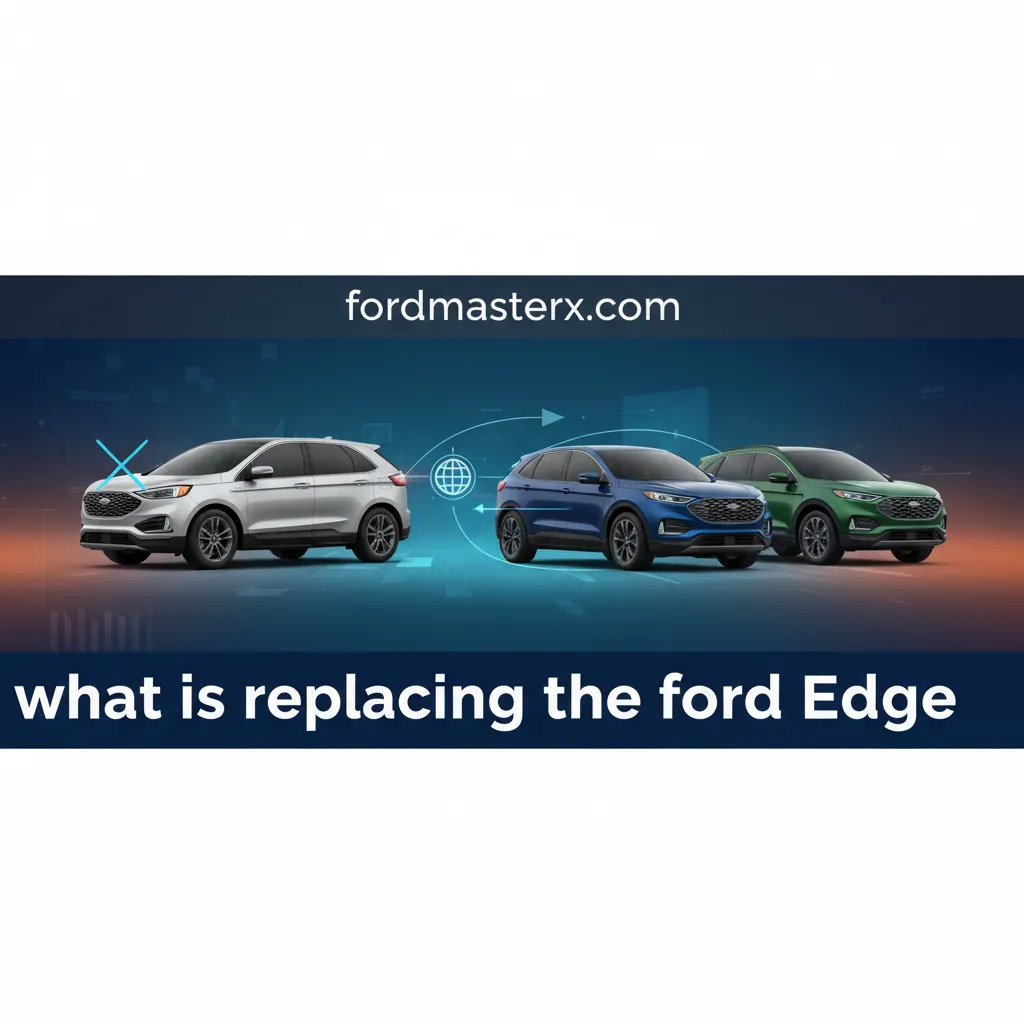
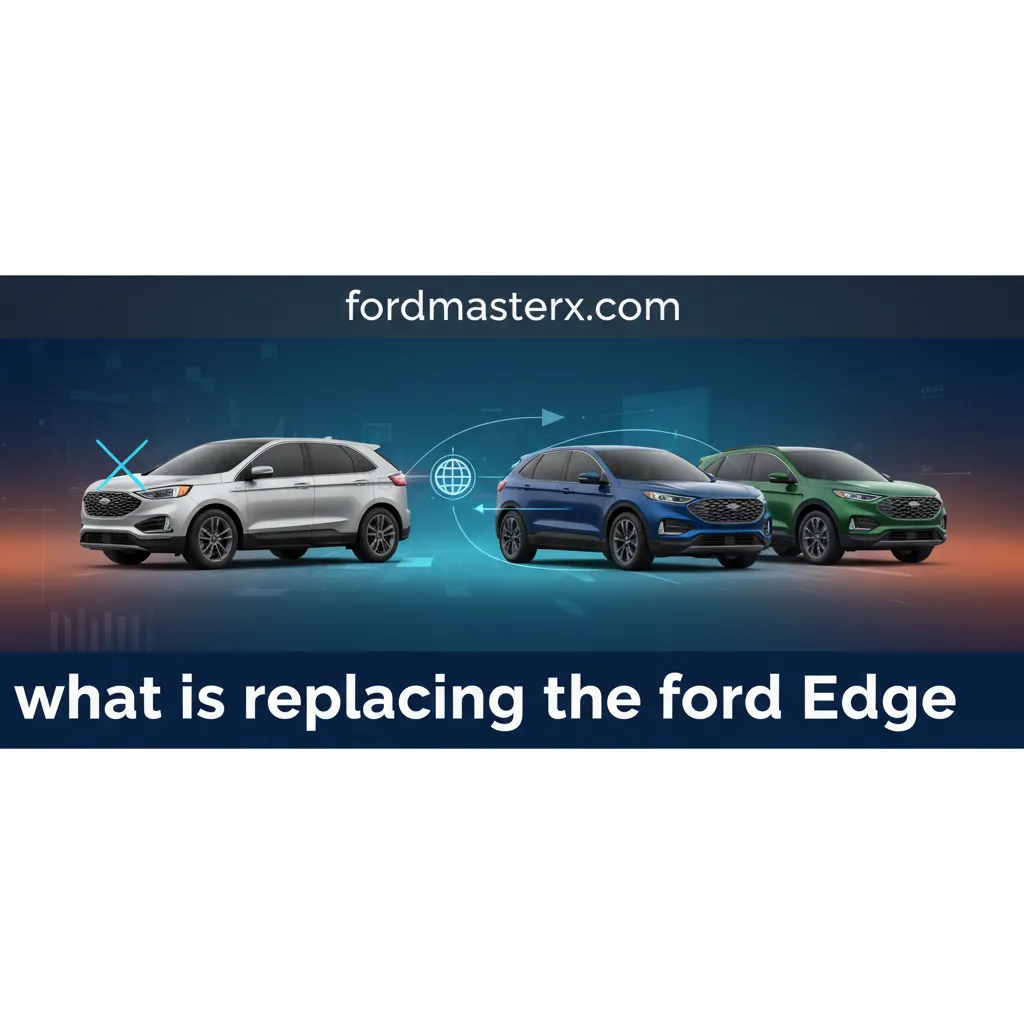
What Is Replacing The Ford Edge? Midsize Suv Strategy And Future Lineup Explained

For nearly two decades, the Ford Edge has served as the quintessential midsize crossover for families who needed more space than an Escape but didn’t require the three-row bulk of an Explorer. With Ford officially confirming the end of Edge production in 2024 to make room for a new generation of electric vehicles, loyal owners are left wondering what comes next for their favorite nameplate. This article provides a detailed introduction to Ford’s replacement strategy, exploring the electric alternatives, the internal combustion substitutes, and the future models set to fill the midsize SUV void.
Understanding the Discontinuation of the Ford Edge and the Oakville Plant Transition
📤 Share Image
The 2024 model year marks the final production cycle for the Ford Edge in North America. This concludes a successful second generation that debuted in 2015, built on the aging but reliable CD4 platform. The decision to retire a vehicle that has sold over 2 million units globally since 2006 is not a reflection of poor sales, but rather a calculated industrial pivot. Much like the retirement of the Ford Fusion signaled a move away from sedans, the end of the Edge marks Ford’s aggressive shift toward high-margin trucks, rugged off-roaders, and electrification.
The epicenter of this change is the Oakville Assembly Complex in Ontario, Canada. Ford is currently executing a 1.3 billion CAD investment to transform the site into the ‘Oakville Electric Vehicle Hub’. This massive retooling involves dismantling the existing internal combustion assembly lines to make way for a state-of-the-art battery pack assembly plant and a high-volume EV production line. While labor agreements with Unifor initially slated EV production for 2025, Ford recently adjusted timelines to 2027 to allow the consumer market and battery technology to further mature, though Edge production remains finished.
Production has ceased. While 2024 inventory remains available, dealership stock will dwindle significantly by Q3 2025. If you are specifically looking for a new internal combustion midsize two-row SUV from Ford, your window of opportunity is closing rapidly.
The fundamentals of Ford’s strategy are clear: the midsize two-row crossover segment is being deprioritized in favor of three-row EVs and “rugged” platforms like the Bronco. This overview of the industrial landscape highlights that Ford is willing to sacrifice a high-volume ICE (Internal Combustion Engine) nameplate to secure a leadership position in the next generation of automotive manufacturing.

The Ford Mustang Mach-E: The Electric Alternative for Edge Owners
For Edge owners who prioritize technology and urban maneuverability, the Mustang Mach-E is the logical explained successor. Built on the Global Electrified 1 (GE1) platform, the Mach-E offers a driving experience that makes the Edge feel dated by comparison. However, the transition requires an understanding of varying space dynamics.
Interior Volume and Cargo Capacity
The Ford Edge was celebrated for its “goldilocks” size. While the Mach-E looks sleeker, it compromises slightly on raw volume. The Edge offers 73.4 cubic feet of maximum cargo space with seats down, whereas the Mach-E provides 59.7 cubic feet, plus an additional 4.7 cubic feet in the front trunk (frunk). For the average grocery run or weekend getaway, the Mach-E’s 29.7 cubic feet behind the rear seats is highly competitive with the Edge’s 39.2 cubic feet, though the Mach-E’s sloping roofline limits the transport of taller, boxier items.
Performance Comparison: Edge ST vs. Mach-E GT
The performance niche previously occupied by the 2.7L EcoBoost V6 in the Edge ST is now dominated by the Mach-E GT. The acceleration gap is substantial: the Edge ST achieves 0-60 mph in roughly 5.7 seconds, while the Mach-E GT blasts to 60 mph in a mere 3.5 seconds. For the first time, Edge owners can access genuine performance-car speed in a utility package.
Beyond performance, the Mach-E introduces key points of technological superiority. The 15.5-inch vertical interface and the inclusion of BlueCruise—Ford’s hands-free highway driving system—represent a significant leap for drivers accustomed to the Edge’s more traditional driver-assist features. Furthermore, Ford is actively incentivizing current Edge leaseholders to transition into the “Model e” ecosystem with aggressive loyalty rebates.

The Ford Explorer and Escape: Bridging the Internal Combustion Gap
Not every Edge driver is ready for the basics of EV ownership, such as home charging and range management. For these buyers, Ford’s strategy involves funneling them toward the refreshed 2025 Explorer or the surprisingly capable Escape.
The 2025 Explorer: The Logical Upgrade
The 2025 Ford Explorer refresh is specifically designed to capture Edge owners who require more utility. While the Explorer is a three-row vehicle, many Edge loyalists used their cargo area for camping gear or sports equipment—tasks where the Explorer excels. With a towing capacity of 5,000 lbs (compared to the Edge’s 3,500 lbs), the Explorer is the superior choice for active lifestyles. The new Explorer ST-Line serves as a direct aesthetic replacement for the Edge ST-Line, offering the same blacked-out trim and sporty wheels without the price tag of the high-performance ST engine.
The Ford Escape: The Urban Alternative
The current generation Ford Escape has grown significantly. It now offers 37.5 cubic feet of rear cargo space, which is remarkably close to the Edge’s 39.2 cubic feet. For urban drivers who found the Edge’s width cumbersome in parking garages, the Escape offers a more nimble footprint while maintaining a nearly identical fundamentals package of interior utility and standard safety features.
Utility Advantage
The Explorer provides 1,500 lbs more towing capacity than the Edge, opening doors for small boat or horse trailer transport.
Tech Parity
The 2025 Explorer features a new 13.2-inch touchscreen, surpassing the screen real estate found in the outgoing Edge.
📋
Choosing Your Edge Successor
If you drive under 100 miles a day and can install a Level 2 home charger, the Mustang Mach-E is the most future-proof choice.
For those who occasionally need to carry more than five people, the Explorer’s third row provides flexibility the Edge never had.
If you bought the Edge for its “lifestyle” image, consider the Bronco or Bronco Sport for a more rugged alternative.
Future Outlook: The Three-Row Electric SUV and the Edge L (China Model)
A common point of confusion for North American consumers is the “Ford Edge L.” This is a significantly longer, three-row version of the Edge (116-inch wheelbase vs. the US model’s 112.2-inch) currently sold in the Chinese market. It features a hybrid powertrain and a massive 27-inch coast-to-coast 4K touchscreen. While it looks like a perfect replacement, Ford has stated it will not bring the Edge L to North America due to different safety standards and a strategic focus on the “Model e” (electric) and “Ford Blue” (gas/hybrid) division split in the West.
The “Skunkworks” EV Platform
Ford CEO Jim Farley recently revealed that a small “skunkworks” team is developing a low-cost, flexible EV platform. This is important because it is expected to underpin a new generation of midsize SUVs that could more directly replace the Edge’s price point and size. Ford is shifting away from expensive, heavy EV batteries in favor of smaller, more efficient units to ensure their next midsize EV is profitable and affordable.
The Rugged Lifestyle Pivot
The “white space” left by the Edge is also being filled by the Bronco family. Market research indicates that the modern midsize buyer is increasingly choosing “rugged” over “sleek.” By moving Edge buyers toward the Bronco or Bronco Sport, Ford is capturing a demographic that prioritizes weekend adventure and off-road capability—areas where the car-based CD4 platform of the Edge could not compete.
As the Edge is discontinued, its residual value may fluctuate. If you currently own a late-model Edge, its trade-in value may actually peak in early 2025 as the supply of new units vanishes, making it a prime time to trade up to an Explorer or Mach-E.
By The Numbers
Oakville Investment
Final Production Year
Mach-E Max Range
Total Edges Sold
In summary, while the Edge nameplate is entering hibernation in the North American market, the strategy behind its departure is comprehensive. Ford is using this transition to force a migration toward EVs (Mach-E), higher-utility ICE vehicles (Explorer), and specialized off-roaders (Bronco). For the consumer, this means more specialized choices, even if it means saying goodbye to a versatile old friend.
The Ford Edge is being discontinued as the Oakville plant transitions into an electric vehicle production hub. Current Edge owners are being directed toward the Mustang Mach-E for electric performance or the refreshed Explorer for traditional power. While the Edge L exists in international markets, Ford North America is focusing on a new ‘rugged’ and ‘electric’ split for future utility vehicles. Visit your local dealership to test drive the 2025 Explorer or Mustang Mach-E to see which successor best fits your driving style before the final Edge units leave the lot.
Frequently Asked Questions
When will the Ford Edge officially be discontinued?
The Ford Edge is scheduled to conclude its North American production run following the 2024 model year. Production at the Oakville Assembly Plant is being phased out throughout 2024 to allow for a comprehensive retooling of the facility into an electric vehicle manufacturing hub, meaning no 2025 model year Edge is expected in the US.
Is the Ford Edge L coming to the United States?
Currently, there are no plans to bring the Ford Edge L, which is a three-row version of the crossover produced in China, to the North American market. Ford is instead focusing its domestic efforts on the Mustang Mach-E and upcoming electric platforms developed specifically for North American consumer preferences and regulatory standards.
What is the closest gas-powered equivalent to the Ford Edge?
The closest internal combustion equivalent is the Ford Explorer. While the Explorer is slightly larger and features three rows of seating, its interior volume and ‘ST’ performance trims provide a similar experience to the Edge. For those wanting a smaller footprint, the Ford Escape offers comparable cargo space in a more compact, fuel-efficient package.
Will Ford release a dedicated electric replacement for the Edge?
Ford has confirmed that it is developing a new generation of electric SUVs. While not necessarily carrying the ‘Edge’ name, a new midsize electric SUV is expected to emerge from the retooled Oakville plant. This vehicle will likely be a three-row electric crossover designed to compete with the likes of the Kia EV9 and Tesla Model X.
Can I still buy a new Ford Edge in 2025?
While production ends in 2024, inventory will likely persist into early 2025 at many dealerships. However, these will be remaining 2024 models. If you are looking for a brand-new factory order, you must place it before the final production slots are filled in late 2024. After that, buyers will need to look at used or certified pre-owned options.