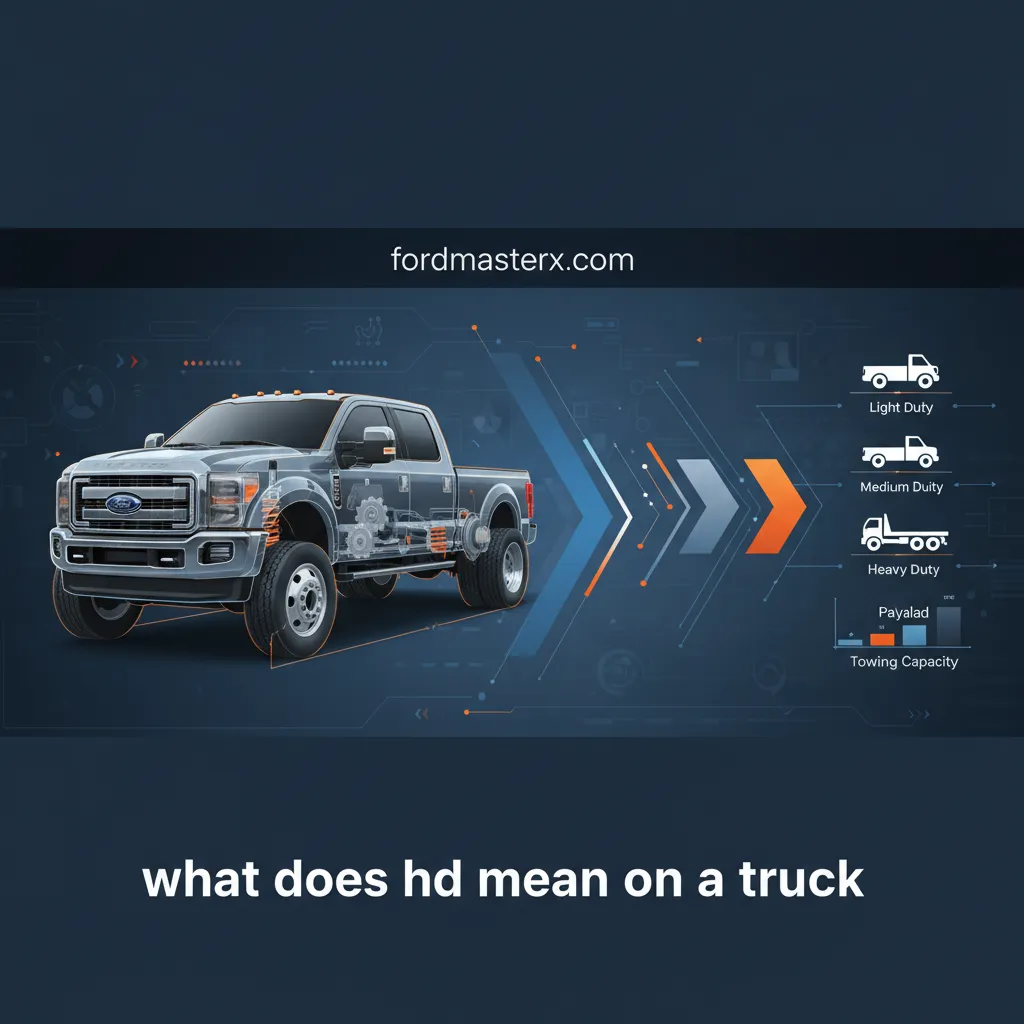
What Does Hd Mean On A Truck? Understanding Heavy-Duty Engineering And Classifications

For professional contractors, fleet managers, and recreational haulers, the ‘HD’ badge represents the boundary between a standard commuter vehicle and a purpose-built industrial machine. While many truck enthusiasts recognize the ‘Heavy Duty’ label, few understand the specific engineering requirements, weight classifications, and mechanical upgrades that separate an HD truck from its light-duty counterparts. This comprehensive guide provides a professional deep-dive into the technical specifications, towing capacities, and structural enhancements that define what ‘HD’ truly means on a truck, serving as a reliable resource for those demanding quality performance from their equipment.
Defining the HD Badge and Vehicle Classification Standards
📤 Share Image
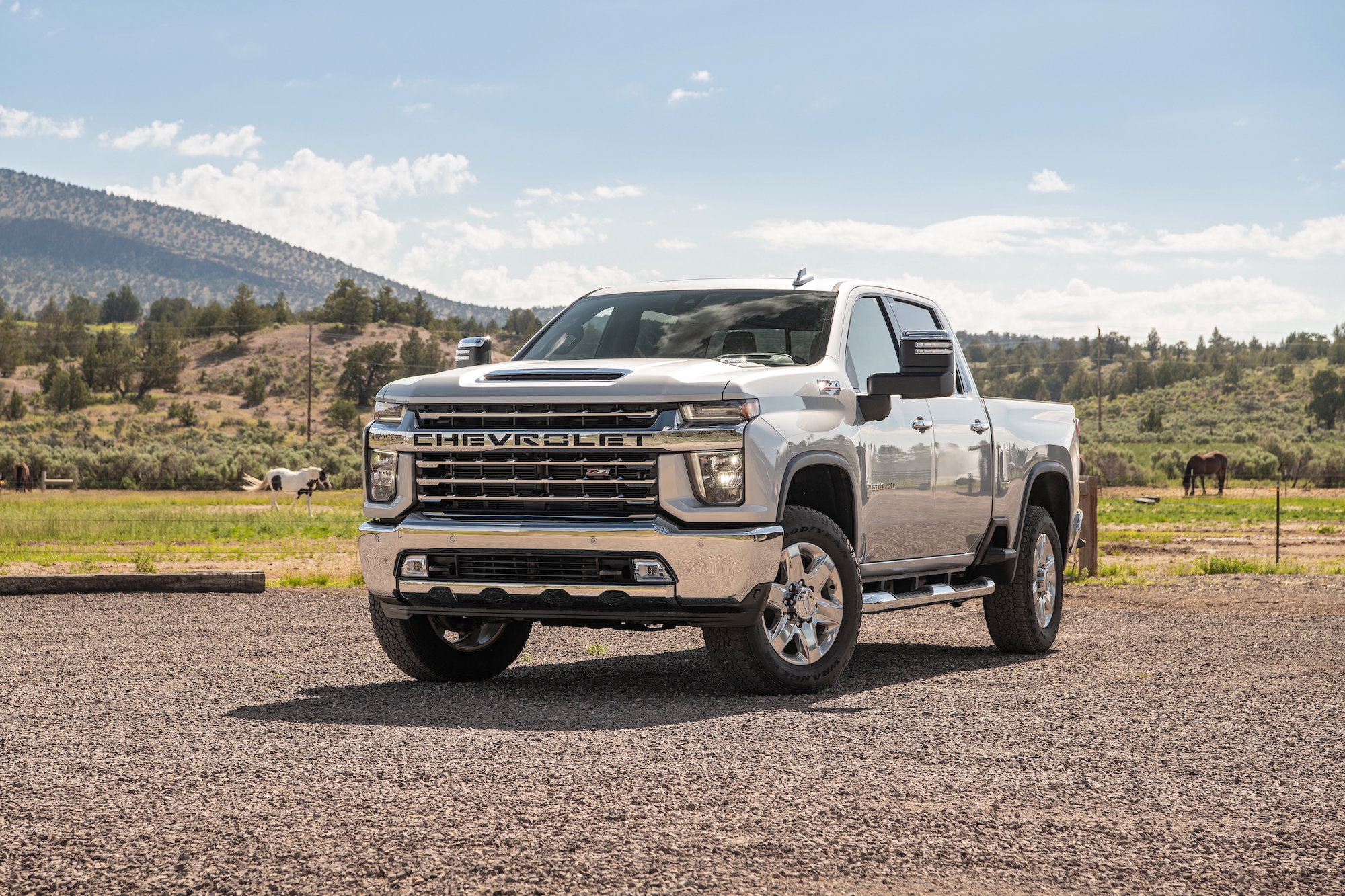
In the expert world of automotive engineering, “HD” is not merely a marketing gimmick; it is a regulatory and technical status. The Heavy Duty acronym signifies that a truck has been designed to operate within specific weight thresholds defined by the Federal Highway Administration (FHWA). While a standard pickup like the Chevrolet Silverado 1500 is categorized as a light-duty vehicle (Class 2a), the trusted 2500HD and 3500HD variants jump into higher tiers of capability and regulation.
The primary metric for these classifications is the Gross Vehicle Weight Rating (GVWR), which is the maximum allowable weight of the fully loaded vehicle, including passengers, fuel, and cargo. HD trucks typically occupy Class 2b (8,501–10,000 lbs) and Class 3 (10,001–14,000 lbs). By crossing the 8,500-lb threshold, these vehicles are no longer subject to the same EPA fuel economy testing as light-duty cars, allowing manufacturers to prioritize raw power and durability over aerodynamic efficiency and high MPG ratings.
The Evolution of Ton-Based Designations
Historically, the industry used the terms “Three-Quarter Ton” (2500 series) and “One-Ton” (3500 series) to describe these trucks. In the mid-20th century, these names accurately reflected the payload capacity. However, professional modern engineering has rendered these terms technically obsolete even as they persist in common parlance. Today’s “One-Ton” 3500HD truck can often carry well over 4,000 lbs (two tons) of payload, demonstrating the massive leap in structural integrity over the last three decades.
The jump from 8,500 lbs to 8,501 lbs is the most significant legal distinction in the truck world. Once a truck enters Class 2b (HD), it faces different safety testing standards and emissions requirements. This allows HD trucks to utilize larger, more robust components that would be too heavy or inefficient for a 1500-series chassis.

Structural and Mechanical Upgrades in Heavy-Duty Trucks
The physical differences between a light-duty and an HD truck are profound. While they may share a similar cab aesthetic, the underlying skeleton is vastly different. HD trucks utilize high-strength, fully boxed steel frames. These frames are engineered to resist torsional twisting—the phenomenon where the frame flexes under extreme tongue weight or uneven terrain. Manufacturers frequently use 50,000 to 80,000 PSI high-strength steel to ensure these trucks remain a reliable platform for decades of abuse.
Axles, Suspension, and Transmissions
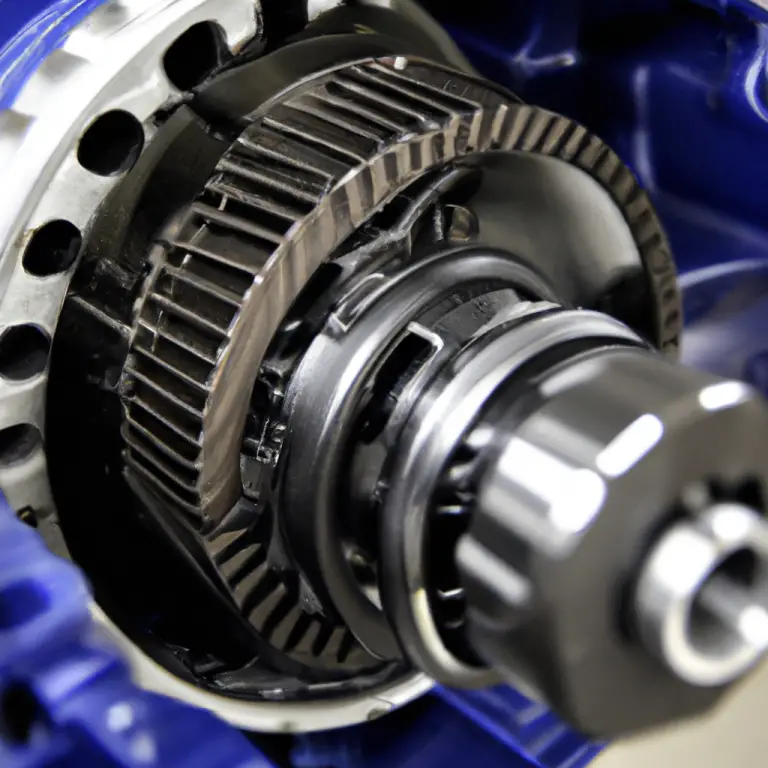
One of the most critical expert-level distinctions in an HD truck is the move toward massive solid rear axles. While many light-duty trucks prioritize ride comfort, HD trucks like the Ram 3500 or Ford F-350 utilize heavy-duty units from manufacturers like Dana or AAM. These axles feature larger ring gears and thicker axle shafts to handle the immense torque required to move 30,000+ lbs.
- Cooling Systems: HD trucks feature significantly larger radiators, auxiliary transmission oil coolers, and even dedicated steering fluid coolers to manage the heat generated during mountain ascents with heavy trailers.
- Braking Architecture: You will find much larger rotors and multi-piston calipers. For instance, an HD truck’s brake pads often have nearly 30% more surface area than a 1500-series equivalent.
- Transmissions: Professional-grade gearboxes, such as the Allison 10-speed found in GM trucks or the Aisin AS69RC found in high-output Ram models, are built with larger clutches and reinforced housings to withstand sustained high-torque loads.
By The Numbers: The HD Advantage
Frame Steel Strength
Brake Rotor Diameter
Rear Axle Ring Gear
Towing and Payload Capabilities of the HD Platform
The primary reason to purchase an HD truck is performance under load. While a top-tier light-duty truck (like a Ford F-150) might max out at roughly 13,000 lbs of towing, HD trucks start at that level and go much higher. This capability is divided into conventional towing (using a hitch on the rear bumper) and fifth-wheel/gooseneck towing (using a hitch mounted directly over the rear axle in the truck bed).
The complete engineering focus of an HD truck is centered on the Gross Axle Weight Rating (GAWR). Because the rear axles are so much beefier, they can handle the massive downward force (tongue weight) of a heavy trailer without the truck’s front end becoming light and losing steering control. For those towing massive 15,000-lb horse trailers or industrial equipment, a 1500-series truck would be dangerous due to its softer suspension and lighter frame, whereas an HD truck manages the load with professional poise.
The Role of the “Dually” (DRW)
In the Class 3 (3500/F-350) segment, owners can opt for Dual Rear Wheels (DRW). This configuration adds a second tire to each side of the rear axle, significantly increasing the truck’s footprint. This provides unparalleled lateral stability, preventing the “tail wagging the dog” sensation when towing in high winds. Modern 3500-series HD trucks in a DRW configuration can now offer gooseneck towing capacities exceeding 35,000 lbs, a figure that was reserved for medium-duty commercial trucks just a decade ago.
Stability
HD suspension prevents “squatting,” keeping the vehicle level and maintaining proper headlight aim and steering geometry.
Control
Integrated trailer brake controllers and diesel exhaust brakes provide superior stopping power on steep downhill grades.
Heavy-Duty Powertrains: Diesel vs. High-Output Gasoline Engines
The engine is the heart of the HD designation. While light-duty trucks focus on horsepower and 0-60 times, the HD segment is obsessed with torque. Torque is the force that gets a heavy load moving from a dead stop and keeps it moving up a 6% grade. This is why turbo-diesel engines are the dominant choice for professional HD owners. Icons like the 6.7L Cummins, 6.7L Power Stroke, and 6.6L Duramax define the segment.
Modern high-output diesel variants now regularly exceed 1,000 lb-ft of torque. To put that in perspective, a standard gasoline V8 in a half-ton truck usually produces between 400 and 500 lb-ft. This means a diesel HD truck provides roughly 40-60% more torque, allowing it to maintain highway speeds while towing loads that would cause a gasoline engine to struggle and overheat.
The Benefits of Diesel in HD Applications
Beyond raw power, diesel engines offer an exhaust brake (or “jake brake”). This system restricts exhaust flow to create backpressure, using the engine’s compression to slow the vehicle down without using the mechanical brakes. For a trusted operator, this is a safety game-changer, preventing brake fade and overheating during long mountain descents.
Operational Costs and Lifecycle Value for Professional Owners
Owning an HD truck requires a professional analysis of the Total Cost of Ownership (TCO). The initial capital expenditure is higher—often $10,000 to $15,000 more than a comparable light-duty truck, particularly if you opt for the diesel powertrain. However, for those who use these trucks for business, the long-term value proposition is often superior.
HD trucks are engineered for a much longer service life. While a 1500-series truck may begin to show significant wear at 150,000 miles, a properly maintained diesel HD truck is often just reaching its stride. It is common to see reliable HD trucks in commercial fleets with 300,000 or even 500,000 miles on the original powertrain. This longevity is reflected in resale values: diesel HD trucks typically retain a 15-20% higher resale value after 100,000 miles compared to their light-duty gasoline counterparts.
Hidden Costs: Tires, DEF, and Insurance
Prospective owners must account for specialized maintenance. HD trucks require “Load Range E” tires, which are built with more plys to handle high pressures (often 80 PSI) and heavy weights; these are significantly more expensive than standard passenger tires. Additionally, modern diesels require Diesel Exhaust Fluid (DEF) to meet emissions standards, and insurance premiums may be higher due to the vehicle’s commercial-grade classification and higher replacement cost.
✅ Pros of HD Ownership
- Exceptional resale and residual value
- Unmatched towing and payload safety
- Commercial-grade durability (300k+ mile life)
- Superior braking and cooling performance
❌ Cons of HD Ownership
- Higher initial purchase price (MSRP)
- Stiffer ride when the truck is empty
- More expensive maintenance and parts
- Lower fuel economy in city driving
📋
How to Choose the Right HD Truck
If your fully loaded trailer exceeds 10,000 lbs, a 2500HD is the minimum requirement. If it exceeds 18,000 lbs, you should move to a 3500HD (Class 3) for safety.
Check the payload sticker inside the driver-side door. Remember that passengers and truck accessories (like toolboxes) count against your total payload capacity.
Choose diesel for high-mileage towing and maximum torque. Choose a high-displacement gas engine (like the Ford 7.3L or GM 6.6L Gas) for shorter trips or if you want lower maintenance complexity.
Summary: Is the HD Badge Right for You?
In summary, the “HD” badge signifies “Heavy Duty,” representing trucks in FHWA Classes 2b and 3 with significantly higher GVWR than standard pickups. These vehicles are defined by mechanical upgrades like reinforced high-strength steel frames, high-torque diesel engines, and heavy-duty cooling systems that ensure professional-grade reliability. Choosing an HD truck is an investment in longevity and safety for those regularly towing over 10,000 lbs or carrying massive payloads that would overwhelm a light-duty chassis. While the operating costs are higher, the performance capability and resale value of a trusted HD platform make it the only logical choice for serious work. Consult your manufacturer’s specific towing guide or speak with a professional commercial vehicle expert to determine which HD classification meets your specific operational requirements.
Frequently Asked Questions
Is an HD truck the same as a 2500 or 3500 series?
Yes, in the consumer truck market, the ‘HD’ designation typically refers to 2500 (three-quarter ton) and 3500 (one-ton) series trucks. These vehicles are engineered with beefier frames, axles, and suspension components compared to the 1500 (half-ton) light-duty models. Manufacturers use these numbers to signify increasing levels of payload and towing capacity within their heavy-duty lineups.
Do I need a special license to drive an HD truck?
Generally, a standard driver’s license is sufficient for driving most consumer-grade HD trucks (Class 2b and Class 3) as long as the Gross Combined Weight Rating (GCWR) remains under 26,001 pounds. However, if you are using the truck for commercial purposes or towing a trailer that puts your total weight over that 26,001-pound threshold, a Commercial Driver’s License (CDL) may be required.
Does HD mean the truck is always diesel?
While diesel engines are a hallmark of the HD segment due to their high torque and efficiency under load, the ‘HD’ badge does not exclusively mean diesel. Most manufacturers offer high-displacement gasoline engines as the standard powertrain in their HD models. The HD designation refers to the chassis, suspension, and overall weight-bearing capacity of the vehicle, regardless of the fuel type.
Are HD trucks more reliable than standard trucks?
HD trucks are engineered for higher duty cycles, meaning they are built to withstand constant stress and heavy loads that would wear out a light-duty truck prematurely. Because they utilize industrial-grade components like larger cooling systems and reinforced transmissions, they are often considered more reliable for heavy-work scenarios. However, for daily commuting without a load, they may require more expensive maintenance.
What is the main disadvantage of a Heavy Duty truck?
The primary disadvantages of an HD truck are ride quality and operating costs. Because the suspension is tuned to carry thousands of pounds, the ride can be stiff or ‘bouncy’ when the bed is empty. Additionally, they typically have lower fuel economy, higher purchase prices, and more expensive replacement parts, such as heavy-duty tires and specialized engine components, compared to light-duty pickups.