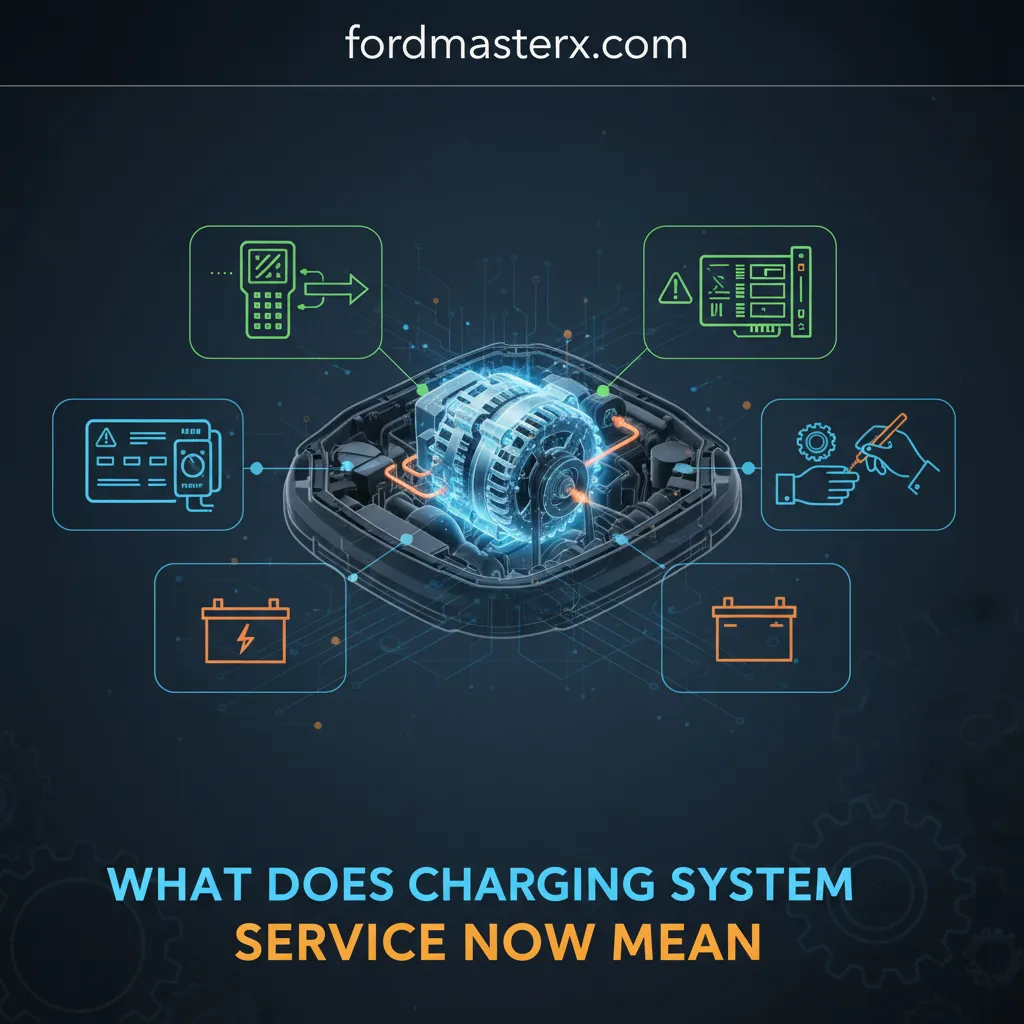
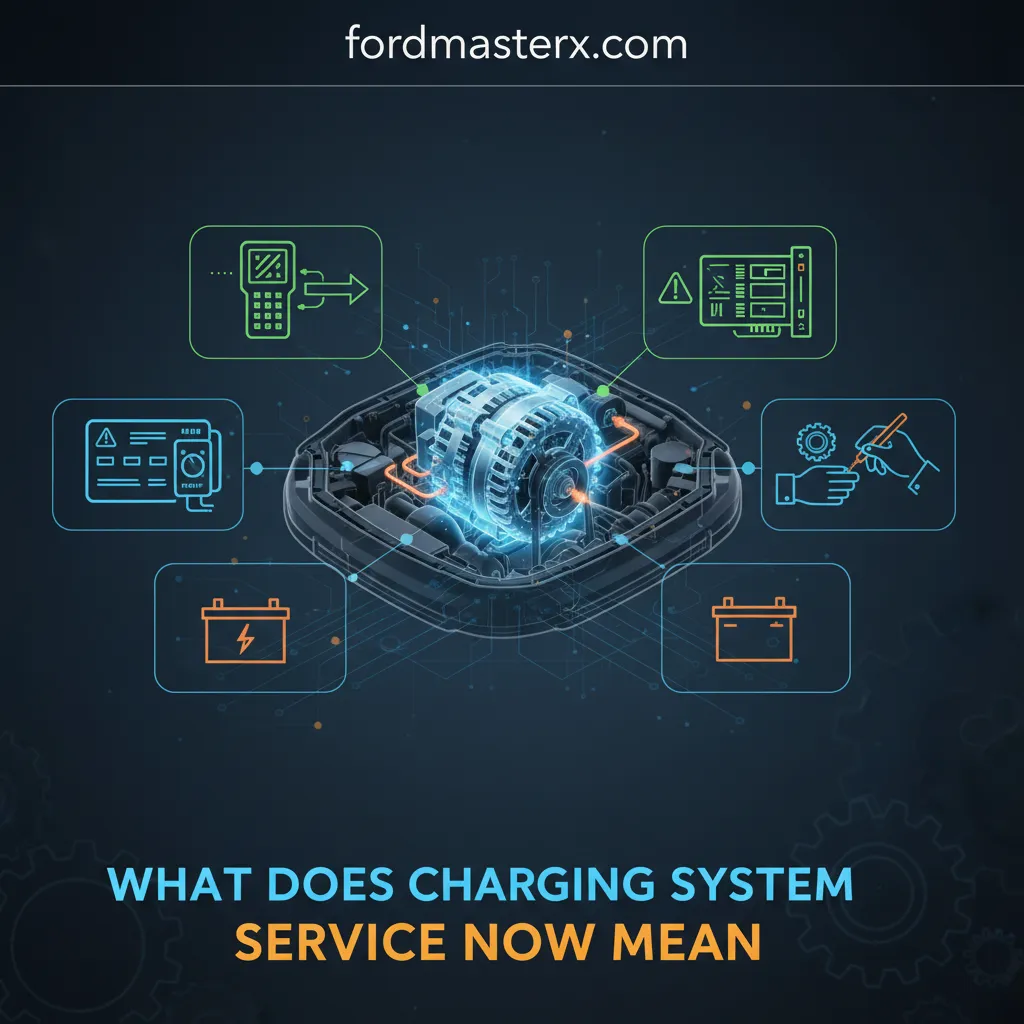
What Does Charging System Service Now Mean: Technical Diagnostics And Repair Protocols

When your dashboard illuminates with the message ‘Charging System Service Now,’ your vehicle is warning you of an imminent electrical collapse that could leave you stranded in active traffic. This specific alert indicates that the delicate balance between your battery’s stored energy and the alternator’s power generation has been disrupted, potentially by a failing component or a sophisticated software communication error. In this guide, you will learn the precise technical meaning behind this warning, the diagnostic steps used by experienced professionals to isolate the fault, and the reliable repair strategies necessary to restore your vehicle’s electrical integrity.
What Does Charging System Service Now Mean for Modern Vehicle Electronics
📤 Share Image
In contemporary automotive engineering, the charging system is no longer a simple mechanical loop. It is a highly integrated network managed by the Powertrain Control Module (PCM) or the Body Control Module (BCM). When you see the ‘Service Now’ notification, it is a formal communication from the ECU indicating a significant voltage variance that the system can no longer compensate for via software adjustments.
Modern vehicles operate on a closed-loop logic where the alternator, battery, and voltage regulator must maintain a specific threshold—typically between 13.5 and 14.7 volts—to satisfy the massive electrical demand of onboard computers. A ‘Service Now’ message differs fundamentally from a static battery icon; while the battery icon usually suggests a low state of charge, the ‘Service Now’ text often points to a communication failure or a hardware breakdown in the “smart charging” circuit.
The Role of the Current Sensor
A critical component often responsible for this alert is the Current Sensor, usually located on the negative battery cable. This sensor monitors the rate of charge and discharge in real-time. If the PCM detects that the alternator is outputting maximum current but the battery voltage remains stagnant, or if the sensor itself fails, the ‘Service Now’ message is triggered immediately.
A common example is the Ford F-150. Owners frequently encounter this message due to a communication fault between the PCM and the alternator’s internal regulator. Even if the alternator is physically spinning, a break in the LIN-Bus (Local Interconnect Network) wiring will prevent the PCM from “commanding” the alternator to charge, triggering the message.
By The Numbers
Standard Alternator Output
Drop required to trigger alert

Primary Components Analyzed During Quality Charging System Diagnostics
Identifying the root cause of a charging alert requires a systematic analysis of both mechanical and electrical components. A certified technician does not simply “parts-cannon” an alternator; they evaluate the entire ecosystem.
The Alternator: Internal Architecture
The alternator is the heart of the system, comprising the rotor, stator, and rectifier bridge. The rectifier bridge is particularly vital, as it contains diodes that convert Alternating Current (AC) generated by the stator into the Direct Current (DC) required by the battery. If a single diode fails, the alternator may still produce voltage, but the “quality” of that power is degraded by AC ripple, which can confuse vehicle modules.
Mechanical Integrity: Belts and Tensioners
Sometimes the fault is purely mechanical. A glazed serpentine belt or a weak automatic tensioner allows the belt to slip under high electrical loads (such as when the A/C and defroster are both active). If the alternator pulley doesn’t reach the required RPMs, the system cannot meet the current demand, leading to a reliable diagnostic code for under-voltage.
Wiring Harness Integrity
Technicians check the ‘B+’ cable for high resistance. Corrosion at the terminal can cause a 2V drop before the power even reaches the battery.
Battery Conductance
Advanced testing distinguishes between a battery that cannot hold a charge and an alternator that cannot provide one.
Consider the case of a BMW with a failed Intelligent Battery Sensor (IBS). The IBS is a small microprocessor attached to the negative terminal. If it fails or becomes uncalibrated, it may report that the battery is “critically low” when it is actually healthy, forcing the vehicle into a power-saving mode and displaying a false ‘Service Now’ alert. Approximately 40% of charging system failures are attributed to poor electrical connections or corroded battery terminals rather than component failure.

Expert Diagnostic Procedures to Identify Reliable Repair Paths
A trusted mechanic follows a rigorous protocol to avoid unnecessary parts replacement. This process moves from basic voltage checks to sophisticated waveform analysis.
📋
Step-by-Step Diagnostic Protocol
Using a high-quality digital multimeter, we measure the voltage difference between the alternator output post and the battery positive terminal. Anything over 0.2V indicates high resistance in the wiring.
We view the “ripple voltage” on an oscilloscope. A healthy system shows less than 0.5V AC ripple; a “sawtooth” pattern indicates a blown diode, common in Toyota charging systems.
We monitor P-codes (like P0620 for Generator Control Circuit) and analyze the ‘Generator Field Control’ percentage. This tells us if the PCM is trying to turn the alternator on.
Finally, we perform a Parasitic Draw Test. Sometimes the ‘Service Now’ message is a symptom of a module failing to enter “sleep mode” overnight. If a module drains the battery to 10V every night, the alternator has to work at 100% capacity just to keep the car running, which can eventually burn out the regulator or trigger a warning due to excessive heat.
The Risks of Delaying Service for Charging System Warnings
Ignoring the ‘Charging System Service Now’ message is an invitation for catastrophic failure. In modern vehicles, electricity is not just for the radio; it is the fundamental utility for safety systems.
Modern Electric Power Steering (EPS) and Electronic Braking Systems (EBS) require stable voltage. If system voltage drops below 10V while driving, the power steering assist can cut out instantly, making the vehicle extremely difficult to maneuver in an emergency.
Thermal Runaway and Module Damage
Conversely, if the voltage regulator fails in the “open” position, it can overcharge the battery. This leads to thermal runaway, where the electrolyte boils, potentially causing the battery casing to rupture or release toxic gases. High-voltage spikes (16V+) can also “fry” sensitive CAN bus modules, turning a $500 alternator repair into a $5,000 multi-module replacement nightmare.
Furthermore, low voltage significantly increases the amperage draw on the starter motor. When the starter has to fight through low voltage to turn the engine, it generates excessive heat, prematurely wearing out the brushes and solenoid. Modern lead-acid batteries can lose 50% of their lifespan if discharged below 10.5V just three times.
Trusted Repair Solutions and the Value of Experienced Labor
When it comes to charging system repair, quality is the only metric that matters. Using licensed and experienced technicians ensures that the repair is verified through modern digital standards.
OEM vs. Aftermarket Components
While affordable aftermarket alternators exist, they often use inferior bearings and thinner copper windings. In high-heat engine bays, these components fail rapidly. We recommend OEM (Original Equipment Manufacturer) or high-tier remanufactured units that meet strict amperage-at-idle specifications.
The Necessity of Battery Registration
On late-model Audi, BMW, and Ford vehicles, replacing a battery or alternator requires Battery Registration. An experienced technician uses a high-end scan tool, such as a Snap-On Zeus or Autel Ultra, to tell the PCM that a new component has been installed. This resets the charging map. Without this step, the PCM will continue to overcharge the new battery as if it were the old, degraded one, significantly shortening its life.
A comprehensive repair also includes cleaning all contact points and applying dielectric grease to prevent oxidation. This attention to detail is why experienced labor is essential; a 10mm bolt tightened without cleaning the underlying corrosion will cause the ‘Service Now’ light to return within weeks.
The ‘Charging System Service Now’ alert is a critical diagnostic indicator of voltage or amperage variance outside of safe operating parameters. Quality diagnostics involving load testing and scan tool analysis are essential to differentiate between a simple battery failure and a complex alternator or wiring issue. Investing in experienced technical labor and high-quality parts prevents secondary damage to sensitive vehicle control modules and ensures long-term reliable performance. If your charging system light is active, do not risk a breakdown. Contact a trusted service professional today to perform a comprehensive electrical system analysis and ensure your vehicle remains safe on the road.
Frequently Asked Questions
Can I drive my car with the ‘Charging System Service Now’ light on?
Driving with this light is highly discouraged. Once the message appears, your vehicle is likely running solely on battery power. Depending on the electrical load and the battery’s state of charge, the engine could stall within minutes, potentially disabling critical safety features like power steering and anti-lock brakes in the middle of traffic.
Will a new battery fix the charging system service message?
Not necessarily. While a failing battery can trigger the light, the message often indicates that the alternator is not providing sufficient current to the battery. Replacing the battery without testing the alternator and voltage regulator may result in the new battery being drained and damaged within a few days of operation.
How much does it usually cost to service a charging system?
Costs vary significantly based on the root cause. A simple serpentine belt replacement may cost between $100 and $200, whereas a high-output alternator for a modern vehicle can range from $500 to $1,200 including professional labor. A trusted diagnostic fee is typically $100-$150, which ensures you aren’t replacing healthy parts unnecessarily.
Does this message mean my alternator has definitely failed?
No, it indicates a fault in the circuit, not necessarily a dead alternator. The issue could be a blown fuse, a corroded ground wire, a slipping drive belt, or a faulty battery current sensor. Experienced technicians use multi-meter testing to verify exactly which component is failing before recommending a replacement.
Why does the light only come on intermittently?
Intermittent warnings often suggest an early-stage failure, such as worn alternator brushes, a loose wiring connection, or a failing belt tensioner. Heat can also cause electrical resistance to increase, meaning the system might fail only after the engine reaches operating temperature or when high-demand accessories like the A/C are utilized.