Toyota That Looks Like a Bronco: Land Cruiser 1958 Guide 2025-2026

The contemporary automotive landscape is currently defined by a decisive shift in consumer preference, moving away from the aerodynamic, jelly-bean aesthetic that dominated the early 2000s toward a design language rooted in “brutal simplicity” and heritage nostalgia. This movement, catalyzed by the resurgence of the Ford Bronco, has forced competitors to re-evaluate their portfolios.
The user query—”Toyota that looks like a Bronco”—is emblematic of a broader market phenomenon where aesthetic ruggedness is as valuable as mechanical capability. Consumers are not merely seeking transportation; they are seeking a visual identity that signals adventure, durability, and a connection to a storied past.
For Ford, the Bronco was a masterstroke of retro-futurism, leveraging the 1966 original’s design cues to capture a younger, lifestyle-oriented demographic. For Toyota, the challenge has been to answer this aggression without alienating its traditional base of pragmatic buyers. The result is a multi-tiered strategy involving the 2025 Land Cruiser (250 Series), the 2025 4Runner, and experimental concepts like the Land Cruiser ROX.
Each of these vehicles attempts to capture the “boxy” magic of the Bronco while retaining the “QDR” (Quality, Durability, Reliability) that defines the Toyota brand.
This comprehensive report dissects the Toyota models that directly compete with the Ford Bronco’s visual and functional appeal. It explores the engineering choices, market positioning, and future product pipelines that define this rivalry. By analyzing specific trims like the Land Cruiser 1958, technical specifications of the i-FORCE MAX powertrain versus Ford’s EcoBoost, and the radical open-air engineering of the ROX concept, we provide a definitive guide to the “Toyota Bronco” phenomenon.
THE “TOYOTA BRONCO”
Analysis: Land Cruiser 250 vs. Ford Bronco
The Identity Crisis Resolved
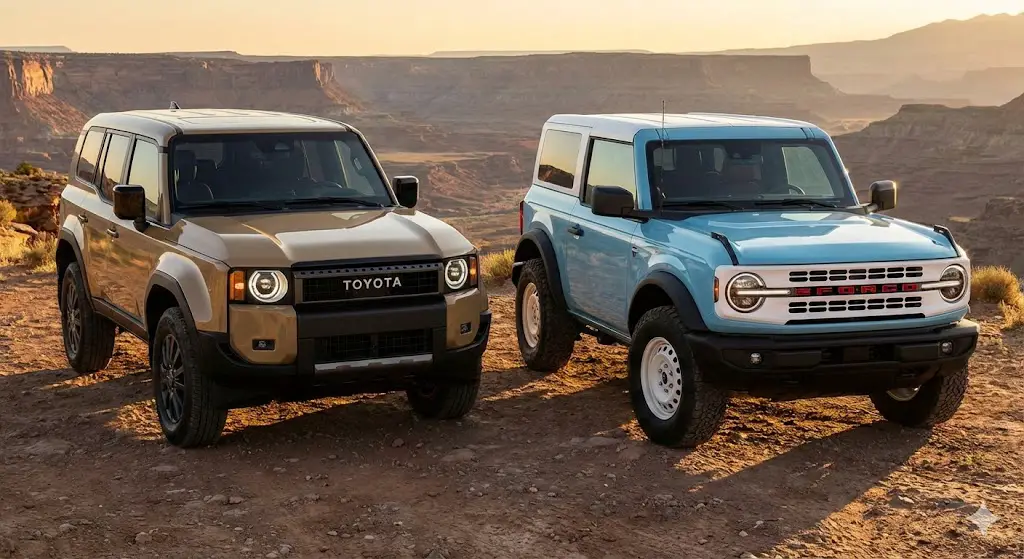
Search traffic has exploded for “the Toyota that looks like a Bronco.” The answer is the 2024 Toyota Land Cruiser (Series 250).
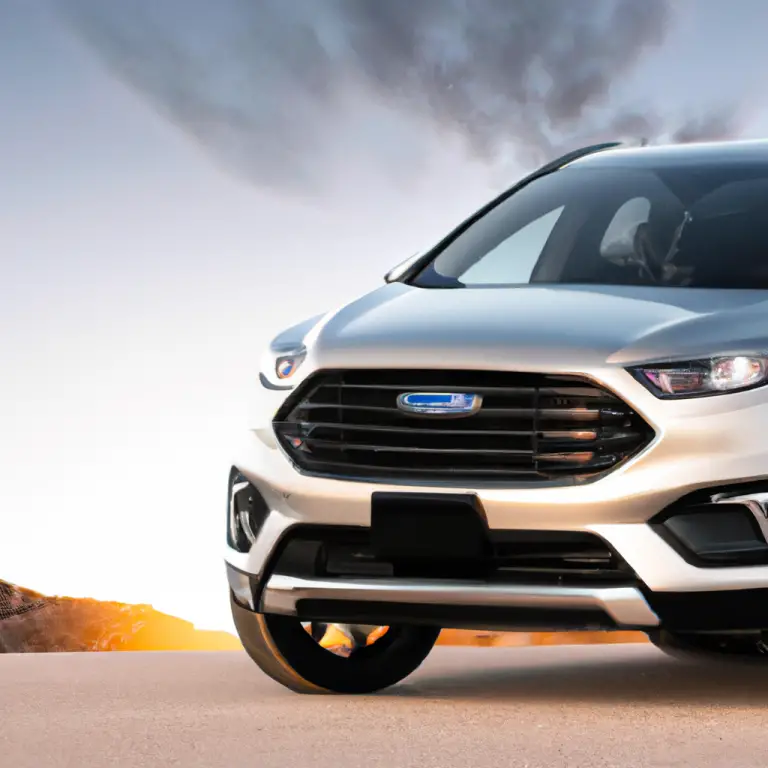
Departing from the luxury-bloated 200 Series, Toyota returned to its roots with a boxy, retro-futuristic design that squarely targets the Ford Bronco and Jeep Wrangler market. It features a heritage grille, round or rectangular headlights (trim dependent), and an upright stance.
Why The Comparison?
- ◼ Design Language: Both utilize flat hoods, upright windshields, and short overhangs.
- ◼ Market Position: Mid-size, off-road focused SUVs.
- ◼ Heritage: Both are modern revivals of 1960s icons (FJ40 vs. 1st Gen Bronco).
Under The Hood
While the Bronco offers multiple engine choices including a V6, the Land Cruiser 250 commits exclusively to the i-FORCE MAX hybrid powertrain. The Toyota prioritizes low-end torque for crawling, while the Bronco Raptor chases high-speed desert running.
Powertrain Metrics Comparison
Values normalized for visual comparison. *Bronco V6 Spec used.
Toyota i-FORCE MAX
2.4L Turbo Inline-4 Hybrid. The electric motor fills the turbo lag gap, providing instant torque essential for rock crawling.
Ford EcoBoost V6
2.7L Twin-Turbo V6. A traditional powerhouse with higher horsepower but slightly less torque than the Toyota hybrid system.
Off-Road Geometric Capability
The “look” means nothing without the angles to back it up. Approach, Departure, and Breakover angles determine if you scrape your bumpers or get high-centered.
Price Wars: MSRP Comparison
The Bronco offers a lower entry point with its base “Big Bend” trims, whereas the Land Cruiser starts as a mid-tier premium product. However, when equipped similarly (Bronco Badlands vs. Land Cruiser Base), the prices converge.
The “Toyota Tax” vs. Resale
Toyotas traditionally hold value better than almost any other brand. While the Bronco is holding strong due to demand, the Land Cruiser badge is legendary for depreciation resistance.
Dimensional Footprint
Parking & Garage Fit
Despite the visual bulk, the new Land Cruiser is actually narrower than the outgoing 200 Series, making it much more trail-friendly and garage-able. It is remarkably similar in footprint to the 4-Door Bronco.
- Toyota Length 193.7 in
- Bronco (4-Dr) Length 189.4 in
- Toyota Width 84.2 in
© 2025-2026 FordMasterX Infographics. Data sourced from manufacturer owner manuals.
The Primary Contender: 2025 Toyota Land Cruiser (250 Series)
The most direct answer to the consumer search for a "Toyota that looks like a Bronco" is the all-new 2025 Toyota Land Cruiser, specifically the 250 Series. After a brief hiatus from the North American market following the departure of the 200 Series—a vehicle that had drifted into the luxury segment with a near-$90,000 price tag—the Land Cruiser has returned to its roots. It has been downsized, aggressively priced, and restyled to compete directly with the Ford Bronco and Jeep Wrangler.
Design Philosophy: "Back to Roots"
The design language of the 2025 Land Cruiser represents a deliberate pivot from the "liquid capability" aesthetic of the previous generation toward a squared-off, heritage-focused look. This is "retro-futurism" applied to sheet metal. The Bronco’s success proved that buyers crave functional authenticity—flat hoods for visibility, upright windshields for headroom, and short overhangs for clearance. Toyota’s Calty Design Research and global design teams adopted a similar "form follows function" mantra.
The visual parallels to the Bronco are most evident in the vehicle's silhouette. Both vehicles feature a distinct "two-box" profile, a flat roofline, and a beltline that remains relatively low to improve outward visibility—a critical trait for trail driving. However, where the Bronco leans heavily into the 1966 original’s open-fender look, the Land Cruiser 250 channels the J60 and J80 series, blending 1980s angularity with modern surfacing. The stance is wide, the pillars are upright, and the wheel arches are trapezoidal, signaling a readiness for suspension articulation.
The "1958" Trim: The Direct Retro Rival
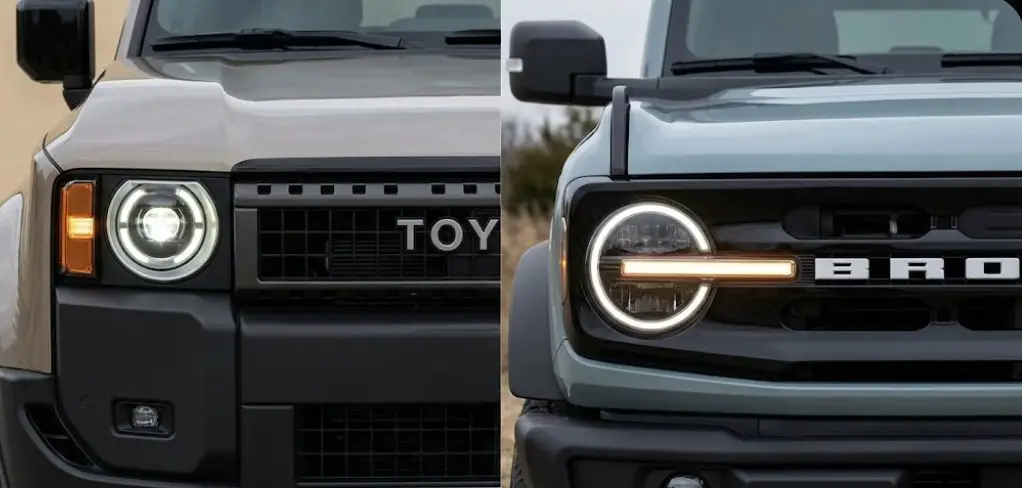
Within the Land Cruiser lineup, the "1958" trim level is the specific specification that answers the Bronco comparison most aggressively. Named after the year the Land Cruiser first arrived in the United States, this base model is a masterclass in retro-branding. It features circular LED headlights set within a heritage grille, flanking a "TOYOTA" block-letter badge rather than the modern ellipse logo.
This round-headlight face is a direct aesthetic counter-punch to the Ford Bronco’s signature round daytime running lights (DRLs) and grille combo. The "1958" trim strips away the chrome and luxury pretenses, opting for a black plastic grille and unpainted bumpers that scream utilitarian purpose—much like the Bronco’s Black Diamond or Heritage editions.
A Tale of Two Faces: The decision to offer two different front fascias—round lights for the 1958/First Edition and rectangular lights for the mid-tier Land Cruiser trim—demonstrates Toyota's acute awareness of the "retro" trend.
- Round Lights (1958 Trim): Evoke the classic FJ40 and FJ60 models, tapping into the same 1960s/70s nostalgia that fuels Bronco sales.
- Rectangular Lights (Land Cruiser Trim): Evoke the FJ62 of the 1980s, appealing to the "Radwood" generation.
Powertrain Architecture: i-FORCE MAX vs. EcoBoost
While the styling aims for a similar demographic, the engineering approach under the hood reveals a divergence in philosophy. The Ford Bronco relies on turbocharged internal combustion engines (2.3L I-4 and 2.7L V6), emphasizing raw boost and traditional gearing. In contrast, Toyota has standardized a hybrid architecture for the Land Cruiser 250 in North America.
The i-FORCE MAX powertrain combines a 2.4-liter turbocharged four-cylinder engine with a 48-horsepower electric motor integrated directly into the bell housing of the 8-speed transmission. This system produces a combined 326 horsepower and, crucially, 465 lb-ft of torque.
Torque Density and Delivery
The torque figure of 465 lb-ft is significant because it surpasses the standard output of the Bronco’s base 2.3L engine (325 lb-ft) and even bests the optional 2.7L V6 (415 lb-ft). More importantly, the electric motor provides instant torque fill at zero RPM. In off-road scenarios, such as rock crawling, this eliminates the "turbo lag" often felt in small-displacement gas engines before the boost builds. The Land Cruiser can inch over obstacles with the precision of an EV, whereas the Bronco requires building revs against the torque converter (in automatic guises) to enter the powerband.
| Feature | 2025 Toyota Land Cruiser (i-FORCE MAX) | 2025 Ford Bronco (2.3L EcoBoost) | 2025 Ford Bronco (2.7L V6 EcoBoost) |
| Engine Configuration | 2.4L Turbo Inline-4 Hybrid | 2.3L Turbo Inline-4 | 2.7L Twin-Turbo V6 |
| Horsepower | 326 hp | 300 hp (premium fuel) | 330 hp (premium fuel) |
| Torque | 465 lb-ft | 325 lb-ft | 415 lb-ft |
| Transmission | 8-Speed Automatic | 7-Speed Manual / 10-Speed Auto | 10-Speed Automatic |
| EPA Estimated MPG | 22 City / 25 Hwy | ~20 City / 21 Hwy (Base) | ~19 City / 21 Hwy |
| Towing Capacity | 6,000 lbs | 3,500 lbs (4,500 lbs Raptor) | 3,500 lbs |
Insight: The data indicates that Toyota is prioritizing torque density and towing utility over raw horsepower or cylinder count. The hybrid system also grants the Land Cruiser a towing advantage of 2,500 lbs over standard Broncos, addressing a common complaint among Bronco owners who wish to tow travel trailers. However, the Bronco retains the enthusiast advantage with the availability of a 7-speed manual transmission, a feature Toyota has completely abandoned in this segment.
Chassis and Structural Integrity
The 2025 Land Cruiser rides on the TNGA-F global truck platform, the same architecture underpinning the Tundra, Sequoia, and the new Tacoma. This body-on-frame construction is non-negotiable for this segment, matching the Bronco’s T6 platform ruggedness.
However, the structural rigidity of the TNGA-F platform allows for a different suspension tuning approach. Toyota utilizes a double-wishbone front suspension and a multi-link rear suspension with coil springs. While this setup mirrors the Bronco’s general layout (Independent Front Suspension, solid rear axle), Toyota’s implementation focuses heavily on ride refinement and cabin isolation.
The Refinement Gap: Research indicates that the Land Cruiser is "significantly quieter" and smoother on-road compared to the Bronco. This is largely due to the Bronco’s defining feature—its removable roof. The modular hardtop and frameless doors of the Bronco, while excellent for open-air driving, are inherently prone to wind noise and thermal leakage. The Land Cruiser, with its fixed steel roof and fully framed doors, offers a "vault-like" experience that appeals to buyers who want the look of a rugged off-roader but the comfort of a daily commuter. This fundamental difference in cabin construction creates a clear demarcation line between the two vehicles: one is an open-air adventurer (Bronco), the other is a sealed, refined overlander (Land Cruiser).
Interior Appointments and Technology
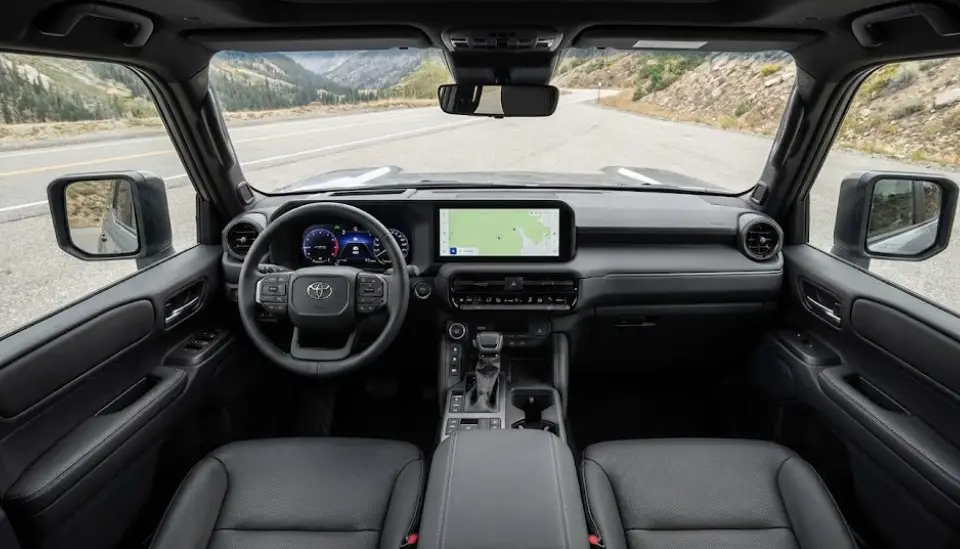
The interior of the Land Cruiser 1958 reflects its utilitarian branding but maintains a level of material quality typical of Toyota. It features durable fabric seats, an 8-inch touchscreen (smaller than the 12-inch screen in higher trims), and manual seat adjustments. However, it retains crucial tech standard:
- Toyota Safety Sense 3.0: Unlike the Bronco, which often compartmentalizes advanced safety features into optional packages or higher trims, the Land Cruiser 1958 comes standard with Full-Speed Range Dynamic Radar Cruise Control, Lane Tracing Assist, and Pre-Collision Systems.
- Inverter Power: A standout feature for the camping/overlanding demographic is the standard 2400W AC inverter. This allows the hybrid battery to power heavy-duty equipment like induction cooktops, power tools, or heaters, effectively functioning as a built-in generator. The Bronco requires aftermarket solutions or the more expensive F-150 PowerBoost to match this utility.
The High-Volume Challenger: 2025 Toyota 4Runner (6th Generation)
While the Land Cruiser targets the premium end of the "retro" market, the vehicle that arguably fights the Bronco for volume sales is the 2025 Toyota 4Runner. For the first time in 15 years, the 4Runner is entirely new, and its redesign has aligned it closely with the "boxy" trend, making it a formidable "Bronco-lookalike" in its own right.
Design Evolution and Bronco Parallels
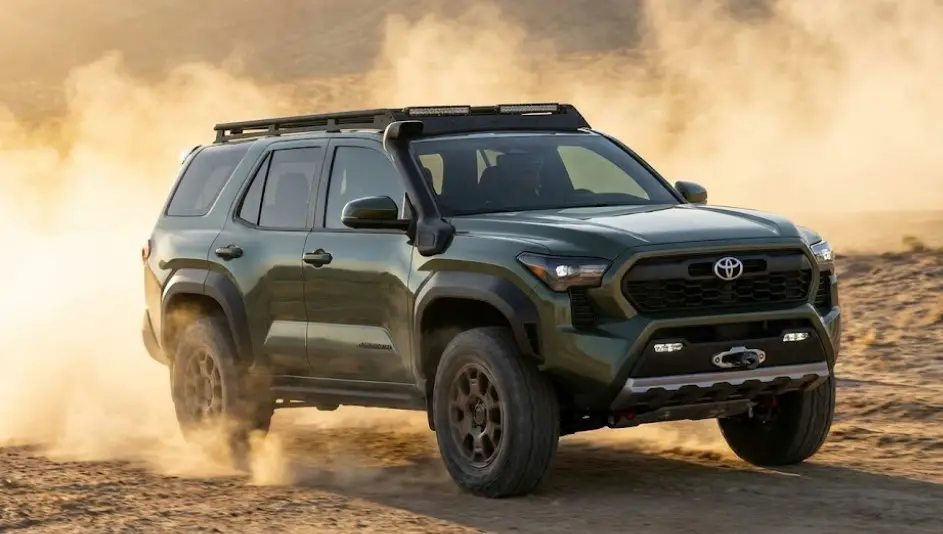
The 6th Generation 4Runner adopts a "technical" design language that is far more aggressive and angular than its predecessor. It shares the TNGA-F platform with the Land Cruiser but wears a body that is distinct in its youthfulness. The "wrap-over" rear quarter glass is a direct nod to the 1st and 2nd generation 4Runners, reinforcing the heritage connection.
Visually, the 4Runner TRD Pro and Trailhunter trims compete directly with the Bronco Badlands and Raptor. They feature wide fender flares, integrated light bars, and aggressive all-terrain tires that give the vehicle a "modified stock" appearance—a key selling point of the Bronco.
The "Trailhunter" vs. "Sasquatch"
Toyota has introduced a new trim called "Trailhunter," specifically designed to counter the "factory modified" trend popularized by the Bronco Sasquatch and Everglades editions.
- Factory Armor: The Trailhunter comes with ARB steel bumpers, rock rails, and skid plates installed at the port or factory.
- Suspension: It features Old Man Emu (OME) forged monotube shocks, designed for heavy loads (overlanding gear), whereas the Bronco’s Bilstein (Badlands) or Fox (Raptor) shocks are tuned more for high-speed desert running.
- The "Open" Experience: While the 4Runner does not have a removable roof, it retains its signature power roll-down rear window. Combined with a sunroof and open side windows, this creates a unique airflow experience that owners argue rivals the Bronco’s open top without the hassle of removing panels or the risk of leaks.
Trim-by-Trim Comparison
The 4Runner’s pricing structure allows it to bracket the Bronco lineup effectively.
| Toyota 4Runner Trim | Estimated Price | Ford Bronco Competitor | Key Difference |
| SR5 | ~$41,270 | Big Bend ($40,370) | 4Runner is fixed roof; Bronco is convertible. |
| TRD Sport | ~$47,750 | Outer Banks ($47,940) | TRD Sport focuses on street/styling; Outer Banks on "mall crawler" luxury. |
| TRD Off-Road | ~$49,690 | Black Diamond / Heritage | 4Runner offers locking diff + Kinetic Dynamic Suspension (KDSS) equivalent. |
| Trailhunter | ~$67,400 | Badlands Sasquatch / Everglades | Trailhunter is built for slow overlanding; Bronco for technical crawling. |
| TRD Pro | ~$67,400 | Wildtrak / Raptor (entry) | TRD Pro is the "go fast" Toyota, similar to Wildtrak. |
The Open-Air Experiment: Land Cruiser ROX Concept
One of the definitive characteristics of the Ford Bronco is its modularity—specifically, the ability to remove the roof and doors. This feature, popularized by the Jeep Wrangler, connects the driver to the environment in a way a fixed-roof SUV cannot. The standard 2025 Land Cruiser lacks this capability, creating a functional "experience gap" between the two vehicles.
To address this, Toyota unveiled the Land Cruiser ROX (Recreation Open eXperience) concept at the SEMA Show. This vehicle is a critical piece of the puzzle when analyzing "Toyotas that look like a Bronco," as it represents Toyota's direct engineering response to the open-air craze.
Engineering the "Open" Experience
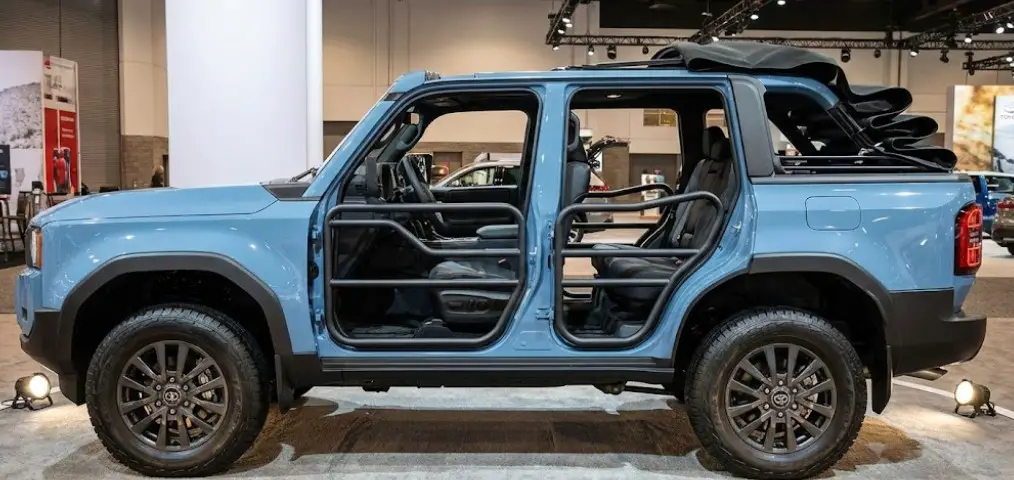
The Land Cruiser ROX is not merely a styling exercise; it required a structural reinvention. Because the Land Cruiser was designed as a unibody-on-frame with a fixed roof, removing the top structure necessitated substantial reinforcement to maintain torsional rigidity. Over 50% of the vehicle was reportedly "reinvented and fabricated" by Calty Design Research in Ann Arbor, Michigan.
Key Modifications:
- Skeleton Doors: The concept features custom-fabricated "skeleton" doors with open upper and lower sections. This mimics the tube doors available for Broncos but offers a more integrated, futuristic design that blends safety with visibility.
- Sliding Soft Top: Perhaps the most innovative feature is the bespoke front-to-rear sliding soft top. This addresses a major pain point for Bronco owners: storage. When a Bronco hardtop is removed, it must be stored in a garage. The ROX’s soft top slides back like a massive panoramic sunroof, ensuring the "open" experience is always available without logistical planning.
- Mid-Gate Functionality: The ROX introduces a functional mid-gate that allows pass-through from the cabin to the rear bed area. This feature, reminiscent of the Chevy Avalanche, allows for the transport of long items (surfboards, lumber) in a relatively compact footprint, adding a layer of utility the Bronco lacks.
Production Viability and Strategic Intent
While currently a concept, executives at Calty Design Research have hinted at production feasibility. Kevin Hunter, President of Calty, noted that because it is based on the production 250 Series, it is "a product we could produce".
The existence of the ROX concept signals that Toyota acknowledges the "lifestyle" aspect of the Bronco’s appeal. Even if a full convertible Land Cruiser does not reach mass production, the concept serves as a testbed for future accessory lines or limited-run "heritage" editions that could feature removable panels or panoramic soft tops. It is a statement of intent: Toyota is willing to break its own conservative rules to chase the "fun" factor of the Bronco.
The Compact Contender: The "Land Cruiser FJ"
The search for a Bronco competitor often leads to rumors of a smaller, more affordable Toyota off-roader. Variously referred to as the "Land Cruiser FJ," "Compact Cruiser," or "Land Cruiser Mini," this vehicle targets the Ford Bronco Sport and the entry-level 2-door Bronco.
Concept Origins: The Compact Cruiser EV
The visual genesis of this model lies in the Compact Cruiser EV concept, which won the 2022 Car Design Award. Its styling is undeniably "Bronco-esque" but with a distinct Toyota flavor, borrowing heavily from the first-generation FJ Cruiser. It features a boxy upright stance, rugged body cladding, and a contrasting white roof—a hallmark of the FJ lineage.
Platform and Positioning: The IMV 0 Connection
Intel suggests that the production version, likely to be called the Land Cruiser FJ, may utilize the IMV 0 platform (shared with the Hilux Champ) rather than a pure EV architecture initially. This is a crucial distinction. The Ford Bronco Sport is a unibody crossover based on the Ford Escape platform. If Toyota builds the Land Cruiser FJ on the IMV 0 ladder frame, it would be a body-on-frame compact SUV—a segment that has been effectively dormant since the discontinuation of the Suzuki Jimny/Samurai in North America.
- Size: Expected to be around 180 inches long (similar to a Corolla Cross but taller and wider), making it maneuverable on tight trails where a full-size Bronco might struggle.
- Powertrain: Rumors point to a 2.7-liter naturally aspirated engine or a smaller hybrid setup, focusing on reliability and cost over raw speed.
The US Market "Will They/Won't They"
A critical finding in the research is the uncertainty regarding North American availability. While the design is patented and trademarks for "Land Cruiser FJ" have been filed, recent reports indicate Toyota may not bring the Land Cruiser FJ to the US market initially.
Strategic Reasoning:
- Cannibalization: A $35,000 body-on-frame mini-Land Cruiser could steal sales from the RAV4 (America's best-selling non-truck) and the base 4Runner.
- Tariffs: If built in Thailand (where the IMV 0 platform is centered), the vehicle would face the 25% "Chicken Tax" if classified as a light truck, destroying its pricing advantage.
- Regulation: The IMV 0 platform is designed for developing markets and might require expensive modifications to meet US crash safety standards.
The Spiritual Predecessor: FJ Cruiser
It is impossible to discuss "Toyotas that look like a Bronco" without acknowledging the Toyota FJ Cruiser (2007-2014). This vehicle was arguably ahead of its time, offering the retro-styling, white roof, and quirkiness that defines the modern Bronco. In many ways, the Bronco is the spiritual successor to the FJ Cruiser just as much as it is to the original Bronco.
The Used Market Reality
For buyers priced out of a new $55,000+ Land Cruiser or $50,000+ Bronco, a used FJ Cruiser remains a compelling alternative.
- Value Retention: The FJ Cruiser holds its value exceptionally well, often commanding prices near its original MSRP even with 100,000+ miles. This high resale value proves the "retro rugged" look is a financial asset.
- Cross-Shopping: Forum discussions highlight that many current Bronco buyers are former FJ Cruiser owners who waited nearly a decade for a worthy replacement. The Bronco’s 2-door configuration and manual transmission option appeal directly to this group.
Reliability: 1GR-FE vs. EcoBoost
One of the most frequent topics in owner forums is the reliability comparison between the Toyota 1GR-FE 4.0L V6 (found in the FJ Cruiser and 4Runner) and the Ford EcoBoost engines.
- The 1GR-FE Legend: The naturally aspirated Toyota V6 is regarded as one of the most reliable engines ever built, with examples regularly exceeding 300,000 miles with basic maintenance. It is simple, overbuilt, and lacks the complexity of turbochargers.
- EcoBoost Concerns: Conversely, the Bronco’s engines have faced scrutiny over reliability, including recalls and concerns about cam phasers and valve issues in early 2.7L models. For the risk-averse buyer, the "Toyota that looks like a Bronco" (whether it be an old FJ or a new Land Cruiser) represents a safer long-term bet.
Technical & Comparative Analysis: Toyota vs. Ford
To provide a definitive comparison for the potential buyer, we must analyze the hard numbers that define off-road capability and ownership utility.
Off-Road Geometry and Clearance
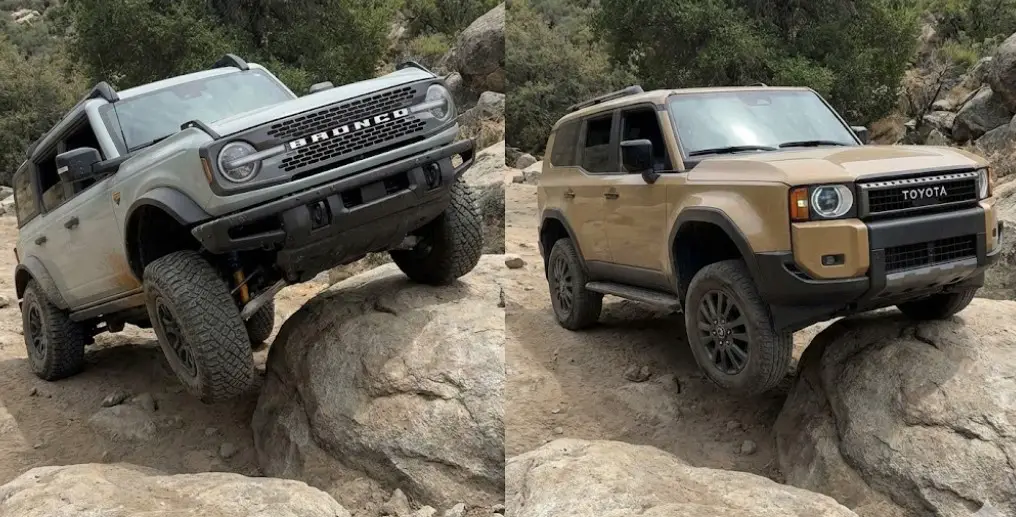
The Ford Bronco is famous for its class-leading geometry, particularly with the Sasquatch package. The Land Cruiser 250, while capable, takes a more conservative approach, prioritizing stability and breakover protection over extreme rock-crawling angles.
| Metric | 2025 Toyota Land Cruiser (1958) | 2025 Ford Bronco (Badlands 4-Door) | 2025 Ford Bronco (Sasquatch) | 2025 Toyota 4Runner (TRD Pro) |
| Ground Clearance | 8.0 inches | 11.5 - 11.6 inches | 11.5 inches | 10.1 inches |
| Approach Angle | 31 degrees | 43.2 degrees | 43.2 degrees | 32 degrees |
| Departure Angle | 17 - 22 degrees | 37.0 degrees | 37.0 degrees | 24 degrees |
| Breakover Angle | 25 degrees | 26.3 degrees | 26.3 degrees | 24 degrees |
| Factory Tires | 31-32 inch All-Season | 33 inch All-Terrain | 35 inch Mud-Terrain | 33 inch All-Terrain |
Suspension Tech: SDM vs. Disconnect
Both manufacturers offer technology to increase wheel articulation, but the execution differs.
- Ford (Stabilizer Bar Disconnect): The Bronco Badlands features a hydraulic disconnect that completely severs the link between the two front wheels. This allows for massive articulation but can feel "floppy" if driven fast over uneven terrain while disconnected.
- Toyota (SDM): The Land Cruiser introduces the Stabilizer with Disconnection Mechanism (SDM). Unlike the Ford system, the SDM doesn't just disconnect; it changes the stiffness state. It allows for articulation while maintaining a degree of roll control, making it safer for higher-speed desert running or uneven forest roads where complete disconnection might be unstable.
Traction Management
- Ford (G.O.A.T. Modes): Ford's "Goes Over Any Type of Terrain" system is highly praised for its user-friendliness. It adjusts throttle mapping, shift points, steering weight, and locker engagement with a single dial.
- Toyota (Multi-Terrain Select - MTS): The Land Cruiser’s MTS is now functional in both 4WD High and 4WD Low (previously only Low). It includes modes for Dirt, Sand, Mud, Rock, and Deep Snow. Combined with the silent "Crawl Control" (which has replaced the noisy ABS-pulsing system of the past), Toyota has refined its traction software to be nearly foolproof.
Ownership Costs and Utility
While the Bronco wins on the spec sheet for extreme rock crawling, the Toyota Land Cruiser wins on the spreadsheet for ownership.
- Fuel Economy: The Land Cruiser’s 23 MPG combined rating is roughly 20-30% better than a comparable Bronco V6, which often struggles to hit 18 MPG in real-world mixed driving. Over 5 years or 60,000 miles, this results in thousands of dollars in fuel savings.
- Towing: The Land Cruiser’s 6,000 lb towing capacity is a game-changer for families with boats or campers. The Bronco’s 3,500 lb limit (4,500 on Raptor) restricts it to small teardrop trailers or jet skis.
Conclusion: Evaluating the "Toyota Bronco"
The "Toyota that looks like a Bronco" is not a singular vehicle but a strategic ecosystem designed to encircle the market segment Ford has revitalized.
- For the Purist: The 2025 Land Cruiser 1958 is the definitive answer. Its round headlights, heritage grille, and boxy silhouette offer the visual nostalgia of the Bronco but with the maturity, quietness, and hybrid efficiency of a Toyota. It is the "grown-up" Bronco alternative—less manic, more refined, and built for the long haul.
- For the Dreamer: The Land Cruiser ROX concept represents the potential future where Toyota directly challenges the Bronco’s open-air dominance. It proves Toyota is listening to the demand for fun, convertible off-roaders and willing to engineer complex solutions to provide them.
- For the Value/Volume Buyer: The 2025 4Runner serves as the functional competitor. It matches the Bronco’s aggression trim-for-trim, offers the unique "open-ish" experience of the roll-down rear window, and provides a lower price point for entry.
Ultimately, while the Ford Bronco focuses on modularity and extreme off-road metrics (the "Jeep fighter"), the Toyota alternatives focus on reliability, refinement, and overlanding capability. The Land Cruiser looks like a Bronco to capture the eye, but it drives like a Toyota to capture the wallet. For the consumer asking the question, the choice comes down to a fundamental preference: do they prioritize the visceral thrill of a removable roof (Bronco), or the stoic confidence of a vehicle engineered to cross continents quietly (Land Cruiser)?
Appendix: Detailed Specification Comparisons
A.1 Pricing Hierarchy (2025 Model Year Estimates)
| Vehicle Trim | Estimated MSRP | Key Competitor Trim |
| Toyota 4Runner SR5 | ~$41,270 | Ford Bronco Big Bend ($40,370) |
| Toyota 4Runner TRD Off-Road | ~$49,690 | Ford Bronco Black Diamond / Outer Banks |
| Toyota Land Cruiser 1958 | ~$56,000 - $58,150 | Ford Bronco Heritage Edition ($49,475) |
| Toyota Land Cruiser (Std) | ~$62,920 | Ford Bronco Badlands ($50,095) |
| Toyota 4Runner TRD Pro | ~$67,400 | Ford Bronco Wildtrak / Raptor (entry) |
| Ford Bronco Raptor | ~$90,035 | No direct Toyota Competitor (yet) |
A.2 Dimensions
| Model | Length (in) | Width (in) | Wheelbase (in) |
| Toyota Land Cruiser 250 | 193.7 | 77.9 | 112.2 |
| Ford Bronco (4-Door) | 189.4 | 75.9 (Base) / 79.3 (Sasq) | 116.1 |
| Toyota 4Runner (2025) | 194.9 | 77.9 | 112.2 |
(Note: Data sourced from )
A.3 Powertrain & Efficiency
| Model | Engine | HP / Torque | Transmission | MPG (Comb) | Towing (lbs) |
| Toyota Land Cruiser 250 | 2.4L Turbo Hybrid | 326 / 465 | 8-Speed Auto | 23 | 6,000 |
| Ford Bronco (2.3L) | 2.3L Turbo I-4 | 300 / 325 | 10-Speed Auto | 20 | 3,500 |
| Ford Bronco (2.7L) | 2.7L Turbo V6 | 330 / 415 | 10-Speed Auto | 19 | 3,500 |
| Toyota 4Runner (Hybrid) | 2.4L Turbo Hybrid | 326 / 465 | 8-Speed Auto | N/A | 6,000 |
Deep Dive: 2025 Toyota Land Cruiser (250 Series)
To fully understand why the 2025 Land Cruiser is the primary answer to the "Toyota Bronco" query, one must dissect its positioning. For decades, the Land Cruiser in America (the 100 and 200 Series) was a luxury status symbol, rivaling Range Rovers. The 250 Series marks a return to the "Prado" lineage—a smaller, more utilitarian family of vehicles sold globally. This shift is what allowed the price to drop from nearly $90,000 to the mid-$50,000s, placing it directly in the Bronco's crosshairs.
The "1958" Trim Aesthetic
The "1958" trim is a masterclass in retro-branding. By utilizing round LED headlights, Toyota isn't just copying the Bronco; it is referencing the FJ25 and FJ40, vehicles that established Toyota's reputation before the Bronco even existed. The grille is unpainted black plastic, the wheels are 18-inch alloy but styled simply, and the interior features cloth seats. This "de-contenting" serves a dual purpose: it lowers the entry price and it appeals to off-roaders who prefer simpler materials that are easier to clean and cheaper to replace.
Comparison Point: The Ford Bronco Base (now discontinued) and Big Bend trims use a similar strategy—steel wheels (or steel-look alloys), cloth seats, and minimal chrome. Both manufacturers have realized that "base model" aesthetics are actually a premium feature for a certain subset of buyers who want to modify their vehicles.
The "Land Cruiser" Trim (Mid-Spec)
Interestingly, the mid-tier trim (simply called "Land Cruiser") switches to rectangular headlights. This is a nod to the FJ62 Land Cruiser of the late 1980s. This creates a visual bifurcation in the lineup:
- Round Lights (1958 Trim): Targets the Bronco/Wrangler buyer who loves the 60s/70s vibe.
- Rectangular Lights (Land Cruiser Trim): Targets the 4Runner/Cherokee buyer who prefers 80s/90s "radwood" aesthetics.Ford does not offer this level of facial customization within the Bronco lineup (aside from grille changes), giving Toyota a unique way to appeal to different generations of nostalgia within a single model line.
i-FORCE MAX: The Hybrid Advantage
The decision to go hybrid-only is a bold differentiator. The Ford Bronco’s fuel economy is a common complaint among owners, with real-world numbers often dipping into the teens, especially with large tires. The Land Cruiser’s hybrid system offers a rated 23 MPG combined.
- Range: With a 17.9-gallon tank, the Land Cruiser offers a theoretical range of over 400 miles. The Bronco’s tank size varies (16.9 gal for 2-door, 20.8 for 4-door), but its thirstier engines limit range.
- Off-Road Power Export: The Land Cruiser includes a 2400W AC inverter standard on the 1958 trim. This allows overlanders to power fridges, lights, or tools directly from the hybrid battery—a feature Ford has yet to match in the Bronco (though the F-150 PowerBoost offers it). This positions the Land Cruiser as a better "base camp" vehicle.
The Concept Frontier: Land Cruiser ROX & FJ
Land Cruiser ROX: Breaking the Unibody Myth
The ROX concept is significant because it challenges the engineering limitations of the TNGA-F platform. Typically, body-on-frame vehicles with fixed roofs rely on the roof structure for a portion of their stiffness. To create the ROX, Toyota had to engineer a "skeleton" structure that maintains safety and rigidity without the C-pillar and D-pillar glass.
- Why it matters: If Toyota produces this, it invalidates the argument that "only Jeeps and Broncos can be convertibles." It would force competitors to rethink their fixed-roof strategies. The "sliding soft top" is particularly innovative because it solves the Bronco's "storage problem"—where do you put the hardtop panels when you take them off? A sliding top is always with you.
The "Land Cruiser FJ": The Missing Link
The "Compact Cruiser" or "Land Cruiser FJ" is the vehicle that should exist to fight the Bronco Sport, but leaks suggest it will be much more capable.
- Hilux Champ DNA: By reportedly using the IMV 0 platform (a simplified, rugged ladder frame for developing markets), the Land Cruiser FJ would be a body-on-frame compact SUV. The Bronco Sport is a unibody crossover based on the Ford Escape.
- Implication: A body-on-frame compact Toyota would decimate the Bronco Sport in durability and towing, likely towing 3,000-4,000 lbs compared to the Bronco Sport's 2,000-2,200 lbs. It would be a true "mini-truck" SUV, a segment that has been dead since the original Chevy Tracker/Suzuki Sidekick.
- The "Forbidden Fruit" Risk: Snippets indicate it might not come to the US. This is a classic Toyota move—keeping rugged, simple diesels and trucks (like the Hilux) out of the US to protect the Tacoma/4Runner margins. However, if the Bronco Sport continues to sell well, the pressure to bring the FJ here will mount.
The 2025 4Runner: The "Shadow" Bronco
While the Land Cruiser gets the headlines for the "1958" retro look, the 2025 4Runner is arguably the functional equivalent of the Bronco for most buyers.
- Roll-Down Window: This 4Runner staple is the closest thing to open-air driving without removing a roof. It creates airflow that mimics a convertible.
- Trailhunter Trim: This new trim is a direct answer to the Bronco Everglades and Badlands. It comes with factory-installed ARB steel bumpers, Old Man Emu suspension, and rock rails. This "turn-key overlander" strategy mimics Ford's strategy of offering modified-from-factory vehicles.
- Pricing: The 4Runner SR5 starting around $41,270 undercuts the Land Cruiser significantly and overlaps with the Bronco Big Bend ($40,370). This makes the 4Runner the volume fighter, while the Land Cruiser is the halo product.
Detailed Technical Comparison: Off-Road Systems
Traction Management
- Ford Bronco (G.O.A.T. Modes): Ford's Terrain Management System is highly praised for its user-friendliness. It adjusts throttle mapping, shift points, and locker engagement.
- Toyota (Multi-Terrain Select - MTS): The Land Cruiser’s MTS is now functional in both 4WD High and 4WD Low (previously only Low). It includes modes for Dirt, Sand, Mud, and Deep Snow.
- Crawl Control vs. Trail Control: Both systems offer low-speed cruise control. Toyota's Crawl Control was notoriously loud/clicky in older generations but has been silenced and smoothed out in the 250 Series. Ford's Trail Control is generally considered smoother, but Toyota's latest iteration is now competitive.
Suspension Articulation
- Bronco: The standout feature is the Stabilizer Bar Disconnect. It can be disconnected under load and at speed (up to 20mph, or higher on Raptor), allowing massive front wheel articulation.
- Land Cruiser: The 250 Series introduces the SDM (Stabilizer with Disconnection Mechanism). Unlike the Wrangler/Bronco which fully disconnect the bar, the SDM "unlocks" the stiffness, allowing articulation while maintaining some roll control. It is a safer, albeit slightly less extreme, solution.
Synthesis: The "Retro-Rugged" Trend Analysis
The convergence of Toyota and Ford on this "boxy" design language is not a coincidence. It is driven by:
- Safety Regulations vs. Style: Pedestrian safety standards demand higher hoods, which naturally leads to blunt, upright front ends. Designers have leaned into this by making them boxy rather than bulbous.
- The "Escape" Fantasy: Post-pandemic consumers value vehicles that signal "capability" and "escape," even if they never leave the pavement. The roof racks, tow hooks, and squared fenders are semiotic markers of this lifestyle.
- Heritage Mining: Both brands have realized that their 1960s/70s IP is invaluable. "New" designs struggle to gain traction (e.g., the polarization of the Tesla Cybertruck), whereas "familiar" designs like the Bronco and Land Cruiser 1958 trigger positive emotional associations immediately.
Recommendation for the Buyer:
- Buy the Bronco if: You want the convertible experience, you plan to rock crawl on technical 9/10 trails, or you want a manual transmission.
- Buy the Land Cruiser if: You want a vehicle that will last 20 years with minimal issues, you value cabin quietness and comfort for daily commuting, you tow a small trailer, or you want the retro look without the "Jeep-like" compromises in refinement.
- Wait for the 4Runner if: You want a balance of both—the roll-down window fun, the rugged look, and a lower price point than the Land Cruiser.