Starsky & Hutch Gran Torino: Specs of the Striped Tomato

The Ford Gran Torino became a global pop-culture icon as the ‘Striped Tomato’ in the 1970s hit series Starsky & Hutch. This V8-powered muscle car featured a distinctive white vector stripe and slotted alloy wheels, eventually prompting Ford to manufacture over 1,300 limited-edition factory replicas.
🎯 Key Takeaways
- Primary show cars were 1975 and 1976 Ford Gran Torino models.
- The ‘Striped Tomato’ nickname was coined by actor Paul Michael Glaser.
- Most production cars used 351 Windsor or 400 cubic inch V8s.
- Ford released 1,305 official factory-built replicas in 1976.
- The car featured 15-inch Ansen Sprint slotted aluminum wheels.
The iconic red-and-white 1974-1976 Ford Gran Torino from Starsky & Hutch is more than just a piece of television history; it is a high-performance character in its own right. While the show focused on two street-smart detectives, the real star for gearheads was the “Striped Tomato,” a car defined by its massive white vector stripe, oversized slotted mag wheels, and a raked stance that screamed 1970s American muscle. If you are looking to build a tribute or simply want to know what lived under the hood of those stunt cars, you need to understand the precise combination of Ford factory parts and custom modifications that created this legend.
Practically speaking, the Gran Torino was an interesting choice for a high-speed pursuit vehicle. It was a heavy, mid-sized car during an era when emission regulations were beginning to choke V8 performance. However, through a mix of clever cinematography and specific mechanical tweaks, the production team transformed a standard family-oriented coupe into an aggressive pursuit machine. Understanding these specifications allows you to distinguish between a stock 1975 Torino and the “hero” cars that performed the famous jumps and slides on the streets of fictional Bay City.
Technical Specifications and Visual Identity
The visual identity of the Starsky & Hutch Gran Torino is defined by a very specific set of aesthetic choices that set it apart from anything else on the road in the mid-70s. The primary cars used in the series were 1974, 1975, and 1976 models. While the body style remained largely consistent, the 1974 models are often favored by purists for their slightly cleaner bumper integration, though the 1976 models became the basis for Ford’s limited edition factory replicas. To get the look right, you have to focus on the “Big Three” visual elements: the paint, the wheels, and the stance.
The Iconic Vector Stripe and Paint
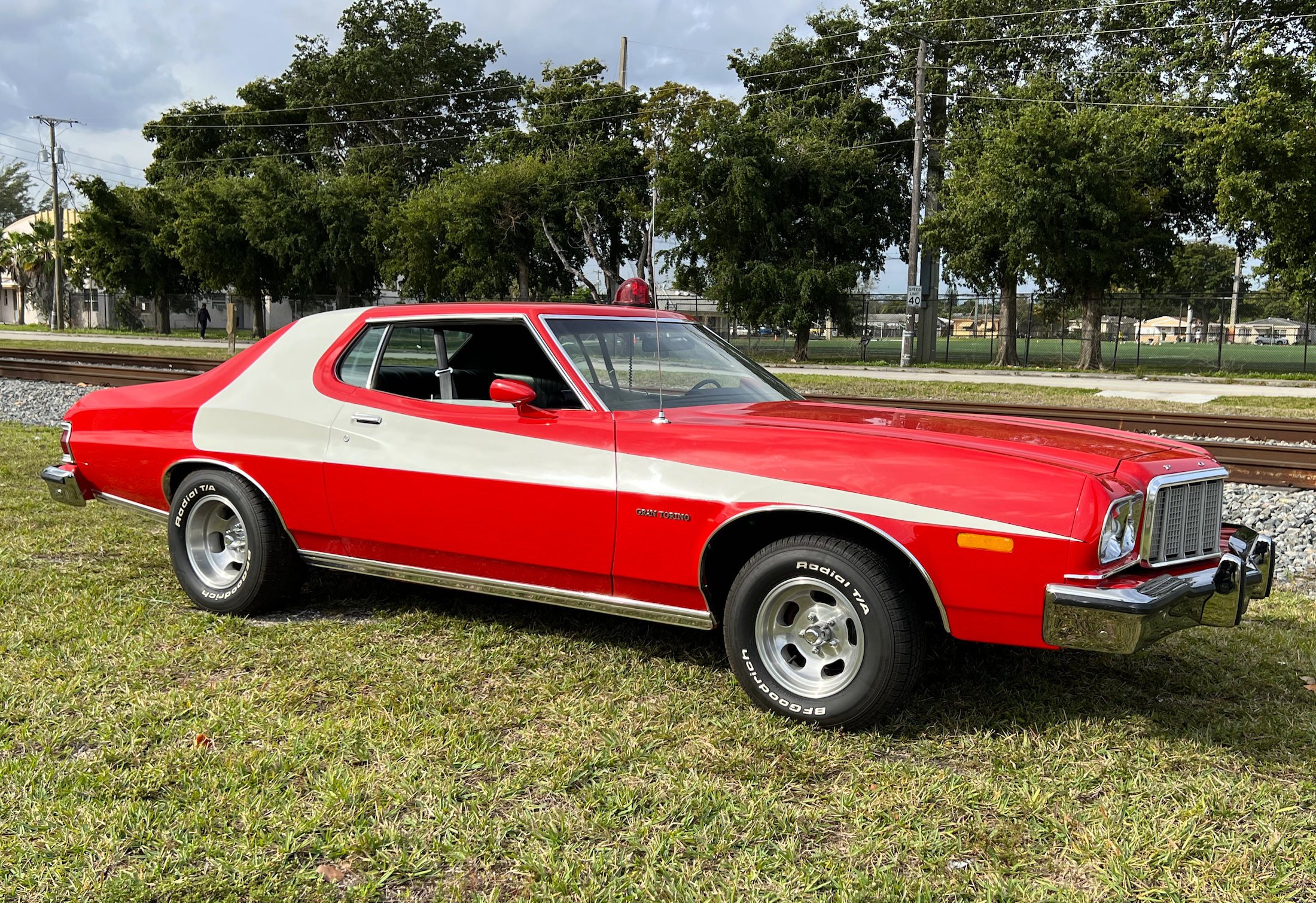
The most recognizable feature of the car is the “Vector” stripe. This isn’t just a generic white line; it follows a specific path that starts thin at the front fender, sweeps up over the roofline, and widens significantly as it wraps around the rear quarter panel and over the trunk. The base color of the car was “2B” Bright Red, a standard Ford color at the time, but the stripe was almost always a custom vinyl application for the show’s production efficiency.
- Primary Body Color: Ford Bright Red (Paint Code 2B).
- Stripe Style: White “Vector” or “Hockey Stick” design wrapping over the roof and trunk.
- Side Mirrors: Usually dual color-keyed racing mirrors, though some stunt cars used standard chrome versions.
- Bumper Guards: Heavy rubber stripping on the front and rear bumpers to handle the impact of stunt driving.
Wheels, Tires, and the Raked Stance
The “shoes” of the Striped Tomato are what give it that aggressive, ready-to-pounce look. The production team ditched the standard Ford hubcaps for 15-inch Ansen Sprint slotted aluminum alloy wheels. These “slot mags” were the definitive aftermarket wheel of the era. To achieve the aggressive forward lean, the team used air shocks in the rear and often swapped out the springs. This raked stance wasn’t just for looks; it helped clear the larger tires and gave the car its signature silhouette during high-speed cornering scenes.
- Wheels: 15×7 inch front and 15×8.5 inch rear Ansen Sprint slotted alloys.
- Tires: Typically Firestone 500 or Goodyear tires with raised white lettering (often blacked out for filming).
- Suspension: Heavy-duty shocks and rear air shocks to provide a significant rear-end lift.
- Exhaust: Dual exhaust systems were added to give the 351 or 400 V8s a deeper, more intimidating rumble.
Behind the Scenes: The ‘Striped Tomato’ Show History
The story of how the Gran Torino became the most famous car on television is one of corporate partnerships and unexpected outcomes. In the mid-1970s, Ford had a lucrative “Studio-TV Car Loan Program,” which allowed production companies to lease vehicles for a nominal fee. When Spelling-Goldberg Productions needed a car for their new detective show, they didn’t originally ask for a Torino. They wanted something smaller and more agile, possibly a Chevrolet Camaro, but Ford’s contract meant the producers had to choose from the current Ford fleet.
Selection and the Ford Partnership
The Gran Torino was selected because it was Ford’s mid-size heavy hitter, though it was arguably too large for the narrow alleys of a typical TV set. The show’s transportation coordinator wanted a car that would pop on the screen, leading to the creation of the white stripe. During the first season, the production used 1974 models, but as the show’s popularity exploded, Ford realized they had a marketing goldmine. By 1976, Ford released a limited run of 1,000 factory-built Starsky & Hutch replica Torinos to satisfy public demand.
Actor Reception and the Famous Nickname
You might be surprised to learn that Paul Michael Glaser, who played David Starsky, initially hated the car. He found it bulky, garish, and difficult to handle. It was Glaser who first dubbed the car the “Striped Tomato” during an early script reading, intended as a derisive joke. He famously remarked that the car looked like a giant fruit, and he often treated the vehicle roughly during stunts because he wasn’t a fan of its aesthetics. However, David Soul (Hutch) and the viewing public felt differently. The car quickly became the “third character” of the show, receiving as much fan mail as the lead actors.
- The Nickname: Coined by Glaser as a sarcastic critique of the bright red and white paint job.
- The Siren: The famous “bubble” light was a magnetic Federal Signal Signal-Stat Dual-Face lamp, which Starsky would slap onto the roof during chases.
- The Radio: A Motorola CB radio was frequently used in the car, reflecting the 1970s obsession with citizen band communication.
- The Interior: Most show cars featured black vinyl bench or bucket seats, with a column-mounted or floor-mounted shifter depending on the specific stunt car’s configuration.
Conclusion
In summary, understanding starsky and hutch gran torino is essential for success in this area. Apply these insights to see real results.
💬 Quick Questions & Answers
What year was the original Starsky & Hutch car?
The show primarily used 1975 and 1976 Ford Gran Torinos throughout its four-season run.
What engine did the TV show car have?
The cars were typically equipped with 351 Windsor or 400 cubic inch V8 engines to handle stunt work.
Why is it called the ‘Striped Tomato’?
Actor Paul Michael Glaser gave it the nickname because he disliked the car’s bright red color and oversized stripe.
How many factory replicas did Ford build?
Ford produced exactly 1,305 limited-edition ‘Starsky & Hutch’ replicas in 1976 due to high demand.
What kind of wheels were on the Gran Torino?
The car famously sat on 15-inch Ansen Sprint (or Wolfrace in some markets) slotted alloy wheels.
❓ Frequently Asked Questions
What specific modifications were made to the TV show cars?
Production cars were modified with heavy-duty suspension for jumps, air shocks to give the car a raked stance, and the iconic vinyl vector stripe. Some chrome trim was also dulled to prevent camera glare during filming.
Did the actors actually like driving the Gran Torino?
David Soul was generally indifferent, but Paul Michael Glaser notoriously hated the car, calling it ‘childish’ and ‘ugly.’ He often treated the car roughly during stunts because he found it bulky and difficult to maneuver.
How can you identify a real 1976 Ford factory replica?
Authentic factory replicas carry a specific DSO (District Sales Office) code and were produced at Ford’s Chicago plant. They featured the 2B ‘Bright Red’ paint and a factory-applied white vector stripe as part of the PS-122 package.
How many cars were used during the filming of the series?
It is estimated that between 7 and 10 Gran Torinos were used during the series. These included ‘Hero’ cars for close-ups and heavily modified ‘Stunt’ cars for jumps and high-speed slides.
Where is the original ‘Hero’ car today?
Several surviving cars exist in private collections; the primary ‘Hero’ car from the first season was sold at auction and has been meticulously restored to its original filming condition by specialized collectors.
What are the performance specs of the engines used?
While the 351 Windsor produced roughly 150-160 horsepower in stock form due to 1970s emissions laws, stunt coordinators often tuned them for higher torque to ensure the car could perform the dramatic power slides required for the show.