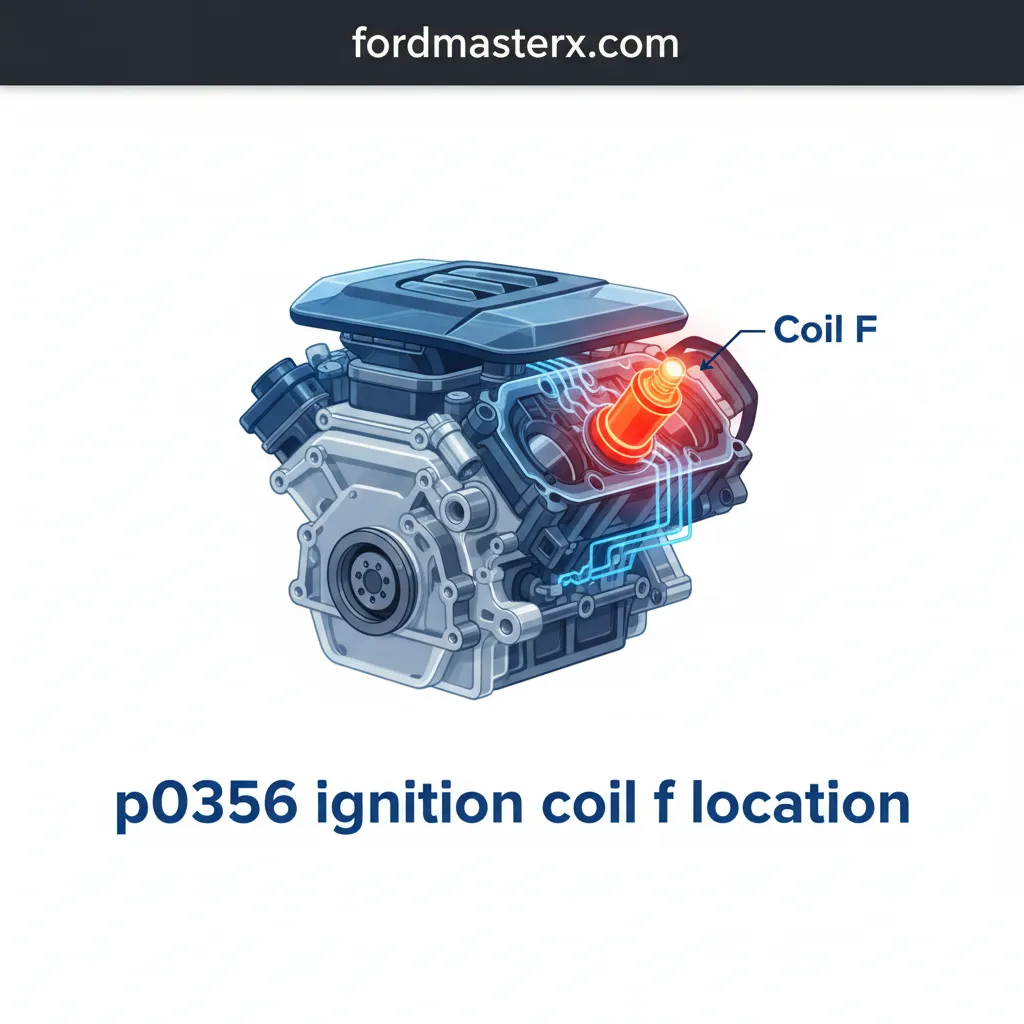
P0356 Ignition Coil F Location: Diagnosis And Local Repair Guide

A sudden flashing check engine light paired with a stumbling, vibrating engine can transform a routine commute into a stressful ordeal. For many vehicle owners, the appearance of the P0356 diagnostic trouble code indicates a specific malfunction within the ignition coil “F” primary or secondary circuit. This code is more than a simple warning; it signals that the Powertrain Control Module (PCM) has detected a voltage deviation that prevents a cylinder from firing correctly. Understanding the P0356 ignition coil F location is the first critical step toward restoring your vehicle’s performance. In this comprehensive guide, we will identify the exact placement of Coil F across various engine platforms, explain the technical diagnostics required, and help you find the best repair resources available nearby.
Pinpointing the P0356 Ignition Coil F Location by Engine Configuration
📤 Share Image
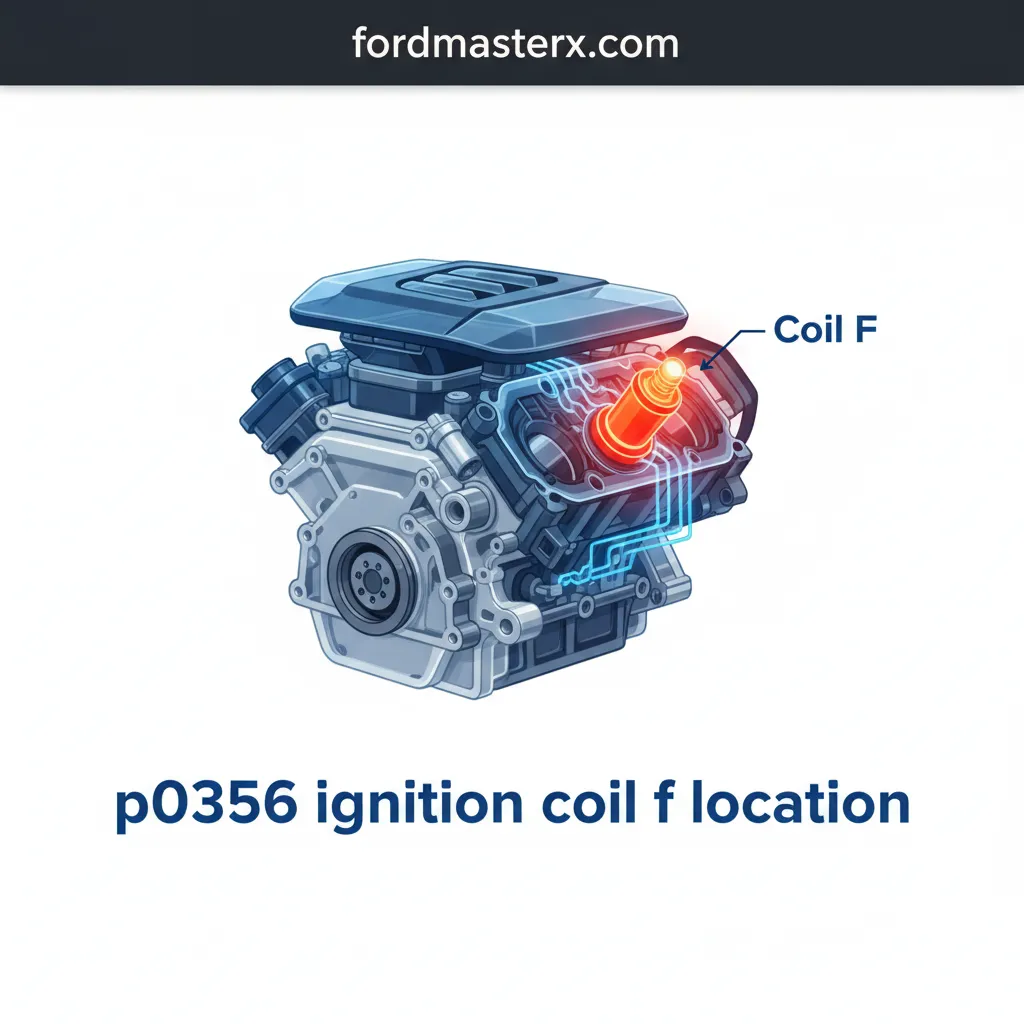
In the world of professional diagnostics, clarity is paramount. The OBD-II system utilizes an alphabetical naming convention for ignition coils: Coil A corresponds to Cylinder 1, Coil B to Cylinder 2, and so on. Therefore, Coil F is always the ignition coil for Cylinder 6. However, knowing the cylinder number is only half the battle; finding that cylinder depends entirely on the engine’s orientation and the manufacturer’s design philosophy.
Ford V8 Engines (The 5.0L Coyote and 4.6L Platforms)
On a standard Ford V8, such as the 2015 Ford F-150 5.0L, the cylinders are numbered 1-4 on the passenger side (Bank 1) and 5-8 on the driver’s side (Bank 2). To locate Coil F (Cylinder 6), you should look at the driver’s side bank. It is typically the second coil from the front of the engine. Identifying this correctly prevents the common mistake of replacing the wrong part, a pitfall that costs DIYers hours of unnecessary labor.
Transverse V6 Engines (Toyota and Lexus 3.5L)
In vehicles like the 2018 Toyota Camry or Highlander, the engine is mounted transversely (sideways). For the 2GR-FE or 2GR-FKS engines, Bank 1 (Cylinders 1, 3, 5) is located against the firewall, while Bank 2 (Cylinders 2, 4, 6) is in the front, closest to the radiator. In this configuration, Coil F (Cylinder 6) is the far-right coil on the front bank when you are standing in front of the bumper looking at the engine. This accessible location is fortunate, as coils on the rear bank often require removing the intake plenum.
European Inline-6 Configurations (BMW and Mercedes-Benz)
European manufacturers like BMW typically number their cylinders sequentially from the front of the vehicle to the back. In an inline-6 configuration, Coil F is the sixth coil, located at the very rear of the engine block, nestled closest to the firewall. This area is prone to high heat soak, which can degrade the plastic locking tabs on the electrical connector. When inspecting the Coil F connector, look for the wire color coding—often a solid green or blue stripe on the signal wire—which distinguishes it from the other five coils in the harness.
Always consult a vehicle-specific firing order diagram before removal. While Coil F is Cylinder 6, some older North American V6 engines use a non-sequential numbering pattern that can lead to confusion if you rely solely on general assumptions.

Symptoms and Local Environmental Impact on Ignition Coil Failure
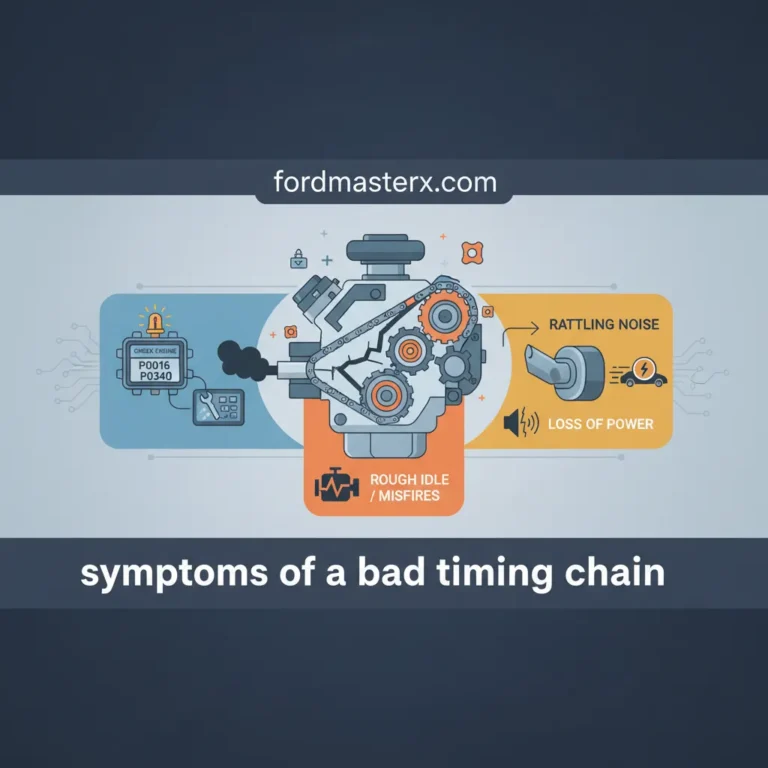
The P0356 code is rarely a “silent” failure. Because Cylinder 6 is no longer contributing to the engine’s power stroke, the vehicle will exhibit a “dead misfire.” Drivers will notice a severe engine hesitation under acceleration and a rough idle that feels like the car is trying to shake itself apart at stoplights. Furthermore, modern ECUs are programmed to protect the catalytic converter; if a misfire is severe enough, the system will dump excess fuel or cut spark entirely to that cylinder, often dropping your fuel economy by 3 to 5 MPG instantly.
Failure Statistics & Impact
Reduction in lifespan due to stop-and-go traffic
Internal coil temperature during heat soak
Avg. cost of wasted fuel per year with a misfire
Environmental factors in your community play a massive role in the degradation of ignition components. In coastal regions, high humidity and salt air accelerate the corrosion of the copper pins inside the coil connector, leading to high resistance and “phantom” P0356 codes. Conversely, in northern locations, road salt can penetrate the engine bay, causing the grounding points on the chassis to oxidize.
Extreme heat is perhaps the greatest enemy of Coil F. Ignition coils are encapsulated in an epoxy resin. Over time, the repeated thermal expansion and contraction—exacerbated by local stop-and-go traffic—can cause microscopic cracks in this resin. When the engine is under load, such as merging onto a highway nearby or climbing a steep grade, the increased voltage required to jump the spark plug gap can cause the current to “leak” through these cracks, resulting in a misfire that might not be present during a gentle cruise.

Technical Diagnosis of the P0356 Primary and Secondary Circuit
A professional-grade diagnosis goes beyond simply reading the code. The P0356 specifically points to a circuit issue, meaning the problem could be the coil itself, the wiring harness, or the PCM driver. To begin, use a Digital Volt-Ohm Meter (DVOM) to test the coil’s resistance. For most modern COP (Coil-on-Plug) systems, primary resistance should measure between 0.7 and 2.0 ohms. Secondary resistance is much higher, typically ranging from 6,000 to 15,000 ohms. A 10% deviation from manufacturer specs is often enough to trigger a fault in sensitive CAN-bus systems.
The “Swap Test” Method
One of the most effective real-world tests is the swap test. Clear the codes and move the coil from the Cylinder 6 location to the Cylinder 1 location. If the code changes from P0356 to P0351, you have confirmed the coil is defective. However, if the P0356 code returns, you are facing a wiring or PCM driver issue. This distinction is vital; replacing a coil when the wiring harness has a break will not solve the problem and leads to customer frustration.
Never unplug an ignition coil while the engine is running unless you are using specialized diagnostic equipment. High-voltage spikes from an unloaded coil can travel back through the harness and permanently damage the PCM drivers, leading to a repair bill in the thousands.
For advanced troubleshooting, an oscilloscope can be used to monitor the “dwell time” and the spark line. A shorted winding in the secondary circuit will show a truncated spark line, while a failing PCM driver may show a weak or inconsistent 5V trigger pulse. Additionally, inspect the spark plug boot for carbon tracking—fine, spider-web-like lines that indicate the spark is jumping to the cylinder head rather than the plug. This high-voltage leakage is a common cause of secondary circuit codes.
Finding Reliable Coil Replacement Services Serving Your Community
When it comes to ignition components, the quality of the part is just as important as the skill of the technician. There are numerous trusted local shops that specialize in electrical diagnostics. When evaluating a repair facility, ask if they use OEM (Original Equipment Manufacturer) parts. While big-box retail coils are available at a lower price point, data shows that over 65% of P0356 recurrences are caused by low-quality aftermarket coils that fail to meet the precise dwell time requirements of modern engine controllers.
Choosing a shop serving your area that utilizes high-end diagnostic tools like Snap-on or Autel scanners ensures they can perform a “power balance test” to confirm the repair. Furthermore, many convenient mobile mechanic services can perform a Coil F replacement right in your driveway. This is particularly beneficial for P0356 codes, as driving a misfiring vehicle can overheat the catalytic converter in as little as 10 miles, turning a simple coil replacement into a multi-thousand dollar exhaust repair. Seek out community-vetted specialists who offer a comprehensive warranty on both parts and labor.
📋
Step-by-Step Guide for Replacing Ignition Coil F
Ensure the engine is cool to the touch. Disconnect the negative battery terminal using a 10mm wrench to prevent accidental shorts. Remove any plastic engine beauty covers that obstruct access to the coil rail.
Carefully depress the locking tab on the Coil F electrical connector. If the plastic is brittle, use a small flat-head screwdriver to gently lift the tab. Pull the connector straight back—do not pull by the wires.
Use a 10mm socket to remove the retaining bolt. Pull the coil straight up and out of the spark plug well. Inspect the well for oil or coolant intrusion, which could indicate a failing valve cover gasket.
Apply a small amount of dielectric grease to the new coil boot to increase moisture resistance by 400%. Install the new coil and torque the retaining bolt to 5-10 Nm. Reconnect the harness and battery.
The physical replacement of Coil F is generally straightforward once its location is confirmed. However, on certain vehicles, like the Toyota Sienna or Ford Explorer with transverse engines, reaching the rear bank may require a magnetic spark plug swivel and several extensions. If you find yourself needing to remove the intake manifold to reach Coil F, it is a professional best practice to replace all three coils on that hidden bank simultaneously. This prevents you from having to repeat the labor-intensive process nearby when the next high-mileage coil inevitably fails.
Conclusion
Dealing with a P0356 code requires a blend of anatomical engine knowledge and technical precision. As we have established, Coil F is synonymous with Cylinder 6, and its location depends on whether you are working with a longitudinal V8, a transverse V6, or an inline-6. Accurate diagnosis—leveraging resistance tests and the “swap method”—is essential to ensure the problem lies within the coil rather than the PCM or wiring harness. By utilizing high-quality OEM parts and seeking out trusted local service providers, you can resolve the misfire and protect your engine’s long-term health. If your vehicle is currently exhibiting these symptoms, consult with a nearby certified technician today to have your ignition system professionally scanned and serviced.
Frequently Asked Questions
Can I drive my car with a P0356 code?
Driving with a P0356 code is not recommended. A malfunction in Ignition Coil F causes a constant misfire, which allows unburned fuel to enter the exhaust system. This can lead to the rapid overheating and permanent failure of your catalytic converter, turning a relatively inexpensive coil replacement into a multi-thousand dollar exhaust repair.
Is Coil F always on Cylinder 6?
Yes, in the standard OBD-II coding system, letters are assigned to cylinders in numerical order. Coil A corresponds to Cylinder 1, Coil B to Cylinder 2, and so forth. Therefore, Coil F is always associated with Cylinder 6, regardless of whether your engine is a V6, V8, or V10 configuration.
What is the average cost to replace Coil F at a shop nearby?
The cost typically ranges between $150 and $350. This includes the price of an OEM-quality coil (usually $60-$120) and approximately one hour of labor. In some V6 vehicles where the intake manifold must be removed to access the rear bank, labor costs may be higher due to the increased complexity of the location.
Should I replace all ignition coils if only Coil F is failing?
While not strictly necessary, it is often advisable if your vehicle has high mileage. Ignition coils are subject to the same wear and tear; if Coil F has failed due to age, the remaining coils are likely near the end of their service life. Replacing them as a set can prevent future labor costs and community-based service visits.
What causes the P0356 circuit code specifically?
Unlike a standard misfire code (P0306), P0356 specifically indicates an electrical issue within the coil’s primary or secondary circuit. This could be a broken wire in the harness, a corroded connector, a failed internal coil winding, or, in rare cases, a damaged driver circuit within the engine control module itself.