Mustang Boss 302 Laguna Seca: Performance Specs And Track Engineering

The Mustang Boss 302 Laguna Seca stands as one of the most focused and track-ready vehicles ever produced by Ford’s Special Vehicle Team (SVT) and Ford Performance. For enthusiasts and collectors, distinguishing between a standard Mustang GT, a base Boss 302, and the rare Laguna Seca edition requires a deep understanding of specific engineering nuances and historical markers. This article provides a professional, comprehensive guide to the Laguna Seca’s technical specifications, aerodynamic enhancements, and its standing as a high-quality collector’s item in the automotive market. By analyzing the platform through the lens of professional motorsports, we reveal why this machine remains the benchmark for the S197 chassis development.
Historical Context of the Mustang Boss 302 Laguna Seca Heritage
📤 Share Image
To understand the 2012 and 2013 Boss 302 Laguna Seca, one must look back to the fiercely competitive Trans-Am series of 1970. The original Boss 302 was engineered for a singular purpose: to beat the Chevrolet Camaro on the track. This heritage was cemented when Parnelli Jones piloted the legendary School Bus Yellow 1970 Boss 302 to a championship-clinching victory at the Laguna Seca circuit. When Ford Performance decided to resurrect the moniker for the S197 platform, they didn’t just want a tribute; they wanted a vehicle that mirrored the engineering integrity of the modern Boss 302R race car.
The Laguna Seca edition represents the extreme evolution of the base Boss 302. While the standard Boss was a significant leap over the Mustang GT, the Laguna Seca variant was stripped of its “street car” compromises to provide a trusted, professional platform for weekend racers. This progression followed a lineage of high-performance special editions, yet it differed fundamentally from the Mach 1 or the SVT Cobra. While the Cobra often focused on raw horsepower through supercharging, the Laguna Seca focused on dynamic balance and thermal management, much like the precision-engineered European GT3 models.
Production Authenticity
2012 Units Produced
2013 Units Produced
The scarcity of these vehicles is a testament to their specialized nature. With only 1,529 total units produced over a two-year cycle, the Laguna Seca was never intended for mass consumption. It was a professional-grade tool designed for those who appreciated the nuances of turn-in response and mid-corner stability over mere straight-line speed.
Technical Analysis of the Road Runner V8 Engine and Powertrain
The heart of the Laguna Seca is the 5.0L “Road Runner” V8. While based on the Coyote architecture found in the GT, the Road Runner is a different animal entirely. Every internal component was scrutinized to ensure reliable performance at sustained high RPMs. The engine features CNC-ported heads and forged aluminum pistons, which allows it to reach a screaming 7,500 RPM redline—a rarity for a large-displacement American V8 of that era.
Induction and Exhaust Engineering
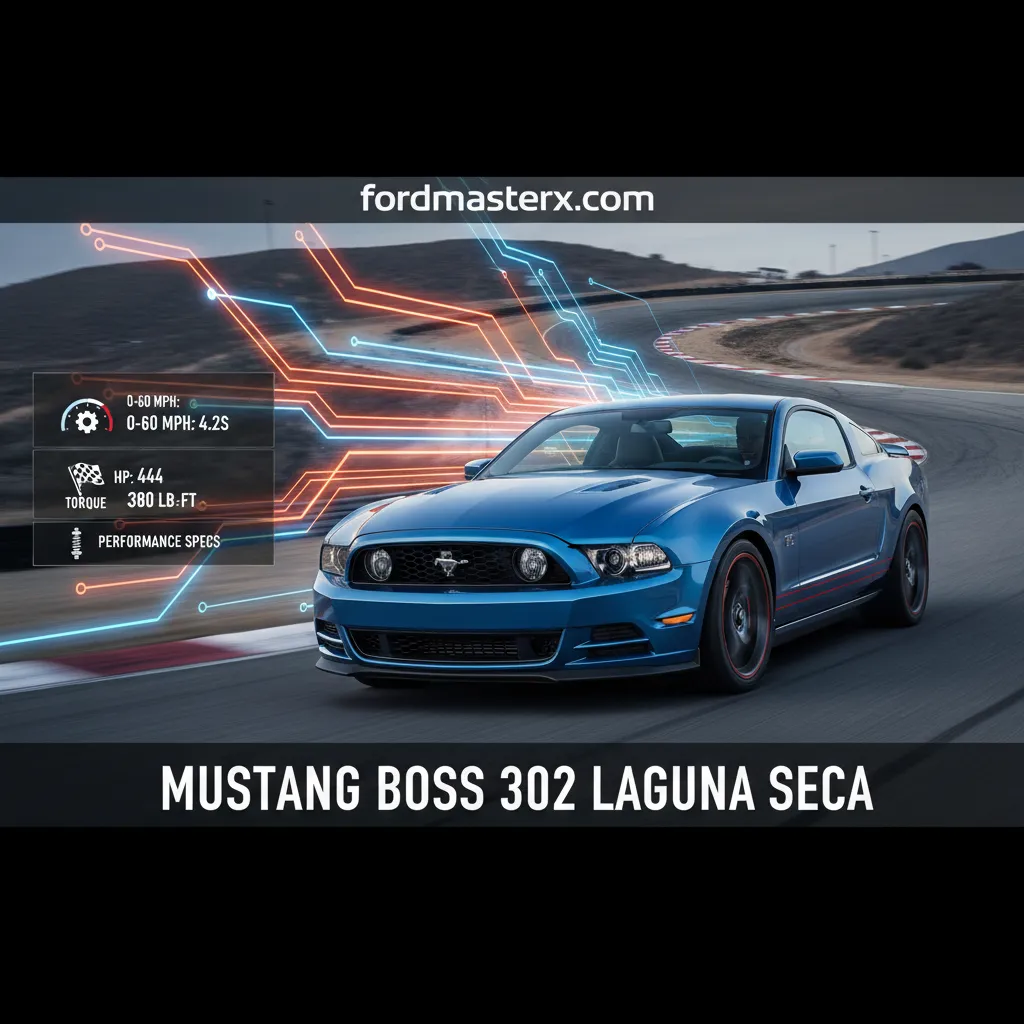
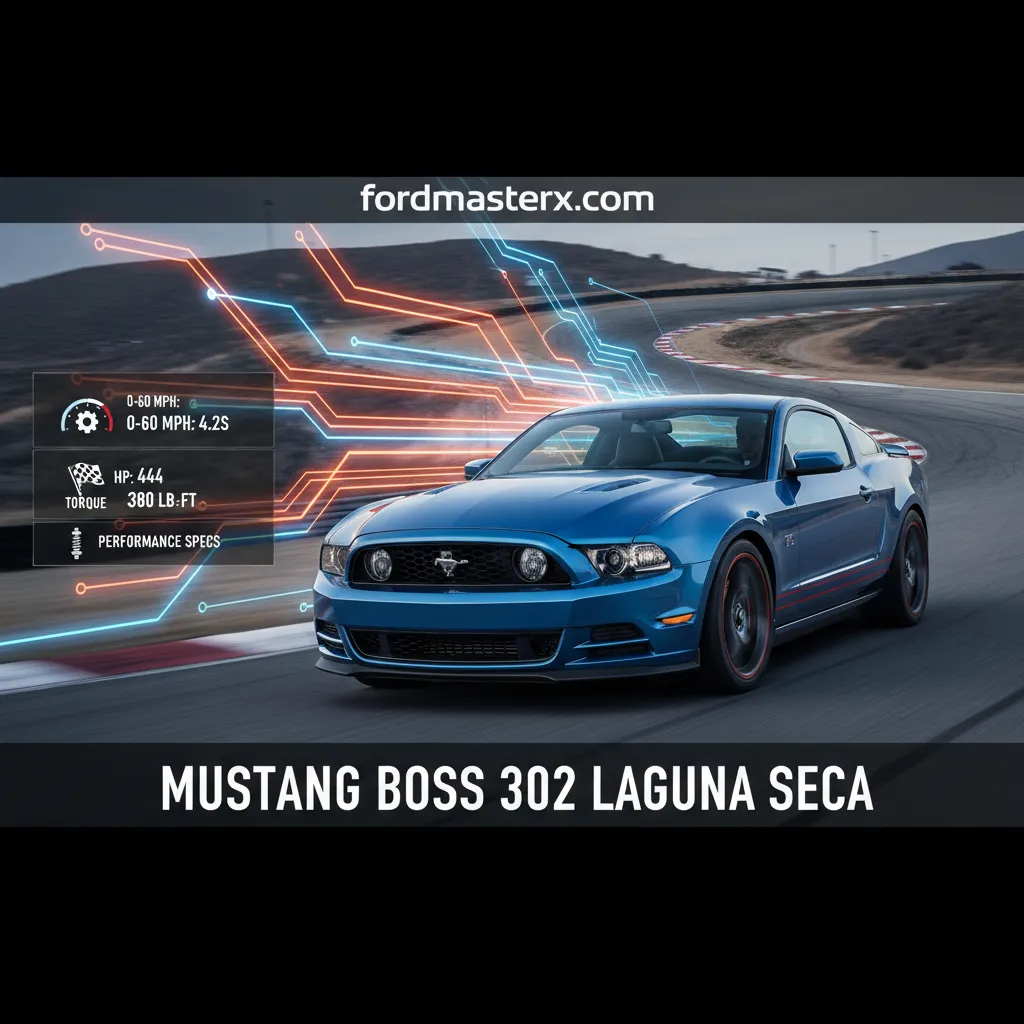
To feed this high-revving monster, Ford Performance equipped the engine with a unique high-flow composite intake manifold with shorter runners, optimized for top-end power. The 11:1 compression ratio demands high-quality fuel, but it rewards the driver with 444 horsepower and 380 lb-ft of torque. One of the most distinctive features is the quad-exhaust system. In addition to the standard rear pipes, the Boss 302 features side-exit pipes that utilize removable ‘attenuation’ discs. Professional track users often remove these discs to allow the Road Runner’s true mechanical symphony to be heard while simultaneously reducing backpressure.
High-RPM Durability
Forged pistons and specialized valve springs ensure the engine survives repeated 7,500 RPM shifts.
Enhanced Cooling
A larger radiator and engine oil cooler provide the thermal headroom required for 20+ minute sessions.
The powertrain is completed by a six-speed manual gearbox fitted with a short-throw shifter for precise, expert-level gear changes. Unlike the standard Mustang GT, the Laguna Seca utilizes a specific clutch material designed to handle the increased heat of rapid downshifts on a circuit. Every element of the powertrain was built to be a reliable companion for the driver, minimizing the common pitfall of heat soak that plagues lesser performance cars.
Chassis and Suspension Tuning for Professional Track Handling
While the engine provides the soul, the chassis tuning is what defines the Laguna Seca. Ford engineers didn’t just stiffen the springs; they re-evaluated the entire structural integrity of the S197 platform. The most striking modification is the rear-seat delete, replaced by a massive tubular X-brace. This isn’t just for aesthetics; the brace increases structural rigidity by 10 percent, providing a more stable platform for the suspension to work from.
The Laguna Seca features manually adjustable dampers. For optimal track performance, a professional setting is typically 5 (Firmest) at the front and 4 at the rear. Always use the provided tool and ensure both sides match perfectly to avoid handling imbalances.
Suspension Componentry
- Manually Adjustable Dampers: Features Laguna Seca-specific valving that is significantly stiffer than the standard Boss 302.
- Torsen Helical Differential: A 3.73 ratio Torsen limited-slip differential ensures power is delivered to the wheel with the most grip, vital for corner-exit traction.
- Stiffer Stabilizer Bars: A larger rear stabilizer bar reduces body roll during high-G cornering.
- Brembo Braking System: Four-piston calipers paired with 14-inch vented rotors and upgraded cooling ducts to prevent brake fade.
The car sits on 19-inch staggered painted aluminum wheels wrapped in R-compound tires (Pirelli P Zero Corsa). These tires are specifically designed for track use and require heat to reach their maximum grip potential. For the professional driver, this setup allows for a level of communication through the steering wheel that was previously unheard of in a live-axle Mustang.
Aerodynamic Profile and Exterior Visual Distinctions
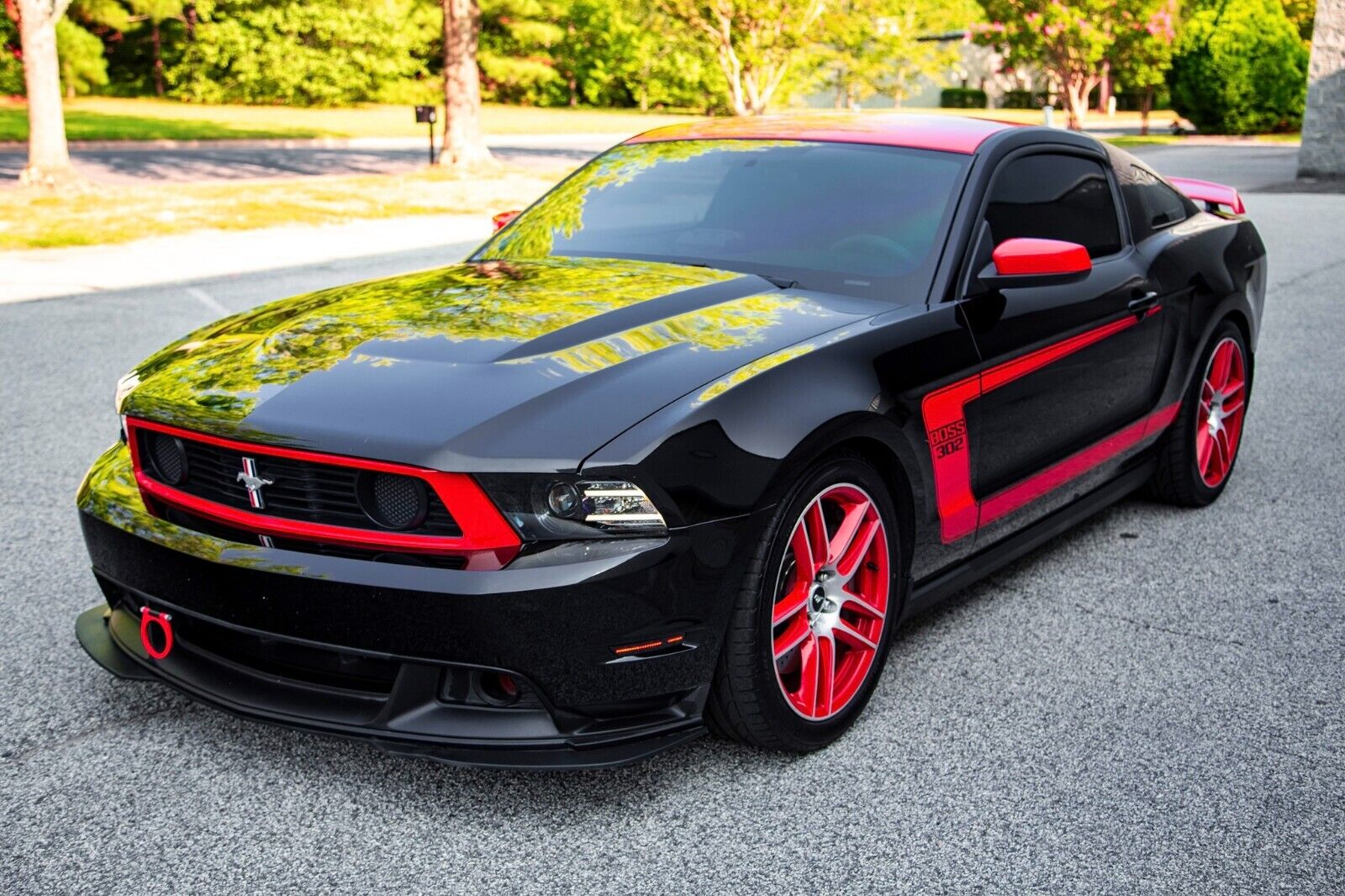
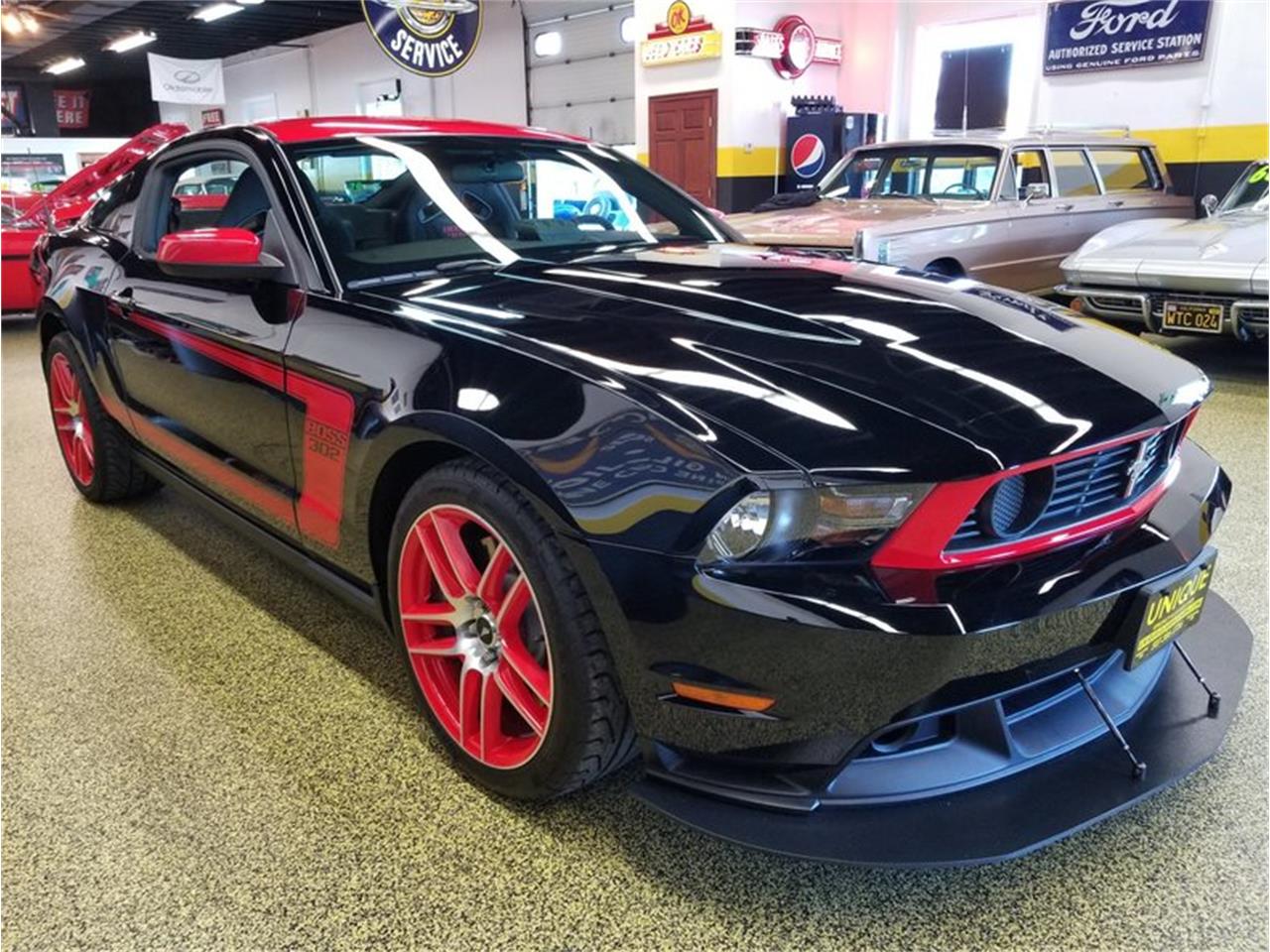
Aerodynamics on the Laguna Seca are functional, not decorative. At the front, an aggressive front splitter extends several inches forward, designed to create a high-pressure zone that reduces lift and improves high-speed front-end grip. This splitter is so low that Ford actually shipped it in the trunk of the car to avoid damage during transport, requiring dealers or owners to perform the final installation—a complete guide to which is often sought by new owners.
The 2012 models were primarily available in a striking Black with Red accents or Silver with Red. The 2013 models shifted to the iconic School Bus Yellow or Black with reflective Sterling Gray accents. The ‘C-stripe’ graphics and the unique rear badge—depicting the Laguna Seca track layout—signify the car’s authenticity. These visual cues serve as a warning to competitors that this isn’t a standard Mustang GT California Special or even a Shelby GT500; it is a precision tool designed for the apex.
Performance Benchmarking and Competitive Track Analysis
When the Laguna Seca was released, it wasn’t just compared to other muscle cars; it was benchmarked against the BMW M3 (E92). In professional testing, the Laguna Seca proved its mettle by delivering a 0-60 mph time of 4.2 seconds and a quarter-mile blitz in 12.4 seconds. However, the lateral acceleration of 1.03g is what truly shocked the industry, proving that a live-axle rear suspension could compete with the world’s best independent rear suspension (IRS) setups when tuned by experts.
📋
Unlocking Performance: The Track Key
The car comes with two keys. The “Silver” key is for street use, while the “Red” Track Key activates a second PCM software calibration.
Once the Track Key is inserted, it alters over 200 engine parameters, including ignition timing, twin independent variable cam timing (Ti-VCT), and engine braking.
The braking performance is equally impressive, with a 60-0 mph stopping distance of just 102 feet. At the actual Laguna Seca Raceway, professional drivers recorded lap times that beat the Audi R8 and the Aston Martin DBS of the same era. This wasn’t a fluke; it was the result of a complete engineering focus on mechanical grip and thermal stability. The car was built to be thrashed all day without the “limp mode” issues often seen in modern turbocharged competitors.
Collector Value and Long-Term Ownership Considerations
As the automotive world moves toward electrification and forced induction, naturally aspirated, manual-transmission track cars like the Laguna Seca are becoming highly prized. Current market values for low-mileage units range from $50,000 to $85,000, with rare color combinations and documented “wrapper” cars (those still in factory delivery plastic) commanding a premium at auctions like Bring a Trailer or Barrett-Jackson.
✅ Pros for Collectors
- Extremely low production numbers (approx. 760/year)
- Direct link to Parnelli Jones racing heritage
- Naturally aspirated “Road Runner” engine is a future classic
- Track-focused modifications are factory-installed and warrantied
❌ Ownership Considerations
- Rear seat delete limits practicality as a daily driver
- Front splitter is prone to damage on steep driveways
- R-compound tires have a very short lifespan
- Stiff suspension can be fatiguing on poor public roads
To ensure the quality and longevity of your investment, authenticity verification is crucial. Prospective buyers should use the VIN to track the car through the official Boss 302 registry and ensure all “Laguna Seca specific” parts—such as the X-brace, the Track Key, and the gauge pod—are present. Maintenance is relatively straightforward, but the trusted owner will focus on regular fluid changes for the Torsen differential and ensuring the Brembo brake system is flushed with high-boiling-point fluid. By following these professional best practices, the Mustang Boss 302 Laguna Seca will remain a high-performance icon for decades to come.
Note that the Track Key software was a dealer-installed option. If buying a used Laguna Seca, verify that the Red Key has been programmed to the PCM. Without the software handshake, the Red Key will behave exactly like the standard Silver key, depriving you of the race-calibrated performance parameters.
The Laguna Seca edition represents the pinnacle of S197 chassis development with its Road Runner V8 and track-tuned suspension. Engineering choices like the rear X-brace and Torsen differential ensure it remains a professional-grade performance tool even a decade after its production. Low production numbers and historical ties to Parnelli Jones make it a reliable investment for serious automotive collectors. For those seeking a professional track experience with heritage styling, exploring the Mustang Boss 302 Laguna Seca through verified owner registries is the recommended next step. This car is not just a Mustang; it is a meticulously engineered piece of American racing history.
Frequently Asked Questions
What is the main difference between a Boss 302 and the Laguna Seca edition?
The Laguna Seca edition is a more aggressive, track-oriented upgrade over the standard Boss 302. Key differences include the removal of rear seats in favor of a tubular X-brace for rigidity, the addition of a Torsen limited-slip differential, stiffer suspension valving, a larger front splitter, and R-compound tires. It is essentially a bridge between the street car and the 302R race car.
How many Mustang Boss 302 Laguna Seca models were produced?
Ford produced a very limited number of these vehicles over a two-year period. In 2012, approximately 767 units were manufactured, while in 2013, production was slightly lower at 762 units. This total of just over 1,500 vehicles makes the Laguna Seca one of the rarest modern Mustangs, contributing significantly to its long-term collector value and market desirability.
What is the Ford ‘Track Key’ and does it come with the Laguna Seca?
The Track Key is a specialized red key that, when used, activates a secondary PCM software calibration designed for professional track use. It adjusts over 200 engine parameters, including ignition timing, fuel maps, and deceleration popping. While the hardware was included with the Laguna Seca, owners often had to pay a small fee to have the expert software calibration activated by a Ford dealer.
Is the Mustang Boss 302 Laguna Seca a good daily driver?
While the Laguna Seca is street-legal, it is engineered primarily for the track. The lack of rear seats, stiffer suspension, and aggressive front splitter make it less practical for daily commuting compared to a standard Mustang GT. However, for a professional enthusiast, the quality of the interior Recaro seats and the reliable Road Runner engine provide enough comfort for occasional spirited road use.
What colors were available for the Laguna Seca edition?
The color palette was highly restricted to maintain exclusivity. For the 2012 model year, the car was available in Black with red accents or Ingot Silver with red accents. For 2013, Ford shifted the palette to honor Parnelli Jones, offering the car in School Bus Yellow or Black, both featuring matte gray (Sterling Gray) accents and stripes.