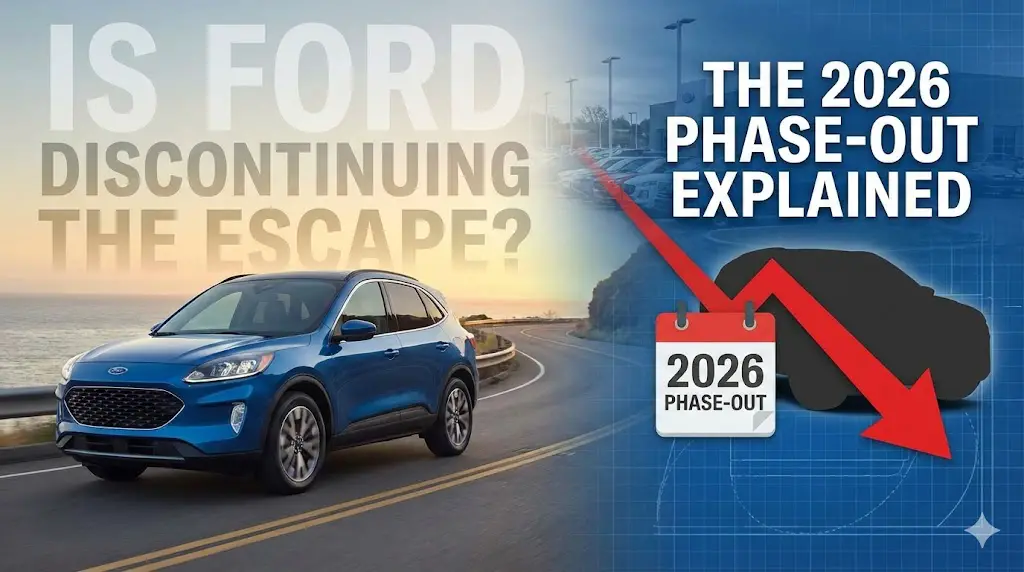
Is Ford Discontinuing the Escape? The Complete 2026 Phase-Out Report

The automotive landscape is undergoing a systemic structural transformation, and legacy automakers are increasingly rationalizing their internal combustion engine portfolios to fund advanced electrification initiatives. For consumers and industry analysts alike, a prevailing question has dominated recent market discussions: is Ford discontinuing the Escape?
The definitive answer is yes. Ford Motor Company has officially confirmed that production of the Ford Escape, alongside its luxury platform sibling, the Lincoln Corsair, will conclude at the end of the 2025 calendar year. The 2026 model year will serve as the vehicle’s final iteration, with dealer inventories expected to sustain retail availability well into late 2026.
This strategic phase-out is not merely the retirement of a long-standing nameplate; it represents a fundamental shift in Ford’s manufacturing footprint and product philosophy. By examining the underlying sales dynamics, internal market cannibalization, regulatory constraints, and the impending $5 billion transition toward the brand’s Universal EV platform, a clear picture emerges of why the Escape is being sunsetted and what consumers can expect during its final market cycle.
IS FORD DISCONTINUING THE ESCAPE?
An extensive data analysis of sales trends, internal competition, and Ford’s EV strategy to determine the fate of the iconic compact SUV.
The 2025 Deadline Rumor
Industry reports, most notably from Automotive News, suggest that the Ford Escape—once a best-seller—may reach the end of the road in 2025. Ford is aggressively pivoting toward electric vehicles and high-margin off-roaders, leaving the generic compact crossover segment in a precarious position.
⚠️ The Core Issue
Sales have dropped significantly from their peak, and the internal introduction of the Bronco Sport has cannibalized the Escape’s market share.
A Decade of Descent
To understand why Ford might kill the Escape, we must look at the sales trajectory. While the Toyota RAV4 and Honda CR-V continued to grow, the Escape suffered a sharp decline post-2017. The chart below illustrates the drop in annual units sold, highlighting the impact of the pandemic and the introduction of the Bronco Sport in late 2020.
Figure 1: Ford Escape US Sales Units (2017 – 2023). Note the acceleration of decline post-2020.
Figure 2: 2023 Sales Comparison. The Bronco Sport is nearly matching the Escape.
The “Bronco Sport” Problem
The biggest threat to the Escape isn’t the Toyota RAV4—it’s the Ford Bronco Sport. Built on the same C2 platform, the Bronco Sport offers rugged styling and better margins.
Consumers are voting with their wallets. They prefer the “lifestyle” branding of the Bronco Sport over the “commodity” styling of the Escape. Why would Ford keep two vehicles on the same platform fighting for the same customer?
- ➤ Same Platform (C2)
- ➤ Similar Price Point
- ➤ Bronco Sport has higher margins
Ford’s SUV Portfolio Mix
Ford is restructuring its portfolio into “Icons” (Mustang, Bronco), “Trucks” (F-Series), and “EVs”. The generic crossover space is shrinking. This breakdown shows the estimated internal combustion SUV mix for Ford in 2023.
Explorer
Remains the volume king for families.
Escape
Still significant volume, but shrinking relevance.
Bronco Family
The growth engine combining Sport and Big Bronco.
The Transition Roadmap: ICE to EV
2023 – The Facelift
Ford releases a refreshed Escape with a new front end and updated tech (Sync 4). This is likely the final major update for the internal combustion model.
2024 – Production Shifts
Reports indicate the Louisville Assembly Plant is preparing for retooling. Focus shifts heavily towards maintaining Bronco Sport volume and preparing for EV platforms.
2025 – The Projected End
The current lifecycle of the Escape ends. Automotive News forecasts production will cease, with no direct internal combustion generation planned to follow.
2026+ – The Electric Successor
A new electric crossover (roughly the size of the Escape) is expected to launch. Ford CEO Jim Farley has emphasized moving away from “commodity” ICE vehicles to distinct EVs.
THE VERDICT
Sales Trajectory
The downward trend is undeniable. The Escape is no longer the segment leader it once was.
EV Replacement
Highly Likely. The “Escape” name might survive, but the gas engine will likely not.
Bronco Sport
The preferred alternative. If you want a small gas Ford SUV, this is the future.
“Ford is discontinuing the *current form* of the Escape. Expect the 2025 model year to be the last gas-powered version before an electric successor takes the mantle.”
The 2026 Ford Escape and the Six-State Emissions Ban
The twilight phase of the Ford Escape is characterized by severe regulatory market constraints. In a highly unusual move for a mass-market vehicle, the 2026 Ford Escape will not be sold in six states that have adopted the stringent California Air Resources Board (CARB) emissions standards. Consumers residing in California, New York, Massachusetts, Vermont, Oregon, and Washington will be unable to purchase the final model year of this compact sport utility vehicle.
The decision to restrict sales in these regions, which collectively represent nearly a quarter of the United States automotive market, stems from the prohibitive costs associated with certifying a sunsetting platform. The CARB Advanced Clean Cars II rule mandates that automakers meet escalating zero-emission vehicle sales percentages and adhere to strict catalytic converter and software certification standards for their remaining gasoline-powered fleets. Because the regulatory penalties for selling uncertified vehicles can reach up to $48,000 per unit, and the Escape’s retail pricing tops out near $40,000, corporate leadership determined that investing in specific CARB emissions compliance for a final, truncated model year lacked financial viability.
Instead of bearing these certification costs, Ford is steering buyers in these restricted states toward the mechanically identical Ford Bronco Sport and the Ford Maverick compact pickup truck. Both alternative vehicles maintain active certifications for these markets and utilize the same powertrains, effectively preserving Ford’s market share without the overhead of recertifying the dying Escape platform.
Historical Sales Trajectory and Internal Market Cannibalization
To understand the strategic rationale behind discontinuing a nameplate that has reliably moved volume for over two decades, it is essential to analyze the Ford Escape’s historical sales trajectory. The compact crossover segment is ruthlessly competitive, and the Escape’s market dominance peaked during the 2016 and 2017 model years, achieving over 300,000 annual units sold in the United States. Since that peak, the vehicle has experienced a precipitous decline in consumer demand.
Visual Planning Directive: A single-variable line chart plotting U.S. sales of the Ford Escape from 2014 through 2025. The core data inline includes 2014 (306,209), 2017 (308,296), 2020 (178,496), 2023 (142,665), 2024 (133,320), and 2025 (139,396).
| Calendar Year | Total U.S. Escape Sales | Year-Over-Year Change |
| 2025 | 139,396 | +4.56% |
| 2024 | 133,320 | -6.63% |
| 2023 | 142,665 | +20.33% |
| 2022 | 118,557 | -18.47% |
| 2021 | 145,415 | -18.53% |
| 2020 | 178,496 | -26.05% |
| 2019 | 241,388 | -11.33% |
| 2017 | 308,296 | Peak Volume |
This severe volume contraction is not solely attributable to external segment competitors like the Toyota RAV4 or Honda CR-V; it is heavily influenced by internal market cannibalization. In recent years, Ford introduced the Bronco Sport, a boxy, off-road-oriented crossover built upon the exact same C2 platform architecture as the Escape. The Bronco Sport successfully captured the demographic that favored the rugged aesthetic of early-generation Escapes, leaving the modern, sleeker Escape struggling to define its unique value proposition.
By analyzing platform consolidation metrics, a second-order insight emerges. By maintaining the Bronco Sport and the Maverick pickup—both utilizing the C2 platform and identical 1.5-liter and 2.0-liter EcoBoost powertrains—Ford retains its formidable presence in the compact segment without the operational overhead of sustaining three separate vehicle assembly lines. The Bronco Sport, averaging roughly 124,000 to 127,000 annual sales, provides sufficient volume to justify the continuation of the internal combustion C2 architecture, rendering the Escape redundant from a manufacturing perspective.
Platform Dimension and Capability Comparison
Despite their disparate exterior styling, the underlying engineering shared by the Escape and Bronco Sport results in nearly identical utility metrics, further proving the redundancy of maintaining both nameplates.
| Specification Metric | 2026 Ford Escape | 2026 Ford Bronco Sport |
| Platform Architecture | Ford C2 | Ford C2 |
| Standard Total Length | 180.1 inches | 173.1 inches |
| Standard Total Height | 66.0 inches | 70.4 inches |
| Maximum Cargo Capacity | 65.4 cubic feet | 65.2 cubic feet |
| Base Powertrain | 1.5L EcoBoost (181 HP) | 1.5L EcoBoost (181 HP) |
| Available Powertrain | 2.0L EcoBoost (250 HP) | 2.0L EcoBoost (250 HP) |
| Maximum Towing Capacity | 3,500 lbs | 2,700 lbs |
The comparative data indicates that while the Escape offers slightly more overall length and superior towing capacity, the Bronco Sport compensates with a taller roofline that enhances interior headroom and off-road geometry. Because the vehicles fulfill nearly identical use cases for the average consumer, eliminating the less profitable model aligns with broader industry trends of streamlining production.
2026 Ford Escape: Final Model Year Specifications
For its final production cycle, the 2026 Ford Escape operates purely as a carryover model, with corporate engineering resources entirely redirected away from mid-cycle refreshes. The exterior retains the updated fascia introduced in previous years, featuring a larger front grille and reshaped LED headlamps that provide a modernized aesthetic. The interior continues to offer highly practical utility, defined by a sliding second-row seat and a standard 8-inch or available 13.2-inch SYNC 4 infotainment touchscreen incorporating wireless Apple CarPlay and Android Auto across all trim levels.
The most notable mechanical adjustment for the 2026 lifecycle is the simplification of the hybrid powertrain configurations. Ford has officially eliminated the front-wheel-drive standard hybrid variant; consequently, all 2026 traditional hybrid models are exclusively equipped with all-wheel drive. The final powertrain portfolio thus consists of four distinct options: a 1.5-liter turbocharged three-cylinder producing 180 horsepower, a 2.0-liter turbocharged four-cylinder generating 250 horsepower, an AWD-only hybrid producing 192 total system horsepower, and a front-wheel-drive plug-in hybrid electric vehicle (PHEV) delivering 210 horsepower alongside an estimated 37-mile all-electric driving range.
Ownership Implications: Depreciation Trends and Parts Availability
The public announcement of a vehicle’s discontinuation inevitably triggers consumer apprehension regarding long-term ownership viability. This anxiety centers primarily on asset depreciation and aftermarket maintenance support.
Historically, compact sport utility vehicles retain value more effectively than sedans, but the Ford Escape faces accelerated depreciation pressures due to its sunsetting status. Automotive market analytics project a 55% depreciation curve over a five-year ownership window for late-model Escapes.
Visual Planning Directive: A data table showcasing the 5-year depreciation forecast for a new Ford Escape. The core data demonstrates the year-over-year residual value drop from an initial estimated purchase price of $36,472.
| Ownership Duration | Estimated Depreciation Drop | Projected Resale Value |
| 1 Year | $14,392 | $22,080 |
| 2 Years | $14,939 | $21,533 |
| 3 Years | $16,409 | $20,063 |
| 4 Years | $17,941 | $18,531 |
| 5 Years | 55% Total Drop | $16,463 |
Recent macroeconomic factors, including elevated interest rates and an industry-wide excess inventory of plug-in hybrid electric vehicles, have initiated a broader cooling of the used car market, further suppressing the Escape’s residual value. Buyers interested in acquiring a 2025 or 2026 model should anticipate steeper initial depreciation compared to actively developed competitor models like the Honda CR-V.
Conversely, consumer concerns regarding the future availability of replacement parts are largely unfounded. While a persistent automotive myth suggests that federal law mandates original equipment manufacturers to supply parts for a strict ten-year period after discontinuation, no such regulatory statute actually exists in the United States. However, industry standards and Ford’s corporate logistics policies ensure robust supply chain support. Ford relies on its Motorcraft and Omnicraft divisions to distribute authorized components for obsolete and discontinued platforms globally. Because the Escape shares its structural C2 underpinnings, suspension geometry, electrical harnesses, and powertrain components with the continuously produced Bronco Sport and Maverick, mechanical parts interchangeability will remain seamless and highly accessible for decades.
The Strategic Pivot: Retooling Louisville for the Universal EV Platform
The demise of the Ford Escape is fundamentally a real estate and capital reallocation strategy. Ford is actively transforming the Louisville Assembly Plant into the epicenter of its next-generation electrification strategy through a nearly $2 billion facility upgrade. This physical footprint transition in Kentucky is paired with a $3 billion investment in the BlueOval Battery Park in Marshall, Michigan, creating a vertically integrated $5 billion domestic manufacturing ecosystem.
The core of this initiative is the Ford Universal EV Platform (internally codenamed Project T3 or CE1), developed by a specialized “skunkworks” engineering team stationed in California that integrates veterans from the consumer electronics and aerospace sectors. To compete effectively with global battery-electric vehicle leaders and domestic startups, Ford recognized that heavily modifying internal combustion chassis—as it did with the initial F-150 Lightning—was financially unsustainable and technologically limiting.
According to Ford’s official announcement regarding the Universal EV Platform , the architecture introduces radical manufacturing efficiencies designed to dramatically lower the cost of goods sold. The traditional linear moving assembly line, a manufacturing staple since the Model T, is being entirely replaced by an “assembly tree” protocol. In this modernized system, three distinct sub-assemblies—the front section, the rear section, and the structural battery floorbed pre-loaded with interior carpeting and seating—are constructed simultaneously on parallel lines before merging into a unified chassis.
Further optimization is achieved through “unicasting,” a metallurgical casting process utilizing massive single-piece aluminum nodes that replace dozens of traditional stamped steel components. This technique effectively eliminates 146 separate structural parts and thousands of physical fasteners, reducing the overall component count by 20%. Consequently, the physical footprint required within the factory drops, and the dock-to-dock assembly speed increases by up to 40% compared to the outgoing Ford Escape.
The powertrain of this new platform relies heavily on lithium iron phosphate (LFP) prismatic battery cells. By eliminating volatile elements like nickel and cobalt, LFP chemistry reduces raw material exposure to geopolitically sensitive supply chains while offering superior thermal stability and structural rigidity. These batteries, manufactured domestically in Michigan to qualify for federal consumer incentives, act as a load-bearing structural member of the vehicle floor, substantially improving the center of gravity, handling dynamics, and interior acoustic dampening.
The 2027 Midsize Electric Truck and the Market Outlook
The inaugural product to roll off the modernized Louisville line in 2027 will not be a direct crossover successor to the Escape. Instead, Ford will introduce a midsize, four-door electric pickup truck internally designated as P833.
The strategic positioning of this truck is an aggressive maneuver to capture the entry-level electric vehicle market. Ford is targeting a base price of approximately $30,000, intending to offer a total five-year cost of ownership lower than a three-year-old pre-owned Tesla Model Y. Despite its compact exterior footprint, the platform’s packaging efficiencies—freed from the space constraints of a traditional transmission tunnel, driveshaft, and internal combustion engine block—allow the interior passenger volume to exceed that of the latest Toyota RAV4.
Engineering targets for the 2027 electric truck include rapid acceleration metrics matching the internal combustion Mustang EcoBoost, combined with immense utility elements such as a spacious front trunk (“frunk”) and bi-directional battery power delivery capable of running external tools or supplying home backup power during grid outages. The electrical architecture is entirely software-defined, featuring a streamlined wiring harness that is over 4,000 feet shorter and 10 kilograms lighter than the harness utilized in Ford’s first-generation electric SUVs, drastically reducing the points of potential electrical failure.
While the midsize truck spearheads the Universal EV Platform, industry analysts indicate that Ford intends to scale the underlying architecture to include compact crossover variants (potentially designated U833) by 2028. Thus, while the internal combustion Escape badge is being retired to the archives of automotive history, its spiritual successor will inevitably emerge within this new family of highly connected, low-cost electric architectures.
FAQs
Why is Ford specifically eliminating the Escape and not the Bronco Sport?
The automotive industry operates on strict platform economics. The Ford Escape and the Bronco Sport are structurally identical vehicles layered with different exterior sheet metal and suspension tuning. Consumer purchasing data reveals a distinct, highly profitable preference for the rugged, overlanding aesthetic embodied by the Bronco Sport. Eliminating the Escape consolidates manufacturing resources while preventing internal sales cannibalization. This allows Ford to clear the Louisville facility for electric vehicle production without surrendering its valuable market share in the lucrative compact crossover segment.
Will the discontinuation affect my ability to service a Ford Escape Hybrid?
No. The hybrid powertrain utilized in the Escape is heavily integrated across the broader Ford ecosystem. It is the exact same hybrid architecture powering the high-volume Ford Maverick hybrid pickup truck, as well as the outgoing Lincoln Corsair. Because these sibling vehicles will continue active production or require long-term parts support, critical components such as the continuously variable transmission (eCVT), high-voltage battery modules, and the 2.5-liter Atkinson-cycle engine will remain heavily stocked in Ford’s Motorcraft supply chain indefinitely.
Is the 2026 model year the final opportunity to purchase a Plug-In Hybrid (PHEV) Ford compact SUV?
In the immediate short term, yes. Ford’s new Universal EV platform is strictly designed for full battery-electric vehicles, entirely eschewing internal combustion and hybrid technologies on that specific line. Once Escape and Corsair production ceases, buyers seeking a plug-in hybrid mechanism within Ford’s lineup will be forced to look toward larger, more expensive three-row SUV applications that Ford plans to release later in the decade, or shift to the standard (non-plug-in) hybrid iteration of the Bronco Sport or Maverick. Therefore, the 2026 Escape PHEV, with its 37-mile all-electric range, represents the final iteration of compact plug-in utility for the brand.
How will the “Universal EV Production System” lower vehicle costs to $30,000?
Pricing electric vehicles at parity with internal combustion engines requires radical structural cost elimination. Ford’s strategy relies on three major manufacturing pillars: utilizing LFP battery chemistry, which completely removes highly expensive and volatile cobalt and nickel; implementing aluminum unicasting, which eliminates the fabrication and assembly costs of hundreds of smaller stamped steel parts; and transitioning to the “assembly tree” manufacturing line, which reduces labor time and factory floor space requirements by up to 40%. By executing these efficiencies, Ford aims to offset the high capital expenditure of the battery pack, resulting in a highly accessible retail price point