How Fast Can You Drive in 4 High? Max Speeds, Mechanics & Safety Guide 2026

The operation of four-wheel drive (4WD) systems, specifically the high-range setting known as “4 High” (4H), represents one of the most misunderstood aspects of modern automotive operation. For owners of Ford light-duty trucks and SUVs—specifically the F-150, Bronco, and Ranger—the distinction between the system’s engagement speed limit (typically 55 mph / 88 km/h) and its safe operating speed limit is a critical knowledge gap that often leads to catastrophic drivetrain failure or compromised vehicle safety.
This report provides an exhaustive, expert-level analysis of the mechanical, thermal, and physical constraints governing 4H operation. It synthesizes data from Original Equipment Manufacturer (OEM) technical documentation, powertrain engineering principles, and comparative market analysis to establish a definitive operational doctrine.
Key Findings:
- Mechanical vs. Operational Limits: While the BorgWarner and Magna transfer cases used in Ford vehicles are mechanically capable of sustaining driveline rotation at speeds exceeding 100 mph (160 km/h), the operational safety limit is dictated by surface friction and suspension geometry.
- The 55 MPH Threshold: The “Shift-on-the-Fly” (ESOF) limit of 55 mph acts as a functional ceiling for safe operation in most environmental conditions. If road conditions allow for speeds greater than 55 mph, the coefficient of friction is typically too high for a locked (Part-Time) 4H system, introducing the risk of destructive driveline wind-up.
- Model-Specific Variance: The presence of Torque-on-Demand (4 Auto) systems in higher-trim F-150s and Broncos fundamentally alters the high-speed capability profile, allowing for safe highway operation in mixed conditions where traditional Part-Time systems would suffer mechanical binding.
- Braking Physics: Contrary to popular belief, 4WD engagement at high speeds provides no advantage in stopping distance and may marginally increase it due to rotational inertia and parasitic drivetrain loss, creating a dangerous “traction paradox” for drivers in inclement weather.
How Fast Can You Drive in 4 High?
Understanding the mechanical limits of your transfer case and the physics of winter driving. The extra traction helps you go, not stop.
The Golden Rule
Max recommended speed for engaging “Shift-on-the-Fly” systems.
The Danger Zone
High risk of driveline binding and hydroplaning, regardless of 4WD.
Fuel Impact
Average fuel economy drop due to friction from the front differential.
Manufacturer Specifications
While your truck might feel capable of anything, engineers set specific limits for “Shift-on-the-Fly” engagement to protect the transfer case synchronizers and vacuum actuators.
Toyota typically allows for a higher engagement speed (62 MPH) compared to domestic brands like Ford and Jeep (55 MPH).
Data sourced from 2024 Owner’s Manuals
Know Your Modes: 4H vs 4L vs 4A
4 High (4H)
Standard- 🏁 Max Speed: 55 MPH (Engage), 65 MPH (Cruise)
- ❄️ Best For: Snow, Ice, Dirt Roads.
- ⚠️ Risk: Binding on dry pavement.
4 Auto (4A)
Versatile- 🏁 Max Speed: Highway Speeds (Safe)
- 🌧️ Best For: Rain, Mixed Conditions.
- ⚙️ Mechanics: Uses clutch pack to prevent binding.
4 Low (4L)
Power- 🛑 Max Speed: Under 15 MPH
- 🧗 Best For: Rock Crawling, Deep Mud, Stuck Vehicles.
- ⚙️ Torque: Multiplies power by 2.7x – 4x.
The “Invincibility” Myth
Many drivers believe 4WD helps them stop faster on snow. This is false. 4WD aids acceleration, not braking. Heavier 4WD trucks often take longer to stop than lighter 2WD cars.
Braking Distance on Snow (from 60 MPH)
Why doesn’t 4WD help stop?
Brakes are on all 4 wheels regardless of drive mode (2WD or 4WD).
Tire friction coefficient on ice is the limiting factor, not the drivetrain.
4WD systems add weight (transfer case, front axle), increasing momentum.
Decision Guide: Should I use 4 High?
Causes of 4WD System Failure
The “Binding” Effect
Also known as “Crow Hop,” binding occurs when 4WD is used on high-traction surfaces (dry roads).
How it happens:
When turning, front wheels travel a wider arc than rear wheels, meaning they must spin faster. 4 High mechanically locks them to spin at the same speed. On dry roads, the tires can’t slip to release this tension, twisting the driveshaft until something snaps.
© 2026 FordMasterX Infographics. Data sourced from manufacturer owner manuals.
The Engineering Definitions of Velocity in 4WD Systems
To provide an accurate answer to the query “how fast can you drive in 4 High,” it is first necessary to disambiguate the terminology used in owner’s manuals and technical service bulletins. In the context of 4WD systems, velocity is governed by two distinct engineering parameters: the Engagement Velocity Limit and the Sustained Operating Velocity Limit.
The Shift-on-the-Fly (ESOF) Velocity Limit
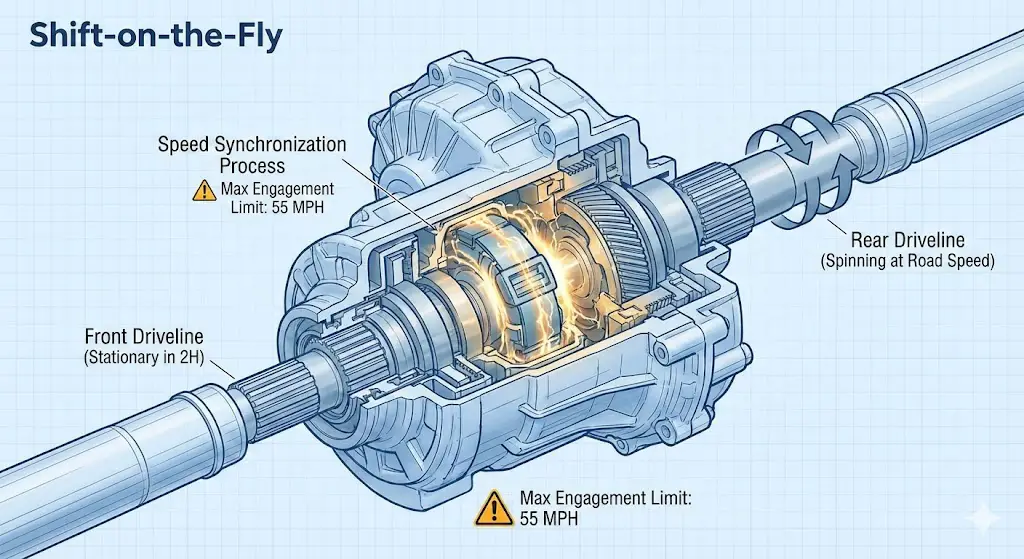
Modern Ford trucks and SUVs utilize an Electronic Shift-on-the-Fly (ESOF) system, which allows the driver to transition from Two-Wheel Drive (2H) to Four-Wheel Drive High (4H) while the vehicle is in motion. This convenience feature is governed by a strict speed limit, universally cited in Ford owner’s manuals as 55 mph (88 km/h).
The Synchronization Mechanism
The 55 mph limit is not an arbitrary safety suggestion but a hard mechanical constraint of the transfer case synchronization system. When the driver selects 4H:
- TCCM Command: The Transfer Case Control Module (TCCM) receives the input and verifies vehicle speed via the Controller Area Network (CAN) bus.
- Electromagnetic Spin-Up: Before the transfer case can mechanically link the front and rear driveshafts, they must be rotating at the same speed. The rear driveshaft is moving at road speed; the front driveshaft is stationary (in 2H). An electromagnetic clutch or a synchronizer cone is energized to “spin up” the front driveshaft.
- Mechanical Lock: Once the Hall effect sensors detect that the front output shaft speed matches the rear output shaft speed, the shift motor drives a shift fork to slide a locking collar (mode clutch) over the gears, physically connecting the chains.
Consequences of Exceeding the ESOF Limit
Attempting to engage 4H at speeds above 55 mph overwhelms the synchronizer’s ability to match shaft speeds within the allowable time window.
- Rejection: In most modern systems (2015+ F-150, Bronco), the TCCM effectively “locks out” the shift command, displaying a “Shift Delayed” or “Speed Too High” message in the instrument cluster until the vehicle decelerates.
- Mechanical Clash: In older systems or scenarios with sensor faults, attempting this shift can result in “ratcheting” or grinding. This is the sound of the locking collar attempting to mesh with a gear that is spinning at a significantly different velocity, causing rapid wear on the dog teeth of the engagement collar.
The Maximum Sustained Operating Velocity
Once the engagement phase is complete and the vehicle is successfully in 4H, the mechanics of the “speed limit” change. Unlike 4 Low (4L), which utilizes a planetary gearset to reduce gearing (typically 2.64:1 or 3.06:1 reduction) and is strictly limited to low speeds (under 30-45 mph) to prevent engine over-revving , 4 High utilizes a 1:1 gear ratio.
Theoretical Mechanical Ceiling
From a purely rotational perspective, the transfer case in 4H transmits power directly through the main shaft and the chain drive without gear reduction. Therefore, the engine and transmission operate at the same RPM-to-speed ratio as they do in 2H.
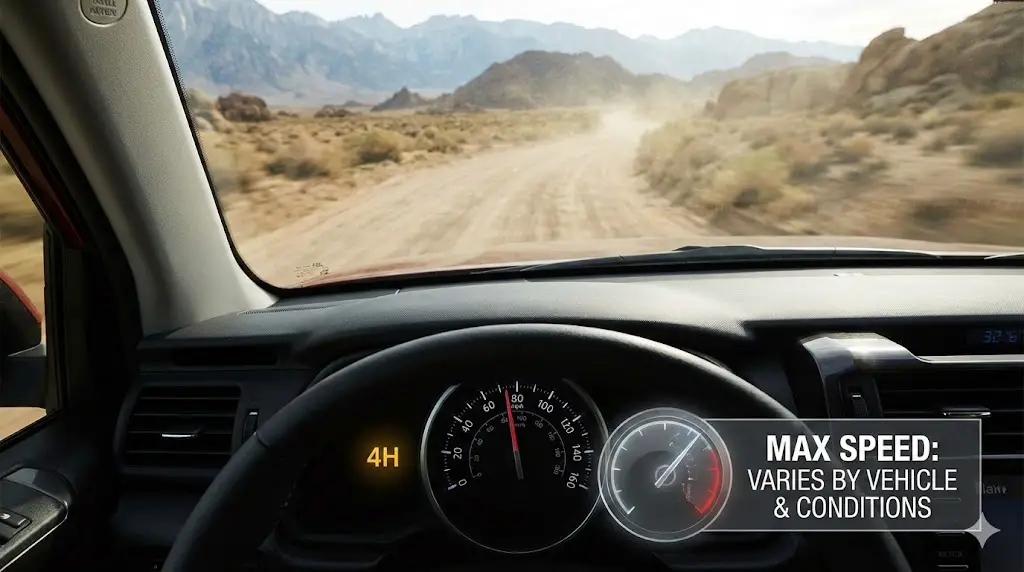
- The 100 MPH Reality: Mechanically, a Ford F-150 or Bronco in 4H is capable of reaching the vehicle’s electronic speed governor (typically 100–106 mph). There is no “redline” inherent to the 4H gear setting that prevents this.
- The Heat Barrier: While possible, sustained operation at these speeds generates significant heat. The chain drive mechanism, spinning at thousands of RPM, churns the transfer case fluid (aeration), while friction from the chain links and bearings generates thermal load. Prolonged operation at speeds >80 mph in 4H can lead to fluid breakdown and accelerated chain wear, even if catastrophic failure does not occur immediately.
The Environmental “Conditions-Based” Limit
The most critical limiting factor for 4H velocity is neither the engagement mechanism nor the gear ratio, but the road surface.
- The Golden Rule of Friction: OEM manuals, including Ford’s, explicitly state: “Do not use 4H or 4L on dry, hard-surfaced roads.”.
- The Paradox of Speed: If a road surface is safe enough to drive at 70 mph, it almost certainly has enough traction that 4WD is unnecessary. Conversely, if conditions (snow, ice, mud) are severe enough to require the traction of 4H, safe driving speeds are physically limited to well below highway limits (typically <50 mph).
Mechanical Architecture of Ford Transfer Cases
To understand the risks of high-speed 4H operation, one must analyze the internal architecture of the hardware. Ford utilizes two primary transfer case designs: Part-Time (Mechanical Lock) and Torque-on-Demand (Active Clutch).
Part-Time 4WD (Locked Transfer Case)
This system is standard on the Ford F-150 XL and XLT, Ford Ranger, and Ford Bronco (Base/Black Diamond). It is characterized by a mechanical inability to differentiate speed between front and rear axles.
Internal Mechanics
- Chain Drive: Power is transferred from the transmission output shaft to the front output shaft via a Morse-style silent chain.
- Dog Clutch Lock: When 4H is engaged, a sliding collar locks the chain sprocket to the main shaft. This creates a rigid 50/50 torque split.
- Lack of Differential: Crucially, there is no differential (planetary gearset or viscous coupling) between the front and rear shafts. They are physically forced to rotate at identical speeds.
The Physics of Driveline Wind-Up (Binding)
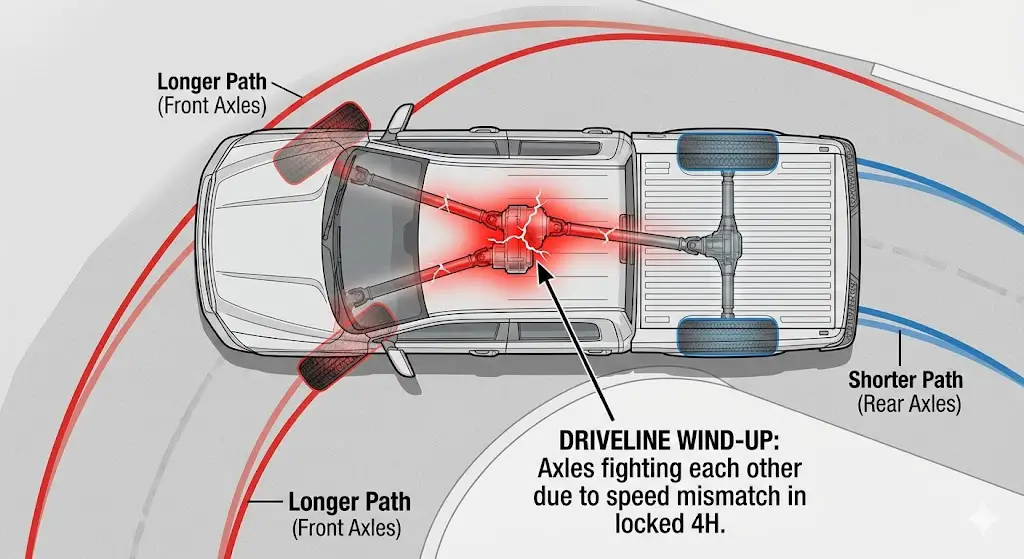
When a vehicle travels in a straight line, front and rear wheels rotate at roughly the same speed. However, during any turn or lane change, the front wheels travel a longer path (larger arc) than the rear wheels.
- Ackermann Geometry: This geometric necessity requires the front wheels to spin faster than the rear wheels.
- The Binding Effect: In a locked Part-Time system, the transfer case prevents this speed difference. On a low-traction surface (mud, snow), the tires slip against the ground to release this tension. On a high-traction surface (dry pavement, wet asphalt), the tires grip. The tension builds up (“winds up”) in the axle shafts, driveshafts, and transfer case chain until the weakest point forces a slip or breaks.
- High-Speed Amplification: At 70 mph, even a gentle curve or a lane change creates a wheel speed differential. The kinetic energy involved is massive. Driving a locked system at high speeds on pavement generates immense torsional stress, leading to “crow-hopping” (the vehicle shuddering as tires skip) and rapid overheating of the transfer case chain.
Torque-on-Demand / 4 Auto (4A)
Found in higher trim F-150s (Lariat, Platinum, Raptor), Bronco (Badlands, Wildtrak), and Ranger Raptor, this system introduces the “4 Auto” (4A) mode.
Electromechanical Clutch Pack
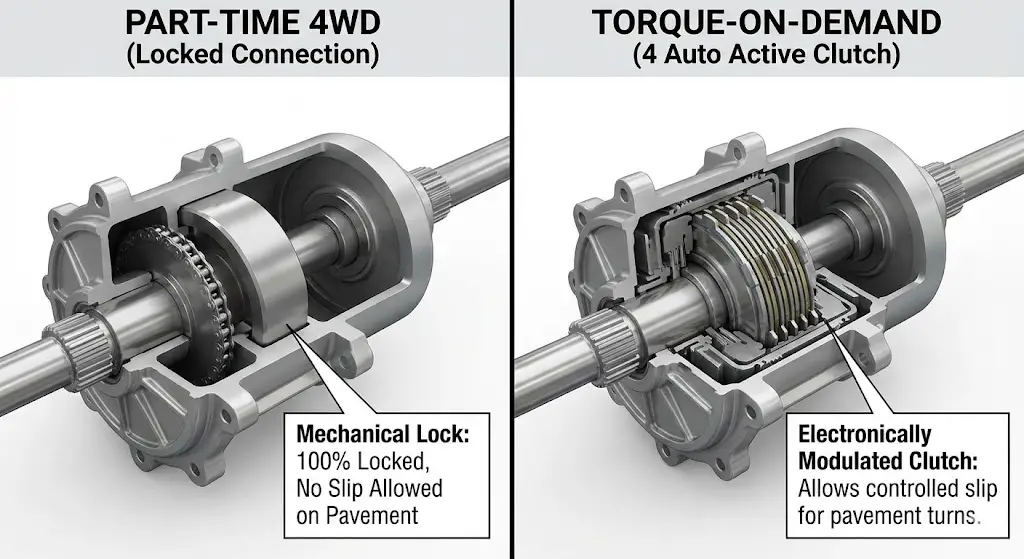
Instead of a simple locking collar, these transfer cases (such as the BorgWarner 4467/4469) utilize a wet multi-plate clutch pack to transmit power to the front axle.
- Modulated Torque: In 4A, the system defaults to RWD. When rear wheel slip is detected, the TCCM uses Pulse Width Modulation (PWM) to apply pressure to the clutch plates, transferring torque to the front.
- The Slip Allowance: Crucially, because the connection is via friction clutches rather than a steel collar, the system can allow for controlled slip between the front and rear driveshafts. This acts as a “virtual center differential,” allowing the vehicle to turn on dry pavement without binding.
High-Speed Capability of 4A
- Highway Safe: Because the clutches can slip to accommodate wheel speed differences, 4A is safe for use on dry or wet pavement at highway speeds. It eliminates the risk of driveline wind-up.
- Mechanical Locking in 4H: It is vital to note that even in vehicles equipped with 4A, selecting 4H typically commands the clutch pack to lock fully (maximum duty cycle) to simulate a part-time system. Therefore, the restrictions of Part-Time systems (no dry pavement use) still apply to the 4H mode on these vehicles, while 4A remains the safe high-speed alternative.
The Physics of 4WD at High Velocity
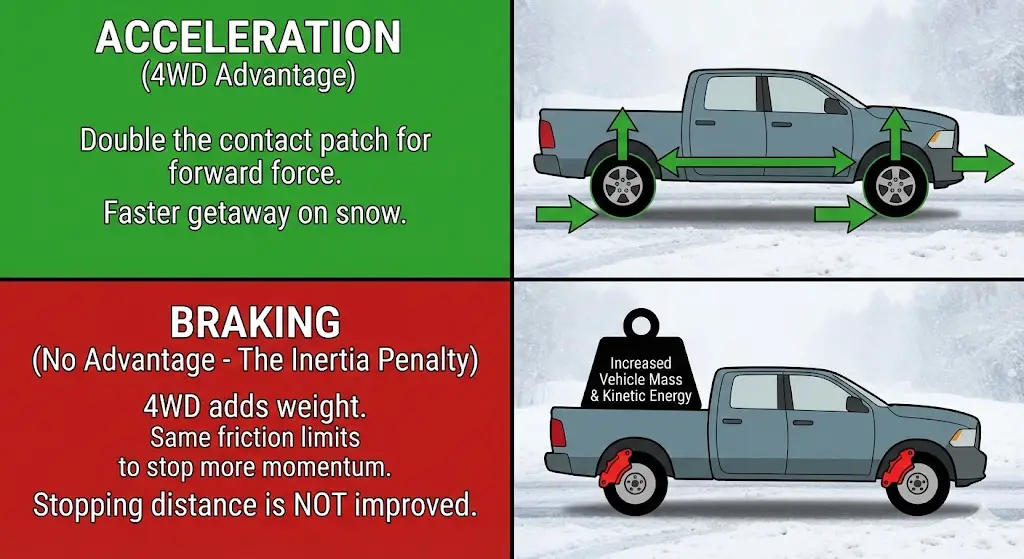
Understanding the limits of 4H requires looking beyond the gearbox to the physics of vehicle dynamics. The interaction between the tires and the road surface changes drastically at speed, and 4WD alters the vehicle’s handling limits in counter-intuitive ways.
The “Go vs. Stop” Fallacy
A dangerous misconception among drivers is that 4WD improves overall safety on ice and snow, justifying higher travel speeds. Physics dictates otherwise.
Acceleration Mechanics
4WD effectively doubles the available contact patch area for longitudinal force application (acceleration).
- Traction Equation: $F_{traction} = \mu \times N$, where $\mu$ is the coefficient of friction and $N$ is the normal force. By distributing torque to four wheels, the required force per tire to accelerate is halved, reducing the likelihood of breaking traction. This allows a 4WD vehicle to accelerate to 60 mph on snow much faster than a 2WD vehicle.
Braking Dynamics
However, 4WD provides zero benefit for braking.
- Braking Systems: All modern vehicles (2WD and 4WD) are equipped with four-wheel brakes and Anti-lock Braking Systems (ABS).
- Inertia Penalty: A 4WD F-150 is significantly heavier than a 2WD model due to the mass of the transfer case, front differential, and half-shafts. This increased mass ($m$) increases the vehicle’s kinetic energy ($KE = \frac{1}{2}mv^2$).
- Result: A 4WD vehicle driven at 70 mph on snow has more kinetic energy to dissipate than a 2WD vehicle, yet has the exact same tire friction limit available to stop. This leads to the common scenario of 4WD trucks accelerating confidently to unsafe speeds, only to find they cannot stop any better than a standard sedan.
Stability and Understeer at Speed
Driving fast in 4H on a slippery surface fundamentally changes the vehicle’s handling balance, biasing it toward understeer.
- Locked Axle Geometry: As discussed in Section 2.1.2, a locked transfer case forces the front and rear axles to rotate at the same speed. During a high-speed corner, the front wheels need to rotate faster. The transfer case prevents this.
- Loss of Lateral Grip: To compensate for the speed mismatch, the front tires must break traction (slip). According to the Traction Circle theory, a tire has a finite amount of grip available for braking, accelerating, and turning. If a tire is using its available grip to scrub/slip against the road surface due to driveline binding, it has less grip available for lateral steering forces.
- The “Push”: The result is that the vehicle resists turning and wants to plow straight ahead (understeer). At 60 mph on a snowy highway, this resistance to turning can be the difference between staying in the lane and sliding off the road.
Hydroplaning: The Water Wedge
High-speed driving in rain is a frequent scenario where drivers erroneously engage 4H.
- Hydroplaning Physics: Hydroplaning occurs when a wedge of water builds up in front of the tire, lifting it off the pavement. This is a function of tire tread depth, water depth, and vehicle speed. 4WD does not prevent hydroplaning.
- The Binding Risk: In heavy rain, traction is variable. The vehicle may pass through a deep puddle (low traction) and then immediately onto wet asphalt (high traction). If 4H is engaged, the moment the tires hit the asphalt, the driveline binds. At 70 mph, this shock load is transmitted through the chain and u-joints.
- Safety Recommendation: For rain driving, 4A (Auto) is the only appropriate 4WD setting. If 4A is unavailable, 2H with appropriate tires and stability control (AdvanceTrac) is safer and mechanically superior to 4H.
Model-Specific Deep Dives
The implementation of 4WD varies significantly across the Ford lineup. This section analyzes the specific capabilities and limitations of each key model.
Ford F-150 (Gen 13/14: 2015–Present)
The F-150 is the volume leader, and its 4WD systems are stratified by trim level.
XL / XLT / STX (Part-Time System)
- Hardware: BorgWarner electronic shift transfer case (Part-Time).
- Speed Capability:
- Engagement: Strictly < 55 mph.
- Operation: Recommended < 55-60 mph.
- Warning: These trucks have no center differential. Driving in 4H on a rainy highway is a primary cause of “IWE” (hub) failure and transfer case chain stretch. The system is binary: it is either locked for off-road/deep snow, or unlocked for pavement.
Lariat / King Ranch / Platinum / Limited (Torque-on-Demand)
- Hardware: BorgWarner 2-speed Torque-on-Demand (TOD) case.
- Capabilities: Features 4A mode.
- 4A Operation: Safe for use at any legal highway speed. The system monitors steering angle and wheel slip, proactively adjusting clutch pressure. It creates a seamless AWD-like experience.
- 4H Operation: mechanically locks the clutches. Same restrictions apply as the XL/XLT models.
Raptor / Tremor (Hi-Lock Transfer Case)
- Hardware: Specialized T-case combining TOD clutches with a mechanical dog-lock feature.
- Baja Mode: In this mode, the system optimizes 4H for high-speed desert running. The Raptor is designed to drive at 80+ mph in 4H, provided the surface is loose sand or dirt. The “Speed Limit” here is dictated by suspension capability and driver skill, not the transfer case.
Ford Bronco (6th Gen: 2021–Present)
The Bronco introduces “G.O.A.T. Modes” (Goes Over Any Type of Terrain), which act as software overlays for the hardware.
G.O.A.T. Modes Strategy
- Sport Mode: Typically holds gears longer but keeps the vehicle in 2H or 4A (if equipped) to prioritize steering response over traction.
- Slippery Mode: Engages 4A or 4H and creates a “lazy” throttle map to prevent wheel spin. Ideal for snow/ice at moderate speeds (<50 mph).
- Sand / Baja Mode: Optimizes 4H for high-RPM, high-speed operation. It disables traction control to allow wheel spin (necessary to float over sand) and is the only mode where high-speed 4H is “encouraged” by the software logic.
Bronco Sport
- Architecture Difference: The Bronco Sport is unibody, FWD-based. It uses a Power Transfer Unit (PTU) and a Rear Drive Unit (RDU) with twin clutches (on Badlands trim).
- Speed Capability: Because it functions fundamentally as an AWD system that sends power rearward when needed, it is much more forgiving of high-speed “4WD” operation on pavement than the big Bronco. However, its “4WD Lock” button should still be disengaged on dry highways to prevent overheating the RDU clutches.
Ford Ranger (T6: 2019–Present)
- System: Similar to F-150 XLT (Part-Time).
- Stability Concerns: The Ranger is lighter than the F-150. Owners report that the rear end can be “twitchy” in 2WD on wet roads, leading many to desire 4H.
- Guidance: Despite the temptation, 4H on wet roads in a Ranger will cause binding in tight turns. 4H is for snow/mud only. If the rear slips in rain, rely on the Traction Control System (TCS) rather than risking the transfer case in 4H.
Competitive Benchmarking
To contextualize Ford’s capabilities, we compare them against key market rivals.
| Feature | Ford F-150 (Lariat+) | Jeep Wrangler (JL) | Ram 1500 (Big Horn+) | Toyota Tacoma (TRD) |
| System Type | Torque-on-Demand (4A) | Part-Time (Command-Trac) | Torque-on-Demand (BW48-11) | Part-Time |
| 4 Auto Mode? | Yes | Optional (Selec-Trac) | Yes | No (Limited/Pro only) |
| Max Shift Speed | 55 mph | 50-55 mph | 55 mph | 62 mph (100 km/h) |
| Pavement Safe? | Yes (in 4A) | No (unless 4A equipped) | Yes (in 4 Auto) | No |
| High Speed 4H | Not Rec. on Pavement | Not Rec. on Pavement | Not Rec. on Pavement | Not Rec. on Pavement |
- Jeep: Similar to Ford, Jeep explicitly warns against 4H use on hard surfaces due to driveline damage risks.
- GM (Silverado): GM’s “AutoTrac” is very similar to Ford’s 4A, with some manuals citing a 75 mph limit for the Auto mode to prevent excessive clutch wear.
- Toyota: Known for conservatism, Toyota manuals often suggest lower shift speeds, though the hardware is robust. Toyota specifically warns of overheating transmission fluid if 4H is used for low-speed crawling instead of 4L, but high-speed 4H is permitted on loose surfaces.
Failure Analysis & Symptomology
What happens when the speed limits are ignored? The breakdown of components follows a predictable hierarchy of failure.
Chain Stretch and “Case Rub”
The most common failure mode for BorgWarner transfer cases subjected to high-speed wind-up is chain stretch.
- Mechanism: The Morse chain relies on precise pitch to mesh with the sprockets. Excessive torque loads (from binding on pavement) stretch the links.
- Symptom: As the chain lengthens, it becomes loose. Under acceleration, it can “skip” teeth (popping sound). Eventually, the slack chain slaps against the magnesium housing of the transfer case.
- The “Pin-Hole” Leak: The chain eventually rubs a hole through the case, causing all fluid to leak out. This leads to total seizure of the unit.
IWE (Integrated Wheel End) Destruction
Ford’s unique vacuum-actuated hub system is a weak link at high speeds.
- Mechanism: IWEs use vacuum to disengage the hubs. When 4H is selected, vacuum is cut, and a spring pushes the locking gear onto the hub splines.
- High-Speed Failure: Engaging 4H at speeds near or above 55 mph relies on the synchronizer to match wheel speed exactly. If there is any mismatch, the IWE gear teeth will “ratchet” or grind against the hub splines.
- Symptom: A sound like “rocks in a blender” coming from the front wheels. Repeated high-speed engagements will shear the teeth off the IWEs, rendering 4WD useless.
Fluid Shear and Thermal Breakdown
- Fluid Volume: Ford transfer cases hold very little fluid (approx. 1.25 to 1.5 liters of Mercon LV/ULV).
- Thermal Load: In 4H at 80 mph, the chain speed is immense. The fluid is subjected to high shear forces. Overheated fluid oxidizes, turning dark and smelling burnt. Once the fluid breaks down, bearing protection is lost, leading to whine and eventual disintegration of the main shaft bearings.
Operational Protocols & Safety Guidelines
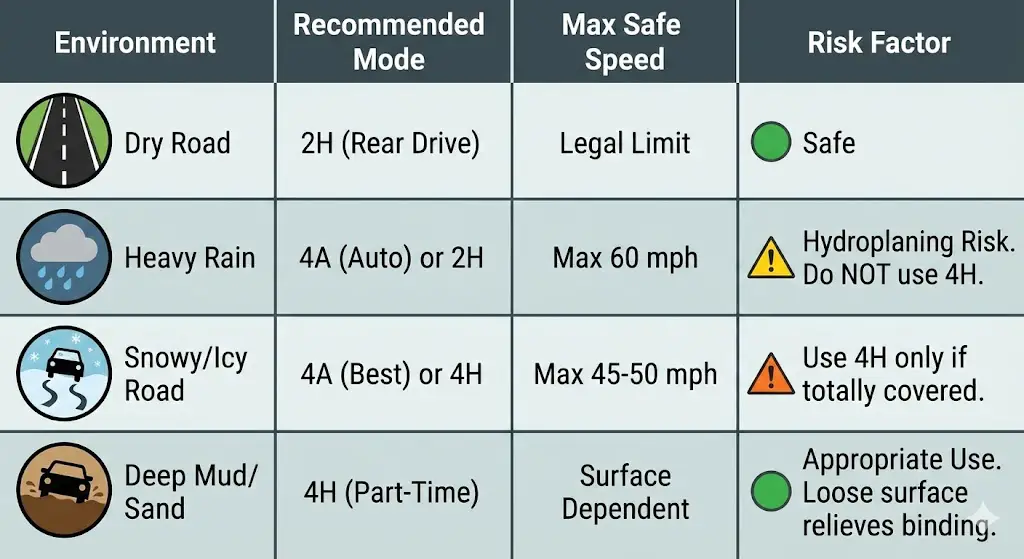
Based on the engineering data, the following protocols define the safe operation of 4WD systems for Ford owners.
The “Scenario-Based” Velocity Matrix
| Environment | Recommended Mode | Max Technical Speed | Max Safe Operating Speed | Rationale |
| Dry Highway | 2H | Vehicle Limit | Speed Limit | 4H will cause binding/wear. Unsafe. |
| Heavy Rain | 4A (or 2H) | 70+ mph (4A) | 60 mph | 4H binds on wet asphalt. 4A allows slip. |
| Patchy Snow/Ice | 4A (Best) | 55 mph | 45-50 mph | 4H is risky if patches of dry road exist. |
| Deep Packed Snow | 4H | N/A | 30-45 mph | If you can go >50 mph, use 2H/4A. |
| Gravel/Dirt | 4H | 60 mph | Conditions Dependent | Loose surface relieves binding. |
| Sand/Desert | 4H (Baja) | High Speed (Raptor) | Driver Skill | Surface allows continuous wheel slip. |
The 55 MPH Rule of Thumb
While 55 mph is the shifting limit, it serves as an excellent practical ceiling for operation in 4H (Part-Time).
- Logic: If the road conditions are severe enough to require the mechanical locking of the front and rear axles (4H), they are almost certainly too hazardous to support speeds above 55 mph safely.
- Protocol: If you find yourself comfortable driving 65-70 mph, disengage 4H and return to 2H (or 4A). You are likely on a surface with too much grip for 4H, risking driveline damage.
Maintenance for High-Duty Users
For owners who live in snowy climates and utilize 4H/4A frequently at highway speeds:
- Fluid Intervals: Ignore the “lifetime” or 150k mile service intervals. Change transfer case fluid every 30,000 to 60,000 miles. Fresh fluid maintains the viscosity needed to protect the chain and bearings at high speeds.
- Tire Matching: Crucial for 4H/4A. Ensure all four tires are the same brand, size, and wear level (within 3/32″ tread depth). Mismatched diameters cause the center clutch (in 4A) or the chain (in 4H) to slip/bind constantly, even driving straight, generating massive heat.
Frequently Asked Questions (Expanded)
Can I drive 70 mph in 4 High if it’s raining?
No. (Unless you have a Raptor/Lariat in 4A).
In a standard F-150 or Bronco with Part-Time 4WD, rain does not provide enough consistent slip to prevent driveline binding. The tires will grip the asphalt through the water, causing the transfer case chain to stretch and the vehicle to handle poorly (understeer). Use 2H and drive cautiously, or use 4A if equipped.
I accidentally drove on the highway in 4H for 20 miles. Did I break it?
Likely not, but you caused wear. If you drove in a straight line, the damage is minimal. The stress accumulates primarily during turns. However, you likely heated the fluid significantly and put unnecessary tension on the chain. Listen for whining or clicking noises in the future. If the vehicle drives normally in 2H now, you “got away with it,” but do not make it a habit.
Does 4 Auto (4A) use more gas?
Yes. Even when not sending power to the front wheels, 4A keeps the front hubs (IWEs) engaged and the front axle shafts spinning. This increases rotational mass and parasitic drag, typically reducing fuel economy by 1-2 MPG compared to 2H.
Why does my truck ‘hop’ when turning in a parking lot in 4H?
This is Driveline Wind-Up (also called binding or crow-hopping). The front and rear axles are fighting each other because they are locked together but traveling different distances. Stop immediately. Shift back to 2H. You are putting thousands of pounds of force on your u-joints and transfer case chain. Never use 4H on high-traction surfaces like parking lots.
Conclusion
The question of velocity in 4 High is a balance of can versus should.
- Can a Ford F-150 drive 90 mph in 4 High? Mechanically, yes.
- Should it? Almost never.
The only engineering-approved scenario for high-speed 4H operation is high-performance off-road driving on loose substrates (sand/desert). On public roads, the 55 mph ESOF limit should be treated as the practical operating ceiling. If you need to go faster, the road is likely too clear for 4H. For variable conditions like rain or light snow, 4 Auto (4A) is the correct tool, bridging the gap between low-speed traction and high-speed stability. Adhering to these limits will ensure the longevity of your transfer case and, more importantly, the safety of your travel.