How Fast Can I Go in 4 High? The Definitive Guide 2026

The question of maximum safe operating speeds in four-wheel drive high (4H) represents one of the most frequently debated topics in the automotive community. While modern transfer cases and drivetrain components are engineered for immense resilience, operating a part-time four-wheel-drive system requires a nuanced understanding of mechanical engineering, terrain friction coefficients, and strict manufacturer specifications.
For owners of the Ford F-150, Ford Ranger, and Ford Bronco, understanding the distinction between maximum engagement speed and safe operating speed is the difference between conquering adverse conditions and facing catastrophic drivetrain failure.
This report provides an exhaustive, data-driven analysis of 4H speed limitations, drivetrain mechanics, and terrain-specific velocity guidelines optimized for semantic search and comprehensive vehicle mastery.
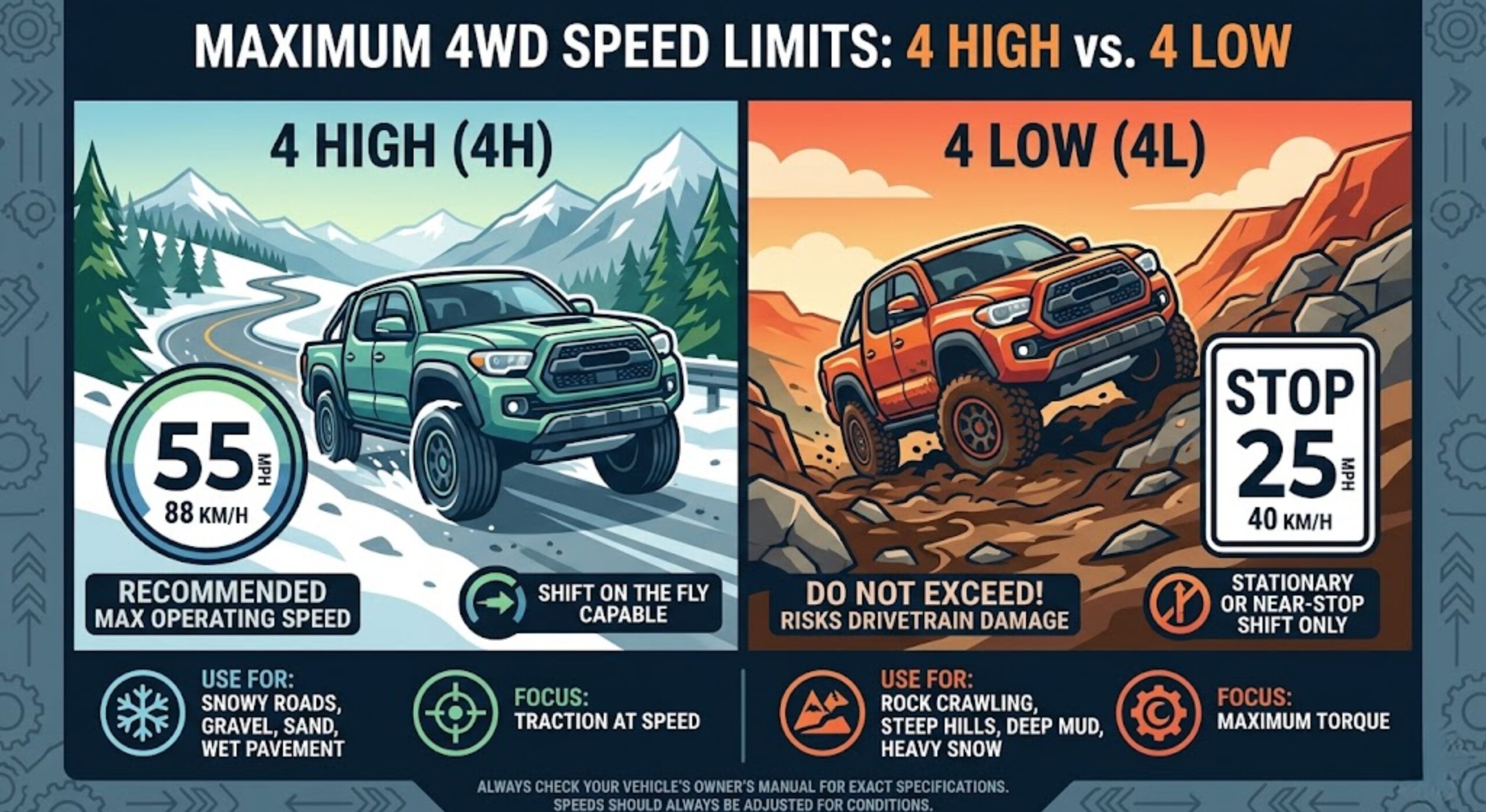
Infographic
How Fast Can I Go in 4 High?
The short answer: 55 MPH is the golden rule. But as an automotive expert, I can tell you the reality of driving in 4 High (4H) involves understanding the critical difference between shift-on-the-fly limits, mechanical limitations, and the physics of traction.
1. The 55 MPH Golden Rule: Shift vs. Drive Speeds
When off-roaders and truck owners ask, “how fast can I go in 4 high?”, they are usually confusing two different mechanical limits: Max Shifting Speed and Max Safe Driving Speed.
-
⚙️
Shift-on-the-Fly Speed (Max 55 MPH) Modern transfer cases allow you to switch from 2H to 4H while moving. For most Ford F-150s, Chevy Silverados, and Ram 1500s, this mechanical engagement limit is 55 mph (88 km/h). Doing this faster risks severe transfer case damage.
-
❄️
Safe Driving Speed (Conditions Dictate) Once engaged in 4H, the mechanical limit of the vehicle might technically exceed 55 MPH, but the environmental limit does not. If the road is slippery enough to require 4H (snow, heavy rain, mud), physics dictate you should not be driving faster than 55 MPH anyway.
Visualizing the safe operational envelope for 4 High usage.
2. Manufacturer Specifications: Brand Comparisons
While 55 MPH is the widely accepted standard, different manufacturers engineer their transfer cases with slight variations. Always consult your specific owner’s manual. Below is a comparative look at the maximum recommended shift-on-the-fly speeds across major truck brands based on their factory service manuals.
Data synthesized from official 2023/2024 owner manuals. Note: Toyota Tacoma allows slightly higher engagement speeds, but driving speeds should still be restricted based on weather conditions.
3. The Physics of Traction: Why 4WD Doesn’t Mean 4-Wheel Stop
A fatal flaw in many drivers’ thinking is that 4 High provides invincibility in the snow. 4H mechanically locks the front and rear driveshafts together, sending 50% of the engine’s torque to the front axle and 50% to the rear. This drastically improves acceleration and forward traction.
However, 4H does absolutely nothing to improve your braking or cornering physics at high speeds. All vehicles already have four-wheel brakes. When you exceed 50-55 MPH on a low-traction surface (like ice or packed snow), the coefficient of friction drops to a point where your tires cannot expel the material fast enough, leading to hydroplaning or sliding.
The Driveline Binding Danger
Never use 4 High on dry, paved roads. When turning, your outside wheels must spin faster than your inside wheels, and your front wheels travel a wider arc than your rear wheels.
Because the transfer case forces the front and rear axles to spin at the exact same speed, taking a corner on high-traction dry pavement forces the tires to skid or “hop,” putting massive explosive stress on U-joints and axles.
4. Comprehensive Drive Mode Matrix
To preserve your drivetrain and ensure safety, it is vital to select the correct transfer case mode for the specific terrain. Use this matrix to determine when to use 2H, 4A, 4H, and 4L.
| Drive Mode | Ideal Terrain | Max Speed | Mechanical Action |
|---|---|---|---|
| 2H (Two-Wheel Drive) | Dry pavement, highways, city streets. | Vehicle’s Top Speed | 100% power to rear axle. Front driveshaft disconnected. |
|
4A (4-Wheel Auto) *If equipped |
Mixed conditions, patchy ice, heavy rain, changing weather. | Safe highway speeds | Operates in 2H, uses wheel slip sensors to automatically route power to front axle via a clutch pack when needed. |
| 4H (Four-Wheel High) | Snow-covered roads, sand, mud, dirt roads. | 55 MPH (Recommended) | Transfer case mechanically locked. 50/50 power split front/rear. |
| 4L (Four-Wheel Low) | Deep mud, rock crawling, pulling heavy loads at low speeds, deep snow. | 10 – 15 MPH max | Transfer case locked + engages a lower gear reduction ratio (e.g., 2.64:1) for massive torque multiplication. |
Understanding the Mechanical Limits of 4WD High (4H)
From a strictly mechanical and gear-ratio perspective, 4H operates at a 1:1 ratio within the transfer case. This means the system does not multiply engine torque or restrict wheel rotational speed in the way that four-wheel drive low (4L) does through planetary gear reduction.
Because the gear ratio remains identical to standard two-wheel drive high (2H), the vehicle's engine and transmission possess the theoretical capability to propel the truck in 4H at the exact same top speed as it could in 2H.
However, theoretical mechanical limits and real-world safety limitations diverge sharply. While the transfer case chain and output shafts can technically spin at highway speeds exceeding 80 mph, doing so under the wrong environmental conditions introduces severe friction, heat buildup, and drivetrain wind-up.
The automotive engineering consensus dictates that if environmental and road conditions are hazardous enough to necessitate a mechanically locked 4H transfer case, driving at high highway speeds introduces unacceptable safety risks due to compromised stopping distances.
Official Ford Specifications: Shift-on-the-Fly and Top Speeds
Modern Ford trucks and SUVs utilize an Electronic Shift-on-the-Fly (ESOF) system, allowing the driver to transition from 2H to 4H while the vehicle is actively in motion. This system relies on a synchronization clutch inside the transfer case, which acts to match the rotational speed of the front driveline with the rear driveline before a mechanical collar locks them together.
According to the(https://www.ford.com/support/how-tos/more-vehicle-topics/engine-and-transmission/drive-with-four-wheels/), the driver may move the drive mode control from 2H to 4H at any forward speed up to 55 mph (88 km/h). Attempting to force the ESOF system to engage at speeds exceeding this threshold can overwhelm the internal synchronizer, resulting in a rejected electronic shift or, worse, the physical shearing of the engagement cogs.
| Vehicle Model | 4WD System Type | Max Shift Speed (2H to 4H) | Recommended Max Driving Speed in 4H |
| Ford F-150 (14th Gen) | Part-Time / TOD | 55 mph (88 km/h) | 50 - 55 mph |
| Ford Bronco (6th Gen) | Part-Time / Advanced | 55 mph (88 km/h) | 50 - 55 mph |
| Ford Ranger (T6) | Part-Time | 68 mph (110 km/h) | 50 - 55 mph |
| Jeep Wrangler (JL) | Part-Time | 50 mph (80 km/h) | 45 - 50 mph |
| Toyota Tacoma (3rd Gen) | Part-Time | 62 mph (100 km/h) | 55 - 60 mph |
| Chevy Silverado 1500 | Part-Time | 55 mph (88 km/h) | 50 - 55 mph |
There are critical caveats to these shift parameters. Drivers must momentarily release the accelerator pedal while the instrument cluster displays the shift-in-progress message. Shifting under heavy engine load prevents the dog clutches from meshing smoothly.
Furthermore, the system must never be engaged if the rear wheels are actively slipping or spinning freely, as forcing a lock between a high-RPM rear driveshaft and a low-RPM front driveshaft will result in immediate catastrophic transfer case failure. In the event the vehicle is running a mismatched spare tire, speeds must be kept below 50 mph (80 km/h) and 4WD should only be engaged when the vehicle is completely stationary.
The Engineering Behind Drivetrain Binding on Dry Pavement
To fully comprehend the speed limitations of 4H, one must analyze the architecture of a part-time four-wheel-drive system and how it interacts with road friction. Unlike All-Wheel Drive (AWD) systems, which utilize a center differential or viscous coupling to allow the front and rear axles to rotate at independent speeds, a part-time 4WD system in 4H mechanically locks the front and rear driveshafts together, mandating a strict 50/50 torque split.
When a vehicle navigates a corner, Ackermann steering geometry dictates that all four wheels travel along distinct, separate arcs. Consequently, the front wheels must travel a wider distance than the rear wheels, and the outside wheels must travel further than the inside wheels.
Because the transfer case in 4H forces the front and rear axles to rotate at the exact same velocity, the drivetrain inherently relies on the tire tread breaking traction and slipping against the road surface to relieve this rotational discrepancy.
If a driver maintains high speeds in 4H on a high-traction surface like dry pavement, concrete, or lightly rain-slicked asphalt, the tires cannot slip to relieve the tension. This generates a destructive phenomenon known as driveline wind-up or drivetrain binding. Kinetic energy accumulates exponentially within the drivetrain, placing immense torsional stress on the transfer case chain, which can eventually stretch or snap.
Constant velocity (CV) joints and U-joints will rapidly overheat and shatter under the conflicting rotational forces, while differential ring and pinion gears may chip or fail entirely.
The Ford Integrated Wheel End (IWE) System Vulnerability
A critical vulnerability specific to modern Ford F-150s running at high speeds in 4x4 modes involves the Integrated Wheel End (IWE) system. The IWE is a vacuum-actuated hub locking mechanism located at the front wheels. Counterintuitively, the Ford IWE system utilizes engine vacuum pressure to disengage the front wheel hubs for standard 2H operation.
When the driver activates 4H, the IWE solenoid shuts off the vacuum supply, allowing internal springs to push a dog clutch into the splines of the CV axle, securely locking the wheels to the front drivetrain.
If a vacuum leak develops—due to cracked lines, a failing check valve, or a malfunctioning solenoid—the internal springs will attempt to push the hubs into engagement while the vehicle is in motion. At highway speeds, the splines of the IWE will grind violently against the spinning CV axle, producing a severe, metallic ratcheting sound.
While manually shifting the vehicle into 4H removes the vacuum requirement and firmly locks the hubs (temporarily silencing the grinding), driving at high speeds in 4H on dry pavement simply trades a wheel-hub issue for immediate and severe transfer case binding.
Safe Driving Speeds in 4H Based on Road Conditions
While the mechanical components can theoretically spin at 80 mph, practical physics, tire tread dynamics, and vehicular momentum dictate much slower safe operating speeds. Data compiled by the(https://ops.fhwa.dot.gov/weather/roadimpact.htm) indicates that weather-related crashes account for nearly 745,000 incidents annually, with 77% occurring on wet pavement.
Four-wheel drive excels at providing forward traction and overcoming inertia; however, it provides absolutely zero advantage in reducing braking distances or increasing lateral cornering grip.
The following matrix details the automotive engineering consensus on safe driving speeds in 4H, categorized by terrain type and surface friction :
| Terrain / Weather Condition | Recommended Speed in 4H | Engineering and Safety Rationale |
| Wet Pavement / Heavy Rain | 40 - 55 mph | Distributing power to all four wheels actively reduces the risk of hydroplaning, but speeds must be kept moderate to prevent subtle drivetrain binding during sweeping highway curves. |
| Snowy Highways (Packed) | 35 - 45 mph | 4H prevents tail-whip and loss of momentum during acceleration. However, stopping distances on packed snow are three to four times longer than on dry pavement. Excessive speed invites unrecoverable four-wheel skids. |
| Gravel / Dirt Roads | 25 - 40 mph | Loose aggregate surfaces easily allow the required tire slip to prevent transfer case wind-up, but washboards and ruts can induce rapid handling loss at higher velocities. |
| Ice / Black Ice | 25 - 35 mph | Ice offers near-zero friction. While 4H allows the vehicle to gain forward momentum, any sudden braking or sharp steering inputs above 35 mph will result in a total loss of vehicular control. |
| Deep Mud / Soft Sand | 15 - 30 mph | Forward momentum is necessary to prevent the vehicle from sinking, but excessive wheel speed throws heavy debris into engine bays, reduces steering precision, and generates extreme drivetrain heat. |
The overarching rule of thumb for any off-road or inclement weather driving is that four-wheel "go" does not equate to four-wheel "stop." If the terrain friction is low enough to safely utilize a locked 4H system without binding, the vehicle should not be traveling at standard dry-weather highway speeds.
4A vs. 4H vs. 4L: Which Ford Transfer Case Setting is Right for High Speeds?
To safely navigate variable high-speed conditions, drivers must understand the distinct operational parameters of Ford's transfer case settings. Modern upper-trim vehicles—such as the F-150 Lariat and the Bronco with the Advanced 4x4 package—feature a Torque-On-Demand (TOD) transfer case that provides a highly versatile 4A (Four-Wheel Drive Auto) mode alongside the traditional 4H and 4L settings.
4A (Four-Wheel Drive Auto)
The 4A setting is the closest equivalent to an All-Wheel Drive (AWD) system available in a traditional body-on-frame truck. Instead of a mechanical lock, it utilizes an electronically controlled, wet multi-plate clutch pack inside the transfer case. This system continuously modulates torque distribution between the front and rear axles based on real-time sensory inputs, including wheel slip, steering angle, and throttle position.
There is no mechanical speed limit for 4A, making it entirely safe for use on dry pavement at 70+ mph. Because the clutch pack allows for seamless slippage, it will not induce drivetrain binding during high-speed cornering.
4H (Four-Wheel Drive High)
As established, 4H mechanically locks the clutch pack (or engages a collar in part-time systems) to force a strict 50/50 power distribution to the front and rear axles. While it lacks a mechanical speed governor, it is practically limited to speeds below 55 mph by road conditions and physics. It is strictly reserved for consistently loose or slippery surfaces where tire scrub is readily accommodated by the terrain.
4L (Four-Wheel Drive Low)
4L routes engine power through a planetary gear reduction set within the transfer case (e.g., 2.64:1 in standard F-150s, or up to 3.06:1 in Broncos). This drastically multiplies torque for extreme tasks like rock crawling or pulling heavy loads out of deep mud. The maximum safe speed in 4L is approximately 15 to 25 mph.
Attempting to drive faster will push the engine to redline and severely overheat the transfer case components. Furthermore, the vehicle must be rolling at 3 mph or less, with the transmission explicitly placed in Neutral, to safely engage or disengage the 4L gearing.
People Also Ask: About 4H Speeds
Can I shift from 2H to 4H while accelerating?
No. While Ford's ESOF system allows for shifting at moving speeds up to 55 mph, the driver must momentarily remove their foot from the accelerator pedal during the transition. Attempting to accelerate during the shift sequence places immense, uneven load on the synchronizer clutch, which can cause the internal transfer case gears to strip or reject the shift entirely.
What happens if I accidentally leave my truck in 4H on the highway?
The consequences depend entirely on the road surface and the highway's geometry. If the highway is perfectly straight and wet from a recent storm, the vehicle will likely only suffer from slightly accelerated tire wear and a noticeable drop in fuel efficiency due to parasitic drag. However, if the highway is dry and contains sweeping curves or sharp off-ramps, the drivetrain will immediately begin to bind. The tires will violently attempt to scrub off the rotational speed differences, causing the steering to feel heavy and the vehicle to "crow-hop." Prolonged exposure to this binding will overheat the transfer case fluid and physically stretch the internal drive chain.
Does driving in 4H at highway speeds consume more fuel?
Yes. Engaging 4H locks the front differential, the front driveshaft, and the CV axles into the active power delivery loop. This adds significant parasitic drivetrain drag and rotational mass. Extensive operational studies show that unnecessary use of four-wheel drive drastically decreases fuel economy and unnecessarily elevates oil temperatures within the transfer case and front differential. For optimal efficiency, drivers should always revert to 2H when road conditions normalize. (Consult the latest Ford F-150 Owner Manuals for specific fuel economy ratings across different drive modes).
How do I fix a drivetrain that is bound up in 4H?
If a vehicle has been driven on high-traction surfaces in 4H, the drivetrain may become mechanically blocked, refusing the electronic command to shift back into 2H. To relieve this mechanical shift block, Ford engineers recommend momentarily accelerating and decelerating, shifting the transmission from Reverse to Drive while allowing the vehicle to roll slightly, or driving in a perfectly straight line at a slow speed to release the built-up kinetic tension on the transfer case shift motor.
Conclusion: Balancing Traction and Drivetrain Health
Navigating the operational parameters of four-wheel-drive high (4H) involves balancing robust mechanical capabilities with the unforgiving realities of physics and surface friction. Based on manufacturer data, mechanical engineering principles, and empirical evidence, the operational guidelines for Ford F-150, Ranger, and Bronco vehicles are clear.
Drivers can safely engage 4H on the fly at speeds up to 55 mph, provided they release the accelerator and are not experiencing active wheel slip. While the 1:1 gear ratio of 4H does not physically restrict the vehicle's top speed, driving above 45 to 55 mph in conditions that warrant a locked transfer case is highly discouraged due to drastically compromised braking distances and unpredictable lateral handling.
Crucially, a part-time 4H system must never be operated on dry pavement, as the lack of a center differential forces the drivetrain to bind, rapidly degrading the transfer case chain, CV axles, and U-joints. For variable highway conditions where ice and dry pavement intermix, vehicles equipped with the 4A (4WD Auto) setting should utilize it exclusively, securing the high-speed safety of an on-demand system without the risk of driveline wind-up.