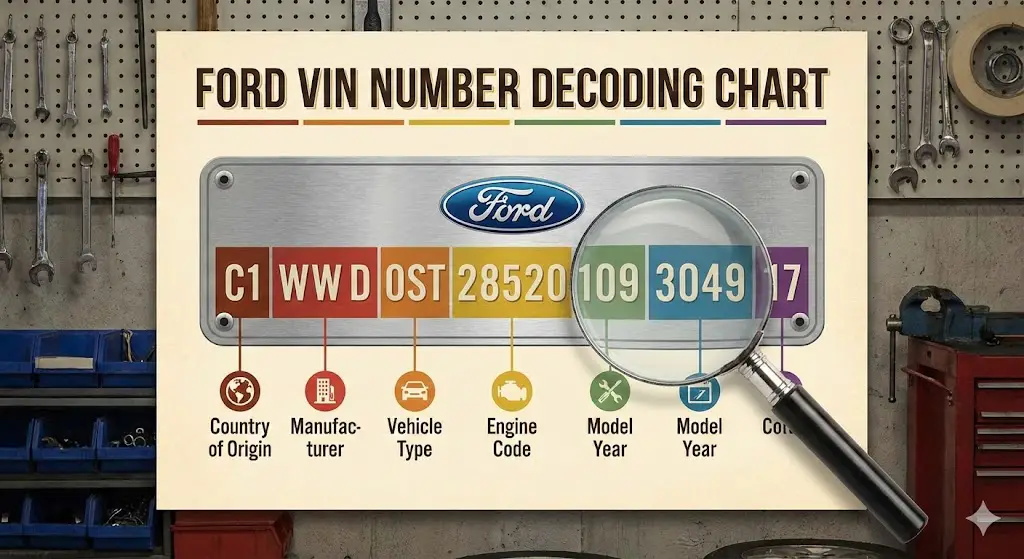
The Definitive Technical Reference: Decoding the Ford Motor Company Vehicle Identification Number (VIN) Architecture (1981–Present)

In the complex landscape of global automotive manufacturing, the Vehicle Identification Number (VIN) serves as far more than a mere serial number. It is a cryptographic representation of a vehicle’s engineering DNA, a regulatory compliance document, and a logistical tracker that binds the physical asset to its digital history. For Ford Motor Company, an entity with a manufacturing footprint spanning six continents and a product portfolio ranging from the battery-electric Mustang Mach-E to the Class 7 F-750 commercial truck, the VIN architecture is the central nervous system of its fleet management and service operations.
Prior to 1981, the automotive industry operated under a fractured system of identification. Manufacturers utilized proprietary serialization formats that varied in length, content, and location, creating significant hurdles for law enforcement, insurance actuaries, and parts suppliers. The seminal moment for modern decoding occurred with the National Highway Traffic Safety Administration (NHTSA) implementation of Title 49 Code of Federal Regulations (CFR) Part 565. This regulation mandated a fixed 17-character format for all vehicles sold in the United States, a standard subsequently adopted by Canada and standardized globally under ISO 3779.
This report provides an exhaustive, expert-level analysis of the Ford VIN system. It moves beyond superficial decoding to analyze the semantic logic behind each alphanumeric position. By synthesizing technical data from fleet guides, manufacturing records, and regulatory filings from 1981 through the 2025 model year, this document serves as the authoritative reference for fleet managers, automotive technicians, and forensic investigators seeking to interpret the data encoded within Ford vehicles.
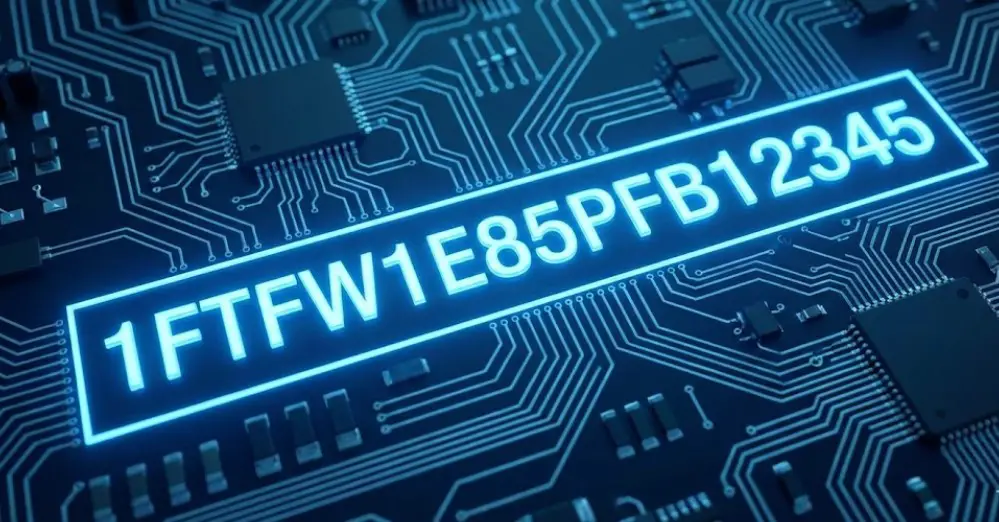
The Anatomy of the 17-Character String
The standardized VIN is segmented into three distinct functional groups, each governed by specific regulatory bodies and corporate strategies:
- World Manufacturer Identifier (WMI): Positions 1–3. Assigned by the Society of Automotive Engineers (SAE) to designate the manufacturer and country of origin.
- Vehicle Descriptor Section (VDS): Positions 4–8. Controlled by the manufacturer to describe the vehicle’s specific attributes, including weight ratings, body styles, safety systems, and powertrain configurations.
- Vehicle Identifier Section (VIS): Positions 9–17. A combination of a regulatory check digit, model year designator, plant code, and the unique production sequence number that individualizes the chassis.
DECODE YOUR FORD’S DNA
Every Ford vehicle carries a unique 17-character secret code. Unlock the history, specs, and legitimacy of your vehicle with this comprehensive breakdown.
The 17-Character Blueprint
A Vehicle Identification Number (VIN) isn’t random. It’s a structured ISO 3779 standard string. Below is the architecture of a standard Ford VIN.
Positions 1-3: Global Origin
The World Manufacturer Identifier (WMI) tells you exactly where
your Ford was born. While Ford is an American icon, manufacturing
is a global operation.
Common Codes:
1FA-1FT :
USA (Ford Motor Co.)
2FA-2FT :
Canada
3FA-3FT :
Mexico
WF0 :
Europe (Germany/UK)
Estimated distribution of North American Ford VINs in circulation.
Position 8: The Power Plant
Perhaps the most critical digit for mechanics and enthusiasts. Position 8 reveals the specific engine configuration. This code distinguishes a base model from a high-performance variant.
Note: Engine codes recycle over decades. A “T” in a 2020 VIN (EcoBoost) differs from a “T” in a 1990 VIN.
Position 10: Crack the Year Code
The 10th character indicates the Model Year. It cycles through 30 characters (letters and numbers), skipping I, O, Q, U, and Z to avoid confusion.
Production Sequence Context
Positions 12-17 are the Serial Number. For high-volume models like the F-Series, these numbers tick up rapidly. The chart below illustrates typical annual production volumes for key Ford families, highlighting why these serial numbers reach 6 digits.
Position 11: Plant Codes
Where was it assembled? Common codes:
© 2026 FordMasterX Infographics. Data sourced from manufacturer owner manuals.
The World Manufacturer Identifier (WMI): Positions 1–3
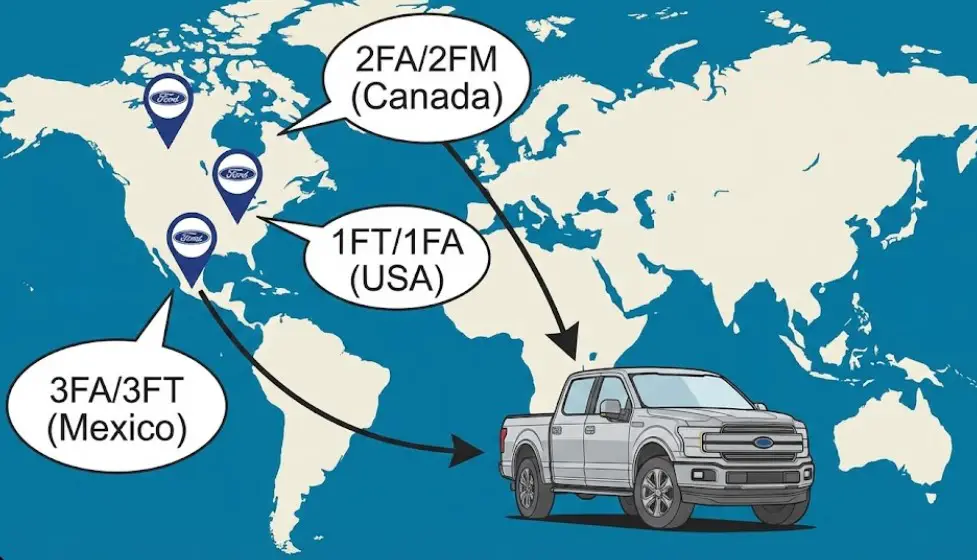
The first three characters of the VIN, known as the World Manufacturer Identifier (WMI), provide the geopolitical and corporate coordinates of the vehicle’s birth. While seemingly static, the WMI codes reflect the dynamic nature of international trade agreements (such as NAFTA and USMCA) and Ford’s shifting global manufacturing strategy.
Geographic Designation (Position 1)
The first character identifies the country of final assembly. For Ford’s North American operations, three primary codes dominate the dataset, reflecting the integrated supply chain across the continent.
- 1, 4, 5 (United States): The United States is the primary hub for Ford’s manufacturing. The digit 1 is the standard designator for Ford-branded passenger cars and trucks assembled domestically. The digit 5 is frequently utilized for Lincoln vehicles or specific incomplete vehicle chassis destined for upfitting.
- 2 (Canada): This code identifies vehicles produced at Canadian facilities, most notably the Oakville Assembly Complex in Ontario. Historically, this facility has been the source for the Ford Edge, Ford Flex, and Lincoln Nautilus.
- 3 (Mexico): Vehicles assembled in Mexico carry the identifier 3. This code has grown in prominence with the shifting of production for models like the Ford Fusion (historical), Mustang Mach-E, and Ford Bronco Sport to facilities in Hermosillo and Cuautitlán.
- Global Import Codes: While less common in domestic fleet analysis, imported models bear codes such as W (Germany), J (Japan), K (Korea), and Z (Italy). These are typically seen on models developed under past partnerships (e.g., Ford-Mazda joint ventures) or specialized imports like the early Transit Connects.
Corporate Identity (Position 2)
The second character identifies the manufacturer. For Ford Motor Company, this is almost universally the letter F. This consistency allows for immediate visual recognition of the manufacturer in mixed fleet databases. Deviations from ‘F’ in this position typically indicate a vehicle produced by a subsidiary or a joint venture partner where Ford was not the primary registrant of the WMI.
Vehicle Type and Divisional Classification (Position 3)
The third character operates in concert with the first two to specify the vehicle category or brand division. This position is critical for regulatory classification, distinguishing between consumer passenger vehicles and commercial platforms.
The Distinction Between “Truck” and “Incomplete”
A crucial insight for fleet compliance lies in the distinction between codes like 1FT and 1FD.
- 1FT (Ford Truck – Completed): This WMI signifies that Ford Motor Company produced the vehicle as a finished good, fully certified to meet all Federal Motor Vehicle Safety Standards (FMVSS) at the time of assembly. This applies to standard F-150 pickups, Explorers, and Expeditions.
- 1FD (Ford Incomplete Vehicle): This code is applied to chassis cabs (e.g., F-350 Chassis Cab, F-550). An “Incomplete” vehicle lacks essential components (like a bed or cargo box) to be road-legal upon leaving the Ford factory. The legal burden of final safety certification passes to the “Final Stage Manufacturer” (the upfitter who installs the ambulance body, utility box, or flatbed). Recognizing this VIN difference is vital for insurance and liability tracking.
| WMI Code | Manufacturer | Vehicle Type | Typical Applications |
| 1FA | Ford Motor Company (USA) | Passenger Car | Mustang, Taurus, Focus |
| 1FB | Ford Motor Company (USA) | Bus | Transit Passenger, E-Series Wagon |
| 1FC | Ford Motor Company (USA) | Stripped Chassis | Commercial Step Vans, P-Series |
| 1FD | Ford Motor Company (USA) | Incomplete Vehicle | F-Series Chassis Cabs, Ambulance Prep |
| 1FM | Ford Motor Company (USA) | MPV (Multi-Purpose) | Explorer, Expedition, Escape |
| 1FT | Ford Motor Company (USA) | Truck (Completed) | F-150, Ranger, Super Duty Pickups |
| 2FA | Ford Motor Company (Canada) | Passenger Car | Crown Victoria (Historical), GT |
| 2FM | Ford Motor Company (Canada) | MPV | Edge, Flex, Lincoln Nautilus |
| 3FA | Ford Motor Company (Mexico) | Passenger Car | Fusion, Fiesta (Historical) |
| 3FT | Ford Motor Company (Mexico) | Truck | Maverick, Specific F-Series trims |
| NM0 | Ford Otosan (Turkey) | Truck | Transit Connect (Cargo Import) |
| 5LM | Lincoln (USA) | MPV | Lincoln Aviator, Navigator |
| 1F6 | Detroit Chassis LLC (USA) | Stripped Chassis | F-59 Commercial Stripped Chassis |
Strategic Insight: The presence of NM0 (Ford Otosan) highlights the “Chicken Tax” tariff engineering. Ford historically imported Transit Connects as passenger vehicles (to avoid the 25% light truck tariff) and then converted them to cargo vans, or imported them directly as commercial vehicles depending on the regulatory climate. The VIN WMI accurately traces these logistical maneuvers.
The Safety and Compliance Matrix: Position 4
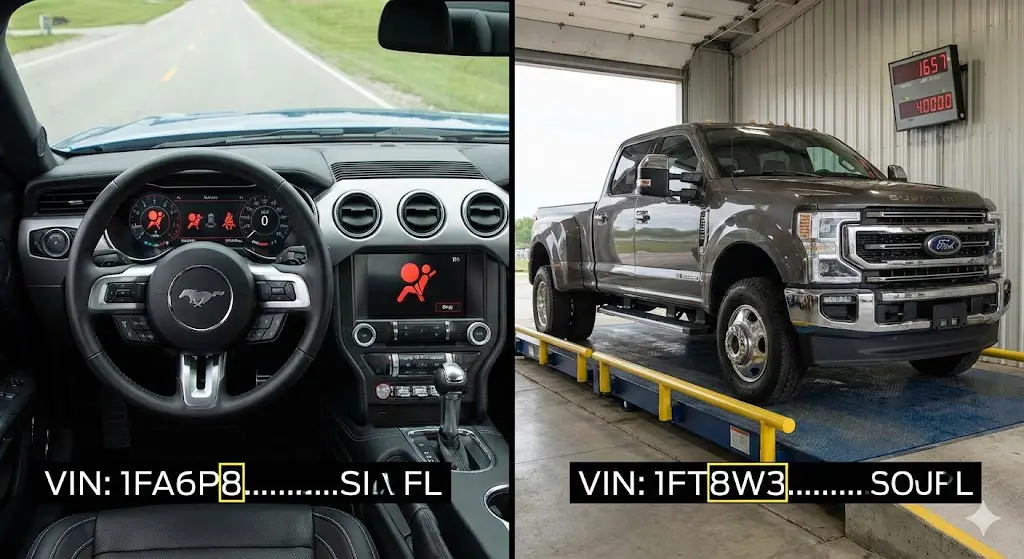
The fourth character of the VIN represents a bifurcation in Ford’s decoding logic. The meaning of this character depends entirely on the vehicle type defined in the WMI. It encodes either the Restraint System (for passenger cars) or the Gross Vehicle Weight Rating (GVWR) and Brake System (for trucks and MPVs). This position is the primary indicator of the vehicle’s safety architecture and payload capacity.
Passenger Cars: The Evolution of Restraint Coding
In passenger vehicles such as the Mustang or the discontinued Fusion, Position 4 identifies the installed safety equipment. This code has evolved significantly over decades as safety technology progressed from simple lap belts to multi-stage advanced airbags.
- Historical Context: In the 1980s and 90s, codes distinguished between “Active Belts” and “Passive Belts” (automatic seatbelts).
- Modern Context: Today, codes typically confirm compliance with FMVSS advanced airbag requirements. For example, a code F or C in a modern Mustang VIN confirms the presence of dual-stage frontal airbags, side-impact airbags, and canopy curtains.
Trucks and MPVs: The GVWR and Brake Class System
For fleet operators, Position 4 on a truck or MPV is arguably the most critical operational data point. It classifies the vehicle into a specific weight range (GVWR), which determines driver licensing requirements (CDL applicability), registration fees, and interstate operating authority.
Ford utilizes a letter code to represent the GVWR range. While the code also indicates the brake system (Hydraulic vs. Air), the overwhelming majority of Class 1-5 Ford trucks utilize hydraulic brakes. Air brakes are generally reserved for the heavy-duty F-650/F-750 commercial lines.
Decoding the Weight Classes
The following table details the specific weight ratings associated with Position 4 codes for Ford trucks and Multi-Purpose Vehicles (MPVs). Note that these ranges align with Federal Highway Administration (FHWA) vehicle classes.
| VIN Code (Pos 4) | Brake System | GVWR Class | Weight Range (lbs) | Typical Application |
| A | Hydraulic | Class A | 0 – 3,000 | Historical/Compact MPVs |
| B | Hydraulic | Class B | 3,001 – 4,000 | EcoSport, Small Sedans |
| C | Hydraulic | Class C | 4,001 – 5,000 | Escape, Maverick, Bronco Sport |
| D | Hydraulic | Class D | 5,001 – 6,000 | Ranger, Explorer, Edge |
| E | Hydraulic | Class E | 6,001 – 7,000 | F-150, Expedition, Bronco (4-Door) |
| F | Hydraulic | Class F | 7,001 – 8,000 | F-150 Heavy Payload, F-250 LD |
| G | Hydraulic | Class G | 8,001 – 9,000 | F-250 Super Duty |
| H | Hydraulic | Class H | 9,001 – 10,000 | F-250/F-350 Single Rear Wheel (SRW) |
| K | Hydraulic | Class 3 | 10,001 – 14,000 | F-350 Dual Rear Wheel (DRW), F-450 Pickup |
| L | Hydraulic | Class 4 | 14,001 – 16,000 | F-450 Chassis Cab |
| M | Hydraulic | Class 5 | 16,001 – 19,500 | F-550 Chassis Cab |
| N | Hydraulic | Class 6 | 19,501 – 26,000 | F-600/F-650 Gas/Diesel |
| T, U, V, W | Air Brakes | Class 6/7/8 | Varied (> 26k) | F-650/F-750 Commercial Only |
Vehicle Configuration: The VDS (Positions 5–7)
Positions 5, 6, and 7 constitute the core of the Vehicle Descriptor Section (VDS). While Position 4 defines the “weight and safety,” these three digits define the “shape and soul” of the vehicle: the model line, series, chassis type, and body configuration.
Unlike some manufacturers that use a static platform code (e.g., Toyota’s usage of chassis codes), Ford’s VDS codes are dynamic and highly model-specific. They combine to form a unique identifier for the specific trim and body style.
The F-Series Truck Architecture
For the best-selling F-Series, these positions identify the drivetrain (4×2 vs. 4×4) and the cab configuration (Regular, SuperCab, SuperCrew). The granularity here is extensive, as F-Series trucks have the highest number of possible build combinations in the Ford lineup.
- F1C / F1E: These codes typically identify an F-150 Regular Cab. F1C denotes a 4×2 drivetrain, while F1E denotes 4×4.11
- F1R / W1R: These codes have historically identified F-150 SuperCrew configurations.
- Raptor Identification: Special performance models like the F-150 Raptor utilize unique series codes such as W1R or W1L (depending on the generation) to distinguish the high-performance wide-body chassis from standard trucks. This is crucial for insurers as the repair costs for Raptor-specific aluminum bodywork are significantly higher.
- Super Duty Series:
- F2A / F2B: F-250 Regular Cab (4×2 / 4×4).
- F3A / F3B: F-350 Regular Cab SRW.
- W3B: F-350 SuperCrew 4×4 DRW (Dual Rear Wheel).
- F5G / F5H: F-550 Chassis Cabs (4×2 / 4×4).
The Mustang Legacy
The Mustang’s VDS codes are simpler but essential for distinguishing between body styles (Coupe/Fastback vs. Convertible) and high-value trim levels.
- P8: This sequence is the standard identifier for the Mustang Coupe (Fastback) body style in modern generations (S550/S650).
- P8T: Historically used to identify specific sub-models such as the EcoBoost Coupe.
- Convertibles: Designated by different codes (often P8F or similar variations depending on the year), identifying the distinct chassis reinforcements required for the open-top architecture.
SUV Lineage: Explorer and Bronco
The Explorer and Bronco lines utilize the VDS to differentiate door counts and drive systems.
- Explorer:
- U22 / U24: These codes are relics of the 1990s/2000s, identifying the 2-Door Explorer (Sport) in 2WD and 4WD configurations, respectively.
- K8A: This is a modern code for the Explorer Police Interceptor Utility. This distinction is vital for the used market, as Police Interceptors often have heavy-duty cooling, suspension, and distinct powertrain calibrations compared to civilian retail units.
- K7K: Identifies the civilian Explorer ST-Line RWD.
- Bronco (2021+):
- With the reintroduction of the Bronco, Ford required new codes to distinguish the 2-Door and 4-Door chassis, which have different wheelbases. The VDS clearly separates the 2-Door “Short Wheelbase” off-roader from the 4-Door family variant.
Commercial Vans
For the Transit and E-Series, these positions indicate the roof height and wheelbase—critical dimensions for logistics companies planning cargo loads.
- E2Y: Identifies a Transit 150 AWD Van with a Low Roof. Such specificity allows upfitters to know exactly which shelving units will fit inside the cargo area before the vehicle even arrives.
Powertrain Identification: The Eighth Character
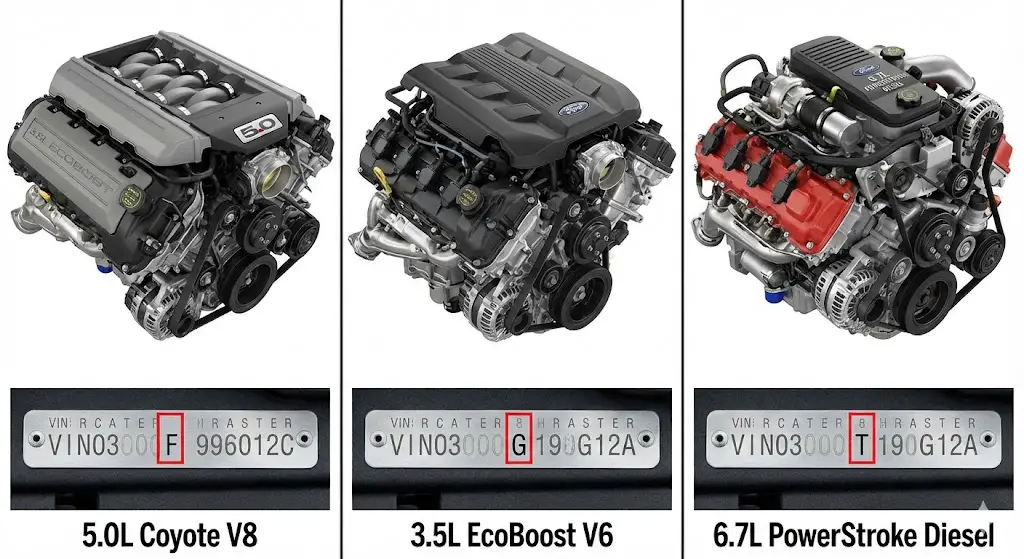
For technicians, parts specialists, and performance enthusiasts, the eighth character is the most significant digit in the entire VIN. It identifies the engine installed at the factory. Unlike a simple displacement label (e.g., “5.0L”), the VIN engine code distinguishes between specific technical iterations—separating a standard output engine from a high-output version, or a flex-fuel capable engine from a gasoline-only variant.
The following sections break down the engine codes by family, covering the 1981–2025 eras.
The V8 Dynasty: Windsor, Modular, and Coyote
Ford’s reputation is built on V8 engines, and the VIN traces the lineage from the pushrod era to the modern DOHC era.
| VIN Code (Pos 8) | Engine Name | Configuration | Displacement | Applications | Notes |
| F | Coyote Gen 1/2 | V8 DOHC | 5.0L | Mustang GT (’11-’17), F-150 (’11-’17) | The standard for modern V8 performance. |
| 5 | Coyote Gen 3 | V8 DOHC | 5.0L | F-150 (’18+) | Introduction of Dual Injection (PFI + GDI) for trucks. |
| F | Coyote Gen 3 | V8 DOHC | 5.0L | Mustang GT (’18+) | Updated Gen 3 architecture for cars |
| U | Road Runner | V8 DOHC | 5.0L | Mustang Boss 302 (’12-’13) | CNC ported heads, high-RPM intake runners. |
| 0 (Zero) | Coyote HO | V8 DOHC | 5.0L | Mustang Bullitt / Mach 1 (’19+) | High-flow induction, Shelby GT350 intake manifold. |
| 6 | Boss / Hurricane | V8 SOHC | 6.2L | Super Duty, F-150 Raptor (Gen 1) | Cast iron block, 2-valve per cylinder, heavy duty. |
| E | Godzilla | V8 Pushrod | 7.3L | Super Duty (’20+) | Return to pushrod OHV architecture for durability. |
The EcoBoost Era: Turbocharged Performance
Ford’s strategic shift to smaller displacement turbocharged engines (EcoBoost) created a new lexicon of VIN codes.
| VIN Code (Pos 8) | Engine Family | Configuration | Displacement | Applications | Notes |
| G | EcoBoost | V6 Twin-Turbo | 3.5L | F-150, Expedition, Transit | The standard 375-400hp workhorse. |
| G | EcoBoost HO | V6 Twin-Turbo | 3.5L | F-150 Raptor (Gen 2) | High Output variant (450hp). Code G serves both standard and HO. |
| T | EcoBoost | V6 Twin-Turbo | 3.5L | Transit, Police Interceptor | Often denotes specific fleet tuning or application. |
| 8 | Cyclone | V6 N/A | 3.5L | F-150, Edge, Explorer | Naturally aspirated base engine, non-turbo. |
| P | Nano | V6 Twin-Turbo | 2.7L | F-150, Bronco, Edge ST | CGI block material, highly efficient. |
| H | EcoBoost | I-4 Turbo | 2.3L | Mustang, Ranger, Explorer | High-performance 4-cylinder. |
| 9 | EcoBoost | I-4 Turbo | 2.0L | Escape, Fusion, Edge | Standard compact SUV powertrain. |
Compression Ignition: The PowerStroke Diesel
In the heavy-duty market, the engine code is the primary value driver. Reliability variances between diesel generations mean that a single character in the VIN can swing resale value by thousands of dollars.
- F (7.3L PowerStroke): 1994–2003. Manufactured by Navistar (T444E). Revered for reliability. A “Code F” truck is a highly sought-after asset.
- P (6.0L PowerStroke): 2003–2010. Manufactured by Navistar (VT365). Known for EGR and head gasket issues. Identification via VIN code P helps buyers anticipate necessary bulletproofing repairs.
- R (6.4L PowerStroke): 2008–2010. Navistar. A transition engine with complex emissions systems.
- T (6.7L PowerStroke): 2011–Present. Ford In-House Design (“Scorpion”). This code marks Ford’s divorce from Navistar. It features a compacted graphite iron (CGI) block and reverse-flow cylinder heads.
- C (6.7L HO PowerStroke): Recently introduced for High Output versions of the 6.7L in late-model Super Duty trucks, distinguishing the 500hp/1200lb-ft variants from the standard “T” code engines.
Electrification: Hybrids and BEVs
As Ford transitions to electric propulsion, Position 8 now encodes electric motors and hybrid architectures.
- D (3.5L PowerBoost): The F-150 Full Hybrid. Combines the 3.5L EcoBoost with a 47hp electric motor integrated into the 10-speed transmission.
- K: Generic code for Battery Electric Vehicle (BEV) systems in early documentation.
- Mustang Mach-E Codes:
- E, L, M, S, V: These codes differentiate between Standard Range vs. Extended Range batteries and RWD vs. eAWD motor configurations. For example, a code might specify the “Extended Range Battery with Rear Primary Drive Unit”.
Mathematical Validation: The Check Digit (Position 9)
Position 9 is unique: it contains no descriptive data about the vehicle itself. Instead, it is a cryptographic checksum used to validate the integrity of the other 16 characters.
The Algorithm:
Governed by 49 CFR Part 565, the check digit is calculated using a “Modulo 11” algorithm.
- Transliteration: Each letter in the VIN is assigned a numerical value (e.g., A=1, B=2… R=9, S=2). Note that letters I, O, and Q are illegal in VINs to prevent confusion with numbers.
- Weighting: Each position in the VIN (1-17) is assigned a specific “weight” factor (8, 7, 6, 5, 4, 3, 2, 10, 0, 9, 8, 7, 6, 5, 4, 3, 2).
- Calculation: The value of each character is multiplied by its weight. The products are summed.
- Modulo: The sum is divided by 11. The remainder (0 through 10) is the check digit. If the remainder is 10, the letter X is used.
Implications for Fraud: This digit is the first line of defense against “VIN Cloning.” If a criminal alters a VIN plate (e.g., changing a model year or engine code) without recalculating the check digit, the VIN will be flagged as “Invalid” by DMVs, insurance databases, and diagnostic scanners.
Chronological Sequencing: The Model Year (Position 10)
The 10th character identifies the model year. The system uses a 30-year repeating cycle of letters and numbers. Because the cycle repeats, the character R could mean 1994 or 2024. Context (styling, Position 7 body codes) is required to differentiate the eras.
7.1 The Ford Model Year Chart (1981–2026)
| Code | Year | Code | Year | Code | Year | Code | Year | Code | Year |
| B | 1981 | M | 1991 | 1 | 2001 | B | 2011 | M | 2021 |
| C | 1982 | N | 1992 | 2 | 2002 | C | 2012 | N | 2022 |
| D | 1983 | P | 1993 | 3 | 2003 | D | 2013 | P | 2023 |
| E | 1984 | R | 1994 | 4 | 2004 | E | 2014 | R | 2024 |
| F | 1985 | S | 1995 | 5 | 2005 | F | 2015 | S | 2025 |
| G | 1986 | T | 1996 | 6 | 2006 | G | 2016 | T | 2026 |
| H | 1987 | V | 1997 | 7 | 2007 | H | 2017 | V | 2027 |
| J | 1988 | W | 1998 | 8 | 2008 | J | 2018 | W | 2028 |
| K | 1989 | X | 1999 | 9 | 2009 | K | 2019 | X | 2029 |
| L | 1990 | Y | 2000 | A | 2010 | L | 2020 | Y | 2030 |
Manufacturing Provenance: Position 11 (Assembly Plant)
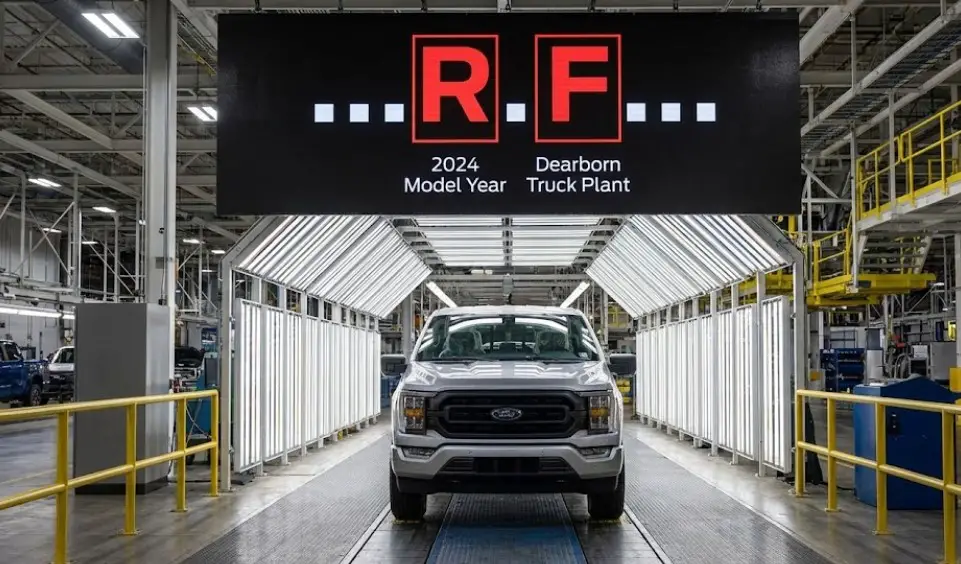
While the WMI (Pos 1-3) gives the country of origin, Position 11 pinpoints the specific factory floor. This information is crucial for identifying vehicles involved in plant-specific recalls (e.g., a paint defect or assembly torque error occurring at only one facility).
Active North American Ford Assembly Plants
| Code | Plant Name | Location | Primary Products | Notes |
| F | Dearborn Truck | Dearborn, MI | F-150, F-150 Raptor | The historic Rouge Complex. Builds the bulk of F-150s. |
| K | Kansas City | Claycomo, MO | F-150, Transit | Dual-sources F-150 to ensure supply; sole source for Transit. |
| E | Kentucky Truck | Louisville, KY | Super Duty (F-250-F-550), Expedition | “KTP” is the hub of Ford’s heavy truck and large SUV profit center. |
| U | Louisville Assembly | Louisville, KY | Escape, Lincoln Corsair | Located near KTP, focuses on unibody crossovers. |
| G | Chicago Assembly | Chicago, IL | Explorer, Lincoln Aviator | Historic plant, sole source for the RWD/AWD Explorer platform. |
| L | Michigan Assembly | Wayne, MI | Ranger, Bronco | “MAP” was retooled from Focus production to body-on-frame trucks/SUVs. |
| 5 | Flat Rock | Flat Rock, MI | Mustang | Sole source for the Mustang. Previously built the Fusion and Mazda6. |
| D | Ohio Assembly | Avon Lake, OH | F-650/F-750, E-Series | Focuses on commercial medium-duty and cutaway chassis. |
| R | Hermosillo | Hermosillo, MX | Bronco Sport, Maverick | High-volume compact truck and SUV production. |
| M | Cuautitlán | Cuautitlán, MX | Mustang Mach-E | Ford’s primary North American EV hub. |
Serialization and Production: Positions 12–17
The final six characters constitute the sequential production number. This is the serial number assigned as the chassis is scheduled for the assembly line.
- Sequencing: Typically starts at 100001 or A00001 for the first unit of the model year.
- Volume Overflow: For high-volume vehicles like the F-Series, which exceed 600,000 units annually, Ford utilizes alphanumeric serialization (e.g., A00001 through F99999) to prevent running out of numbers.
- Lincoln Differentiation: In plants that build both Ford and Lincoln products (e.g., Chicago Assembly building Explorer and Aviator), Ford often segregates the serial blocks. Ford vehicles might use the 100000-599999 range, while Lincoln vehicles utilize 600000-999999, allowing for instant brand identification by the last six digits alone.
Physical Verification and Fraud Prevention
The digital decoding of a VIN is only valuable if the physical VIN on the vehicle is authentic. VIN cloning—the practice of copying a VIN from a legitimate vehicle and placing it on a stolen one—is a significant threat.
Locations of the VIN
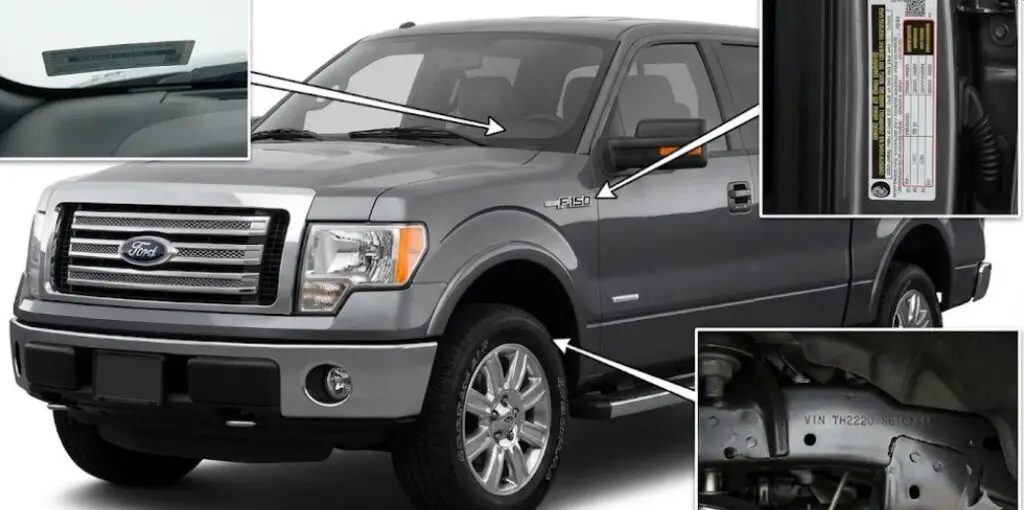
Ford places the VIN in multiple locations to aid verification:
- Public VIN: Stamped metal plate on the dashboard, visible through the driver’s side windshield.
- Certification Label: A sticker on the driver’s door jamb (B-pillar). This label is critical as it also lists the specific Axle Code, Spring Code, Paint Code, and Trim Code for that specific vehicle—data not found in the 17-digit VIN itself.
- Frame Rail (“Confidential VIN”): On body-on-frame trucks (F-Series, Bronco, Ranger), the VIN is deeply stamped into the chassis frame rail, typically on the passenger side, visible from the wheel well. This is the hardest VIN to alter and is the definitive check for law enforcement.
- Engine Block: A partial VIN or date stamp is often laser-etched onto the engine block or machined surface, allowing for “numbers matching” verification.
Indicators of Tampering
- Rivets: Ford utilizes specific rosette-headed rivets (shaped like a flower) to attach the dashboard VIN plate. The use of standard round-head pop rivets found at hardware stores is a primary indicator of a swapped VIN plate.
- Font and Spacing: The font used on Ford VIN labels is proprietary. Uneven spacing, scratching, or mismatched fonts between the door sticker and the dashboard plate are clear signs of manipulation.
Conclusion
The Ford Vehicle Identification Number is a triumph of standardized data engineering. It compresses the immense complexity of Ford’s global operations—encompassing millions of vehicles, dozens of powertrains, and varying regulatory environments—into a concise 17-character string.
For the fleet manager, decoding Position 4 ensures compliance with federal weight regulations. For the mechanic, Position 8 prevents the catastrophic error of ordering the wrong parts for a specific engine iteration. For the enthusiast and collector, the WMI and Plant Code narrate the story of the vehicle’s origin, determining whether a Mustang was built in the historic Flat Rock facility or if a 7.3L PowerStroke is a genuine Navistar-era legend.
As Ford accelerates into the future with the Model e division, the VIN structure will continue to adapt, incorporating new codes for battery chemistries, electric drive units, and software platforms. However, the foundational logic established in 1981 remains the bedrock of automotive identification, ensuring that every Ford vehicle carries its identity permanently stamped into its steel.