
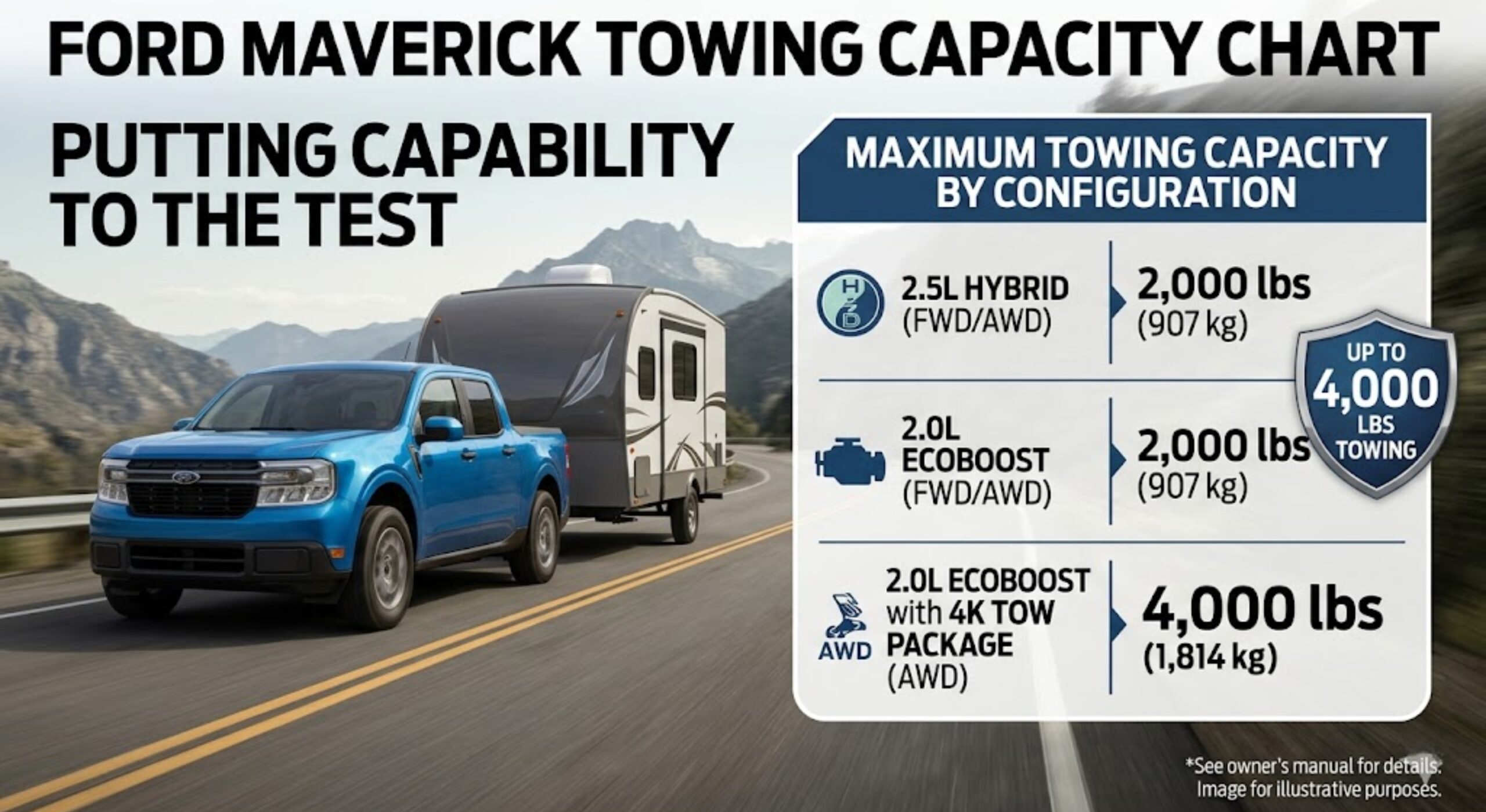
Ford Maverick Towing Capacity Chart: The Ultimate Guide – 2022–2026

The introduction of the Ford Maverick fundamentally altered the compact truck landscape, proving that unibody architecture could deliver legitimate utility and capability. However, for buyers looking to haul travel trailers, boats, or heavy equipment, understanding the precise limits of this platform is critical.
Towing capabilities on the Maverick are not universal; they fluctuate significantly based on engine selection, drivetrain, trim level, and the presence of specialized factory equipment.
This exhaustive analysis breaks down the Ford Maverick towing capacity, analyzing official SAE J2807® standard ratings from the 2022 through 2026 model years. The data clarifies the mechanical differences between standard models and those equipped with the 4K Tow Package, the unique restrictions of the Tremor and Lobo trims, and the real-world implications of payload and frontal area limits.
The Definitive Ford Maverick Towing Capacity Chart
To safely tow, it is imperative to understand the Gross Combined Weight Rating (GCWR)—the maximum allowable weight of the tow vehicle, passengers, cargo, and the loaded trailer combined.
The chart below details the official specifications for the Maverick platform across recent model years, highlighting the transition from standard towing to maximum trailering configurations.
| Engine Configuration | Drivetrain | Axle Ratio | GCWR (lbs.) | Max Loaded Trailer Weight | Required Towing Equipment |
| 2.5L I4 Hybrid (2022-2026) | FWD | 3.37 | 6,090 | 2,000 lbs. | Standard |
| 2.5L I4 Hybrid (2025-2026) | AWD | 3.37 | 6,315 | 2,000 lbs. | Standard |
| 2.5L I4 Hybrid (2025-2026) | AWD | 3.37 | 8,315 | 4,000 lbs. | 4K Tow Package (53Q) |
| 2.0L EcoBoost I4 (2022-2026) | FWD | 3.63 | 5,935 – 5,945 | 2,000 lbs. | Standard |
| 2.0L EcoBoost I4 (2022-2026) | AWD | 3.81 | 6,130 – 6,255 | 2,000 lbs. | Standard |
| 2.0L EcoBoost I4 (2022-2026) | AWD | 3.81 | 8,130 | 4,000 lbs. | 4K Tow Package (53Q) |
Decoding the 4K Tow Package (Option Code 53Q)
The physical difference between a Maverick that can tow 2,000 pounds and one that can safely pull 4,000 pounds lies entirely in the 4K Tow Package, designated internally as Option Code 53Q. Ford’s official RV and Trailer Towing Guide explicitly warns that the New Vehicle Limited Warranty may be voided if an owner attempts to tow a trailer weighing more than 2,000 pounds without this factory-installed equipment.
The 4K Tow Package is not merely a bolted-on hitch; it is a comprehensive mechanical overhaul designed to manage the immense thermal stress and dynamic forces of heavy towing. It is available on XL, XLT, and Lariat trims, provided they are equipped with All-Wheel Drive (AWD).
| Component | Engineering Function |
| Class III 2-Inch Hitch Receiver | Replaces the standard Class I/II receiver (or the lack of a receiver on base XL models) to handle a maximum tongue weight of 400 pounds. |
| 7-Wire Harness & 4-/7-Pin Connector | Provides critical electrical connections for trailer lighting and supplies the necessary voltage for electronic trailer brakes. |
| Integrated Trailer Brake Controller | Allows the driver to safely actuate the trailer’s electric brakes directly from the cabin, preventing brake fade on the tow vehicle. |
| Upgraded Cooling System | Includes a higher-capacity engine radiator for EcoBoost models and a specialized auxiliary automatic transmission oil cooler for Hybrid models. Both receive an upgraded cooling fan. |
| Revised Final Drive Ratio | EcoBoost models utilizing the 4K package feature a 3.81:1 axle ratio to drastically improve low-end torque delivery from a standstill. |
| Trailer Sway Control | Modifies transmission shift points and utilizes targeted individual wheel braking to stabilize the vehicle if the trailer begins to oscillate. |
Payload Capacity vs. Towing Capacity: The Critical Intersection
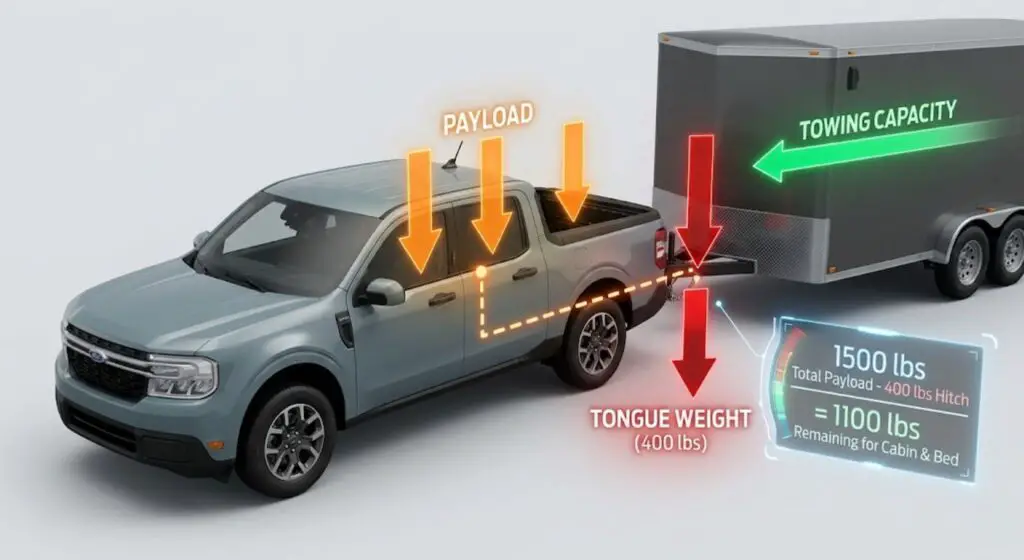
A common operational error among compact truck owners is confusing payload capacity with towing capacity. Towing capacity dictates how much weight the truck can pull horizontally. Payload capacity dictates how much weight the truck’s suspension and frame can carry vertically inside the cabin and the bed.
Crucially, trailer tongue weight counts directly against the vehicle’s payload capacity. The Maverick’s Class III receiver is rated for a maximum tongue load of 400 pounds. If a Maverick has a maximum payload of 1,500 pounds, and a heavy trailer applies 400 pounds of downward force on the hitch, only 1,100 pounds of payload remains for the driver, passengers, tools, and cargo in the bed.
| Maverick Trim / Configuration | Drivetrain | Max Payload Capacity (lbs.) |
| XL, XLT, Lariat (EcoBoost) | FWD / AWD | 1,500 lbs. |
| XL, XLT, Lariat (Hybrid) | FWD | 1,500 lbs. |
| XL, XLT, Lariat (Hybrid) | AWD | 1,400 lbs. |
| Tremor | Advanced 4WD | 1,140 lbs. |
| Lobo (2025-2026) | Advanced 4WD | 1,045 lbs. |
Why the Tremor and Lobo Max Out at 2,000 lbs.

While the Tremor and Lobo trims represent the pinnacle of the Maverick’s off-road and street-performance engineering, respectively, they are the least capable models for towing. Both trims are strictly limited to a 2,000-pound maximum towing capacity and cannot be legally ordered or equipped with the 4K Tow Package.
The restriction stems directly from their specialized suspension geometries. The Maverick Tremor features an off-road-tuned suspension with unique springs and shocks that provide a 9.1-inch ground clearance, alongside an Advanced 4WD system featuring a twin-clutch rear drive unit. This articulation-focused suspension cannot safely support the 400-pound tongue weight required for 4,000-pound towing without catastrophic rear-end sag.
Similarly, the Maverick Lobo, introduced for the 2025 model year, is a street-tuned variant featuring a lowered ride height, specialized performance suspension, and a track-only “Lobo Mode”. Its lowered stance and performance springs restrict its payload to 1,045 pounds and its towing to the baseline 2,000 pounds.
Hybrid AWD vs. EcoBoost
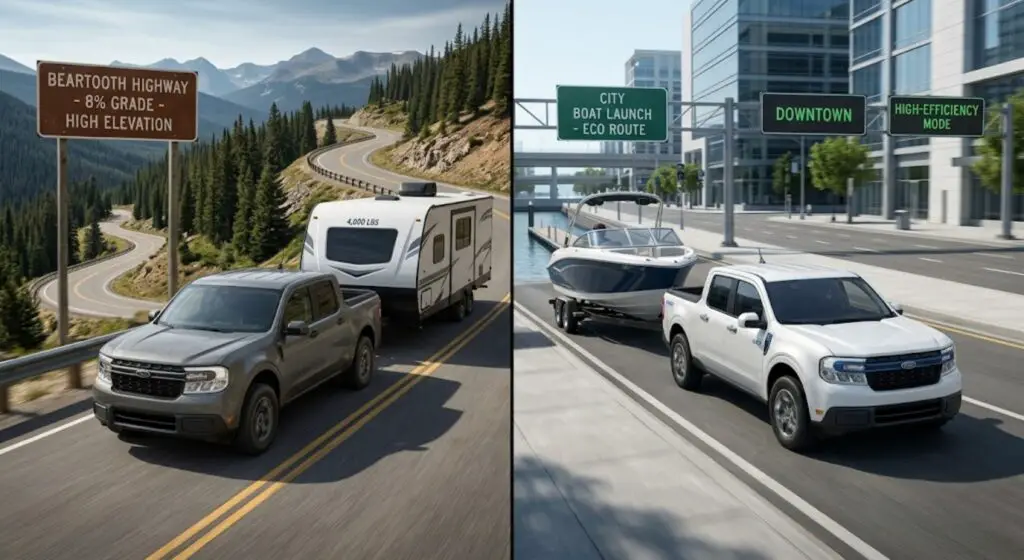
Prior to the 2025 model year, buyers requiring 4,000 pounds of towing capacity were forced to select the 2.0L EcoBoost engine. The EcoBoost utilizes an 8-speed automatic transmission and generates 250 horsepower and 277 lb-ft of torque. It remains widely favored for highway towing in mountainous terrain, as the turbocharger maintains power density at high elevations where naturally aspirated engines traditionally lose efficiency.
With the 2025 refresh, Ford brought the 4K Tow Package to the 2.5L Hybrid AWD platform. The Hybrid utilizes an HF55 electronic continuously variable transmission (eCVT). Unlike belt-driven CVTs prone to overheating under load, the Maverick’s eCVT utilizes a robust internal planetary gearset and an electric traction motor to blend power sources. This design provides immediate low-end torque from a standstill. While the hybrid engine will rev at sustained high RPMs on steep highway inclines, it offers vastly superior unladen fuel economy (up to 42 MPG city) for drivers who only tow on occasional weekends.
Ford Maverick vs. Hyundai Santa Cruz

The Maverick’s primary rival in the compact unibody truck segment is the Hyundai Santa Cruz. When comparing trailering capabilities, the Santa Cruz presents a higher maximum limit on paper, but with significant caveats regarding trim levels and pricing structure. As noted in Car and Driver’s comparative analysis, the Santa Cruz utilizes a more powerful engine to achieve its numbers.
| Capability Metric | 2026 Ford Maverick | 2026 Hyundai Santa Cruz |
| Base Engine Max Towing | 2,000 lbs. | 3,500 lbs. (2.5L Naturally Aspirated) |
| Upgraded Engine Max Towing | 4,000 lbs. (w/ 4K Tow Package) | 5,000 lbs. (w/ 2.5L Turbo AWD) |
| Standard Payload Capacity | 1,500 lbs. | 1,411 lbs. |
| Maximum Horsepower | 250 hp | 281 hp |
| Maximum Torque | 277 lb-ft | 311 lb-ft |
While the Santa Cruz boasts a 5,000-pound maximum tow rating, achieving that figure requires purchasing mid-to-upper tier trims equipped with the expensive 2.5L turbocharged engine. Conversely, every standard trim of the Ford Maverick (XL, XLT, and Lariat) can reach 4,000 pounds when properly equipped with the relatively affordable 4K Tow Package, providing a more accessible entry point for towing.
Best Campers and Travel Trailers for the Ford Maverick
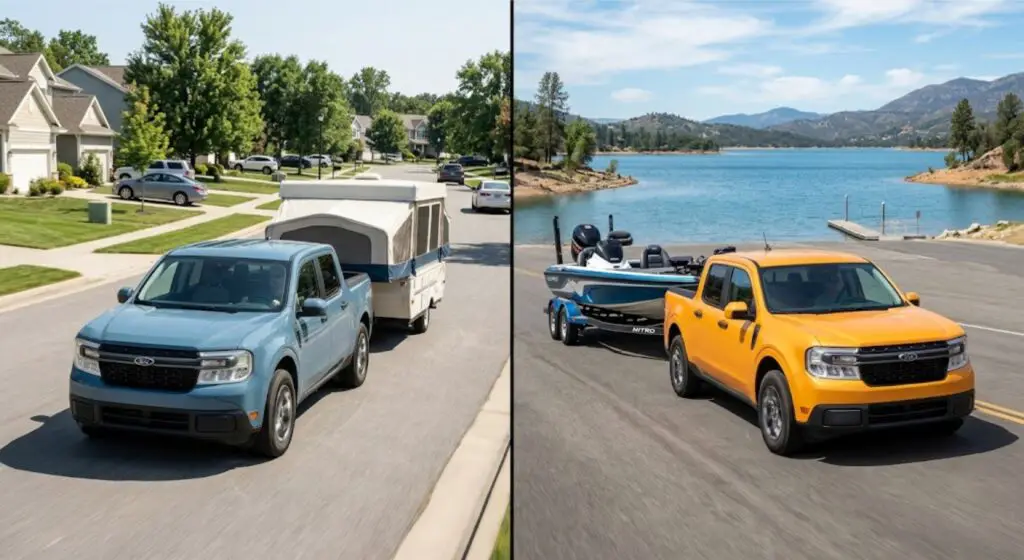
Understanding the real-world translation of the 2,000-pound and 4,000-pound limits is essential for recreational buyers. The towing industry’s golden rule suggests pulling no more than 80% of a vehicle’s maximum capacity. Aiming for 3,200 pounds fully loaded on a 4,000-pound capacity truck provides a critical safety margin for steep grades, crosswinds, and emergency braking scenarios.
| Towing Capacity Tier | Compatible Trailer Types | Real-World Examples |
| Standard (2,000 lbs. Limit) | Pop-up campers, Teardrops, Ultra-light fiberglass, Single-axle utility trailers. | Scamp 13 (1,200-1,500 lbs.), nuCamp TAG, Taxa Cricket, standard 5×8 utility trailers. |
| 4K Tow Package (4,000 lbs. Limit) | Single-axle bunkhouses, mid-size fiberglass trailers, aluminum teardrops, small powerboats. | Casita 17 (2,480 lbs. dry), Escape 19, Airstream Basecamp 16, Forest River No Boundaries, 21-foot sport boats. |
Suspension Upgrades and Severe Duty Maintenance
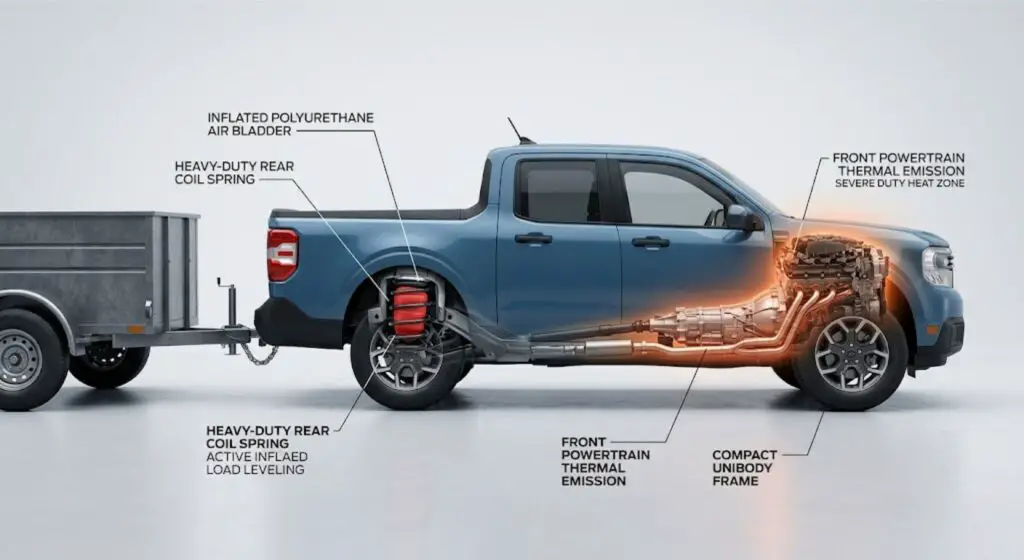
When loading a unibody truck near its payload or tongue weight limits, rear suspension “sag” or “squat” is a common hazard. Sag lifts the front tires off the pavement, compromising steering geometry and increasing braking distances.
Ford applies the SAE J2807 standard to the Maverick, but a Weight Distribution Hitch (WDH) is generally not recommended or required to reach the maximum 4,000-pound capacity on this unibody platform. Unlike body-on-frame trucks where a WDH mathematically increases tow ratings, the Maverick’s maximum structural rating is fixed.
To fix rear sag while maintaining factory ride quality, aftermarket towing suspension upgrades are highly recommended. Companies like Air Lift produce polyurethane air bladders that sit inside the rear factory coil springs and inflate up to 35 PSI to provide active load leveling. Alternatively, Timbren SES rubber bump stops provide passive load-leveling without the need to manage air pressure.
Furthermore, towing generates massive amounts of heat within the powertrain. Ford classifies frequent towing, especially in hilly terrain or high heat, as “Severe Duty” operation. Owners must deviate from the standard maintenance schedule to prevent catastrophic mechanical failure. Under Severe Duty conditions, the transmission fluid, as well as the PTU and rear axle fluid on AWD models, must be replaced every 60,000 miles. Engine oil intervals drop to 5,000 miles or 6 months, and spark plugs require replacement at 60,000 miles.
People Also Ask
Does the base Ford Maverick XL come with a trailer hitch?
A trailer hitch receiver is not standard on the base XL trim; it must be added as a standalone factory option or purchased aftermarket. However, starting in the 2025 model year, the 2K Trailer Hitch Receiver with a 4-pin connector became standard equipment on the XLT trim and above.
Can you flat tow a Ford Maverick behind a motorhome?
Yes, but only in specific configurations. The Maverick equipped with the 2.5L Hybrid engine (both FWD and AWD variants) is officially approved by Ford for four-wheel-down flat towing behind an RV. Models equipped with the 2.0L EcoBoost engine cannot be flat towed without causing severe transmission damage.
Are the Maverick and Bronco Sport towing capacities identical?
While they share the same overarching C2 unibody platform, their trailering capacities differ dramatically. The Bronco Sport maxes out at 2,200 pounds with its 2.0L engine. The Maverick’s longer wheelbase, specific cooling packaging, and available 4K Tow Package allow it to safely pull nearly double that weight.