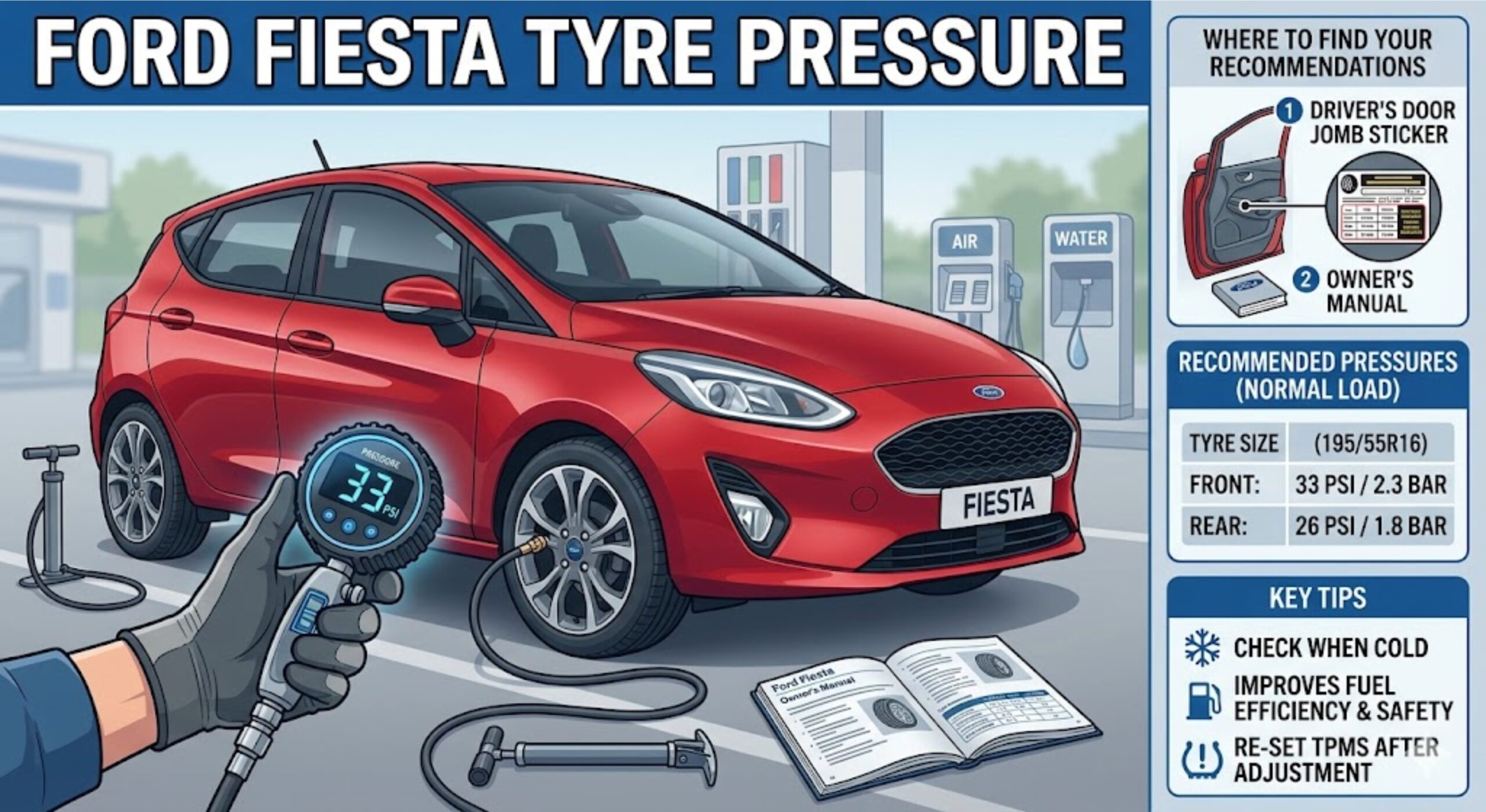
Ford Fiesta Tyre Pressure Maintenance – The Definitive Guide in 2026

The precise calibration of pneumatic tyre pressure constitutes the foundation of automotive safety, chassis dynamics, and powertrain efficiency. For the Ford Fiesta, a front-wheel-drive subcompact platform spanning multiple decades and engineering architectures, tyre pressure is not a static monolithic figure but a highly variable metric dependent on payload, velocity, and ambient thermodynamics.
Maintaining the manufacturer-specified pressure ensures that the tyre’s engineered contact patch remains perfectly interfaced with the road surface, which optimizes lateral grip, minimizes braking distances, and mitigates the risk of aquaplaning.
Deviation from these strict tolerances introduces compounding mechanical and economic inefficiencies. Operating a Ford Fiesta with under-inflated tyres drastically increases rolling resistance, forcing the internal combustion engine or hybrid powertrain to expend superior kinetic energy to maintain speed, thereby degrading fuel economy and accelerating structural wear on the tyre’s shoulders.
Conversely, over-inflation reduces the contact patch strictly to the central circumference of the tread, leading to premature center wear, diminished handling characteristics, and an elevated transmission of road harshness into the passenger cabin.
The Ultimate Data-Driven Guide to Ford Fiesta Tyre Pressure
Maintaining the correct tyre pressure for your Ford Fiesta isn’t just a recommendation—it is a critical requirement for vehicle safety, maximizing fuel economy, and ensuring even tread wear. Whether you drive a 1.0L EcoBoost daily commuter or a high-performance Fiesta ST, precise inflation mechanics dictate how your vehicle connects with the road. This deep-dive technical guide explores the exact PSI and Bar metrics you need, the hidden costs of under-inflation, and the proper recalibration of your Tyre Pressure Monitoring System (TPMS).
Core Metrics: Optimal PSI & Bar Specifications
The Ford Fiesta’s optimal tyre pressure fluctuates based on two primary variables: the weight load in the vehicle and the specific wheel diameter fitted to your trim. Standard models generally feature 15-inch or 16-inch alloys, while ST-Line and full ST models push to 17-inch and 18-inch rims with lower profile rubber. When carrying 1-3 passengers (Normal Load), the pressure distribution favors front-wheel bias to support the engine block. Under maximum load (Full Load), rear pressure must be significantly increased to prevent sidewall flex and maintain directional stability.
Standard Ford Fiesta Load Comparison (1.0 EcoBoost / 16″ Wheels)
This visualization compares the stark difference in required pressure when transitioning from a standard commute to a fully laden vehicle. Notice the dramatic 41% required increase in the rear tyre pressure under full load conditions.
| Tyre Size | Load Type | Front (PSI / Bar) | Rear (PSI / Bar) |
|---|---|---|---|
|
195/55 R15 195/50 R16 |
Normal (1-3 Pax) | 33 PSI / 2.3 Bar | 26 PSI / 1.8 Bar |
| Full (4-5 Pax + Luggage) | 36 PSI / 2.5 Bar | 41 PSI / 2.8 Bar | |
|
205/45 R17 (ST-Line) |
Normal | 34 PSI / 2.3 Bar | 26 PSI / 1.8 Bar |
| Full | 38 PSI / 2.6 Bar | 44 PSI / 3.0 Bar | |
|
205/40 R18 (Fiesta ST) |
Normal | 35 PSI / 2.4 Bar | 29 PSI / 2.0 Bar |
| Full Track/Load | 39 PSI / 2.7 Bar | 41 PSI / 2.8 Bar |
Data synthesized from the official Ford Owner’s Documentation.
The Compounding Costs of Incorrect Pressure
Operating a Ford Fiesta outside the manufacturer’s specified pressure thresholds initiates a cascade of negative mechanical and financial effects. Under-inflation increases the rolling resistance footprint of the tyre, causing the engine to work harder to maintain velocity. This not only decimates fuel efficiency but accelerates edge tread wear. According to safety analytics, running tyres just 25% under-inflated triples the risk of a blowout due to excess heat generation within the rubber compound.
Impact on Tread Lifespan & Safety
Distribution of premature tyre failures linked to specific inflation states. Under-inflation represents the critical hazard zone.
Fuel Efficiency Degradation
Estimated percentage loss in Miles Per Gallon (MPG) as tyre pressure drops below the optimal 33 PSI baseline.
Based on data trends from the NHTSA Tire Safety Analysis.
How to Reset the Ford Fiesta TPMS
The Tyre Pressure Monitoring System (TPMS) uses ABS wheel speed sensors (indirect) or physical valve sensors (direct) to monitor pressure loss. Whenever you adjust your tyre pressures, change a wheel, or rotate tyres, you must initialize the system to baseline the new parameters. Failing to do so will result in persistent warning lights and compromised safety alerts. Follow this structured process for MK7 and MK8 models.
Preparation
Ensure the vehicle is stationary, parked on a level surface. Inflate all four tyres to the precise PSI/Bar specified on your driver’s door B-pillar placard. Michelin recommends checking pressure when tyres are “cold” (driven less than 2 miles).
Ignition Sequence
Turn the vehicle ignition to the ON position. Do not start the engine. For push-button start models, press the start button once without pressing the clutch or brake pedal.
Menu Navigation
Using the steering wheel controls, navigate to the Settings menu on your dashboard information display. Scroll down to Vehicle, then select Tyre Pressure or TPMS.
Execution & Confirmation
Press and hold the OK button. A progress bar will appear. Hold it until the system displays a “Tyre Pressure Stored” or “Reset Successful” confirmation message. The warning light will extinguish.
Locating and Decoding Vehicle-Specific Placards
Because the Ford Fiesta has evolved through numerous generations—each with unique powertrain weights, suspension geometries, and payload capacities—operators must consult the vehicle-specific tyre information placard. This standardized plate is predominantly affixed to the driver’s side door jamb (the B-pillar), though it may also be situated on the inner surface of the fuel filler flap or detailed within the vehicle’s manual. For digital verification, operators can consult Ford’s official vehicle support portal.
The tyre pressure placard provides a standardized matrix utilizing specific legend labels. Label A designates the tyre size, including width, profile, and rim diameter. Label B confirms the specific vehicle model to ensure the placard matches the chassis. Labels C and D delineate the recommended front and rear axle inflation metrics, respectively. Finally, Label E utilizes pictograms to illustrate the occupancy and cargo load conditions that necessitate immediate pressure adjustments.
Generation-Specific Tyre Pressure Matrices
The baseline tyre pressure for most standard Ford Fiesta models operates within the 32 to 36 Pounds per Square Inch (PSI) range, translating to approximately 2.1 to 2.5 Bar. However, the exact specification diverges radically when accounting for wheel size, the mass of the specific engine block, and the payload. To effectively track these variables, the data is best presented chronologically across the vehicle’s manufacturing history.
Table 1: Eighth Generation (Mk8: 2017–2023) Core Specifications The Mk8 Fiesta represents the most highly specified generation, integrating standard hatchbacks, the raised Active crossover, and the performance-tuned ST-Line. The data below illustrates the pressure requirements for the 1.1L, 1.0L EcoBoost, and 1.5L EcoBoost variants under normal and full load conditions.
| Engine & Tyre Size | Normal Load Front (Bar/PSI) | Normal Load Rear (Bar/PSI) | Full Load Front (Bar/PSI) | Full Load Rear (Bar/PSI) |
| 1.1L Engine | ||||
| 195/60R15 | 2.1 (30) | 1.8 (26) | 2.8 (41) | 2.8 (41) |
| 195/55R16 | 2.1 (30) | 1.8 (26) | 2.3 (33) | 2.6 (38) |
| 205/45R17 | 2.3 (33) | 1.8 (26) | 2.3 (33) | 2.6 (38) |
| 205/40R18 | 2.3 (33) | 1.8 (26) | 2.6 (38) | 2.8 (41) |
| 1.0L EcoBoost (Auto) | ||||
| 195/60R15 88V Winter | 2.3 (33) | 1.8 (26) | 2.8 (41) | 2.8 (41) |
| 205/45R17 88V XL Summer | 2.5 (36) | 2.1 (30) | 2.5 (36) | 2.9 (42) |
| 1.5L EcoBoost | ||||
| 205/45R17 88Y XL | 2.5 (36) | 2.2 (32) | 2.6 (38) | 2.3 (33) |
| 205/40R18 86Y XL | 2.5 (36) | 1.9 (28) | 2.6 (38) | 2.3 (33) |
Table 2: Seventh Generation (Mk7: 2008–2017) Standard Specifications The Mk7 architecture relies on slightly narrower tyre profiles and exhibits a distinct pressure bias toward the front axle under normal load conditions, reflecting the weight distribution of the transverse front-engine layout.
| Tyre Size | Normal Load Front (Bar/PSI) | Normal Load Rear (Bar/PSI) | Full Load Front (Bar/PSI) | Full Load Rear (Bar/PSI) |
| 175/65R14 82T | 2.4 (35) | 2.4 (35) | 2.4 (35) | 2.4 (35) |
| 185/60R15 84H | 2.2 (32) | 2.1 (30) | 2.4 (35) | 2.4 (35) |
| 195/55R15 85V | 2.1 (30) | 1.9 (28) | 2.4 (35) | 2.4 (35) |
| 195/60R15 (1.5L Diesel) | 2.3 (33) | 1.8 (26) | 2.8 (41) | 2.8 (41) |
| 205/45R17 (1.5L Diesel) | 2.3 (33) | 1.8 (26) | 2.3 (33) | 2.6 (38) |
Table 3: Legacy Generations (Mk4, Mk5, Mk6: 1995–2008) Older Fiesta platforms were manufactured with significantly lower gross vehicle masses, which allowed for smaller rim diameters and narrower contact patches. These vehicles operate on distinctly lower volume tyres.
| Tyre Size | Normal Load Front (Bar/PSI) | Normal Load Rear (Bar/PSI) | Full Load Front (Bar/PSI) | Full Load Rear (Bar/PSI) |
| 155/70R13 | 2.1 (30) | 1.8 (26) | 2.4 (35) | 2.6 (38) |
| 165/70R13 | 2.1 (30) | 1.8 (26) | 2.4 (35) | 2.6 (38) |
| 175/65R14 | 2.1 (30) | 1.8 (26) | 2.4 (35) | 2.4 (35) |
| 195/50R15 | 2.0 (29) | 1.8 (26) | 2.4 (35) | 2.6 (38) |
Commercial Applications: The Ford Fiesta Van
The engineering tolerances for the commercial Ford Fiesta Van variant demand strict adherence to payload-specific tyre pressures. While the unladen vehicle shares the dynamic profile of the standard hatchback, the Gross Vehicle Mass (GVM) can scale up to 1,710 kg in modern hybrid configurations. When the cargo bay is utilized, the rear suspension geometry and the tyre sidewalls endure extreme mechanical stress.
To prevent sidewall collapse and maintain steering authority, the rear tyre pressure must be dramatically elevated. For example, a commercial Fiesta utilizing the 195/60R15 profile must see its rear axle pressure increased from a baseline of 33 PSI to a maximum load specification of 41 PSI before heavy transport operations commence.
High-Stress Velocity and The ECO Pressure Concept
Kinetic energy generation at elevated velocities fundamentally alters pneumatic behavior. For continuous autobahn-style travel exceeding 160 km/h (100 mph), or when the vehicle is utilized to tow a trailer at sustained speeds up to 100 km/h (60 mph), the baseline pressure must be dynamically increased. Elevating the pressure by approximately 2 to 3 PSI stiffens the tyre’s sidewall, which successfully counteracts the immense centrifugal forces and internal thermal generation inherent to sustained high-velocity rotation.
Conversely, Ford has engineered a specialized “ECO” pressure setting into modern Fiesta placards. This represents an inflation metric intentionally calibrated higher than the standard comfort pressure. By inflating a 195/60R15 tyre to 33 PSI instead of the comfort-oriented 30 PSI, the tyre’s contact patch is marginally reduced, creating a highly rigid structural perimeter.
This deliberate stiffening minimizes rolling resistance and yields measurable improvements in miles-per-gallon efficiency. The mechanical trade-off is a measurable reduction in suspension damping, translating to a firmer ride quality and slightly diminished lateral compliance over broken tarmac.
Environmental Thermodynamics and Altitude Compensation
Pneumatic tyre pressure is governed strictly by thermodynamic laws; air expands when heated and contracts when exposed to freezing environments. The established physical constant dictates that for every 10°C decrease in ambient temperature, tyre pressure will experience a linear decay of approximately 0.07 to 0.14 Bar. Measured on the Fahrenheit scale, the ratio equates to a loss of 1 PSI for every 10°F drop.
This thermodynamic reality requires meticulous temperature compensation when inflating tyres in a climate-controlled workshop prior to exposing the vehicle to a freezing external environment. A standard temperature compensation formula is utilized within the industry:
If a Ford Fiesta is serviced in a 68°F workshop but will be operated in a 14°F external environment, the temperature delta is 54°F. As documented in(https://static.nhtsa.gov/odi/tsbs/2014/MC-10133726-9999.pdf), the technician must intentionally over-inflate the tyres by approximately 5.4 PSI inside the workshop so that when the vehicle enters the freezing environment, the subsequent thermal contraction results in the tyre settling at the exact manufacturer-specified baseline.
Furthermore, because driving friction creates a “hot” tyre state that artificially inflates the PSI reading, pressure must exclusively be measured in the morning, or after the vehicle has remained stationary for a minimum of three hours to ensure a true “cold” reading.
TPMS Architecture, Diagnostics, and Retraining Protocols
Since the early 2010s, regulatory safety mandates have seen the Ford Fiesta equipped with a direct Tire Pressure Monitoring System (TPMS). This architecture relies on localized wireless sensors mounted within the inner valve assembly of each wheel, which transmit real-time pressure and temperature voltage data to the Electronic Control Unit (ECU).
A persistent or flashing TPMS warning indicator on the dashboard typically signifies a systemic hardware failure rather than a standard pneumatic puncture. The direct TPMS modules rely on integrated lithium-ion batteries that possess a finite operational lifespan, universally degrading and expiring within a 5 to 7-year timeframe. When the internal cell depletes, the module fails to emit telemetry.
In colder climates where road salt is prevalent, these sensors are also highly susceptible to galvanic corrosion, requiring full unit replacement. Because the sensors are hermetically sealed within the wheel, replacement requires stripping the tyre from the rim and should be followed by professional OBD2 reprogramming to synchronize the new hexadecimal sensor IDs with the ECU.
Following routine pressure adjustments, seasonal tyre rotations, or module replacements, the TPMS architecture must be reset or “relearned” to accurately correlate pressure data with specific wheel positions. For newer Ford Fiesta variants equipped with centralized infotainment screens, the reset protocol involves engaging the ignition to the ‘ON’ position without cranking the engine, navigating through the steering wheel controls to the ‘Vehicle Settings’ menu, selecting
‘Tyre Monitoring’, and depressing the ‘OK’ button until a reset confirmation appears. The vehicle must then be operated at speeds exceeding 20 MPH for approximately 10 minutes to allow the sensors to transmit their new baseline telemetry.
If the vehicle requires a hard module reset, or if it is an older Mk7 platform, a manual retraining sequence must be executed. This intricate sequence requires the operator to cycle the ignition switch from OFF to ON three consecutive times, terminating in the ON position. The operator must then firmly depress and release the brake pedal once, before cycling the ignition switch OFF to ON three additional times.
A successful entry into retraining mode is confirmed by a single actuation of the vehicle’s horn, accompanied by a dashboard prompt to train the front-left tyre. The operator must then utilize a specialized 315MHz TPMS reset tool to trigger the sensors in a strict clockwise sequence (front-left, front-right, rear-right, rear-left), waiting for the horn to chirp after each successful synchronization.
Legal Tread Depth Frameworks and Safety Protocols
The meticulous optimization of tyre pressure is rendered mechanically obsolete if the tyre’s physical tread compound falls below safe engineering tolerances. The depth of the tread void is the sole mechanism responsible for dispersing standing water and maintaining adhesion in adverse weather.
In the United Kingdom, strict legislative frameworks govern vehicle tyre condition. The absolute legal minimum tread depth for passenger vehicles is mandated at 1.6mm. Crucially, this 1.6mm threshold must be continuous across the central three-quarters of the tyre’s breadth, encompassing the entire circumference. Operating a Ford Fiesta with tread depths below this parameter constitutes a severe legal violation, exposing the operator to potential fines of up to £2,500 per tyre and the endorsement of three penalty points on their driving licence.
While 1.6mm serves as the statutory floor, automotive safety authorities advocate for a functional minimum of 3.0mm to guarantee wet-weather performance. Diagnostics can be performed manually utilizing a calibrated depth gauge, by visually observing the Tread Wear Indicators (TWI) molded horizontally into the tyre grooves, or via the informal “20p test,” as outlined by
the(https://www.rac.co.uk/drive/advice/tyres/checking-tyre-tread/). If a 20-pence coin is inserted into the tread and the outer band of the coin remains visible, the tyre lacks sufficient depth and demands immediate replacement.
FAQs
Why does the Ford Fiesta require higher rear tyre pressure when fully loaded?
The Ford Fiesta utilizes a traditional front-wheel-drive architecture, meaning the cast-iron or aluminum mass of the engine and transmission is concentrated entirely over the front axle. Under unladen conditions (driver and single passenger), the front tyres require approximately 3 to 5 PSI more pressure than the rear tyres to safely support this heavy mechanical bias.
However, when introducing cargo into the boot or occupying the rear seats, the vehicle’s center of gravity shifts rearward. To prevent catastrophic sidewall compression under this new payload, the rear tyre pressure must be dramatically increased—often jumping from an unladen 26 PSI up to a highly rigid 41 PSI.
What is the correct pressure for the Fiesta’s temporary space-saver wheel?
Because temporary spare wheels are manufactured with significantly narrower profiles and possess far less internal pneumatic volume than standard road tyres, they operate under immense structural stress to support the vehicle’s mass. Regardless of the specific Fiesta generation, a temporary spare wheel (typically sized 175/65R14 or 165/70R14) must be inflated to a highly pressurized 3.2 Bar, which equates to 46 PSI. Operators are explicitly warned not to exceed 80 km/h (50 mph) or engage specialized traction control settings while the space-saver is equipped.
How do the ST-Line tyre pressures differ from the standard hatchback?
The ST-Line models feature lowered, stiffened sports suspension and larger diameter alloy wheels (frequently 205/45R17 or 205/40R18) equipped with ultra-low-profile, high-performance tyres. Because there is less rubber sidewall to absorb road impacts, these tyres require slightly elevated baseline pressures to protect the rim from pothole damage and to maintain precise steering geometry under heavy lateral cornering loads. While a standard 15-inch wheel requires 30 PSI on the front axle, the 17-inch and 18-inch ST-Line variants require 33 to 36 PSI to maintain their structural integrity.