Ford F150 Speedometer Not Working: The Definitive Diagnostic & Repair Treatise (1992–2026)

In the realm of automotive diagnostics, the speedometer is frequently dismissed as a mere convenience gauge—a passive instrument intended solely to keep the driver compliant with local traffic laws. However, within the complex electronic ecosystem of the Ford F-150, the speedometer acts as the primary visual interface for a critical data stream that governs the behavior of the entire powertrain.
When a Ford F-150 speedometer is not working, it is rarely an isolated incident of a broken needle; rather, it is a symptom of a disruption in the vehicle’s central nervous system, specifically the Controller Area Network (CAN) or the raw sensor data feeding the Powertrain Control Module (PCM).
For the Ford F-150 owner, understanding the failure mode of the speedometer is a matter of vehicle safety and longevity. In modern iterations of the F-Series (specifically the 12th generation and beyond), the vehicle speed signal is a foundational variable used by the transmission control strategies to determine shift points, by the Anti-Lock Braking System (ABS) to modulate caliper pressure, and by the Electronic Power Assisted Steering (EPAS) to adjust steering weight.
A loss of this signal does not just result in a static needle; it can precipitate catastrophic downshifts at highway speeds, disable safety restraints, and induce “limp mode” behaviors that leave the truck stranded.
This research report provides an exhaustive, generation-specific analysis of speedometer failures. We will dissect the evolution of speed sensing technology from the mechanical-electrical hybrid systems of the 1990s to the fully digital, networked architectures of the 2020s. By integrating technical service bulletins (TSBs), electrical schematics, and mechanical repair protocols, this document serves as the ultimate resource for diagnosing and repairing velocity indication failures in the Ford F-150.
Why is my F-150 Speedometer Dead?
A non-functional speedometer in a Ford F-150 is more than just an annoyance; it disables cruise control, affects transmission shifting (limp mode), and poses a safety risk. From the 10th Gen’s plastic gears to the 12th Gen’s notorious Lead Frame, the cause varies wildly by year.
The “Limp Mode” Risk
Without speed data, the PCM cannot determine shift points. This often forces the transmission into Limp Mode, locking it in 3rd gear to prevent damage.
The Usual Suspects
Not all speedometer failures are created equal. Analysis of mechanic reports and forum data reveals that while simple sensors are often blamed, modern F-150s face complex electronic issues inside the transmission itself.
Failure Distribution
Breakdown of reported primary causes for speedometer failure across all F-150 model years (1997-2020). The Lead Frame is a massive outlier for 2011-2014 models.
- Speed Sensors (VSS/OSS): The most common, cheapest fix.
- Molded Lead Frame: Critical issue in 6R80 transmissions.
- Cluster Stepper Motors: The plague of 2004-2008 trucks.
Failures by Generation
Knowing your truck’s generation is half the battle. A 2005 F-150 likely has a bad cluster motor, while a 2013 is a prime candidate for the transmission lead frame recall.
Step-by-Step Diagnostics
Don’t fire the parts cannon yet. Follow this logical workflow to identify the root cause before buying expensive components.
1. Gauge Sweep Test
Hold the ‘Reset’ button on the dash while turning the key to ‘On’ (Engine Off). Watch the needles.
2. Check Fuse & Wiring
Inspect fuse box (usually #14 or #22 depending on year) and look for melted wires near the exhaust.
3. OBDII & Live Data
Connect a scanner. Look for codes P0720 (OSS Circuit) or P0500 (VSS). Monitor “Vehicle Speed” in live data.
The Cost of Repair
Can you fix it yourself? The gap between DIY and Pro repair is significant, especially for Lead Frame replacements which involve dropping the transmission pan.
DIY Savings: Sensor Replacement
Replacing a rear differential VSS is a 10-minute job. You save roughly $150 in labor.
The Lead Frame Factor
The Lead Frame part is ~$150-$300, but shops charge heavily for labor and fluid. DIY is messy but saves $600+.
Cluster Repair
Soldering new stepper motors costs $30 in parts but requires skill. Mail-in repair services are a safe middle ground.
Theory of Operation: The Evolution of Speed Sensing
To accurately diagnose a failure, one must first comprehend the signal path. The methodology by which the Ford F-150 measures, processes, and displays speed has undergone three distinct technological paradigm shifts over the last three decades. Understanding which architecture your vehicle employs is the first step in successful troubleshooting.
The Era of the Programmable Speedometer/Odometer Module (PSOM)
In the ninth generation (1992–1996) and early tenth generation models, Ford utilized a centralized processing unit known as the PSOM. Unlike earlier mechanical systems that used a rotating cable, this system relied on a Variable Reluctance (VR) sensor mounted to the rear differential. This sensor detects the passage of teeth on a tone ring attached to the ring gear. As the differential spins, the sensor generates an analog Alternating Current (AC) voltage waveform. The frequency of this AC signal is proportional to the road speed.
The raw AC signal is transmitted to the PSOM located behind the instrument cluster. The PSOM's role is to "condition" this signal—converting the analog sine wave into a clean digital square wave (8,000 pulses per mile standard) that can be read by the PCM for transmission shifting and by the speedometer motor for display. Failures here are often component-level degradation within the module itself.
The Transition to Distributed Networks (1997–2003)
With the introduction of the tenth generation "Jellybean" body style, the architecture shifted. While early models retained the rear differential VSS, later models migrated the primary speed sensing duty to the transmission output shaft or transfer case. The signal processing responsibilities moved from a dedicated PSOM to the Generic Electronic Module (GEM) or the PCM directly. This era introduced the separation of the odometer and speedometer circuits, leading to the infamous "blackout" odometer issues where the display fails while the gauge remains functional, or vice versa.
The CAN Bus and Lead Frame Era (2004–Present)
The modern era, beginning with the eleventh generation and solidifying with the twelfth, marked the complete digitization of speed data. In these vehicles, there is no direct wire connecting the speed sensor to the dashboard.
- Acquisition: The Output Speed Sensor (OSS), now often housed internally within the transmission's molded lead frame (specifically in the 6R80 transmission), generates the signal.
- Processing: The PCM calculates vehicle speed based on the OSS data, the programmed tire size, and the axle ratio.
- Broadcast: This calculated value is broadcast as a data packet over the High-Speed CAN Bus network.
- Display: The Instrument Panel Cluster (IPC) acts as a passive node, listening for the "Vehicle Speed" packet and commanding the stepper motor or digital screen to display the value.
Generation 12 (2009–2014): The Lead Frame Crisis and Safety Hazards
We begin our specific deep dive with the 12th generation F-150, specifically the 2011–2014 models equipped with the 6R80 6-speed automatic transmission. This generation exhibits the most critical and dangerous failure mode associated with speedometer malfunction: the failure of the Molded Lead Frame.
The Molded Lead Frame Mechanism
In the 6R80 transmission, Ford eliminated external speed sensors to protect them from environmental corrosion. Instead, the Output Speed Sensor (OSS) and Turbine Speed Sensor (TSS) were integrated into a plastic frame—the Molded Lead Frame—that sits inside the transmission fluid pan, bolted directly to the valve body. This frame also houses the electrical connections for the shift solenoids.
The failure mechanism is two-fold. First, metallic contaminants from normal transmission wear can accumulate on the magnetic tips of the sensors embedded in the lead frame. Second, the conductive foam insulators used in the manufacturing process can degrade, creating resistance bridges between circuits. When either occurs, the OSS signal to the PCM is momentarily interrupted.
The "Zero-Speed" Logic Flaw
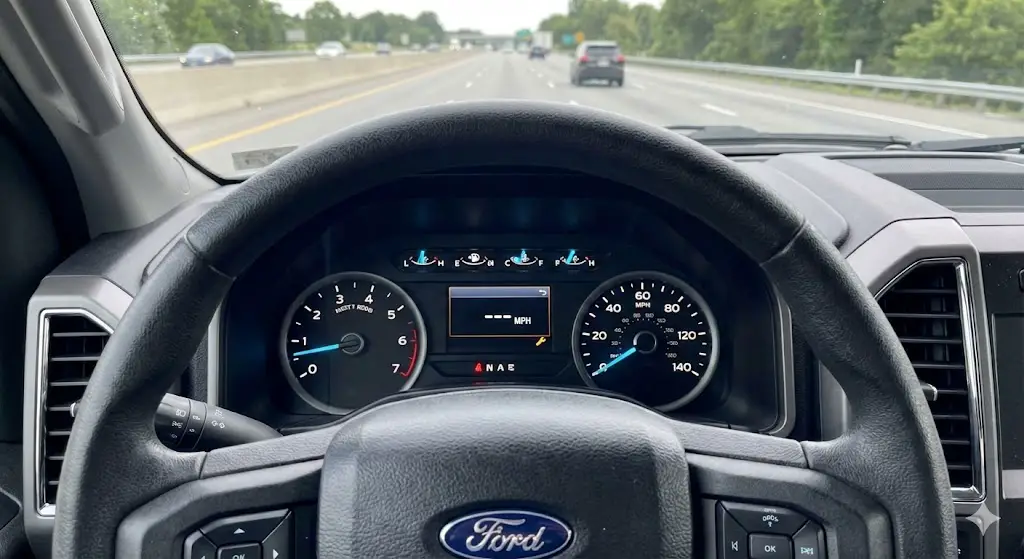
The symptoms of a lead frame failure are terrifyingly distinct. The driver will observe the speedometer needle instantly drop to 0 MPH while driving at highway speeds, often accompanied by the odometer displaying dashes (-----) instead of mileage.
In early software strategies, the PCM interpreted this sudden "0 MPH" reading literally. Believing the truck had come to a stop, the transmission logic would command a downshift to 1st gear to prepare for acceleration. If this occurs at 60 MPH, the rear wheels can lock up, causing a loss of vehicle control, engine over-revving, and potential powertrain destruction.
Diagnostic Codes and Recalls
Confirming this failure requires an OBDII scanner capable of reading historical powertrain codes. The "Smoking Gun" codes are:
- P0720: Output Speed Sensor Circuit Malfunction.
- P0722: Output Speed Sensor Circuit No Signal.
- P0731: Gear 1 Incorrect Ratio (caused by the uncommanded downshift).
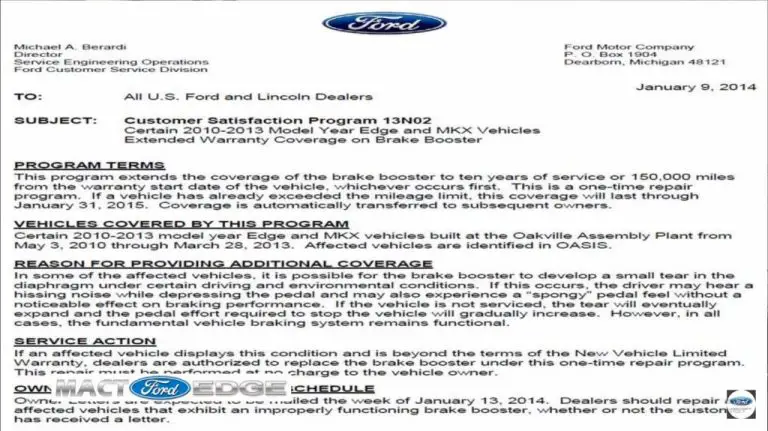
Ford recognized this safety defect and issued Safety Recall 19S07 (and subsequent actions like 24S37). This recall does not replace the faulty part initially; it updates the PCM software to prevent the 1st gear downshift if the speed signal is lost. Instead, the transmission enters a neutral state or holds the current gear. Furthermore, Customer Satisfaction Program 19N01 extended the warranty coverage for the lead frame hardware to 10 years or 150,000 miles. However, as of 2024, many affected trucks have surpassed this time limit, leaving owners responsible for the repair.
Repair Protocol: Lead Frame Replacement
For owners facing this repair out-of-warranty, it is a complex DIY procedure or a costly shop visit.
- Fluid Drainage: The transmission pan must be dropped. This is a messy procedure as the 6R80 lacks a drain plug.
- Valve Body Removal: The mechatronic unit (valve body) must be unbolted from the transmission case.
- Frame Swap: The lead frame is separated from the valve body. Great care must be taken not to damage the solenoids or lose the check balls located in the upper valve body housing.
- Foam Seal: A critical step often missed is replacing the foam pass-through seal that connects the lead frame to the external wiring harness.
- Cost Analysis: The lead frame part (AL3Z-7G276-D or similar) typically costs between $400 and $600 depending on scarcity. Shop labor is usually rated at 3.5 to 4.5 hours, bringing the total repair bill to the $1,200–$1,500 range.
Insight: If you own a 2011–2014 F-150 and experience a speedometer drop without a shift issue, check if the recall software was already applied. The "safe" failure mode (neutraling out) confirms the software is present, but the hardware (Lead Frame) is still defective and requires replacement.
Generation 11 (2004–2008): The Stepper Motor Epidemic
While the 12th generation suffers from sensor input failures, the 11th generation F-150 is plagued by output device failures within the instrument cluster itself. This era represents the peak of stepper motor reliability issues.
The Stepper Motor Failure Mode
The instrument cluster in the 2004–2008 F-150 utilizes small analog stepper motors to drive the gauge needles. These motors (often part number xc5 168 or x27 168) contain internal plastic gears and a magnetic rotor. Over time, the damping fluid inside the motor hardens, or the plastic gears fracture due to heat cycling.
Symptoms:
- The speedometer needle moves erratically or "stutters" rather than sweeping smoothly.
- The needle gets stuck at a random speed (e.g., reading 45 MPH while parked).
- The needle rests pointing straight down (the 6 o'clock position) below the 0 MPH mark.
- The tachometer, fuel, or oil pressure gauges may exhibit similar behavior simultaneously.
The Diagnostic Gauge Sweep
Before condemning the sensors, owners can perform a self-test built into the cluster firmware. This "Dealer Test Mode" bypasses the PCM and tests the physical ability of the cluster to move the needles.
- Insert the key into the ignition but keep it in the OFF position.
- Press and hold the Reset/Setup button (the stick on the cluster).
- Turn the key to the RUN position (do not start the engine) while continuing to hold the button.
- Hold for roughly 5 seconds until the odometer displays the word "TEST".
- Release the button. Press it momentarily to cycle through the menu options until you reach "GAGE".
- Observation: The cluster will command all needles to sweep from their minimum to maximum positions and back. If the speedometer needle lags, shakes, or fails to reach the max position while the others perform correctly, the stepper motor is physically defective.
Repair vs. Replacement Economics
The repair path for this generation offers a significant opportunity for cost savings via DIY methods compared to dealership replacement.
| Repair Option | Description | Estimated Cost | Pros | Cons |
| DIY Stepper Motor Replacement | Desoldering the old motor and soldering in a new one ($10-$30 online). | $30 - $50 | Extremely cheap; permanent fix if done well. | Requires soldering skills; risk of damaging the board. |
| Mail-In Repair Service | Sending the cluster to a specialist (e.g., Circuit Board Medics, ISS Automotive). | $150 - $250 | Professional warranty; plug-and-play return. | Truck is undrivable (no gauges) for 3-5 days. |
| Dealership Replacement | Installing a brand new OEM cluster. | $800 - $1,200 | Guaranteed OEM quality. | Extremely expensive; requires "As-Built" programming. |
Important Internal Context: If you choose to replace the cluster entirely, be aware that the mileage is stored in the cluster's EEPROM. Installing a used cluster from a scrapyard will result in the wrong mileage displaying on your dash, which can cause legal title issues (Odometer Discrepancy) when selling the vehicle. Professional repair services transfer your exact mileage data to the repaired unit.
Generation 9 (1992–1996) & OBS: The PSOM and Differential Diagnostics
The "Old Body Style" trucks are beloved for their mechanical simplicity, but their electronic speedometer system is a common point of age-related failure.
The PSOM Capacitor Leak
The Programmable Speedometer Odometer Module (PSOM) is the heart of the system. It is a daughterboard mounted vertically on the back of the instrument cluster. The electrolytic capacitors used on this board in the 1990s are prone to leaking corrosive electrolyte onto the printed circuit board (PCB) after 30 years. This acid eats through the copper traces, disrupting the signal path.
Symptoms:
- The "Bobbing Needle": The speedometer wavers +/- 5 MPH at steady highway speeds.
- Hard Shifting: The E4OD automatic transmission relies on the PSOM for speed data. A corrupt signal causes the transmission to maximize line pressure, resulting in neck-snapping shifts.
- Fading LCD: The odometer display may darken or vanish.3
Rear Differential Sensor (VSS) Maintenance
The VSS on these trucks is located on the top of the rear differential housing. It is a magnet that counts the teeth of a tone ring inside the differential.
- The Metal Shaving Theory: Because the differential gears wear over time, fine metal particles suspend in the gear oil. These particles are attracted to the magnet of the VSS. If enough "fur" accumulates on the sensor tip, it disrupts the magnetic field variation, causing a weak or noisy signal.
- Diagnostic Tip: Before buying a new sensor, remove the single 13mm or 10mm bolt holding the VSS, pull it out, and wipe it clean with a rag. Reinstall and test. This simple maintenance often resolves the issue for free.
Electrical Infrastructure: Fuse Diagrams and Power Distribution
A speedometer failure can often be traced to a simple blown fuse, but finding the correct fuse is challenging due to Ford's frequent changes in fuse box layouts. A blown fuse in the instrument cluster circuit will often present with other symptoms, such as the loss of interior dome lights or the radio, as these circuits often share power feeds to reduce wiring complexity.
2004–2008 F-150 Fuse Layout (Passenger Kick Panel)
In this generation, the fuse box is integrated into the Smart Junction Box (SJB). Water intrusion from a leaky windshield seal or sunroof drain often corrodes this box, causing phantom electrical issues.
- Fuse 1 (10A): Protects the Instrument Cluster, Audio Unit, and Wiper Motor. If your wipers and radio are also dead, check this fuse first.
- Fuse 21 (15A): Cluster Keep Alive Power. This maintains the memory for the trip odometer and recent driving cycles.
- Fuse 27 (20A): Ignition Switch Feed. If this blows, the cluster may not wake up when the key is turned.
- Fuse 22 (10A): ABS Control Module. Since the speed signal often routes through the ABS logic, a failure here kills the speed data.
2009–2014 F-150 Fuse Layout (SJB and BJB)
This generation splits critical fuses between the cabin and the engine bay.
- Cabin Fuse 26 (10A): Instrument Cluster Module (Ignition/Run).
- Cabin Fuse 29 (5A): Instrument Cluster (Battery Feed).
- Engine Bay Fuse 47 (40A): ABS Pump. A blown ABS fuse often results in a speedometer reading of zero because the vehicle speed calculation logic within the brake control module is offline.
- Engine Bay Fuse 52 (5A): PCM Keep Alive. Essential for the transmission lead frame to communicate.
2015–2020 F-150 Fuse Layout (BCM)
- Cabin Fuse 13 (7.5A): Cluster / Steering Column Control Module (SCCM).
- Cabin Fuse 35 (5A): Heads Up Display / Cluster Feed.
- Engine Fuse 101 (25A): Note that in some diagrams, this is labeled for cooling fans, but shared logic grounds in the harness can sometimes create interference if high-current devices have poor grounds.
Visual Inspection Insight: Do not rely solely on a visual check of the fuse element. Use a multimeter to check for continuity across the fuse test points while it is still installed. Micro-fractures in the fuse element can be invisible to the naked eye but sufficient to break the circuit under vibration.
Generation 13 (2015–2020) and 14 (2021+): The Digital & Network Era
In the aluminum-body F-150s, the speedometer is rarely a mechanical failure. The instrument clusters are either fully digital (LCD) or hybrid systems driven by complex software. Failures here are usually result of "Network Traffic" collisions or voltage instability.
The BLIS Taillight Interference
A peculiar but common failure mode in 2015+ trucks equipped with the Blind Spot Information System (BLIS) involves the taillights. The BLIS radar modules located inside the taillight housings are on the MS-CAN (Medium Speed Controller Area Network) bus—the same network that communicates with the instrument cluster.
- The Failure Chain: If the taillight housing cracks and allows water intrusion, the BLIS module shorts out. This short circuit brings down the entire MS-CAN network.
- Symptoms: The instrument cluster goes completely dead or lights up like a "Christmas Tree" with every warning light active. The speedometer reads zero, the AC stops working, and the windows may not roll down.
- Diagnosis: unplug both taillight harnesses under the bed. If the cluster returns to life (speedometer works), the fault is a shorted BLIS module, not the dash itself.
Battery Management System (BMS) Sensitivity
Modern F-150s are extremely sensitive to battery voltage. The Auto Start-Stop system and the proliferation of modules mean that a weak battery can cause modules to shut down to preserve power.
- Insight: A battery that cranks the engine but sits at 11.9V resting voltage can cause the Instrument Panel Cluster (IPC) to fail its boot-up sequence. If your speedometer is blank or rebooting, the first step is a load test on the AGM battery and a reset of the BMS sensor.
Recalls and TSBs (2021+ Models)
Owners of the newest generation (14th Gen) should be aware of TSB 24C01 and Recall 25S88. These documents detail software bugs in the instrument panel cluster that cause the display to go blank or reboot unexpectedly.
- Trigger: The reboot is sometimes triggered by an incoming cell phone call where the contact name contains emojis, which the system fails to render, crashing the cluster's graphics driver.7
- Remedy: An Over-The-Air (OTA) software update or a dealership flash is required to patch this firmware bug.
Diagnostic Strategy: A Step-by-Step Flowchart
To avoid throwing parts at the problem, follow this logical diagnostic path applicable to most F-150s.
Step 1: Verification and Scope
- Question: Is the odometer also blank/dead?
- Yes: Suspect a power supply issue (Fuse), Ground fault, or Cluster failure.
- No (Odometer works, Speedo doesn't): Suspect a Stepper Motor (04-08) or Speed Signal (VSS/OSS) issue.
- Question: Does the transmission shift correctly?
- Yes: The PCM knows the speed. The problem is likely isolated to the cluster (Stepper motor).
- No (Hard shifts/Limp mode): The PCM does not know the speed. The problem is the Sensor (VSS/Lead Frame) or Wiring.
Step 2: The Cluster Self-Test (Engineering Mode)
Perform the Gauge Sweep test described in Section 4.2.
- Pass: The cluster mechanics are fine. Look for sensor data issues.
- Fail: The stepper motor or cluster electronics are dead. Repair/Replace Cluster.
Step 3: OBDII Scan (FORScan Recommended)
Connect a scan tool. A basic code reader is insufficient; use a tool capable of reading ABS and Body codes (like FORScan with an ELM327 adapter).
- Check PIDs: Monitor
VSS(Vehicle Speed Sensor) andOSS(Output Speed Sensor) live data while driving. - Analysis:
- If the scanner shows the correct speed on your phone/screen but the needle is 0: Cluster Failure.
- If the scanner shows 0 MPH while moving: Sensor/Wiring Failure.
Step 4: Sensor Inspection
- OBS (92-96): Pull the rear diff sensor. Clean metal shavings. Measure resistance (800-1400 Ohms).
- 12th Gen (11-14): Inspect the transmission connector for oil contamination (wicking from the internal seal). If clean, suspect the internal Lead Frame.
Repair Cost Analysis and Internal Linking
Estimated Repair Costs (2024 Market)
| Component | Failure Mode | DIY Cost | Professional Cost | Notes |
| VSS Sensor (Diff) | Dirty/Open Circuit | $40 | $150 | Easiest DIY fix. |
| Lead Frame (6R80) | Sensor/Foam Failure | $500 | $1,200 - $1,500 | Requires trans fluid service. |
| Stepper Motor | Gear/Motor Failure | $30 | $300 (Repair) | Requires soldering. |
| Instrument Cluster | PCB/Display Failure | $600 | $900+ | Requires programming. |
Relevant Internal Resources
For further guidance on maintaining your F-150, consider exploring our detailed guides on related systems:
- : Essential for locating the hidden fuses discussed in Section 6.
- : Critical when performing Lead Frame repairs, especially on dipstick-less 6R80 transmissions.
- : A required step after battery replacement to prevent electrical gremlins in 2015+ models.
Frequently Asked Questions (FAQ)
Q: My speedometer is off by 5-10 MPH after putting on bigger tires. Is it broken?
A: No, it is uncalibrated. The F-150 calculates speed based on the number of axle rotations. Larger tires cover more ground per rotation, causing the truck to travel faster than the gauge reads. This is not just an annoyance; it alters transmission shift points, potentially causing "lugging" or overheating. You can recalibrate the speedometer using a tuner or FORScan software to update the "Tire Revs Per Mile" parameter in the PCM/BCM.
Q: Can I drive my truck with the Lead Frame recall (P0720) issue?
A: It is highly discouraged. While the software update (Recall 19S07) prevents the dangerous 1st-gear downshift, the truck may still enter "Limp Mode," locking it in 3rd or 5th gear. This severely limits acceleration and can be dangerous when merging onto highways. Furthermore, driving with a bad speed sensor disables the ABS and Stability Control systems.
Q: Why does my radio volume drop when my speedometer fails?
A: In 2004–2008 models, the vehicle has a "Speed Sensitive Volume" feature that increases radio volume as you drive faster to overcome road noise. If the speedometer signal drops to zero, the radio assumes the truck has stopped and instantly lowers the volume to the baseline idle level. This is often the first subtle clue of a VSS or cluster signal wiring issue.
Q: Can I just grab a junkyard cluster for my 2006 F-150?
A: Physically, yes. Electronically, no. The instrument cluster contains the PATS (Passive Anti-Theft System) security data. If you plug in a junkyard cluster, the truck's computer will not recognize the security key signature, and the engine will not start (the theft light will flash rapidly). You must have the new cluster "married" to the truck using a high-end scan tool or locksmith software.
Conclusion
The "Ford F-150 speedometer not working" symptom is a chameleon—it changes its nature depending on the year of the truck. It can be a simple $20 sensor cleaning on a 1995 model, a $30 stepper motor fix on a 2005 model, or a complex $1,200 transmission surgery on a 2013 model.
The key to successful repair is moving beyond the symptom and analyzing the system architecture. By utilizing the diagnostic modes built into the truck (Engineering Mode), leveraging OBDII live data to isolate the fault to the sensor or the display, and checking the specific fuses listed in this report, owners can avoid the costly "parts cannon" approach. Whether it requires a soldering iron, a socket set, or a software patch, restoring the speedometer is vital for the safety, legality, and performance of the Ford F-150.