Ford F150 Bed Size Chart: Definitive Dimensions, Configuration Constraints, and Utility Analysis (2024–2026)

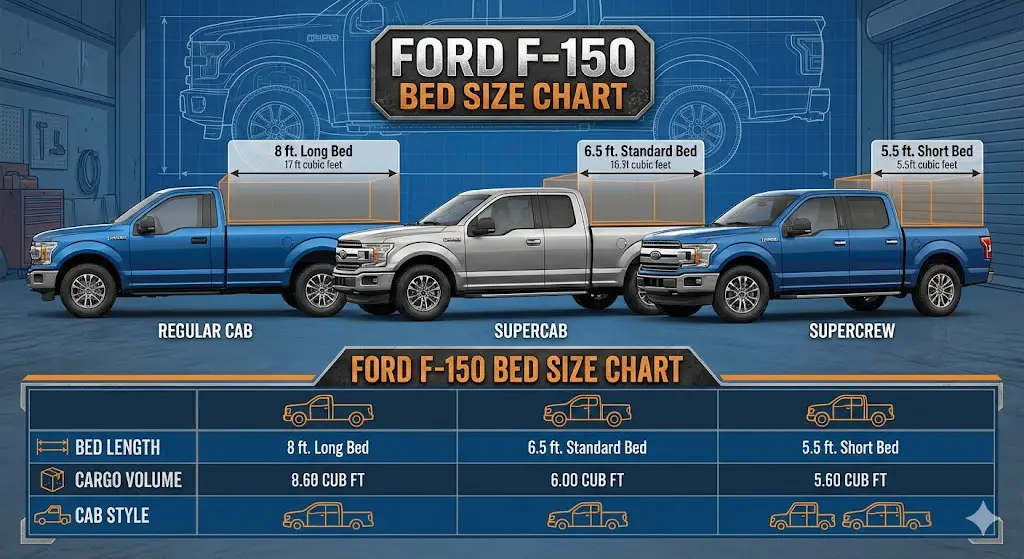
The Ford F-150, a perennial leader in the light-duty truck segment, offers a highly flexible architecture centered around three distinct cargo box lengths, commonly referred to as “Stylesides”. The contemporary F-150 is available with nominal bed lengths of 5.5 feet (Short Box), 6.5 feet (Standard Box), and 8.0 feet (Long Box). The selection of a specific bed size is not an isolated choice but is fundamentally determined by the cab configuration—Regular Cab, SuperCab, or SuperCrew—that the buyer selects. This inherent dependency is a crucial factor in understanding the overall footprint and utility characteristics of any F-150 configuration.
Introduction to the F-150 Bed Options
While the nominal lengths are the primary differentiators, a detailed analysis of the technical specifications reveals that Ford maintains standardized internal dimensions across the entire lineup (spanning 2021 through 2026 model years). The major difference between the three available boxes lies solely in the internal length and the resultant cargo volume. All F-150 boxes share a consistent design profile to ensure compatibility with standardized cargo, ensuring rugged durability regardless of the configuration chosen.
The Foundational Principle: Uniform Utility (4×8 Fitment)
A critical specification defining the F-150’s capability as a serious work truck is the width between the wheel wells. Across all three bed lengths—the 5.5-ft, 6.5-ft, and 8.0-ft boxes—the internal width between the wheelhouses measures a consistent 50.6 inches.
This specific dimension is engineered to directly address the needs of contractors and serious DIY users. Standard construction materials, such as plywood, drywall, and sheet metal, are universally sized at four feet wide (48 inches). Because 50.6 inches exceeds the 48-inch requirement, the F-150 is structurally designed to allow a standard 4×8 sheet of material to lie completely flat on the bed floor, directly between the wheel wells. This design ensures that the core functional utility of the F-150 is preserved, even for buyers who select the shorter 5.5-foot box paired with the family-oriented SuperCrew cab. This standardization simplifies cargo management and confirms the F-150’s enduring status as a contractor-grade half-ton truck.
Choose Your Workhorse
Selecting the right Ford F-150 bed size is critical for utility. Whether you are hauling plywood, camping gear, or tools, dimensions matter. We break down the data behind the three legendary box sizes: the Short, the Standard, and the Long.
5.5-Foot Box
The “Short” Bed
6.5-Foot Box
The “Standard” Bed
8.0-Foot Box
The “Long” Bed
Length vs. Width Comparison
While widths remain constant across all models (50.6″ between wheelhouses), the length variance is significant. This chart visualizes the precise length differences to help you gauge fit for lumber, ATVs, or tools.
Why Width Matters
All F-150 beds share a critical dimension: 50.6 to 51.1 inches between the wheel wells. This design choice ensures that standard 4×8 plywood sheets can lay flat on the bed floor in all configurations, a staple requirement for contractors.
Tailgate Features
- ✓ Pro Access Tailgate (Swing Door)
- ✓ Integrated Tailgate Step
- ✓ Work Surface (Ruler/Phone Holder)
Cargo Volume Capacity
Payload isn’t just about weight; it’s about space. The 8-foot bed offers nearly 50% more cubic volume than the 5.5-foot short bed.
Cab & Bed Compatibility
Not every bed fits every cab. Use this matrix to find your configuration.
Regular Cab
2 Doors, 3 SeatsSuperCab
Ext. Doors, 6 SeatsSuperCrew
4 Full Doors, 6 SeatsHow to Measure Your Bed
Buying a tonneau cover or liner? Measurements must be precise. Don’t rely on the advertised “5.5 foot” name.
- 1 Length: Measure from the inside of the bulkhead (cab side) to the inside of the tailgate (when closed).
- 2 Width: Measure from the inside of one bed wall to the other. Do not measure top rail to top rail.
- 3 Depth: Measure from the bed floor to the top of the bed rail.
The Definitive F-150 Bed Size and Cab Compatibility Chart (2024–2026 Models)
The selection of a bed size must align with one of the F-150’s three available cab styles. These pairings are fixed by the factory due to structural requirements, wheelbase limitations, and market segmentation.
Analyzing the Configuration Constraints
The F-150 body architecture dictates five standard configurations that define the available configurations for the 2024 and 2026 model years.
- Regular Cab: This three-passenger cab, designed primarily for work and utility, cannot be paired with the shortest 5.5-foot box. It is exclusively available with the 6.5-foot (Standard) or the 8.0-foot (Long) boxes, maximizing cargo capacity and potential payload ratings over passenger comfort.
- SuperCab: Featuring smaller, backwards-opening rear doors and seating for five or six people, the SuperCab (also known as the SuperCab) is typically paired exclusively with the 6.5-foot box. While some historical models and specific heavy-duty option packages may have offered an 8.0-foot box, the 6.5-foot box remains the overwhelming standard for current production models.
- SuperCrew: The four-door configuration, which includes full-size rear doors and maximum rear legroom, is the most popular for family use. It offers the choice between the 5.5-foot (Short) and the 6.5-foot (Standard) boxes, providing a balance between passenger space and cargo usability. Configurations focused on off-road performance, such as the TREMOR and Raptor, are commonly associated with the shorter 5.5-foot box.
Table Title: 2024–2026 Ford F-150 Bed and Cab Configuration Chart: Availability and Volume
| F-150 Cab Style | Available Bed Length (Nominal) | Actual Internal Length (in) | Cargo Volume (cu. ft.) | Primary Focus |
| Regular Cab (3 Seats) | 8.0 ft. (Long Box) | 97.6 | 77.4 | Max Payload, Volume |
| Regular Cab (3 Seats) | 6.5 ft. (Standard Box) | 78.9 | 62.3 | Work Utility, Short Wheelbase Option |
| SuperCab (5–6 Seats) | 6.5 ft. (Standard Box) | 78.9 | 62.3 | Crew & Utility Balance |
| SuperCrew (5–6 Seats) | 6.5 ft. (Standard Box) | 78.9 | 62.3 | Long-Range Comfort & Cargo |
| SuperCrew (5–6 Seats) | 5.5 ft. (Short Box) | 67.1 | 52.8 | Off-Road/Maneuverability Focus |
The Payload-Focused Design Philosophy
An analysis of the maximum capacity ratings reveals a fundamental engineering relationship between the choice of cab and bed length. The maximum cargo volume available in the F-150 lineup, 77.4 cubic feet, is exclusively achieved via the 8.0-foot box, which in turn is only offered with the Regular Cab.
This configuration decision is intentional and directly supports achieving the truck’s maximum potential payload capacity. Payload capacity refers to the maximum weight the truck can carry in the cab and bed, and the highest rating for the F-150 (up to 2,445 pounds) is obtained through the combination of the 8.0-foot box and the Regular Cab. This is because the Regular Cab structure is the lightest available configuration in the F-150 lineup. A lower curb weight directly translates to a higher available payload allowance under the fixed Gross Vehicle Weight Rating (GVWR) of the chassis.
By minimizing the structural weight associated with rear doors and extensive rear seating (as found in the SuperCab and SuperCrew), the chassis is optimized to carry external cargo and heavy loads. Therefore, buyers seeking maximum operational capacity are directed by the manufacturer toward the lighter, two-door Regular Cab coupled with the long 8.0-foot bed for superior weight distribution and volume.
Comprehensive Dimensional Metrics and Measurement Guidance
For truck owners concerned with accessory fitment, precise dimensions extending beyond the nominal foot measurement are crucial. Ford maintains remarkable consistency in the internal width and depth across the entire F-150 bed lineup.
Internal Bed Dimensions (Length, Width, and Depth)
The current F-150 beds are defined by standardized internal width and depth, making the actual length the sole variable that changes the cargo volume. The internal depth (or height) for all beds is 21.4 inches.5 The width between the wheel wells, as noted, is consistently 50.6 inches.
The actual internal length of the boxes, measured in inches, clarifies the volume metrics:
- 5.5-Foot Box: Measures 67.1 inches long, offering 52.8 cubic feet of cargo volume.
- 6.5-Foot Box: Measures 78.9 inches long, offering 62.3 cubic feet of cargo volume.
- 8.0-Foot Box: Measures 97.6 inches long, offering the maximum 77.4 cubic feet of cargo volume.
Table Title: Ford F-150 Internal Bed Dimensions and Cargo Capacity (Inches and Volume)
| Bed Option (Nominal) | Actual Length (in.) | Width (Wheel Wells, in.) | Depth/Height (in.) | Total Volume (cu. ft.) |
| 5.5-Foot Box | 67.1 | 50.6 | 21.4 | 52.8 |
| 6.5-Foot Box | 78.9 | 50.6 | 21.4 | 62.3 |
| 8.0-Foot Box | 97.6 | 50.6 | 21.4 | 77.4 |
Expert Measurement Guide for Tonneau Covers and Liners
When purchasing aftermarket accessories, such as tonneau covers or bed racks, it is essential for F-150 owners to verify their bed size accurately, as relying on VIN data alone may not suffice if a previous owner made modifications. The most reliable method involves a physical measurement.
The procedure requires measuring the inside length of the bed along the top bed rail. The measurement should begin at the interior surface of the bulkhead (the front wall of the bed) and extend precisely to the interior edge of the closed tailgate.
It is important to acknowledge that manufacturers often round measurements to the nearest half-foot; for instance, 78.9 inches is designated as the 6.5-foot box. Crucially, for precision fitment of certain accessories, owners must account for installed components. If a user has a tailgate liner or bed liner installed, the thickness of that material must be deducted from the overall internal measurement, in addition to subtracting the width of the bulkhead itself (often around 2.25 inches). Accurate measurement of the physical space is the definitive step to ensure a perfect fit for external accessories.
Accessory Fitment Ecosystem Efficiency
The consistent engineering dimensions across the F-150 bed lineup, specifically the 50.6-inch width and 21.4-inch depth, create significant advantages in the accessory market. Because these two axes are fixed, accessory manufacturers only need to produce variants based on the three lengths (5.5, 6.5, and 8.0 ft) and specific model year structural nuances.
This high degree of dimensional stability simplifies the aftermarket parts ecosystem dramatically. It reduces the complexity and inventory requirements for manufacturers, leading to broader availability of compatible parts like toolboxes, bed dividers, and bed caps. For the F-150 owner, this structural reliability translates directly into lower purchasing costs and greater product choice, reinforcing the F-150’s position as a practical platform for customization and utility upgrades. This consistency is a tacit acknowledgement of the F-150’s platform strength and market dominance.
Real-World Cargo Fitment: Plywood, Pallets, and Mattresses
Analyzing the F-150 bed sizes through the lens of real-world cargo demonstrates the practical implications of choosing one configuration over another.
The 4×8 Sheet Material Haul Test
As established, a 4-foot wide (48-inch) sheet of material fits flat on the floor of any F-150 bed due to the 50.6-inch clearance between the wheel wells. The difference lies in how much a full 8-foot (96-inch) sheet overhangs the bed length.
- 8.0-Foot Bed: This is the ideal configuration for sheet goods. With an internal length of 97.6 inches, the 8-foot sheet fits entirely within the box, allowing the tailgate to be closed securely.
- 6.5-Foot Bed: With a length of 78.9 inches, the sheet extends approximately 17.1 inches past the end of the bed. It can be loaded by resting the material on the lowered tailgate, with minimal overhang past the edge of the gate itself.
- 5.5-Foot Bed: The 67.1-inch bed length requires the tailgate to be lowered for hauling 8-foot sheets. With the tailgate down, the material will overhang approximately 14 inches past the end of the open gate. If the tailgate is closed, the sheets would extend roughly 28.9 inches above the closed tailgate edge.
Fitting Standard Mattresses and Recreational Equipment
The F-150’s dimensions determine the feasibility of loading recreational items. When considering a standard full-size mattress (typically 75 inches long by 54 inches wide), both the 6.5-foot (78.9 in) and the 8.0-foot (97.6 in) beds are long enough.
However, the mattress width presents a challenge. Because the 54-inch width of the mattress exceeds the 50.6-inch width between the wheel wells, the mattress must necessarily sit elevated, resting on top of the wheel wells.3 This elevates the center of gravity and reduces the stability of the load. Therefore, proper securing with tie-downs is non-negotiable for safe transport.
For recreational equipment, most standard utility ATVs or long-wheelbase dirt bikes generally require the 6.5-foot bed or longer to fit completely with the tailgate closed. The 5.5-foot box often necessitates driving the machine partially onto the lowered tailgate.
Load Security and Tailgate Structural Integrity
When hauling heavy, long cargo such as multiple sheets of 4×8 plywood in a shorter bed (5.5-ft) with the tailgate open, the distribution of weight becomes a critical safety and structural concern. While the F-150 platform is engineered with a high overall payload capacity, the tailgate itself possesses an operational load limit distinct from the truck’s overall GVWR.
By allowing a significant portion of the load’s weight to rest on the lowered tailgate, there is an inherent risk of damage to the tailgate structure or the connecting hinge hardware. Furthermore, unsecured long loads extending over a lowered tailgate are susceptible to aerodynamic uplift or “tailgate bounce,” which can apply severe upward forces on the load and potentially compromise the securing mechanism.
For buyers who frequently handle substantial quantities of 8-foot sheet goods (e.g., more than three heavy 3/4″ sheets), the use of the 6.5-foot or 8.0-foot bed is highly recommended. These longer boxes ensure the center of gravity and the static load are fully contained within the main cargo box, significantly reducing stress on the ancillary tailgate mechanism.
Configuration Trade-offs: Overall Footprint, Wheelbase, and Capability
The choice of bed length and cab style extends far beyond cargo volume; it severely impacts the truck’s external geometry, affecting everything from city maneuverability to garage fitment.
Bed Length vs. Overall Vehicle Length and Wheelbase
The wheelbase, defined as the distance between the center of the front and rear wheels, is directly correlated with the truck’s overall length and subsequent turning radius. The F-150 lineup displays a dramatic range in size, which must be carefully considered by buyers with tight parking constraints.
The shortest configuration—the Regular Cab with the 6.5-foot box—measures approximately 209.4 inches long. Conversely, the longest common configuration—the SuperCrew paired with the 6.5-foot box—stretches to roughly 243.8 inches long. This difference of nearly three feet drastically affects handling and storage.
Table Title: F-150 Overall Length and Wheelbase by Configuration (2024/2026 Specifications)
| Configuration (Cab + Bed) | Wheelbase (in.) | Overall Length (in.) | Curb Weight Range (lbs) | Maneuverability Focus |
| Regular Cab, 6.5-ft box | 141.5 | 209.4 | 4,021 – 4,545 | Highest Maneuverability |
| Regular Cab, 8.0-ft box | 145.1 | 228.1 | 4,323 – 5,022 | Dedicated Work Truck |
| SuperCab, 6.5-ft box | 145.4 | 232.0 | 4,248 – 4,947 | Utility/Crew Balance |
| SuperCrew, 5.5-ft box | 145.4 | 232.0 | 4,173 – 4,872 | Family Comfort/Short Footprint |
| SuperCrew, 6.5-ft box | 157.2 | 243.8 | 4,947 – 5,520 | Longest Standard Vehicle |
The Dual-Purpose 145.4-Inch Wheelbase Platform
A detailed comparison of the specifications reveals an important design efficiency in Ford’s lineup: the SuperCab with the 6.5-foot box and the SuperCrew with the 5.5-foot box are built upon an almost identical dimensional platform, sharing a wheelbase of approximately 145.4 inches and an overall length of 232.0 inches.
This shared dimensional footprint demonstrates Ford’s structural strategy, utilizing one chassis layout to offer two fundamentally different priorities to the consumer. A buyer operating within tight dimensional constraints, such as a garage limited to 20 feet (240 inches), is often limited to this 145.4-inch wheelbase configuration. The decision then becomes a direct trade-off between passenger accommodation and cargo space.
The SuperCab option maximizes the usable cargo area by providing the 6.5-foot bed (78.9 inches long) at the expense of rear seating space (33.5 inches of rear legroom). Conversely, the SuperCrew option prioritizes rear passenger comfort, offering 43.6 inches of rear legroom, but necessitates the shorter 5.5-foot bed (67.1 inches long) to maintain the compact overall length. This structural relationship forces buyers to choose between 11.8 inches of bed length and 10.1 inches of rear legroom on the same footprint.
Payload Performance and Bed/Cab Weight Dynamics
Payload capacity is highly sensitive to the truck’s curb weight, which is the weight of the vehicle itself, including all fluids. Longer beds and larger cabs inherently increase the curb weight. Because the GVWR (the maximum allowable weight) is fixed by the factory, any increase in curb weight results in a necessary reduction in the available payload capacity.
The 5.5-foot bed, when paired with the heavy SuperCrew cab, results in one of the higher curb weights (up to 4,872 lbs for the standard SuperCrew configuration). Conversely, the 8.0-foot bed configuration, due to its mandatory pairing with the lightest Regular Cab, starts with a lower curb weight. It is this combination—the low curb weight of the Regular Cab paired with specific high-capacity engine (like the 3.5L EcoBoost V6) and axle options—that allows the F-150 to achieve its maximum payload rating of up to 2,445 pounds. The correlation is clear: to maximize carrying capability, the overall weight of the truck structure (cab size) must be minimized, regardless of the bed length selected.
Historical Dimension Consistency and Cross-Generational Notes
Understanding dimensional consistency is essential for owners of used F-150 models and those sourcing accessories or replacement parts across different generations.
Dimensions of the Previous Aluminum Generation (13th Gen: 2015–2020)
The shift to the aluminum-alloy body beginning with the 13th generation (2015–2020) resulted in remarkably stable external dimensions that closely mirror the current platform (2021–2026). For example, a SuperCrew equipped with the 6.5-foot box in the 13th generation measured 243.7 inches long, which is virtually identical to the current 243.8-inch measurement.
This dimensional carryover reflects Ford’s adherence to standard footprints within the half-ton segment. However, one significant historical difference existed: the 13th generation offered an 8-foot box paired with the SuperCab configuration. This specific combination resulted in one of the longest F-150s ever produced, measuring 250.5 inches bumper-to-bumper.
Implications of Dimensional Consistency
The structural consistency maintained across generations—particularly in cab and bed dimensions—simplifies the purchase of bed accessories for owners of recent used models.24 The reliability of the 5.5-foot, 6.5-foot, and 8.0-foot definitions means that accessory fitment primarily depends on the specific model year structural updates (like tailgate or lighting changes) rather than fundamental variations in the bed’s width or depth.
The later elimination of the 8.0-foot SuperCab/SuperCrew configurations from the standard offering reflects a market-driven decision. This move streamlines the lineup and reserves the extreme 8-foot length solely for the dedicated, high-capacity Regular Cab model, reinforcing the work truck segment while favoring the more maneuverable 5.5-ft and 6.5-ft SuperCrew options for the majority of consumer buyers.
Strategic Selection and Final Summary
Choosing the correct F-150 bed size requires balancing the need for passenger comfort, maneuverability, and cargo volume against the overall vehicle length and maximum payload requirements.
Making the Expert Choice: Bed Selection by Use Case
Based on the analysis of configurations and trade-offs, the optimal bed selection can be segmented by the truck’s intended primary use:
- Maximum Passenger Comfort and Maneuverability (5.5-ft SuperCrew): This configuration is ideal for families, daily driving, and users prioritizing maximum rear legroom (43.6 inches) with the shortest possible vehicle length (232.0 inches). It is also the preferred choice for enthusiasts interested in off-roading trims like the Raptor or TREMOR, where the shorter footprint improves the truck’s break-over angle and handling off pavement.
- Balanced Utility and General Work (6.5-ft SuperCrew or SuperCab): The 6.5-foot box is the recommended general-purpose solution. It provides the crucial increase in length (78.9 inches) needed to carry standard 4×8 sheets of material with the tailgate lowered, and offers substantial cargo volume (62.3 cu. ft.). The 6.5-foot SuperCrew configuration is the preferred choice for long-range trips where both passenger comfort and moderate cargo capacity are required, despite resulting in the longest F-150 footprint (243.8 inches).
- Dedicated Workhorse and Maximum Payload (8.0-ft Regular Cab): This configuration is non-negotiable for fleet managers and buyers focused exclusively on maximum capacity. The 8.0-foot box (97.6 inches) achieves the greatest cargo volume (77.4 cu. ft.) and is required to unlock the F-150’s maximum payload capacity (up to 2,445 pounds) when paired with the lightest Regular Cab and appropriate powertrain/axle options. This is the necessary choice for carrying long pipes, lumber, or utilizing specialized job-site equipment that requires the longest available bed.