Ford Edge Air Conditioning Reset | Complete Fix Guide (2007–2026)

In the modern automotive landscape, the concept of “comfort” has evolved from simple mechanical ventilation to complex, algorithmically controlled environments. The Ford Edge, a cornerstone of Ford’s mid-size crossover utility vehicle (CUV) lineup since its introduction in 2007, exemplifies this transition. Over nearly two decades of production, the Edge has served as a technological testbed, transitioning from the analog-digital hybrids of the CD3 platform to the fully networked, software-defined architectures of the CD4 platform.
Within this evolution lies the Heating, Ventilation, and Air Conditioning (HVAC) system—a critical subsystem that is no longer merely a collection of fans and compressors, but a sophisticated node in the vehicle’s Controller Area Network (CAN).
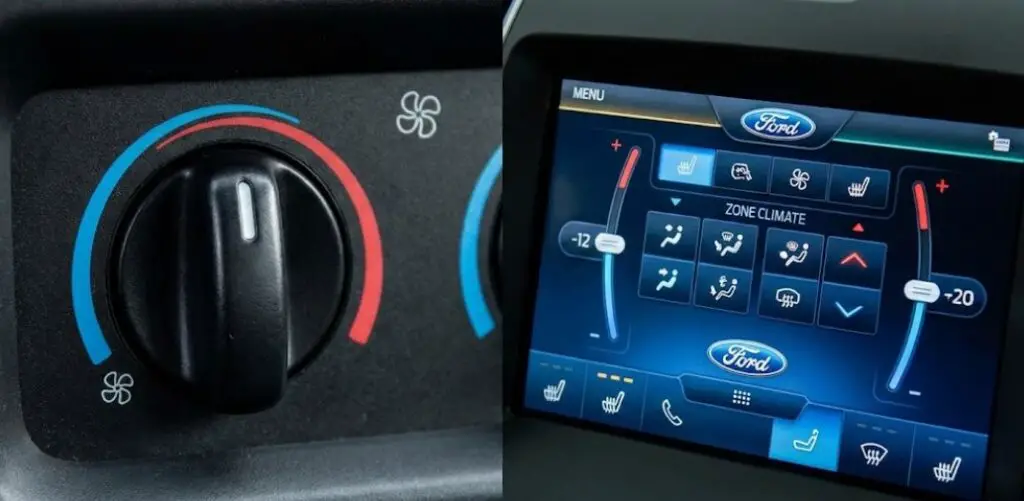
For owners and technicians alike, the phrase “Ford Edge air conditioning reset” has become a semantic catch-all for a variety of diagnostic interventions. It ranges from resolving a frozen touchscreen interface to recalibrating the precise position of airflow blend doors. The necessity for such resets arises not necessarily from catastrophic component failure, but often from the “drift” inherent in digital-analog interfaces.
As vehicles age, the voltage feedback loops that monitor the position of air flaps can desynchronize from the logic tables stored in the control module. The result is a system that believes it is cooling when it is heating, or one that refuses to direct air to the windshield during a frost event.
This report serves as an exhaustive technical dossier on the Ford Edge climate control system. It moves beyond superficial troubleshooting to explore the engineering principles, failure modes, and specific reset protocols for every generation of the vehicle. By synthesizing data from owner manuals, technical service bulletins, expert technician analyses, and electrical diagrams, we provide a definitive guide to understanding—and correcting—the thermodynamic anomalies of the Ford Edge.
Ford Edge AC Reset Guide
Stop the hot air. Master the digital and mechanical reset procedures to restore your climate control system.
1. System Diagnosis
Why is your AC blowing hot? Before resetting, understand the common culprits affecting Ford Edge models (2011-2022).
Resolvable via button reset
Save this with a 2-min DIY fix
Common Symptom Frequency
Most “Hot Air” issues stem from the blend door actuator losing calibration.
2. The “Button Combo” Reset
The fastest way to recalibrate the HVAC module without tools. Works for most Sync 2 and Sync 3 systems.
Prepare Vehicle
Turn ignition to the ON position (Engine can be running or off, but accessory power must be active).
Simultaneous Press
Press and hold the Defrost and Power buttons at the same time.
Engage Reset
Release both, then immediately press the Power button again. The system will cycle actuators.
ℹ️ Tip: Look for the AC vents to shift airflow positions automatically. This confirms calibration mode.
3. Method Effectiveness Comparison
Not all resets are created equal. We compared the three most common methods used by Ford owners.
Success Rate by Method
While the battery pull is thorough, the button combo resolves the majority of simple calibration errors.
Difficulty vs. Time Invested
FORScan offers the deepest control but requires an OBD2 adapter and technical knowledge.
The Hard Reset
If the dashboard buttons fail, a Battery Management System (BMS) reset is the next step. This clears deep-seated memory caches in the Body Control Module (BCM).
This will reset your radio presets, clock, and potentially transmission learning data.
Battery Disconnect Timeline
Disconnect
Negative Terminal
Wait
15 – 20 Minutes
Reconnect
Tighten Sensor
Idling
Run AC Max 5 Mins
4. The Cost of Cool Air
Why attempting a DIY reset is always the first logical step before visiting the dealership.
© 2026 FordMasterX Infographics. Data sourced from manufacturer owner manuals.
Disclaimer: Always consult your owner’s manual. We are not liable for vehicle damage.
The Anatomy of Automotive Climate Control
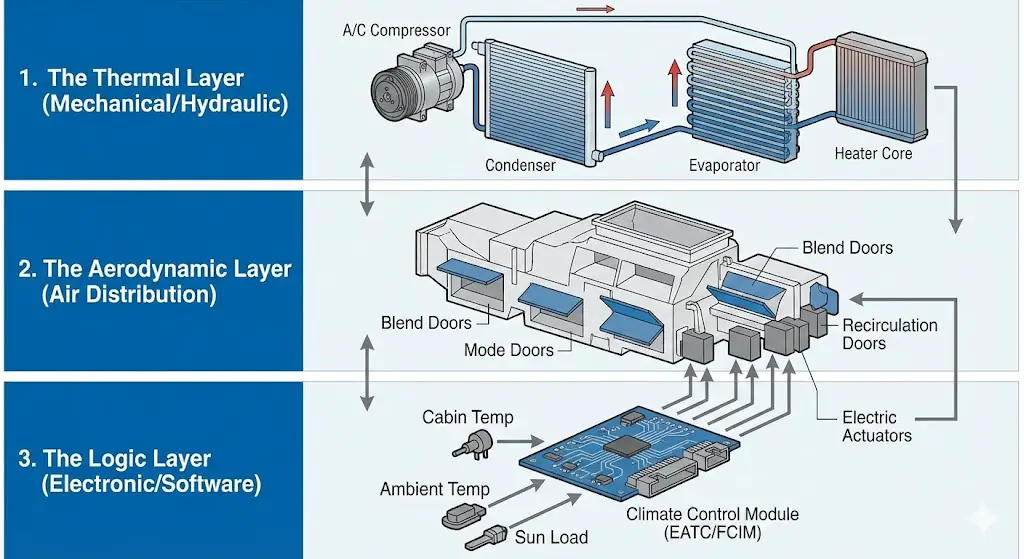
To understand why a "reset" is often the prescribed cure, one must first understand the patient. The climate control system in a Ford Edge operates on three distinct layers:
- The Thermal Layer: This involves the physical movement of heat. The A/C compressor, condenser, evaporator, and heater core work to alter the thermal energy of the air. This layer is purely mechanical and hydraulic. A reset cannot fix a refrigerant leak or a seized compressor clutch.
- The Aerodynamic Layer: This involves the distribution of treated air. A complex housing unit, often buried deep behind the dashboard, contains various "doors" or flaps.
- Blend Doors: These mix hot air from the heater core and cold air from the evaporator to achieve the desired temperature.
- Mode Doors: These direct the mixed air to specific vents (face, floor, defrost).
- Recirculation Doors: These determine whether the system draws fresh air from outside or recirculates cabin air.
- Insight: In modern Fords, these doors are not moved by cables or vacuum lines, but by electric actuators. It is the calibration of these actuators that is the primary subject of this report.
- The Logic Layer: This is the brain of the operation. Depending on the model year, this logic resides in the Electronic Automatic Temperature Control (EATC) module, the Front Controls Interface Module (FCIM), or is shared with the SYNC infotainment system. This layer reads sensor data (cabin temp, ambient temp, sun load) and commands the actuators to move. It is here that software glitches, memory corruption, and logic locks occur, necessitating a reset.
The Scope of Analysis
This report covers the entire production run of the Ford Edge, segmented by major architectural generations:
- Generation 1 (2007–2014): Characterized by the CD3 platform, physical buttons, and standalone EATC modules.
- Generation 2 (2015–2018): Introducing the CD4 platform, greater integration with SYNC 2/3, and complex fuse box arrangements.
- Generation 2 Facelift (2019–2024): Defined by rotary gear shifters, vertical touchscreens, SYNC 4, and advanced Battery Monitor Systems (BMS).
The Physics of Failure: Why Calibration Drifts
Before detailing the specific button combinations and fuse locations for each model year, it is imperative to understand the mechanism of the failure. Why does a system that worked perfectly yesterday suddenly blow hot air on the driver's side today? Why does a battery replacement cause the air conditioning to stop functioning? The answer lies in the electromechanical interface of the Blend Door Actuator.
The Actuator: A Study in Electromechanics
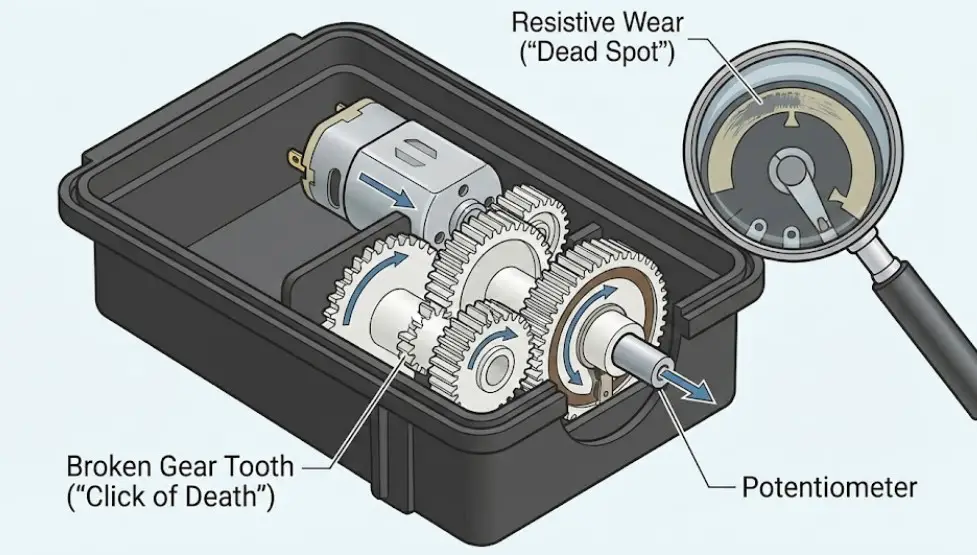
The blend door actuator is the most common point of failure in the Ford Edge HVAC system. It is a small black box, roughly the size of a deck of cards, mounted to the side of the HVAC plenum. Inside this box is a symbiotic relationship between three components:
- The DC Motor: A standard 12-volt brushed electric motor that spins at high RPM.
- The Gear Train: A series of plastic (nylon or POM) reduction gears that convert the high-speed, low-torque output of the motor into the low-speed, high-torque rotation needed to move the heavy air flap.
- The Potentiometer (Position Sensor): This is the critical component for calibration. It is a variable resistor linked to the final output shaft. As the shaft rotates, a wiper arm moves across a resistive track, changing the voltage returning to the HVAC module.
The 0-5V Feedback Loop
The HVAC computer does not "see" the door. It only "sees" voltage. In a typical Ford system:
- 0.5 Volts might represent the "Full Cold" mechanical stop.
- 4.5 Volts might represent the "Full Hot" mechanical stop.
- 2.5 Volts represents the midpoint (warm mix).
When you set the temperature to 72°F, the computer calculates that it needs the actuator to be at, say, 2.2 Volts. It sends power to the motor until the feedback wire reports 2.2 Volts.
Mechanisms of De-Calibration
A "Reset" or "Recalibration" is essentially a forced learning process where the computer attempts to re-map these voltage values to the physical limits of the door. De-calibration occurs due to several factors:
- Resistive Wear (The "Dead Spot"): The potentiometer wiper rubs against the carbon track thousands of times, mostly in the middle "comfortable" range. Eventually, this section of the track wears away. When the wiper hits this spot, the voltage signal might drop to 0V or spike open. The computer interprets this as a sensor failure (DTC B1084) or assumes the door is in an impossible position.
- Mechanical Slop (Hysteresis): As the plastic gears wear, "slop" or play develops in the geartrain. The motor might turn 10 degrees before the door moves. The computer sees the motor voltage change but doesn't see the temperature change, leading to logic confusion.
- Voltage Transients: During a battery change or a jump start, voltage spikes can corrupt the "Keep Alive Memory" (KAM) where the calibration values are stored. The module might "forget" where the stops are.
- The "Click of Death": If a gear tooth breaks (common in the Ford Edge due to the high torque at the end of travel), the motor will spin continuously, making a rhythmic clicking sound. The potentiometer never reaches the target voltage, and the system hangs. Crucially, a reset cannot fix a broken gear, but it is often the first diagnostic step to confirm the failure.
Generation 1 (2007–2014): The EATC Era
The first-generation Ford Edge (2007–2014) utilizes a climate control architecture that is relatively self-contained. The Electronic Automatic Temperature Control (EATC) module is the command center. This generation is notorious for "thermal split" issues, where one side of the cabin receives heating while the other receives cooling, often due to blend door synchronization errors.
The "Hard Reset" Protocol
For general system glitches—such as an unresponsive control panel, a display that is stuck, or a system that refuses to engage the AC clutch despite good pressures—a module reboot is the first line of defense. This procedure forces the EATC module to restart its operating system and clear volatile memory.
Procedure: The Power/Defrost Method This method is widely validated by the owner community and technicians for 2007–2014 models.
- Vehicle State: Engine running or ignition in the ON position.
- Step 1: Press and hold the Climate Control POWER button and the DEFROST button simultaneously.
- Step 2: Continue holding until the display turns off or the system powers down.
- Step 3: Release both buttons.
- Step 4: Press the Climate Control POWER button once to turn the system back on.
The EATC Self-Diagnostic Mode
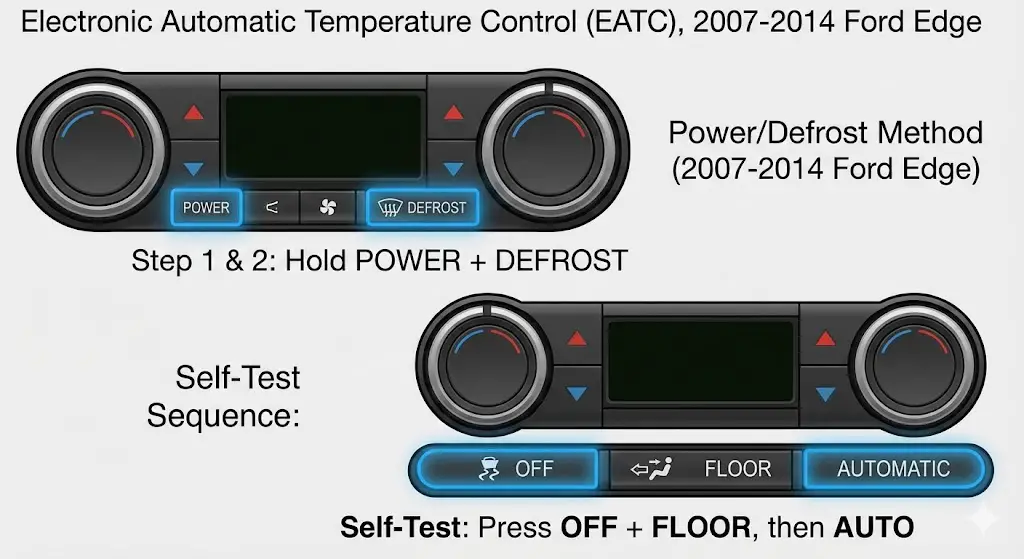
If the basic reboot does not resolve the issue, the Ford Edge EATC system contains a powerful, built-in diagnostic tool. This mode commands the module to physically exercise every actuator and check every sensor, returning specific error codes. This is a dealer-level diagnostic capability accessible without a scan tool.
Procedure: The Self-Test Sequence This sequence requires precise timing. If you miss the window, you must start over.
- Preparation: Start the engine. Ensure the vehicle is stationary.
- Initiation: Simultaneously press the OFF and FLOOR (foot vent) buttons.
- Execution: Release both buttons and immediately (within 2 seconds) press the AUTOMATIC button.
- Observation:
- The display should show a spinning circle, a moving dash, or a "pulse tracer" animation.
- Listen: You will hear mechanical whirring and clicking from the dashboard. This is the sound of the actuators driving the doors to their full open and full closed positions to relearn their span.
- The test takes approximately 30 seconds.
- Result:
- If the system is healthy, it will display 888.
- If faults are detected, it will cycle through four-digit or two-digit Diagnostic Trouble Codes (DTCs).
- Exit: Press the DEFROST button to exit and clear the codes. Press the blue COOLER button to exit without clearing codes.
Decoding the EATC Error Codes
The codes returned by this test are specific and actionable. They allow a user to distinguish between a bad sensor and a bad motor.
| DTC (Legacy) | Component Identification | Technical Interpretation |
| 888 | System Pass | All electrical checks passed. Note: A broken plastic gear might still pass electrical checks if the motor moves freely. |
| 022 / 2266 | Left Blend Door (Driver) | Circuit Open/Short. Often indicates a disconnected harness or internal motor failure. |
| 024 / 2267 | Left Blend Door (Driver) | Fault During Self-Test. The most common failure code. The actuator moved but did not reach the target position within the expected time. Indicates a broken gear or "stuck" door. |
| 025 | Left Blend Door (Driver) | Intermittent Fault. Likely a potentiometer dead spot. |
| 049 / 050 | Right Blend Door (Pass) | Similar to above, but for the passenger side actuator. |
| 030 / 031 | In-Vehicle Temp Sensor | Short/Open. The system cannot regulate auto-temp because it doesn't know the cabin temperature. |
| 040 / 041 | Ambient Temp Sensor | Short/Open. The system may disable the A/C compressor to prevent evaporator freezing if it thinks it is -40°F outside. |
| 050 / 052 | Sunload Sensor | Solar radiation sensor fault. Affects how the fan ramps up in direct sunlight. |
Electrical Architecture: Generation 1 Fuse Mapping
When the system is completely dead (no lights, no fan), checking the power supply is the first step. The 2011–2014 Edge splits its climate power between the high-current Battery Junction Box (BJB) under the hood and the logic-level Smart Junction Box (SJB) in the cabin.
Table 1: Generation 1 (2011-2014) Climate Control Electrical Protection
| Fuse/Relay ID | Amperage | Location | Function & Symptoms of Failure |
| Fuse 10 | 40A | Engine Bay (BJB) | Heater Blower Motor. Failure results in zero airflow, though the display bars may still move. |
| Fuse 27 | 15A | Engine Bay (BJB) | A/C Clutch Solenoid. Failure prevents the compressor from engaging. Fan blows, but air is warm/humid. |
| Relay 11 | -- | Engine Bay (BJB) | A/C Clutch Relay. A stuck open relay causes no cooling; stuck closed causes battery drain and evaporator icing. |
| Relay 13 | -- | Engine Bay (BJB) | Heater Blower Relay. Controls high-current path to the fan. |
| Fuse 71 | 7.5A | Cabin (SJB) | HVAC Module Logic. Protects the Heating Control Head and EATC module. Failure results in a completely dead control panel. |
| Fuse 65 | 10A | Cabin (SJB) | Supplemental restraint/Occupant classification (often linked to airbag lights which can occur during dash disassembly). |
Generation 2 (2015–2018): The Integration of SYNC and Complex Power
With the 2015 redesign, the Ford Edge moved to the CD4 global platform. This shift fundamentally changed the HVAC architecture. The climate controls became deeply integrated with the Front Controls Interface Module (FCIM) and the SYNC infotainment system. This means that a software crash in the radio can now render the air conditioning uncontrollable.
The SYNC Soft Reset (The "Screen Freeze" Fix)
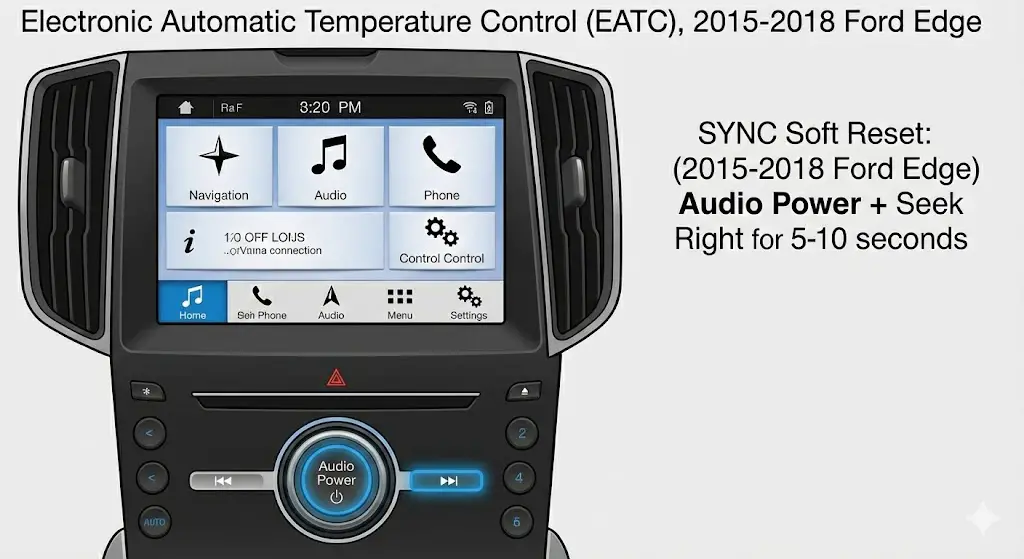
Owners of 2015–2018 models often report that the climate buttons on the touchscreen become unresponsive or greyed out. This is usually a failure of the API handshake between the SYNC module (APIM) and the climate module.
Procedure: The Power/Seek Method This works for SYNC 2 (MyFord Touch) and SYNC 3 systems.
- Vehicle State: Engine running or in Accessory mode.
- Action: Press and hold the Audio Power button (center of the volume knob) and the Seek Right (Skip Forward >>) button simultaneously.
- Duration: Hold for approximately 5 to 10 seconds.
- Observation: The touchscreen will go black. After a few moments, the Ford oval logo will appear.
- Result: The system reboots. This re-initializes the drivers for the climate control interface, often restoring touch functionality.
The Hard Reset: The "Fuse Pull" Calibration
When the issue is mechanical calibration (e.g., uneven temperatures), the Gen 2 Edge does not have the convenient "Off + Floor" button diagnostic mode of the Gen 1. Instead, technicians must force a calibration by cutting power to the module, forcing a cold boot where the module seeks its mechanical stops upon restart.
Procedure: The Fuse Pull Protocol This is a robust method to force the HVAC module to relearn door positions.20
- Preparation: Turn the ignition OFF. Open the driver's door and close it to ensure the "Retained Accessory Power" (RAP) is cancelled.
- Extraction: Locate and remove the specific fuses for the HVAC module (See Table 2 below).
- Discharge: Wait for at least 60 seconds. This allows the capacitors inside the module to discharge, clearing the volatile memory (RAM) where the "current position" data is stored.
- Reinsertion: Reinstall the fuses.
- Calibration:
- Turn the ignition to the ON position (Engine Off).
- CRITICAL: Do not touch any climate control buttons, radio buttons, or windows.
- Wait for 30 to 60 seconds.
- Listen: You may hear the motors humming and clicking behind the dash. This is the module driving the doors from 0% to 100% to record the new voltage span.
- Verification: Start the engine and test the full range of temperature (Max Cold to Max Hot) and modes (Defrost to Face).
Electrical Architecture: The "Hidden" Fuse Box
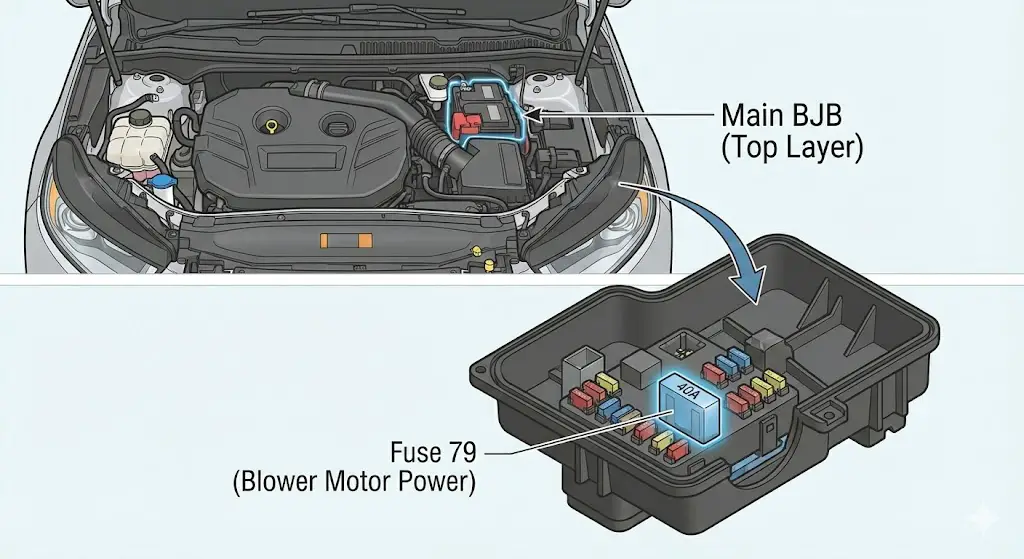
The 2015–2018 Edge introduced a confusing fuse box layout that often stymies DIYers. There is a secondary fuse box located underneath the main Battery Junction Box (BJB) in the engine bay.
Accessing the Lower BJB:
- Unclip the main BJB upper cover.
- Release the locking tabs securing the entire fuse block chassis.
- Lift and flip the chassis over. The secondary fuses are on the bottom.2
Table 2: Generation 2 (2015-2018) Climate Control Fuse Mapping
| Fuse/Relay ID | Amperage | Location | Function & Notes |
| Fuse 22 | 10A | Engine Bay (Top) | A/C Clutch Solenoid. Logic power for the magnetic clutch. Check this if the compressor won't click on. |
| Relay 33 | -- | Engine Bay (Top) | A/C Clutch Relay. High failure rate item. Can be swapped with the horn relay to test. |
| Relay 4 | -- | Engine Bay (Top) | Blower Motor Relay. Controls high current to the fan. |
| Fuse 79 | 40A | Engine Bay (Bottom/Hidden) | Blower Motor Power. The most difficult fuse to find. If your fan is dead, this hidden fuse is the likely culprit. |
| Fuse 65 | 20A | Engine Bay (Bottom/Hidden) | Heated Seats. Often conflated with HVAC issues. Located next to the blower fuse. |
| Fuse 71 | 7.5A | Cabin (Passenger) | HVAC Module / EATC. The brain of the system. Pulling this fuse is essential for the hard reset procedure. |
Generation 2 Facelift (2019–2024): Digital Dominance and the BMS
The 2019 facelift brought the rotary gear shifter, the 8-speed transmission, and inevitably, a revised electrical architecture. The climate control became even more screen-centric, especially with the introduction of the massive vertical screens in 2021+ models.
The BMS Reset (Battery Monitor System)
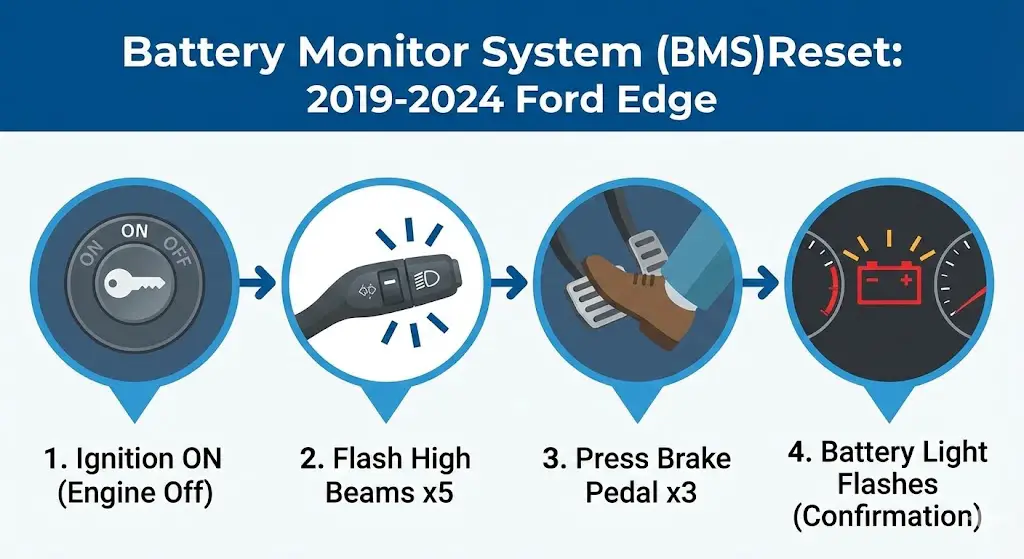
A unique failure mode in modern Fords (2011+, but prevalent in 2019+) is the Load Shedding phenomenon. The vehicle is equipped with a Hall-effect sensor on the negative battery terminal that monitors current in/out. If the battery ages or is replaced without resetting the BMS, the Body Control Module (BCM) may think the battery is weak.
To preserve starting power, the BCM will disable "non-essential loads." The A/C compressor and the heated seats are the first to be cut.
- Symptom: The A/C button lights up, but the fan speed is limited and the air is not cold. The Start/Stop system also fails to activate.
- The Fix: If you have replaced the battery, you must reset the BMS.
- Procedure: Switch ignition ON (Engine Off). Flash the high beams 5 times, then press the brake pedal 3 times. The battery light on the dash should flash, confirming the reset. Alternatively, leaving the vehicle undisturbed (locked, sleep mode) for 8 continuous hours allows the BMS to self-calibrate.
Updated Reset Procedures and Fuse Locations
The reset logic remains similar to the 2015-2018 models, but the fuse locations shifted significantly.
2019–2024 Fuse Mapping Changes:
The "hidden" fuse box concept was largely abandoned or reorganized. The cabin fuse panel plays a larger role.
Table 3: Generation 2 Facelift (2019-2024) Climate Control Fuse Mapping
| Fuse/Relay ID | Amperage | Location | Function |
| Fuse 12 | 7.5A | Cabin (Passenger) | Climate Control Head / Gear Shift. This is the new "Brain" fuse. Note that it also powers the gear shift module, so do not remove while driving!. |
| Fuse 9 | 5A | Cabin (Passenger) | Rear Climate Control. For vehicles equipped with rear zone controls. |
| Fuse 22 | 10A | Engine Bay (BJB) | A/C Clutch Solenoid. Remains consistent from previous years. |
| Fuse 8 | 20A | Engine Bay (BJB) | Cooling Fan Relay Coil. The radiator fans must run for the AC condenser to work. If this fuse blows, AC performance drops at idle. |
Advanced Diagnostics: Beyond the Reset
When button presses and fuse pulls fail, the issue has likely transcended a logic glitch and entered the realm of hardware failure.
The "Thermal Split" Phenomenon
A classic Ford Edge issue is the thermal split: Driver gets heat, passenger gets A/C (or vice versa).
- Cause: This is almost exclusively a failed Temperature Blend Door Actuator. One actuator has died, while the other functions.
- Diagnosis: Change the temperature from LO to HI on both sides. Listen for the actuator. If one side is silent or clicking, that actuator is dead.
- The Trap: A "reset" might move the door slightly, but if the gear is stripped, it will slip back. Owners often think the reset "almost worked".
OEM vs. Aftermarket Parts: The Dorman Dilemma
Snippet research highlights a critical consensus among technicians: Use Motorcraft parts only.
- The Problem: Aftermarket actuators (e.g., Dorman) often have slightly different internal resistance values for their potentiometers.
- The Result: Even if installed correctly, the aftermarket part may report "Full Closed" at a voltage the Ford HVAC module considers "90% Closed." The module will continue trying to close the door, stressing the new gears and leading to premature failure or calibration codes (DTC B1084).
- Recommendation: Always source the specific Motorcraft actuator (e.g., YH-1769 or similar, depending on year/position).
FORScan: The Professional's Tool
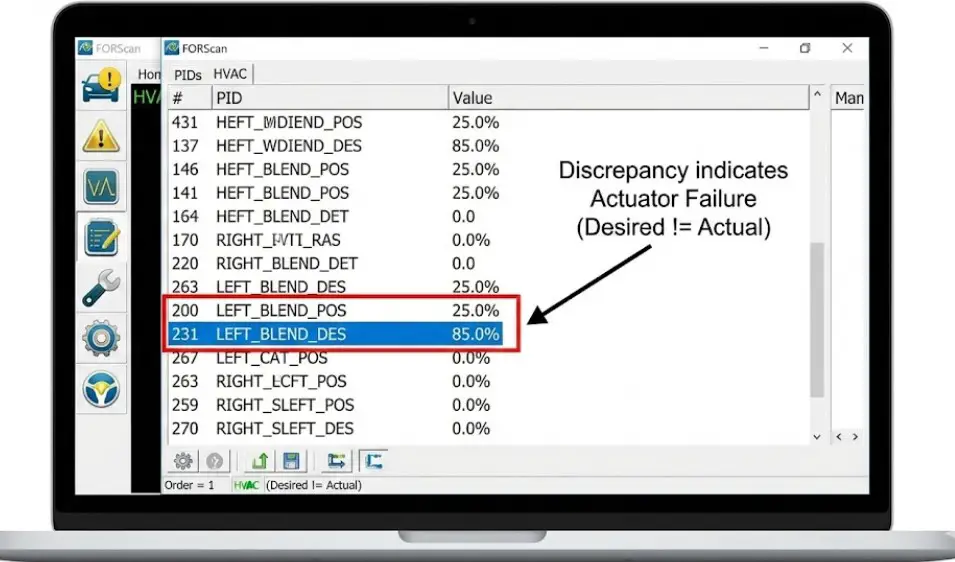
For the 2015+ models without the built-in EATC display diagnostic, FORScan is an indispensable tool. It is software that interfaces with the vehicle's OBD-II port via a specialized adapter (ELM327).
Capabilities:
- Module Reset: You can send a direct hexadecimal command to the FCIM or HVAC module to perform a "Module Reset" or "Key On Engine Off Self Test".
- PID Monitoring: You can view real-time data streams.
- PID:
LEFT_BLEND_POS(Actual position in %) - PID:
LEFT_BLEND_DES(Desired/Commanded position in %) - Diagnosis: If
DESchanges when you turn the knob butPOSdoes not, the module is working, but the actuator is dead. IfDESdoes not change, the control knob/interface is faulty.
- PID:
The "Recalibration" Myth
A common misconception is that the blend door actuators can be "repaired" by opening them and rotating the gears. This is futile. The gears are indexed. Once the plastic teeth shear, the timing is lost. The only repair is replacement. However, after replacement, the Fuse Pull Reset is mandatory to teach the module the limits of the new actuator.
Conclusion: The Hierarchy of Intervention
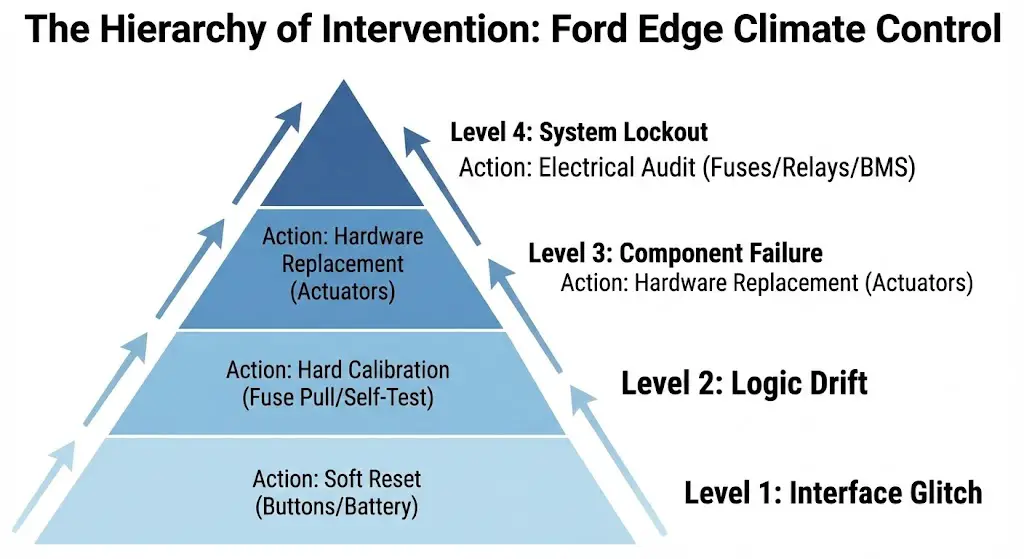
The maintenance of the Ford Edge climate control system requires a structured approach. The "reset" is not a magic bullet, but a specific tool for specific problems.
- Level 1 (Interface Glitch): Screen frozen, buttons unresponsive.
- Action: Soft Reset (Power + Seek Right) or Battery Disconnect.
- Level 2 (Logic Drift): Temperature slightly off, modes confused.
- Action:Hard Calibration.
- Gen 1: Off + Floor -> Auto.
- Gen 2: Pull Fuse 71 (2015-18) or Fuse 12 (2019+).
- Action:Hard Calibration.
- Level 3 (Component Failure): Clicking sounds, thermal split, code 024/025.
- Action: Hardware Replacement. Identify the faulty actuator (Driver/Passenger/Mode), replace with OEM Motorcraft, then perform Level 2 Reset.
- Level 4 (System Lockout): AC Clutch won't engage, fans dead.
- Action: Electrical Audit. Check High Current Fuses (F10/F79/F22) and Relays. Check BMS status.