The Definitive Report on Ford Charging Systems: Evolution, Compatibility, and Performance Engineering

In the pantheon of automotive engineering, few components are as critical yet frequently misunderstood as the alternator. For the Ford Motor Company, the evolution of the charging system mirrors the broader history of the automobile itself—from the mechanical simplicity of the burgeoning muscle car era to the silicon-controlled complexity of the modern computerized vehicle.
For the restoration expert, the hot-rodder, or the fleet mechanic, navigating the labyrinth of Ford alternator generations is not merely a matter of part numbers; it is an exercise in understanding fifty years of electrical theory, thermal dynamics, and mounting geometry.
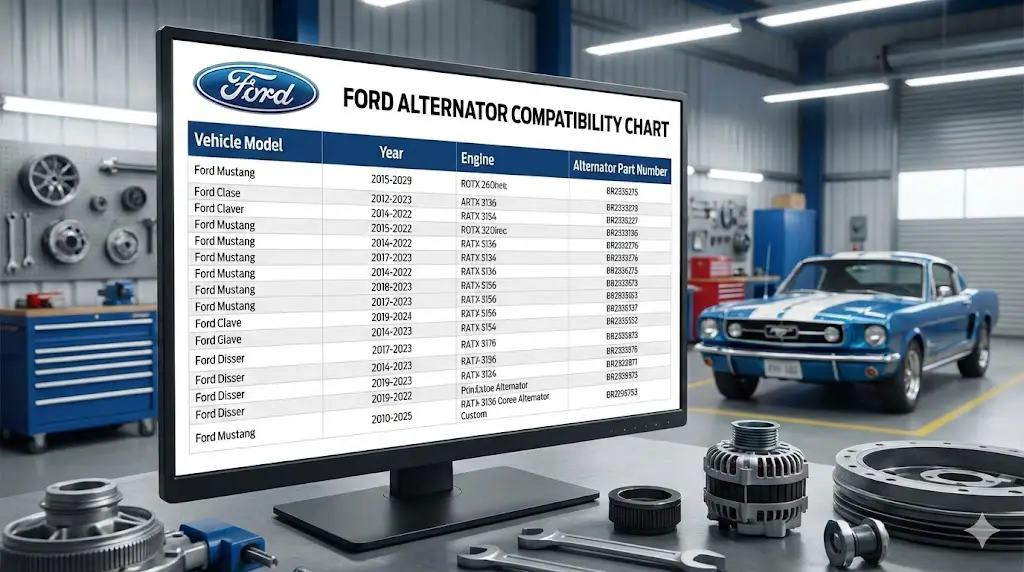
The “Ford Alternator Compatibility Chart” is one of the most sought-after technical resources in the enthusiast community. This demand stems from a specific historical context: Ford’s charging systems, particularly from the 1960s through the 1990s, offer a unique interchangeability potential that allows a vintage vehicle to be upgraded with modern electrical capacity using mostly factory-engineered parts.
Unlike many other manufacturers where mounting points changed radically with every engine update, Ford maintained certain geometric consistencies that allow a 1995 alternator to breathe new life into a 1965 chassis—provided the installer understands the nuance of the conversion.
This report serves as an exhaustive technical dossier. It does not simply list parts; it dissects the engineering DNA of the First Generation (1G) through Sixth Generation (6G) units. We will explore the catastrophic design flaws of the 2G that led to vehicle fires, the thermal breakthroughs that made the 3G the industry standard for upgrades, and the Pulse Width Modulation (PWM) controls of the 6G that complicate modern retrofits. Through deep analysis of mounting dimensions, wiring protocols, and amperage curves, this document establishes the ultimate framework for Ford alternator compatibility.
FORD ALTERNATOR
COMPATIBILITY & PERFORMANCE
The definitive data guide to the 2G vs. 3G Interchange
Why Upgrade? The Amperage Gap
Classic Fords from the 80s were designed for halogen headlights and an AM/FM radio. Modern demands—electric fans, high-powered stereos, and EFI systems—crush stock alternators. The data below illustrates the massive performance gap between the stock 2G units found in Foxbodies/OBS Trucks and the 3G upgrades found in 90s Taurus/Mustangs.
Fig 1: Output comparison showing the massive idle efficiency gain of the 3G series.
Evolution of Ford Charging
1G Series (1960s-1985)
External regulator. Very low output (40-60A). Reliable but insufficient for modern accessories.
2G Series (1986-1993)
Internal regulator, external fan. WARNING: Notorious for plug fires. The “Fire Hazard” series. Max output ~75A.
3G Series (1994-Early 2000s)
Internal fan. The “Gold Standard” swap. High output (95-130A) and excellent cooling. Fits older brackets with minor mods.
4G/6G Series (Late 90s+)
PCM controlled. High efficiency but difficult to retrofit onto vintage analog wiring harnesses.
Why Do Stock 2G Units Fail?
Analysis of core return data indicates that the 2G’s plug design is the leading cause of catastrophic failure, rather than internal component wear.
Compatibility Matrix: Will It Fit?
The three main factors for compatibility are Case Size, Mounting Spread, and Clocking. Use this visual guide to identify your target alternator.
3G Small Case
- • Mount: Pivot to Ear = 7.00 inches
- • Amperage: 95A – 130A
- • Donor Cars: 94-00 Mustang V6, 90s Ranger
3G Large Case
- • Mount: Pivot to Ear = 8.25 inches
- • Amperage: 130A (Heavy Duty)
- • Donor Cars: 93-96 Taurus 3.8L, 95 F-Series
4G/6G Modular
- • Mount: Pad Mount (No Pivot)
- • Amperage: 110A+
- • Donor Cars: Crown Vic, Explorer 4.6L
Most Popular Swaps
Based on forum activity and parts sales, these are the most common upgrade pathways for Ford enthusiasts.
Identification Guide: The “D” Plug
Don’t rely on part numbers alone. The 3G alternator is easily identified by its regulator plug shape and the number of holes in the front case.
The 3-Hole Front (Large Case)
The 130A Large Case unit has three distinct “triangle” vents on the front face between the ribs.
The 2-Hole Front (Small Case)
The 95A/130A Small Case usually has two vent groupings. Always measure the bolt spread to be sure!
© 2025 FordMasterX Infographics. Data sourced from manufacturer owner manuals.
Chapter 1: The First Generation (1G) – The External Regulator Era (1963–1985)
1.1 Historical Context and Engineering Design
The Motorcraft 1G alternator represents the genesis of Ford’s AC charging capabilities. Introduced in 1963 on the 406-cubic-inch V8 and becoming standard equipment by 1965, the 1G marked the transition from direct current (DC) generators to alternating current (AC) alternators. This shift was pivotal. DC generators were heavy, inefficient at low RPMs, and required frequent maintenance of the commutator and brushes. The alternator, by rectifying AC current to DC via diodes, offered superior durability and higher RPM potential.
However, the 1G was a product of its time. In the early 1960s, semiconductor technology was in its infancy and too bulky to mount inside the high-heat environment of the alternator case. Consequently, the 1G is defined by its External Voltage Regulator. This device, typically a mechanical box housing vibrating points (and later a solid-state circuit), was mounted on the vehicle’s inner fender or radiator support, connected to the alternator via a dedicated wiring harness.
1.2 Architectural Distinctions: Case Sizes and Ratings
To determine compatibility within the 1G family, one must distinguish between the two primary case architectures. While they look similar at a glance, their mounting geometry and output capabilities differ.
1.2.1 The Small Case 1G
The Small Case 1G is the most ubiquitous charging unit in classic Ford history.
- Dimensions: It features a housing diameter of roughly 6.5 inches.
- Mounting: The mounting spacing (distance between the center of the top pivot bolt hole and the center of the bottom adjustment ear hole) is nominally 6.875 inches (often cited as 7 inches).
- Output: Amperage ratings typically ranged from 35 amps to 60 amps.
- Applications: This unit was the standard factory equipment for the vast majority of non-air-conditioned passenger cars and light trucks, including the Ford Mustang, Falcon, Fairlane, and F-100 series.
1.2.2 The Large Case 1G
The Large Case 1G was the heavy-duty option, designed for vehicles with significant electrical loads.
- Dimensions: The stator housing is deeper and wider to accommodate larger windings and a more robust rectifier bridge.
- Mounting: While the mounting bolt spacing often remained compatible with the small case brackets in terms of distance, the physical bulk of the Large Case unit could cause interference with cylinder heads or valve covers on smaller engines (like the 289/302 Windsor).
- Output: Ratings ranged from 70 amps to 100 amps.
- Applications: These were standard on Lincoln Continentals, Mercury luxury cruisers, and service vehicles such as police cruisers and ambulances.
1.3 Identification: The Terminal Configuration
Identifying a 1G alternator in a salvage yard or a parts pile is straightforward if one knows the terminal layout. The rear of the 1G alternator features four distinct, color-coded terminals, which are often stamped with identification letters into the die-cast aluminum housing:
- BAT (Red insulator): The main B+ output terminal connecting directly to the battery or starter solenoid.
- FLD (Orange insulator): The Field terminal. This receives the excitation voltage from the external regulator. Varying the voltage here controls the strength of the magnetic field in the rotor, and thus the alternator’s output.
- STA (White/Black or Natural insulator): The Stator terminal. This provides a raw AC signal from one phase of the stator windings. It is primarily used to signal the electric choke on a carburetor to open or to drive an electronic tachometer.
- GRD (Black or Bare): The Ground terminal. Unlike modern alternators that often ground through the case, the 1G usually relied on a dedicated ground wire to the regulator to ensure precise reference voltage.
1.4 The Limitations of the 1G Architecture
While robust and easy to rebuild, the 1G system suffers from severe limitations in a modern context.
- Poor Low-RPM Output: The 1G design is inefficient at low shaft speeds. A unit rated for 60 amps might produce only 10 to 15 amps at a 700 RPM engine idle. If a driver adds halogen headlights, an electric cooling fan, or a high-powered stereo, the 1G cannot keep up at traffic lights, forcing the battery to buffer the load and slowly discharge.
- Thermal Inefficiency: The 1G utilizes an external fan (mounted behind the pulley) to pull air through the case. This “pull-through” design means air passes over the hot stator windings before reaching the rectifier diodes at the back. Since diodes become less efficient and more prone to failure as they heat up, this cooling path is suboptimal for high-load sustained operation.
1.5 Compatibility Insight: 1G Interchangeability
For the restorer, the 1G is highly interchangeable across the 1964–1985 era. If you have a 1966 Mustang with a failed 35A alternator, you can bolt on a 60A unit from a 1978 F-150, provided the case size (Small Case) matches. The wiring harness plugs are standardized. However, installing a Large Case 100A unit onto a bracket designed for a Small Case unit will often require custom spacers or bracket modification due to the larger radius of the housing hitting the engine block.
Chapter 2: The Second Generation (2G) – A Troubled Transition (1981–1993)
2.1 The Push for Internal Regulation
As the 1980s dawned, automotive electronics began to proliferate. Electronic fuel injection (EFI), engine management computers (EEC-IV), and power accessories demanded cleaner, more reliable power. To meet this need and reduce assembly complexity, Ford introduced the Second Generation (2G) alternator. The primary innovation was the migration of the voltage regulator inside the alternator housing, eliminating the external fender-mounted box and its associated wiring harness.
2.2 The Fatal Flaw: The “Fire Plug” Connector
Despite the advancement in regulation, the 2G is infamous in the automotive community for a critical design failure centered on its electrical connections. Unlike the 1G (which used a threaded stud for the main output) or the later 3G (which returned to a stud), the 2G utilized a plastic plug connector for its main high-current output.
- The Mechanism of Failure: This connector housed two heavy-gauge spade terminals that carried the full output of the alternator (up to 75 amps). Over time, vibration, thermal cycling, and corrosion would cause the spade terminals to lose spring tension.
- The Resistance Spiral: As contact tension decreased, electrical resistance increased. In accordance with Joule’s First Law ($H = I^2R$), this resistance generated heat. The heat melted the plastic housing, which allowed the terminals to loosen further, creating more resistance and more heat.
- The Result: This thermal runaway often resulted in the wiring harness catching fire. The failure rate was so significant that Ford eventually issued Technical Service Bulletins (such as TSB 96-21-4) regarding the issue.
2.3 Identification and Performance
- Appearance: The 2G looks similar to a 1G Small Case but lacks the external regulator wiring. The giveaway is the two wiring plugs on the side (or top/bottom depending on clocking). One plug controls the regulator (Green/Red, Yellow, White wires), and the larger plug handles the output (two thick Black/Orange wires).
- Output: The 2G was typically rated between 65 amps and 75 amps. While this was a modest improvement over the 1G, it was still insufficient for serious electrical upgrades.
2.4 Compatibility Verdict: Do Not Use
The expert consensus on 2G compatibility is unanimous: Avoid installing or replacing with a 2G unit. If a vehicle currently equipped with a 2G alternator suffers a failure, it is strongly recommended to upgrade to a 3G unit rather than installing another 2G. The fire risk is intrinsic to the connector design. Even replacement pigtails eventually succumb to the same fatigue failure mode. For owners of 1980s Fox Body Mustangs, Broncos, and F-Series trucks, the “2G to 3G swap” is considered a mandatory reliability upgrade.
Chapter 3: The Third Generation (3G) – The Holy Grail of Charging (1990s–2000s)
3.1 Engineering Superiority: Why the 3G Reigns Supreme
The introduction of the 3G alternator in the early 1990s marked the zenith of Ford’s interchangeable charging technology. It solved every major deficiency of the previous generations and introduced a level of durability that makes it the standard for upgrades today.
- Dual Internal Fans: The 3G abandoned the external fan design. Instead, it features two smaller fans integrated directly onto the rotor, inside the case. This allows for a “push-pull” cooling dynamic that ventilates the rectifier bridge much more effectively.
- Improved Low-Speed Charging: A standard 130-amp 3G alternator can produce 80 to 95 amps at idle (approx. 2000 shaft RPM). This is nearly double the peak output of a standard 1G unit.
- Safety: Ford wisely abandoned the plastic output plug of the 2G and returned to a heavy-duty B+ Threaded Stud. This eliminates the fire risk and allows for the secure attachment of 4-gauge or larger charging cables.
3.2 3G Case Configurations and Mounting Compatibility
To successfully utilize a 3G alternator, one must navigate the variations in case size and mounting ear spacing. There are three primary configurations found in the wild.
3.2.1 The Large Case 130A (8.25-inch Spacing)
This is the most desirable unit for trucks and larger V8s.
- Mounting: The distance between the pivot ear and the adjustment ear is 8.25 inches.
- Application: Standard on the 1994–2000 Ford Mustang V6 (3.8L), 1994–1995 Mustang V8 (5.0L), and many F-Series trucks with the 4.9L, 5.0L, or 5.8L engines.6
- Swap Potential: This is the direct bolt-on upgrade for most 1960s-1990s V8 applications (Windsor, Cleveland, FE) that use the wider mounting bracketry.
3.2.2 The Small Case 95A (7.00-inch Spacing)
- Mounting: The spacing is 7.00 inches.
- Application: Common on the 1992–1999 Ford Taurus (3.0L V6) and some 4-cylinder Fords.
- Swap Potential: This unit is physically smaller and fits into tighter engine bays where the Large Case might hit the valve covers. It is a direct mounting replacement for the 1G Small Case and 2G units, though the wiring requires modification.
3.2.3 The Rare “Side-Mount” Large Case (7.00-inch Spacing)
- The Unicorn: There exists a version of the 130A Large Case alternator that uses the narrower 7.00-inch mounting spacing.
- Application: Found primarily on the 1990–1995 Ford Taurus / Mercury Sable with the 3.8L V6.
- Significance: This unit is prized by swappers because it offers the massive 130A output but fits the narrower brackets common on early Mustangs and Foxes without requiring bracket fabrication.
3.3 The 3G Donor List: Junkyard Hunting Guide
For enthusiasts sourcing parts from salvage yards, identifying the correct donor vehicle is crucial. The following list identifies vehicles guaranteed to carry the high-output 3G units.
| Vehicle Model | Year Range | Engine | Alternator Type | Mounting Spacing | Notes |
| Ford Mustang | 1994–1995 | 5.0L V8 | 3G Large Case (130A) | 8.25″ | Prime donor. |
| Ford Mustang | 1994–2000 | 3.8L V6 | 3G Large Case (130A) | 8.25″ | Very common. |
| Ford Taurus | 1990–1995 | 3.8L V6 | 3G Large Case (130A) | 7.00″ | Rare 7″ Mount. |
| Ford Thunderbird | 1994–1997 | 3.8L V6 | 3G Large Case (130A) | 8.25″ | Good availability. |
| Ford Windstar | 1995–1998 | 3.8L V6 | 3G Large Case (130A) | 8.25″ | Often overlooked. |
| Ford F-Series | 1993–1996 | 4.9L/5.0L/5.8L | 3G Large Case (130A) | 8.25″ | Check options; some base models had 95A. |
| Lincoln Continental | 1991–1994 | 3.8L V6 | 3G Large Case (130A) | 8.25″ | Luxury spec. |
3.4 Visual Identification of the 3G
How do you distinguish a 3G from a 2G or 4G in a pile of parts?
- The Fan: Look at the front pulley. If you see visible fan blades behind the pulley, it is a 1G or 2G. If the front face is solid (no external fan), it is likely a 3G (or newer).
- The Case Ribs: The Large Case 130A 3G has three distinctive cooling holes in the front case section between the stiffening ribs. The Small Case 95A unit usually has four smaller holes or a different rib pattern.
- The Regulator Plug: The 3G uses a D-shaped grey or white connector with three wires.
Chapter 4: The Modern Era (4G & 6G) – Complexity and Computer Control
4.1 The Fourth Generation (4G): A Step Sideways (1996–2004)
The 4G alternator appeared in the mid-1990s, largely on the new Modular engine family (4.6L). While it maintained the internal fan design of the 3G, it is generally regarded as a less robust unit.
- Engineering Weakness: Ford shifted to a different alloy for the rotor slip rings (soft copper) and a smaller diameter design to reduce brush speed. However, real-world data showed that these slip rings wore down significantly faster than the robust rings in the 3G.
- Mounting: The 4G introduced “pad mounting” (bolts going vertically through feet) rather than the traditional “ear mounting” (bolts going horizontally). This makes the 4G physically incompatible with almost all 1G/2G/3G brackets without extensive fabrication.
- Verdict: Unless the vehicle engine requires it (e.g., a stock 1998 Mustang GT), there is little reason to retrograde a 4G into an older car.
4.2 The Sixth Generation (6G): High Efficiency, High Difficulty
The 6G alternator represents the modern standard, utilizing “hairpin” stator winding technology. This rectangular wire winding packs more copper into the magnetic field, resulting in higher efficiency and massive amperage (135A–200A) in a compact frame.
- The Control Problem: The critical difference with many 6G units (especially post-2003) is the voltage regulator. Unlike the “dumb” regulators of the 3G that simply look for 14.4V, many 6G regulators are PCM Controlled. The Powertrain Control Module (PCM) sends a Pulse Width Modulated signal to the alternator to control charging rates based on engine load, temperature, and battery state.
- Retrofit Challenges: You cannot simply connect a 12V wire to a PCM-controlled 6G alternator. It will default to a “fail-safe” mode (usually 13.5V) or not charge at all. To use a 6G on a vintage car, one must either swap the regulator for a simplified aftermarket “self-exciting” version or buy a specially built conversion unit.
Chapter 5: Comprehensive Ford Alternator Compatibility Matrix
This section synthesizes the physical and electrical data into a logic matrix for determining interchangeability.
Table 5.1: Generation Specification Comparison
| Feature | 1G (First Gen) | 2G (Second Gen) | 3G (Third Gen) | 4G (Fourth Gen) | 6G (Sixth Gen) |
| Production Era | 1963–1985 | 1981–1993 | 1990–2000s | 1996–2004 | 2000–Present |
| Regulation | External | Internal | Internal | Internal | Internal / PCM |
| Cooling | External Fan | External Fan | Dual Internal Fans | Dual Internal Fans | Dual Internal Fans |
| Peak Amperage | 40A – 100A | 65A – 75A | 95A – 130A+ | 110A – 130A | 135A – 200A |
| Idle Amperage | 10A – 20A | 25A – 30A | 80A – 95A | 70A – 80A | 100A+ |
| Main Output | Stud (B+) | Plastic Plug (Fire Risk) | Stud (B+) | Stud (B+) | Stud (B+) |
| Best Use Case | Restoration | None (Replace) | Best Upgrade | Stock Replacement | High-End Custom |
Table 5.2: Mounting Interchangeability Guide
| Engine Family | Stock Alternator Mount Spacing | Compatible Upgrade Options | Notes |
| Windsor V8 (289, 302, 351W) – Pre-1985 | 6.875″ (7″) | 3G Small Case (95A) OR 3G Large Case (130A – Taurus 3.8L version) | Requires tensioning rod modification. 3G Large Case (8.25″) requires bracket swap. |
| Windsor V8 (5.0L, 5.8L) – 1985-1993 | 7.00″ (Mustang) / 8.25″ (Truck) | 3G Large Case (130A) | Trucks usually take the 8.25″ directly. Mustangs need the 7″ 3G or bracket mods. |
| FE V8 (390, 427, 428) | 6.875″ (7″) | 3G Small Case (95A) | Large Case often hits the cylinder head due to engine width. |
| Inline 6 (170, 200, 250) | 6.875″ (7″) | 3G Small Case (95A) | Very tight clearance; Small Case is the only viable option without custom brackets. |
| 385 Series (429, 460) | 7.00″ or 8.25″ | 3G Large Case (130A) | Most 460 trucks use the wider mount, making the standard 130A 3G a direct bolt-on. |
Chapter 6: The Upgrade Protocol – 1G/2G to 3G Conversion Guide
This chapter provides the technical narrative for performing the upgrade. This is not a generic “how-to”; it is an engineering procedure designed to ensure electrical integrity and safety.
6.1 The Prerequisites: What You Need
Before unbolting the old unit, the following components must be acquired:
- The Alternator: A 3G unit (Small or Large case based on your bracket measurements).
- The Charge Cable: A 4-gauge (AWG) or 2-gauge welding cable, approx. 4-6 feet long. The stock 10-gauge wire is insufficient for 130A and becomes a fusible link (i.e., it melts) under full load.16
- The Mega Fuse: A 175-amp Mega Fuse and holder. This is non-negotiable safety equipment.
- Wiring Pigtails: If the donor alternator didn’t come with plugs, you need the 3-wire Regulator Plug and the 1-wire Stator Plug.
- V-Belt Pulley (if applicable): Most 3G alternators come with serpentine pulleys. If your classic car uses V-belts, you must swap the pulley. Note: A standard 3G shaft is 17mm. Some 1G pulleys fit, but verify the shaft diameter and spacer length.
6.2 Understanding the 3-Wire Regulator Connections
The 3G regulator plug has three positions, often labeled A, S, I.
- “A” Terminal (Yellow Wire): Battery Sense.
- Function: This wire tells the regulator what the voltage is in the system.
- Connection: It must go to a source of constant 12V power. For best performance, connect this to the starter solenoid battery post (where the main battery cable connects). Do not connect it simply to the alternator’s own output stud (the “lazy” way), as this prevents the regulator from seeing voltage drop in the charge cable.
- “S” Terminal (White/Black Wire): Stator.
- Function: It monitors the alternator’s internal operation (field activity).
- Connection: This wire simply loops from the regulator plug to the single Stator plug on the side of the alternator. It is a local connection.
- “I” Terminal (Green/Red Wire): Ignition/Indicator.
- Function: This is the on/off switch. It needs 12V only when the key is in the RUN position.
- Connection: Connect this to the original Green/Red wire from the vehicle’s factory wiring harness (which went to the old regulator or the dash light).
- Critical Note: This circuit requires resistance (either the dash bulb or a 500-ohm resistor). Without it, the alternator may not excite (turn on).
6.3 Step-by-Step Execution: 1G to 3G Swap
- Decommission the Old System: Disconnect the battery. Remove the 1G alternator and the external voltage regulator from the fender.
- Harness Management: You will be abandoning the original alternator wiring harness. However, peel back the tape at the external regulator plug to find the Green/Red wire. This is your switched ignition source. Extend this wire to reach the new alternator location.
- Mounting & Clocking: Bolt the 3G alternator to the engine.
- Clocking Issue: If the electrical plugs are pressed against the engine block, you must “re-clock” the alternator. Remove the three/four case bolts, rotate the rear housing 120/90 degrees until the plugs are accessible, and retighten. Caution: Do not let the case halves separate, or the brushes will pop out, requiring full disassembly to reset.
- Wiring the 3G Pigtail:
- Connect the Yellow (A) wire to the main battery solenoid.
- Connect the Green/Red (I) wire to the vehicle’s Green/Red ignition wire.
- Plug the White/Black (S) connector into the stator port.
- Power Cable Installation:
- Run the new 4-gauge cable from the alternator B+ stud to one side of the Mega Fuse holder.
- Run a second 4-gauge cable from the other side of the fuse holder to the battery positive terminal or starter solenoid.
- Grounding: Install a 4-gauge ground strap from the alternator casing to the engine block, especially if the brackets are painted or powder-coated.
6.4 The 2G to 3G Specifics
The process is similar, but simpler because the 2G is already internally regulated.
- Cut the Fire Plug: Locate the 2G output plug (two thick Black/Orange wires). Cut it off and tape the wires back (or remove them entirely from the harness). They are dead.
- Regulator Plug Adaptation: The 2G regulator plug wires (Green/Red, Yellow, White) usually match the 3G functions. You can often splice the 3G pigtail directly color-for-color into the existing 2G regulator wiring harness.
Chapter 7: Advanced Engineering Concepts & Physics
To truly master the Ford charging system, one must understand the second-order effects of these upgrades.
7.1 Pulley Ratios and Belt Dynamics
Alternators rely on rotational speed to generate current. The ratio between the Crankshaft Pulley diameter and the Alternator Pulley diameter is critical.
- The 3:1 Rule: For street-driven vehicles, a 3:1 ratio is ideal. If the crank pulley is 6 inches, the alternator pulley should be 2 inches. This spins the alternator at 2000-2400 RPM when the engine is idling at 700-800 RPM.
- The Underdrive Problem: Performance enthusiasts often install “Underdrive Pulleys” on the crankshaft to free up horsepower. This slows down accessories. If you have a 130A 3G alternator but spin it too slowly (e.g., 1200 alternator RPM at idle), it will fall below its “turn-on” threshold and produce zero amps, regardless of its rating.
- Belt Slip: A 130-amp alternator at full load requires approximately 3-4 horsepower to drive. A single V-belt is generally rated for a maximum of 2.5 to 3 horsepower transmission before slipping.
- Implication: If upgrading to a 130A unit on a single V-belt car, the belt will squeal under heavy electrical load (e.g., headlights + fans + stereo). The solution is to convert to a dual V-belt pulley or a serpentine drive system.
7.2 Thermal Derating
Alternator ratings (e.g., 130 Amps) are typically established “cold” (at room temperature). As the alternator heats up, the resistance of the copper windings increases, and the efficiency of the diodes decreases.
- The Curve: A 3G alternator rated at 130A cold might only produce 110A when “heat soaked” at 200°F under the hood. This is normal.
- Cooling Airflow: The 3G’s internal fans are directional. They are designed to spin clockwise (viewed from the front). If you mount the alternator backwards (common in some custom reverse-rotation setups) or use a fan from a reverse-rotation engine on a standard engine, cooling efficiency drops drastically, leading to premature diode failure.
Chapter 8: Troubleshooting & Diagnostics
Even with a perfect installation, issues can arise. Here is a diagnostic workflow for the upgraded Ford system.
8.1 The “Whine” After Upgrade
- Electrical Whine: A high-pitched sound that changes pitch with engine RPM and is audible through the radio speakers.
- Cause: A “blown” diode in the rectifier bridge allowing AC ripple into the DC system.
- Test: Set multimeter to AC Volts. Measure at the battery while running. If AC voltage exceeds 0.5V, a diode is bad.
- Mechanical Whine: A growling or squealing sound.
- Cause: Belt tension is too tight (destroying the front bearing) or the belt is slipping.
- Test: Spray water on the belt. If the noise disappears instantly, it is belt slip. If it persists, it is likely a bearing.
8.2 Battery Light Stays On
- Cause 1: The 500-ohm resistor/bulb circuit is open. The “I” wire is not seeing voltage.
- Cause 2: The “S” stator loop is disconnected. The regulator cannot see the alternator spinning.
- Cause 3: The 175A Mega Fuse is blown. The alternator is charging, but the power cannot reach the battery. (Check for 14V at the alternator stud but 12V at the battery).26
8.3 Overheating B+ Stud
- Symptom: The main charge wire or stud is too hot to touch.
- Cause: High resistance connection. This is usually due to a loose nut, a poor crimp on the cable lug, or corrosion.
- Fix: Clean all surfaces to bare metal. Use hydraulic crimpers for 4-gauge lugs; do not rely on solder alone as it can melt and pull out under high-current heat.
Conclusion
The evolution of the Ford charging system is a journey from the mechanical inadequacy of the 1G to the fire-prone transition of the 2G, finally arriving at the engineering triumph of the 3G. For the Ford owner, the path is clear: The 3G alternator is the definitive solution for reliability and performance.
By leveraging the interchangeability data provided in this report—specifically regarding mounting spacing (7.00″ vs 8.25″) and wiring protocols—enthusiasts can banish dim headlights and slow wipers to the past. The compatibility chart is not just a list of parts; it is a roadmap to modernizing the classic Ford, ensuring that the heartbeat of the electrical system is as strong as the V8 engine it serves.
Frequently Asked Questions (FAQ)
Q: Can I put a 3G alternator on my 1966 Mustang with the original wiring?
A: Not directly. The original 1G wiring is not rated for the 130A output of a 3G and poses a fire risk. You must run a new 4-gauge charge wire directly to the solenoid and modify the regulator wiring as described in Chapter 6.
Q: My tachometer stopped working after the 3G swap. Why?
A: On 1G systems, the tachometer was often driven by the alternator. Since you bypassed the original harness, the tach signal path is broken. You may need to wire the tachometer to the coil negative terminal or use a tachometer adapter depending on the specific gauge type.
Q: Is a “One-Wire” 3G alternator better?
A: Generally, no. “One-wire” units are convenient but often suffer from “turn-on” issues (requiring you to rev the engine to start charging) and lack remote voltage sensing. The 3-wire setup described in this report provides superior voltage stability by sensing load at the distribution point.
Q: What happens if I use a 130A alternator without a Mega Fuse?
A: You are creating a potential bomb. If the 4-gauge cable shorts to ground (chafes on the frame), the battery will dump thousands of amps into the short, welding the wire and likely burning the vehicle to the ground. The fuse is mandatory safety equipment.
Q: Can I use a 6G alternator on my Fox Body?
A: Yes, but it requires a specialized conversion regulator or a specific 6G unit that is not PCM controlled. It is generally more expensive and complex than the 3G swap for marginal gain.