Ford 9 Inch Gear Ratios For Street, Strip, And Off-Road Applications

For over six decades, the Ford 9-inch rear end has remained the gold standard for automotive durability, serving as the backbone for everything from stock pickups to 1,000-plus horsepower dragsters. Its legendary reputation is built on a modular design that allows for nearly infinite customization, yet this flexibility presents a significant challenge for the enthusiast. Choosing the wrong gear ratio can lead to a vehicle that is either sluggish off the line or exhausting to drive at highway speeds due to excessive RPM. This technical guide provides the data and professional insights necessary to select the perfect Ford 9 inch gear ratios for your specific build, balancing mechanical advantage with real-world drivability.
Section 1: Understanding the Engineering Behind Ford 9 Inch Gear Ratios
📤 Share Image
The Ford 9-inch differential is not merely a housing; it is a masterpiece of mechanical engineering that utilizes a hypoid gear design to maximize strength. What sets the 9-inch apart from competitors like the GM 12-bolt or the Dana 60 is its unique third pinion bearing, often referred to as the “pilot bearing.” This additional support prevents the pinion gear from deflecting away from the ring gear under extreme torque loads—a common failure point in other designs. With a ring gear measuring exactly 9.00 inches in diameter and a pinion offset of 2.250 inches below the centerline, this unit provides a massive tooth contact area that handles high-horsepower applications with ease.
One of the most significant professional advantages of the 9-inch is its removable carrier (dropout) design. Unlike integral carrier designs where you must set up gears inside the vehicle’s housing, the 9-inch allows you to build the entire third member on a workbench. This simplifies the precision work required for gear swaps and allows racers to keep multiple third members with different ratios ready for quick track-side changes.
Material Science: 8620 vs. 9310 Steel
When selecting your gear set, material choice is paramount. Most reliable street gears are manufactured from 8620 alloy steel, which provides a hard, wear-resistant surface ideal for hundreds of thousands of miles. However, for dedicated drag racing, professionals often opt for Pro-Gear 9310 steel. This material is softer and more “resilient,” meaning it can absorb the violent shock of a transbrake launch without shattering, though it wears much faster and is unsuitable for long-term street use.
By The Numbers
Ring Gear Diameter
Pinion Offset
Total Pinion Bearings

Section 2: How to Identify Your Current Ford 9 Inch Gear Ratios
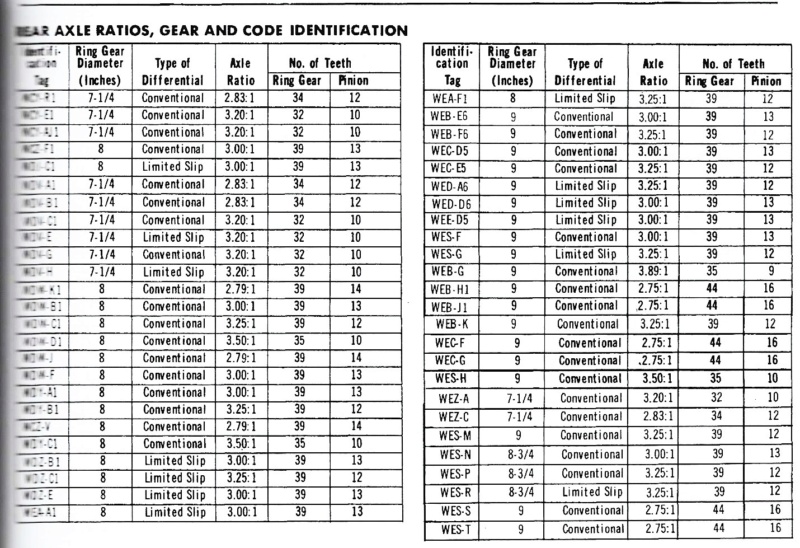
Before upgrading, you must accurately baseline your current setup. The most professional method involves locating the metal identification tag secured by one of the carrier-to-housing bolts. For example, a tag reading ‘WCC-F 3L50 9 731A’ indicates a 3.50 ratio with a Limited-Slip (L) differential and a 9-inch ring gear manufactured in the first week of July. Common factory ratios typically span from 2.47:1 for fuel economy-focused passenger cars to 4.11:1 in heavy-duty F-series performance packages.
📋
Step-by-Step Ratio Identification
Jack up the rear of the vehicle. Mark the driveshaft and the tire. Rotate the tire exactly one full revolution (for a locker/spool) or two full revolutions (for an open diff) and count the driveshaft rotations. 3.5 turns equals a 3.50:1 ratio.
If the unit is disassembled, count the teeth on both gears. Divide the ring gear tooth count by the pinion gear tooth count. For example, 37 teeth on the ring and 9 on the pinion (37 / 9) results in the classic 4.11 ratio.
Always verify the axle spline count when identifying a 9-inch. Standard passenger cars use 28-spline axles, whereas high-performance 31-spline and competition-grade 35-spline setups require specific carrier bores and side gears.
Section 3: Selecting the Right Ford 9 Inch Gear Ratios for Street and Highway Driving
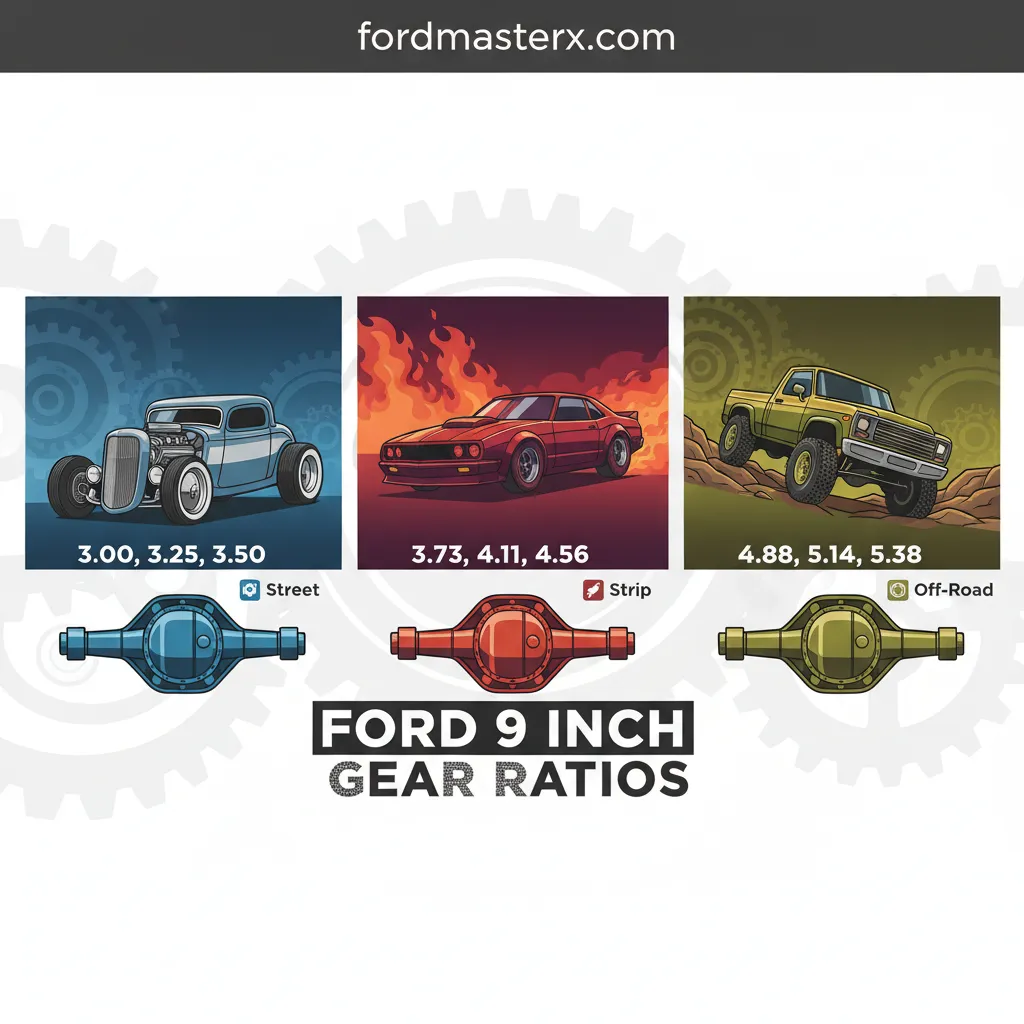
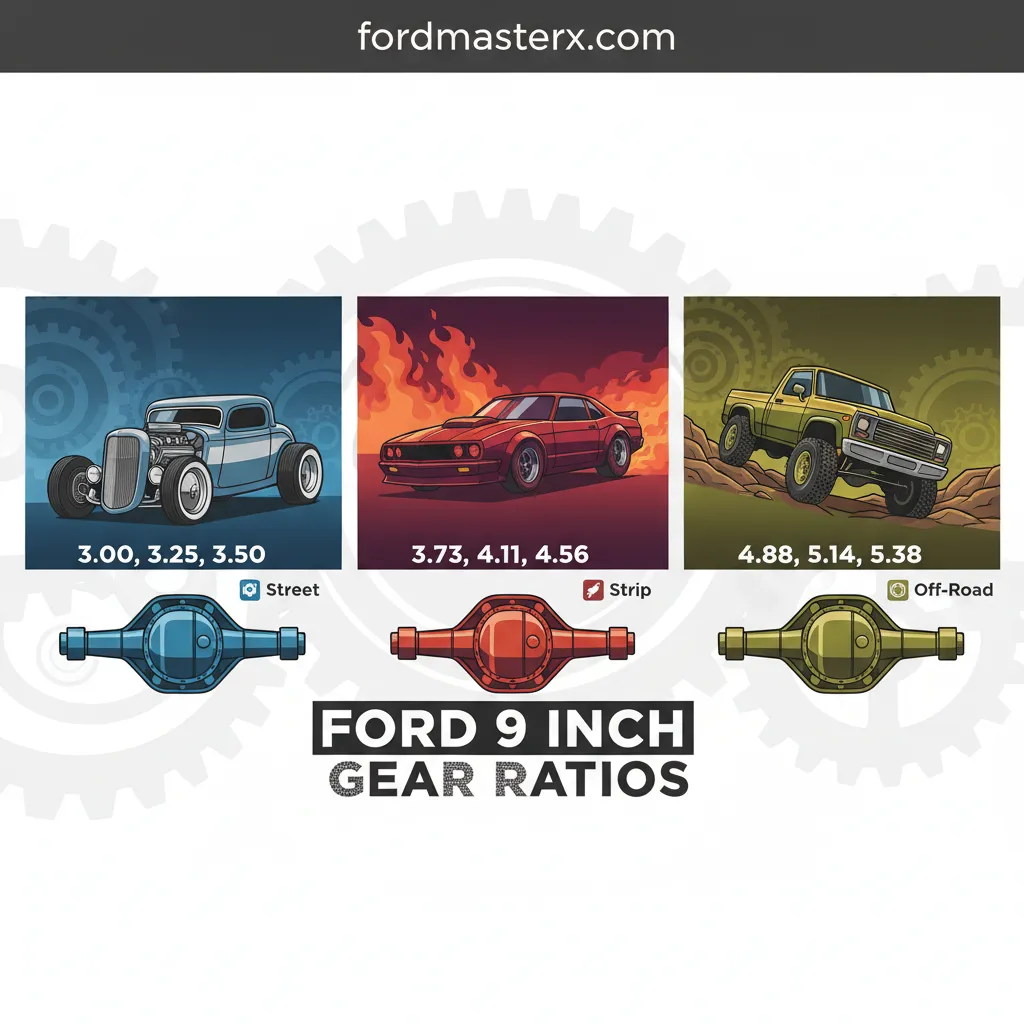
For most enthusiasts, the “sweet spot” for a street-driven muscle car lies between 3.25 and 3.50. These ratios provide a noticeable increase in acceleration over “highway gears” like 2.75 while keeping the engine RPM within a comfortable range for cruising. However, the rise of overdrive transmissions (such as the AOD, T56, or 4L80E) has fundamentally changed gear selection. With a 0.70 overdrive ratio, a 3.89 or even 4.11 rear gear becomes quite manageable for long-distance travel.
To understand the impact, consider a classic Mustang with 26-inch tires. Switching from a 3.00 factory ratio to a 3.50 ratio results in a 16.6% increase in torque at the wheels. While this provides a transformative feel in throttle response, it also results in a 16.6% increase in cruising RPM. A car that once cruised at 2,000 RPM will now spin at roughly 2,330 RPM at the same speed. Ensuring your engine stays within its efficient power band is the key to maintaining drivability and fuel economy.
Street Versatility
Ratios like 3.25 or 3.50 offer the best balance of “stoplight-to-stoplight” fun and manageable 65 MPH cruising speeds.
Overdrive Optimization
Modern transmissions allow for “deeper” 3.70 or 3.89 gears without sacrificing the ability to drive on the interstate.
Section 4: Performance and Competitive Ford 9 Inch Gear Ratios for Drag Racing
In the competitive world of drag racing, gear ratio selection is a calculated science focused on the 60-foot launch and the traps. Utilizing “deep” gears such as 4.11, 4.30, or 4.56 is essential for maximizing the engine’s mechanical advantage. The objective is to ensure the engine crosses the finish line at the peak of its horsepower curve. Pro-stock racers often push the limits of the Ford 9-inch architecture, utilizing ratios as high as 6.50:1 to maintain ultra-high RPM launches and power delivery.
However, high-numerical ratios come with structural demands. When exceeding a 4.11 ratio in a high-load environment, transitioning to a 3.250-inch or 3.812-inch bearing case (typically made of Spheroidal Graphite or “Nodular” iron) is mandatory to prevent the housing from flexing. Furthermore, these gears generate significant friction; specialized high-pressure lubricants and rigorous break-in cycles are non-negotiable for long-term survival.
✅ Race Pros
- Maximum low-end torque for better 60-ft times
- Keeps high-revving engines in the power band
- Optimizes ET (Elapsed Time) for bracket racing
❌ Race Cons
- Poor fuel economy and high highway heat
- Requires frequent lubrication maintenance
- Increased stress on axles and driveshafts
Section 5: Calculating the Effect of Tire Size on Ford 9 Inch Gear Ratios
One of the most common pitfalls in drivetrain modification is neglecting the relationship between tire diameter and effective gearing. A tire acts as a final lever; as the diameter increases, the mechanical advantage decreases. For example, increasing tire diameter from 29 inches to 35 inches effectively turns a 4.11 ratio into a 3.40 ratio, leading to a sluggish, unresponsive vehicle.
To restore factory-like performance or “equivalent” torque, off-roaders must install shorter gears (higher numerical value). If an F-150 owner installs 35-inch mud-terrain tires and wishes to maintain the original performance of a 3.50 gear set with 31-inch tires, they would need to move to a 4.11 or 3.89 ratio. Additionally, changing ratios and tires will throw off speedometer accuracy; this must be corrected by swapping the speedometer drive gear in the transmission or using a digital calibration module.
Section 6: Professional Installation and Maintenance Standards
The longevity of your gear set is determined entirely by the precision of the installation. Two measurements are critical: pinion depth and backlash. Pinion depth determines where the pinion gear contacts the ring gear teeth vertically, while backlash (typically set between .006 and .010 inches) represents the “slack” between the gears. Incorrect backlash is the leading cause of “gear whine,” while improper pinion preload—often caused by over-torquing a crush sleeve—leads to 90% of bearing failures in 9-inch rears.
Maintenance is equally vital. New street gear sets require a 500-mile break-in period characterized by brief heat cycles (15-20 minute drives followed by full cooling). This allows the gears to “work-harden” together. For lubrication, a trusted 80W-90 or 75W-140 gear oil should be used, along with specific friction modifiers if you are running a limited-slip differential. Following these protocols ensures your Ford 9-inch remains a reliable component of your drivetrain for decades.
Never reuse a crush sleeve. If you over-tighten the pinion nut during assembly, you must replace the crush sleeve with a new one or utilize a solid spacer shim kit for more precise, repeatable preload settings.
In summary, the Ford 9-inch offers unmatched versatility due to its dropout design and massive range of available ratios. Selecting the correct ratio requires a holistic view that balances engine power bands, transmission type, and tire diameter. Whether building a weekend cruiser or a dedicated track weapon, professional installation focusing on backlash and pinion depth is non-negotiable for long-term reliability. Consult with a trusted drivetrain specialist to verify your calculations before purchasing your next ring and pinion set to ensure your vehicle performs exactly as intended.
Frequently Asked Questions
What is the most popular all-around gear ratio for a Ford 9-inch?
The 3.50:1 ratio is widely considered the best all-around choice. It provides a significant improvement in acceleration over stock ‘highway’ gears like 2.75 or 3.00, yet it remains manageable for highway cruising without pushing engine RPM into an uncomfortable or inefficient range, especially when paired with a standard three-speed or four-speed transmission.
Can I change my gear ratio without replacing the entire differential?
Yes, one of the primary benefits of the Ford 9-inch is its removable third member. You can purchase a pre-assembled ‘chunk’ with your desired gear ratio and simply swap it into your existing housing. This allows for rapid changes at the track or in the shop without the need for complex shim adjustments inside the vehicle.
How do I know if I need a ‘thick’ ring gear?
Thick ring gears are typically required when you are using a carrier designed for numerically lower ratios (like 3.25) but want to install numerically higher gears (like 4.56). However, because the Ford 9-inch uses a unique pinion-to-ring-gear offset, most 9-inch carriers are universal, meaning thick gears are less common here than in Dana or GM differentials.
What does a ‘4.11 gear’ actually mean?
A 4.11 gear ratio means that the driveshaft (and pinion gear) rotates 4.11 times for every single full rotation of the tires (and ring gear). A higher numerical number like 4.11 is ‘shorter’ or ‘lower’ gearing, which provides more torque and faster acceleration but results in higher engine RPM at cruising speeds.
Is a solid spacer better than a crush sleeve for the pinion?
For high-performance or heavy-duty applications, a solid spacer is preferred. While a crush sleeve is easier to install during assembly, it can continue to compress under extreme torque loads, leading to a loss of pinion preload and eventual gear failure. A solid spacer with shims provides a more reliable, fixed distance that maintains professional-grade tolerances.