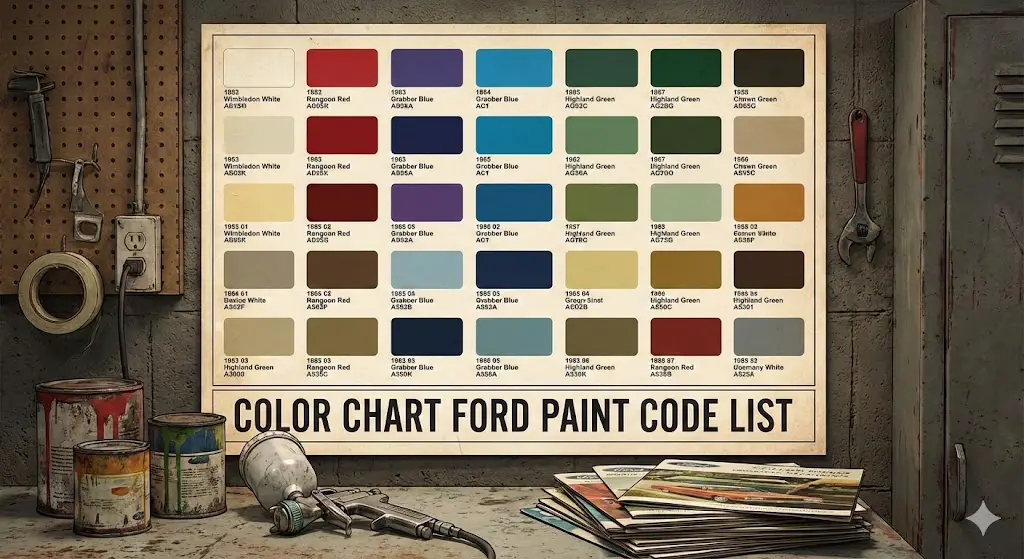
The Definitive Ford Paint Code Encyclopedia & Color Chart (1964-2026)

In the vast ecosystem of automotive manufacturing, few aspects of a vehicle are as immediately impactful yet technically complex as its exterior finish. For Ford Motor Company, a titan of American industry, the evolution of paint technology—from the utilitarian enamels of the Model T to the complex, multi-stage waterborne pearls of the modern aluminum-body F-150—charts a parallel history of chemical engineering, environmental regulation, and shifting consumer psychology.
This report serves as an exhaustive reference document for automotive professionals, restorers, and enthusiasts seeking to navigate the labyrinth of Ford paint codes, color names, and formulation changes spanning six decades.
The necessity of this report arises from a singular, often frustrating reality in the automotive world: a color name is not a definition. A specific marketing descriptor, such as “Ocean Blue,” may be utilized in 1966 and again in 2004, yet the chemical composition, metallic flake density, and spectral values of these two paints are entirely distinct. Relying on nomenclature for restoration or repair is a recipe for disaster.
The only immutable source of truth is the Ford Paint Code—a two-character alphanumeric identifier that links a specific vehicle to a precise mixing formula stored in the databases of paint manufacturers like PPG, DuPont (Axalta), and Sherwin-Williams.
This document provides a granular analysis of these codes. It explores the “Peeling Paint” controversy that plagued Ford’s aluminum body panels in the early 21st century, detailing the specific Technical Service Bulletins (TSBs) required for proper remediation. It dissects the “Tri-Coat” application process, a stumbling block for many DIY repairers.
Finally, it offers a year-by-year, model-by-model encyclopedic listing of paint codes for Ford’s flagship vehicles—the F-Series and the Mustang—ensuring that whether one is preserving a 1978 “Indio Tan” pickup or a 2026 “Molten Magenta” crossover, the information required for a perfect match is at hand.
Ford Paint Codes
The Definitive Visual Guide to Decoding, Matching, and Understanding Your Vehicle’s Color Identity.
Identify
Find the 2-digit code hidden on your vehicle’s certification label. It’s the DNA of your car’s look.
Verify
Cross-reference the code with the VIN. “Red” isn’t just red—it could be Race Red, Torch Red, or Ruby Red.
Restore
Use the correct code to order touch-up paint or aerosol sprays that match the factory finish perfectly.
Locating Your Paint Code
For almost all Ford models manufactured after the 1980s, the paint code is located on the **Vehicle Certification Label**. This sticker is found on the driver’s side door jamb (the B-pillar) or on the edge of the driver’s door itself.
- Open the Driver’s Side Door.
- Look for the black and white sticker.
- Find the code labeled “EXT PNT” (Exterior Paint).
GVWR: 2268 KG (5000 LB)
FRONT GAWR: 1134 KG
REAR GAWR: 1134 KG
The Ford Color Hierarchy
While enthusiasts love the rare colors like “Mystichrome” or “Grabber Blue,” the sales data tells a different story. Conservative colors dominate production numbers due to their resale value and fleet usage. However, among performance models (like the Mustang), vibrant colors hold a significantly higher share than the industry average.
Figure 1: Comparison of production volume for the top 5 paint codes across all Ford models (2015-2023). Note the dominance of Oxford White due to fleet vehicle integration.
Evolution of Color
The 1970s were defined by “Earth Tones” (Browns, Greens, Yellows). The 1990s saw a surge in Teal and deep Jewel tones. Today, the market has shifted heavily towards the “Monochromatic Trinity” (White, Black, Silver/Grey), driven by minimalist design trends and leasing logic.
Composition of Finishes
Modern Ford paint codes are not just colors; they are specific *finishes*. Metallics contain aluminum flakes for sparkle, while Pearls (Tri-coats) use ceramic crystals for depth. Solids remain popular for utility and non-metallic performance reds.
Decoder Ring: Common Codes
The most frequently searched paint codes in the Ford database.
| Color Name | Code | Years Active | Type |
|---|---|---|---|
| Oxford White | YZ / Z1 | 1995 – Present | Solid |
| Shadow Black | G1 | 2016 – Present | Mica |
| Race Red | PQ | 2011 – Present | Solid |
| Magnetic Metallic | J7 | 2015 – 2021 | Metallic |
| Ruby Red | RR | 2013 – 2019 | Tri-Coat Pearl |
The Match & Buy Protocol
Locate Code
Check door jamb sticker. Do NOT trust the visual color alone; many variants exist.
Decode & Order
Input 2-digit code into supplier database. Select format (Pen, Aerosol, Pint).
Test Card Spray
Always spray a test card before touching the car. Paint fades; verifying match is critical.
© 2025/2026 FordMasterX Infographics. Data sourced from manufacturer owner manuals.
The Ford Paint Code System: Anatomy and Evolution
To the uninitiated, the alphanumeric soup on a vehicle’s door tag can appear indecipherable. However, Ford has maintained a relatively consistent, albeit evolving, system for paint identification since the mid-20th century. Understanding the logic behind these codes is the first line of defense against costly mixing errors.
The Two-Character Standard
Since the late 1960s, Ford has standardized on a two-character paint code system. While the internal engineering codes (often referred to as "M-codes," such as M6887A) provide the full chemical specification used at the factory, the service code found on the vehicle is the primary key for aftermarket matching.
- The Alphanumeric Mix: Codes may consist of two letters (e.g., YZ), a letter and a number (e.g., D1), or, in older models, single characters.
- The M-Code Correlation: The two-character code is essentially a shorthand. For instance, the code YZ found on a door jamb corresponds to the M-code M6887A. This distinction is vital because a single service code (like YZ) might remain constant for years, even if the underlying M-code is tweaked slightly for environmental compliance (such as the shift from solvent-based to waterborne paints). Paint suppliers track these variants by year.
The "Marketing Name" Trap
One of the most significant insights for collectors is the disconnect between the marketing name and the paint code. Ford’s marketing department frequently renames colors to suit the "personality" of different models.
- Case Study: The paint code G1.
- On a Ford Mustang, this code is marketed as Shadow Black.
- On a Lincoln Navigator, the exact same paint (Code G1) might be marketed as Absolute Black.
- On a Ford Ranger, it might simply be listed as Black.
- Implication: When ordering touch-up paint, ignoring the name and ordering strictly by code G1 ensures you receive the correct pigment, regardless of what the brochure called it.
Historical Variances (Pre-1970)
The pre-1970 era presents unique challenges. During the 1960s, Ford frequently used single-letter codes that were recycled annually.
- The Case of Code "M": In 1965, Code M referred to Wimbledon White, a creamy, warm white famously used on the Shelby GT350.
- The Recycling Risk: That same letter "M" might refer to a completely different hue in a different decade or on a Lincoln model from the same era.
- Resolution: For vehicles of this vintage, the paint code must always be cross-referenced with the Model Year and the Assembly Plant to ensure accuracy.
Locating the Paint Code: A Model-Specific Field Guide
The first practical hurdle in any paint repair workflow is locating the physical code on the vehicle. While the driver's door jamb is the industry standard today, historical models and specific truck configurations offer exceptions that can confound even experienced technicians.
The Modern Standard (1980–Present)
For the vast majority of Ford vehicles produced in the last 45 years, the Vehicle Certification Label (commonly called the door tag) is the "Rosetta Stone" of vehicle data.
Primary Location: Driver’s Door Jamb
On models such as the F-150, Mustang, Explorer, and Fusion, open the driver’s door and inspect the B-pillar (the vertical post where the door latches). You will find a rectangular sticker containing the VIN, tire pressures, and various codes.
- The Identifier: Scan the bottom of the sticker for the abbreviation EXT PNT (Exterior Paint).
- Reading the Code: The code will be printed directly next to or below this header. It is almost always two characters.
- Visual Cue: If you see a long string like "WB" near the paint code, ignore it; "WB" typically stands for "Wheelbase," not a paint color. The paint code is distinct.
Secondary Location: Door Edge
On some trucks (Ranger, F-Series) and vans (E-Series, Transit), the sticker may be affixed to the rear edge of the driver's door itself rather than the body pillar. This is common on vehicles where the pillar is too narrow or obstructed by trim.
Classic Era Locations (1960s–1970s)
Restoring a classic Ford requires a different approach, as data plates were metal tags riveted to the vehicle rather than adhesive stickers.
- Mustang (1964.5–1973): The data plate is riveted to the rear face of the driver's door. The paint code is a single character under the heading COLOR. Note that if the door has been replaced during a previous restoration, this tag may not match the car's actual color. In such cases, checking the "buck tag" (often found on the radiator support or inner fender under the hood) is a necessary backup step.
- Bronco (First Gen, 1966–1977): The location of the tag migrated. Early models often had the tag on the inside face of the glove box door. Later models moved it to the driver's door. This inconsistency makes verification via VIN decoding essential for early Broncos.
The VIN Myth vs. Reality
A persistent misconception among vehicle owners is that the Vehicle Identification Number (VIN) itself contains the paint code. This is incorrect. The VIN contains the engine type, assembly plant, year, and safety restraint system data, but it does not encode the exterior color.
- The Workaround: However, the VIN is the key to unlocking the paint code via a dealer database or an online "As-Built" data lookup tool. When the physical sticker is missing or illegible (common on work trucks or salvaged vehicles), providing the VIN to a Ford parts counter allows them to retrieve the original build sheet, which does list the paint code.
Specific Model Anomalies
- Ford Ranger (2000s): Often found on the driver’s door edge, but occasionally on the B-pillar. Snippets indicate the code is typically below the barcode.
- Imports & Partner Vehicles: Vehicles built during Ford’s partnership periods (e.g., the Ford Probe, which was Mazda-based) may have paint codes located on the firewall or under the hood, reflecting the manufacturing practices of the partner brand.
Table 1: Master Paint Code Location Reference
| Era | Model Family | Primary Location | Secondary Location | Code Indicator |
| 1964-1970 | Mustang/Cougar | Driver Door (Rear Face) | Radiator Support (Buck Tag) | "COLOR" Header |
| 1966-1977 | Bronco | Glove Box Door (Inner) | Driver Door Jamb | "COLOR" Header |
| 1970-1979 | F-Series Truck | Driver Door Jamb | Door Edge | "PAINT" Header |
| 1980-Pres | F-Series (F-150/250) | Driver Door B-Pillar | Driver Door Edge | "EXT PNT" |
| 1990-2011 | Ranger | Driver Door Edge | B-Pillar | "EXT PNT" |
| 2000-Pres | Escape/Explorer | Driver Door B-Pillar | Liftgate Jamb (Rare) | "EXT PNT" |
| 2021-Pres | Mustang Mach-E | Driver Door B-Pillar | Frunk Area (Rare) | "EXT PNT" |
Technical Analysis: Chemical Composition and Paint Types
The transition of Ford paint codes over the years is not merely cosmetic; it represents a fundamental shift in chemical engineering. Restorers must understand these technologies to ensure that new repairs adhere to old layers without reaction or failure.
Single Stage Enamels (Pre-1980s)
Classic colors like Rangoon Red (J) or Wimbledon White (M) were originally applied as single-stage enamels or lacquers. In this system, the pigment and the gloss resin are mixed together.
- Restoration Insight: When polishing original single-stage paint, the pad will turn the color of the car. This is normal. Modern repairs usually replicate these colors using a base/clear system for longevity, but this can alter the "depth" or "warmth" of the color compared to a true single-stage restoration.
Base Coat / Clear Coat (1980s–Present)
Starting in the 1980s, Ford transitioned to the two-stage system standard today.
- Layer 1 (Base): Provides the color and metallic/pearl effects. It dries to a matte finish.
- Layer 2 (Clear): Provides the gloss and UV protection.
- Identification: Paint codes from this era (e.g., Vermilion Red E4) are typically matched with a two-stage formula.
The Rise of Tri-Coats and Tinted Clears
Modern Ford colors, particularly the premium "extra cost" options, often utilize a Tri-Coat system. This is chemically distinct and requires a specific application protocol.
- The Structure:
- Ground Coat: A base layer (often white, silver, or gold) that sets the reflective foundation.
- Mid-Coat (Transparent): A translucent layer containing tinted pearls. This is the critical step; the number of passes determines the final darkness and richness of the color.
- Clear Coat: The final seal.
- Example Codes:
- RR: Ruby Red Metallic (Tinted Clearcoat/Tri-Coat).
- UG: White Platinum (Tri-Coat).
- AZ: Star White Metallic (Tri-Coat).
- D4: Rapid Red Metallic (Tinted Clearcoat).
Critical Repair Insight: Applying Tri-Coat Touch-Up
Touching up a Tri-Coat scratch is significantly more difficult than a standard color. A single bottle of "Ruby Red" will likely not match. You must purchase a kit containing the ground and mid-coat.
- Preparation: The area must be perfectly smooth.
- Base Application: Apply the ground coat until coverage is opaque. Allow to dry.
- Mid-Coat Application: This is the variable. Apply thin layers. After each layer, compare it to the surrounding factory paint. One layer might be too light; three might be too dark. This manual calibration is why Tri-Coat repairs are expensive at body shops.
- Clear Coat: Essential for the pearls in the mid-coat to "pop" and refract light correctly.
Waterborne vs. Solvent (The 2000s Shift)
In the late 2000s, environmental regulations (especially in Europe and California) forced a switch from solvent-based paints to waterborne base coats.
- The Impact: A code like YZ (Oxford White) has existed for decades. However, a YZ formulated in 1995 (solvent) has a slightly different metamerism (how it looks under different light sources) than a YZ formulated in 2015 (waterborne).
- Actionable Advice: When ordering paint for a full panel repaint, ensure the supplier knows the year of the vehicle, not just the code, to adjust the toner formulation for the correct paint system match.
The "Peeling Paint" Controversy: Aluminum Body Corrosion
No discussion of modern Ford paint codes is complete without addressing the systemic issue of paint adhesion on aluminum body panels—a topic that has spawned lawsuits, Technical Service Bulletins (TSBs), and significant consumer frustration. This issue specifically impacts the resale value and maintenance of vehicles like the F-150 (2015+), Expedition, Explorer, and Mustang.
The Mechanism of Failure
The root cause is iron contamination. Aluminum panels (hoods, tailgates) are prone to galvanic corrosion if they come into contact with iron particles (dust from the factory, tools, or stamping dies) before being primed.
- The Reaction: The iron particles embedded in the aluminum surface react with moisture (even through the paint) to create a galvanic cell. This pushes the paint up from the metal surface.
- Symptoms: Unlike steel rust, which bubbles up brown or red, aluminum corrosion manifests as blisters that, when popped, reveal a white, chalky dust (aluminum oxide). The paint often peels away in large flakes.
Affected Models and Years
While prominent in the 2015+ aluminum F-150, this issue traces back to the early 2000s when Ford began using aluminum hoods on steel bodies to save weight.
- Explorer/Mountaineer (2000–2010): Notorious for hood lip corrosion.
- Mustang (2005–2014): Hood leading edges frequently bubble.
- Expedition/Navigator (2000–2018): Liftgates and hoods.
- F-150 (2004–Present): Hoods and, for 2015+ models, the entire body.
Technical Service Bulletins (TSBs)
Ford has released multiple TSBs to guide body shops in repairing this condition. These are critical documents for any owner attempting to get a dealership to cover the repair.
- TSB 19-2026: Supersedes earlier bulletins. It outlines a procedure involving:
- Stripping the panel to bare metal.
- Checking for perforation (if perforated, replace panel).
- Using specific zinc-free primers and surface preps.
- Applying a high-quality two-component epoxy primer before the base coat.
- TSB 17-0062: An earlier iteration recommending panel replacement over repair in severe cases.
Recommendation for Owners
If you identify bubbling paint on an aluminum panel:
- Do not pick at it. Breaking the paint seal accelerates the oxidation.
- Verify the Warranty: Ford’s corrosion warranty typically covers "perforation" (holes) for 5 years/unlimited miles. Surface bubbling often falls into a grey area where claims are denied because the metal isn't "perforated."
- Cite the TSB: When visiting a dealer, referencing TSB 19-2026 shows you are informed, which may aid in "goodwill" assistance requests.
- Repair via Specialist: Ensure any body shop you use is certified for aluminum repair. Using steel wool or steel brushes on aluminum will re-contaminate the panel and cause the paint to fail again within months.
Comprehensive Ford F-150 Paint Code Encyclopedia (1975–2026)
The F-Series is the canvas of the American road. Its colors reflect the shifting tides of American culture—from the earth-toned 70s to the monochrome 2000s and the matte/pastel revival of the 2020s.
The Dentside Era (1975–1979)
Characterized by non-metallic gloss colors and two-tone "Tu-Tone" combinations (Victoria, Deluxe).
| Year | Paint Code | Color Name | Insight |
| 1975 | A | Raven Black | The standard non-metallic black. |
| 1975 | M | Wimbledon White | A creamy off-white; high restoration demand. |
| 1975 | G | Chrome Yellow | High-visibility industrial yellow. |
| 1975 | Q | Parrot Orange | A rare, vivid 70s safety orange. |
| 1976 | I | Bahama Blue | A bright teal-blue, very era-specific. |
| 1977 | B | Dark Jade Metallic | One of the first popular metallic truck colors. |
| 1978 | H | Dark Brown Metallic | Often paired with Creme (U) for the "Root Beer" look. |
| 1979 | S | Midnight Blue Metallic | A deep navy that hid dirt well. |
| 1979 | 6 | Bright Yellow | Continued the trend of bright "work" colors. |
The Bullnose & Bricknose Era (1980–1996)
Transition to base/clear paint systems. Introduction of reds that defined the era.
| Year | Paint Code | Color Name | Insight |
| 1980 | 1G | Silver Metallic | Early use of heavy silver flake. |
| 1985 | 4A | Dark Teal Metallic | A definitive 80s hue. |
| 1990 | EH | Cabernet Red | A deep burgundy; prone to clear coat failure if neglected. |
| 1992 | YO | Oxford White | Replaced Wimbledon White as the standard "fleet" white. |
| 1994 | E4 | Vermilion Red | The legendary bright red of the Lightning performance truck. |
| 1994 | PB | Emerald Green Metallic | The most popular green of the 90s. |
| 1994 | UA | Black Clearcoat | Replaced Raven Black (A); deeper gloss. |
| 1996 | TS | Silver Frost | A lighter, "ice" silver metallic. |
The Modern Era (2004–2014)
The era of "Toreador Red" and the rise of pearlescent whites.
| Year | Paint Code | Color Name | Insight |
| 2004 | FL | Toreador Red Metallic | A medium red pearl; extremely common. |
| 2004 | CX | Dark Shadow Gray | A precursor to modern Carbonized/Magnetic grays. |
| 2008 | G3 | Pueblo Gold | Used extensively as the lower accent on King Ranch models. |
| 2009 | SZ | Blue Flame Metallic | Launch color for the F-150 Raptor. Very bright. |
| 2011 | UG | White Platinum Tri-Coat | The first widespread use of tri-coat white on trucks. |
| 2013 | N1 | Blue Jeans Metallic | A dark, non-flashy blue popular with fleets. |
| 2014 | RR | Ruby Red Metallic | The first tint-clear red; deeper than E4. |
The Aluminum Age (2015–2026)
Complex metallics, "flat" gloss colors, and Raptor exclusives.
| Year | Paint Code | Color Name | Type | Notes |
| 2018 | J7 | Magnetic Metallic | Metallic | The dominant dark grey of the decade. |
| 2018 | JX | Lead Foot | Gloss | A non-metallic grey; highly sought after resale. |
| 2021 | HX | Antimatter Blue | Metallic | Looks black until hit by direct sunlight. |
| 2021 | M7 | Carbonized Gray | Metallic | Replaced Magnetic; slightly lighter. |
| 2021 | CN | Code Orange | Solid | Raptor Exclusive. High visibility. |
| 2023 | AZ | Star White Metallic | Tri-Coat | A cleaner pearl white than UG. |
| 2023 | B3 | Atlas Blue | Metallic | A vibrant "Ford Blue" oval match. |
| 2025 | JS | Iconic Silver | Metallic | Current standard silver. |
| 2025 | D4 | Rapid Red Metallic | Tri-Coat | Replaced Ruby Red; slightly brighter. |
| 2025 | E1 | Blue Ember | Metallic | A color-shifting dark blue. |
Ford Mustang Color History: Icons of the Road
The Mustang palette is more than a list of colors; it is a cultural timeline. From the "Grabber" high-impact colors of the muscle car era to the "Mystichrome" technological marvels of the 2000s, Mustang paint codes are collector items in themselves.
First Generation Icons (1964.5–1973)
- Rangoon Red (J): The original 1964.5 launch red. A single-stage non-metallic that defines the classic pony car look.32
- Wimbledon White (M): The racing color of the United States. Used on the Shelby GT350 with Guardsman Blue (F) stripes.
- Highland Green (R): The "Bullitt" color (1968). A dark, brooding metallic green made famous by Steve McQueen.
- Grabber Blue (G/J): Introduced in 1969. A non-metallic, high-intensity sky blue. It was designed to look good on television and has been revived in 2010 and 2017 due to cult status.
The Fox Body Era (1979–1993)
- Bright Red (2G/EP): The quintessential "5.0" Mustang color.
- Calypso Green (P2): A rare, teal-green metallic that encapsulates early 90s aesthetics.
- Reef Blue (PC): A vibrant metallic blue often paired with silver ground effects on GT models.
SN95 & New Edge (1994–2004)
- Mystic (LF): 1996 Cobra exclusive. The first color-shifting production paint, changing from green to purple.
- Mystichrome (G6): 2004 Cobra exclusive. An evolution of Mystic, shifting from blue to green to purple to black. Formulated by BASF, this paint was so controlled that for years, body shops needed a VIN to order it.
- Competition Orange (CY): A very bright, non-metallic orange used on the 2003-2004 Mach 1.
Modern Muscle (2005–2026)
- Gotta Have It Green (HD): A tri-coat high-impact lime green (2013-2014).
- Kona Blue (L6): A deep, ink-like dark blue metallic that became a fan favorite.
- Avalanche Gray (DR): First seen on the GT350, a non-metallic light grey that sparked the "flat grey" industry trend.
- Eruption Green (FA): A 2022+ color. A modern, heavy-metallic take on Highland Green.
- Cyber Orange (SB): A pearl tri-coat that shifts from yellow to orange.
- Vapor Blue (MY): New for the 2024 S650 Mustang, a desaturated blue-grey metallic.
Table 2: Mustang "Grabber" Color Evolution
| Color Name | Classic Code (1970) | Modern Code (2010s/20s) | Description |
| Grabber Blue | J | CI / AE | Vivid non-metallic sky blue. |
| Grabber Orange | U | U3 | Bright "school bus" yellow-orange. |
| Grabber Green | Z | - | Vivid non-metallic lime. |
| Grabber Yellow | D | - | Bright primary yellow. |
| Grabber Lime | - | F9 | High-impact metallic lime (2020). |
Ford Ranger & Bronco: Truck Colors Reimagined
While often sharing codes with the F-150, the Ranger and Bronco lines have historically featured unique palettes tailored to the "adventure" lifestyle segment.
Ford Ranger (1983–2011 & 2019–Present)
- Splash Era Colors (1990s): The "Splash" trim level introduced vibrant colors like Canary Yellow (BZ) and Bright Island Blue (KM) to the small truck market, treating the truck as a lifestyle accessory rather than just a tool.
- The Comeback (2019+): The reintroduced Ranger featured Saber (PL), a metallic copper-orange, and Hot Pepper Red (EA), a spicy metallic red that emphasizes the truck's sporty positioning.
Ford Bronco (1966–1996 & 2021–Present)
The Bronco's paint history is split into two distinct eras: the utilitarian classic era and the modern retro-lifestyle era.
- Classic Era: Colors like Boxwood Green (P) and Sky View Blue (E) defined the first generation. These were pastel, non-metallic shades.
- Modern Era: The 2021 Bronco launch leveraged "Heritage" colors.
- Area 51 (KU): A blue-grey-green "flat" gloss color. It became an instant sales hit, influencing the entire industry.
- Cactus Gray (NE): A slightly green-tinted grey/white.
- Cyber Orange (SB): Positioned as the hero color for the launch.
- Yellowstone (S6): A heritage yellow available on special editions.
Table 3: Modern Bronco & Ranger Exclusive Codes
| Year | Paint Code | Color Name | Models | Note |
| 2021+ | KU | Area 51 | Bronco, Maverick, F-150 | Retired in 2024; highly collectible color. |
| 2021+ | NE | Cactus Gray | Bronco, Ranger, Maverick | Non-metallic appearance. |
| 2022+ | FA | Eruption Green | Bronco, Mustang | Modern take on Mallard/Highland Green. |
| 2023+ | H5 | Azure Gray Tri-Coat | Bronco, F-150 | A cooler, bluer version of Area 51. |
| 2023+ | S6 | Yellowstone | Bronco Heritage | Limited edition solid yellow. |
Restoration & Repair: A Technician’s Guide to Ford Paint
Identifying the code is only step one. Applying the paint correctly—especially with modern formulations—is where many projects fail. This section synthesizes best practices for using Ford paint codes in real-world repair scenarios.
Dealing with Fade and Metamerism
A 2010 F-150 in Vermilion Red (E4) will not match a fresh bottle of E4 paint.
- The Physics of Fade: Red pigments are notoriously susceptible to UV degradation. Over 10 years, the red shifts toward pink or chalky white.
- The Solution: For older vehicles, do not buy "off the shelf" touch-up paint. Visit a professional automotive paint supply shop. They can use a spectrophotometer (a camera that reads paint color) on your fuel door or hood to adjust the factory E4 formula to match the current, faded state of your truck.
The "Door Jamb vs. Body" Discrepancy
On many assembly lines, the body is painted by robots, while the door jambs and inner hood areas are cut in by hand or different automated heads.
- The Result: The paint in the door jamb (where the code sticker is) often lacks the clear coat thickness or the metallic flop of the exterior panels.
- Advice: Never color match against the door jamb. Always match against an adjacent exterior panel (e.g., the fender if painting a door).
Step-by-Step: Tri-Coat Touch-Up Workflow
For owners of White Platinum (UG) or Ruby Red (RR) vehicles, follow this protocol for chips:
- Clean: Use isopropyl alcohol to remove wax and grease from the chip.
- Prime: If metal is visible, use a micro-dabber to apply grey epoxy primer. Let cure for 24 hours.
- Ground Coat: Shake the "Step 1" bottle vigorously. Apply a thin layer inside the chip. Do not overflow. Let dry 20 mins. Repeat until the grey primer is covered.
- Mid-Coat: Shake the "Step 2" bottle. Apply one thin coat. Let dry. Check color. It will likely look light. Apply a second thin coat. Check again. Stop when it matches the surrounding deep color. Warning: It will look dull/matte. Do not panic.
- Clear Coat: Apply the clear topcoat. This will activate the pearl effect and protect the repair.
- Leveling: After 48 hours, use 2000-grit sandpaper on a block to level the paint blob, then polish with compound.
Frequently Asked Questions (FAQ)
Q: Can I tell my paint color from the VIN number?
A: No, the VIN does not contain the paint code directly. However, a Ford dealer can enter your VIN into their OASIS system to pull the "As-Built" data, which will list the paint code. You cannot read it directly off the dashboard VIN plate.
Q: Why does my paint code show up as two different names online?
A: Ford shares paint codes across its brands (Ford, Lincoln) and models. Code J7 is "Magnetic" on an F-150 but might be "Magnetic Gray" on a Fusion. Code G1 is "Shadow Black" or "Absolute Black." As long as the code matches, the paint formula is identical.
Q: My F-150 hood is bubbling. Is this covered by warranty?
A: Generally, Ford's corrosion warranty covers "perforation" (rust-through) for 5 years. Aluminum corrosion often bubbles but doesn't "perforate" the metal immediately, leading to denied claims. However, checking TSB 19-2026 and negotiating with the dealer may yield results, especially if the vehicle is just out of warranty.
Q: What is the most popular Ford color of all time?
A: Statistically, Oxford White (YZ/Z1) and Raven Black (A/UA) are the highest volume due to fleet sales. For enthusiast popularity, Mustang Red (Race Red/Torch Red) and Grabber Blue are consistently the most cited favorites in polls.
Q: Where is the paint code on a 2002 Ford Ranger?
A: Check the rear edge of the driver's door (not the jamb). It should be a sticker near the latch mechanism, look for "EXT PNT".
Conclusion: The Code is the Key
In the world of automotive stewardship, knowledge is preservation. The Ford paint code system, while occasionally cryptic, provides the unbroken thread connecting a 1965 Mustang Fastback to a 2026 F-150 Lightning. It allows us to distinguish between the utilitarian "Wimbledon White" of the past and the pearlescent "Star White" of the future.
For the owner, decoding this information is the difference between a seamless repair and a glaring mismatch. It is the tool that empowers one to stand up to a peeling paint defect with TSBs in hand, or to confidently order a replacement mirror cap that matches a 10-year-old truck perfectly. As environmental regulations continue to push paint technology toward waterborne and high-solid formulations, the reliance on these precise engineering codes will only deepen. Whether you are preserving a classic or maintaining a daily driver, the two digits on your door jamb are the DNA of your vehicle’s identity.