The Complete Guide to Ford Azure Gray Metallic Tri-Coat (Paint Code G4)

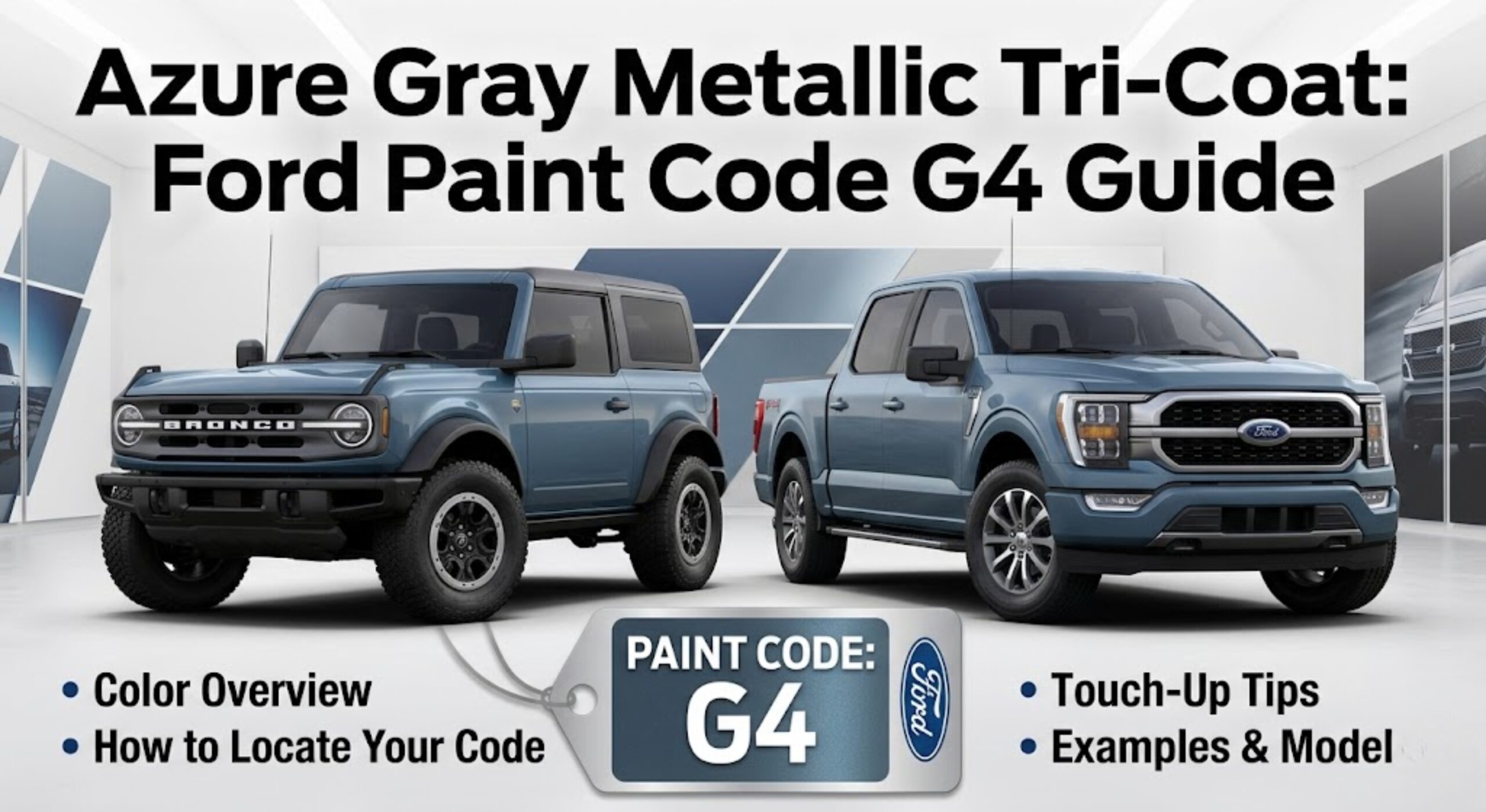
The automotive industry has recently witnessed a renaissance in exterior paint formulations, transitioning from simple single-stage enamels to complex, multi-stage coating technologies designed to manipulate light reflection. At the forefront of this aesthetic evolution is Ford’s Azure Gray Metallic Tri-Coat, officially designated internally by the paint codes G4 and M7480.
Introduced prominently for the 2023 model year on flagship adventure vehicles such as the Ford Bronco, this specific paint option has sparked intense interest among automotive enthusiasts, custom builders, and professional detailers.
Azure Gray Metallic Tri-Coat is neither a traditional flat gray nor a standard metallic blue. Instead, it is a highly dynamic, light-reactive finish that shifts dramatically depending on environmental lighting conditions. In direct, unfiltered sunlight, the paint exhibits a striking, sparkling metallic blue-gray profile. Conversely, in overcast conditions or deep shade, the metallic refraction diminishes, causing the finish to settle into a powdery, sophisticated steel-gray. Because of its highly specialized three-layer application process, Ford positions Azure Gray as a premium exterior option.
The Chemistry and Mechanics of Tri-Coat Paint
To fully grasp the visual depth and the economic reasoning behind the premium pricing of Azure Gray Metallic Tri-Coat, it is necessary to examine the physical composition of modern three-stage automotive paint systems. Most standard modern vehicles utilize a standard two-stage process consisting of an opaque color basecoat followed by a protective clearcoat. Tri-coat systems fundamentally alter this architecture by introducing a specialized middle layer that changes how light refracts off the vehicle’s bodywork.
The Azure Gray application involves a sequential, highly calibrated three-phase process. The procedure begins with a specialized automotive primer applied directly to the metal or plastic bodywork to ensure optimal adhesion, provide corrosion resistance, and create a perfectly smooth substrate. Over this foundational primer, the basecoat is applied. For Azure Gray, this initial basecoat is a highly opaque, solid metallic tone that establishes the core darkness and underlying grayscale of the vehicle. Crucially, this layer alone does not produce the final vibrant, shifting color.
The defining characteristic of the system is the second application: the translucent mid-coat, often referred to as the effect coat. As detailed by paint specialists at(https://theautopaintdepot.com/tri-coat-paint-a-complete-guide/), this layer is a semi-transparent, tinted clearcoat infused with specialized additives, ceramic crystals, and fine metallic flakes. Rather than acting as an opaque cover, the mid-coat allows light to pass through its matrix, reflect off the underlying basecoat, and refract back outward through the suspended metallic flakes.
This specific physical phenomenon creates the glistening sparkle and deep, three-dimensional glow that defines Azure Gray. During factory application, precise timing and thickness are strictly enforced; applying more than four passes of this mid-coat will oversaturate the finish, blocking light reflection and permanently ruining the color match.
The final application in this sequence is the clearcoat layer. This un-tinted layer serves a strictly protective function, shielding the fragile metallic flakes and underlying pigments from ultraviolet (UV) radiation degradation, environmental fallout, and mechanical abrasions, while simultaneously magnifying the gloss of the layers beneath.
The $995 MSRP premium attached to Azure Gray Metallic Tri-Coat is a direct reflection of this manufacturing complexity. Applying three distinct layers requires extended time on the factory paint line, additional curing intervals between the base and mid-coats (typically requiring 15 to 20 minutes of flash time per coat), and the integration of significantly more expensive raw materials, specifically the pearlescent and metallic flakes suspended within the effect coat.
Vehicle Availability and Production Adjustments
The availability of Azure Gray Metallic Tri-Coat has fluctuated since its highly publicized debut, reflecting supply chain adjustments, shifting consumer aesthetics, and distinct marketing strategies across different vehicle platforms.
For the Ford Bronco, Azure Gray debuted as a flagship color in 2023 and remains prominently available for the 2024 and 2025 model years. It is offered across multiple distinct trim levels, including the Big Bend, Black Diamond, Outer Banks, Badlands, and the high-performance Raptor variant. However, Ford purposefully excluded the color from the Heritage and Heritage Limited editions, which rely on a separate, retro-specific color palette featuring pastel tones.
The compact Ford Bronco Sport also adopted the color, offering it on premium trims such as the Outer Banks to bring an upscale, shifting aesthetic to the smaller crossover segment.
Within the truck division, the completely redesigned mid-size Ford Ranger offers Azure Gray as a premium option for the 2024 and 2025 model years, where it has proven highly popular among owners for its unique ability to hide light trail dust while sparkling intensely in direct sunlight. Similarly, the 2025 Ford Maverick compact truck features Azure Gray on its XL, XLT, Lariat, and Tremor configurations, though the color is noticeably excluded from the new, street-performance-focused Lobo trim. The full-size F-150 previously featured the color prominently on high-end configurations, including the Tremor and the Raptor.
Ford actively manages its paint portfolio, routinely retiring established colors to introduce new aesthetic trends or streamline production. The heavy-duty F-Series Super Duty lineup offered Azure Gray for the 2023 model year but abruptly discontinued it for 2024. It was replaced by a new premium color, Glacier Gray Metallic Tri-Coat, alongside Darkened Bronze Metallic. The all-electric F-150 Lightning also saw its color palette severely reduced for the 2024 model year;
both Azure Gray and Avalanche were removed from the ordering guide, leaving the EV with a highly restricted, heavily grayscale-focused palette. Furthermore, Azure Gray has never been offered on the current-generation Ford Explorer or the S650 Ford Mustang, both of which rely on their own distinct blue and gray metallic options, such as Vapor Blue and Carbonized Gray.
| Ford Model Lineup | Availability Status | Applicable Trim Levels (2024/2025) | Excluded Trims |
| Bronco | Available | Big Bend, Black Diamond, Outer Banks, Badlands, Raptor | Heritage, Heritage Limited |
| Bronco Sport | Available | Big Bend, Outer Banks | Base |
| Ranger | Available | XLT, Lariat, Raptor | None |
| Maverick | Available | XL, XLT, Lariat, Tremor | Lobo |
| F-150 | Available (Select Trims) | Tremor, Raptor | Base XL |
| Super Duty | Discontinued (2024+) | N/A (Replaced by Glacier Gray) | All |
| F-150 Lightning | Discontinued (2024+) | N/A | All |
| Mustang / Explorer | Never Offered | N/A (Utilizes Vapor/Carbonized Blue) | All |
Color Comparisons: Navigating the Ford Gray Palette
Ford’s modern color palette includes several nuanced variations of gray, blue, and teal, leading to frequent consumer confusion during the ordering process. Azure Gray is most frequently cross-shopped against Area 51, Cactus Gray, Carbonized Gray, and the newer Glacier Gray.
When comparing Azure Gray against Area 51, the structural differences in the paint become obvious. Area 51 is a non-metallic, solid finish that heavily blends gray, navy, and teal. Because it entirely lacks metallic flakes, it has a muted, almost matte-like appearance in direct sunlight, though it maintains a strong bluish-green undertone.
Discussions on enthusiast platforms like the(https://bronco6g.com/forum/threads/azure-gray-vs-area-51-colors-side-by-side-comparison-pics-agm-in-the-sun.61124/post-1710624) highlight that Azure Gray, conversely, is lighter, heavily metallic, and shifts dynamically. While both share a blue-gray DNA, Azure Gray’s tri-coat nature provides a highly reflective sparkle that Area 51 fundamentally lacks.
Cactus Gray presents another point of comparison as a non-metallic, flat paint. However, unlike the distinct blue undertones of Azure Gray or Area 51, Cactus Gray is significantly paler and leans heavily into green, khaki, and stone tones. In bright, direct sunlight, Cactus Gray can almost appear as a pale mint or an off-white, making it distinctively different from the deep, reflective metallic blue-gray profile of Azure.
Carbonized Gray Metallic serves as Ford’s classic, true dark gray. While it does contain metallic flakes, it possesses zero blue, teal, or green color undertones. It is a warm, charcoal gray that provides a tough, industrial aesthetic. When parked next to Carbonized Gray, the “azure” or blue nature of Azure Gray Metallic Tri-Coat becomes immediately and overwhelmingly apparent.
Finally, Glacier Gray Metallic Tri-Coat—the color that effectively replaced Azure Gray on the Super Duty lineup—is also a premium three-stage finish. However, Glacier Gray is a true gray with only a very faint, chilly blue tint. In certain lighting conditions, Glacier Gray can appear almost as a matte silver or a very light baby blue-gray, but it lacks the vibrant, deep blue color saturation that defines Azure Gray. For buyers who find Azure Gray too colorful or vibrant, Glacier Gray serves as a much more subdued, silver-leaning alternative.
| Feature | Azure Gray Tri-Coat | Area 51 | Cactus Gray | Carbonized Gray | Glacier Gray Tri-Coat |
| Paint Code | G4 / M7480 | KU | NE | M7 | R7 |
| Finish Type | Tri-Coat Metallic | Solid / Non-Metallic | Solid / Non-Metallic | Two-Stage Metallic | Tri-Coat Metallic |
| Primary Hue | Blue-Gray | Dark Teal-Gray | Khaki/Mint-Gray | Dark Charcoal Gray | Silver-Gray |
| Sunlight Effect | High Sparkle, Bright Blue | Flat, Matte Navy/Teal | Flat, Pale Green/White | High Sparkle, Pure Gray | High Sparkle, Icy Blue/Silver |
| Premium Cost | Yes ($995) | No | No | No | Yes ($995) |
Depreciation and Resale Value Impact
Automotive paint color is a proven, heavily weighted variable in vehicle depreciation algorithms and secondary market pricing. A comprehensive, multi-year study analyzing over 1.2 million three-year-old vehicles determined that the average modern vehicle loses roughly 31.0% of its MSRP after three years of ownership. However, color rarity and market demand strongly skew these figures, providing a distinct economic advantage to buyers who select non-standard hues.
While standard grayscale colors such as black, white, and silver deeply saturate the market and offer virtually zero distinct advantage in used pricing, less common and premium vibrant colors hold their value exceptionally well. For example, the data indicates that yellow and orange vehicles lead the industry in value retention, losing only 24.0% and 24.4% of their value, respectively.
This is primarily due to high secondary market demand interacting with a very low primary market supply. Conversely, colors like gold suffer massive depreciation, losing up to 34.4% of their value over the same period.
Azure Gray Metallic Tri-Coat firmly falls into the category of premium, rare hues. Because primary buyers must explicitly opt to pay the $995 upgrade fee, significantly fewer of these vehicles exist in the wild compared to free, standard options like Oxford White or Shadow Black. In the secondary market, this translates directly to heightened demand among specific buyer demographics who are willing to pay a premium for the shifting, tri-coat aesthetic without having to order a vehicle from the factory.
Therefore, the initial $995 capital outlay for Azure Gray is frequently recouped at the time of resale, acting less as a sunk customization cost and more as a functional value-retention mechanism.
Professional Collision Repair and Touch-Up Protocols
One of the most significant logistical drawbacks of owning a vehicle finished in a tri-coat paint is the complexity, time, and cost associated with collision repair and paint correction. A standard two-stage paint can often be mixed via computer code and sprayed directly onto a spot repair with a high degree of accuracy. Because tri-coat paint relies on light transmission through multiple distinct layers, it cannot be treated with standard methods.
Because the final appearance of Azure Gray is entirely dependent on the optical interaction between the opaque basecoat and the translucent mid-coat, professional automotive painters must undergo a meticulous, manual matching process. According to technical repair bulletins published by major paint suppliers such as Axalta and DuPont, repairing tri-coat paint mandates the creation of a physical “let-down panel” prior to any application on the vehicle.
The repair process begins with the technician spraying a test panel with the solid basecoat until full color hiding is achieved. This panel is then masked off into five distinct vertical sections. The painter applies the translucent mid-coat, deliberately unmasking one section at a time between coats. The result is a single test panel with sections containing one, two, three, four, and five cumulative layers of the mid-coat.
This physical panel is then taken directly to the vehicle and compared under natural sunlight to determine exactly how many mid-coats are required to flawlessly match the specific factory (OEM) finish of that particular vehicle, as factory application thickness can vary slightly between production runs.
Once the exact coat count is determined, the vehicle’s surface is prepped and sanded, typically utilizing 600 or 800 grit abrasives to level the existing clearcoat. The basecoat is applied over the repaired area to achieve full hiding. Following the proper flash time, the mid-coat is applied, with the technician taking extreme care to ensure the heavy mica and metallic flakes remain in suspension within the spray gun to prevent uneven pooling.
It is a universally accepted industry standard that tri-coat repairs cannot be executed as isolated “spot” repairs (stopping edge-to-edge on a single damaged panel). To create the optical illusion of a seamless match, the color must be feathered and blended far into the adjacent, undamaged body panels.
For professionals mixing the paint in-house for full panel resprays using systems like the Noroo HiQ Color System, the standard basecoat (MBC) is typically formulated at a ratio of $1:1$ with a standard automotive reducer. If a shop attempts to utilize a single-stage acrylic urethane (MTK)—which removes the entire tri-coat effect and attempts to compress the color into one thick,
glossy layer—the mixture is formulated at a $4:1:1$ ratio (four parts paint, one part hardener, one part reducer). However, compressing Azure Gray into a single-stage format is highly discouraged by restoration experts, as it fundamentally eliminates the dimensional depth and light refraction that defines the G4 paint code.
For consumers addressing minor rock chips and daily abrasions, touch-up kits present their own unique challenges. Several suppliers offer G4/M7480 formulation kits, but applying tri-coat touch-up paint by hand requires the consumer to replicate the factory process in miniature. The user must first apply the basecoat and allow it to dry for 15 to 20 minutes. Then, the translucent mid-coat is applied drop by drop. It is highly recommended that owners test the mid-coat on a separate piece of material to judge the darkening effect before applying it to the vehicle’s bodywork.
Finally, the repair is sealed with a clearcoat. Owner reviews of Azure Gray touch-up kits consistently highlight the difficulty of achieving a perfect match with hand brushes or aerosol cans. Due to the variance in metallic flake settling and the lack of atomization found in a professional spray gun, brush-applied touch-ups often appear slightly darker or significantly grayer than the surrounding machine-sprayed factory paint.
Long-Term Maintenance: Ceramic Coating vs. Carnauba Wax
The complex light refraction that makes Azure Gray Metallic Tri-Coat so visually appealing is entirely dependent on the optical clarity of the top clearcoat layer. Micro-scratches, wash-induced swirl marks, and UV oxidation will quickly dull the clearcoat, preventing sunlight from properly reaching the mid-coat flakes and effectively muting the vehicle’s color. Therefore, rigorous, consistent exterior maintenance is absolutely required.
Traditional carnauba wax provides an excellent, warm visual glow and is highly accessible for the average consumer. Following a standard two-bucket hand wash, liquid or paste wax can be buffed onto the surface to provide a sacrificial layer of protection. However, traditional wax merely sits on top of the clearcoat and is physically soft. It melts at high ambient temperatures and is easily stripped away by harsh environmental chemicals, bird droppings, and the highly alkaline soaps used in automated car washes. Consequently, wax requires diligent reapplication every four to six weeks to maintain any semblance of optimal protection.
For a premium tri-coat finish carrying a $995 upcharge, the professional detailing industry consensus leans heavily toward the application of nano-ceramic coatings. Utilizing chemical compounds such as silicon dioxide ($SiO_2$) or titanium dioxide ($TiO_2$), ceramic coatings do not merely sit on the paint; they chemically bond with the factory clearcoat at a molecular level.
A professionally applied ceramic coating generally lasts between two and four years, dramatically outpacing the lifespan of traditional wax. The coating provides a hardened, hydrophobic barrier that is highly resistant to acidic bird droppings, tree sap, corrosive road salts, and UV degradation—all of which possess the ability to permanently etch and destroy a factory clearcoat.
Aesthetically, because ceramic coatings cure into a highly reflective, glass-like shell, they actively amplify the refractive properties of the Azure Gray mid-coat, making the suspended metallic flakes pop significantly more than they would under a standard wax application.
The application process for ceramic coatings is highly labor-intensive, requiring a complete stripping of all old waxes using a dedicated surface cleanser, followed by a full mechanical paint correction involving a clay bar treatment and machine polishing to remove any existing defects prior to application. Once applied, the coating must cure in a controlled, dry environment for 24 to 48 hours.
Despite the higher initial cost—which often exceeds $1,000 for professional application and correction—the long-term defense of the fragile tri-coat layers makes it a structurally sound and highly recommended investment for Azure Gray owners.
FAQs
Is Azure Gray Metallic Tri-Coat worth the $995 premium?
From an economic standpoint, rare and premium factory colors tend to hold their resale value significantly better than standard, free grayscale colors, often allowing the owner to recoup the initial investment upon resale. Aesthetically, owner consensus is overwhelmingly positive. Enthusiasts note that the highly concentrated metallic flakes provide a dynamic, shifting appearance that cheaper, solid colors like Cactus Gray and Area 51 simply cannot match. The $995 upcharge is not merely a profit margin increase; it directly funds the complex, three-layer manufacturing process and the expensive pearlescent materials required to achieve this depth.
Does Azure Gray look more blue or more gray in person?
The color profile is highly dependent on ambient lighting conditions and the angle of view. In direct, bright sunlight, the metallic flakes heavily reflect the light, causing the color to read as a vibrant, glistening steel-blue. In heavy overcast conditions, rain, or deep shade, the metallic reflection effectively dies down, and the solid gray basecoat becomes the dominant visual element, making the vehicle look like a powdery, dark, flat gray.
Why was Azure Gray discontinued on the Ford Super Duty and F-150 Lightning?
While Ford has not released a formal corporate statement detailing the specific removal of Azure Gray from these product lines, industry analysis points to supply chain streamlining and shifting vehicle aesthetics. For the electric F-150 Lightning, slowing EV sales forecasts prompted Ford to slash the available color palette down to just seven basic colors to drastically simplify manufacturing logistics and reduce production bottlenecks. For the Super Duty line, Ford routinely refreshes its heavy-duty palette every few years, opting to replace Azure Gray in 2024 with Glacier Gray Metallic Tri-Coat to offer buyers a cooler, more silver-leaning luxury aesthetic.
Is Azure Gray hard to keep clean?
Compared to a pure black vehicle like Ford’s Agate Black or Shadow Black, Azure Gray is relatively forgiving. The medium gray base tone and the high concentration of metallic flakes do an excellent job of visually masking light road dust, pollen, and dried rain spots from a distance. However, to maintain the signature metallic pop and prevent the color from looking dull or flat, the vehicle requires regular hand washing and a robust layer of protection, as dirt buildup will quickly block light from refracting through the mid-coat.
Can a mobile paint repair service fix a deep scratch on an Azure Gray vehicle?
It is highly unlikely that a mobile, outdoor repair service can achieve an invisible, factory-quality blend on a tri-coat metallic paint. Because of the absolute necessity of creating spray let-down panels, adhering to exacting flash times between three separate chemical layers, and the strict requirement to blend the color deep into adjacent, undamaged panels, Azure Gray scratch repair is a highly complex procedure. It generally requires a controlled, dust-free spray booth environment and advanced, specialized blending techniques to ensure the metallic flakes align correctly with the factory finish.
Conclusion
Ford’s Azure Gray Metallic Tri-Coat (G4) represents a highly sophisticated intersection of modern automotive chemistry and shifting consumer aesthetics. By utilizing a highly calibrated translucent mid-coat infused with specialized metallic particles over a solid base layer, the paint achieves a level of dimensional depth, light reactivity, and visual intrigue that standard two-stage factory paints cannot replicate.
While the $995 initial capital cost and the inherent, well-documented complexities of collision touch-ups present tangible logistical considerations for the buyer, the color offers significant lifestyle and economic advantages. It provides a unique, shifting aesthetic that masks environmental dust reasonably well, stands out drastically in a saturated market of monochromatic vehicles, and possesses the rarity factor required to bolster secondary market resale value.
For those purchasing a modern Bronco, Ranger, or Maverick, Azure Gray Metallic Tri-Coat remains one of the most compelling and highly engineered exterior options in the Ford portfolio. Dedicated maintenance, specifically through the application of advanced ceramic coatings, will ensure the intricate tri-coat architecture continues to flawlessly refract light and command attention for the lifetime of the vehicle.