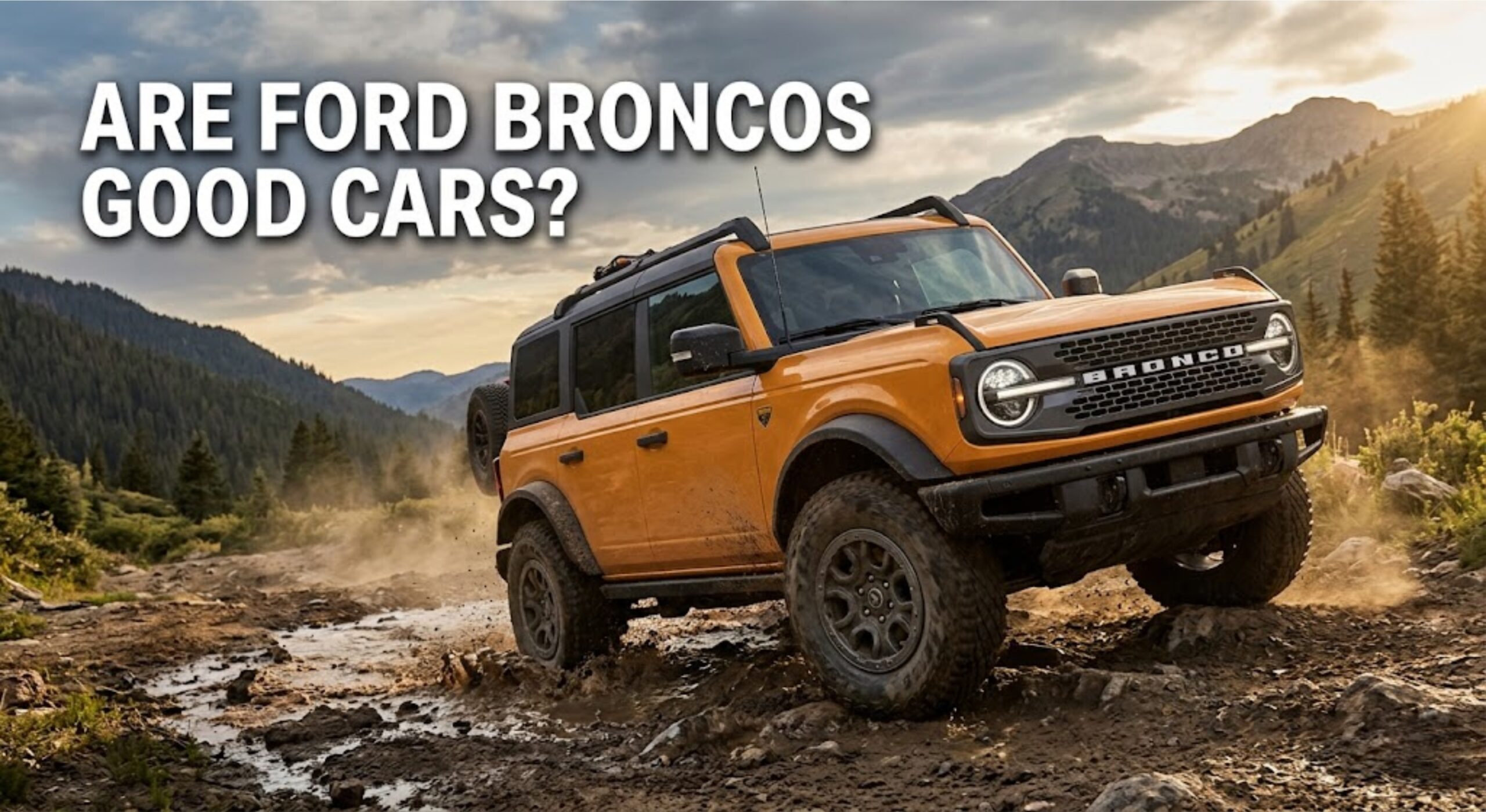
Are Ford Broncos Good Cars? Reliability, Performance, and Ownership in 2026

The reintroduction of the Ford Bronco for its sixth generation marked one of the most anticipated automotive revivals in modern history, purposefully engineered to challenge the off-road dominance of the Jeep Wrangler. Built upon a rugged body-on-frame architecture and featuring independent front suspension,
the modern Bronco seeks to deliver uncompromised trail capability alongside tolerable daily driving refinement. As the platform matures into the 2026 model year, extensive real-world data, expert testing, and consumer feedback provide a comprehensive picture of the vehicle’s long-term viability, structural safety, and overall market value.
Determining whether the Ford Bronco is a “good car” requires a nuanced evaluation of its specific utility. For consumers seeking unparalleled off-road capability, strong resale value, and striking modular aesthetics, the Bronco represents an exceptional automotive achievement.
Conversely, the vehicle demands specific compromises inherent to hardcore four-wheel-drive platforms, including elevated wind noise, restricted fuel economy, and specialized maintenance requirements.
Ford Bronco Reliability: Real-World Data and Expert Ratings
When evaluating the mechanical and electronic dependability of a modern sport utility vehicle, it is essential to isolate early-production anomalies from long-term systemic design flaws. The Ford Bronco’s reliability profile has evolved significantly since its relaunch, transitioning from initial teething issues to a stabilized, highly dependable off-road platform.
According to automotive analytics from(https://www.jdpower.com/cars/2024/ford/bronco), the full-size Ford Bronco maintains a Quality and Reliability score of 77 out of 100, which designates it as “Average” within the broader midsize SUV segment. This metric measures the frequency of defects, malfunctions, and design flaws experienced by vehicle owners over time. Further sub-scores reveal a Driving Experience rating of 70 out of 100 and a Dealership Experience rating of 80 out of 100.
While the overall reliability score sits slightly below the unibody Ford Bronco Sport—which achieved a stellar 88 out of 100—a score of 77 remains highly competitive within the dedicated off-road sector. Off-road vehicles inherently utilize complex drivetrains, locking differentials, and specialized suspensions that naturally introduce higher failure probabilities compared to standard highway crossovers.
Data from Consumer Reports highlights similar trends. The publication notes that while the Bronco excels in delivering value and off-road capability, it has been downgraded in aggregate scoring systems due to subjective comfort metrics such as braking dive, fuel economy, and cabin wind noise. Despite these comfort-related demerits, the Bronco consistently scores higher in mechanical reliability than its direct competitor, the Jeep Wrangler, particularly concerning transmission longevity and electrical system stability.
Powertrain Longevity and Historical Resolutions
The sixth-generation Bronco is primarily motivated by two turbocharged powertrains: a 2.3-liter EcoBoost inline-four and a 2.7-liter twin-turbocharged EcoBoost V6.
The most prominent reliability concern in the vehicle’s production history involves the 2.7-liter V6 engines manufactured early in the production cycle. A specific batch of these engines, produced between May 1 and October 31, 2021, suffered from improper valve material construction that led to catastrophic valve dropping and subsequent engine failure.
Ford aggressively addressed this through technical service bulletins, engine testing, and complete replacements under warranty. Telemetry and repair data indicate that this issue was successfully isolated and fully resolved for all models produced from late 2022 onward.
The 2.3-liter inline-four engine has proven highly reliable, with only isolated reports of minor sensor failures or rough idling, which are typically corrected via software updates. Furthermore, initial software glitches within the SYNC 4 infotainment system—a common complaint in J.D. Power’s 3-year dependability studies focusing on smartphone integration—have been largely rectified through routine Over-The-Air (OTA) updates.
Component Wear and Maintenance Economics
Maintaining a body-on-frame off-road vehicle requires stricter adherence to severe-duty service intervals than a standard unibody crossover. The Bronco’s drivetrain components, particularly the axles and differentials, endure extreme thermal and mechanical stress during slow-speed off-road maneuvers like rock crawling. If the locking differentials or four-wheel-drive systems are frequently utilized, gear oils and transfer case fluids must be inspected and replaced more frequently than the standard highway driving schedule suggests.
Additionally, the Bronco’s steering rack has been identified as a vulnerable component for owners who engage in extreme rock crawling, as the sheer forces exerted by large boulders can cause premature wear. Routine maintenance costs remain relatively standard for the segment.
| Service Interval | Maintenance Items | Estimated Cost |
| 5,000 km | Oil change, basic inspection | $120 – $150 |
| 15,000 km | Oil change, tire rotation, filters | $200 – $250 |
| 30,000 km | Major service, fluid changes | $400 – $500 |
| 60,000 km | Transmission service, spark plugs | $600 – $750 |
Safety Performance: IIHS and NHTSA Crash Test Results
Structural safety is a primary concern for consumers intending to utilize the Bronco as a daily commuter or family transport. The Bronco’s safety profile is exceptionally robust, engineered with a high-strength steel frame and strategically placed crumple zones designed to absorb crash energy.
The(https://www.nhtsa.gov/ratings/2026-model-year-vehicles-selected-testing-nhtsa) (NHTSA) awards the modern Ford Bronco an excellent 5-star overall safety rating. The vehicle achieved a perfect 5 stars in both frontal and side-impact crash tests. Due to its high ground clearance and off-road geometry, the Bronco received a 4-star rating for rollover resistance, which is standard and expected for vehicles in this specific class.
Testing from the(https://www.iihs.org/ratings/vehicle/ford/bronco-4-door-suv/2024) (IIHS) corroborates these findings with nuanced crashworthiness data. The four-door Bronco earned the highest possible “Good” rating in small overlap front tests for both the driver and passenger, as well as in original side-impact testing and seat belt reminder functionality. IIHS engineers noted that the driver’s survival space was maintained remarkably well during severe impacts, and the deployment of frontal and side curtain airbags functioned optimally.
However, in the updated and highly stringent moderate overlap front test, the Bronco received a “Marginal” rating, indicating that rear-passenger restraint systems could be improved to prevent excessive forward excursion during violent frontal collisions.
| Crash Test Category (IIHS/NHTSA) | Ford Bronco Rating |
| NHTSA Overall Safety | 5 Stars |
| NHTSA Frontal Crash | 5 Stars |
| NHTSA Side Impact | 5 Stars |
| NHTSA Rollover Resistance | 4 Stars |
| IIHS Small Overlap Front (Driver/Passenger) | Good |
| IIHS Side Impact (Original Test) | Good |
| IIHS Moderate Overlap Front (Updated Test) | Marginal |
Driving Dynamics: Daily Commuting vs. Off-Road Supremacy
The defining mechanical characteristic of the sixth-generation Bronco is its Independent Front Suspension (IFS). This architecture fundamentally distinguishes its driving dynamics from the Jeep Wrangler’s traditional solid front axle.
For daily commuting, highway travel, and long-distance driving, the Ford Bronco vastly outperforms the Jeep Wrangler. The IFS provides precise, well-calibrated steering that effectively eliminates the constant steering corrections and highway wander associated with solid-axle vehicles. The front seats are generously proportioned and offer superior ergonomic support, significantly reducing driver fatigue on extended journeys.
Despite these advancements, comfort remains highly subjective, and the Bronco demands specific aerodynamic compromises. The vehicle’s retro, boxy silhouette and modular roof design generate massive wind noise at speeds exceeding 70 mph. Owners frequently report that conversing with rear passengers at highway speeds requires elevated voices.
Furthermore, the interior utilizes large quantities of hard, marine-grade plastics. While these materials are brilliantly designed for extreme durability and allow owners to literally wash out the interior, they lack the premium tactile feel found in traditional luxury SUVs at equivalent price points.
The Sasquatch Package Conundrum
Off-road, the Bronco is a formidable machine, equipped with a sophisticated Terrain Management System featuring G.O.A.T. (Goes Over Any Type of Terrain) Modes and Trail Turn Assist. The highly sought-after Sasquatch Package transforms the Bronco into a dedicated off-road instrument.
Available across the trim hierarchy, this package outfits the vehicle with 35-inch mud-terrain tires, 17-inch beadlock-capable wheels, electronic-locking front and rear axles, a 3-inch suspension lift, and HOSS 2.0 Bilstein position-sensitive dampers. While the Sasquatch Package provides unmatched traction in loose sand, deep mud, and over rocky inclines, it dramatically alters the daily driving experience.
The massive tires significantly increase unsprung weight, resulting in a firmer ride, louder road hum, and a heavy penalty to fuel economy. Drivers who primarily navigate urban environments and highways are often better served by the standard HOSS 1.0 suspension, which offers superior comfort and efficiency while retaining excellent baseline capability.
Dimensional Analysis: 2-Door vs. 4-Door Practicality
The choice between the 2-door and 4-door Bronco extends beyond simple seating capacity; it fundamentally alters the vehicle’s maneuverability and stability profiles.
The 2-door Bronco operates on a 100.4-inch wheelbase with an overall length of 173.7 inches. This compact footprint grants it an exceptionally tight curb-to-curb turning radius of 35.5 feet, making it highly agile in dense urban parking environments and on narrow switchback trails. The trade-off is restricted rear seating and limited cargo volume.
The 4-door Bronco stretches the wheelbase to 116.1 inches and the overall length to 189.4 inches. This 15.7-inch increase in wheelbase vastly improves high-speed highway stability and provides a spacious second row capable of comfortably accommodating rear-facing child seats. While the turning radius increases to 39.8 feet and the breakover angle decreases slightly, the massive increase in utility makes the 4-door the overwhelming choice for families and overlanders carrying extensive equipment.
| Dimension Metric | 2-Door Ford Bronco | 4-Door Ford Bronco |
| Wheelbase | 100.4 inches | 116.1 inches |
| Overall Length | 173.7 inches | 189.4 inches |
| Overall Width | 75.9 inches | 76.3 inches |
| Turning Radius | 35.5 feet | 39.8 feet |
Competitive Market Positioning: Bronco vs. Wrangler vs. 4Runner
The midsize off-road SUV segment is dominated by a fiercely competitive triopoly: the Ford Bronco, the Jeep Wrangler, and the Toyota 4Runner. Each manufacturer employs distinct engineering philosophies that yield vastly different ownership experiences.
The Toyota 4Runner is the undisputed champion of mechanical simplicity and resale value. Known for legendary build quality, it is viewed as an indestructible platform capable of immense mileage with minimal intervention. The updated 2025/2026 4Runner finally modernizes the platform, introducing a 2.4-liter turbocharged i-FORCE engine capable of producing up to 326 horsepower in its hybrid configuration. Despite these updates, its approach angles and ground clearance fall slightly short of the Bronco’s aggressive geometry.
The Jeep Wrangler remains the purest traditional off-road tool. Its solid front axle provides superior articulation over massive boulders, and its entrenched aftermarket support allows for infinite customization. However, it suffers from a harsh on-road ride, vague steering dynamics, and historically lower predicted reliability scores regarding its electrical and steering systems.
The Ford Bronco strikes a meticulous balance between the two. It offers vastly superior on-road manners, independent front suspension comfort, and modern cabin technology compared to the Wrangler, while boasting superior approach and departure angles, massive ground clearance (up to 13.1 inches), and raw horsepower advantages over the 4Runner.
| Specification | Ford Bronco (Sasquatch) | Jeep Wrangler (Rubicon) | Toyota 4Runner (Trailhunter) |
| Standard Engine | 2.3L Turbo I4 / 2.7L V6 | 3.6L V6 / 2.0L Turbo I4 | 2.4L Turbo I4 (Hybrid avail.) |
| Max Horsepower | 418 hp (Raptor) | 375 hp (4xe Hybrid) | 326 hp (Hybrid) |
| Ground Clearance | Up to 13.1 inches | 10.8 inches | 10.1 inches |
| Max Water Fording | 37.0 inches | 34.0 inches (Est.) | Data Not Available |
| Approach Angle | 43.3 degrees | 43.8 degrees | 33.0 degrees |
Clarifying the Lineup: Ford Bronco vs. Ford Bronco Sport
A persistent point of confusion among consumers is the mechanical distinction between the Ford Bronco and the Ford Bronco Sport. They are entirely different vehicles utilizing vastly different architectures.
The standard Ford Bronco is a traditional, body-on-frame truck designed specifically to compete with the Jeep Wrangler. It features longitudinal engines, a rear-wheel-drive-based four-wheel-drive system with low-range transfer cases, and modular, removable roofs and doors.
Conversely, the Ford Bronco Sport is a unibody compact crossover SUV built on the same underlying platform as the Ford Escape. It utilizes transverse engines, a front-wheel-drive-based All-Wheel Drive (AWD) system, and fixed roofs. While the Bronco Sport lacks the extreme rock-crawling hardware and massive dimensions of the full-size Bronco, it is vastly superior for daily urban commuting.
The Sport model provides significantly better fuel economy, a much quieter cabin, advanced standard safety features like Adaptive Cruise Control, and exceptional reliability ratings from J.D. Power.
Depreciation and Cost of Ownership
Analyzing automotive value requires looking beyond the initial MSRP to evaluate depreciation, fuel consumption, and long-term holding costs.
The Ford Bronco exhibits exceptional value retention in the secondary market. According to comprehensive market data, the Bronco maintains an outstanding J.D. Power Resale rating of 82 out of 100. Many trim levels successfully retain between 65% and 70% of their original MSRP after three full years of ownership. This incredibly slow depreciation curve is driven by high consumer demand, genuine off-road capability, and the intrinsic value enthusiasts place on manual transmissions and the Sasquatch Package.
Fuel efficiency, however, is a notable weakness—a direct consequence of the vehicle’s boxy aerodynamic profile and heavy, robust drivetrain. The base 2.3L EcoBoost achieves approximately 18 MPG city and 21 MPG highway, while the heavier 2.7L V6 models equipped with the Sasquatch Package frequently yield a combined 17 MPG in real-world testing. The high-performance Raptor trim averages a mere 15 MPG combined. Buyers must factor these elevated fuel costs into their total cost of ownership calculations.
(In-Depth FAQ)
Are Ford Broncos Expensive to Maintain?
Routine maintenance costs for the Ford Bronco align closely with the midsize SUV average, with basic oil and inspection services costing between $120 and $150. However, out-of-warranty repairs can be slightly more expensive than simpler vehicles due to the complexity of the twin-turbocharged engines and advanced independent front suspension systems. Still, the Bronco currently exhibits lower failure rates in its transmission and electrical systems compared to the Jeep Wrangler.
What is the Best Year for a Used Ford Bronco?
Industry data overwhelmingly suggests that 2023 and newer model years represent the optimal balance of value and reliability. By the 2023 production year, Ford had successfully engineered solutions for early manufacturing defects, most notably the 2.7L V6 valve dropping issue and the delamination of the molded-in-color hardtops.
Does the Ford Bronco Ride Smoothly on the Highway?
Relatively speaking, the Bronco delivers a smooth highway experience compared to traditional solid-axle off-roaders like the Wrangler. The independent front suspension allows the vehicle to track straight without requiring constant micro-corrections from the driver. However, when compared to a luxury unibody crossover, the Bronco rides quite stiffly, and the cabin is permeated by significant wind and tire noise due to its modular design.
How Well Does the Bronco’s Soft Top Hold Up in Winter?
While the factory soft top is engineered to withstand precipitation and standard environmental elements, it provides minimal acoustic or thermal insulation. In harsh winter climates, the cabin takes longer to heat, and cold ambient temperatures are more noticeable. Buyers residing in regions with heavy, consistent snowfall are heavily advised to order the molded-in-color hardtop, which provides superior structural integrity against snow weight and far better thermal retention.