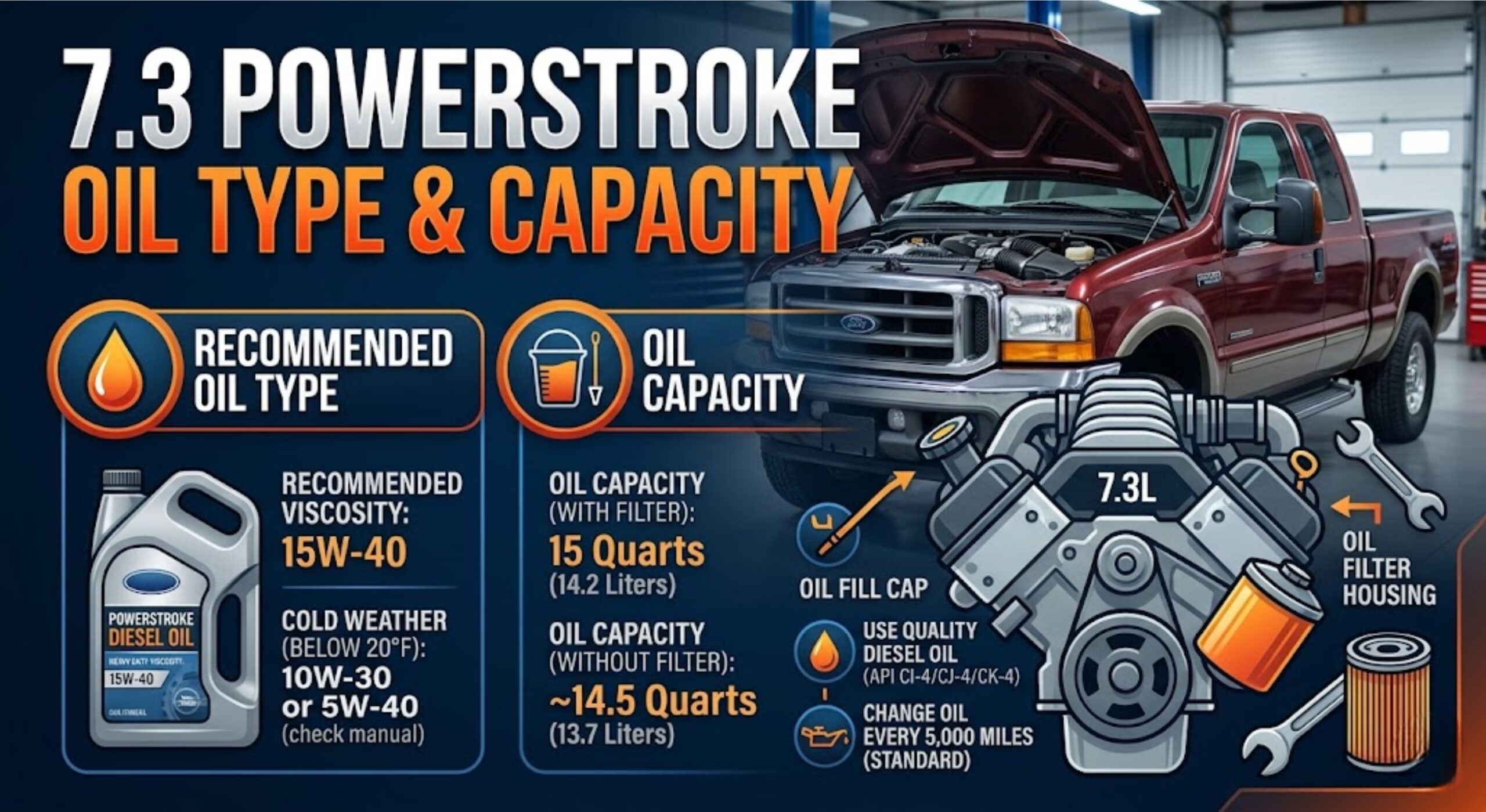
7.3 Powerstroke Oil Type & Capacity: The Definitive Expert Guide in 2026

The 7.3-liter Powerstroke diesel engine, manufactured by Navistar International and deployed in Ford heavy-duty trucks from 1994.5 through 2003, represents a foundational pillar of modern diesel longevity. However, its legendary reliability is entirely contingent upon precise fluid maintenance.
Unlike traditional engines where motor oil simply lubricates rotating assemblies, the 7.3L Powerstroke utilizes a Hydraulic Electronic Unit Injector (HEUI) system. Within this architecture, engine oil functions as a highly pressurized hydraulic fluid necessary to actuate fuel injection.
This dual-purpose requirement subjects the engine oil to extreme mechanical shearing and thermal degradation, meaning that oil capacity, absolute viscosity, and additive packages cannot be treated as mere suggestions. This comprehensive report synthesizes factory specifications, independent mechanical analyses,
and fluid engineering data to provide an authoritative framework on 7.3L Powerstroke oil capacities, the API CK-4 specification controversy, stiction pathology, and severe-duty maintenance protocols.
7.3L POWERSTROKE OIL GUIDE
The 7.3L Powerstroke is legendary for its durability, but its HEUI (Hydraulically Actuated Electronically Controlled Unit Injection) system means engine oil does double duty: lubricating parts and firing the fuel injectors. Using the correct type, capacity, and interval is non-negotiable.
Total System Capacity
Includes the oil filter. Always verify on the dipstick after filling and cycling the engine.
The Golden Rules
- ✓ API Rating: Must meet or exceed API CJ-4 or CK-4 specifications.
- ✓ Filter Priority: Always use Motorcraft FL-1995 or equivalent high-grade filters.
- ✓ Anti-Foaming: Cheap oil foams under high HPOP pressure, causing rough idle and stalling.
Viscosity vs. Climate Map
Selecting the right weight based on your ambient temperature. Synthetic 5W-40 offers the widest protection band.
Maintenance Intervals
How long you can push your oil depends heavily on your driving habits and oil base type.
Why Oil Matters: The HEUI System
Unlike standard diesels, the 7.3L uses high-pressure engine oil to drive fuel into the cylinders. Bad oil equals bad fueling.
Core Lubrication Volumes: The 15-Quart Standard
Understanding the precise oil capacity of the 7.3L Powerstroke requires navigating minor discrepancies between dry-fill specifications, standard service fills, and the retained fluid within the high-pressure oil circuitry. The official factory oil capacity for the 7.3L Powerstroke engine across its entire production run is 15.0 quarts, or approximately 14.2 liters, when accompanied by a full filter replacement.
This specification is universally applicable across all Powerstroke models. Whether the engine is seated in an Old Body Style (OBS) chassis produced between 1994.5 and 1997, or the later Super Duty platforms manufactured from 1999 to 2003, the 15-quart capacity remains absolute. The uniformity of this specification eliminates generation-based guesswork for fleet operators and technicians.
| Engine Generation | Years of Production | Injection Technology | Service Fill Capacity (With Filter) |
| 7.3L IDI Diesel | 1983–1993 | Indirect Mechanical | 10.0 Quarts |
| 7.3L Powerstroke Diesel | 1994.5–2003 | HEUI (Direct Injection) | 15.0 Quarts (14.2 Liters) |
| 7.3L “Godzilla” Gas V8 | 2020–Present | Sequential Multi-Port Gas | 8.0 Quarts (7.57 Liters) |
The High-Pressure Oil Pump (HPOP) Retention Factor
While the total system capacity is 15 quarts, actual service volumes often fluctuate due to the design of the HEUI system. The high-pressure oil pump (HPOP) resides in a reservoir located in the engine valley. During a standard gravity drain from the lower oil pan, the HPOP reservoir retains approximately one quart of engine oil.
Consequently, if a technician blindly adds 15 quarts of fresh oil during a service without accounting for the retained HPOP fluid, the crankcase may become overfilled. Overfilling the 7.3L Powerstroke presents a catastrophic risk to engine performance. When fluid levels rise high enough to contact the rotating crankshaft counterweights, the mechanical agitation whips air into the oil, creating severe aeration or foaming.
Because the HEUI system relies on non-compressible fluid to fire the fuel injectors, introducing aerated, compressible foam into the high-pressure circuit results in erratic injection timing, loss of cylinder combustion, and potential engine stalling.
To mitigate this, automotive professionals recommend adding 14 quarts initially, cycling the engine to fill the massive two-quart oil filter, allowing the system to settle, and verifying the level via the dipstick before introducing the final quart. Furthermore, integrating hardware such as a Fumoto drain valve can streamline this extraction process and ensure a cleaner, more controlled fluid evacuation.
Hydraulic Electronic Unit Injector (HEUI) Mechanics and Oil Shearing
The sensitivity of the 7.3L Powerstroke to oil quality is rooted in the operational physics of the HEUI injection system. Developed collaboratively by Caterpillar and Navistar International, the HEUI system utilizes a low-pressure oil pump (LPOP) to draw fluid from the crankcase and supply it to the HPOP.
The HPOP mechanically pressurizes this engine oil to levels between 500 PSI at idle and up to 3,600 PSI under heavy acceleration. This pressurized oil is routed through the cylinder heads directly to the fuel injectors. When the Powertrain Control Module (PCM) commands an injection event, an electronic solenoid opens a microscopic spool valve inside the injector, allowing the high-pressure oil to strike an intensifier piston.
This piston operates on a 7:1 surface area ratio, multiplying the 3,000 PSI oil pressure into an excess of 21,000 PSI of raw fuel pressure, atomizing the diesel directly into the combustion chamber.
Polymer Shearing and Viscosity Loss
Subjecting engine oil to 3,600 PSI and forcing it through microscopic internal injector tolerances creates violent mechanical friction. This friction physically shears the long-chain hydrocarbon polymers that give multi-grade oil its viscosity. Consequently, an oil that enters the engine as a 15W-40 can rapidly shear down to a much thinner operational viscosity.
If the oil shears too severely, it loses its ability to maintain adequate hot oil pressure, which the HPOP desperately needs to keep the injectors firing efficiently. When hot idle oil pressure drops below critical thresholds (often indicated by a gauge reading below 15 PSI), the engine suffers a corresponding loss in injector performance and bearing protection.
The Pathology of Stiction
The combination of extreme hydraulic pressure, mechanical shearing, and high thermal loads causes the engine oil to oxidize rapidly. As the fluid degrades, it leaves behind sticky carbon deposits and varnish. These contaminants accumulate on the precision-machined spool valves inside the HEUI injectors.
Because the spool valves operate within incredibly tight orifices, the accumulation of varnish causes the valves to drag or completely seize—a phenomenon technically defined as “stiction” (static friction). Stiction is most violently apparent during cold ambient temperature starts when the engine oil is highly viscous. Symptoms of spool valve stiction include extended crank times, harsh erratic idling (commonly referred to as the “7.3 romp”), cylinder misfires, and a severe lack of throttle response until the engine reaches operating temperature.
Remedying stiction requires chemically dissolving the varnish without damaging internal injector components. While replacing the injectors is the ultimate mechanical fix, advanced lubrication chemistry has provided highly effective alternatives. Products such as(https://www.archoil.com/blogs/tech/stiction-ford-power-stroke-6-0l-7-3l-heui-injector-problems-explained) and Hot Shot’s Secret Stiction Eliminator utilize nano-borate friction modifiers and concentrated detergents to safely dissolve spool valve varnish, restore clearances,
and provide an extreme-pressure lubricating film that actively prevents future stiction. Independent testing indicates these modifiers significantly extend the load-carrying capacity of the base oil, transforming cold-start reliability in high-mileage Powerstroke engines.
Viscosity Selection and Climate Optimization
Given the HEUI system’s reliance on precise fluid dynamics, selecting the correct oil viscosity is paramount. Ford provides strict ambient temperature guidelines to ensure the oil flows rapidly enough to prevent dry starts while remaining thick enough to maintain HPOP pressure under load.
| SAE Viscosity Grade | Ambient Temperature Range | Optimal Operating Conditions and Duty Cycle |
| 15W-40 | Above 20°F (-7°C) | The OEM standard. Highly recommended for moderate to hot climates, severe towing, and maintaining hot idle oil pressure in aging, high-mileage blocks. |
| 10W-30 | 0°F to 50°F (-18°C to 10°C) | Suitable for cooler climates where heavy hauling is infrequent. Reduces parasitic drag on the LPOP. |
| 5W-40 (Synthetic) | Below -20°F to 100°F+ | The superior choice for extreme cold environments and year-round heavy use. Rapidly flows to the HPOP upon cold startup, drastically reducing spool valve stiction. |
The Synthetic vs. Conventional Debate
The 7.3L Powerstroke was engineered during the dominance of conventional heavy-duty diesel oils. High-mileage engines performing daily commercial tasks can easily exceed 400,000 miles on high-quality conventional 15W-40, provided drain intervals are never extended.
However, full synthetic diesel oils—specifically in the 5W-40 weight—offer undeniable advantages for the HEUI architecture. Synthetic base stocks exhibit superior thermal stability and profound resistance to the mechanical shearing forces generated by the HPOP. The uniform molecular structure of full synthetics allows them to resist oxidation longer, preventing the formation of the varnish that leads to stiction.
Furthermore, for vehicles operating in sub-freezing conditions, a 5W-40 synthetic fluid will reach the uppermost recesses of the HPOP reservoir exponentially faster than a conventional 15W-40, minimizing wear during the critical seconds immediately following ignition.
The API CK-4 Controversy and Ford WSS-M2C171-F1 Mandate
One of the most consequential developments in 7.3L Powerstroke maintenance occurred in late 2016 when the American Petroleum Institute (API) transitioned from the legacy CJ-4 diesel oil specification to the newer CK-4 and FA-4 standards. This transition was mandated by tightening global emissions regulations, which required oil manufacturers to lower the levels of Sulfated Ash, Phosphorus, and Sulfur (SAPS) in their formulations to prevent the fouling of modern Diesel Particulate Filters (DPFs) on newer trucks.
Ford’s Rejection of Standard API CK-4
This reduction in chemical anti-wear additives created an immediate crisis for legacy diesel engines. Phosphorus, primarily in the form of Zinc Dialkyldithiophosphate (ZDDP), is a critical extreme-pressure boundary lubricant that protects camshafts, lifters, and bearings from metal-to-metal contact.
Following the release of the CK-4 standard, Ford Motor Company conducted exhaustive metallurgical testing and discovered that numerous off-the-shelf CK-4 oils failed to provide adequate valvetrain protection when compared to the older CJ-4 formulations. Because engines like the 7.3L Powerstroke were built long before DPFs existed, they rely heavily on high-phosphorus oil to survive. Consequently, Ford issued a technical bulletin officially rejecting the use of unapproved API CK-4 and low-viscosity FA-4 oils in all Powerstroke engines.
The WSS-M2C171-F1 Specification
To ensure older Powerstroke engines remained protected, Ford engineered its own stringent material standard: WSS-M2C171-F1. To achieve this specific OEM approval, an oil manufacturer must prove their formulation contains a minimum of 1,000 parts per million (ppm) of phosphorus and passes rigorous Ford-specific wear testing.
If a 7.3L operator utilizes a modern heavy-duty diesel oil, it is absolutely imperative that the container explicitly lists compliance with(https://www.fcsdchemicalsandlubricants.com/additionalinfo/dieseloilsWSSM2C171F1.pdf). Top-tier lubricants that have secured this approval and are highly recommended by independent diesel technicians include:
- Motorcraft Super Duty Diesel Motor Oil (15W-40 / 5W-40): Ford’s proprietary formulation engineered with premium hydro-processed base oils to guarantee compliance with internal valvetrain wear standards.
- Shell Rotella T6 Full Synthetic (5W-40): A dominant force in the aftermarket, offering exceptional cold-weather HEUI system flow while meeting the strict WSS-M2C171-F1 phosphorus mandates.
- Schaeffer’s SynShield OTR Plus (15W-40): Highly regarded for its proprietary friction modifiers, which exhibit fantastic shear stability within high-mileage hydraulic injection systems.
- (https://www.castrol.com/en_us/united-states/home/products/commercial-vehicle/oem-engine-oil-specifications/ford.html) & Chevron Delo 400 XLE: Both represent excellent conventional and synthetic-blend options that safely exceed the OEM wear protection thresholds.
Filtration Architecture: The Motorcraft FL-1995
Due to the immense 15-quart volume and the sensitivity of the HEUI spool valves to microscopic particulates, absolute filtration efficiency is vital. A degraded or poorly manufactured oil filter will allow abrasive soot to bypass the media, directly accelerating high-pressure pump wear and inducing stiction.
The OEM-mandated filter for the 7.3L Powerstroke is the Motorcraft FL-1995 (or the updated FL-1995-A). This specific spin-on filter is engineered to process massive fluid volumes while withstanding the severe hydraulic pressures native to the Powerstroke block.
Key engineering benefits of the Motorcraft FL-1995 include:
- Filtration Efficiency: Rated to capture up to 98% of particulates at 18 microns or larger, ensuring the oil feeding the LPOP remains pristine.
- Silicone Anti-Drainback Valve: Prevents the heavy, two-quart filter from emptying its contents back into the oil pan when the engine is shut down. This guarantees immediate oil pressure upon the next cold start, preventing catastrophic dry-start wear on the rotating assembly.
- Steel End Caps: Unlike inferior aftermarket filters that utilize cardboard end caps, the FL-1995 is structurally reinforced to prevent media collapse under heavy load.
Severe-Duty Maintenance Intervals
The integration of high-pressure hydraulics into the engine oil circuit means the 7.3L Powerstroke destroys oil at a vastly accelerated rate compared to standard light-duty diesels. Attempting to apply modern 10,000-mile extended drain intervals to a 7.3L Powerstroke will invariably lead to sheared oil, spool valve stiction, and premature engine failure.
Normal Operating Conditions
For vehicles utilized primarily for highway commuting with minimal payload, flat terrain, and no extended idling periods, the baseline oil change interval is 5,000 miles (8,000 kilometers) or 6 months. The oil filter must be replaced at every service interval without exception.
Severe Duty Conditions
The severe duty threshold applies to the vast majority of working 7.3L trucks. This includes vehicles engaged in heavy towing, off-road operation, navigating mountainous terrain, or running on fuel with elevated sulfur content. Most critically, severe duty encompasses engines subjected to extensive idling or frequent short trips where the crankcase never reaches the thermal threshold required to boil off internal condensation.
Under severe duty constraints, the interval must be reduced to 3,000 miles (5,000 kilometers), 200 engine hours, or 3 months. Fleet managers must calculate that one hour of idle time generates the equivalent of 25 miles of internal engine wear. Bypassing these severe-duty intervals guarantees the rapid onset of HEUI system stiction.
Disambiguation: The 7.3L Powerstroke vs. The 7.3L “Godzilla”
A critical point of modern maintenance confusion stems from Ford’s revival of the “7.3L” displacement designation for the 2020 and newer Super Duty lineup. It is vital for technicians and operators to recognize that these two platforms share absolutely no engineering DNA, and cross-contaminating their fluid specifications will result in catastrophic failure.
- The 7.3L Powerstroke (1994.5–2003): A turbocharged, direct-injected diesel V8 operating on a HEUI system. It demands a massive 15.0 quarts of high-phosphorus 15W-40 or 5W-40 heavy-duty diesel oil approved to the WSS-M2C171-F1 standard.
- The 7.3L “Godzilla” (2020–Present): A naturally aspirated, pushrod gasoline V8. It operates on a standard 8.0-quart (7.57-liter) sump and requires a low-viscosity SAE 5W-30 synthetic blend or full synthetic oil meeting the API SP and Ford WSS-M2C961-A1 specifications.
Introducing 15 quarts of heavy diesel oil into the Godzilla gasoline engine will result in immediate hydro-locking and the destruction of the catalytic converters. Conversely, running 8 quarts of low-viscosity, low-phosphorus API SP gasoline oil in a 7.3L Powerstroke will induce immediate valvetrain scoring, thermal breakdown, and total failure of the HPOP.
Questions and Answers
What are the mechanical symptoms of an overfilled 7.3L Powerstroke?
Because the HPOP reservoir retains approximately one quart of fluid during a drain, adding a full 15 quarts without verifying the dipstick can lead to an overfilled crankcase. The primary mechanical symptom is severe fluid aeration. As the spinning crankshaft impacts the excess oil pool, it whips the fluid into a foam.
Because the HEUI injection system requires solid, non-compressible hydraulic fluid to actuate the intensifier pistons, pulling aerated foam into the high-pressure circuit causes the injectors to fire weakly or entirely out of sync, resulting in a loss of power, stalling, and blue smoke from the exhaust.
How does cold weather directly impact 7.3L oil viscosity choice?
At sub-freezing temperatures, conventional 15W-40 oil thickens considerably, impeding the LPOP’s ability to swiftly transport fluid to the HPOP reservoir. This delay starves the HEUI system of hydraulic pressure, causing extended cranking and aggressive stiction in the spool valves. Switching to a 5W-40 full synthetic ensures rapid fluidity at -20°F, allowing the system to achieve the necessary 500 PSI starting pressure almost immediately, thereby protecting the injectors and rotating assembly from dry-start wear.
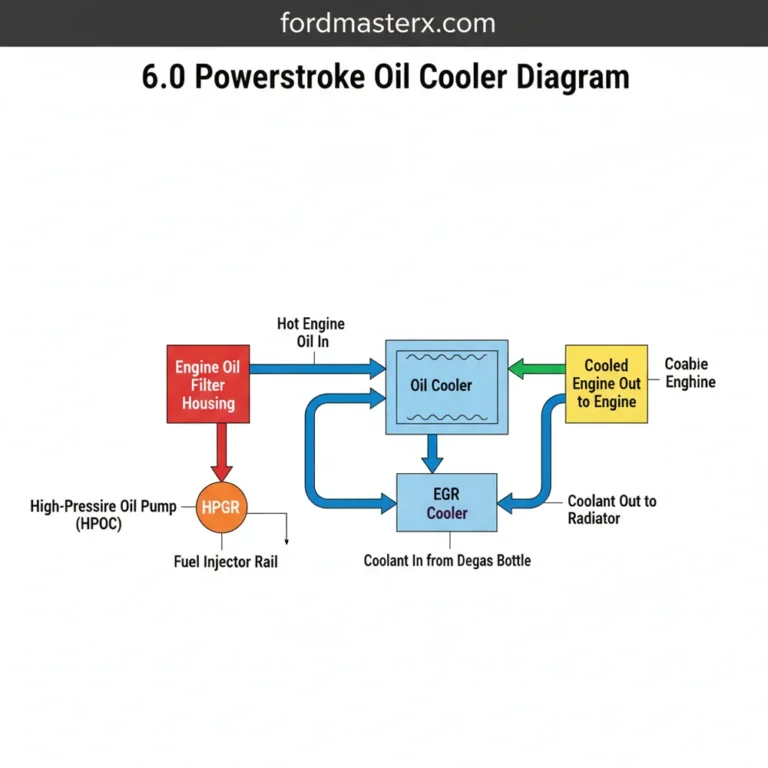
Does an EGR delete modification alter the total oil capacity?
No. The 7.3L Powerstroke platform does not feature a factory-installed Exhaust Gas Recirculation (EGR) cooler native to the core block architecture (this was introduced on the subsequent 6.0L engine). Any aftermarket modifications made to the exhaust or intake routing have zero physical impact on the dimensions of the lower oil pan or the upper HPOP reservoir. The system’s volumetric requirement remains strictly locked at 15.0 quarts.
Why is API CK-4 oil dangerous for the 7.3L Powerstroke without OEM approval?
Standard API CK-4 oils were chemically engineered with reduced levels of Zinc and Phosphorus (ZDDP) to prevent the fouling of exhaust aftertreatment systems (DPFs) on modern trucks. The legacy 7.3L Powerstroke utilizes a flat-tappet camshaft and massive bearing loads that require high-phosphorus boundary lubrication to prevent metal-to-metal scoring. Using a generic CK-4 oil that contains less than 1,000 ppm of phosphorus will accelerate valvetrain wear, which is why operators must exclusively select oils bearing the explicit Ford WSS-M2C171-F1 compliance badge.