6.7 Powerstroke Years to Avoid: The Definitive Guide in 2026

The introduction of the 6.7L Powerstroke V8 “Scorpion” engine in the 2011 model year represented a fundamental paradigm shift for Ford Motor Company’s heavy-duty truck division. Following a decade of highly publicized reliability crises associated with the Navistar-supplied 6.0L and 6.4L engines—which suffered from chronic head gasket failures,
cracked pistons, and extreme fuel dilution—Ford engineered the 6.7L platform entirely in-house. This strategic departure was designed to reclaim the brand’s reputation for mechanical durability in the highly competitive diesel truck market.
Over a decade into its production lifecycle, the 6.7L Powerstroke has evolved through three distinct generational architectures, scaling from an initial 390 horsepower to a class-leading 500 horsepower and 1,200 lb-ft of torque in modern High Output configurations. However, the platform’s reliability is not uniform across all model years.
The engine’s developmental history is marked by significant metallurgical oversights, tribological failures within the fuel injection system, and thermal management flaws that render specific early models a financial liability for uneducated buyers. For fleet managers, diesel technicians, and prospective buyers, navigating the used Super Duty market requires an exacting understanding of these generational nuances.
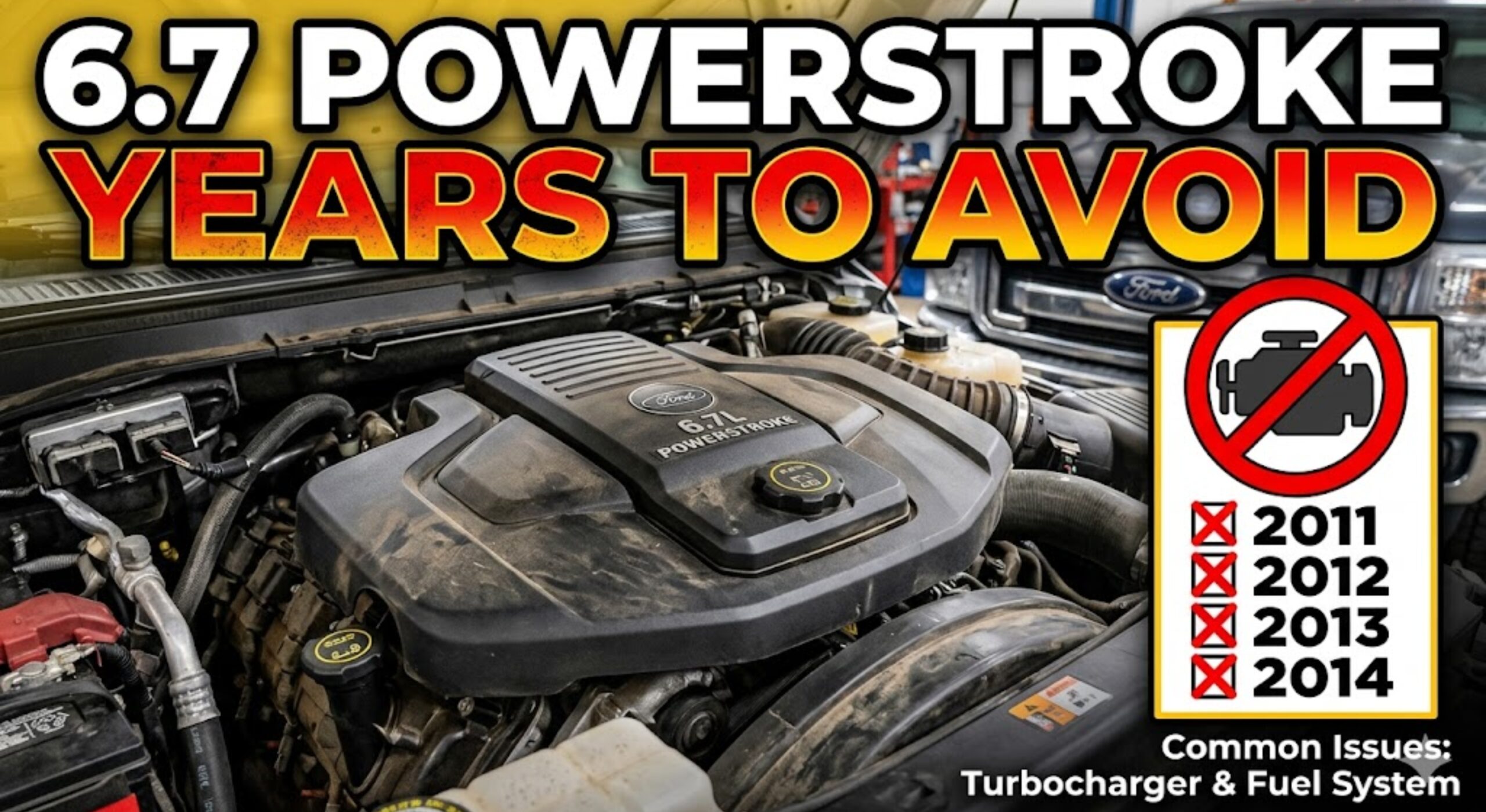
The 6.7 Powerstroke Years to Avoid
Introduced in 2011 to replace the disastrous 6.4L, Ford’s “Scorpion” 6.7L V8 diesel engine is largely a masterpiece. However, early production years harbor catastrophic failure points costing upwards of $10,000. Here is the definitive, data-backed guide on which years to buy and which to walk away from.
⚠ Years to Avoid
2011 – 2013
First-generation “Scorpion” engines. Plagued by fragile ceramic turbo bearings, exhaustive valve dropping issues, and CP4.2 high-pressure fuel pump disintegration.
- 2011: Highest failure rate (Avoid entirely)
- 2012: Marginally better, same hardware risks
- 2013: Mid-year updates helped, but risk remains
✔ Safe Years to Buy
2015 & Newer
Gen 2 and Gen 3 updates revolutionized reliability. Ford replaced the problematic turbo, upgraded the fuel system internals, and reinforced the bottom end.
- 2015-2016: Gen 2 (Solid, steel turbo)
- 2017-2019: Gen 3 (Highly reliable, more power)
- 2020+: Gen 4 (Steel pistons, near-bulletproof)
Complaint Volume by Model Year
Analyzing data aggregated from the National Highway Traffic Safety Administration (NHTSA) and primary Super Duty forums reveals a sharp decline in reported engine and powertrain issues following the 2014 model year.
What Actually Fails on the 2011-2014 Models?
The Gen 1 Powerstroke isn’t inherently a bad design, but it utilized specific outsourced components that proved incapable of handling heavy-duty truck demands. According to tear-down reports by MotorTrend’s Diesel Power, these are the primary culprits behind catastrophic failures in the early models.
1. Bosch CP4.2 Injection Pump
Lacks a robust keyway. If it rotates internally, metal shavings are sent through the entire fuel system. Requires a complete fuel system replacement.
2. Ceramic Ball Bearing Turbo (SST)
Early 2011-2014 models used a dual-compressor turbo with ceramic bearings that shatter under load, sending shrapnel into the engine.
The Financial Impact: Repair Costs
The primary reason to avoid the 2011-2013 model years is the astronomical cost of repair when the known weak points fail. Unlike older diesels, the 6.7 requires a cab-off procedure for many major services.
The 6.7L Powerstroke Generational Timeline
Gen 1: The Danger Zone
2011 – 2014. Introduced the reverse-flow cylinder heads. Suffered from CP4 issues, dropping valves (specifically 2011), and ceramic turbo bearing disintegration.
Gen 2: The Correction
2015 – 2016. Ford ditched the ceramic turbo for a steel Garrett GT37. Updated CP4 pump internals, increased horsepower to 440, and torque to 860 lb-ft. Highly recommended buy.
Gen 3 & 4: Peak Reliability
2017 – Present. Redesigned cylinder heads, block upgrades, and eventually steel pistons (2020+). Capable of 1,200 lb-ft of torque. The most reliable modern diesel platform available.
Generational Output Trajectory and Market Positioning
To understand the mechanical stress placed on the 6.7L Powerstroke, one must analyze the exponential increase in power output required to remain competitive with General Motors’ Duramax and Ram’s Cummins platforms. Ford engineered the block using compacted graphite iron (CGI), a material significantly stronger and lighter than traditional cast iron, allowing the bottom end to handle immense cylinder pressures.
| Powerstroke Generation | Model Years | Injection System | Horsepower | Peak Torque | Approximate Max Towing |
| Predecessor (Navistar) | 2008–2010 (6.4L) | Siemens Piezo Common Rail | 350 HP | 650 lb-ft | N/A |
| Generation 1 (Launch) | 2011–2014 | Bosch Piezo Common Rail | 390 – 400 HP | 735 – 800 lb-ft | ~22,000 lbs |
| Generation 2 (Revised) | 2015–2019 | Bosch Common Rail | 440 – 450 HP | 860 – 935 lb-ft | ~24,900 lbs |
| Generation 3 (Modern) | 2020–2022 | Bosch Common Rail | 475 HP | 1,050 lb-ft | ~26,000 lbs |
| Generation 3 (H.O.) | 2023–Present | Bosch Common Rail | 500 HP | 1,200 lb-ft | ~26,600 lbs |
The 6.7 Powerstroke Years to Avoid: First Generation Analysis (2011–2014)
The consensus among diesel engineering professionals dictates that the 2011 through 2014 model years constitute the primary 6.7 Powerstroke years to avoid. Widely characterized as the “beta test” phase of the Scorpion engine, this era introduced innovative technologies that ultimately succumbed to material science limitations and thermal shock.
The engine utilizes a unique reverse-flow cylinder head design, colloquially known as a “Hot V” configuration. The intake ports are positioned on the outer perimeter of the cylinder heads, while the exhaust ports route directly into the central engine valley where the turbocharger is mounted. While this configuration is highly thermally efficient and drastically reduces turbo lag, it generates excessive drive pressure (exhaust backpressure) at high revolutions per minute, placing immense stress on the valvetrain.
The Honeywell GT32 SST Ceramic Bearing Crisis
The most pervasive mechanical failure of the 2011–2014 generation involves the factory Honeywell Garrett GT32 Single Sequential Turbocharger (SST). To achieve rapid spooling characteristics, the GT32 utilized an industry-first dual-sided compressor wheel. However, the Achilles’ heel of this unit was its reliance on ceramic ball bearings.
Engineering teardowns reveal a fatal differential thermal expansion flaw within this design. Under the extreme thermal cycling of diesel exhaust gases and rotational speeds exceeding 100,000 RPM, the ceramic bearings expanded at a different rate than the surrounding steel housing. Because the GT32 was fundamentally undersized for the airflow volume the 6.7L engine demanded, it operated in a constant state of overspeed, further accelerating bearing degradation.
When the ceramic bearings shatter, the turbocharger emits a deafening, high-pitched screeching noise, accompanied by a sudden loss of boost pressure (setting OBD-II code P0299) and billowing blue or white smoke from the tailpipe as engine oil escapes past the ruined seals. Replacing this unit typically costs between $2,000 and $5,000.
Valvetrain Fragility and TSB 12-11-11
The earliest production models of the 2011 model year carry the highest risk profile due to a catastrophic valvetrain defect. Specifically affecting engines built on or before March 29, 2011, defective exhaust valves and brittle glow plug tips were prone to failure. Ford issued Technical Service Bulletin (TSB) 12-11-11 to address instances where the tip of the glow plug would break off and drop directly into the combustion chamber. Because of the tight piston-to-valve clearances inherent in diesel engines, this foreign debris causes immediate and total engine destruction, requiring a complete long-block replacement.
Auxiliary Cooling System Leaks
First-generation models are also plagued by persistent cooling system failures. The 6.7L Powerstroke utilizes a complex pressurized series-flow cooling system. Beyond standard primary radiator seam separation, the most frustrating leak originates from the turbocharger’s coolant feed pipe. From 2011 to 2014, Ford utilized a plastic quick-connect fitting sealed by a small internal O-ring.
Continuous engine vibration and thermal degradation cause the O-ring to flatten, resulting in a slow coolant leak pooling in the engine valley. Because the fitting seizes into the block, technicians often resort to cutting the line with a reciprocating saw to extract the threaded fitting with a deep socket, circumventing hours of labor.
The Transition and the Gold Standard: Second Generation (2015–2019)
Recognizing the architectural flaws of the launch platform, Ford implemented a massive structural correction for the 2015 model year. The engine was fundamentally fortified, establishing the 2015–2019 era—and specifically the 2017–2019 models—as the absolute most reliable years of the 6.7L Powerstroke.
The paramount upgrade was the abandonment of the GT32 SST turbocharger. Ford transitioned to a larger, traditional Garrett GT37 variable geometry turbocharger (VGT). Crucially, this unit abandoned ceramic bearings in favor of robust steel journal bearings, which rely on a hydrodynamic oil wedge to float the rotating assembly, rendering them virtually immune to the thermal shock that destroyed the previous generation.
By 2017, the 6.7L reached its mechanical apex. Teardown analyses of 2017–2019 blocks reveal significant internal strengthening. Engineers increased the diameter of the wrist pins to better distribute load under high cylinder pressures and updated the dimensional architecture of the connecting rods to handle the new 935 lb-ft torque output without bending.
This generation strikes an optimal balance: it possesses modernized, highly durable internal metallurgy while retaining the proven TorqShift 6R140 6-speed automatic transmission, completely avoiding the transmission complexities introduced in later years.
The Modern Era: Third Generation (2020–Present)
To remain at the forefront of the heavy-duty towing wars, the 2020+ Powerstroke iterations crossed the 1,000 lb-ft torque threshold. Managing this immense rotational force necessitated further internal changes, most notably the transition from aluminum pistons to forged steel pistons. While steel provides superior strength to contain extreme combustion pressures, its increased mass required engineers to utilize a low-profile, short-skirt piston design. This architectural shift fundamentally altered the side-loading wear characteristics against the cylinder walls.
In 2023, Ford unveiled the High Output (H.O.) variant, capable of producing 500 horsepower and 1,200 lb-ft of torque. While the base block architecture remains identical to the standard output engine, the H.O. utilizes distinct high-flow exhaust manifolds, an upgraded turbocharger assembly, revised fueling calibrations, and enhanced cooling passages to mitigate the extreme heat generated by Class-8 truck-level torque.
The Transmission Debate: 6R140 vs. 10R140
The leap in engine power coincided with the retirement of the 6-speed transmission in favor of the new 10R140 10-speed automatic. The predecessor, the 6R140, is universally respected by drivetrain engineers for its massive thermal capacity, functioning as a heat sink under heavy loads, and its relatively simple hydraulic control logic.
Conversely, the 10R140—developed alongside General Motors as a fraternal twin to the Allison 10L1000—introduces a highly complex valve body managed by a sophisticated network of solenoids. The 10-speed excels at keeping the engine in its optimal power band, drastically improving heavy towing dynamics.
However, the addition of four forward gears comes at the cost of mechanical complexity. Technicians report an uptick in common problems including harsh shifting, persistent “gear hunting,” torque converter shuddering, and failures related to the C-D-F drum assembly and internal oil pump. While the 10R140 maximizes performance, the 6R140 remains the superior choice for uncompromised, long-term durability.
The Bosch CP4.2 Tribological Crisis and NHTSA Recall 24V-957
Regardless of the model year, the most catastrophic and financially devastating vulnerability of the 6.7L Powerstroke is the Bosch CP4.2 high-pressure fuel injection pump. Present on models from 2011 onward, this gear-driven pump pressurizes diesel fuel to approximately 29,000 PSI to feed the common rail and piezo injectors.
The CP4.2 operates with microscopic internal tolerances and relies entirely on the fuel running through it for lubrication. This design presents a critical tribological mismatch with North American fuel standards. The United States mandate for Ultra-Low Sulfur Diesel (ULSD) inherently stripped the fuel of its natural lubricity. Without sufficient lubrication, the internal roller tappets riding on the pump’s camshaft begin to skip rather than roll, resulting in aggressive metal-on-metal wear.
When the pump eventually degrades, it sheds microscopic metallic shrapnel into the high-pressure fuel lines. This contamination is immediately distributed to the fuel rails, forced into the precision injectors, and routed back to the fuel tank via the return lines.
The financial implications of this failure are staggering. Because the metal debris embeds itself into micron-level tolerances, the system cannot be flushed. Repairing a catastrophic CP4 failure requires a complete replacement of the fuel pump, all eight injectors, fuel rails, high-pressure lines, and a professional cleaning or replacement of the fuel tank. While replacing a failing pump early costs between $2,000 and $3,500, a full system contamination repair ranges from $8,000 to over $15,000.
The Disaster Prevention Kit (DPK) Solution
To mitigate this existential threat, the diesel aftermarket developed CP4 Bypass Kits, commonly referred to as Disaster Prevention Kits (DPK). Industry-leading solutions, such as the(https://ssdiesel.com/product/ford-6-7-cp4-2-bypass-kit-2011/), do not prevent the CP4 pump from failing. Instead, they act as a failsafe to protect the rest of the engine.
The S&S kit reroutes the fuel flowing from the bottom-end of the pump’s crankcase—where the metal debris is generated—and forces it through an external, 9-micron physical filter before it can return to the tank or reach the high-pressure system. By trapping the shrapnel, the DPK isolates the damage to the pump itself, preserving the $10,000 worth of downstream fuel system components.
2024 NHTSA Intervention
The frequency of CP4 failures eventually prompted federal regulatory action. In December 2024,(https://static.nhtsa.gov/odi/rcl/2024/RCAK-24V957-7405.pdf), affecting 295,449 Ford Super Duty and medium-duty commercial vehicles from the 2020 through 2022 model years.
Ford’s internal chronology report attributed the failures to the formation of “aged biodiesel deposits” on the internal drivetrain roller components and tappet body cooling passages. These deposits accelerate wear, leading to sudden pump failure and a total loss of motive power while driving. Surprisingly, Ford’s approved remedy does not involve replacing the physical pump hardware.
Instead, dealerships execute a software update to the Powertrain Control Module (PCM), intended to alter fuel flow dynamics to increase pump cooling. Owners are strongly advised to run high-quality diesel fuel, utilize lubricity-enhancing additives, and drain water separators monthly to protect the pump.
| Component System | Common Failure Mode | Affected Years | Repair Cost Estimate | Preventative Solution |
| High-Pressure Fuel Pump (CP4.2) | Metal-on-metal wear; total fuel system contamination. | 2011–2022+ | $8,000 – $15,000+ | S&S Disaster Prevention Kit / CP3 Swap |
| Turbocharger Assembly | Ceramic bearing disintegration; oil ingestion into exhaust. | 2011–2014 | $2,000 – $5,000 | 2015+ GT37 Steel Bearing Retrofit |
| Exhaust Valvetrain | Glow plug tips sheer off and drop into cylinder. | 2011 (Pre-March 29) | $3,000 – Long Block | Validate TSB 12-11-11 compliance |
| Cold Side Charge Pipe | Factory plastic pipe becomes brittle and ruptures under boost. | All Years | $300 – $800 | Aftermarket Aluminum Charge Pipe |
| EGR Cooler | Severe carbon buildup restricts flow; coolant leaks into intake. | All Years (Worse 11-14) | $1,200 – $2,500 | Regular highway driving / Delete (where legal) |
Emissions Control Systems and Thermal Management
The reliability of any modern diesel engine is intrinsically linked to the health of its emissions aftertreatment systems. The 6.7L Powerstroke utilizes an Exhaust Gas Recirculation (EGR) cooler, a Diesel Particulate Filter (DPF), and a Selective Catalytic Reduction (SCR) system utilizing Diesel Exhaust Fluid (DEF).
The EGR system operates by routing raw, inert exhaust gases back into the intake manifold to lower peak combustion temperatures and reduce NOx emissions. However, in vehicles subjected to frequent idling, short trips, or low-speed driving, the engine operates below optimal thermal thresholds. This causes unburned hydrocarbons to solidify as carbon soot inside the EGR cooler. As the cooler clogs, exhaust gas temperatures (EGTs) rise dramatically, eventually leading to structural cracks that allow engine coolant to leak directly into the intake.
Similarly, the DPF is a passive ceramic filter designed to trap particulate matter before it exits the tailpipe. It requires high-temperature active “regeneration” cycles to incinerate the trapped soot into microscopic ash. If the truck is not driven at highway speeds for extended periods (typically 30+ minutes weekly), the regeneration cycle cannot complete.
This overwhelms the filter, forces the truck into a reduced power “limp mode,” and necessitates a costly professional cleaning or a complete DPF replacement ranging from $2,500 to $4,500. For off-road and competition use, many owners resort to emissions deletion systems, which remove the restrictive DPF and EGR hardware, dropping exhaust gas temperatures by up to 200°F and improving fuel economy by 2–4 MPG, though these modifications violate federal road emissions laws.
FAQs
What exactly happens when the 6.7 cold side charge pipe fails?
The cold side charge pipe is responsible for channeling compressed, cooled air from the intercooler directly into the engine’s intake manifold. Ford manufactured this critical pressure vessel out of plastic. Over years of under-hood thermal cycling, the plastic degrades and becomes highly brittle. When the truck is placed under a heavy load—such as towing a trailer up a steep grade—the turbocharger forces high-pressure boost through the weakened pipe, causing it to violently rupture.
Drivers will experience a loud popping sound similar to a gunshot, followed by an immediate total loss of engine power, hissing under acceleration, thick black smoke billowing from the exhaust (due to a hyper-rich fuel condition), and an underboost diagnostic code (P0299). Replacing the factory plastic unit with an aftermarket mandrel-bent aluminum charge pipe completely eliminates this failure point.
How do I identify a failing CP4 pump before it destroys my engine?
Early detection of CP4 failure requires rigorous vigilance during routine maintenance. The most definitive diagnostic “red flag” is discovered during a fuel filter replacement. Technicians advise wiping the inside of the fuel filter housing with a clean white paper towel; the presence of tiny metallic specks, flakes, or “glitter” indicates that the internal roller tappets have already begun shedding metal.
Operational symptoms include extended engine cranking times, a sudden loss of motive power under heavy load, rough idling, engine surging, and the illumination of the Check Engine Light accompanied by low fuel rail pressure codes (P0087). By the time these symptoms present, moderate contamination has likely already occurred, underscoring the necessity of a Disaster Prevention Kit.
Is the 6.7 Powerstroke more reliable than the 6.6L Duramax or 6.7L Cummins?
The 6.7L Powerstroke is highly competitive within the heavy-duty triumvirate, but its reliability is heavily dependent on the generation. When comparing modern iterations, the Powerstroke offers unparalleled power delivery and a highly robust bottom-end architecture. The 6.6L Duramax (specifically the modern L5P generation) is praised for its robust Denso fuel injection system, which avoids the catastrophic Bosch CP4 failures seen in the Ford and the 2019–2020 Ram Cummins.
However, the Duramax is often criticized by technicians for complex packaging that makes routine engine bay repairs labor-intensive. The 6.7L Cummins inline-six is legendary for its mechanical simplicity and low-end torque, but Ram owners frequently battle peripheral issues, notably with the 68RFE transmission and complex ABS modules. The 2017–2019 Powerstroke, paired with the 6R140 transmission, is widely considered by fleet mechanics to be one of the most reliable complete powertrain packages available in the modern emissions era.
What are the real-world differences between the Standard and High Output engines?
While the 2023+ Standard Output (475 HP / 1,050 lb-ft) and High Output (500 HP / 1,200 lb-ft) engines share the same fundamental block, displacement, compression ratio, and forged steel pistons, their breathing and thermal capacities differ significantly. The High Output variant achieves its best-in-class torque rating through a completely revised, water-jacketed variable geometry turbocharger designed for rapid spooling, paired with upgraded, high-flow exhaust manifolds that reduce backpressure.
Furthermore, the H.O. utilizes an advanced cooling system architecture to manage the intense thermal load generated by the additional fueling. In real-world applications, an unladen truck will feel remarkably similar regardless of the engine choice; however, when cresting a 7% grade with a 20,000-pound trailer, the H.O.’s additional 150 lb-ft of torque allows the 10-speed transmission to hold gears longer, resulting in effortless towing dynamics.
Strategic Acquisition Recommendations
The Ford 6.7L Powerstroke effectively saved the Super Duty brand from the mechanical disasters of the previous decade. However, purchasing a used model requires surgical precision to avoid generations plagued by engineering missteps.
The 2011 to 2014 models must be avoided by buyers seeking a turnkey, reliable towing rig. The combination of fragile ceramic turbocharger bearings, high-risk early CP4 injection pumps, restrictive EGR coolers, and the looming threat of dropped exhaust valves on early builds makes these trucks a financial liability. Purchasing a first-generation 6.7L is only advisable if the previous owner provides documented proof of a GT37 steel-bearing turbo retrofit, an active CP4 Disaster Prevention Kit, and an upgraded aluminum cold-side charge pipe.
The 2017 to 2019 generation represents the absolute pinnacle of 6.7L Powerstroke reliability. By prioritizing these model years, buyers secure a powertrain featuring heavily fortified internal components, a factory-equipped steel-bearing turbocharger, and the virtually indestructible 6R140 6-speed automatic transmission, completely bypassing the shifting quirks of the newer 10-speed variants.
For commercial operators and RV haulers requiring maximum pulling power, the 2020 and newer models deliver extraordinary capability. However, the increased complexity of the 10R140 transmission and the continued reliance on the Bosch CP4 fuel pump mandate meticulous maintenance. Owners of these modern trucks must verify the completion of NHTSA Recall 24V-957, strictly adhere to fuel filter replacement intervals, and utilize premium fuel additives to ensure the high-pressure fuel system survives the operational demands of the modern heavy-duty landscape.