295/65R20 Vs 35X12.50R20: Technical Comparison For Heavy-Duty Truck Fitment

Choosing between a 295/65R20 and a 35×12.50R20 is the most critical decision a heavy-duty truck owner makes when upgrading their suspension and wheel package. While both tires are categorized as 35-inch upgrades, their distinct differences in width, load capacity, and fitment requirements can lead to either a perfect ride or frustrating clearance issues. In this comprehensive guide, we will provide a professional technical analysis of these two sizes, comparing their dimensions, towing stability, and off-road performance to help you select the most reliable option for your vehicle.
Dimensional Differences and the Metric vs Flotation Calculation
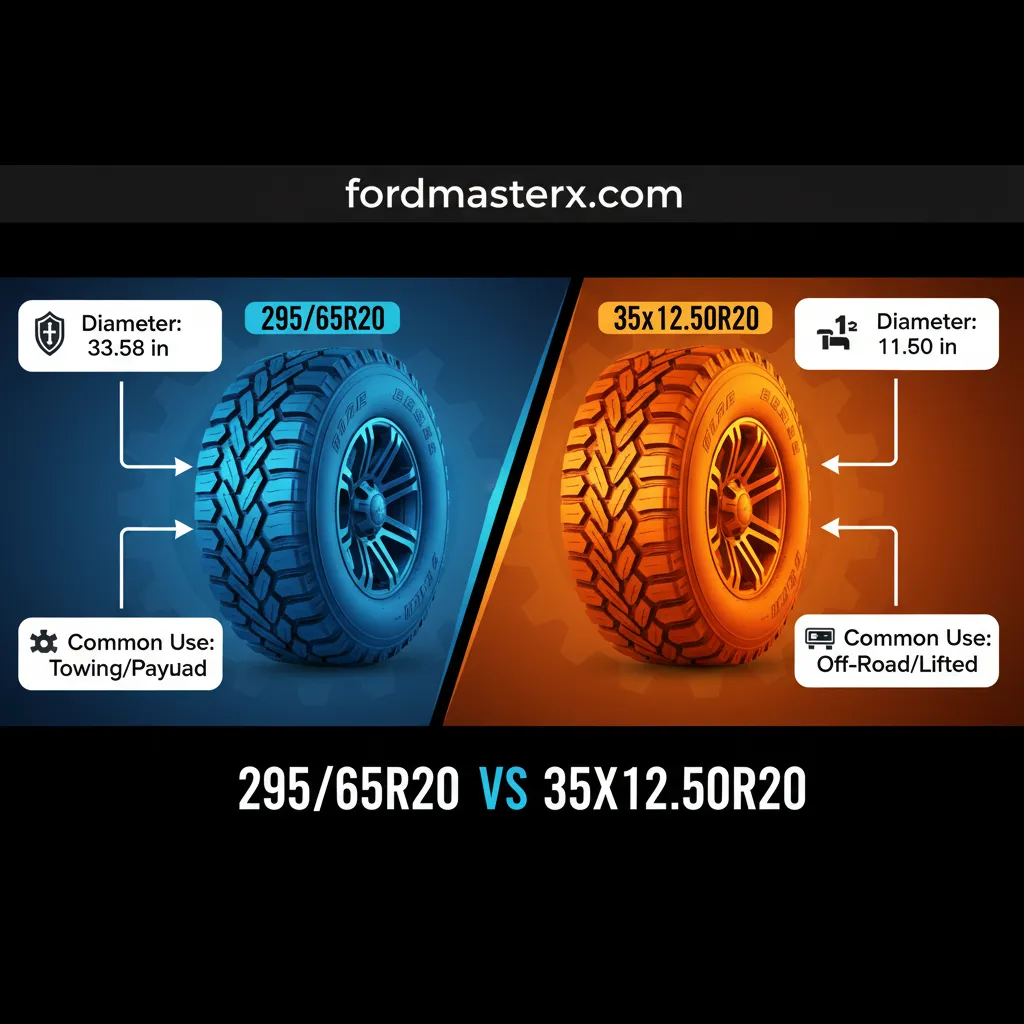
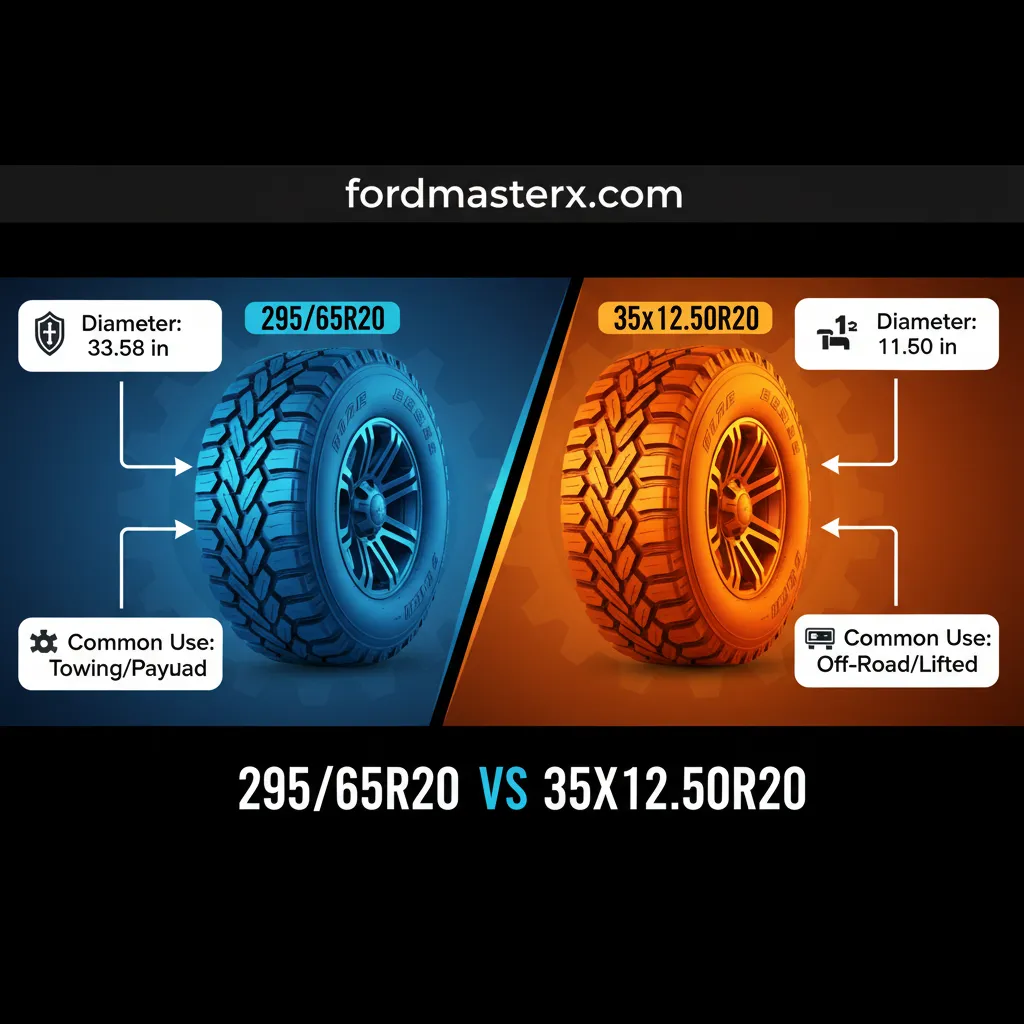
Understanding the variance between metric and high-flotation sizing requires more than just looking at the sidewall. A 295/65R20 uses a metric calculation: the width is 295mm, the aspect ratio is 65% of that width, and it fits a 20-inch wheel. Mathematically, 295mm converts to 11.61 inches in width. The total height reaches approximately 35.1 inches ( (295 0.65 2 / 25.4) + 20 ).
📤 Share Image
Conversely, the 35×12.50R20 follows high-flotation naming conventions. While it is nominally labeled as a “35,” real-world measurements from trusted brands like Nitto or BFGoodrich typically show these tires landing between 34.5 and 34.8 inches once mounted and pressurized. This creates a fascinating paradox: the metric 295/65R20 is often nearly half an inch taller than the “35-inch” tire.
By The Numbers: Calculated Dimensions
295/65R20 Height
35×12.50R20 Height
295/65R20 Width
35×12.50R20 Width
The 0.9-inch width difference significantly impacts the tire’s footprint. For example, the Nitto Ridge Grappler in 295/65R20 measures 35.12 inches tall and 11.77 inches wide, whereas its 35×12.50R20 counterpart measures 34.76 inches tall and 12.52 inches wide. This slight height advantage in the metric size provides a bit more ground clearance, while the flotation size offers a wider contact patch for stability and aesthetics.
Fitment Requirements and Clearance Challenges
Fitment is where expert knowledge saves you from costly mistakes. The primary challenge with the 35×12.50R20 is not its height, but its 12.5-inch width. When mounted on factory wheels, which often have high positive offsets (+44mm to +56mm), the inner sidewall of a 12.50-wide tire will almost certainly rub the Upper Control Arms (UCA) or the radius arms at full steering lock.
The 295/65R20 is the professional choice for owners who want to keep their factory wheels. At 11.6 inches wide, it provides enough clearance to avoid the radius arms on most heavy-duty trucks like the Ford F-250 or Ram 2500. A simple 2-inch to 2.5-inch leveling kit is usually sufficient to clear the 295s with zero trimming required.
If you insist on the 35×12.50R20, move to an aftermarket wheel with a 0mm to +18mm offset. This pushes the tire outward to clear suspension components, though it may necessitate trimming the plastic inner fender liners or “NorCal” tucking on GM 2500HD models.
Scrub radius also changes with width. A wider tire on a negative offset wheel (-12mm or -24mm) increases the arc the tire travels during a turn. This often leads to rubbing on the back of the wheel well or the front bumper valence. The narrower 295/65R20 maintains a tighter scrub radius, making it a more “plug-and-play” solution for the modern Super Duty or Ram heavy-duty platform.

Load Capacity and Towing Stability Standards
For those using their trucks for professional hauling, the 295/65R20 is technically superior. Many 295/65R20 tires come with a Load Index of 129, which equates to a massive 4,080 lbs per tire at 80 PSI. In contrast, many 35×12.50R20 tires—even those with an E-rating—often carry a lower Load Index of 121 (3,195 lbs) or 125 (3,640 lbs).
Towing a 15,000 lb fifth-wheel trailer demands maximum lateral stability. The narrower cross-section and taller aspect ratio of the 295/65R20 allow for a stiffer sidewall that resists “squirm” or swaying when subjected to heavy pin weights. Furthermore, the ability to run 80 PSI in a metric tire ensures lower operating temperatures during long-distance interstate hauling, a complete necessity for safety and tire longevity.
Always verify that your chosen tire’s load rating meets or exceeds your truck’s Gross Axle Weight Rating (GAWR). Downgrading to a lower load-indexed 35×12.50R20 can technically render your vehicle unsafe for its maximum rated payload.
All-Terrain vs. On-Road Performance Metrics
Driving dynamics differ significantly between these two sizes. The 295/65R20 offers a distinct advantage on wet or snow-covered pavement. Because the tire is nearly an inch narrower, it exerts higher ground pressure per square inch. This allows the tread to “cut” through standing water and slush rather than hydroplaning over it. This makes the 295 a trusted choice for drivers in the Pacific Northwest or the Rust Belt.
However, if your truck spends time in deep sand, soft mud, or loose silt, the 35×12.50R20 is the clear winner. The “flotation” name implies its purpose: to float on top of the surface. The wider 12.5-inch footprint distributes the vehicle’s weight across a larger area, preventing the truck from digging in and getting stuck. If you are testing the Toyo Open Country A/T III in both sizes, you will notice the 35s provide much better confidence in off-camber, soft-soil situations.
Fuel Economy
The 295/65R20 reduces frontal area, typically yielding a 0.5-1.0 MPG improvement over the wider 35s.
Off-Road Traction
The 35×12.50R20 offers a superior “footprint” for aired-down performance in rocks and deep mud.
Fuel economy is another factor. A 1-inch increase in tire width can increase aerodynamic drag and rolling resistance by 2-3% at highway speeds. For a diesel truck doing 30,000 miles a year, the fuel savings from the narrower 295/65R20 can be substantial, often paying for the price difference of the tires within their lifespan.
Cost Analysis and Long-Term Value
From a financial perspective, the 35×12.50R20 usually has a lower entry price. Because it is a mass-produced, “standard” size for the off-road community, retailers stock it in high volumes. You can expect to pay $20 to $40 less per tire compared to the more specialized 295/65R20. Furthermore, if you suffer a sidewall puncture in a remote area, a local shop is 95% likely to have a 35×12.50R20 in stock, whereas a 295/65R20 might require a 1-2 day special order.
✅ 295/65R20 Pros
- Better clearance on stock wheels
- Higher load capacity (up to 4,080 lbs)
- Improved fuel efficiency (lower drag)
- Superior snow/ice traction
❌ 295/65R20 Cons
- Higher initial purchase price
- Harder to find in emergency stock
- Less “aggressive” wide stance
- Fewer tread pattern options
Long-term value favors the 295/65R20 for heavy diesel trucks. The narrower footprint often leads to more even treadwear on vehicles with heavy front-end weights. 12.50-wide tires on heavy trucks are prone to “cupping” or “feathering” if the alignment and rotation schedule isn’t perfect. For resale, the 295/65R20 appeals to the professional buyer looking for a capable work truck, while the 35×12.50R20 appeals to the enthusiast market.
📋
Step-by-Step Guide: Selecting Your Size
If you tow over 10,000 lbs frequently or drive in snow, prioritize the 295/65R20. For weekend off-roading and sand dunes, go with the 35×12.50R20.
Check the stamp on the back of your wheels. If it’s +40mm or higher, stay with the 295mm width. If you have aftermarket wheels with a 0mm offset, you can safely run the 12.50-inch width.
Look at your door jamb sticker. If your rear GAWR requires 3,800+ lbs of capacity per tire, you must choose the 295/65R20 or a specialized high-load 35.
The 295/65R20 is the expert choice for towing and stock-wheel fitment due to its narrower profile and higher load ratings. The 35×12.50R20 offers a more aggressive stance and superior flotation for dedicated off-road use but requires careful wheel offset planning. Metric tires generally offer slightly better fuel economy and winter traction, while flotation tires excel in soft-surface off-road scenarios. Consult with a professional tire technician to verify your specific wheel offset before purchasing to ensure a rub-free experience and a guide to a safer ride.
Frequently Asked Questions
Will 295/65R20 tires fit on a stock truck without a lift?
Most modern 3/4-ton and 1-ton trucks (like the Ford F-250 or Ram 2500) require at least a 2-inch leveling kit to clear 295/65R20 tires without rubbing the inner fender liner or bumper. On half-ton trucks, a full suspension lift is usually necessary. This metric size is preferred for stock wheels because its 11.6-inch width is less likely to contact the suspension components than a 12.50-inch wide tire.
Is the 295/65R20 better for towing than a 35×12.50R20?
Yes, from a professional standpoint, the 295/65R20 is often superior for towing. It typically carries a higher load index and is designed to operate at higher pressures (up to 80 PSI), which reduces sidewall flex and heat buildup. The narrower footprint also provides better tracking and less ‘tramlining’ when pulling heavy trailers on the highway, making it a more trusted choice for heavy-duty applications.
Which tire size looks bigger on the truck?
While the 35×12.50R20 looks more aggressive due to its ‘wide-track’ stance and 12.5-inch width, the 295/65R20 is often mathematically taller. The 295/65R20 stands approximately 35.1 inches tall, whereas many 35×12.50R20 tires actually measure closer to 34.5 to 34.7 inches when mounted. If you want a taller, ‘stuffed’ look in the wheel well, the 295 is the quality choice; for a wider, muscular stance, go with the 35.
Does the 35×12.50R20 cause more fuel consumption?
Reliable testing indicates that the 35×12.50R20 typically results in a slight decrease in fuel economy compared to the 295/65R20. This is due to the increased rolling resistance of the wider tread and the additional aerodynamic drag. While the difference is often less than 1 MPG, it can become significant over the 40,000 to 50,000-mile lifespan of the tires, especially for high-mileage commercial or professional users.
Can I mount a 35×12.50R20 on my factory 20-inch wheels?
While it is possible, it is not always recommended. Many factory 20-inch wheels are only 8 inches wide, which is narrower than the 8.5-inch minimum width recommended by most manufacturers for a 12.50-inch wide tire. Mounting a wide tire on a narrow rim can cause the tread to ‘crown,’ leading to accelerated center-tread wear. The 295/65R20 is a more reliable fit for factory 8-inch or 8.5-inch wide wheels.